Lifestyle
The best spots to see 58,000 jacaranda trees in L.A., O.C.

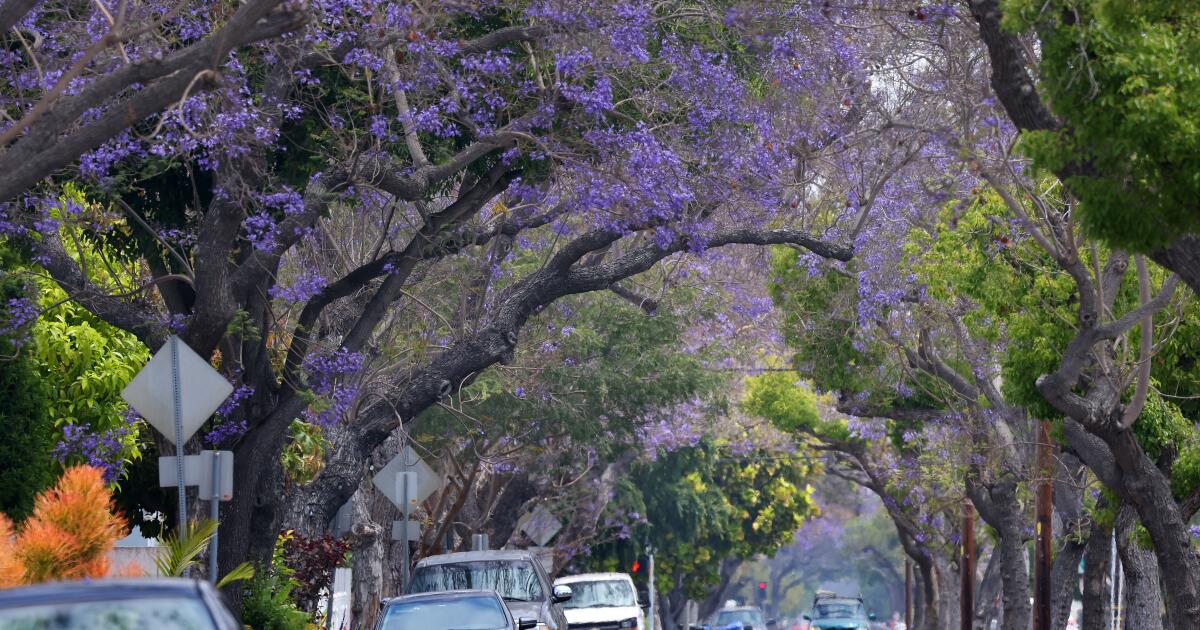
What would Los Angeles be like without the nearly 30,000 jacaranda trees on city streets?
It depends on who you ask.
“The tree stands for California at its worst: all flash, no substance, a pain left for others to clean up, inspiration for a thousand delusions and a million excuses,” The Times’ Gustavo Arellano wrote in a 2022 column titled “Why I hate jacarandas.” Evan Meyer, executive director of the Theodore Payne Foundation for Wild Flowers and Native Plants, noted last year that trees like jacaranda, native to Brazil, Argentina and Bolivia, are not beneficial to Los Angeles’s wildlife.
Despite its non-native status and exasperating tendency to blanket cars and sidewalks with slippery, aphid-attracting flowers, jacaranda trees have their fans, especially right now when streets, freeways and medians are saturated with bluish-purple flowers. There are more than 58,000 of them across Los Angeles and Orange counties.
Lora Hall, an urban forester for the city of San Marino, which has about 270 jacaranda trees with two new ones recently planted, says residents generally love them. So much so that when she requests feedback when replacing dead or damaged trees, residents often pick jacaranda. “Our population prefers flowering trees to nonflowering trees,” she says. Jacaranda are “second only to our ginkgo displays, which turn gold in the fall.”
Michael King, forestry program coordinator for the city of Pasadena, which has nearly 2,000 jacaranda, or Jacaranda mimosifolia, says the tree’s popularity likely spread throughout Southern California, including Pasadena, “as other horticulturalists and landowners took a liking to the purple flowers and the tree’s ability to thrive in our local climate.” According to the city’s Official Street Tree List published in 1940 by the City’s Park Department, the jacaranda tree is listed as the official street tree for Del Monte and Paloma streets.
While jacaranda trees inspire a love-hate relationship, their benefits include their resiliency compared to most tree species, says Lisa Smith, a board-certified master arborist and trees instructor for the UCLA Extension Landscape Architecture program.
“The city of L.A. would be pretty lacking in tree canopy without many non-natives,” she says. “Although it’s always great to plant natives, to grow our urban canopy, we need a greater diversity of species, which we can accomplish by utilizing climate-resilient species.”
Regarding density, Smith believes that some parts of Southern California like Pasadena have greater concentrations because the trees thrive in hot conditions. “You’ll find this species more commonly in the city’s warmer and more inland areas,” she says.
To illustrate, Smith points to the jacaranda planted on the median along Wilshire Boulevard near the West Los Angeles VA Medical Center. “They were installed for the Democratic convention over a decade ago,” she says. Today, they are “rocking and thriving, even in that windy, harsh, heat island of a location.”
The flowering trees, which grow 25 to 40 feet tall and can be just as wide, became popular in Los Angeles during the 1920s and ‘30s thanks to the efforts of botanist Kate Sessions, who introduced more than 100 species in San Diego in 1892.
Jacaranda trees usually bloom by June, but they may flower at any time of year depending on conditions such as light, heat, rain or pruning.
If you are wondering where you can see jacarandas around Los Angeles and Orange counties, The Times gathered all the publicly available tree data we could find. Jacaranda-rich areas include Santa Ana (nearly 4,200), Anaheim (2,000), Pasadena, Santa Monica (1,050), and the Mid-Wilshire neighborhood (940). Areas with the most jacaranda trees per square mile include West Hollywood (1,400), West Los Angeles (639) and Beverly Grove (720).
And here are some specific streets where you can find jacarandas. In Pasadena, forester King recommends East Del Mar Boulevard (from Arroyo Parkway to Lake Avenue); Del Monte Street (North Arroyo Boulevard to Lincoln Avenue); and Paloma Street (from Allen Avenue to Altadena Drive). In San Marino, Hall recommends Monterey Road (from Garfield Avenue to Old Mill Road).
According to the mapping data, other jacaranda-lined streets include Oakhurst and Palm drives (from Burton Way to Santa Monica Boulevard) in Beverly Grove; Palm and Alta drives (from Santa Monica Boulevard to Sunset Avenue) in Beverly Hills; Poinsettia Place and the intersection of Santa Monica Boulevard and Fairfax Avenue in West Hollywood; Whittier Drive along Holmby Park just outside Westwood; and South Garnsey Street (from West McFadden to West Wilshire avenues) in Santa Ana.
— Brittany Levine Beckman contributed to this report

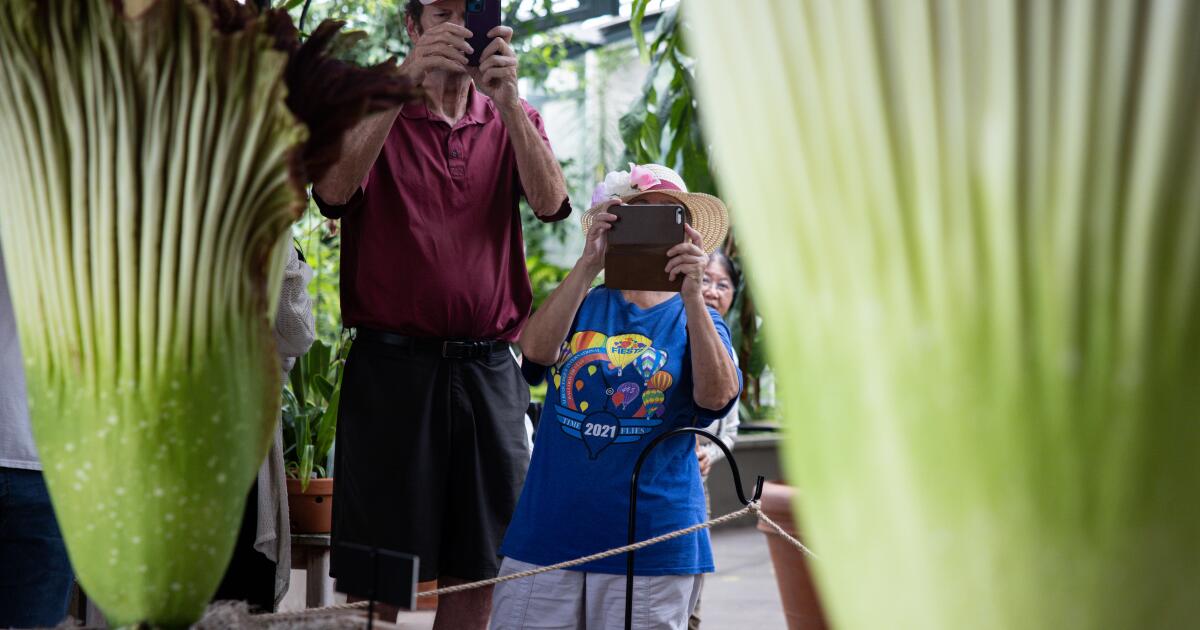
The Huntington’s long-awaited stink has arrived. Two corpse flowers nicknamed Odora and Odorysseus have bloomed at the San Marino conservatory, drawing thousands for the rare occasion and quickly surpassing last year’s numbers.
Corpse flowers have been a staple of the Huntington since 1999, when the garden exhibited its first corpse flower. Native to Sumatra, Indonesia, these plants are endangered in the wild and only bloom for 24 to 48 hours every few years. Once bloomed, they reek of rotting flesh.
As the day goes on, these smelly specimens will close back up and collapse, losing their infamously rotten odor.
The double bloom this summer was “definitely a surprise,” said Brandon Tam, the Huntington’s associate curator of orchids. The last time multiple corpse flowers bloomed on the same day at the Huntington was in 2018.
“We knew that Odorysseus was going to bloom probably Sunday,” Tam said. “But what surprised us was that we saw that Odora was opening just a few hours after.”
As an “inflorescence” — a plant structure containing hundreds of male and female flowers at the base — the plant usually staggers its bloom to avoid self-pollination.
A developmental irregularity caused Odora’s spadix to cave in, but the plant remains healthy, said Brandon Tam, the associate curator of orchids at the Huntington.
(Kayla Bartkowski / Los Angeles Times)

Jaime Holmes from San Gabriel holds her nose in front of the blooming corpse flowers.
(Kayla Bartkowski / Los Angeles Times)
But sometimes, “these plants have a mind of their own,” Tam said.
Climate factors can influence when they bloom. Tam said Southern California’s recent high humidity may have signaled a prime environment for the plants to unfurl.
Visitors may have noticed that Odorysseus’ spadix — the conic protrusion emerging upward from the plant — was much taller than Odora’s, which had caved in. Tam said Odora’s spadix was a developmental irregularity, but emphasized the plant remains healthy.
“It just looks a little different — completely normal,” Tam said. “When it reblooms for us in three to four years, it’ll look just perfectly fine.”
At the time of the bloom, Odorysseus measured 71 inches in height, and Odora measured 41.
As of 8:51 a.m., the Huntington recorded over 5,700 reservations, said Keisha Raines, the Huntington’s assistant director of news and media relations. That number easily surpassed last year’s bloom, which drew about 4,900 visitors. It also excludes walk-ins and any more reservations made throughout the day.
Parking lots quickly filled inside the Huntington, forcing some visitors to park on the streets outside.
Raines thinks the rare double bloom influenced the spike in reservations. She also believes general awareness of the corpse flower increases each summer.
“It’s kind of lore,” Raines said. “It’s just continuing to build, and more people want to see it.”
Inside the conservatory, eager sniffers took selfies and marveled at the plants’ size and smell. Outside, the line ran all throughout the walkways, extending past the exit.
Ventura resident Michelle Shock and her 8-year-old daughter, Fable, initially came to the Huntington for a tea party at the Rose Garden, and dressed for the part in light-colored, semi-formal dresses. They scheduled the party two weeks ago and got lucky when they heard the corpse flowers were in bloom on the same day.
“I’ve always wanted to see one,” Shock said while waiting in line. “I think the last time I knew of one blooming was when I was pregnant with her. We were up in the Bay, and I missed it. So here we are now, together, which is better.”

Gastonia Goodman, 72, peers through the window at the blooming corpse flowers.
(Kayla Bartkowski / Los Angeles Times)
Fable predicted the plants would smell like “rotten flesh from Minecraft.” Shock guessed they’d smell like forgotten meat in a broken freezer or animal remains on a farm.
For spouses Jennifer Kraus and Abigail Cruz, the plants smelled like rotten garbage.
“It was pretty ripe,” Kraus said. “Totally enjoyed it though.”
The couple drove two hours from the Inland Empire to catch the bloom, which had been on Cruz’s bucket list.
“The minute that we saw it on Facebook, [Kraus] started following it and making sure that we’re here when it had bloomed,” Cruz said.
They were among the first to arrive, so the wait was short. “We were here at o-dark-30 this morning, ready to go,” Kraus said.
North Hollywood resident Lilla Saito took two hours off work to witness the corpse flowers for the first time and tracked the livestream every day, “just waiting for it to bloom.” Saito stood in line for about 45 minutes to catch a whiff, which Saito said “smelled like a trash room.”
It was Paige Patino’s first bloom too. Patino lives 10 minutes away from the Huntington and wore a T-shirt with flowers on it for the occasion. It was “really cool” to “see both of them active,” Patino said.
For Tam, this year’s stench ranks in the top three. He thinks each individual plant stinks more than previous blooms, but on top of that, he said: “The fact that we have two in bloom makes it stinkier.”

California Attorney General Rob Bonta is one of several attorneys general seeking to stop the merger of Paramount and Warner Bros. Discovery.
Bloomberg via Getty Images/Bloomberg
hide caption
toggle caption
Bloomberg via Getty Images/Bloomberg
Stay up to date with our Up First newsletter, sent every weekday morning.
A dozen states, led by California, are suing to block Paramount from buying Warner Bros. Discovery in a Hollywood mega-merger that would unite some of the nation’s largest movie studios, television newsrooms, and other entertainment properties.
“The unlawful merger of these two entertainment behemoths would lead to higher prices, lower quality, and less content for film and television, harming movie theaters, basic cable distributors, and ultimately, audiences on every sofa and movie theater seat in the U.S.,” California Attorney General Rob Bonta said in a statement announcing the suit, which was filed in federal court in California’s Northern District.
The deal would give a wealthy family that has taken pains to show its allegiance to President Trump the effective ownership of the companies’ competing movie studios, streamers (Paramount+ and HBO Max), sports programming (CBS Sports and Turner Sports) and news divisions (CBS News and CNN) as well as a suite of cable channels, such as Comedy Central, VH1, MTV, TNT, TBS, HGTV and Discovery, among others.

The president has repeatedly praised Larry and David Ellison, the digital titan and his son who are the controlling owners of Paramount. And he has publicly urged the sale of Warner’s CNN to new owners.
“We’re trying to have CNN go in a normal path,” Trump told CNN anchor Jake Tapper yesterday at the end of an interview about the late Sen. Lindsey Graham.
In his statement Monday, Bonta said, “With this lawsuit, California and our sister states are fighting for free and fair markets, not rigged markets. America has no kings in government or our economy.”

Paramount is inviting in sovereign wealth funds from Saudi Arabia, Qatar and the United Arab Emirates as major investors who will forego voting rights. The financing proposal also envisions that the company will take on $80 billion in new debt. That will assuredly trigger major cuts throughout the combined company. Warner dramatically reduced its own debt after slashing budgets, but is still tens of billions of dollars in the red, which helped set the stage for Paramount’s unsolicited bid.
Bonta sees “red flags”
In late June, Bonta told MS NOW’s Jacob Sobroff that the deal presented “red flags in the air everywhere.” The acquisition is valued at approximately $111 billion, including debt and major (though nonvoting) investment stakes from Saudi and other sovereign wealth funds. Bonta has armed his office for potentially costly legal battles by hiring a new batch of lawyers, including some who left the U.S. Justice Department after Trump took office a second time. He also secured new funds from the state legislature specifically for antitrust enforcement.
The other states involved in the lawsuit are Arizona, Colorado, Connecticut, Massachusetts, Minnesota, Nevada, New Jersey, New Mexico, New York, Oregon, and Washington. An overlapping cadre of Democratic state attorneys general have sued to block the takeover of local TV giant Tegna by Nexstar, the nation’s largest owner of television stations. A federal judge in Sacramento has put the full integration of the two station groups on hold in advance of a trial that is scheduled to be heard a year from now.
Paramount has argued that the entry of streaming giants such as Netflix, Amazon and Apple into entertainment has altered the landscape, rendering such antitrust concerns obsolete. Anticipating the same vast shifts, Disney swallowed up most of Fox’s Hollywood holdings in 2019.
Any delay caused by the attorneys general could prove costly, securities filings show. Starting Oct. 1, Paramount has to pay Warner shareholders a “ticking consideration” of roughly $650 million for every 90 days the deal is set back. If the deal is not consummated by next June 4, Paramount will have to pay Warner $7 billion.
A Silicon Valley titan expands power in Hollywood
Though Paramount’s new chairman and CEO is Hollywood producer David Ellison, a past financial donor to the campaigns of Presidents Barack Obama and Joe Biden, the takeover bid was financed and guaranteed by Ellison’s father: Oracle co-founder Larry Ellison.
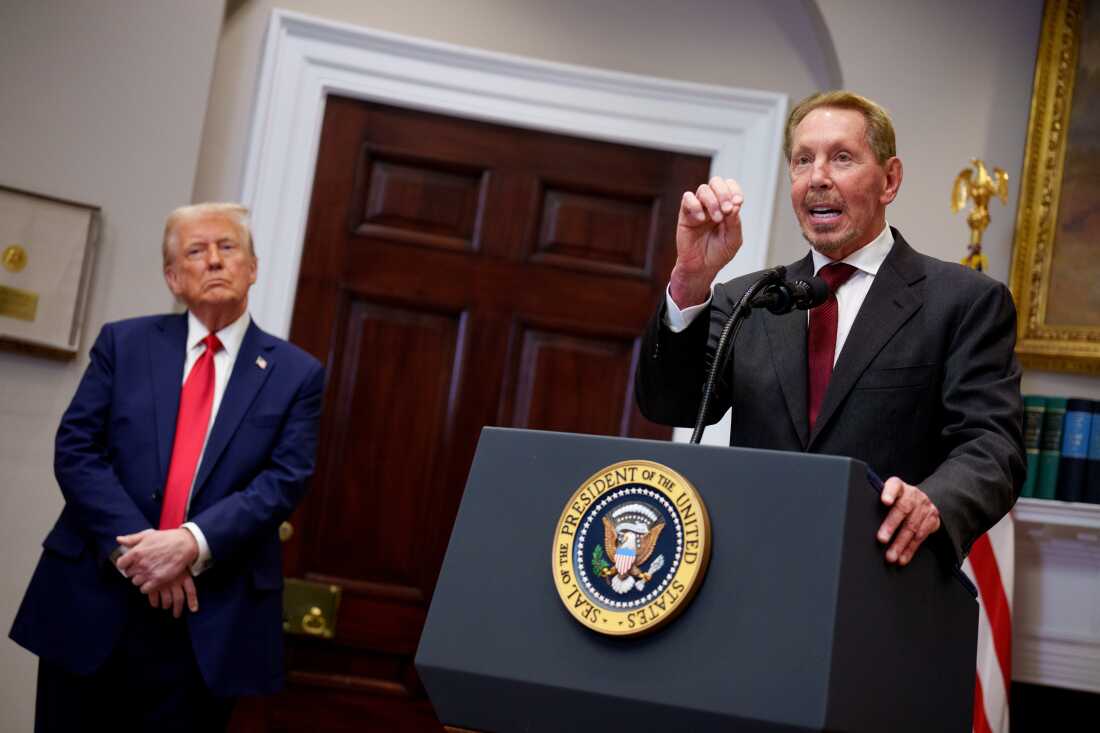
Oracle co-founder Larry Ellison, a friend and adviser of President Trump, is backing Paramount’s $111 billion plan to buy Warner Bros. Discovery.
Andrew Harnik/Getty Images/Getty Images North America
hide caption
toggle caption
Andrew Harnik/Getty Images/Getty Images North America
Larry Ellison is one of the richest people on Earth. He is also a Trump supporter and adviser — both formally and informally — serving, for example, on a board counseling the White House on artificial intelligence. Last fall, Trump made good on his plans to grant Larry Ellison and Oracle a controlling stake in TikTok’s U.S. operations.
The Ellisons took over Paramount just last summer, making concessions to Trump’s chief broadcast regulator and earning the president’s vocal support.
“The Ellison family, two great people, great people,” Trump said in March, ahead of a dinner David Ellison threw in Trump’s honor. “It’s a great family.”
David Ellison hired a new editor in chief for CBS News: Bari Weiss, founder of the center-right The Free Press. She arrived with a record of deeming mainstream media, including CBS News, to be too reflexively “woke” and anti-Trump. Her effort to reshape coverage has been met with a series of controversies, including firings and fiery resignations by CBS journalists accusing her of bias, which the network and Weiss deny. Bonta’s announcement did not focus on the combining of CBS News and CNN.
Given that Oracle provides the software skeleton on which much of the nation’s commerce and government runs, and that the Ellisons now control major media platforms and the digital data they gather, the family has the ability to create a vast reservoir of information about how people act online.
Trump’s remarks on the Paramount-Warner deal — and especially on CNN’s fate —represent a sharp break from past administrations. Predecessors both Republican and Democrat tended to respect the independence of regulators in the antitrust division of the Justice Department and the Federal Communications Commission.
Past Warner deals led to a trail of debt
Makan Delrahim, who is now Paramount’s chief legal officer, ran the Justice Department’s antitrust division during Trump’s first term. He led an ultimately unsuccessful effort to block AT&T’s takeover of TimeWarner, the precursor company to Warner.
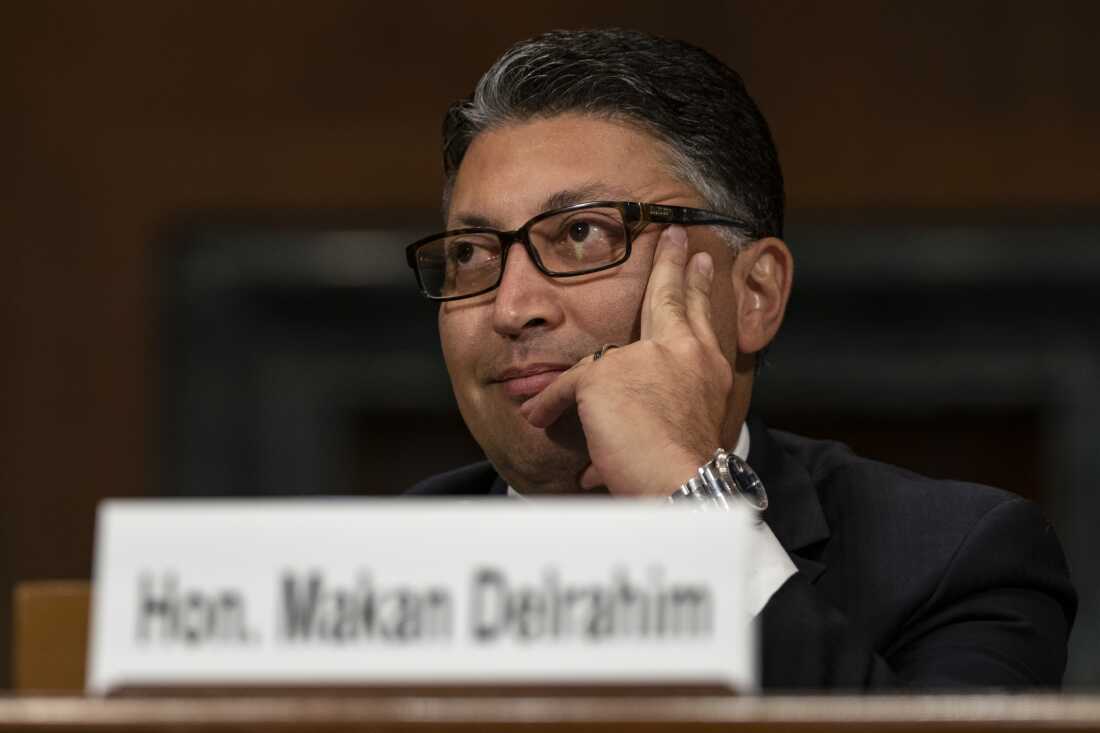
Makan Delrahim was U.S. assistant attorney general for the Justice Department’s antitrust division during President Trump’s first term. He is now the chief legal officer at Paramount.
Bloomberg/Bloomberg via Getty Images/Bloomberg
hide caption
toggle caption
Bloomberg/Bloomberg via Getty Images/Bloomberg
In retrospect, AT&T may have preferred Delrahim to prevail; the deal was brutally panned by analysts and the stock market. The telecom giant unloaded the media properties less than four years later. They were taken over by Discovery in a deal that burdened the new cable TV conglomerate with tens of billions of dollars of debt. Warner CEO David Zaslav was able to reduce it significantly, but not overtake it, and announced plans last summer to split the company in two in seeking to get ahead of an undesired offer from Paramount.
The Warner board initially struck a deal with Netflix valued at nearly $83 billion for much of the company, not including CNN and other basic cable channels. Then Paramount raised its offer for the whole company and Netflix pulled out rather than compete.
While the top British regulator has expressed qualms too, signaling a possible review that could delay the process, Paramount has won approval from the Justice Department and many regulators abroad. The Justice Department approved the acquisition last month after an eight-month review.
The Wall Street Journal reported senior officials at the Justice Department fast-tracked its process for approval before career attorneys, who were weighing filing suit to block the deal, could intercede. The outgoing antitrust chief denied that in an interview with Politico.
The FCC has not yet signed off. It is involved because Paramount holds broadcast licenses for the 28 local television stations it owns. The FCC is led by Brendan Carr, a Trump appointee and vocal ally who has endorsed Paramount’s bid.
“I think this is a good deal, and I think it should get through pretty quickly,” Carr told CNBC back in March.
Paramount has made minor concessions to try to win approval from officials in Europe. The European Union undertook formal reviews of both the consolidation of assets and its reliance on foreign investors, which are set to conclude soon.
The litigation from the states could tie Paramount up for far longer.
Lifestyle
As L.A. River morphs into impromptu stage for nature-loving musicians, gentrification fears remain

Yo-Yo Ma closed his eyes as he drew a bow slowly across his cello, playing the first notes of the Catalan lullaby “The Song of the Birds.” But this venue wasn’t like any vaulted concert hall he had toured globally.
At Maywood’s Riverfront Park, Ma was accompanied by the vroom of nearby traffic, cascade of a yucca rainstick and burbling hum of a water synth. An oblivious biker pushed past the world-renowned classical musician. The music flowed on.
Ma’s pop-up show in Southeast Los Angeles was part of his ongoing efforts to highlight people’s relationship to nature through music. He is among a new wave of artists who have been hosting shows along the L.A. River, a waterway with a complex history.
Yo-Yo Ma plays cello for a small group of artists and environmental advocates as part of the L.A. Phil Insight program, which aims to spark conversations around the arts.
(Halline Overby for InsightLA)
The river once terrorized Angelenos; its unconstrained flow was prone to flooding until most of its 51 miles were lined with concrete starting in the 1940s. While it’s been neglected, trashed and often forgotten over time, myriad governmental and nonprofit groups have been working for years to restore habitat, add park space and establish recreational elements (sometimes in conflict over the vision). And recently, creatives and activists, who dream of transforming it into a hospitable greenway, have been hosting arts events.
“Awareness around the river itself is changing,” said Maria Meija, executive director of L.A. River Arts, one of the organizations bringing attention to its history and cultural significance through public programming. She sees the serpentine stretch of the river as a natural highway that connects Angelenos from the San Fernando Valley to Long Beach. “We believe that if the river is properly activated as a green and cultural landscape, then Angelenos will fundamentally also get to experience Los Angeles in a different way.”

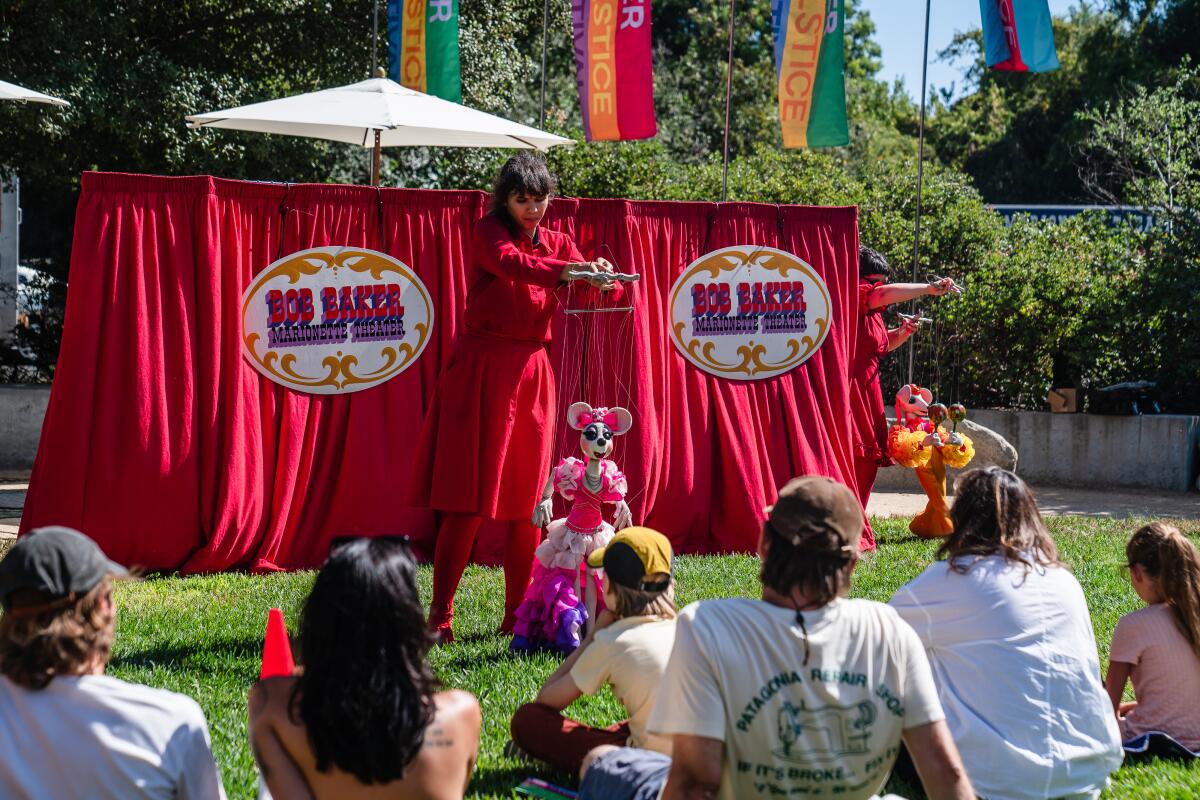
The River Solstice Festival was a family affair, with guests lounging on picnic blankets, watching puppet and opera performances and participating in birdwatching.
(Ariana Drehsler / For The Times)
Visions of those possibilities were realized on the summer solstice in mid-June at L.A. River Arts’ inaugural River Solstice Festival at an Elysian Valley park abutting a soft-bottomed area of the river known as the Glendale Narrows.
Children and parents applauded the performances by the Bob Baker Marionette Theater and opera singer San Cha at Lewis MacAdams Riverfront Park in what’s otherwise known as Frogtown. Attendees also gathered for guided bird-watching along the bike path by the water. Four-year-old Juni Wahab was entranced by the sight of the swallows and cormorants swooping low overhead and the rushing twists of water.
1
2

3

4

1. Bob Baker Marionette Theater performs at the River Solstice Festival, clockwise from top left. Meanwhile, attendees enjoy the park and river as skateboarders roll down the bike path. (Ariana Drehsler / For The Times)
“It’s going so fast,” Wahab said, wiggling and pointing as her aunt held on tightly for safety. “There are so many waves.”
A quick stroll upstream, a group of DJs unaffiliated with the family-friendly festival hosted a day party aimed at Gen Z and millennial attendees, perched on one of the channel’s outcrops. Roughly a dozen people at the if-you-know-you-know event grooved and shuffled to EDM music while kayak enthusiasts paddled by and locals fished for carp.
Dominic Tsoi drove from Orange County to spin at the open decks hosted by the DJ collective Helipad Society. “This event really resonated with me, because it mixes two things that I really love, music and being a part of nature,” said Tsoi, adding the commute was worth it. An indoors club setting can feel stifling, but outdoors is where Tsoi feels free.

DJs have been putting on pop-up events like this one at the L.A. River and sharing videos of their sets on TikTok.
(Ariana Drehsler / For The Times)
Just up the sloped bank, Antonio Solano and Erick Torres were sweeping outside their tent, where they live under the Glendale Freeway. Torres started noticing events at the river increase over the last three years.
“It gets people together,” said Torres, who’s been living above the river for over a decade. The music is a source of pleasure even as Torres and Solano stay vigilant to avoid city encampment sweeps. “It’s good, we enjoy it.”
Social media has driven interest in these DIY events as artists playing ambient music against a backdrop of verdant green have gone viral on TikTok.
“The attention has expanded to people who otherwise wouldn’t have given the L.A. River a second thought,” said Noah Klein, a lifelong Angeleno who has hosted popular river jams over the last two years through his Living Earth public art series.

Erika Apelgren wears a flower crown that she made at the River Solstice Festival.
(Ariana Drehsler/For The Times)
People don’t need approval to host these impromptu gatherings, said Dash Stolarz, director of public affairs at the Mountains Recreation and Conservation Authority. The park agency oversees commercial use of the L.A. River recreation zones in Elysian Valley and the Sepulveda Basin, another section of soft-bottomed riverbed.
In her 25 years on the job, this was the first time Stolarz had heard of people using the riverfront for mini concerts. She was excited by the ingenuity of artists; as long as people aren’t charging for events, they don’t need permission.
“It’s exactly how we envisioned people enjoying the river,” Stolarz said. “We want people to use the river like a park.”
Though unlike a regular park, the L.A. River is primarily treated as a flood control channel, so park rangers carefully monitor for rain when the recreation zones open for leisure, like kayaking, during the summer.
While appreciating the L.A. River can be a good thing, social media algorithms can flatten the context around the waterway, particularly when it comes to demographic changes in nearby neighborhoods.
“The City of L.A.’s greatest skill is the erasure of its own history, and the L.A. River kind of feels like the perfect encapsulation of this,” Klein said.
Once home to mostly working-class Latino families, neighborhoods along the river in northeast L.A. have seen home prices surge for years. To preserve the history of these neighborhoods, Clockshop, an arts organization, has been collecting interviews with locals as part of a multimedia oral history project since 2023. The project includes everything from videos of an Indigenous musician performing a song about water in the Tongva language to brothers worrying about the future of their family’s 60-year-old pickle business in the face of gentrification.
Jon Christensen, director of the Laboratory for Environmental Narrative Strategies at UCLA, said river revitalization can be part of a “green gentrification cycle” as new development pushes out old communities. Like the chicken-and-egg paradox, it’s hard to tell which comes first: the amenities surrounding the L.A. River or the more affluent people seeking them.
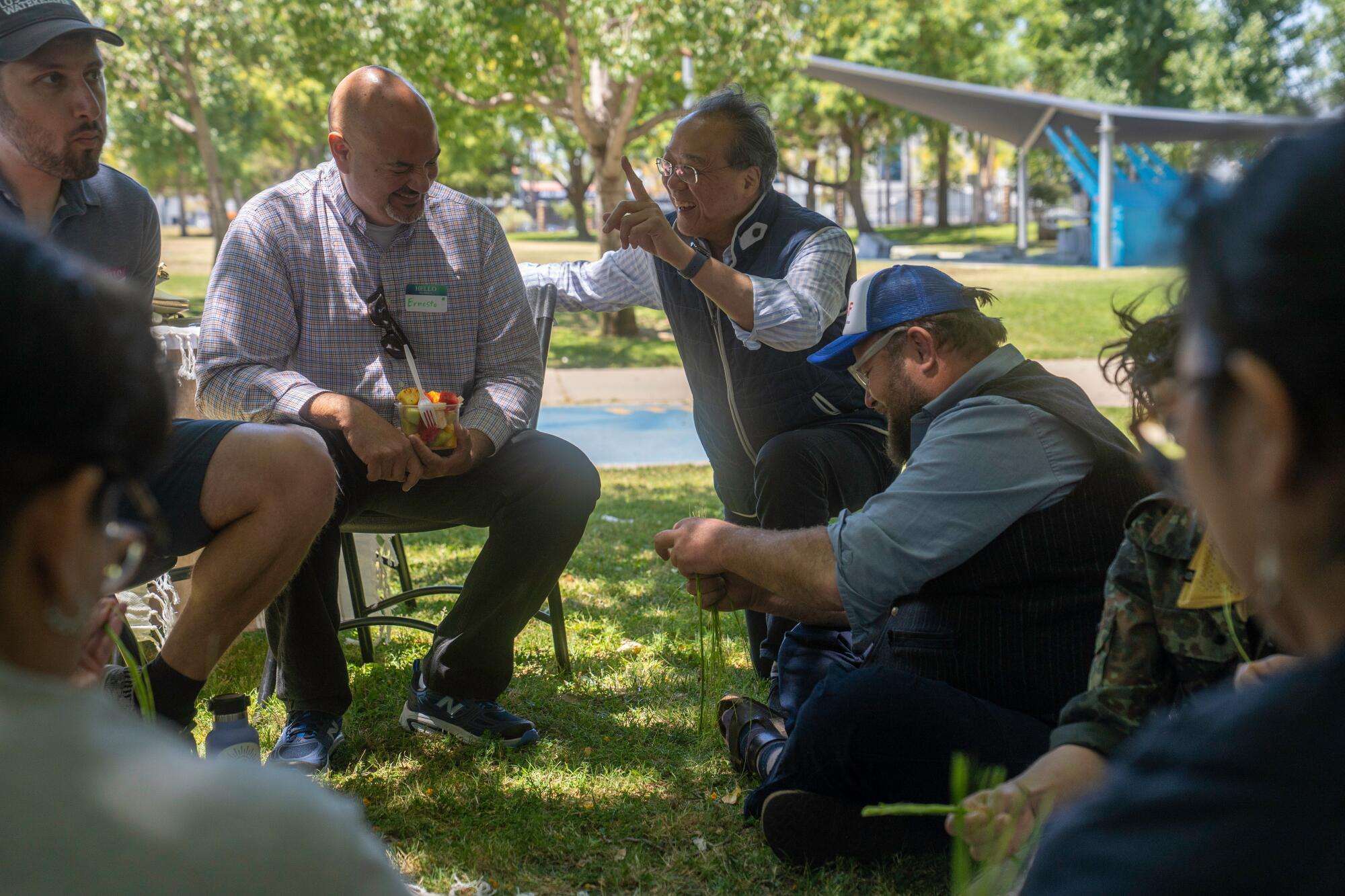
Yo-Yo Ma, who hosts a podcast called “Our Common Nature,” chats with attendees at his intimate river concert. Human connection to the natural world is among his passions.
(Halline Overby for InsightLA)
Christensen hopes artists engaging with the river spurs conversation for more equitable green investments that benefit communities and the environment. “When people are more connected to nature, they want to support nature more,” Christensen said of his studies on how people connect to the outdoors. “It’s really kind of a virtuous cycle there.”
Cindy Donis, a water organizer with East Yard Communities for Environmental Justice, said artwork can also raise awareness around inequities. While there are aspirations to turn the river into a greenbelt, nightmarish pollution incidents have still haunted Southeast L.A. communities.
Ma’s performance was nearly canceled in May due to 25,000 gallons of crude oil that spilled into the L.A. River after a pipeline rupture in Boyle Heights. Weeks later, the Lineage warehouse fire sent even more debris and pollution downstream. Donis said multiple people reached out with complaints of a foul smell emanating from the river. Miles away, some at the River Solstice Festival wore masks due to poor air quality caused by the fire.

Charles Kelley with his daughter Zirah Kelley pose along the L.A. River bike path near the River Solstice Festival.
(Ariana Drehsler/For The Times)
Earlier this year, East Yard Communities for Environmental Justice held an exhibition at Art Space Huntington Park called “We Are Water” to uplift local Indigenous artists. “Art really allows and embraces healing,” Donis said. “It’s another tool that allows us to process these feelings and get closer to the solutions as a community.”
The L.A. River inspired Arturo Gonzalez to found his arts education nonprofit that focuses on gang intervention among young people in East L.A. As Ma performed in the park, Gonzalez stood in the river basin, spray-painting in neon-pink blockbuster letters the name of his organization, East Side of the River, onto pillars under Slauson Avenue.
As a teenager in the early 2000s, Gonzalez was involved in gangs that would tag the gray walls of the L.A. River, but his passion for graffiti and Chicano art eventually led him out of those circles.
“The river was a safe place to paint, where you could sit and spend the day learning colors, composition,” he said of illicit tagging as a teenager, which eventually led to his public art work. “There’s a thin line between vandalism and art.”

Arturo Gonzalez spray-paints the name of his organization, East Side of the River, which focuses on gang intervention.
(Halline Overby for InsightLA)
This time, Gonzalez arrived with permission from the county and painted on a detachable fabric in case the mural needs to be removed.
“The opportunity to get into the river and paint again was like a dream,” he said. He seeks the input of local residents in his planned projects so they can participate in beautifying their neighborhoods. “We call it wall medicine for the community.”
-

 Politics5 minutes ago
Hegseth announces joint task force with DOJ to prosecute leaks to journalists ‘with the full force of the law’
-

 Health11 minutes ago
Microwaved squishy toy explodes onto boy’s face and chest amid viral trend, causing horrific burns
-

 Sports17 minutes ago
FBI, Atlanta police target unauthorized drones flying near World Cup venues
-

 Technology23 minutes ago
Why careful people still end up on data broker sites
-
 Business29 minutes ago
Netflix to add videos from digital publishers to its homepage
-
 Entertainment35 minutes ago
Tom Segura and Christina Pazsitzky split after 18 years of marriage
-
Lifestyle41 minutes ago
Like ‘rotten flesh’? Thousands rush to whiff double corpse flower at Huntington
-
 Politics47 minutes ago
Preliminary report reveals cause of death for Sen. Lindsey Graham

