Lifestyle
Rainbow Girls: 10 Years of Protection and Prejudice


YouTube
Photographer Julia Gunther made the portraits in this story 10 years apart for her independent documentary project, Rainbow Girls. She wanted to know what, if anything, had changed for these South African lesbian women over a decade that, on paper, promised big gains for LGBTQ rights.
In the autumn of 2012, photographer Julia Gunther was working in South Africa, researching a documentary project about activism within LGBTQ communities in and around Cape Town.
Gunther was particularly interested in making portraits of individuals advocating in the challenging environments of the city’s many townships.
By chance, during a meeting with Professor Zethu Matebeni, at the time a senior researcher at the Institute for Humanities in Africa (HUMA) at the University of Cape Town, a fax arrived inviting Matebeni to judge a lesbian beauty pageant in the township of Khayelitsha a few days later. She suggested that Gunther attend, as it would be a good opportunity to meet other LGBTQ advocates.
The pageant, called Miss Lesbian, was organized by Free Gender, a lesbian rights organization founded in 2008 by community activist Funeka Soldaat and based in Khayelitsha.
That year’s edition of the pageant would be held on Dec. 1 (World AIDS Day) in the Andile Msizi town hall. When Gunther called Free Gender to ask for permission to take photos, she ended up speaking to Siya Mcuta, a volunteer, who told her that everyone was welcome.
Gunther spent the entire day making portraits of the contestants, including Mcuta and Velisa “Vee” Jara, for whom this was her third pageant.
Jara can remember how excited she was. “We don’t often have events like Miss Lesbian in our community.”
“I could see the girls were nervous about presenting themselves in their hometown,” Gunther recalls. “But they had such a strong sisterhood that they got through the day together.”
The images Gunther made at the pageant would later form the core of her project, Rainbow Girls — a series of portraits of lesbian activists, filmmakers and ordinary women celebrating and advocating for LGBTQ rights in Cape Town.
The project’s name referenced the “Rainbow Nation,” a term coined in 1994 by Archbishop Desmond Tutu to describe post-apartheid South Africa.
“Rainbow Nation” symbolized multicultural unity and hope in a country once defined by strict racial divisions under apartheid.
Yet, despite South Africa adopting the world’s first constitution prohibiting discrimination based on sexual orientation, life for many LGBTQ individuals remained dangerous and unequal.
Gunther met with Mcuta and Jara a few days after the pageant to discuss the future of LGBTQ rights in South Africa. They explained that pageants like Miss Lesbian helped sensitize traditionally intolerant communities.
“The Miss Lesbian beauty pageant is our way of having fun, being happy and expressing ourselves,” Mcuta explained in 2012. “We are doing this for the younger generations to see.”
Over the years, Gunther kept in touch with Mcuta, Jara and others, meeting them whenever she was photographing in South Africa. “We’d bump into each other at political rallies, demonstrations, or at a party.”
Meanwhile, Rainbow Girls, Gunther’s project, began to be published internationally and in South Africa. In 2015, a selection of images was featured in Cape Town’s GRID photo festival, held at the Castle of Good Hope.
“The girls could see their portraits in their hometown and show them to friends and family,” Gunther says.
Protection and prejudice
In the book Gender Violence, the Law, and Society, psychologist Deepesh Dayal describes LGBTQ communities in South Africa as existing in a paradox of constitutional protection and prejudice.
On paper, South Africa has made some advances in the protection of LGBTQ people since 2012, passing the Prevention and Combating of Hate Crimes and Hate Speech Act in 2023. That same year, the country’s Minister of Social Development at the time, Ms Lindiwe Zulu, led a walk against LGBTQ-based violence in Pretoria.
But South Africa’s lesbian, gay, bisexual, transgender, queer and intersex communities still face significant challenges, particularly in terms of discrimination and hate crime. The protections guaranteed by the country’s progressive constitution have yet to deliver the safety and acceptance they promise.
South Africa has one of the highest homicide rates on Earth — there were more than 7,700 murders recorded in the third quarter of 2023 alone.
Journalists from MambaOnline.com documented at least 24 LGBTQ individuals killed in 2021. When Phelokazi Mqathana, a 24-year-old lesbian, was murdered in Khayelitsha, it was the eighth known killing in less than three months. The true number of murders and rapes is likely far higher, as tens of thousands of cases have gone unsolved since 2019.
Lesbian, gay, bisexual, transgender, queer and intersex communities are disproportionately the target of violent crimes. The dangers of living openly as a black lesbian in South Africa were all too familiar to Jara and many of the other women featured in this story.
In the past decade, they have faced persistent and violent threats in their daily lives — they have been attacked, beaten and threatened. Tsidi lost her partner, Mpho, who was stabbed to death in a hate crime in 2021.
“Vee would tell me about the challenges the former pageant contestants faced living in Khayelitsha as black lesbian women,” Gunther explains. “Constantly navigating threats and dealing with family members who refused to accept them was incredibly difficult. It put enormous pressure on their mental health.”
Whenever Gunther spoke to Jara, she found herself asking the same question: Were things getting better or worse? Had anything changed for the women featured in Gunther’s Rainbow Girls project since the 2012 Miss Lesbian pageant?
A decade later
In 2022, 10 years after making her original Rainbow Girls portraits, Gunther began considering a follow-up. Later that year, when she returned to Cape Town with her partner, writer Nick Schönfeld (the author), she met with Jara, and together they decided to organize a reunion of the women she had photographed a decade earlier.
Gunther was eager to make new portraits, capturing the changes of the past 10 years, both externally and in personality, mood and outlook.
Jara, too, was excited. She’d lost contact with many of her fellow contestants. “I wanted all of us to meet up again,” Jara says. “We had grown a lot and now led different lives.”
Gunther wondered if, by placing the portraits from 2012 and 2022 side by side, one could see the impact of a decade of advocacy and struggle.
Over the course of two days, she and Jara invited nine women featured in Gunther’s Rainbow Girls project to the Castle of Good Hope to talk about the past 10 years. This time, Gunther not only made portraits but she also filmed conversations between Jara and the other women.
“One of the biggest issues facing LGBTQ people in South Africa is that they struggle to be heard,” Gunther explains. “We wanted to create a record of their experiences, told in their own words.”
At the start of each conversation, Jara presented the sitter with their 2012 portrait. For some, seeing themselves from a decade earlier was a moment of spontaneous joy. For others, like Sino and Tsidi, it was an emotional reminder of what they had endured.
Jara subsequently asked each participant about their experiences since they’d last met and what, if anything, had changed for them in the past 10 years.
She chose to conduct the conversations in Xhosa — one of South Africa’s official languages spoken by approximately eight million people.
“I wanted them to be comfortable so they could share more,” Jara says. She recently completed a basic counseling course at the University of South Africa.
“In a way, it made the conversations more private, because I don’t speak Xhosa,” adds Gunther. Although Jara recounted the conversations for her, Gunther didn’t understand their full extent until they were translated. “That’s when the true power of their stories hit me.”
October was South African PRIDE month. Jara and the other women featured in this story hope that this film will contribute to the fight for full LGBTQ equality.
Ntombozuko ‘Nozuko’ Ndlwana (from left), Thozama, Nana, Zintle, Hlomela Msesele and Tsidi Zondi (in front) pose for a photo backstage during the Miss Lesbian beauty pageant in the Khayelitsha township of Cape Town, South Africa, in 2012.
Julia Gunther
hide caption
toggle caption
Julia Gunther
Nick Schönfeld divides his time between writing about affordable health care, gender equality, education, and distributive justice, and publishing books for children.
See more of Julia Gunther’s work on her website or follow her on Instagram: @juliagunther_photography.
Catie Dull photo edited and Zach Thompson copy edited this story. Connie Hanzhang Jin created the pull quotes.


Azar Nafisi on the set of Eran Riklis’ Reading Lolita in Tehran
Marie Gioanni/Greenwich Entertainment
hide caption
toggle caption
Marie Gioanni/Greenwich Entertainment
A new film version of Azar Nafisi’s critically-praised, worldwide bestselling memoir, Reading Lolita in Tehran, is now in theatres.
The film shows a group of women meeting clandestinely in Nafisi’s home in the mid-1990s, to read forbidden books. They read classics of the West, like Madame Bovary, The Great Gatsby, Pride and Prejudice, and Lolita.
Education had become dangerous and even deadly during the Islamic Revolution, and reading forbidden books was Nafisi’s way to fight back.
The film, directed by Eran Riklis, begins with Nafisi as a university professor and ends with her exiled from her homeland. Nafisi told Scott Simon about the experience of seeing herself and her story depicted on the big screen, “I feel towards it the way I feel towards my children.”
The film is directed by Eran Riklis and won the the Audience Award and a special jury prize at the 2024 Rome Film Festival.
It stars Iranian actors Goldshifteh Farahani, Zar Amir Ebrahimi, and Mina Kavani. Like the author, some of the actors are exiled from Iran.

Actor Golshifteh Farahani stars as Azar Nafisi in Eran Riklis’ Reading Lolita in Tehran.
Greenwich Entertainment
hide caption
toggle caption
Greenwich Entertainment
“These girls were very different, one from the other,” Nafisi said of the students who studied with her in Tehran. Remembering them now, and seeing them depicted on the screen, Nafisi saw anew the power of great literature.
“Outside the classroom, they probably wouldn’t talk to one another. But in that class, they learned to communicate and to connect,” she said.
Through the stories in the books, Nafisi said each woman could find more and become more herself. “It reached a sort of magic,” she said.
The magic was brutally broken by a government that was desperate to quiet the voices of dissenters. Nafisi’s homeland changed quickly into a place she barely recognized
“This wasn’t my land,” she told Simon. “This was a country ruled by a regime that stoned people to death.”
When the religious hardliners in the government banned women from appearing in public without a headscarf, the film shows Nafisi, played by Goldshifteh Farahani, agonizing in front of a mirror with a black headscarf.
“The expression on her face is fear, because by and by, she disappears into this garment,” Nafisi said. For some, the headscarf was a symbol of the place of women in society, but for Nafisi the stakes were even higher.
“This is not a political fight. This is an existential one,” she said. “Our identity as human beings, as women, has been taken away from us.”
When fighting against covering her hair became too dangerous, Nafisi found small ways to rebel. “I never wore my scarf properly. I would always show a few strands out of the scarf to tell them, ‘You don’t own me.’”
Nafisi’s book about fighting the Iranian Revolution through the simple act of reading was an international bestseller, won numerous literary awards, and was named as one of the “100 Best Books of the Decade” by The Times (London).
Nafisi now lives in Washington, D.C., and continues to make a passionate case for the role of artists and writers in society.
She shared with Simon an illustrative story from the beginning of Islamic Revolution. The new leaders tore down the statues of the king and the royal family and changed the names of streets. But when they tried to bring down the statue of Persian poet Abul-Qâsem Ferdowsi, and erase his place of honor within the culture, the people opposed it.
“I thought how fantastic that they can bring down the statue of the Shah, but they can’t touch the poet,” she said.

Get ready to catch a whiff of stink. Not one, but two rare corpse flowers are set to bloom at the Huntington in the coming days, with one of them making its first-ever public bloom.
If both plants unfurl on the same day, it would be just the second time a double bloom has ever occurred at the Huntington.
For those unfamiliar with these funky flora, be warned. Corpse flowers bloom for just 24 to 48 hours, and once opened, they reek of gym socks, rotten eggs and decaying flesh … or, well, a corpse.
Brandon Tam, associate curator of orchids for the Huntington, speaks to reporters in front of two corpse flowers as they prepare to bloom.
(Kayla Bartkowski / Los Angeles Times)
Couple that with their tropical native climate of Sumatra, Indonesia, and you’re in for a sweaty, stinky viewing experience.
The stench is important for pollination, said Brandon Tam, the Huntington’s associate curator of orchids. It attracts carrion beetles and flesh flies, which lay their eggs on rotting animal carcasses.
At the Huntington, pollinators aren’t the only thing it entices. Since the garden exhibited its first corpse flower in 1999, thousands of people flock to its conservatory every summer, just to smell these putrid plants.

-
Share via
It smells like rotting flesh, but thousands of people will be lining up to catch a whiff.
“The kids that first came in 1999 are now bringing their kids — their own kids — to experience this over 20 years later,” Tam said. “It’s amazing, this plant, the impact that it has had over many generations.”
Glendale resident Trinity Shi, 42, witnessed three blooms at the Huntington in 2022 and 2023 and compared the smell to rotten fish: pungent, but not unbearable. She was excited to feature such an unusual specimen on her Instagram plant blog, @cubehousejungle, and hopes to make it to this year’s bloom too.
“It feels really prehistoric to look at this plant, because it is so giant,” Shi said of the corpse flower, which can grow over 12 feet tall. “It’s become kind of like a mascot for the Huntington.”
Thanks to cultivation techniques, the Huntington coaxes the plants to bloom every two to three years, not four to six like they do in their natural habitat, where they’re endangered.
Still, the blooms are notoriously unpredictable, Tam said. He guessed one of the plants will bloom in the coming days.
This upcoming bloom spotlights a plant nicknamed Odora, who last opened in 2024, and Odorysseus, a rookie public bloomer. Visitors offered name suggestions for Odorysseus on the Huntington’s Instagram page, where contenders included Stinkerbell, Gagatha and Count Flatula, among others.
It’s not unusual for the Huntington to have multiple soon-to-be bloomers on display. But only once, in 2018, did two plants actually unfurl on the same day.

A detailed view of a corpse flower as it prepares to bloom.
(Kayla Bartkowski / Los Angeles Times)
For Odora and Odorysseus, siblings from a 2002 pollination, a double bloom is unlikely, Tam said. The plants are inclined to bloom out of sequence, “because they want to pollinate another plant that’s in the vicinity.” That can’t happen if they bloom simultaneously.
Though many refer to these plants as “flowers,” they are actually an “inflorescence,” a flowering structure containing hundreds of smaller blooms inside.
When it’s almost time for the plant to open, the spadix — a conic protrusion from inside the plant — emerges and accelerates in growth, climbing up to six inches per day. After a few days, its growth slows down.
“When it gets to about the one-inch range, we’ll know it’s about to bloom for us fairly soon,” Tam said.
When it does bloom, the spathe — leaflike structures encasing the plant — unfurl around 3 or 4 p.m., reaching maximum size in the early hours of the morning. The odor comes from the spadix, which heats up to about 98 degrees to strengthen the smell.

Brandon Tam, associate curator of orchids at the Huntington, walks past the corpse flowers as they prepare to bloom.
(Kayla Bartkowski / Los Angeles Times)
From there, visitors have until about 3 to 5 p.m. to smell the plant before it closes back up and collapses, losing its odor. Eventually, the plant returns as a leaf or a flower, photosynthesizing energy in preparation for its next bloom.
Today, the Huntington houses 43 corpse flowers, making it one of the largest corpse flower collections in North America. The Huntington cultivates them on-site and has distributed many to botanic gardens and zoos across the country.
“It’s important when it comes to conservation that we make plants accessible,” Tam said. “If we’re able to share these plants with other organizations and other hobbyists, we’re able to decrease the amount of plant theft that occurs in the wild, where a lot of conservation work is much needed.”
Eager sniffers can visit the Huntington from 10 a.m. to 5 p.m. Wednesday to Monday. Be sure to stay hydrated, cool and patient, as it’s humid inside the conservatory and lines can be long. For those who want to track the blooms’ progress from afar, catch the Huntington’s online livestream.
Library, art museum, botanical garden
The Huntington
Address: 1151 Oxford Road, San Marino
Admission: $13-34; children 3 and under, free; “Museums for All” (SNAP EBT) program, $5.
Info: huntington.org
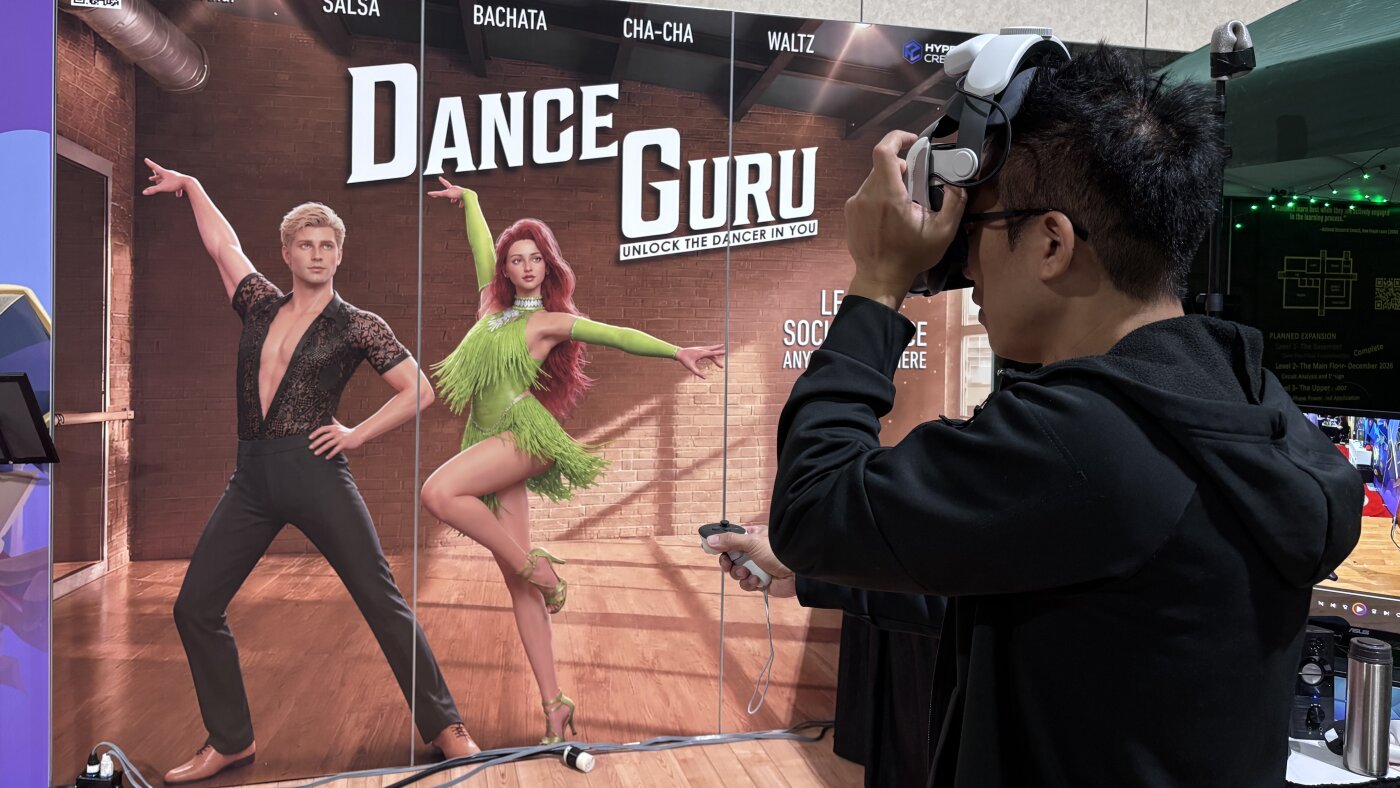
Entrepreneur David Huang tests out a VR headset while conducting demonstrations of the social dance lesson app Dance Guru at the Augmented World Expo in Long Beach, Calif., June 17, 2026.
Chloe Veltman/NPR
hide caption
toggle caption
Chloe Veltman/NPR
Wedding season is in full swing, bringing with it a familiar sense of dread for anyone who fears the dance floor.
But relief may finally be at hand with the help of a new app, Dance Guru, and a virtual reality (VR) headset.
The social dance instruction app transports users to a spacious, digital dance studio. Waiting inside is a computer-generated coach: a handsome, male avatar wearing a shirt open to his navel. He speaks with a slightly gravelly English accent.
“Watch me now,” he instructs at the start of a waltz lesson — which NPR tried out at the Augmented World Expo in Long Beach, Calif., an annual conference showcasing the latest developments in virtual and augmented reality.
The avatar then demonstrates a basic box step.

From there, the lesson becomes interactive. The coach tells the user to hold his hand while an electric pinging sound tracks the student’s foot placement.
“One, two, three, four, five, six,” the virtual teacher counts down.
When the user stumbles, he remains remarkably patient. “Do not worry, foundations take time. Let’s try that again. Work on grounding your steps more intentionally.”
Solving the beginner’s dilemma
Dance Guru creator David Huang said he came up with the idea for the app a couple of years ago out of frustration.
“I always wanted to learn to dance and I was always terrible at it,” Huang said. “And I always ended up stopping midway through the lessons.”
He soon realized that many beginners hit the exact same roadblocks.

“Private lessons are too expensive, and you feel like you’re always forgetting the dance steps,” Huang said. “You cannot find a partner to dance with. So I figured maybe I can create something like this.”
The Dance Guru platform currently offers tutorials in salsa, bachata, waltz, and cha-cha, in both lead and follow modes. To make the digital instruction feel authentic, Huang used motion-capture technology to record the movements of real-life dance teachers — with their permission.
Building on the legacy of online tutorials and video games
Dance Guru belongs to a small but growing wave of apps using VR to demystify social dance. At a nearby booth, conference attendee Victor Chen is testing out a competing app called Trip the Light. It currently offers salsa lessons, as well as freestyle options, where a user can dance with a partner without having to learn specific steps.

Trip the Light’s booth at the Augmented World Expo included posters of the app’s virtual instructors. Real-life performers, who gave Trip the Light permission to motion capture their movements, were used as a basis for these avatars.
Chloe Veltman/NPR
hide caption
toggle caption
Chloe Veltman/NPR
“A lot of times when you’re trying to learn a choreography, it’s watching a YouTube video and you have to pause it, rewind, and play it,” Chen said. “If you were to have a virtual avatar dancing in front of you and correcting for any parts that you missed, it might be a lot easier.”
Interactive video games like Dance Dance Revolution and Just Dance, and YouTube tutorials have been helping people improve their skills in private for years. But those games are mostly aimed at solo players. Unlike the new generation of immersive VR apps, they cannot simulate the mechanics or confidence required for partner dancing on a live dance floor.
The reality check
But this kind of app won’t work for every dancer.
“Everyone learns a little bit differently. And so unless you have a game that has lots of different ways of teaching, you’re going to have things that work for some people and don’t work for others,” said Ariana Katana, a trained contemporary dancer and dance content creator who’s active on YouTube, Twitch and other platforms. “Also, it’s hard to dance with a headset on.”
And then there’s the issue of not being able to physically feel a virtual partner’s hand or shoulder while dancing with them. Patrick Ascolese, the creator of Trip the Light, said the experience could become more tactile in the future. “Haptic suits and wearables will be coming, but I think we’re a little away from that,” he said.
Ascolese said even with their limitations, immersive tools like Trip the Light have immense potential as judgment-free training grounds — giving reluctant dancers the baseline confidence they need to eventually step onto the dance floor with real partners in the real world, including at weddings.
“Just like anything else, practice makes perfect,” said Ascolese. “So the more time you spend in VR with a virtual partner, it works towards helping you get over that social hurdle. We are teaching you the moves that you have to do in order to go out and have fun.”
Jennifer Vanasco edited the broadcast and digital versions of this story. Chloee Weiner mixed the audio.




-

 Virginia53 seconds ago
Southwest, Central Virginia Weather | 6 p.m. – July 11, 2026
-

 Washington4 minutes ago
Hulking four-star Arizona OL commits to Cal over Washington football
-

 Wisconsin9 minutes ago
Who should be Central Wisconsin’s girls soccer MVP for 2026? VOTE
-

 West Virginia16 minutes ago
West Virginia man sentenced for quadruple murder
-

 Wyoming19 minutes ago
Wyoming health officials confirm second measles case, possible exposure at Grand Teton Park
-

 Crypto24 minutes ago
Ripple Swell 2026 Nears With Expanded Event Bringing Together Finance and XRP Ecosystem
-

 Finance30 minutes ago
Trump’s Financial Disclosure Revealed a $1.67 Million Micron Stock Stake | The Motley Fool
-

 Fitness34 minutes ago
Lawlor: It’s a fitness exercise, but there were lots of positives – Fleetwood Town Football Club

