Lifestyle
Proenza Schouler Designers Depart in Further Fashion World Tumult


The very messy game of designer musical chairs that roiled the fashion world at the end of 2024 is continuing into 2025.
On Wednesday, Proenza Schouler, a New York brand that was once considered the future of fashion in the city, announced that its designers, Jack McCollough and Lazaro Hernandez, would be stepping down from the company, which they founded back in 2002. They will remain on the board and will continue to be minority shareholders. A search is underway for their replacements.
No reason was given for the decision, other than that the time simply felt “right,” and no statement was made about what the designers would do next. Mr. McCollough and Mr. Hernandez reportedly began thinking about exploring other opportunities after the company’s 20th anniversary in 2022, and their new chief executive, Shira Suveyke Snyder, was brought in last October in part to manage the transition.
Still, a designer leaving a house he or she founded when it is relatively stable and they are relatively young (Mr. Hernandez and Mr. McCollough are 46) is almost unheard-of, unless there has been a falling out with a backer or the designer is planning to take another job.
It is possible Mr. McCollough and Mr. Hernandez are setting a new precedent when it comes to career paths. But they are also widely rumored to be under consideration to be the new designers of Loewe, the Spanish brand owned by LVMH, replacing Jonathan Anderson, who has been said for months to be heading to Dior. (A spokesman declined to comment on the move.)
It should be noted that Mr. Anderson has not officially left Loewe, nor has Maria Grazia Chiuri, the creative director of Dior women’s wear whom he would theoretically replace, left Dior. Also, Kim Jones, the creative director of Dior men’s wear, recently re-signed his contract with the brand.
LVMH, which once explored acquiring Proenza Schouler, has neither confirmed nor denied the various anonymous reports suggesting all the above, even as the rumors have spread across social media. Neither Loewe nor Proenza Schouler nor JW Anderson, Mr. Anderson’s namesake brand, are on the coming fashion show schedules in New York, Paris or London.
According to headhunters, major luxury groups are now asking that designers who take on positions at fashion houses in their group stop doing double duty with their own labels. For example, Veronica Leoni, the new designer at Calvin Klein, put her Quira collection on hold when she took the bigger job.
All of which has further fueled the speculation about who is going where.
The only thing that is certain is that despite Proenza Schouler’s being synonymous with Mr. McCollough and Mr. Hernandez, the designers intend for it to go on without them. It is not being closed or suspended, and the opening of a second store in New York in February is going ahead. (The February woman’s collection will be released digitally; the fate of a planned men’s collection is to be determined.)
What Proenza Schouler, which was named after Mr. McCollough and Mr. Hernandez’s mothers, will look like without its founders is less clear.
Other than being known for a coolly urban art gallerist vibe and a hit bag (the PS1), and despite Mr. McCollough and Mr. Hernandez’s being highly mediagenic, winning five Council of Fashion Designers of America awards and being championed by Anna Wintour, Proenza Schouler never really fulfilled the promise of becoming the Next Great American Brand.
Within the industry, the designers are still known as “the Proenza boys,” which reflects the sense that they have remained designers on the verge. Two collections shown in Paris during the couture shows were tepidly received, and the company has struggled with a revolving cast of investors. (Currently Proenza Schouler is majority-owned by Mudrick Capital.)
The Proenza job opening now joins those at Fendi, Maison Margiela and Helmut Lang and will further reshape a fashion world in the midst of extraordinary designer change. Eight creative directors are making their debuts this year as fashion houses seek to offer something new in the face of a global slowdown in luxury spending. The dominoes are not done falling.



A gold-colored item embossed with the word “President” sits on the Resolute desk in the Oval Office of the White House on Nov. 10, 2025.
Jacquelyn Martin/AP
hide caption
toggle caption
Jacquelyn Martin/AP
The New York Times journalist Jonathan Swan has spent the past 11 years covering President Trump through three political campaigns, his first, and now second, term in office and the ongoing war with Iran. Swan says aside from the COVID-19 pandemic, he can’t remember a time where Trump looked “as stuck as he looks right now.”
“It’s pretty clear he realizes that this war [with Iran] has not gone well, has not played out the way that Netanyahu pitched him or that Trump himself thought [it] would play out,” Swan says. “Trump is someone who is naturally given to hubris, but I think we saw a very extreme version of that with this war.”
Swan and his co-author Maggie Haberman spoke with more than 1,000 sources for their new book, Regime Change: Inside the Imperial Presidency of Donald Trump. The book paints a picture of an unrestrained president remaking the American government and its international relations in profound ways.

Swan notes that the president, who sat for an interview for the book, has been particularly fixated on becoming a “great man of history” during his second term. During one interview, Trump showed Swan and Haberman a document that compared him to notorious historical figures like Mao, Stalin, Hitler, Attila the Hun and Genghis Khan.
“[The list had] nothing to do with morality, all just about pure power projection. And Trump was relishing being in their company,” Swan says. “Maggie and I talked about it afterwards, and it really occurred to us that when you look at it through that lens, his second term makes a lot more sense.”
Swan says the president’s fixation on power is reflected in his decisions to go to war in Iran and implement regime change in Venezuela. But he also sees it manifested in Trump’s White House decor, which leans on what Swan calls the president’s “inner Louis XIV” style.
“He’s gilded almost every corner of the Oval Office,” Sway says. “The history of the Oval Office in the White House has been of modesty when it comes to design and decoration, reflecting the fact that America is a republic, not a monarchy. Trump has no use for that history.”
In a post on Truth Social, Trump referred to Regime Change as “mostly made up, Fake News, largely fiction, as have been most of the things [Haberman] has written about me for so many years.”
Interview highlights

On how Trump’s second term differs from his first
This term is unrecognizable from term one. And I still think a lot of people view [this] administration and government through the lens of the first term. It just couldn’t be more different. One of the ways in which it’s different is the team around him.
I remember in term one covering Trump, and you would have so many conversations with senior officials, including senior national security officials, and the overwhelming impression that you would receive from talking to these people was, A, they thought they were working for someone who was dangerous. And they saw their own roles as protecting the country and the world from the person that they were ostensibly working for. Those types of people don’t exist anymore in this administration. …
At a senior level, it’s really a group of people who believe in him, are loyal to him, in some cases went through the campaign with him. Many of them were radicalized on the campaign through the investigations and the efforts to prosecute Donald Trump. Many of them received some subpoenas themselves and viewed the stakes of the 2024 election as not so much about policy, but about staying out of prison.
So that’s the mindset of Trump and his inner circle. And it’s created a situation where there’s very little friction between a Donald Trump idea that might’ve just leapt straight from his internal monologue out of his mouth, with no filter, to an effort to make it actual American policy and execution.
On Trump’s meeting style
Meetings have no beginning, middle or end. There’s almost no delineation. And what often ends up happening is it’s essentially one meeting that just rolls throughout the afternoon with different people joining and leaving. And Trump [is] engaged or not engaged, people who have no business being in the meeting sometimes joining, whether it’s a pro wrestler, or a crypto investor, or foreign somebody from a golf monarchy, or a CEO. …
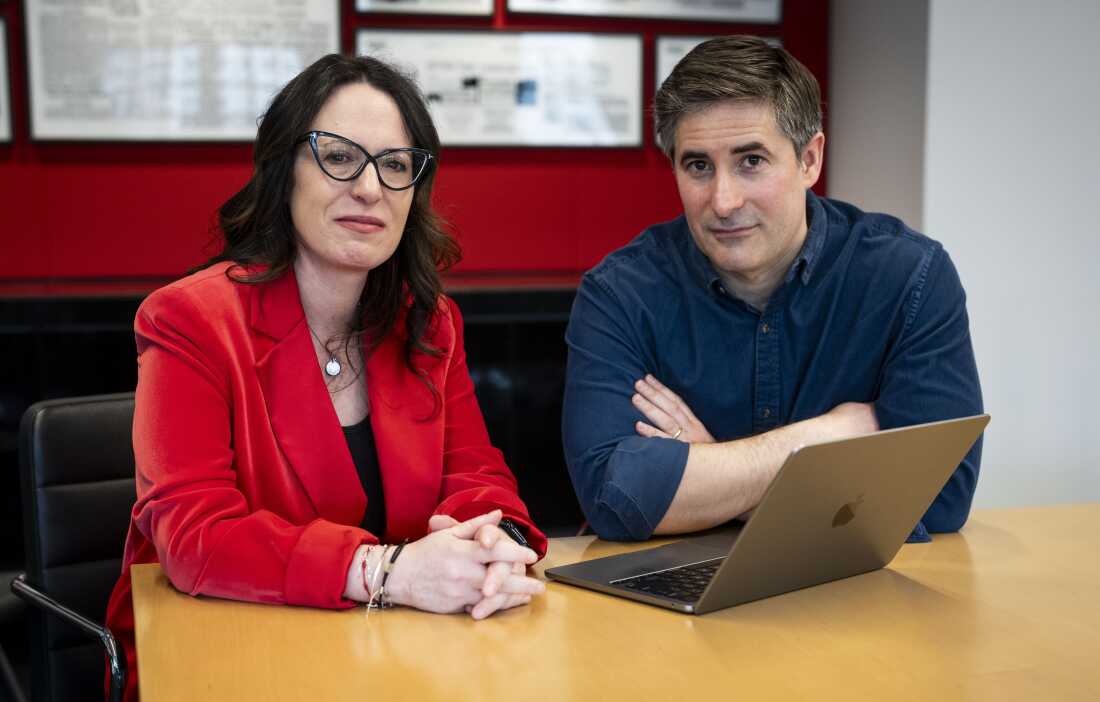
The New York Times journalists Maggie Haberman and Jonathan Swan are the authors of Regime Change: Inside the Imperial Presidency of Donald Trump.
Doug Mills/The New York Times
hide caption
toggle caption
Doug Mills/The New York Times
The conversations are non-linear. Trump will get fascinated about one thing that has nothing to do with the topic and that can derail a meeting. We have a scene in the book where he’s having a conversation, a very small meeting, which is highly classified about a defense program, and this guy comes in, just walks into the Oval, salt of the earth, kind of country looking guy, and he’s holding stone samples for the Rose Garden … and the two go off and sort of start conferring, looking out the window, talking about the paving and the stone and this and that, gets on the phone with another contractor. And before time’s up, the meeting’s ended, they haven’t actually resolved the issue they were going to resolve.
On the higher level of secrecy in Trump’s second term
When there are issues that Trump really cares about, or his team wants to keep secret, they can be incredibly secretive, to the point of great frustration across the government. And when it comes to the weightiest issues like the planning of going to war with Iran, we found that very, very senior people in the government were, A, completely cut out of the loop and, B, had no idea about what was being discussed in the Oval Office.
On Trump’s focus on decorating the White House

I traveled with President Trump to the Middle East, palace after palace. And it was really instructive to watch him with these Middle Eastern rulers in Saudi Arabia and Qatar and the United Emirates. He was just in a state of absolute pleasure, going from one palace to the next, admiring the marble, looking at most rarefied displays of state wealth on Earth. And that’s essentially what he’s trying to create at the White House. … He’s building this grand ballroom. He seemed to almost be competing with Melania as to who had had the better bedroom. They have separate bedrooms and he was taking objects that she had placed in the center hall of the residence and putting them in his bedroom.
YouTube
On the challenge of interviewing Trump
An interview with Trump requires an enormous amount of preparation if you want to hope to come out of it with any level of success. He’s a really difficult interview… He’s an overwhelming presence and you are confronted with a sort of tidal wave of words. Many of the words and the sentences are detached from reality or completely false. And you have to make judgments in real time about what you let go. You can’t fact-check everything. You just can’t. You can pick your moments.
I see my role in every interview as the representative of the people in that chair. You’re the one who’s lucky enough to be sitting in that chair interviewing the president of the United States. What would regular people want to know and want me to do in that situation? And I think that when you’re interviewing a president of the United States, you want to find the balance between letting them explain themselves and not cutting in every two seconds, but finding moments that are really important to puncture the bubble. Trump creates an unreality bubble. It’s the way he operates. … Tucker Carlson actually described it publicly as like being under a spell and I certainly wouldn’t ascribe a supernatural dimension to it, but I know what he’s getting at.
Thea Chaloner and Susan Nyakundi produced and edited this interview for broadcast. Bridget Bentz, Molly Seavy-Nesper and Meghan Sullivan adapted it for the web.

The real spectrum of housing insecurity
Annika McFarlane/Getty Images/Getty Images
hide caption
toggle caption
Annika McFarlane/Getty Images/Getty Images
Who counts as homeless in America?
If you ask the Department of Housing and Urban Development, around 750,000 people are homeless in America. If you ask the Department of Education, that number shoots up into the millions. What does this discrepancy tell us? And how do our cultural ideas about homelessness shape who we see as homeless, and who gets help? To find out, Brittany talks with Dr. Margot Kushel, Director at the UCSF Benioff Homelessness and Housing Initiative, and Dr. Molly Richard, assistant professor in the Department of Public Health at the University of Rhode Island’s College of Health Sciences.
Want more deep dives on cultural taboos? Check out these episodes:
The truth about men on the ‘down low’
Why can’t we be normal about polyamory?
Support Public Media. Join NPR Plus.
Follow Brittany on Instagram: @bmluse
For handpicked podcast recommendations every week, subscribe to NPR’s Pod Club newsletter at npr.org/podclub.
This episode was produced by Corey Antonio Rose. It was edited by Neena Pathak. We had engineering support from Josephine Nyounai. Our Supervising Producer is Cher Vincent. Our Executive Producer is Barton Girdwood. Our VP of Programming is Yolanda Sangweni.
Lifestyle
They just completed all of L.A. Times’ 101 Best California Experiences — and we’ve got questions!

By December of 2023, Paul Preston realized that his girlfriend Susan Huckle was a big fan of road trips and lists. So for Christmas, he gave her L.A. Times’ ”101 Best California Experiences” zine, a traveler’s bucket list highlighting my top destinations throughout my four decades of traveling the state.
The gift, I’m delighted to hear, was a hit.
Preston and Huckle went through it and checked off locations they’d seen already. Then they hit the road.
And now, after two and a half years of roaming the state between work assignments, they’re back to report that they’ve covered all 101 locations on that list. Though the two have also traveled beyond state lines, the quest to cover California “totally informed our lives for the last two or three years,” said Huckle, who sent me a note of thanks after ticking the last box.
After the note arrived, I was eager to call them and learn more. I caught the couple, of course, in the middle of a day trip.
Susan Huckle and Paul Preston set out to visit every spot on the L.A. Times’ 2023 list of “101 Best California Experiences.” Along the way, they got married in Yosemite Valley.
(Nick Wuthrich)
“We’re out exploring,” Preston said. “So you’re getting what we’re about.”
They’re also now married. That happened last July in Yosemite Valley, which, yes, was on the list.
Huckle, 41, an actress, a host on “L.A. This Week” on Channel 35, a Universal Studios performer and an author, grew up in Santa Maria on California’s Central Coast.
Preston, 56, is also an actor. He leads movie location tours and hosts podcasts, movie trivia nights and special events. He grew up and went to college on the East Coast, so he had fewer California miles under his belt when the couple met in 2020.
Their California 101 travels began in early 2024 with a trip to Paso Robles, where they saw the green slopes along Highway 46, Morro Rock and the elephant seals at Piedras Blancas near Hearst Castle.
“And then,” Preston said, “we just kept going.”
Some of their most satisfying stops, the two agreed, were places they hadn’t heard of, such as Orange Works in the Central Valley town of Strathmore and Angel Island State Park, sometimes known as the Ellis Island of the West. Huckle called Angel Island “a marriage of natural beauty with great, powerful, historic information.”
By early this year, there were only a few destinations left to check.
In April, they did the Indian Canyons and Sunnylands estate near Palm Springs, the Integratron near Joshua Tree and the Cheech Marin Center for Chicano Art & Culture in Riverside. In June, they rafted the South Fork of the American River, along with stops in Old Sacramento and, last of all, Columbia State Historic Park. Then they made their own favorites lists.
Susan Huckle’s top 10:
Yosemite Valley
Badwater Basin
Mammoth Mountain
Angel Island State Park
Cheech Marin Center
Joshua Tree National Park
American River South Fork
The Marshall Store on Tomales Bay
Santa Cruz Island
Sunnylands
Paul Preston’s top 10:
Yosemite Valley
Hollywood Bowl
Griffith Observatory
Catalina
Mammoth Mountain
American River South Fork
Erick Schats’ Bakery in Bishop
Huntington Library and Gardens
Palm Springs Aerial Tramway
Balboa Park, San Diego
Now that they’ve seen so much of the state, I had questions. For one, which spots not on the list would they have included?
Alcatraz, they agreed. Also, as an admirer of redwoods, Preston liked Calaveras Big Trees State Park. As an avid cyclist, Huckle liked the 22-mile Marvin Braude Bike Trail from Torrance to Pacific Palisades.
And was anything on the list a disappointment?
“The Carmel Mission,” Huckle said quickly. “It’s beautiful and the missions are an important part of California history.” But she said the mission’s account of its own history seemed “whitewashed,” saying little about the Native loss and trauma that historians are increasingly recognizing in accounts of the missions.
Said Huckle: “I was like, ‘C’mon guys, nobody really thinks this any more, right?’”
Now that they’re done with the Times’ “101 Best California Experiences,” what what will shape their next trips?
They have a list for that. Huckle picked up an L.A. guide, Danny Jensen’s “Secret Los Angeles,” and the couple plans to start where the book does, with the Triforium, a many-colored sculpture that went up outside City Hall in 1975 (and once featured music).
After that? Maybe the Faces of Elysian Valley, a traffic circle sculpture that Huckle said “looks like Easter Island in the middle of Cypress Park.”
That will leave only about 138 more destinations in the book to cover.
If anybody can do it, it’s these two.
-

 Technology2 minutes ago
Google is better at playing the AI regulations game
-

 World8 minutes ago
Iran calls on Houthis to prepare to cut off Red Sea gateway — can the terror group do it?
-

 Politics14 minutes ago
Todd Blanche roasts Adam Schiff in heated hearing: ‘You’re a lawyer, you know the rules’
-

 Health20 minutes ago
Game-changing cholesterol pill wins FDA approval after cutting LDL nearly 60%
-

 Sports26 minutes ago
2026 AL, NL MVP Odds: Ohtani Favored; Alvarez Holding Off Challengers
-

 Technology32 minutes ago
Tesla helped save a driver. Is your car ready?
-
 Business38 minutes ago
SpaceX stock erases all its gains and slides below IPO price in intraday trading
-
 Entertainment44 minutes ago
Contributor: Hollywood will stop fueling racism when audiences demand better

