Lifestyle
People in prison explain what music means to them — and how they access it


Many states have introduced tablets into prisons, allowing users to do things like listen to music and send messages. Several incarcerated people told NPR that while the devices aren’t perfect, the ability to stream music has been a game-changer.
Sarah Gonzales for NPR
hide caption
toggle caption
Sarah Gonzales for NPR

Many states have introduced tablets into prisons, allowing users to do things like listen to music and send messages. Several incarcerated people told NPR that while the devices aren’t perfect, the ability to stream music has been a game-changer.
Sarah Gonzales for NPR
Joe Garcia first heard about Taylor Swift in the late 2000’s, while he was in the Los Angeles County jail awaiting trial on murder charges. He initially wasn’t impressed with her music.
Now, multiple albums and prison transfers later, he credits Swift’s music with helping him get through his life sentence.
“Taylor Swift’s voice, the fairytale romance of it all, takes me back to a much more idyllic time and kind of keeps me focused on recapturing that type of sentiment as I go forward in life,” said Garcia, who was convicted of murder and is eligible for a parole hearing, which is tentatively scheduled for April.
Garcia — who counts “White Horse,” “The Man” and “…Ready for it?” among his top five — detailed his journey into Swiftdom in an essay that was published in the New Yorker last fall in collaboration with the Prison Journalism Project (PJP), a nonprofit organization that trains and publishes incarcerated writers.
The piece describes the impact of Swift’s music on his life — including his rekindled relationship with the woman he describes as his “sweetheart” — and the often-complicated logistics of accessing music behind bars over the years.
It has since been shared widely on social media, where many users wrote that it brought them to tears.
Garcia, who is now at High Desert State Prison in California, told NPR that even though he wasn’t able to follow the reaction in real time, he’s been moved to hear that his essay (one of many he’s published through PJP) resonated with so many people.
“In a lot of ways, I’m a normal human being with all kinds of emotions and heartache and depression … just like anybody who’s not in prison,” he told Morning Edition in a phone interview. “And so I’m always trying to figure out a way to communicate that type of empathy, I guess, and get people on the outside to understand what it’s like in here.”
Joe Garcia wrote about his experience listening to Taylor Swift in prison in a New Yorker essay that went viral in September.
Courtesy of Prison Journalism Project and Joe Garcia
hide caption
toggle caption
Courtesy of Prison Journalism Project and Joe Garcia
Garcia hoped that centering Swift, one of the most beloved and influential musicians working today, would be a relatable way to get that point across.
And while he can (and did) speak at length about his favorite eras, his piece shines a spotlight on a much broader topic: the mechanics, and meaning, of music in prison.
How people get access to music in prison
Garcia’s story illustrates some of the challenges that incarcerated people have faced in accessing music — and how new technology has made it possible for many to listen to songs and artists of their choice, some for the first time in years.
His essay details how he navigated ever-changing sets of rules and social dynamics to listen to music in various prisons over more than a decade.
That journey included shared CD players, a borrowed pocket radio, a reconfigured “old-school boombox,” an MP3 player paid for by his family and, most recently, a tablet.
Dozens of states have made tablets available — either for free or for sale — to prisoners in recent years, starting with Colorado in 2016. Almost all people incarcerated in California, where Garcia resides, now have them. And the companies behind the tablets said they had roughly one million users nationwide as of late last year.
“We are given a free tablet that is assigned to us by the state,” Garcia explained. “And then there’s a whole bunch of services that are either free or we have to pay for.”
Users can pay money to send messages, make video calls, play games, download books and stream music, among other functions.
There are still limits around consuming music, as incarcerated people told NPR. Songs cost money and tablets are in many cases only allowed during certain hours of the day. And the streaming services they come with don’t all let users do things like play an artist’s entire discography or curate a personalized playlist — as opposed to saving existing playlists.
Even so, they say, the technology makes a big difference in their day-to-day lives.
“Music is just a huge, tremendous factor in here,” Garcia said. “All throughout my everyday day to day, you see guys walking around with headphones on, with earbuds in. They’ll be singing along to whatever they’re listening to, they’ll be reciting their own type of rap lyrics, they’ll be in circles comparing things.”
Not everyone is listening to the same songs, of course.
A Spotify playlist of the dozens of songs PJP writers said meant the most to them in 2023 includes artists as varied as Smokey Robinson, Carrie Underwood, Kendrick Lamar, John Lennon and Miley Cyrus (and also Swift).
Music as a means of relief and connection
Several people at prisons across the country told NPR that music makes them feel connected, both to others and the outside world.
Jeffrey Shockley, who is 24 years into serving a life sentence in Pennsylvania for murder, says music offers some relief from the “mundane monotony” of prison. That’s especially true when you’re not limited by what radio stations are nearby and which songs they decide to play, he adds.
Jeffrey Shockley, who is serving a life sentence in Pennsylvania, says he listens to everything from Beethoven to Eminem.
Courtesy of Prison Journalism Project and Jeffrey Shockley
hide caption
toggle caption
Courtesy of Prison Journalism Project and Jeffrey Shockley
Shockley estimates he has more than a thousand songs on his tablet, ranging from Christian music to classical to Eminem. He says being able to choose what he wants to hear throughout the day — like reggae on a happy morning or Beethoven before bed — has a huge impact on his mood.
“It’s being able to have that ability to reach out and hear something different that will catapult you out of whatever depths of hell you may be in in that moment, figuratively speaking,” he added.
Plus, Shockley said, listening to different genres gives him more to talk about with different types of people.
Garcia similarly says music is one of the few mediums — along with sports and news — that people in prison can share, regardless of their race or background. He says music helps him connect with others, even as someone who was admittedly somewhat antisocial before prison.
“Music is kind of one facet of me trying to open my heart and really appreciate people for who they are,” he added. “And I really do see that a lot in the other incarcerated guys … We end up using it as a platform to come together instead of being divisive.”
Garcia said music not only helps him connect with other people, but also with the outside world. He’s spent his whole life paying attention to new music — which is why he’s now listening to Billie Eilish and Olivia Rodrigo at age 54.
“I don’t want to lose track of what the world is like,” he added.
Reflecting on the past and looking to the future
Music can bring back powerful memories and provide a source of hope for the future, incarcerated people say.
Shockley, 61, says hearing the music his grandmother raised him on, like gospel and Aretha Franklin, reminds him both of his family and simpler times.
“[Like] when you’re a young boy and you’re doing things and running around, playing in the backyard in the green grass,” he explained. “And now you’re sitting in a concrete jungle and hoping for a breath of fresh air .. It’s like a tranquil moment that some people may take for granted because when you don’t have it, you miss it.”
That music, he adds, inspires him to try to give back and uplift others as he was taught — but admittedly struggled to do — when he was younger.
“I don’t want to be who I was,” he said. “So I’m going to be who I can be or should have been.”
KC Johnson, who is incarcerated in North Carolina, described their tablet as a “lifesaver.”
They got it in 2021, just two months before their mom died. The two shared a love of blues, and Johnson was especially grateful to be able to listen to music that reminded them of her.
KC Johnson, whose release date is in three years, looks forward to going to concerts for the first time in over two decades.
Courtesy of Prison Journalism Project and KC Johnson
hide caption
toggle caption
Courtesy of Prison Journalism Project and KC Johnson
Johnson, who was convicted of robbery and second-degree murder, said music — especially concerts — was a huge part of their life before they went to prison some 17 years ago.
Now they listen to music pretty much all day: on their tablet while studying, with a portable radio while running or over the speakers at their work-release job at a local food bank (notably the only time they don’t need headphones).
“That’s where all my money goes,” said Johnson, 45. “It’s for my tablet, for my music.”
Johnson’s projected release date is in late 2026, at which point they are planning to move into a halfway house. They are especially excited that the facility allows MP3 players, which will hopefully mean easier access to artists on demand, including on runs.
Johnson is also looking forward to seeing live music again, for the first time in over two decades. Going to a festival is at the top of their to-do list. They say they’ve always loved the positive energy at concerts, where everyone is there for the same reason and getting along.
“I just want to get back in that atmosphere,” Johnson said. “So much has changed in the world, but I feel like going to something like that, it will still be like it was when I was younger — or I hope it is.”
Johnson sees music as a way to reconnect with their past self — and expects the same will be true even once they’re out of prison.
“The songs that I’ve listened to and hear will remind me of my strength and endurance and everything that got me through,” they said. “It’s a powerful tool, music is.”
The broadcast piece was produced by Mansee Khurana.


In central London’s Waterloo Place, a life-size statue that emerged overnight in late April has been creating a stir. When I visited a few weeks after it was erected, local authorities had already set up protective barriers around it.
The installation — signed by the famed street artist Banksy — depicts a man in a suit hoisting a flag as he strides over a precipice. As he marches on, the flag blows backward to cover his face, leaving him unaware he’s only a step away from a perilous fall.
Set among grand monuments celebrating Britain’s past, the “flag man” takes on a particular visual irony at a time when the country — and much of the world — is debating its path forward.
Like many viewers there, I found myself wondering whether this statue is Banksy’s warning about the consequences of uncritical nationalism, or simply a reflection on human shortsightedness. Or, perhaps, it is just prompting us to ponder a broader question: What happens when devotion to a symbol prevents us from seeing what lies ahead?
Whatever the message, the work feels remarkably attuned to the current moment.
For more Far-Flung Postcards, click here.
Lifestyle
Wait, it’s a candle? Her beeswax fruit and veggie ones look so real, you’ll want to take a bite
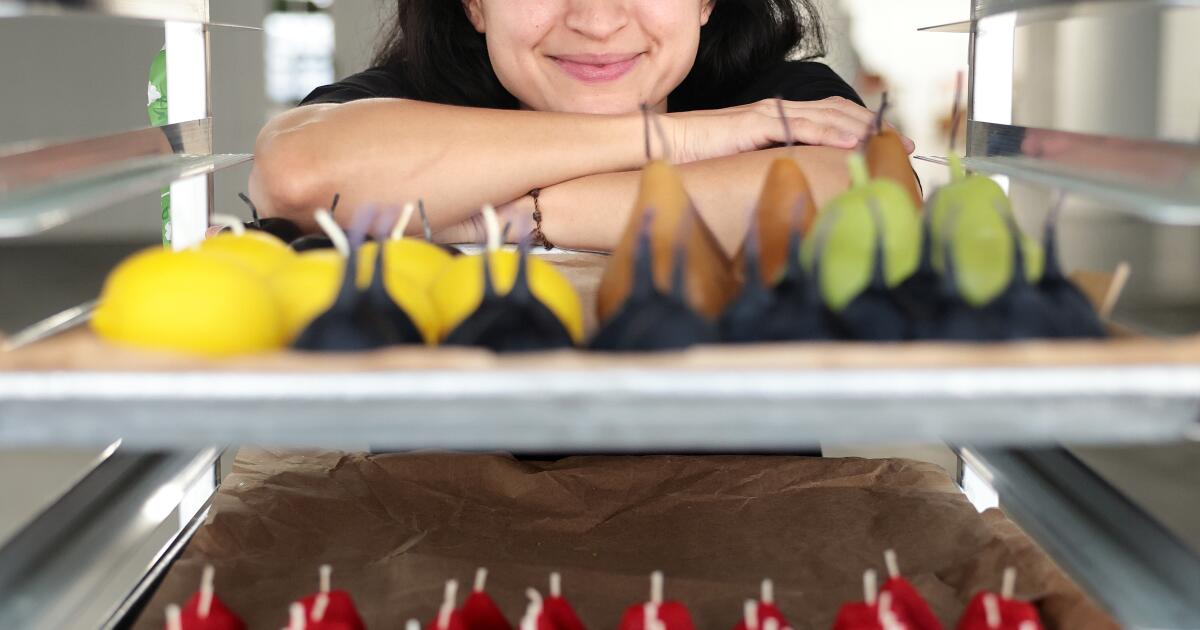
Jessica Gonzalez hustles behind her booth at the recent Renegade Craft Fair, frantically ringing up sales, answering questions and packaging her beeswax candles.
It’s hot on the grounds of the Los Angeles State Historic Park in April, but 35-year-old Gonzalez and her fiancé, Jordan Colindres, keep their cool as a crowd gathers to admire her Happy Organics candle collection, a homage to her family’s produce company in the Central Valley that looks like real fruits and vegetables.
“I love doing in-person events because it’s so fun to see people’s reactions,” she said a few months later. “It makes me feel good to see other people finding joy in my candles. They often say, ‘Oh, that’s really funny.’ And it is funny to have a cherry candle on top of your birthday cake.”

3

1. A staff member pulls a beeswax corn candle, $26, out of its mold at Happy Organics’ studio in downtown Los Angeles. 2. Each Beeswax Mixed Berry Birthday Candles set is cast from real mixed berries — strawberries, raspberries, blackberries, blueberries and cherries. A set of 10 is $30. 3. Bartlett green pears and heirloom tomatoes, $24 to $40.
Judging by the smiles and charmed looks on shoppers’ faces, her produce-inspired candles are less about illuminating rooms and more about sharing the joy she sought when she first started the company in 2018.
In this series, we highlight independent makers and artists, from glassblowers to fiber artists, who are creating original products in and around Los Angeles.
But then, it’s hard not to smile at the playfully elegant Bosc pears, puckered mandarins and green-and-purple asparagus taper candles which range in price from $12 to $40. Some are molded into corn on the cob, celery and rhubarb shapes. Others are made to look like mushrooms, figs, tomatoes and snap peas. The most popular are the small birthday candles shaped like raspberries, cherries and blackberries, packed in molded-pulp baskets just like you’d find at the grocery store or farmers market.

-
Share via
Gonzalez didn’t start out as a designer. The youngest of nine children, she was born in 1991 in Salinas and later moved to Merced, where she grew up on a 10-acre farm. She studied computer science at Mills College, then worked in tech consulting in the Bay Area and eventually became the CTO of an ag-tech company. When her mother, Angela, became ill in 2016, she returned to Merced to be with her family.
When her mom died suddenly soon after she moved home, Gonzalez left the tech industry. “I wasn’t connected with what I was doing,” she said. “I wanted to find something more meaningful; something I loved. I didn’t want my ego to keep me stuck in what I studied in college. I decided to let myself try new hobbies and passions and look for joy again.”
After her mother’s death, she began working with her father, Salvador, and her uncles at the family’s apiary, where they managed more than 30 hives. (Her grandfather was also a beekeeper in Michoacán, Mexico.) Soon, she began selling their raw honey at local farmers markets. In a heartbreaking turn, her father was diagnosed with cancer a year later, so she started making cannabis-infused honey, balms and chocolates to help ease his pain.
When she saw that the beeswax candles, which last significantly longer than paraffin candles, were selling faster than the honey, she decided to focus on making candles from the leftovers from her uncles’ hives.
She was only 25, but it was a turning point. “It was one of those moments where I felt like I needed to change my path,” she said. “I needed to change everything in my life.”

Jessica Gonzalez and her father Salvador on their family farm in Merced. (Gonzalez family)

Gonzalez at Happy Organics’ studio in downtown Los Angeles. (Christina House / Los Angeles Times)
When her father died in 2018, she inherited his bees and started Happy Organics, although she hadn’t planned on starting a business. After experiencing so much loss, making candles became a kind of therapy. “It felt great to work with my hands again, something I thought I’d never have time for,” she said.
Her oldest sister, Sonia Gonzalez, said Gonzalez reminds her a lot of their father, who reinvented himself many times over the years.


The nopal cactus is cast from a real nopal and hand-poured in 100% pure beeswax in the Los Angeles studio.
“He grew up as a village boy in the rural mountains of Michoacán, Mexico, and went on to work in restaurants, cut down Christmas trees and pick strawberries and broccoli in the fields of Salinas,” she wrote in an email. “From there, he started selling produce door-to-door, then at flea markets and eventually built his own produce distribution business from the ground up. As the youngest of nine kids from a working-class family, Jessica’s always been incredibly resourceful, responsible, and amazing at reinventing herself.”
Like a lot of millennials, Gonzalez taught herself how to make candles by watching YouTube videos. She started with hand-dipped tapers, working in the garage on the farm that helped her feel safe and connected to her parents. “It was a really nice environment to try something new and creative,” she said.
Inspired by her family’s produce, she cast real corn, strawberries and cherries in plaster, then made a silicone mold to create copies. Even when using the same mold, color can vary from batch to batch, and how it cools also affects the result. “That’s just how handmade things are,” she said. “There’s always some variation.”

Cherry molds make cherry candles at Happy Organics’ studio in downtown Los Angeles.

A variety of fruit and veggie candles.
When she moved to Los Angeles in 2023 to be with Colindres, her business took off. “L.A. is a great place to grow,” she said. “There’s so much opportunity here. When I go to a farmers market, I never know who I’ll meet.”
She sold her candles in person at craft shows, the Hollywood Farmers’ Market and most recently, during a residency at the P.F. Candle Co. showroom in Echo Park.

2

3

1. A staff member trims the wicks on a pair of carrot birthday candles, $22. 2. Gonzalez passes by shelves of candles at Happy Organics’ studio in downtown Los Angeles. 3. Asparagus taper candles, $30.
“I have a lot of respect for her as a fellow candle maker (making molds is not easy), but getting to know her story more and how her choice of foods and wax is reflective of her family’s history gave it so much meaning,” P.F. Candle Co. founder and creative director Kristen Pumphrey said in an email. “It’s been a tough couple of years for L.A. businesses, so we gotta stick together — there’s this wonderful sense of community hosting a local brand that’s so passionate about their work.”
As her business has expanded, her products are now available at Terrain, Joan’s on Third and the MoMA Design Store in addition to her website. She has also had to source beeswax from other vendors across the country to keep up with demand.
Kimberly Curtis, owner of Hide & Seek Vintage in Studio City, said Gonzalez’s strawberry and cherry birthday candles “flew off the shelves last year” during the holidays. “Our customers love them,” she added.

Gonzalez holds a cabbage candle.
Still, Gonzalez stays connected to her Central Valley roots. Everything she and her small team make in downtown Los Angeles is handmade and “takes time,” she said, describing the steps involved in crafting quality candles. Right now, her favorite is the Nopal Cactus candle, which she made using a clipping from an employee’s yard. While others help her with production, wholesale management and packaging, she focuses on sales, content and all-new product development.
When asked if she has advice for others who want to start their own business, Gonzalez admits she sometimes feels overwhelmed.

In 2013, Gonzalez and her family gathered at their Merced ranch to celebrate her parents’ anniversary.
(Gonzalez family)
“The biggest thing that has gotten me through the toughest spots is my why or my reason for starting,” she said. “I think that has to be really strong. That’s what brought me a lot of comfort when I felt like quitting: going back to the beginning and remembering why I started this.”
For Gonzalez, her reason is always close to her heart. “I wanted to feel connected to my parents in some way,” she said. “This was a good representation of my upbringing.”

The Kennedy Center, the facade of which remains covered with a tarp, is seen in Washington, DC, on June 28, 2026. A US federal judge asked on June 24 for an explanation for why a tarpaulin continues to cover the facade of the Kennedy Center where President Donald Trump’s name was recently removed. District Judge Christopher Cooper gave the board of trustees of the performing arts venue until the end of July to explain “the purpose for and status of the tarp and scaffolding that Defendants have erected on the front portico of the Center.”
ALEX WROBLEWSKI/AFP via Getty Images
hide caption
toggle caption
ALEX WROBLEWSKI/AFP via Getty Images
More than two weeks ago, President Trump’s name was removed from the Kennedy Center facade though it is still covered by a tarp and the legal battle continues.
On Monday, a U.S. Department of Justice filing on behalf of the Kennedy Center included some surprises. The document was submitted in response to issues raised by lawyers for ex-officio board member Rep. Joyce Beatty of Ohio who is suing to remove President Trump’s name from the center and stop its closure for renovations.
Among the revelations, the Kennedy Center admitted that, during a board meeting on December 18, 2025, Beatty had been “muted and prevented from speaking.” It was at that meeting that the board voted to add President Trump’s name to the center. The filing later acknowledges the congresswoman was “prevented from voicing her opposition.”
The John F. Kennedy Center for the Performing Arts is a living memorial to its namesake. The guidelines for how the theatre complex spends federal dollars are very specific. Among other rules, it states that “no additional memorials or plaques shall be designated or installed.” Beatty argues adding Trump’s name runs afoul of those rules and that any change requires approval from Congress.
According to one of Beatty’s filings, “There was no advance notice in the agenda that the Board would be considering a name change,” a statement the Kennedy Center now does not deny. The center admits that, prior to voting, there was “no discussion about potential risks or downsides of the vote to adopt a secondary name for the Center.” Nor was there a board discussion “about any potential conflict of interest that might result from the vote.”
The center’s lawyers previously contended that if Trump’s name were to be removed, it would “lose money from donors who support” him and “impede the Center’s fundraising efforts.”
Closing for renovations
Earlier this year, Trump announced on social media that the Kennedy Center would close for two years for renovations. He wrote that he made the decision after “a one year review” with “Contractors, Musical Experts, Art Institutions, and other Advisors and Consultants.”
But, according to the center’s lawyers, Trump’s announcement “was made without presenting any plans, analyses, timelines, or funding information to his cotrustees and without any Board vote.”
The Kennedy Center has long denied reporting by The Washington Post that ticket sales plummeted after President Trump became the Center’s board chair. In Monday’s legal filing, the Center admits that, by October 2025, “nearly half of the Center’s tickets were going unsold.”
-

 San Francisco, CA3 minutes ago
May 17 officially declared
-

 Dallas, TX8 minutes ago
Dallas City Hall named to World Monuments Fund’s ‘Irreplaceable America’ list – Lake Highlands
-

 Miami, FL15 minutes ago
Ex-con lists $138M in luxury penthouses, including Miami trophy condo
-

 Boston, MA18 minutes ago
Celtics reportedly trading Jaylen Brown to 76ers for Paul George, picks
-

 Denver, CO23 minutes ago
LeBron James to the Nuggets? Latest reports and betting odds
-

 Seattle, WA30 minutes ago
Residents and activists clash over plan to curb SEPA appeals at Seattle hearing
-

 San Diego, CA33 minutes ago
San Diego family celebrates UCSD graduation amid ICE fears
-

 Milwaukee, WI38 minutes ago
ICE enforcement in Milwaukee, city accuses feds of violating ordinance

