Lifestyle
My eyes are different sizes and colors. Will I ever find a date who doesn’t flinch?

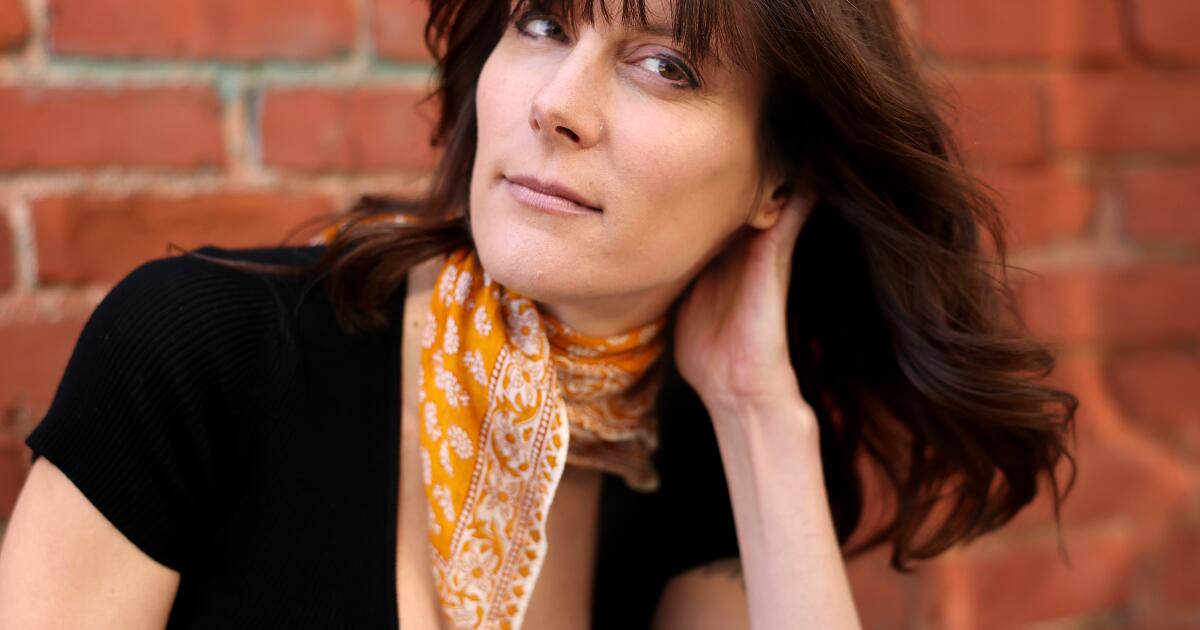
I’m sitting across from an orthodontist, sipping a lukewarm coffee and gliding through typical first-date banter about L.A. traffic. But as this Hinge experiment with his simp-y Harry Styles hair and $200 sweatpants tries to lock eyes with me, I’m still staring just past his shoulder at a fake eucalyptus plant. I am silently praying this passes for eye contact, because I know what’s coming when my gaze meets his. The flinch.
If this term isn’t in your immediate search history, the flinch is an inverse of the male gaze; a jaw-tightening, ball-shriveling squint usually directed at my face. It is a subtle move that says without question: We are not the same.
Because I’m blind, and he isn’t.
My brain crackles with anxiety. Now I’m thinking about all those nice folks with herpes and how they have medication to help keep everything under wraps for a while. Now, I’m longing to have herpes and a vast collection of Valtrex as I down my drink. I need to order another round. Do it — do it now. Before this man notes with absolute certainty that you do not have anything close to the deep brown eyes he thought he saw in your dating profile, before he excuses himself and that second drink never happens.
Dating, in theory, is fun. Meeting a stranger at a cafe covered in hipsters and Moroccan tile, sitting at a too-small table and pretending to be interested in the Americano-length version of someone else’s life, can be total fire. But if you’re me, dating mostly makes you want to haul it outta there like you were in an episode of “The Last of Us.”
Ayla Harrison developed the eye condition retinopathy of prematurity as a newborn.
My face is unfortunate. It is lopsided. My eyes are different sizes and colors. My right eye is lazy, shriveled and blind; it moves like an out-of-control marble circling a drain. My left eye suffers hemorrhages that can cause episodes of total blindness. The reason for my Picasso of a face is because of a retinal disease I snag after my mother goes into labor three months early. She looks that Medicaid doctor right in his very symmetrical face and says through grunts and gritted teeth: “My girl doesn’t like to wait.”
Doctors move me to an ICU and crank my oxygen levels to 100% to keep me stable. Later, a nurse with nicotine stains on her fingernails, tells my parents I have developed retinopathy of prematurity, an eye condition caused by all that one-hundo oxygen. The disease will open me up to a revolving door of vision issues for life.
Then there is rushing. More doctors. A surgeon barely salvages the sight in my left eye, but my right eye can’t be saved. They tell my parents I’ll be blind in that eye forever. A teeny tiny Cyclops. I weigh less than a pound. I am so small the surgeon can place my entire hand on his pinkie nail.
And for a moment, everyone is staring.
The first boy I love has a rat-tail. We’re both 8 years old. To win his affection, on a dare, I decide to eat a cockroach off the ground during recess. Kids point and lose their collective 8-year-old mind, but the attention makes me feel electric. Then he makes direct eye contact with me. I look down; my performance upended in an instant. He’s staring at me like someone asked him to find Waldo and he stops on my mismatched marble-y eyes. The baby fat in his jaw tightens. Then it happens. My first flinch.
I stop going to recess.
At dinner, I mention my eye contact problem to my mother. She nurses her third rum and Diet Coke and says: “Look boys in the eye like you want to steal their wallet.”
By the time I reach high school, I can’t address another person unless my eyes are glued to the floor.
In the teenage dating hierarchy, I am a hard pass. Boys in artfully shredded Abercrombie jeans flinch in a chain reaction of disgust as I pass them in the halls. Cheerleaders corner me and demand to know what is wrong with my eyes. The cheer captain shoves me into a locker. I latch onto her perfect French braids and pull down hard until my knuckles go white. Somewhere JV cheerleaders chant “Fight!” like it is a pep rally.
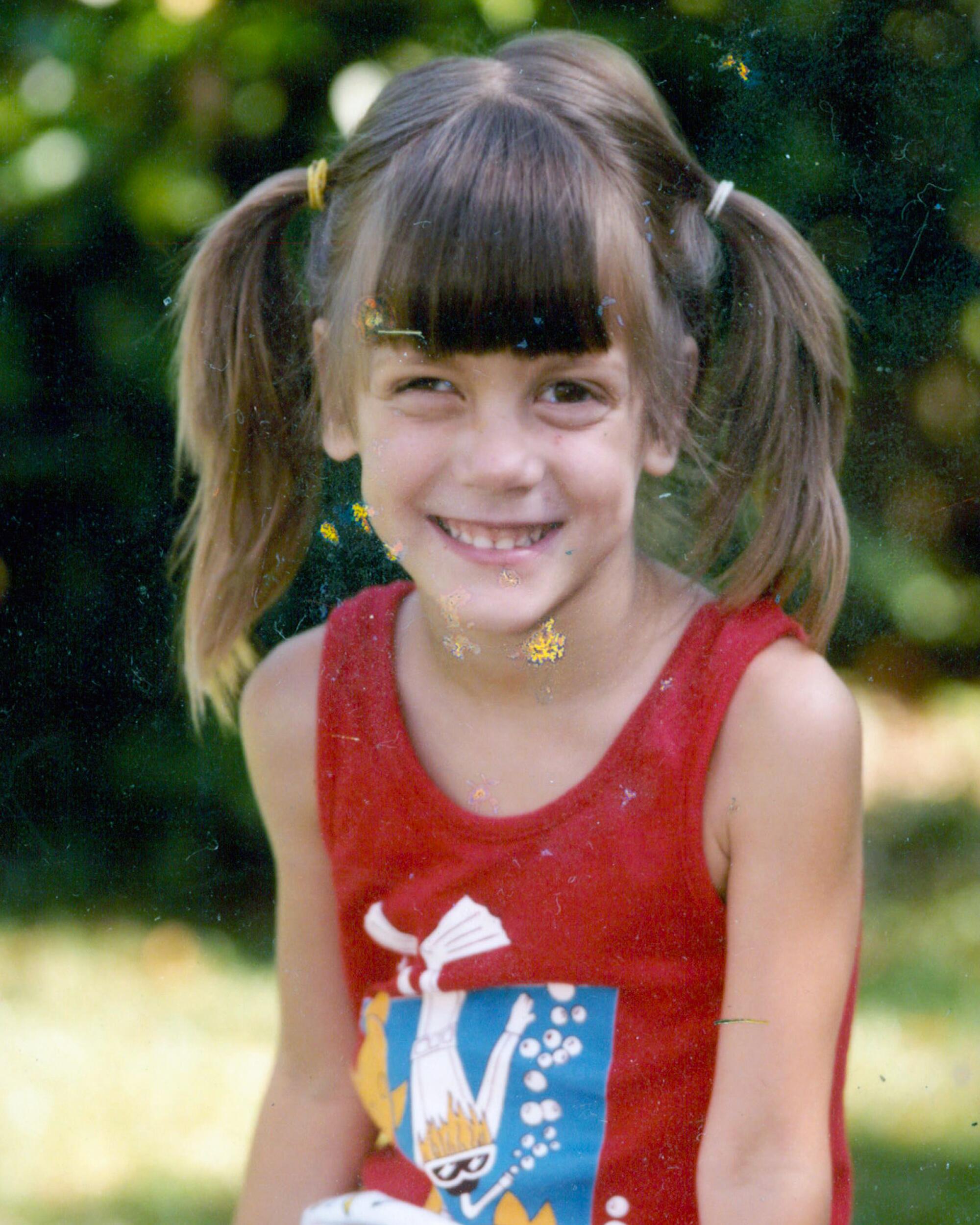
Harrison in a preschool photo.
(Ayla Harrison)
And for a moment, everyone is staring.
I walk home alone with a busted lip and decide teenagers in my small Southern town are just wolves in Adidas track pants.
Years happen. I leave my swampy hometown. Before I go, my childhood eye doctor warns me that I have the eyes of an 80-year-old. I ignore him because I am 22.
I avoid discussing my ROP with anyone, and instead, I diligently plaster my bangs to my forehead to hide my blind eye. It’s a trick I learn working as a waitress at a neon-tinged strip club in some blink-of-an-eye Florida town that pushes all-you-can-eat oysters and lap dances until 3 a.m. I mimic the dance moves of the strippers. Just like the girls swaying onstage in G-strings, I want to feel that burn-a-hole-in-your-pocket desire from men. A dancer, this oiled-up pole ballerina, tells me about a weekend trip she took to L.A. “Life there is like a buzzsaw knocked up a glitter bomb,” she says.
A month later, I move to Santa Monica. I slide into the rip current of L.A. men and let myself fall in love in the time it takes to change a channel. But the relationships either fade or split open like cantaloupe dropped on hot pavement. And then, on one random Wednesday, my left eye hemorrhages and fills with blood. And suddenly, I cannot see.
Again, more doctors — specialists this time. Their offices are in tall towers. And like in many niche areas of medicine, there are silence and bright lights and a lot of nodding. There are lasers and emergency surgeries. Eventually I can see again, but not without a lot of help from a perpetual weekly doctor appointment. I make friends with the 89-year-old nana-and-pop-pop set in the lobby. I am there so often my mother asks if this ophthalmologist gives out a rewards card like at Yogurtland.
My eyes bleed while I’m in the shower and during yoga. My sight snaps off like a light while I’m at the supermarket. My episodes of blindness go on for months — and still — my mother asks: “When are you going to meet someone? And can you send artisanal doughnuts through the mail?”
This only reminds me of what’s coming: the flinch.
I need a new plan. Or a therapist. Instead, I call my ophthalmologist, a woman I’ve seen so many times I probably fund a fraction of her vacation house.
In the exam room, my ophthalmologist decides to fit me with therapeutic contact lenses. She explains these fancy lenses will protect my diseased eye and — bonus — they will make my eyes appear to be the same color. She finishes her adjustments, offers me a mirror like I’m in a Marvel movie, and waits for applause. I study my blind eye, tucked in its new costume, and opt for a late-night Google question instead: What if I got another procedure done on my eyes?
I suggest more surgeries — cutting-edge surgeries to fix my bad eye and its marble-y wobbling. My doctor pops a trained, reassuring smile and fires off a lecture on the dangers of continuing to rip open my eyes on the regular. The only thing all of those surgeries will do is make my condition worse, she tells me.
Two weeks later, in a different medical tower, I’m meeting with my retinal specialist this time. I hit him with my question about correcting my mismatched eyes. The response is identical — a list of horrors. He pauses to add, “But you are a single woman now. So maybe think about it,” and moves to a new patient without another word.
Tears hit me in a wet burst as my doctor shouts to an 82-year-old in the next room: “How are you doing today?” The door closes behind him.
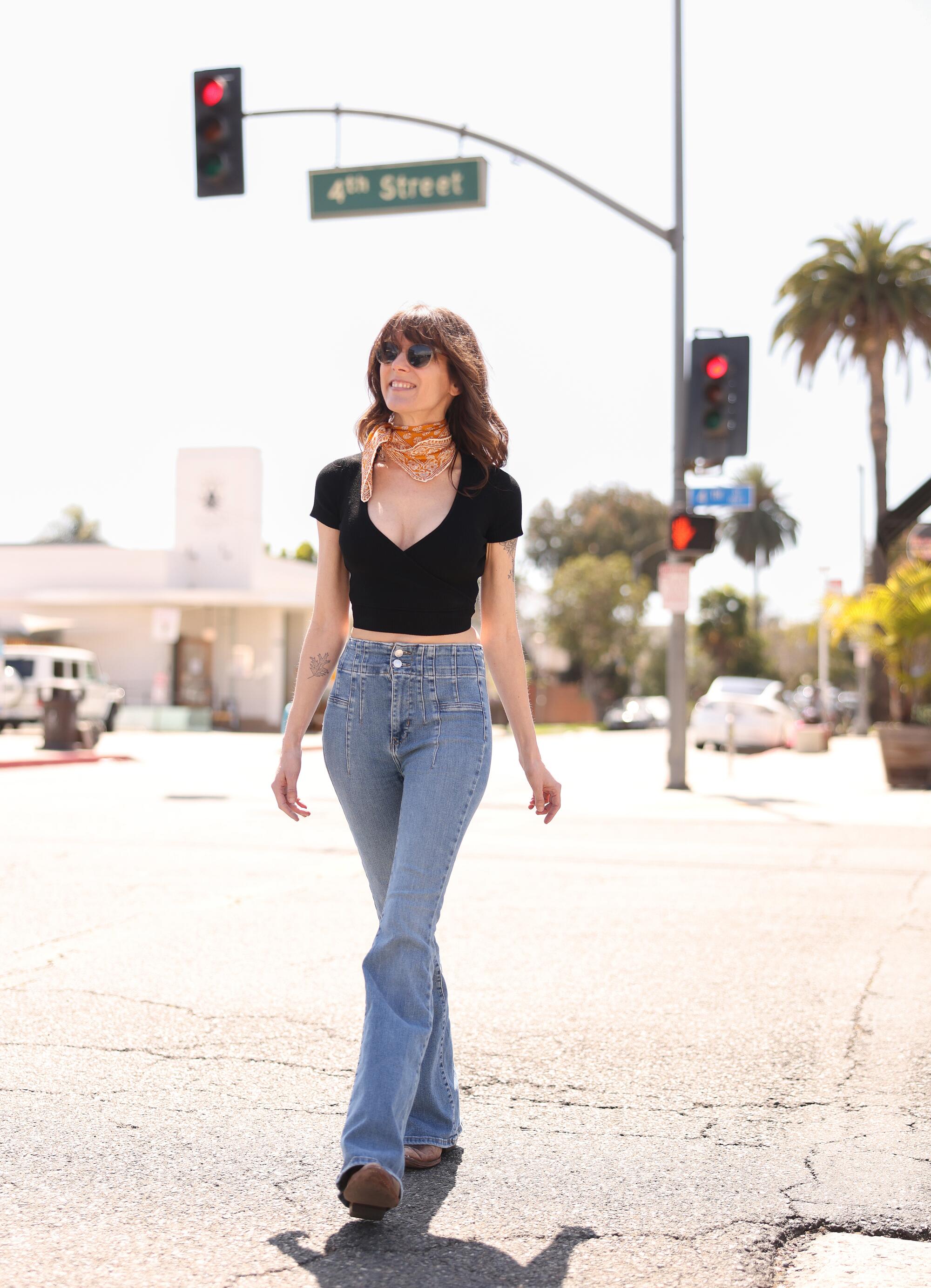
Harrison crosses 4th Street in Long Beach. She went on a date at a nearby Peruvian restaurant with a man who surprised her.
I call my mother between sobs. I manage to say, “I can’t wear this lens.” I stammer on about how the lens is just a fancy bandage; a device to hide the fact that my vision loss is a ticking time bomb just waiting to go off. And who’s going to love that? My mom patiently waits out my sobs. Finally she says, “What sight you have left could go before I finish this sentence, but no one needs to be OK with that except you.”
Then she asks me if I’ve seen Reese Witherspoon do that one dance on TikTok yet.
Weeks later, I go on a date with a man. I sit across from him at a too-small table at a Peruvian restaurant on 4th Street in Long Beach. His voice is a mix of Spanish slang and a SoCal surfer lilt. And I swear he never drops eye contact. Normally this would wreck me. But with my new lens, I feel an odd new confidence. So, I commit first-date seppuku and tell him about my lens and my vision loss. As I talk, my anxiety hijacks my thoughts, and I immediately regret opening my mouth. Because I’m waiting for the flinch — for that lightning-fast jolt of expected pain. And then I realize I am too busy future spiraling to notice that my date is ordering a second round of drinks.
I am too busy to notice that our date is still going.
It goes until ice melts into the dark amber whiskey in our sweaty cocktail glasses. It goes until it is the soft yellow of morning sunlight. It goes until he holds my hand on a crowded street, and I know it’s my turn to look him in the eye. At a crosswalk, I turn my head and stare at this man.
And for a solid three seconds, I have an overwhelming urge to steal his wallet. I smile. Somewhere, my mother is right.
Then he asks, “Can I kiss you?” I nod. He leans in and kisses me right on my diseased little eyes, right in the middle of that crowded street.
And for a moment, everyone is staring.
The author is a playwright and screenwriter based in L.A. She’s on Instagram: @outinthestacks



American model Carol Alt was only 22 years old — and 5′ 11″ — when she shot to stardom after she was featured on the cover of the 1982 Sports Illustrated Swimsuit issue.
Alt was featured in Vogue, Harper’s Bazaar, Elle and Cosmopolitan, as well as, scoring sought after ad campaigns like Cover Girl, Hanes, Givenchy and Diet Pepsi.

Fireworks, by Matthew Burgess and illustrated by Cátia Chien has won the Caldecott Medal for the most distinguished American picture book for children, and All the Blues in the Sky, written by Renée Watson has been awarded the Newbery Medal for the most outstanding contribution to children’s literature.
Clarion Books; Bloomsbury Children’s Books
hide caption
toggle caption
Clarion Books; Bloomsbury Children’s Books
The best books for children and young adults were awarded the country’s top honors by the American Library Association on Monday.
Illustrator Cátia Chien and author Matthew Burgess took home the Caldecott Medal for the book Fireworks. The Caldecott is given annually to the most distinguished American picture book for children. Fireworks follows two young siblings as they eagerly await the start of a July 4th fireworks show. Paired with Chien’s vibrant illustrations, Burgess’ poetic language enhances the sensory experience of fireworks.” When you write poems with kids, you see how immediately they get this,” Burgess told NPR in 2025 in a conversation about his book Words with Wings and Magic Things. “If you read a poem aloud to kids, they start to dance in their seats.”
The Newbery Medal, awarded for the most outstanding contribution to children’s literature, went to Renée Watson for All the Blues in the Sky. This middle-grade novel, also told in verse, follows 13-year-old Sage, who struggles with grief following the death of her best friend. Watson is also the author of Piecing Me Together, which won the 2018 Coretta Scott King Award and was also a Newbery Medal honor book. “I hope that my books provide space for young people to explore, and say, “Yeah, I feel seen,” Watson told NPR in 2018. “That’s what I want young people to do — to talk to each other and to the adults in their lives.”
This year’s recipients of the Coretta Scott King Book Awards include Will’s Race for Home by Jewell Parker Rhodes (author award) and The Library in the Woods, by Calvin Alexander Ramsey and illustrated by R. Gregory Christie (illustrator award). Arriel Vinson’s Under the Neon Lights received the Coretta Scott King-John Steptoe Award for New Talent.
Los Angeles based artist Kadir Nelson was honored with the Coretta Scott King-Virginia Hamilton Award for Lifetime Achievement. His work has appeared in more than 30 children’s books.
This year’s Newbery Honor Books were The Nine Moons of Han Yu and Luli, by Karina Yan Glaser; A Sea of Lemon Trees: The Corrido of Roberto Alvarez by María Dolores Águila and The Teacher of Nomad Land: A World War II Story by Daniel Nayeri.
Caldecott Honors books were Every Monday Mabel by Jashar Awan, Our Lake by Angie Kang, Stalactite & Stalagmite: A Big Tale from a Little Cave by Drew Beckmeyer, and Sundust by Zeke Peña.
Edited by Jennifer Vanasco and Beth Novey.

Where to score tickets for this Sunday’s Pistons vs. Nets game for under $30

Exclusive: San Francisco Police Department investigating Zoox collision with a parked car | TechCrunch

Man found dead over the weekend by police in South Dallas identified

New Japanese restaurant brings affordable bentos, hand rolls to Boston

Huge new $27 million Denver bathhouse would include sauna, cold plunges

Florida High School Football Rankings: Top 25 teams – Oct. 21

Cleary's 21 help Le Moyne down Central Connecticut State 69-64 in OT

How old is Bo Nix? What to know about Oregon quarterback ahead of 2024 NFL Draft

99th annual Pony Swim held in Virginia

Indiana Members Credit Union announced as new anchor tenant at Bottleworks District

Graham pushes back on Tillis’ criticism of Noem, Miller for labeling man killed by Border Patrol a ‘terrorist’

North Korea’s Kim to outline plans to boost nuclear arsenal

Rep. Ilhan Omar rushed by man on stage and sprayed with liquid at town hall event

Video: F.A.A. Ignored Safety Concerns Prior to Collision Over Potomac, N.T.S.B. Says

Democrats demand Kristi Noem be fired or warn impeachment will follow
-

 Illinois6 days ago
Illinois school closings tomorrow: How to check if your school is closed due to extreme cold
-

 Sports1 week ago
Miami’s Carson Beck turns heads with stunning admission about attending classes as college athlete
-

 Pittsburg, PA1 week ago
Sean McDermott Should Be Steelers Next Head Coach
-

 Lifestyle1 week ago
Nick Fuentes & Andrew Tate Party to Kanye’s Banned ‘Heil Hitler’
-

 Pennsylvania2 days ago
Rare ‘avalanche’ blocks Pennsylvania road during major snowstorm
-

 Sports1 week ago
Miami star throws punch at Indiana player after national championship loss
-

 Cleveland, OH1 week ago
Northeast Ohio cities dealing with rock salt shortage during peak of winter season
-

 Technology6 days ago
Ring claims it’s not giving ICE access to its cameras