Lifestyle
Much Ado About First Folios — the world's largest Shakespeare collection reopens

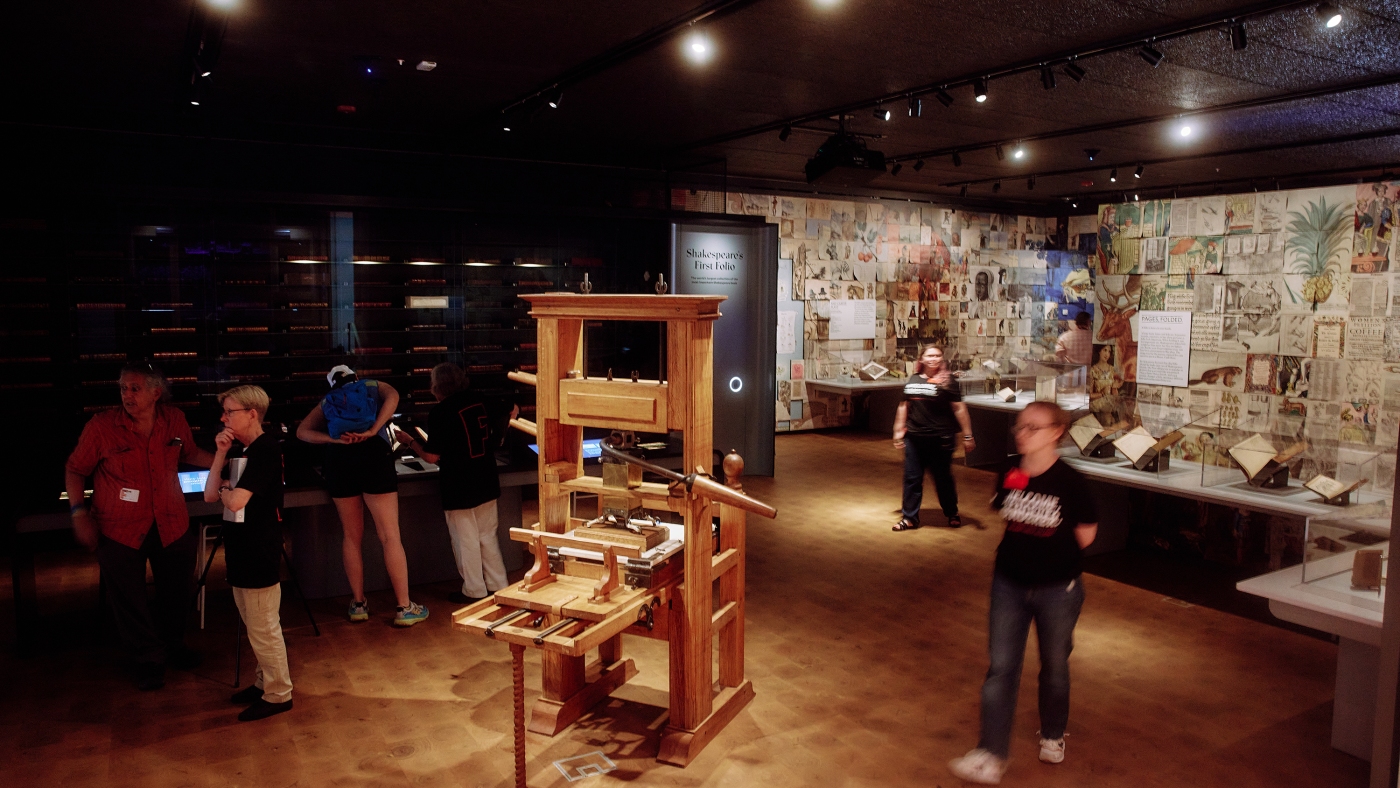
The new main exhibition hall at the Folger Shakespeare Library in Washington, D.C., on June 14, 2024.
Jared Soares for NPR
hide caption
toggle caption
Jared Soares for NPR
The Folger Shakespeare Library in Washington, D.C. — home to the world’s largest Shakespeare collection — is emerging from a four-year metamorphosis that has left it almost entirely transformed — new museum spaces, new leadership announced, new programming outreach.
After years of being available only to scholars, the jewels of the library’s collection — 82 copies of Shakespeare’s “First Folio,” printed 400 years ago — will now be together on public display for the first time.
We got a behind-the-scenes sneak peek to look at how the Folger is reaching out to new audiences.
Shakespeare and the classics in Chocolate City
So much has changed at the Folger Shakespeare Library since it closed for renovations in January 2020, that it makes sense that the show reopening its performance space is called Metamorphoses. Mary Zimmerman’s adaptation of Ovid’s epic Roman poem is all about change, and Karen Ann Daniels, who directs programming for the Folger and is artistic director of its theater, sensed that it could speak to underserved audiences in D.C. if the Folger Theatre did it right.
“The play could really lean into the larger history of the populations of D.C.,” she said. “I’m totally thinking Chocolate City. That’s really where my idea came from.”
Her idea was to do the play with an all-Black cast, a notion director Psalmayene 24 wasn’t sure he was on board with until Memphis police officers fatally injured Tyre Nichols, a Black FedEx employee, last year during a traffic stop. The director said he worked through his grief at the incident by incorporating elements of the Black diaspora into Metamorphoses to celebrate Black humanity.

”The play could really lean into the larger history of the populations of DC,” said Folger Theatre Artistic Director Karen Ann Daniels, shown here in the Folger’s performance space on June 14, 2024.
Jared Soares for NPR
hide caption
toggle caption
Jared Soares for NPR
“So in some ways this play is a response to America’s own proclivity for lethal anti-Blackness,” he said. “And when you do a show like this at a place like Folger, it says something about how not only Folger Theatre is changing, but how American culture is changing, how D.C. is changing, and how universal the stories that pass through this theater actually are. These stories are for everyone, and can be told in many different ways.”
The librarian has a favorite First Folio. It’s not the fanciest one.
A huge display case in the middle of the library’s new exhibition space glows softly, quietly announcing that it contains the Library’s crown jewel: 82 copies of Shakespeare’s First Folio printed in 1623 — more than a third of all the copies that are known to exist.
The First Folio marked the first time, just a few years after Shakespeare’s death, that his works were collected into a single volume, which makes it a benchmark for scholars. But no two of the copies collected by Henry and Emily Folger in their lifetime look the same. Some are skinny, others massive.

One of the Folger Shakespeare Library’s 82 copies of the First Folio, the Bard’s complete works printed in 1623, just a few years after his death.
Jared Soares for NPR
hide caption
toggle caption
Jared Soares for NPR
“These were all printed in 1623,” confirmed Folger librarian and director of collections Greg Prickman, “in the printshop of William Jaggard and his son Isaac, but over the intervening 400 years a whole lot has happened to these books. Sometimes they get damaged and parts are removed. Sometimes parts are added from other copies.”
Asked if he has a favorite, he headed to the far right side of the display case, past Folios prettily bound in leather with gold tooling.
“The one that I like the most is #30 — the only copy in this collection that has the original binding that was put on when this book was first purchased, not long after it was printed.
“So, if you wanted to see, ‘What does Shakespeare’s First Folio look like when it was just another quote-unquote new book?’ that’s the copy that you’re gonna be looking at, is #30.”
A sampler of Shakespearean insults
To the right of the main display case, there’s a smaller interactive display that lets you create a Shakespearean conversation. We only spent a few moments with it, but the display makes its own selections from phrases in the Bard’s plays once you choose a category — perhaps “blessing” (“You have been nobly born”) or “burning” (“Do as thou wilt, for I have done with thee”).
We only played with it for a few minutes, but we note that the plays contain a full complement of Shakespearean insults, so in theory, it could have you spouting such Elizabethan invective as:
“Away, thou rag, thou quantity, thou remnant.” (Taming of the Shrew, Act 4, scene 3)
“I am sick when I do look on thee.” (A Midsummer Night’s Dream, Act 2, scene 1)
“I must tell you friendly in your ear, Sell when you can; you are not for all markets.” (As You Like It, Act 3, scene 5)
“More of your conversation would infect my brain.” (Coriolanus, Act 2, scene 1)
“The rankest compound of villainous smell that ever offended nostril.” (The Merry Wives of Windsor, Act 3, scene 5)
“And thou unfit for any place but hell.” (Richard III, Act 1 scene 2)
“Villain, I have done thy mother.” (Titus Andronicus, Act 4, scene 2)
“Would thou wert clean enough to spit upon!” (Timon of Athens, Act 4, scene 3)
The Mulberry Conundrum
The exhibition space has lots of rare manuscripts in a room called “Out of the Vault,” which of course made us wonder what else is in “the vault,” which is not open to the public. So we asked, and were led down a staircase to an imposing, steel, bank-vault door, behind which lie the refrigerated (“because that makes the books happy”) library stacks containing the quarter of a million other volumes in the Folger’s collection.
There are also 100,000 objects down here, ranging from paintings of the Bard, to props, costumes, models and “pieces of the tree,” said Prickman, enigmatically.

Librarian Greg Prickman is the Folger’s Director of Collections and Exhibitions.
Jared Soares/Jared Soares for NPR
hide caption
toggle caption
Jared Soares/Jared Soares for NPR
“The mulberry tree,” he continued when pressed. “’Objects associated with Shakespearean legends’ is probably the best way to put it. I’m not the one to tell this story.”
So we looked it up.
Shakespeare allegedly planted a mulberry tree at his home in Stratford. More than a century later in the 1750s, the home’s then-owner, Rev. Francis Gastrell, got so tired of people asking to see it that he chopped it down, and local entrepreneur Thomas Sharpe bought the wood and had it crafted into Shakespearean souvenirs — everything from a carved casket that was presented to actor David Garrick (1717-1779), to snuff boxes and medallions.
So many items were created that they pretty clearly didn’t all come from one tree, but the Folger has some.
Why the Folgers placed a bet on the Humanities
The impulse to reach a more universal audience is what led Folger Library director Michael Witmore to spearhead the library’s $80.5M rethink — a wholesale “metamorphosis,” if you will, of a building and a mission that had been, frankly, functioning quite well.
“For the first part of the Folger’s existence, it was primarily a research library,” said Witmore, “serving scholars who were studying everything from animal husbandry to lyric poetry to theater. But we have the facilities and collection to do more, and this renovation allows us to take a world-class research library and surround it with a cultural institution that is a destination.”
A destination in the service of words written more than 400 years ago. Words that are also available digitally — “we digitize in order to create access, said Prickman, “and we exhibit materials in order to create access. The originals remain.”
And the presence of those originals just down the block from the Library of Congress, U.S. Capitol, and Supreme Court, was a big part of the intention of Henry and Emily Folger, said Witmore.

A view of the new underground entrance to the Folger Shakespeare Library’s exhibition areas.
Jared Soares for NPR
hide caption
toggle caption
Jared Soares for NPR
“We need these words and these stories to elevate our sense of what’s possible as citizens. When you think about what happens in the Capitol, which is where words — you may not agree with them, you may think they’re funny or shallow — but it’s where words really matter. Including when the court is looking at what those words mean.
“So to put a Shakespeare library where his works are being performed, and where people are working through the poems and other things, right in this spot I think is a big bet on the importance of the humanities and the arts in a functioning democracy.”
Story edited and field produced by Jennifer Vanasco. Broadcast story produced by Isabella Gomez Sarmiento.


Scott Simon talks with author Judy Blume at the Santa Fe International Literary Festival in May.
Tira Howard Photography./Courtesy Santa Fe International Literary Festival
hide caption
toggle caption
Tira Howard Photography./Courtesy Santa Fe International Literary Festival
Judy Blume is the legendary writer of books for young adults including Are You There God It’s Me Margaret, Deenie, Tiger Eyes, Tales of a Fourth Grade Nothing and Blubber.
Her last book, 2015’s In The Unlikely Event, was published more than a decade ago. Blume now spends her time reading children’s books behind the counter at her bookstore in Key West, Florida. Though she says she is done writing, her books remain beloved; her readers numerous and devoted.
Judy Blume spoke with NPR’s Scott Simon at the Santa Fe International Literary Festival in May. Here are excerpts from that conversation, edited in parts for clarity and length.
Scott Simon: How did you begin to write? What do you think made you a writer?
Judy Blume: I was a reader. And, you know, I meet so many kids and they say, “I want to be a writer when I grow up, but I don’t like to read.” And I say, “You know what? Forget being a writer.” Because I think every writer — that I know anyway — grew up a reader. And certainly that was true for me.
Simon: What was the spark that set it in motion from reading to writing, do you think?
Blume: I was married young. I had two kids young. And I was desperate for a creative outlet. I loved taking care of babies, but I needed something else and it could have been anything.
Simon: I have read that at one point in your life you made felt art pieces?

Scott Simon with Judy Blume in Santa Fe in May.
Tira Howard Photography/Courtesy Santa Fe International Literary Festival
hide caption
toggle caption
Tira Howard Photography/Courtesy Santa Fe International Literary Festival
Blume: Oh God, my first career. You know, I stopped because the Elmer’s glue — I’m an allergic person — started to give me funny things on the tips of my fingers. I made $300 selling those. And I bought myself a small electric typewriter. And the rest is history.
But I always had stories inside my head — when I was 9 years old. I bounced a rubber ball against the side of my house for hours. But really what was going on were stories. Fabulous stories, very melodramatic. I never told anybody. I never asked a friend, “Hey, do you have stories inside your head all the time?” Because I thought they’d think I was weird, which I might have been. So the stories were always there.
Simon: When you were writing, what was the process like for you?
Blume: Well, I kept a notebook for each book and I scribbled everything in it. Everything, everything, everything for a long time. For months.
And then on the day that I feel ready to start, well, that’s either the scariest part of writing or the best. Because, you know, when you have a good day — I mean, I had kids, and I would sit down at the dinner table and I would say, like, “You will never believe what Tony did today.” Because they’re real. They’re real to you. And you’re living with them for months, sometimes years. And you’re locked up in a little room all day with them. That’s why 50 years is enough. I was ready to come out into the world.
But I have found another career that I love dearly. I have a bookstore and I love that.

Tira Howard Photography/Courtesy Santa Fe International Literary Festival
Simon: I get the idea that you, at least for the moment, don’t miss writing right now.
Blume: I don’t miss writing but I’m very glad that I wrote. I mean, writing changed my life. But it was time to let it go. Could I have come up with more ideas and written more books? Yes. But I’m really happy that I found something else that I love to do.
Simon: Do characters ever come calling on you?
Blume: No. They know better. They’re quiet.
You know how many letters I get? “We need Judy to write a book — Margaret In Menopause.”
Margaret is always going to be 12. She’s not knocking, saying, “Let me out. I’m in menopause!”
They are what they are. They stay in the book. They stay in the book. They live for me in the book. And then I have to let them go.

Director James Burrows attends the “Will & Grace” start of production kick off event and ribbon cutting ceremony at Universal City Plaza on August 2, 2017 in Universal City, California.
Jason LaVeris/Getty Images
hide caption
toggle caption
Jason LaVeris/Getty Images
LOS ANGELES — James Burrows, who helped create volumes of laughter as director of more than a thousand episodes of such classic television comedies as “Cheers,” “Taxi,” “Friends” and “Will and Grace,” died Friday. He was 85.
His family confirmed his death in a statement to People, saying he “passed away peacefully today surrounded by his family.” No location or cause of death was provided.
Burrows spent his career behind the camera specializing in situation comedies. Few viewers recognized him or knew his name, other than to see it flash quickly on the screen in the opening credits. But they knew his work.
Burrows got his start in television relatively late at age 35 in 1974, directing episodes of “The Mary Tyler Moore Show,” “The Bob Newhart Show,” and “Laverne & Shirley.”
He co-created “Cheers,” directing 243 of the 273 episodes, as well as all 246 episodes of “Will and Grace.”
He also helmed multiple episodes of such hits as “Frasier,” “Friends” and “Mike & Molly,” and the pilots of “Two and a Half Men” and “The Big Bang Theory.”
“When I direct a television show, I try to reach that sweet spot where the best script meets the best performance and the best chemistry between performers,” Burrows wrote in his 2022 memoir “Directed by James Burrows.” “Hitting that exact moment, where these factors land in combination, results in the sweetest and most enduring laugh.”
His family said, “Burrows understood that great comedy was never simply about laughter. It was about humanity, connection, and truth. That understanding became the foundation of a career that forever changed television.
“But beyond his remarkable achievements, Burrows will be remembered for something even greater: his kindness, generosity, and unwavering belief in the people around him. He possessed a rare ability to make everyone better and was known for remembering every person he met by name, making colleagues at every level feel seen, valued, and appreciated,” the family statement said.
Born James Edward Burrows on Dec. 30, 1940, in Los Angeles, he moved to New York when he was 5 years old. He spent five years in the Metropolitan Opera Children’s Chorus until his voice started to change. He attended LaGuardia High School of Music & Art.
His father was writer, director and producer Abe Burrows, whose Broadway hits included “Guys and Dolls” and “Can-Can.” The elder Burrows also mentored Larry Gelbart, future creator and producer of the TV show “M(asterisk)A(asterisk)S(asterisk)H.”
The younger Burrows spent hours of his youth in theaters and studios watching his father work, dining with him at such famed New York haunts as Sardi’s and Gallagher’s and meeting celebrities who attended his father’s New Year’s Eve parties.
After earning a bachelor’s degree from Oberlin College, Burrows attended the graduate program of the Yale School of Drama, where his classmates included actor-comedian Robert Klein, playwright John Guare and film director John Badham.
At Yale, he was required to take directing classes and he got hooked.
Burrows’ first sitcom experience was as Burl Ives’ dialogue coach on “O.K. Crackerby!” which was directed by his father and ran for one season on ABC in 1965.
From there, he was an assistant on “The Patty Duke Show.” He moved back to New York and worked for Broadway producers Lee Guber, Frank Ford and Shelly Gross. He first met actor Moore while working on the Broadway production of “Holly Golightly,” an adaptation of “Breakfast at Tiffany’s” that was directed by his father.
Burrows eventually worked as a stage manager for various road productions, where he met such actors as Hugh O’Brien, Zsa Zsa Gabor and Julie Harris.
By 1974, after working in dinner theater and summer stock, he turned on his television and saw Moore’s eponymous TV show. He wrote her a letter asking if there was any opening “small or smaller” at her production company that he could fill, according to his memoir.
Moore’s husband and business partner, Grant Tinker, invited Burrows to Los Angeles to direct an episode of the comedy. He apprenticed for MTM Enterprises, which had four sitcoms on the air at the same time.
Burrows cited his theater background for learning how to give actors direction and block out scenes. He’s credited for being one of the first sitcom directors to increase the typical multi-camera television shoot from three to four cameras.
The common thread between Burrows’ shows were the bonds between friends and unrelated families, whether it was the motley crew of regulars meeting at the bar in “Cheers” or the drivers working toward a better life in “Taxi” or the 20-somethings sharing the same apartment building in “Friends.”
“The best sitcoms transcend the screen and reach out and grab the audience by the throat and by the heart,” Burrows wrote in his memoir.
He relished discovering new acting talent while directing more than 75 pilots that were picked up as series.
“Having directed over a thousand shows means that almost any night you can turn on your television or go online and find a show that I directed. I’m very proud of that,” he wrote in his memoir.
In 2019, Burrows was an executive producer on live productions of “All in the Family” and “The Jeffersons” with famous actors re-creating episodes of those 1970s comedies.
Burrows was married in 1997 to Debbie Easton, whom he met when she worked as a hairstylist on “Frasier.” Daughters Kat Schatzow, Ellie Gluck and Maggie Burrows, who followed her father into directing, are from his first marriage to Linda Solomon, who died in 2004. His stepdaughter Paris is from his wife’s previous marriage. He has a sister, Laurie Burrows Grad, and seven grandchildren.

GOLETA — For a few minutes, the atmosphere inside Captain Fatty’s Brewery in Santa Barbara County was quiet, different from the usual Friday night clamor.
On this late May evening, the 15 men gathered there were contemplating tackling something few had previously had the courage or skill to take on. Austin Nieves, a recent transplant to the area and the man who had brought this brave group together, broke the strained silence by handing out beers.
Within minutes, the men, who ranged in age from 30 to 60, began chatting among themselves.
Then they started braiding hair.
The May 22 event — Goleta’s version of the viral U.K.-inspired “Pints and Ponytails” night — was sold out. The idea is to have expert hairstylists train uninitiated or intimidated fathers on how to comb and braid their kids’ hair, using salon-type head mannequins but in a setting for bros.
“When the first guys got there, they were stiff,” said Nieves, a Pasadena native who moved to Santa Barbara in April 2025. “Then after that first beer, they went from sitting around the edge of the bar to jumping right into learning and giving it a shot.”
Dads group members Dan Ucko, left, and Eric Schalla participate in the hairstyling event at Captain Fatty’s Brewery in Goleta.
The gathering was one of several father functions by the Santa Barbara Dads group, which Nieves founded last spring.
May’s papa party offered, along with the suds, a learning experience and camaraderie among fathers, which Nieves believes is much needed.
“When my wife had our son, she immediately became part of at least five mom groups and classes that offered her help, advice, friendship and training,” Nieves said. “As a first-time father, I really only had my brothers, who had children themselves, to turn to.”
Scientific studies have shown that as fathers have taken a more active role in child rearing, they’ve faced loneliness, doubt and confusion.
Researchers Chris Knoester and David J. Eggebeen wrote in 2006 in the “Journal of Family Issues” that fatherhood leads “to declines in feelings of well-being and participation in social activities” as fathers spend less time with friends.
Clinical psychologists Hillary Halpern and Maureen Perry-Jenkins documented that the transition from single life to fatherhood is often accompanied by a roller coaster of emotions. And researchers from Stockholm’s Karolinska Institute determined in a 2021 study that fathers might require help “during their transition to fatherhood.”

Eric Drachman, of Santa Barbara, center, pays close attention as hair stylist Chi Jou Lin, left, teaches a group of dads how to style their daughters’ hair.

A detail of one of the mannequin heads.
One such way to assist men is specifically a fathers group, according to the 2021 study.
Most men “were mostly satisfied with participating in father groups and described that they positively impacted their relationship with their partner and child.”
The increased contact also helped improve “their self-confidence and family equality and decreased their loneliness.”
Nieves agreed that his leisure time and focus changed sharply after the birth of his child, Hudson, now 3 years old, as did his friend group updates.
“They were talking about all this crazy fun or TV shows and I was talking about my son being able to lift his head,” Nieves said. “That’s when I knew I had to branch out.”
Nieves, then living in Costa Mesa with his wife, Katie, created the Orange County Dads club in October 2023.

Scientific studies have shown that as fathers have taken a more active role in child rearing, they’ve faced loneliness, doubt and confusion.
His group of merry men held meetups at coffee shops, beer halls and the zoo, hosted holiday hootenannies and even offered CPR classes.
Its success helped spawn a chapter in the Whittier area.
Though strictly a fathers club, the group, Nieves said, has grown thanks to wives and partners sharing his social media posts with their husbands.
Mikhail Alfon, founder of Blue Light Media, a social media strategy agency, took his son, Santos, to multiple Orange County meetups.
“This is our first child and obviously life changes a lot,” said Alfon in a social media post. “Finding peers and friends that are in the same stage of life is great.”
That sense of community, however, faced a challenge as Nieves and his family purchased a home in Santa Barbara and moved in April 2025.

Peter Aguilar, left, and Fredy Medel work on their technique. Medel’s partner, Daniela Fajardo, holding their 1-year-old daughter, Faylani, records the event.
Within a month, however, he had established a Santa Barbara-based dads group. Their first meetup was in May 2025, and they’ve made a point to gather once a month.
Austin Jones, a Santa Barbara-based real estate agent and investor, found Nieves through Instagram.
“I’m a husband, a dad and businessman, and it ends up being a lot of hats but very little support, at times,” Jones said. “It’s nice to find people in the trenches with you.”
Jones was intrigued by Pints and Ponytails as he’s battled the hair-care needs of his 2 ½-year-old daughter, Noa, and her textured, curly locks.
In a short while, Jones had gained enough confidence in whipping his mannequin’s hair into a ponytail that he vowed to try with his daughter soon.
“I was only pretty good at putting on a headband before this,” he quipped.
The six mannequin heads and the hour of instruction came courtesy of Santa Barbara cosmetologist Chi Jou “Belle” Lin, who offers area mobile services.
“I saw the social media post and a lot of people reached out to me to teach the class,” Lin said. “I had to help.”
Lin said the mannequins she brought varied in hair length and type, from straight to coily, but also fine in texture, as she tried to replicate young children’s hair.

A pint of beer, hairstyling tools and sprays.
She also taught the fathers basic hair-care techniques, including shampooing, detangling, checking for lice and how to tie ponytails and braids.
Even if they started out reticent, the fathers became active participants, asking questions about creating a neat French braid, what to do about tangled ponytails and how to deal with frightened children, Lin said.
“I was really impressed with the dads and their skills and the real-life questions,” said the stylist, who has personal experience at home in her 2 ½-year-old daughter, Lotus. “Not all men have the courage to ask questions.”
For Nieves, the secret in gaining new dads and retaining others is simplicity.
“If you open the door, the fathers will follow because everyone can use some help,” Nieves said. “But they just need to know it exists and they’re not alone.”

Dads Gabriel Sandoval, left, Jose Guerrero and David Talavera toast one another at the May 22 Santa Barbara County Dads’ “Pints and Ponytails” event in Goleta.
Days after the Goleta get-together, Santa Barbara dad Eric Drachman became a celebrity at the preschool of his daughter, Noa, who is soon to be 3.
“When the videos of the event were posted, the teachers at the school recognized me,” Drachman said. “They would ask my daughter, ‘Who did your hair?’”
The query that means most, however, is when Noa asks her father to fix her hair.
“She asks occasionally,” he said. “It‘s such a fun dynamic we have.”
-

 Los Angeles, Ca1 hour ago
Armed home invasion in L.A.’s Fairfax District leaves resident assaulted
-

 Detroit, MI2 hours ago
Tigers top Chicago White Sox 4-1; Detroit pitcher Troy Melton allows 1 hit in 6 innings
-

 San Francisco, CA2 hours ago
MLB Rumors: Latest Intel on Potential Matt Chapman Trade for San Francisco Giants
-

 Dallas, TX2 hours ago
Dallas’ Fair Park to Get $2.5M Boost From McKesson – Dallas Weekly
-

 Miami, FL2 hours ago
Air quality alert in effect in Miami-Dade and Broward counties: National Weather Service
-

 Boston, MA2 hours ago
Boston Signs Big Blueliner Rylind MacKinnon To One-Year Extension
-

 Denver, CO2 hours ago
Fire destroys home under construction in northwest Denver
-

 Seattle, WA2 hours ago
We can stop pretending that a suburban stadium would be better for soccer in Seattle

