Lifestyle
Moo Deng is a worldwide phenomenon. How long can this global love affair last?


CHONBURI PROVINCE, Thailand — Like most babies, Moo Deng spends a lot of her time sleeping.
But for a few hours a day, the 4-month-old pygmy hippo springs to life, gumming on leaves, zooming around the compound and tossing her head in a silent, open-mouthed roar.
These moments, captured by her zookeeper at the Khao Kheow Open Zoo, a two-hour drive south of Bangkok, and shared on social media, have turned her into a global phenomenon — an “It Girl” beloved for her sporadic fits of energy and proclivity for snapping toothlessly at hoses and knees.
Named for a Thai dish that means “bouncy pork,” Moo Deng has become the muse for cakes, clothing, tattoos and fireworks. Make-up tutorials demonstrate how to get her baby-pink cheeks and dewy skin. Partygoers this year dressed up as the pygmy hippo for Halloween. So did comedian Bowen Yang on “Saturday Night Live.”
Her remote home — struggling post-pandemic — has been transformed into a must-see attraction for international visitors and locals alike.
When Dong Kim, a 29-year-old travel blogger, visited in October, the excited hordes reminded him less of a zoo than a South American soccer game or a Black Friday door-buster sale.
Atthapon Nundee, the 31-year-old zookeeper who makes viral videos of Moo Deng, sprays the pygymy hippo and her mother with water.
(Lauren DeCicca / Getty Images)
“I’ve gone to the Great Wall, I’ve been to the Colosseum, I’ve been to Christ the Redeemer in Rio. But [this] was by far the longest line I have ever waited in,” he said. “It literally felt like people would die for this hippo.”
But Moo Deng’s sudden celebrity was not merely a result of cute animal worship or the fact that the pygmy hippo, native to West Africa, is an endangered species. While she was gestating in her mother’s womb, a 31-year-old zookeeper was hatching a plan to make her a star — tapping into a worldwide culture well-versed in capitalizing on internet virality — and save the financially strapped zoo while he was at it.
Today Moo Deng is the most famous animal on the planet — for now.

Nearly 175 years before Moo Deng took the internet by storm, another exotic hippo helped save the world’s first modern zoo.
The London Zoo began in 1828 as a members-only community, but opened to the public in 1847 in an effort to earn enough money to stay afloat. Visitors grew bored until Obaysch, named after an island in the Nile where he was captured, arrived three years later. The first hippo seen in Europe since the Roman Empire, Obaysch doubled annual attendance, drawing up to 10,000 visitors every day.

Baby hippo Moo Deng plays with a zookeeper in the Khao Kheow Open Zoo in September.
(Sakchai Lalit / Associated Press)
“They had to figure out a way to keep the public interested,” said Robert Young, professor of wildlife conservation at the University of Salford in England. “The thing they came up with … celebrity animals.”
Fans quickly grew attached to their favorites. When the zoo sold Jumbo the Elephant to P.T. Barnum in 1882, people protested in the streets. A black bear named Winnipeg became the inspiration for Winnie the Pooh. Guy, a western lowland gorilla, received hundreds of birthday cards every year.
In the 20th century, animals in the news (Sea Biscuit) and movies and TV shows (Lassie, Punxsutawney Phil) captured the hearts of millions. Recently, social media has hastened the celebrity of animals such as Grumpy Cat and JiffPom the Pomeranian.
In 2017, Fiona the hippo went viral as the internet watched her fight to survive infancy. She became the biggest attraction at the Cincinnati Zoo, inspiring her own ice cream flavor and children’s book.
Leasing giant pandas from China has become another strategy to draw visitors. But foot traffic subsides after two years, Young said, while zoos spend hundreds of thousands of dollars a year on bamboo that the pandas sometimes refuse. Pygmy hippos can be housed and supported at a much lower cost.
Huanyuan Zhang, a college lecturer at the University of Oxford who studies West African forest ecology, was surprised to see a sudden uptick this year in references to his research. He was even more perplexed to discover the cause was a pygmy hippo born more than 6,000 miles from its native land.
“It just feels like, out of many friends, one of your normal friends suddenly becomes a celebrity,” said Zhang, who hopes that the world’s love for Moo Deng will raise awareness of deforestation and endangered species. There are fewer than 2,500 pygmy hippos alive today compared with 12,000 in 1982.

Male panda Yun Chuan was introduced to the public at the San Diego Zoo on Aug. 8. He and Xin Bao, a female panda, are the first giant pandas to enter the United States in 21 years.
(Myung J. Chun / Los Angeles Times)
Young said zoos often rely on ambassador animals to bring attention to lesser-known species. But social media, he noted, will always favor the Moo Dengs of the world.
“The big issue,” he said, “is how do you get people interested in the uglies? Getting people to want to save a gorilla is quite easy. You try and get people to want to save the aye-aye, possibly the ugliest primate on the planet, it’s a very different situation.”

Four years after the pandemic choked off travel, the Khao Kheow Open Zoo had yet to recover from the financial devastation. With only a couple of thousand visitors per day, the budget to maintain the 2,000-acre zoo was stretched to its limits. Anticipating the birth of Moo Deng, zookeeper Atthapon Nundee sensed an opportunity.
Nundee had studied to become an electrician, but his first job out of college was driving a 10-wheeler truck around the country. After three years, he started looking for something closer to home. The zoo, a five-minute commute, had an opening.

Fans cheer as they see Moo Deng run around her enclosure at the Khao Kheow Open Zoo in November.
(Lauren DeCicca / Getty Images)
Over the next eight years, Nundee cared for baby hippos including two of Moo Deng’s siblings: Moo Wan and Moo Tun, also named after Thai pork dishes. Though Moo Deng is known for her spunky attitude, Nundee said her siblings were just as playful. So with one more on the way, Nundee was ready.
“I know when they become funny, how to set up the camera, which angle to take to see when it’s cute,” he said. “Any animal can become famous like Moo Deng. It’s just about how friendly you are with the animal.”
Moo Deng’s celebrity did not start at the moment of birth. To his dismay, Nundee discovered her crawling around the morning of July 10, placenta still attached. Their star had been born, and no one was there to document it.
But in August, the zoo posted a poll online asking the public to help choose her name. Nundee’s close-ups of her splashing in the water and snapping at the air started circulating on social media. Admirers called her sweet, or feisty, or filled with silent rage. Japanese residents working at the local industrial park shared their fan art, boosting Moo Deng’s popularity in Asia before her stardom spread west.
By September, the meme-ification of Moo Deng caught the attention of Molly Swindall, an influencer who posts about baby animals and attending Taylor Swift concerts. The 29-year-old was so enchanted that, in early October, she flew more than 18 hours to Thailand, stood at Moo Deng’s enclosure for four hours, and then returned to New York the next day.
“She’s absolutely iconic,” Swindall said. “Whether it’s a leaf being stuck to her face for a couple hours, or her moon-walking or biting knees, or running around with rage, she just makes you laugh.”

Moo Deng was so popular the zoo had to impose time limits for viewing.
(Sakchai Lalit / Associated Press)
By the time she returned for a second visit, the zoo had implemented a five-minute limit for spectators, after some were caught tossing water and shells to try and rouse Moo Deng. Swindall still went through the queue three times, waiting about 30 to 40 minutes each round.

The baby hippo’s economic impact has spread far beyond the confines of the sprawling zoo in the Chonburi province.
Miles before the entrance, posters advertise Moo Deng ice cream. The restaurants in the area fill up at lunch time, and on weekends, makeshift stalls sell snacks along the road. The influx of tourists has boosted local incomes by 50% or more, nearby workers said. The month that Moo Deng was born, the zoo had fewer than 85,000 visitors. In October, total attendance rose to 300,000.
Decha Sontanawan, 59, spent about $1,000 to turn an old truck into a merchandise stall for Moo Deng pillows, keychains and T-shirts to sell outside the zoo. He recouped his investment within four days.

Decha Sontanawan sells Moo Deng pillows outside the Khao Kheow Open Zoo.
(Lauren DeCicca / Getty Images)
Now Sontanawan, his wife, his daughter and his son-in-law, who all work at the zoo, take turns manning the Moo Deng truck on their days off. “Everything is better. Everything’s recovered, everything’s booming,” he said.
Skyrocketing demand has transformed Moo Deng into a brand. About 70 companies have paid the zoo for the rights to print Moo Deng on products such as pajamas, pet food and squeezable condensed milk. A supermarket chain launched its own Moo Deng-themed coconut juice after signing a contract that Monday afternoon, and a Thai business newspaper has reported that collaborations are expected to generate as much as $4.3 million by March.
The money now accounts for 30% of revenue, according to Narongwit Chodchoy, the zoo director, with proceeds going to zoo habitats and living conditions, as well as flood victims in Chiang Mai in Northern Thailand.
“We have to try to keep her fame and reputation going,” he said, although, at some point Moo Deng will lose some of her youthful “bounciness,” and thus some of her charm.
That’s why the zoo is already pursuing its next viral hit. A pair of two-toed sloths is on the way, in the hopes that with three — two males and one female— the zoo will produce another small star. If so, the baby also will be managed by Moo Deng’s keeper, who has enjoyed his own rise in fame, if not in pay.
For now, Moo Deng is still going strong. Other baby pygmy hippos born this year in Sydney, Berlin and Edinburgh, have failed to match her allure. The Edinburgh Zoo promoted its newborn pygmy hippo Haggis this month as a rival to Moo Deng’s famed cuteness. It later apologized for pitting the babies against each other.

Skyrocketing demand has transformed Moo Deng into a brand. About 70 companies have paid the zoo for the rights to print Moo Deng on products such as pajamas, pet food and squeezable condensed milk.
(Sakchai Lalit / Associated Press)
When a common hippo was born in Eastern Thailand last month, she was named by an online poll too, and christened Hom Daeng, the Thai word for “Shallot.” Pygmy hippo fans couldn’t help but compare. One Facebook user complained that Hom Daeng was too dry, unlike Moo Deng, who appears perpetually moist in photos.
“This one has no aura at all,” another critic wrote. “It’s like comparing a celebrity to an ordinary person.”
Special correspondent Poypiti Amatatham in Bangkok contributed to this report.

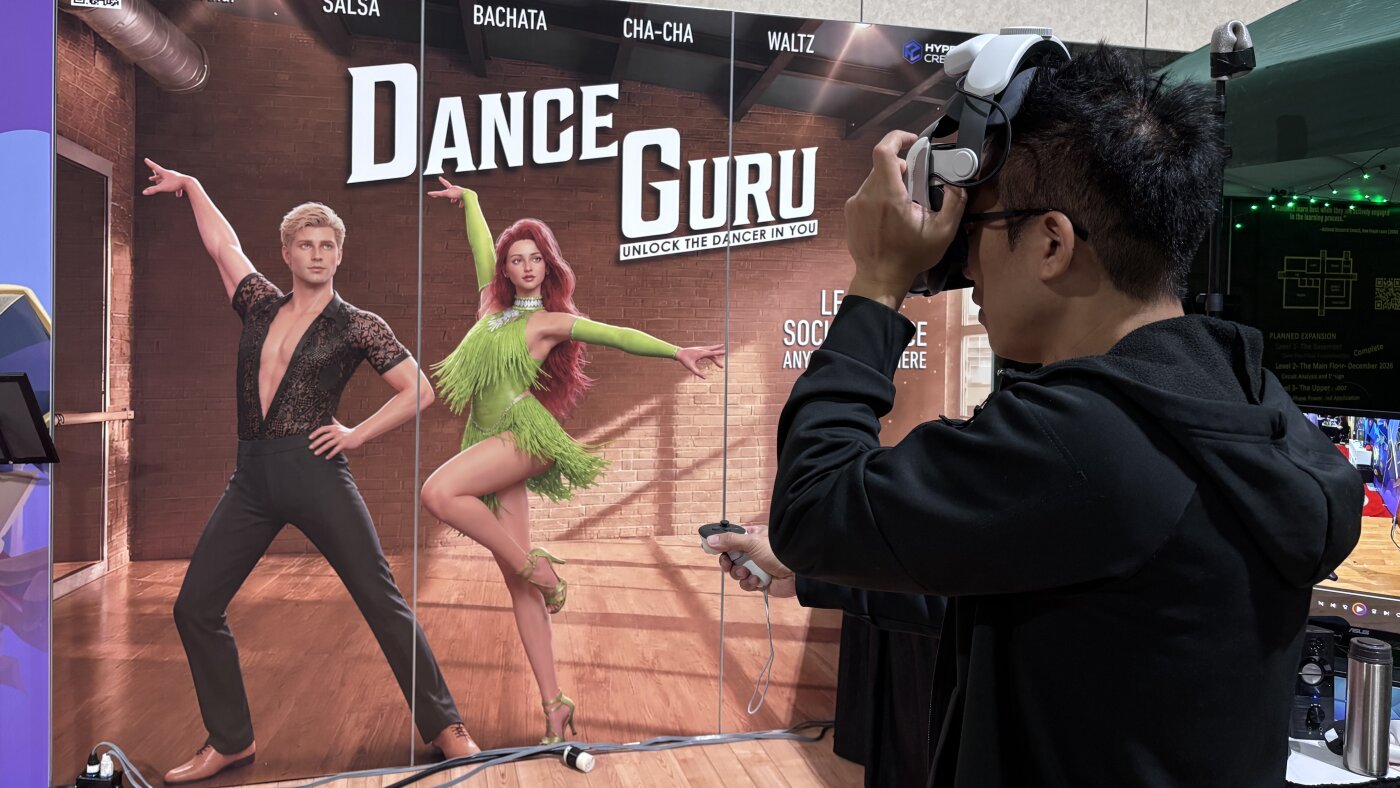
Entrepreneur David Huang tests out a VR headset while conducting demonstrations of the social dance lesson app Dance Guru at the Augmented World Expo in Long Beach, Calif., June 17, 2026.
Chloe Veltman/NPR
hide caption
toggle caption
Chloe Veltman/NPR
Wedding season is in full swing, bringing with it a familiar sense of dread for anyone who fears the dance floor.
But relief may finally be at hand with the help of a new app, Dance Guru, and a virtual reality (VR) headset.
The social dance instruction app transports users to a spacious, digital dance studio. Waiting inside is a computer-generated coach: a handsome, male avatar wearing a shirt open to his navel. He speaks with a slightly gravelly English accent.
“Watch me now,” he instructs at the start of a waltz lesson — which NPR tried out at the Augmented World Expo in Long Beach, Calif., an annual conference showcasing the latest developments in virtual and augmented reality.
The avatar then demonstrates a basic box step.

From there, the lesson becomes interactive. The coach tells the user to hold his hand while an electric pinging sound tracks the student’s foot placement.
“One, two, three, four, five, six,” the virtual teacher counts down.
When the user stumbles, he remains remarkably patient. “Do not worry, foundations take time. Let’s try that again. Work on grounding your steps more intentionally.”
Solving the beginner’s dilemma
Dance Guru creator David Huang said he came up with the idea for the app a couple of years ago out of frustration.
“I always wanted to learn to dance and I was always terrible at it,” Huang said. “And I always ended up stopping midway through the lessons.”
He soon realized that many beginners hit the exact same roadblocks.

“Private lessons are too expensive, and you feel like you’re always forgetting the dance steps,” Huang said. “You cannot find a partner to dance with. So I figured maybe I can create something like this.”
The Dance Guru platform currently offers tutorials in salsa, bachata, waltz, and cha-cha, in both lead and follow modes. To make the digital instruction feel authentic, Huang used motion-capture technology to record the movements of real-life dance teachers — with their permission.
Building on the legacy of online tutorials and video games
Dance Guru belongs to a small but growing wave of apps using VR to demystify social dance. At a nearby booth, conference attendee Victor Chen is testing out a competing app called Trip the Light. It currently offers salsa lessons, as well as freestyle options, where a user can dance with a partner without having to learn specific steps.

Trip the Light’s booth at the Augmented World Expo included posters of the app’s virtual instructors. Real-life performers, who gave Trip the Light permission to motion capture their movements, were used as a basis for these avatars.
Chloe Veltman/NPR
hide caption
toggle caption
Chloe Veltman/NPR
“A lot of times when you’re trying to learn a choreography, it’s watching a YouTube video and you have to pause it, rewind, and play it,” Chen said. “If you were to have a virtual avatar dancing in front of you and correcting for any parts that you missed, it might be a lot easier.”
Interactive video games like Dance Dance Revolution and Just Dance, and YouTube tutorials have been helping people improve their skills in private for years. But those games are mostly aimed at solo players. Unlike the new generation of immersive VR apps, they cannot simulate the mechanics or confidence required for partner dancing on a live dance floor.
The reality check
But this kind of app won’t work for every dancer.
“Everyone learns a little bit differently. And so unless you have a game that has lots of different ways of teaching, you’re going to have things that work for some people and don’t work for others,” said Ariana Katana, a trained contemporary dancer and dance content creator who’s active on YouTube, Twitch and other platforms. “Also, it’s hard to dance with a headset on.”
And then there’s the issue of not being able to physically feel a virtual partner’s hand or shoulder while dancing with them. Patrick Ascolese, the creator of Trip the Light, said the experience could become more tactile in the future. “Haptic suits and wearables will be coming, but I think we’re a little away from that,” he said.
Ascolese said even with their limitations, immersive tools like Trip the Light have immense potential as judgment-free training grounds — giving reluctant dancers the baseline confidence they need to eventually step onto the dance floor with real partners in the real world, including at weddings.
“Just like anything else, practice makes perfect,” said Ascolese. “So the more time you spend in VR with a virtual partner, it works towards helping you get over that social hurdle. We are teaching you the moves that you have to do in order to go out and have fun.”
Jennifer Vanasco edited the broadcast and digital versions of this story. Chloee Weiner mixed the audio.




For half a century, Deidre Hall has taken on every kind of disaster in the drama-packed town of Salem, Ill., as a star of “Days of Our Lives.”
There was the time — actually, it happened twice — when her character, Dr. Marlena Evans, was famously possessed by the devil and even levitated.

In Sunday Funday, L.A. people give us a play-by-play of their ideal Sunday around town. Find ideas and inspiration on where to go, what to eat and how to enjoy life on the weekends.
Or the time a serial killer, who was actually Marlena under hypnosis, seemed to kill several beloved characters. The long-running show’s storylines have become legendary, and in March, while promoting “Hail Mary,” actor Ryan Gosling even gave Hall a shout-out, admitting he was a fan, praising the hard work of soap opera actors and calling her an “OG acting inspiration.”
But Hall’s real life in Santa Monica is much quieter than her character’s, and she likes it that way.
“When I bought my house in Santa Monica, I didn’t realize how great it would be to live near Montana Avenue,” says Hall, 78, about the popular shopping spot. Every day, she walks to the main street with her golden retriever, Riley, and enjoys Pilates, art and good food along the way. “The owners of the Farms Market even keep dog biscuits, so guess where the dog wants to go every time we walk — the Farms, of course,” she says, laughing.
When she isn’t filming the daily soap opera, which airs on Peacock, Hall enjoys raising monarch butterflies, exploring the shops and restaurants on Montana, and hosting movie nights at home with her two sons.
Here’s what a perfect day in L.A. looks like for her.
This interview has been lightly edited and condensed for length and clarity.

7 a.m.: Breakfast and dog walk
I usually kick off my day with a protein shake, feed our golden retriever and take her out for a walk. She’s a phenomenal girl. When we adopted her, her name was Riley, but I did think about naming her after Mrs. Hughes from “Downton Abbey.”

10 a.m.: Church and garden time
After I walk the dog and go to church, I like to spend some time in my yard. I’m not a natural gardener, but I really enjoy it. I started raising monarch butterflies because my identical twin sister, who played my twin on the show, planted a butterfly garden. Monarchs are amazing because they are transitional. Every year, they travel from Mexico to southern New England, but it’s getting harder for them. Their numbers have dropped by about 80%. To help, I plant milkweed, which is what they need to survive. I buy my milkweed from the Staghorn Garden on Wilshire Boulevard in Santa Monica. Julie, who owns the nursery, is delightful and has a wide variety of milkweed. The monarchs always seem to find my garden. Julie was raising some caterpillars too, and she cared a lot about them. We talked about how important it is to help the butterflies. That’s why I do this. Sometimes I get milkweed with eggs already on it, and Julie knows her butterflies are going to a good home.

1 p.m.: Walk to Montana Avenue for some lunch
I live near Montana and love taking long walks, going to Pilates and trying out the great restaurants nearby, like R+D Kitchen and La La Land. I’m a big fan of the waffles at the Courtyard Kitchen. Just a few days ago, I had a chicken salad on raisin bread with an Arnold Palmer, and it was delicious. It is right on Montana and has a nice outdoor seating area. It’s one of my favorite spots. La La Land always has a long line in the morning, which is perfect if you want coffee. They serve coffee, doughnuts, croissants and avocado toast. There’s plenty of outdoor seating, and you can even bring your dog.

2 p.m.: Peek inside a clock shop
There’s a small clock shop on Montana Avenue that’s closed on Sundays, but if you walk by, you’ll see all kinds of clocks — standing, table and wall clocks. The owner is great at fixing them. Once, I bought a wall clock from MacKenzie-Childs, but it didn’t work. And I was really upset because it matched everything else on my countertop. I brought it to the owner and said, “I love this, but I can’t make it work.” He fixed it right away. His name is John, but I call him Geppetto. And we all know why. He really does have a magic touch.

2:30 p.m.: Visit a neighborhood art gallery
Ten Women Gallery is run by 10 artists, all of whom show their work there. I was drawn to some watercolors there, bought a few cards and spoke with one of the artists. She told me, “You seem to love watercolors,” and mentioned that the artist who painted them, Pamela Harnois, lives in Los Angeles and teaches nearby. I got Pamela’s name and found out she taught at the Brentwood Art School. I was so inspired by her gift that I started taking private lessons with her on Saturdays. That gallery is where I discovered my love for watercolor painting.

3 p.m.: Grab some ice cream at Rori’s
The other day, my longtime girlfriend wanted to get ice cream and told me, “We are walking to Rori’s Artisanal Creamery.” It’s a small shop on Montana near Lincoln. They make everything themselves, using local ingredients from grass-fed cows with no added hormones. The place is family-owned and probably has the healthiest ice cream you’ll find. They switch up their flavors often, but my favorite is the salted caramel.

6 p.m.: Family dinner and movie night at home
R+D Kitchen is always packed, so my sons, who are 31 and 33, do the cooking. They come over, and together we make salads and cook dinner. There’s a neighborhood grocery store called the Farms, off Montana, a small family-run place that has everything we need. Everyone knows each other there, and people bring their dogs. We try to have movie night every Sunday. Sometimes the day changes, but we always make sure to have one night a week where we cook a meal and sit down as a family. Keeping that tradition has become really important to us. My sons are great cooks, which is funny because they definitely didn’t get that from me. [Laughs]
9 p.m.: Take Riley for one last walk and visit neighbors
After dinner, I take my dog for a walk. It’s a great way to meet neighbors. We always go around the same block. We’ve met so many people, and since she’s a golden retriever, she loves meeting everyone.

10 p.m.: News, knitting and bedtime
I am a news junkie, so I usually watch whatever is on the news before I go to bed. I have a long-standing passion for knitting. Lately, though, the news would make me drop a stitch.
For Iris van Herpen, couture is a laboratory as much as a runway. Our chief fashion critic, Vanessa Friedman, takes us inside this Dutch designer’s latest Paris show — from sci-fi-inspired gowns to an audacious attempt at a dress made of charged plasma.
-

 Massachusetts7 minutes ago
Officials ID man and woman killed in Route 6 crash in Dartmouth
-

 Minnesota10 minutes ago
Minnesota weather: Warm Saturday with hotter days ahead
-

 Mississippi15 minutes ago
Tracking Mississippi State baseball players, signees picked in 2026 MLB Draft
-

 Missouri22 minutes ago
Missouri pushes for more nuclear energy to power the future
-
Montana25 minutes ago
Montana Lottery Mega Millions, Big Sky Bonus results for July 10, 2026
-

 Nebraska30 minutes ago
Nebraska has two players honored by the Big Ten Conference on Thursday
-

 Nevada37 minutes ago
Planetary parade this weekend — when to see it in Northern Nevada
-

 New Hampshire40 minutes ago
9 Most Hospitable Towns In New Hampshire

