Lifestyle
Meow Wolf supercharged the way we experience art. Is L.A. ready for the wild ride?

A Meow Wolf exhibition is designed as a dream space, a walk-through floor-to-ceiling collection of psychedelic art with a sci-fi bent and an anything-goes, punk rock spirit.
Apples that melodically squeal when squeezed? One can find those in “Omega Mart,” Meow Wolf’s Las Vegas exhibition. A video game that grapples with an uncompromising, impossible-to-please parent? Head to “The Real Unreal” outside Dallas. A neon-soaked forest in a suburban backyard? That originated in Meow Wolf’s Santa Fe, N.M., home.
“We are undefinable in so many ways, and it makes people think, ‘It’s just entertainment,’” says Meow Wolf curator Han Santana-Sayles, 31, sitting in her newly rented Pasadena home. “But I truly believe we are a wild art experiment.”
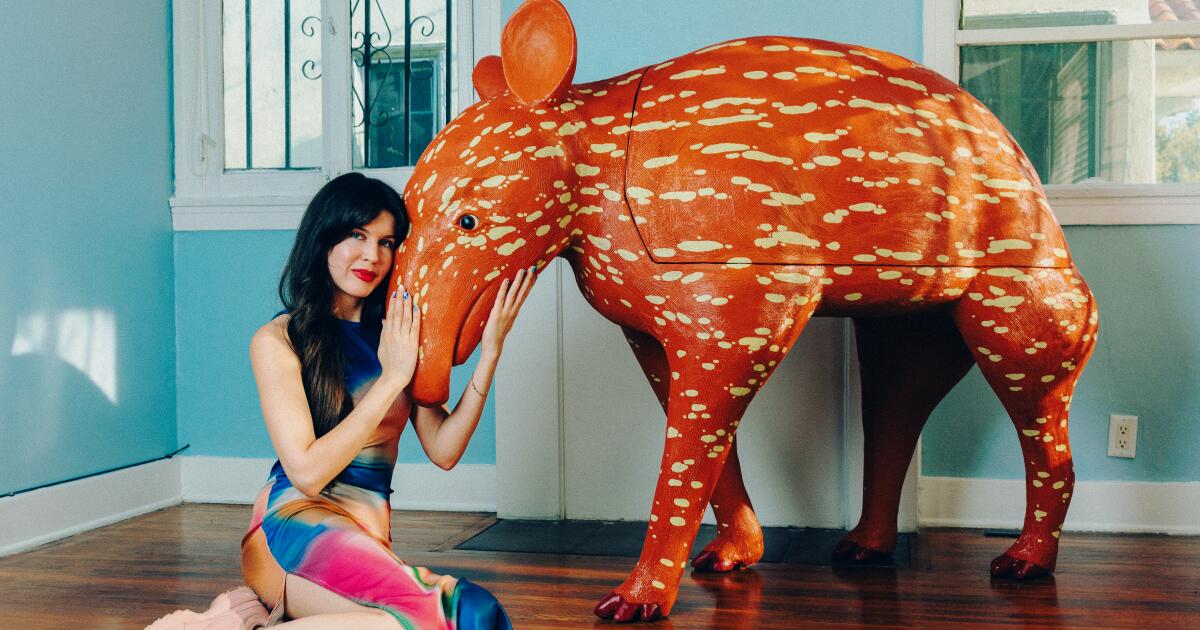
Pasadena-based Han Santana-Sayles recently returned home to SoCal to help curate Meow Wolf’s in-development West L.A. location. The centerpiece of her family room is a desk fashioned to look like a tapir, created by artist Miles Robinson.
(Ethan Benavidez / For The Times)
Meow Wolf spaces, of which there are currently four open, are warped visions of reality, designed to get guests to see the world, and hopefully themselves, differently. They’re spots where the familiar — think a grocery store or a home — is used as an entry point to otherworldly, maximalist art that’s at once a fantastical twist on nature and a deep dive into why-are-we-here philosophies.
So what happens when Meow Wolf decides that its next place of expansion is the home of American make-believe?
Meow Wolf is coming to Los Angeles, and it aims to turn our city’s most ritualistic experience — that is, the act of going to the movies — into an interactive, art-driven wonderland.
The Santa Fe-based art collective-turned-capitalistic enterprise — leaders of the so-called “experience economy” — is in the closing round of negotiations that will bring a Meow Wolf exhibition to West Los Angeles, with an opening targeted for 2026. Meow Wolf will be taking over a vacant movie theater complex and intends to fully embrace the spot’s cinematic roots. Meow Wolf’s move into its largest market yet is intended as a statement piece, a declaration that weirdness and art-focused ventures still have a place in an immersive economy that’s been racked by closures and layoffs, Meow Wolf included.
“A movie theater is representative of the history of L.A., a city that has been known for over 100 years with Hollywood and moviemaking,” says Meow Wolf Chief Executive Jose Tolosa. “I think the location we picked is one of the components that embodies the richness and the history of the city, and the artistry of the city.”
Anticipate multiple rooms of narrative-based art that strive to test perceptions, grappling with not only the stories we tell one another but why we tell them, says co-founder Sean Di Ianni, 39, who is overseeing the L.A. project.
If Disney and Universal theme parks ask us to “ride the movies,” Meow Wolf will be challenging guests to question their communal power, exploring, via hallucinatory art, the minds of those who make them, sell them and love them. Expect it all to be delivered with hints of mysticism, as Meow Wolf artists will dabble in themes of ritual and religion.
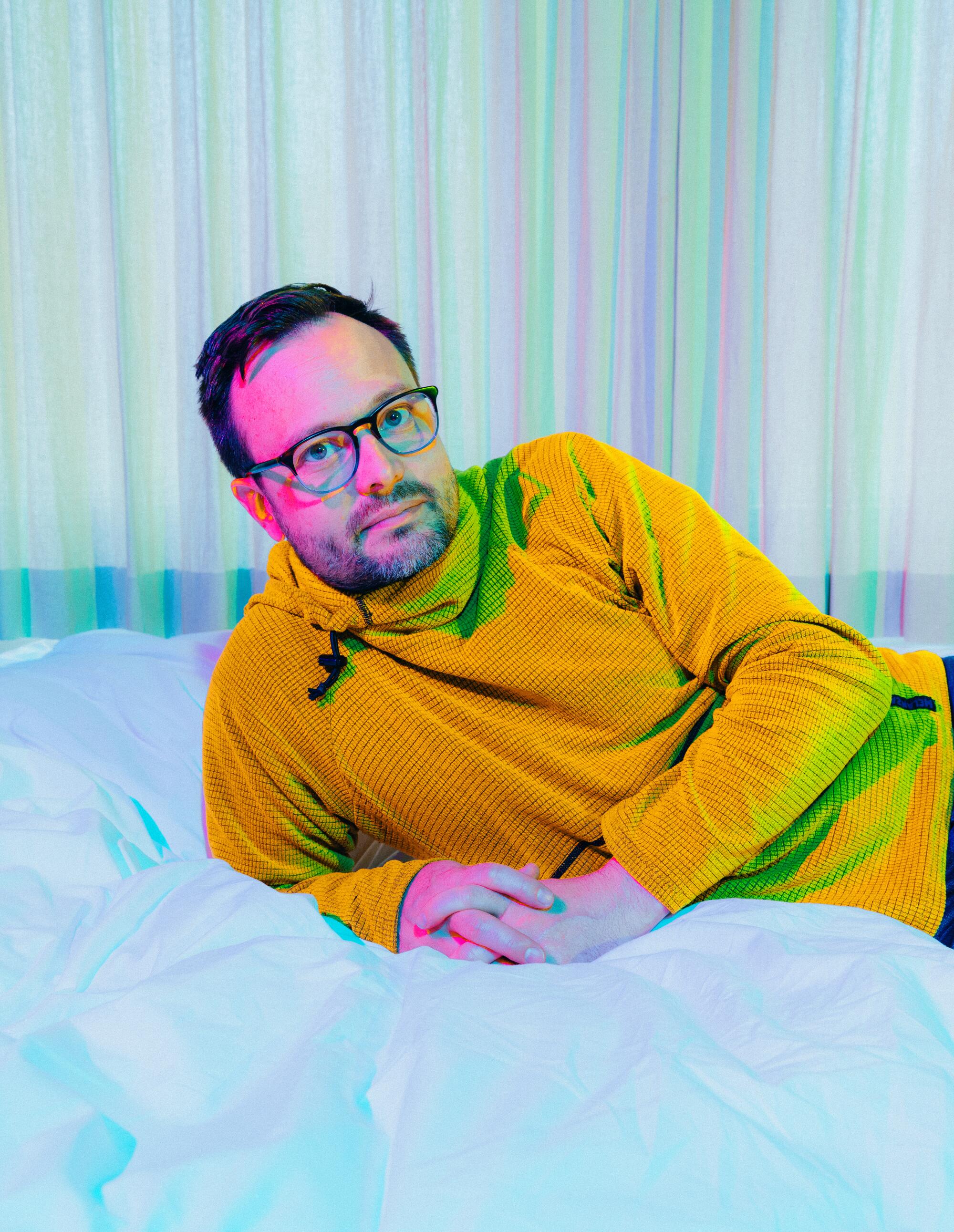
Meow Wolf co-founder Sean Di Ianni says the L.A. locale will explore the communal power of film.
(Ethan Benavidez / For The Times)
Like past Meow Wolf exhibitions, a significant number of installations will come from the local art community. Santana-Sayles, a Murrieta native who now resides a few blocks from where her grandmother once lived, will lead the outreach into L.A.’s art world, a process that is in its infancy. A Meow Wolf exhibition is a mix of elaborately designed environments and commissioned works from artists who reside in the host city.
“I’m looking for a super broad range,” she says. “I want to include people who do wild projection mapping. But I also want to find people who do just pastels — really, really well. Or they’re painters. Or they draw. They’ve homed in on this one thing. We don’t want it to read as a theme park. We’re a contemporary arts platform.”
I want to include people who do wild projection mapping. But I also want to find people who do just pastels — really, really well. Or they’re painters. Or they draw.
— Meow Wolf curator Han Santana-Sayles
And yet the company’s rise from experimental art collective in 2008 to an “experience economy” corporation has been meteoric, attracting creative talent from theme park giants such as the Walt Disney Co. and NBCUniversal. It has been embraced by the likes of the Themed Entertainment Assn., and Meow Wolf’s play-focused, active approach has shifted the industry, encouraging environments with multiple access points that increasingly push guests to lean in and participate.
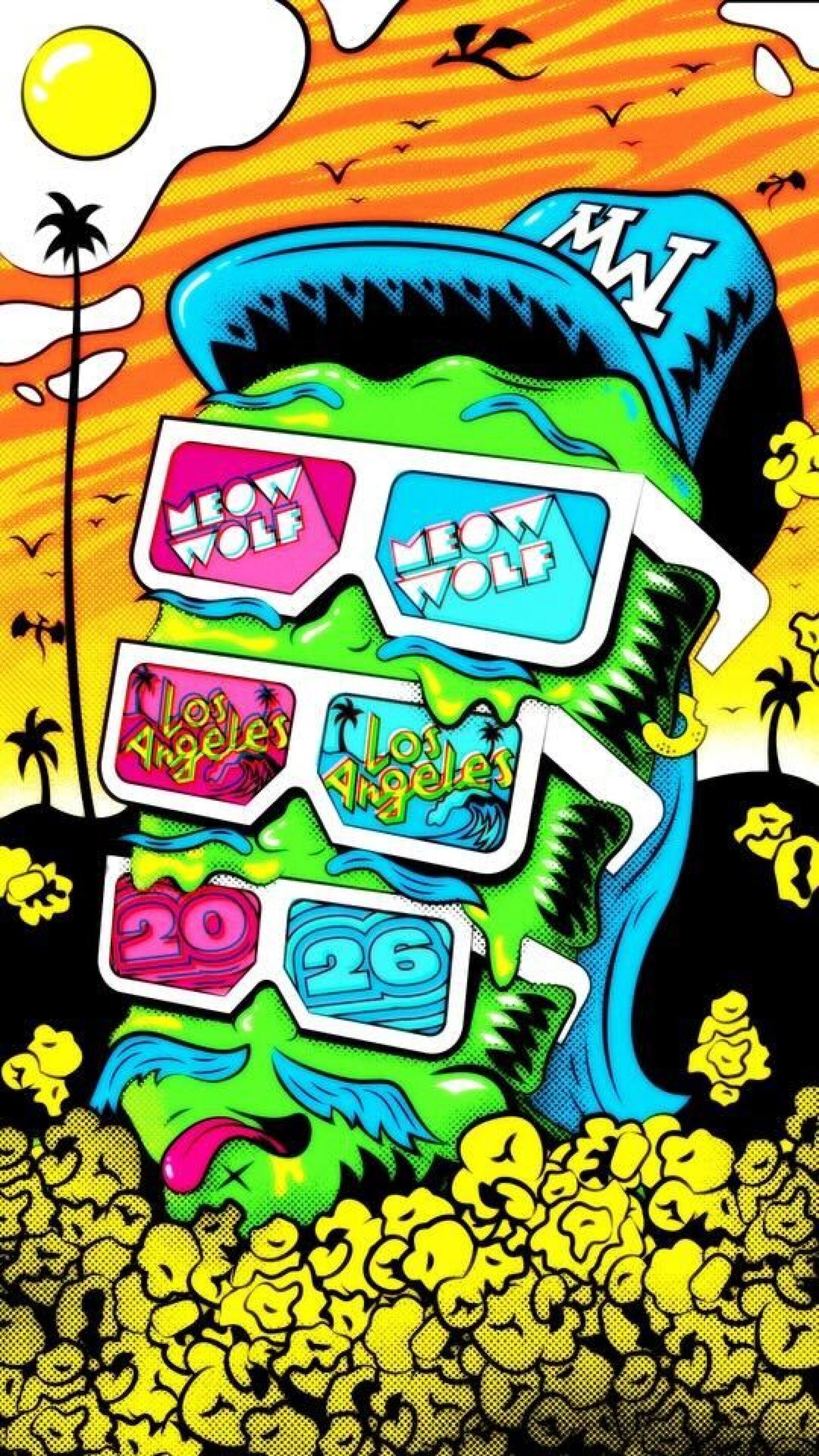
Meow Wolf’s poster art for its in-development West Los Angeles space.
(Meow Wolf)
Meow Wolf’s roots in underground art and its penchant for flirting with popular culture have resulted in a specific kind of tension. Meow Wolf is a corporation, but one that staunchly believes in original intellectual property. Meow Wolf stands by the power of the individual creator, having long supported independent muralists, game designers or sculpture artists, but it also traffics in interconnected storylines that require the sort of environmental storytelling defined by Disney’s theme parks.
Its ambitions are high art, but it’s also extremely populist. And that says nothing of Meow Wolf’s outspoken penchant for progressive politics. Melding all of this with a capitalistic enterprise could seem like a contradiction, but it also feels uniquely fit for Los Angeles.
“I love the chaoticness of it,” Santana-Sayles says of Los Angeles. “I love that yesterday I was on the street and someone was flipping a sign, really incredibly. He had a Walkman on and was doing a dancing Jesus sign movement. On the other corner was a juggler, a Cirque du Soleil-qualified juggler. Then on the other side of the street was a kid skateboarding with a dog under his arm.
“It’s an active, creative, chaotic mix of things,” she says. “It feels like art.”
The Los Angeles announcement arrives at what has become a reflection point for the immersive community.
Meow Wolf, along with long-running New York-based theatrical production “Sleep No More,” defined the immersive space. Since 2016, when the once-scrappy Meow Wolf art collective opened Santa Fe’s “House of Eternal Return,” the company has welcomed about 10 million visitors across its four venues. Yet in April Meow Wolf announced it would cut 165 employees; exhibitions in Denver and Las Vegas were heavily affected. “Sleep No More,” meanwhile, which has been running since 2011, will end this year.
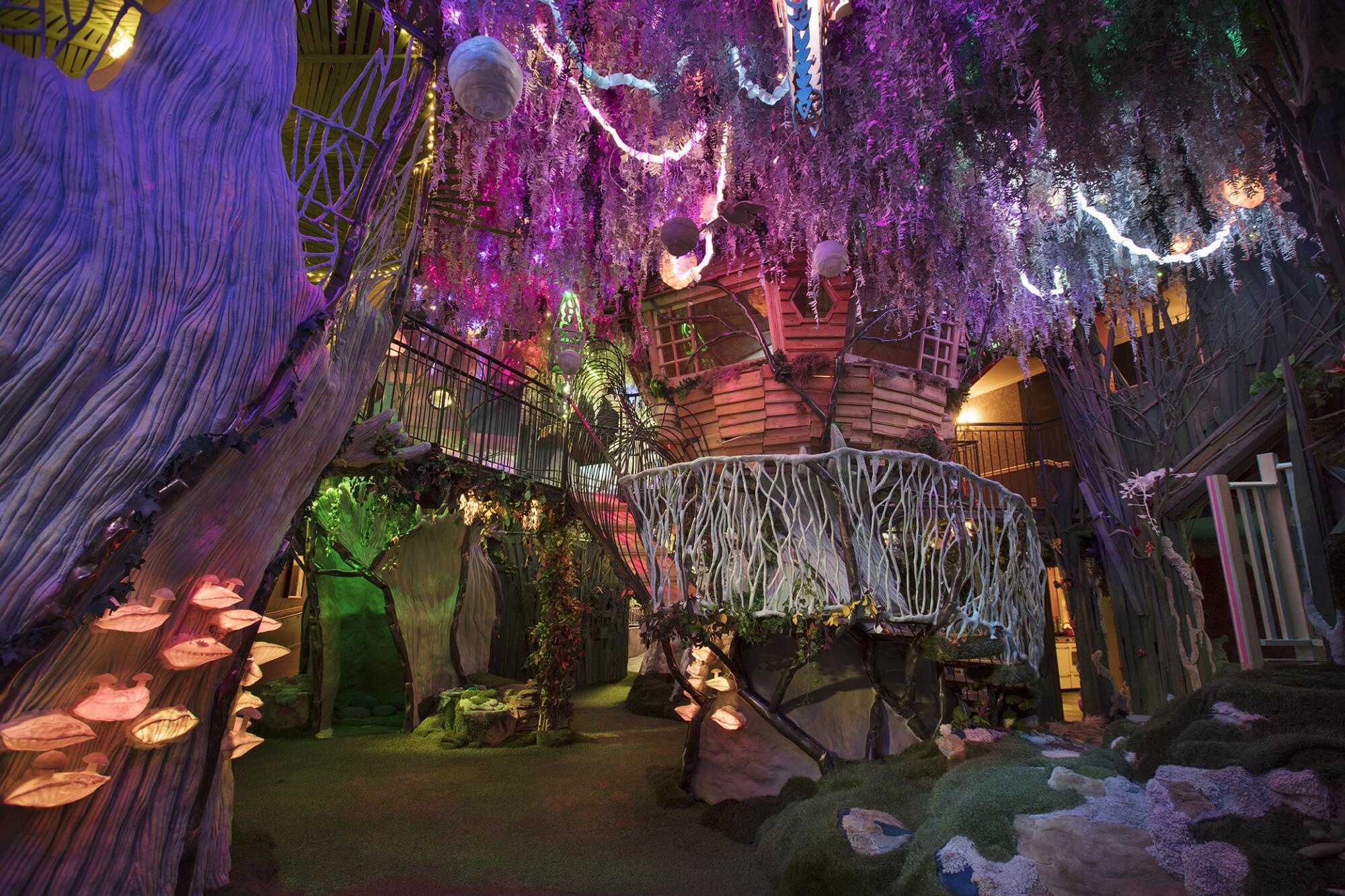
A suburban house leads to a fantastical twist on nature at Meow Wolf’s “House of Eternal Return” in Santa Fe, N.M.
(Kate Russell / Meow Wolf)
The two spawned an industry of interactive, social media-primed spaces, one that saw the rise and fall of everything from projection-based exhibitions such as “Immersive Van Gogh” to Lost Spirits, a heavily themed Las Vegas rum distillery with circus trappings, which just shuttered. The Walt Disney Co. even got in on the action via the Star Wars: Galactic Starcruiser, a two-day live-action role-playing game that utilized a mobile phone app to drive gameplay with real-life actors and sets. It lasted about a year.
Meow Wolf’s Tolosa pins the recent layoffs on two factors. One, he says, the company has become better at understanding its staffing needs, having opened a Denver exhibition with more than 300 employees. Last year’s “The Real Unreal” in Grapevine, Texas, in contrast, launched with a staff of around 100. He also notes that attendance tends to peak from a period of opening to around 18 months after, necessitating that the company adjust its models.
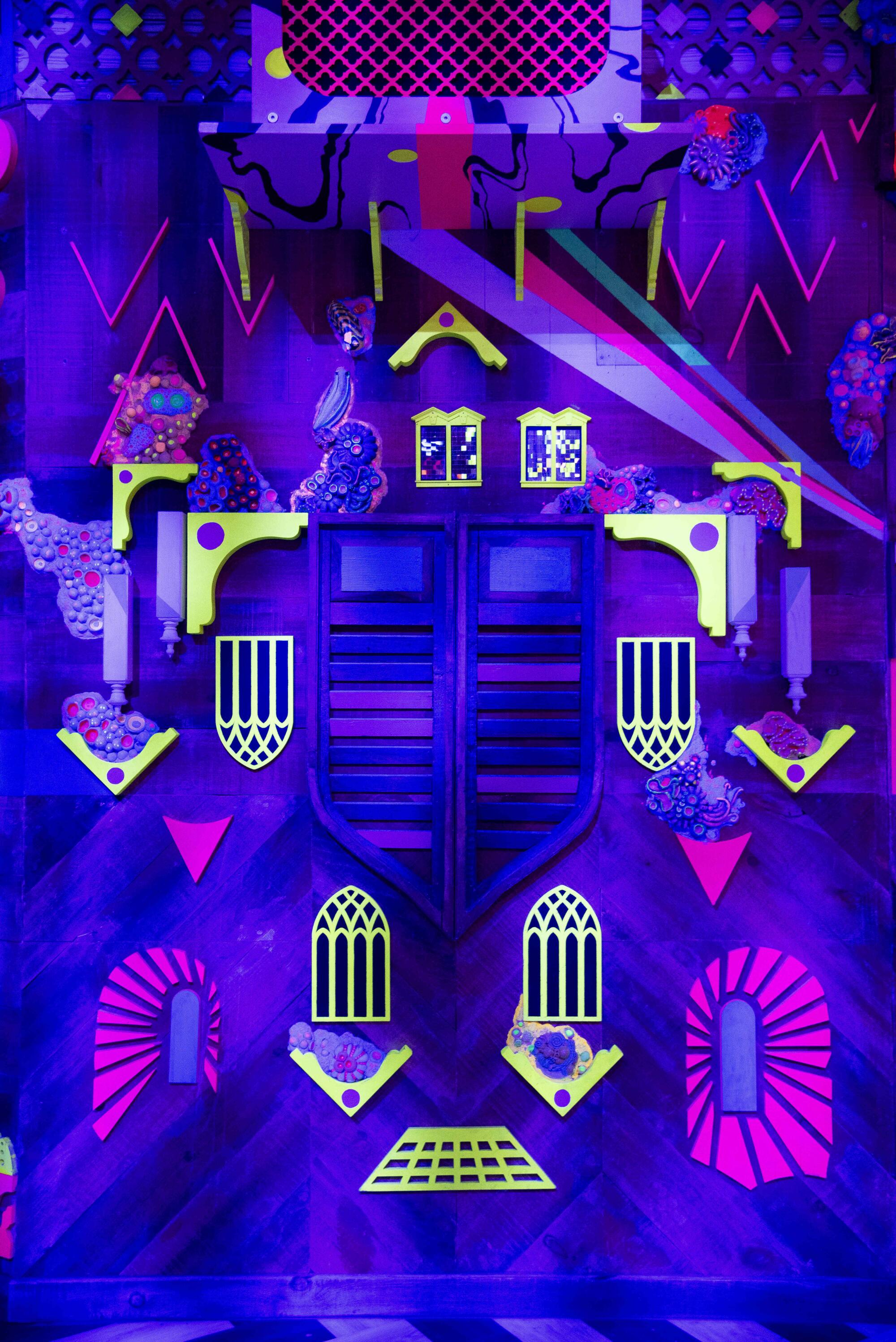
A fixture in a neon city at Meow Wolf’s “The Real Unreal” in Grapevine, Texas.
(Emil T. Lippe / For The Times)
“We remain committed to a growth path,” Tolosa says. “Not only in L.A. but beyond. We’re already looking into other cities.” Tolosa adds that Meow Wolf is continuing to build an app that will connect all of its exhibitions, and is exploring other mediums such as gaming.
Meow Wolf, says Noah Nelson, founder of immersive entertainment site No Proscenium and its accompanying conference, is still one of the most recognizable names in the sector. While the layoffs raised eyebrows, the pledge to future exhibitions is an argument that the audience isn’t eroding.
“Meow Wolf represents the paradox,” Nelson says.
“It was born from a wild artist collective that created these family-friendly psychedelic sandboxes,” he says. “It morphed into a business that became increasingly a business and is still trying to hold onto that family-friendly psychedelic sandbox energy. It’s still trying to maintain its soul. That’s a tightrope that is very hard to walk, and it has at times been downright scary to watch them walk it. The upside is that they’re still walking it.”
Meow Wolf represents the paradox. It was born from a wild artist collective that created these family-friendly psychedelic sandboxes. It morphed into a business that became increasingly a business and is still trying to hold onto that family-friendly psychedelic sandbox energy.
— Noah Nelson, founder of immersive entertainment site No Proscenium
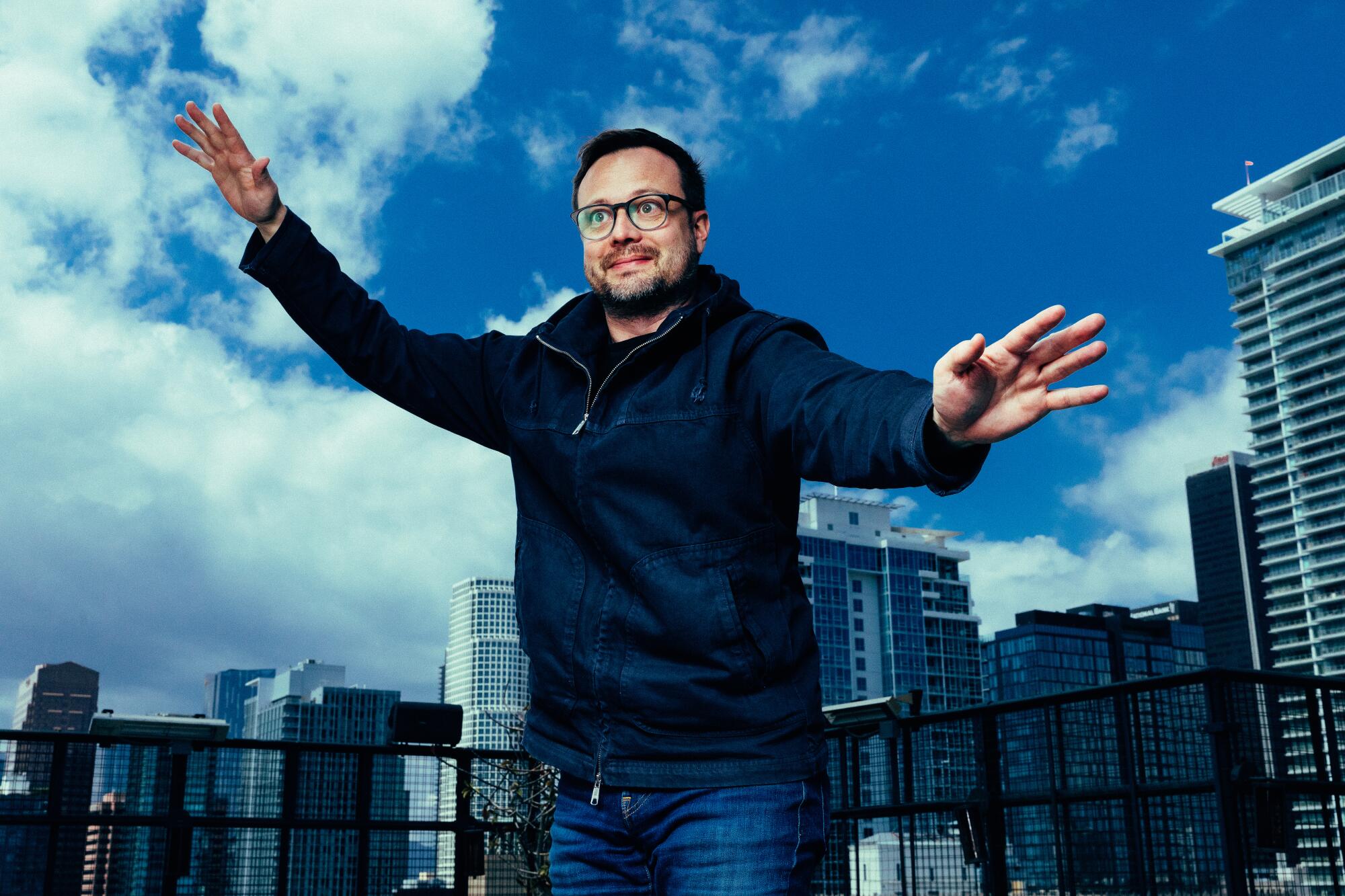
Meow Wolf’s Sean Di Ianni has seen the art collective through ups and downs. “I’ve felt the pain, the struggle, the beauty and the mystery and magic in all different ways,” he says.
(Ethan Benavidez / For The Times)
Di Ianni helped grow Meow Wolf from an artist community into a corporation.
“I’ve been on all sides of this,” Di Ianni says. “I’ve created things. I helped organize things. I helped form the business. I’ve conducted layoffs myself. I’ve felt the pain, the struggle, the beauty and the mystery and magic in all different ways. It’s still happening. We’re still experiencing it. People, sometimes people who weren’t around for it, think of the early days as some utopian fantasy. It wasn’t that. It was a chaotic, anarchic mess.
“I guess what I’m saying,” he says, “is it’s always been a struggle.”
Di Ianni and Santana-Sayles hope Los Angeles will be a point of healing. After all, it just may be Meow Wolf’s most personal artistic statement yet.
The large thematic touchpoints for what would become Meow Wolf’s L.A. space were sketched out about two years ago. Many of them originated with Matt King, whom Di Ianni credits for leading a significant portion of Meow Wolf’s philosophical bent. King died by suicide in July 2022.
While Di Ianni is keeping much of the narrative a secret, he said the team envisioned as its setting “a world at a distant crossroads” in the midst of some sort of ritual. “What if this place we’re creating has some event that occurs, and people are drawn to this event the way people are drawn to a panda being born at a zoo?” Di Ianni says.
Santana-Sayles digs deeper.
She was King’s fiancée at the time of his death, and at various points a conversation with her delves into a discussion on how to process grief. An art piece of King’s, a woven portrait of flowers, sits in her living room waiting to be hung. After his death, she says, she made the decision to return to L.A. to be closer to her family. That Meow Wolf would center its next project here became a fortunate coincidence.
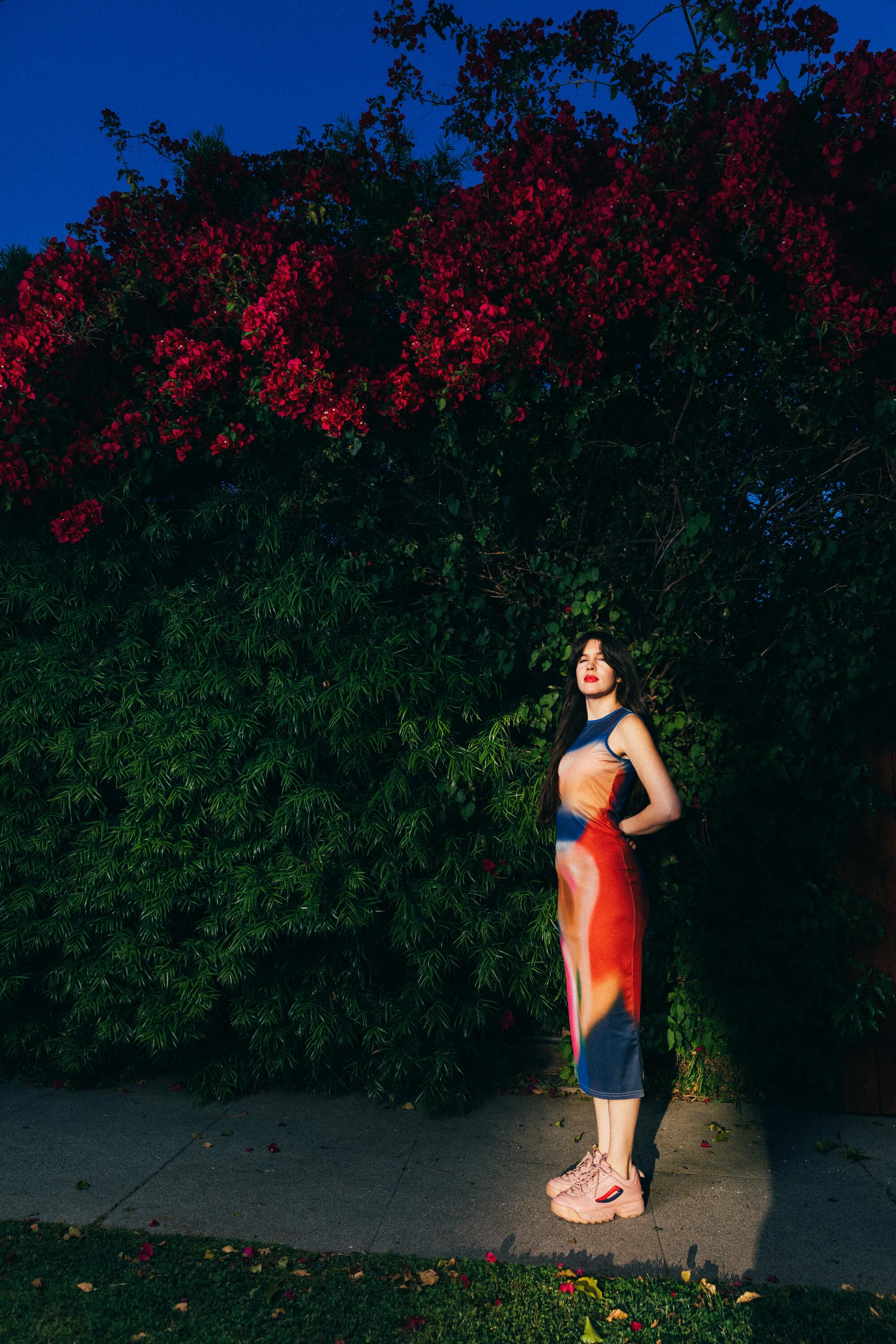
Han Santana-Sayles is eager to work on an exhibition in her home region. “I love the chaoticness of it,” she says of Los Angeles.
(Ethan Benavidez / For The Times)
“It’s so hard to be split from people,” she says of the last two years of her life. “They become you, and you become them.”
She takes comfort in being able to bring one of King’s final Meow Wolf ideas to fruition, and she and Di Ianni speak of wanting to protect what King was envisioning. “It’ll be harder for me to work on a Meow Wolf that he had nothing to do with,” Santana-Sayles says. “That won’t be far off. It’s the project after this. That will be way more challenging for me. I feel like I still get to hold his hand.”
When discussing some of the themes for the Los Angeles exhibition, she heads to her bookshelf and digs out a stack of King’s books, specifically ones he was reading in the last year of his life. King, she says, was becoming heavily fascinated with theories that interwove astrology and the Bible.
“He would come to dinners and say, ‘I’m so excited to tell you that this chapter of the Bible is actually parallel to this incredible spring equinox and the equinox is a metaphor for the way Moses parted the sea,’” she says. “I thought Matt, frankly, was sometimes extremely discerning about his sources and sometimes not at all. He would flip between different texts — historic texts, and then things that were on the verge of conspiracy theory. He just wanted to absorb.
“This exhibit,” Santana-Sayles says, “I do think, in the funniest way, grapples with big mystical and religious questions. Not overtly, but in a way people will read themselves into. I think there’s a lot to be explored there.”
Santana-Sayles and her team will have a significant say in how. It’s early days but she’s in the midst of working with consultants to create demographic surveys of Los Angeles, striving to ensure the exhibit will fully represent the diversity of the region. As a SoCal native from a Mexican American family, Santana-Sayles says, “I would be dishonored” if the exhibit failed in its mission to capture the breadth of the L.A. population. A cultural engagement specialist has been hired for outreach to Indigenous artist groups.
“It’s really important to make that intentional,” she says. “I’m not just going out and saying, ‘They have art I like. I’m going to bring them in.’ It’s a combination. Yes, they’re an amazing artist, and they have a really important story for this region.”
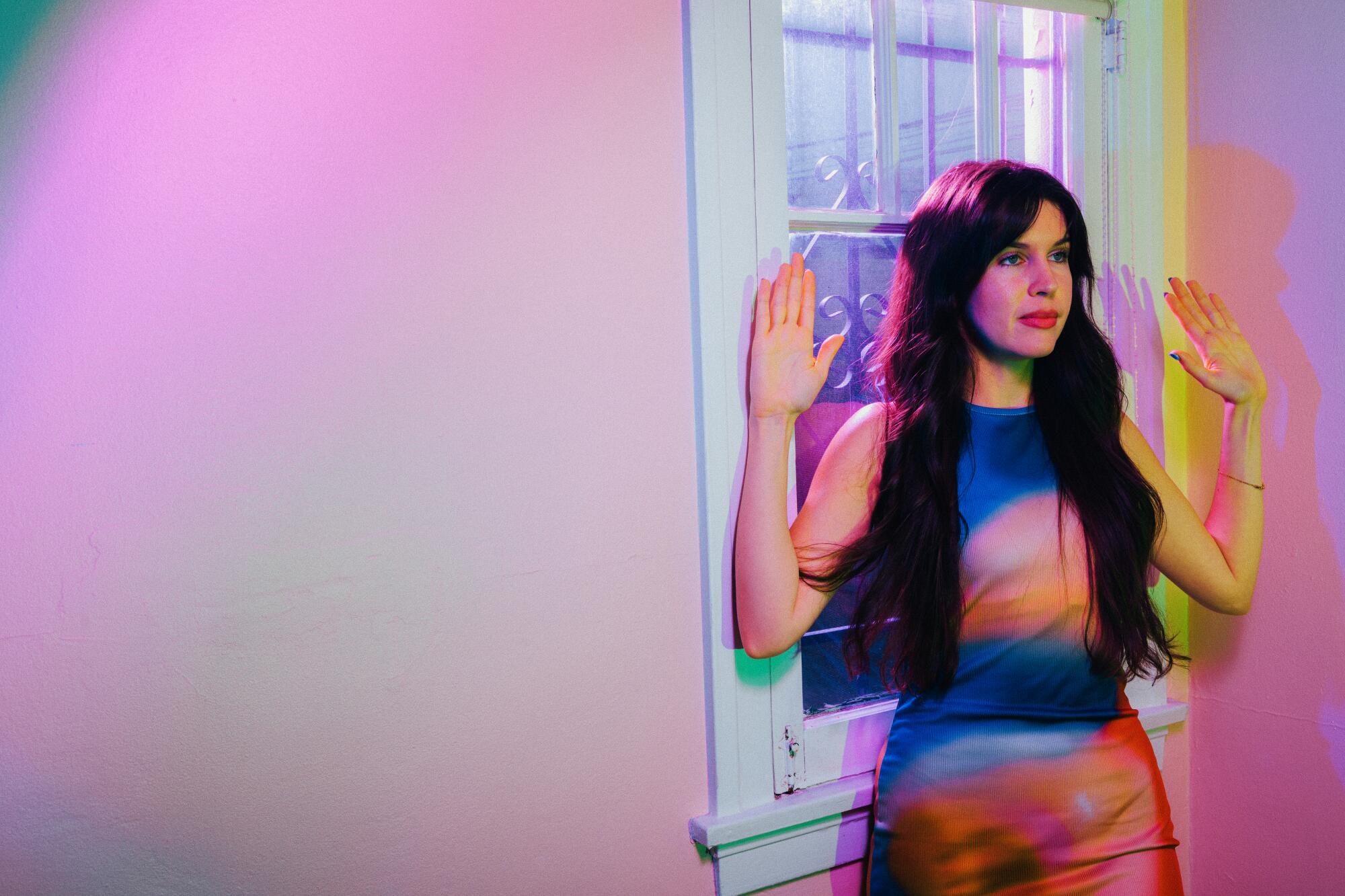
Han Santana-Sayles will be leading Meow Wolf’s outreach to the L.A. art community. “It has to be immersive in some way that playfully subverts reality,” she says, when asked what she’s looking for.
(Ethan Benavidez / For The Times)
Santana-Sayles is asked what makes a Meow Wolf artist. It’s not always an easy answer. In Grapevine, for instance, “The Real Unreal,” housed in a former Bed Bath & Beyond, is centered around a family story of grief. On a tour of the space last summer, many of the locally commissioned pieces appeared designed to celebrate community and healing, be it a calming tower of reflective geometric shapes that feels like a place of worship, or murals that reference Greek mythology and hint at being at an emotional crossroads.
“We’re really looking for experiential art — it has to be immersive in some way that playfully subverts reality and that thematically connects with what we’re doing as a whole with the exhibition,” Santana-Sayles says. Then she references works from other Meow Wolf exhibitions.
“There’s so many different ways to do that,” she continues. “Ways people do that are with materials, characters and concepts. We have people doing Indigenous futurism. We have people working with only trash art, reconstructing everyday items. We have people making completely different planets that have their own interesting logic. The umbrella feels quite broad, but that’s really what I’m trying to find. I’m looking for people who have a really defined sense of what they do.”
Regardless of what is conceived, don’t assume a passive experience. The Meow Wolf design philosophy is one that’s based on active participation by the guest, a shift from less assertive forms of entertainment of yore, be it a museum or the early days of theme parks. Stray, not-so-hidden paths and an assortment of nooks dot a Meow Wolf exhibition, inviting guests to choose their own narrative. Story threads are peppered throughout. “Omega Mart,” for instance, grapples with environmental distress and corporate responsibility.
Meow Wolf’s West L.A. theater, says Di Ianni, also will be built for discovery. The byzantine paths and shifts in art direction are what he refers to as “good mystery confusion.”
“That was one of the challenges of using a movie theater as a point of entry,” Di Ianni says. “It’s passive. But there are stories told in movie theaters, and then there are stories of movie theaters and stories of the people who work at movie theaters. But when you get into that auditorium, it’s meant to be a blank space where stories are told. It’s a little meta. This is a storytelling space about storytelling.”
For those looking for further hints as to where the Los Angeles exhibition may veer, Di Ianni mentions that he and the team back in Santa Fe soon will be doing a group watch of Wolfgang Petersen’s “The Neverending Story.” The 1984 film is a fantastical work about the beauty of our imaginations and how art can bring dreamlike worlds to life.
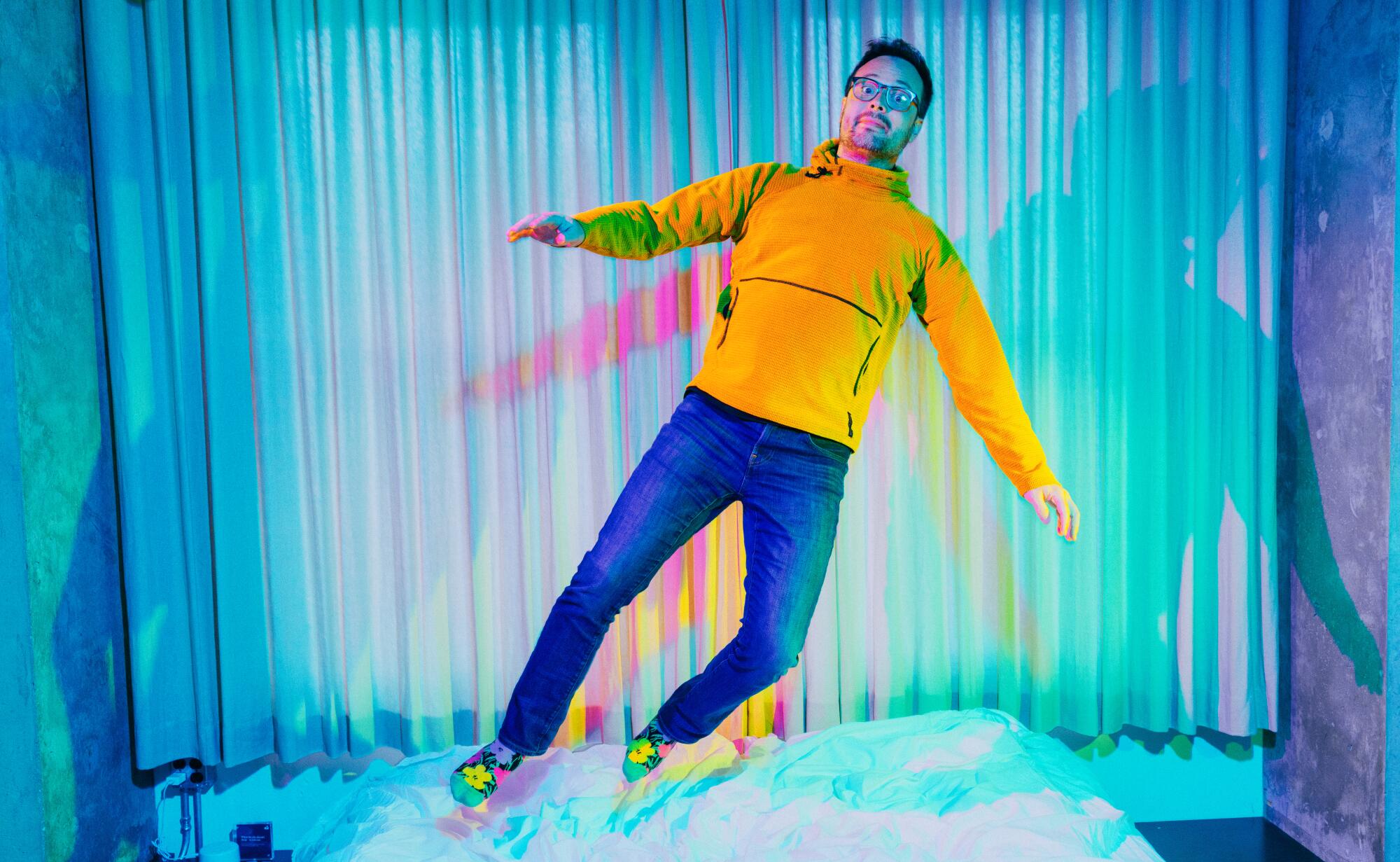
Sean Di Ianni, based in Santa Fe, N.M., says Meow Wolf’s L.A. location will be “a storytelling space about storytelling.”
(Ethan Benavidez / For The Times)
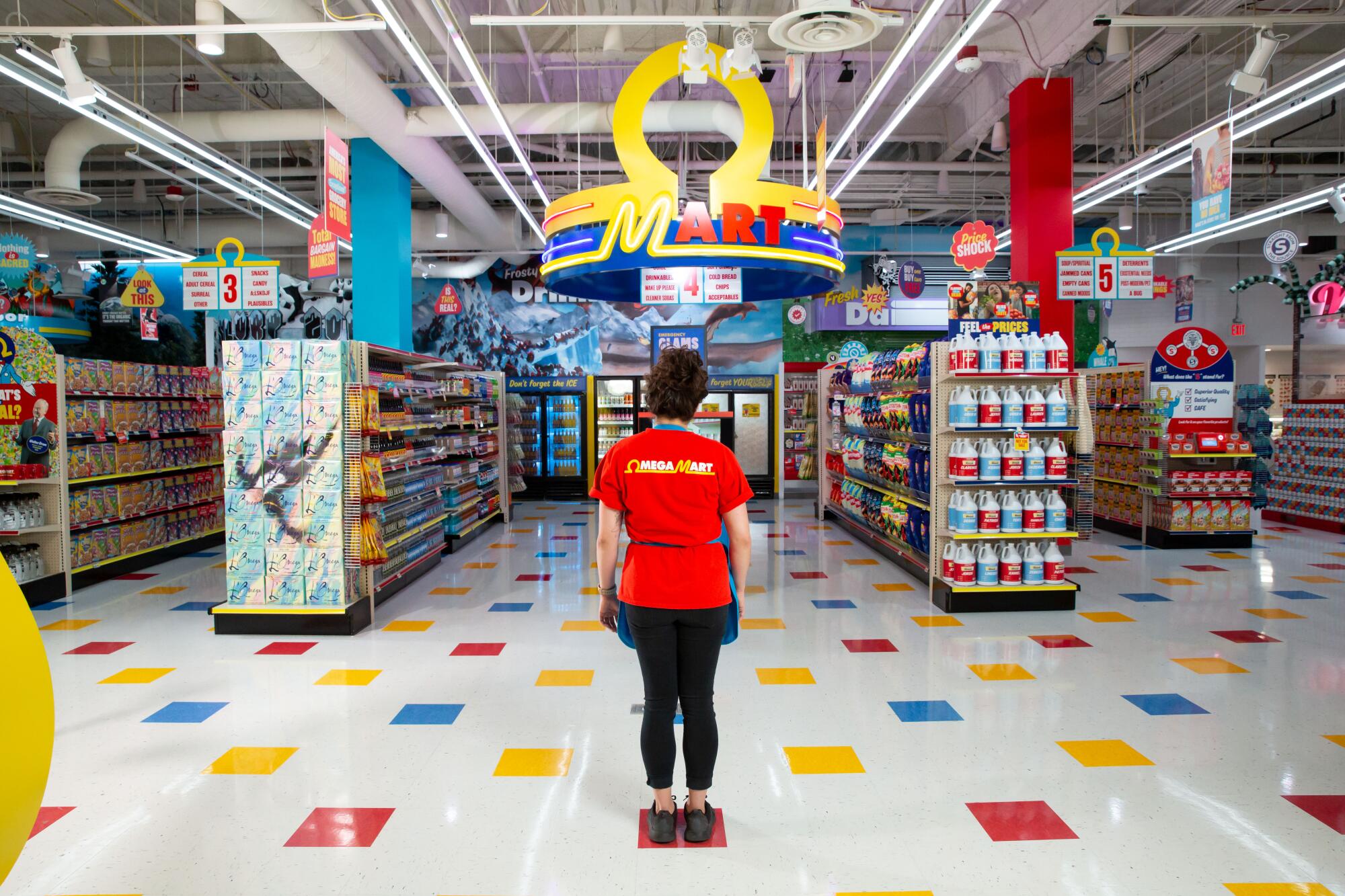
At Meow Wolf’s “Omega Mart,” guests first enter a satiric take on a grocery store, where portals lead to otherworldly art exhibitions.
(Christopher DeVargas / Meow Wolf)
And that’s ultimately fitting for a Meow Wolf exhibition. While there are narrative threads and elaborate ideas, Meow Wolf spaces are essentially places of wonder, where dozens of disparate artists come together to create something akin to an explorable fairy tale.
“We can’t control whether you decide to change your perception of the world, or change yourself or change the world,” Di Ianni says. “But we can set up the conditions for people to have a little more access to that possibility. It’s very high-minded and very activist in a way. That’s what art and entertainment does. That’s why we go on vacation. That’s why we go to Disneyland. We want to see the world differently. We want to open up possibilities.”
Meow Wolf’s exhibitions have always been theaters for fantasy, centering the guest as the performer. Eventually, they were bound to find themselves in a city whose primary industry is known for creating dreamers.


The Kennedy Center, the facade of which remains covered with a tarp, is seen in Washington, DC, on June 28, 2026. A US federal judge asked on June 24 for an explanation for why a tarpaulin continues to cover the facade of the Kennedy Center where President Donald Trump’s name was recently removed. District Judge Christopher Cooper gave the board of trustees of the performing arts venue until the end of July to explain “the purpose for and status of the tarp and scaffolding that Defendants have erected on the front portico of the Center.”
ALEX WROBLEWSKI/AFP via Getty Images
hide caption
toggle caption
ALEX WROBLEWSKI/AFP via Getty Images
More than two weeks ago, President Trump’s name was removed from the Kennedy Center facade though it is still covered by a tarp and the legal battle continues.
On Monday, a U.S. Department of Justice filing on behalf of the Kennedy Center included some surprises. The document was submitted in response to issues raised by lawyers for ex-officio board member Rep. Joyce Beatty of Ohio who is suing to remove President Trump’s name from the center and stop its closure for renovations.
Among the revelations, the Kennedy Center admitted that, during a board meeting on December 18, 2025, Beatty had been “muted and prevented from speaking.” It was at that meeting that the board voted to add President Trump’s name to the center. The filing later acknowledges the congresswoman was “prevented from voicing her opposition.”
The John F. Kennedy Center for the Performing Arts is a living memorial to its namesake. The guidelines for how the theatre complex spends federal dollars are very specific. Among other rules, it states that “no additional memorials or plaques shall be designated or installed.” Beatty argues adding Trump’s name runs afoul of those rules and that any change requires approval from Congress.
According to one of Beatty’s filings, “There was no advance notice in the agenda that the Board would be considering a name change,” a statement the Kennedy Center now does not deny. The center admits that, prior to voting, there was “no discussion about potential risks or downsides of the vote to adopt a secondary name for the Center.” Nor was there a board discussion “about any potential conflict of interest that might result from the vote.”
The center’s lawyers previously contended that if Trump’s name were to be removed, it would “lose money from donors who support” him and “impede the Center’s fundraising efforts.”
Closing for renovations
Earlier this year, Trump announced on social media that the Kennedy Center would close for two years for renovations. He wrote that he made the decision after “a one year review” with “Contractors, Musical Experts, Art Institutions, and other Advisors and Consultants.”
But, according to the center’s lawyers, Trump’s announcement “was made without presenting any plans, analyses, timelines, or funding information to his cotrustees and without any Board vote.”
The Kennedy Center has long denied reporting by The Washington Post that ticket sales plummeted after President Trump became the Center’s board chair. In Monday’s legal filing, the Center admits that, by October 2025, “nearly half of the Center’s tickets were going unsold.”


Paul Tremblay has made a career of pushing the horror genre – and the novel format – in strange and exciting new directions.
In his latest, Dead but Dreaming of Electric Sheep, the author offers an amalgamation of genre elements that can be best described as psychological-dystopian-science-fiction horror. It’s a mouthful, but the narrative does all of that and more in a way that defies categorization.
Julia Flang is a former semiprofessional gamer working two mediocre jobs she dislikes and living in a modest ranch house in a San Fernando Valley suburb with her retired uncle, whom she calls Uncle Fun. Julia likes movies and gaming but there’s little else going on in her life, so when her estranged mother, the CFO of a large tech company, contacts her with a possible job offer – a “once-in-a-lifetime thing” that pays handsomely just for doing the interview – she hesitantly agrees.

The job is relatively simple and perfect for someone with gaming skills: using a controller built into a phone to get a man, who is stuck in a vegetative state, from California to the East Coast. It will require her to learn how to control his body – walking, moving, sitting, standing, using his arms – so she can maneuver him out of the facility where he is located and into cars and planes and through crowded airports. A fan of movies, Julia decides to call the man Bernie – after the movie Weekend at Bernie’s. When the ethics of the job start to bother her, Julia realizes it’s too late and she must go through with it. However, she’s soon contacted by people interested in sabotaging the whole thing, people who, like her, don’t align with the shady interests of conglomerates and those set to make “gobs of money” from this new, somewhat inhuman technology.

As with every Tremblay novel, any synopsis barely scratches the surface. The novel’s chapters alternate between Julia and you (yes, you). Julia’s chapters are “normal” in the sense that they obey a chronological order and have action, basic descriptions of movement and places, and dialogue. The chapters in second person are like fever dreams from a shadow world; the desperate experiences of a man trapped inside his own body with no control of it, no clue what’s happening to him, and only a few fragmented memories of his life. Also, Tremblay uses a similarly fragmented style of storytelling (including words and sentences trapped in boxes and/or “moving” on the page) to keep things interesting but also confusing and creepy.
This novel operates on several different levels and – planes of existence? Bernie has a head full of AI that controls his body, but his consciousness is still there and struggling to regain control, struggling to remember things. There are monsters, leeches, mysterious rabbits, and eerie shadows in his world, but the true horror comes from the lack of control, from being moved around against his will and having no clue what comes next. Bernie is the embodiment of losing control to AI, and when taken together with the commentary of creativity and AI and the meta interludes in which the author takes a wrecking ball to the fourth wall and addresses readers, this is the best anti-Generative AI story horror has produced so far.
Despite the horror of it, this is a very funny novel. Julia is sarcastic and struggles to keep her comebacks in line, but the conversations she has and messages she writes are always entertaining. However, the humor is far from the crown jewel here. That title belongs to a plethora of big ideas Tremblay juggles. The nature of life, death, and consciousness, the evils of conglomerates, inhuman practices in the name of capitalism, and AI, and even what it means to be human are all explored here: “Is Bernie alive? Is he feeling pain? Is he experiencing everything as a prisoner looking through the bars of his body? Has his consciousness been winnowed to a metaphysical keyhole? Where does consciousness begin or end?” There are no definite answers here, but the way Tremblay infuses humanity, love, the importance of relationships, and humor throughout the narrative provides the kind of answers that can’t and don’t need to be spelled out.
A genre-bender full of big ideas that constantly switches between a world full of real or uncomfortably plausible nightmares and a bizarre hellscape in which loss of self, memory, and autonomy are only the tip of the proverbial iceberg, Dead but Dreaming of Electric Sheep is a horrific and terrifyingly disorienting novel that invites readers to consider a future that already started. Tremblay has always been an innovator, but this beautifully written collection of real and imagined grotesqueries cements him not only as one of the most original and exciting voices in horror but also as one of the smartest, most engaging authors in contemporary fiction.
Gabino Iglesias is an author, book reviewer and professor living in Austin, Texas. Find him on X, formerly Twitter, at @Gabino_Iglesias.

-

 News2 minutes ago
In the United States, Every World Cup Team Is a Home Team
-
Lifestyle40 minutes ago
How does the Kennedy Center board make decisions? This legal filing sheds some light
-

 Technology50 minutes ago
Meta is adding ridiculous ‘rate limits’ and a soft paywall to its smart glasses
-

 World55 minutes ago
Boy, 2, pulled alive from rubble six days after Venezuela’s devastating twin earthquakes
-

 Politics57 minutes ago
Socialism goes west as DSA-backed challenger ousts longtime Democrat
-

 Health1 hour ago
Americans are giving up multivitamins for a different daily health habit, study finds
-

 Sports1 hour ago
2026 World Cup Quarterfinal Odds: Which Squads Will Make Final 8?
-

 Technology1 hour ago
Warehouse robots move packages without human handoff

