Lifestyle
Lassie has one. So do Kermit and Godzilla. Why can't P-22 have a star in Hollywood?


• Famed cougar P-22 is a rock star in the wildlife world, inspiring a novel, songs, murals, documentaries and festivals that have drawn thousands since his death in December 2022.
• An advocate credits his life story with making the Wallis Annenberg Wildlife Crossing a reality and inspiring legislation to build more.
• But attempts to get P-22 a star on the Hollywood Walk of Fame have been rebuffed. He’s one of L.A.’s biggest celebrities, advocates say. Why can’t he get a star?
An advocate for L.A.’s most famous feline, P-22, is asking why the puma can’t get a star on the Hollywood Walk of Fame, which has honorees including Lassie and Rin Tin Tin and fictional characters such as Batman and Godzilla.
“He is as Hollywood as anyone on that Walk of Fame,” conservationist Beth Pratt, regional executive director of the National Wildlife Federation and leader of the Save L.A. Cougars campaign, wrote in a text message Monday.
The stars cost money to install, more than $75,000, plus a $250 nomination application fee, but advocates say they’re confident they could easily raise the cash to honor one of L.A.’s biggest celebrities, who not only has plenty of recognition but also has made a real difference in the wildlife community. P-22’s story was used as inspiration for building the Wallis Annenberg Wildlife Crossing in Agoura Hills and has led to legislation requiring jurisdictions around the state to create safe passages for wildlife.
Big cat photographer Steve Winter worked for 15 months to capture this famous photo of P-22 prowling under the Hollywood sign in Griffith Park on June 5, 2013, at 11:02 p.m.
(Steve Winter / National Wildlife Federation)
Attempts to get P-22 a star have been repeatedly rebuffed because the cougar doesn’t have enough screen credits, said Pratt, though there are four documentaries about him — “The Secret Diary of P-22,” “America’s Most Infamous Mountain Lion,” “P22: That Cat That Changed America” and its sequel, “Strong Hunter.”
But it isn’t screen credits per se that make someone eligible, said Ana Martinez, producer of the Hollywood Chamber of Commerce’s Hollywood Walk of Fame, which has been honoring stars on Hollywood Boulevard since 1958. Martinez has been at her post for 37 years, and she’s seen plenty of requests that haven’t made the cut.
“They have to be entertainers,” she said Monday. “He [P-22] is a beautiful animal, and I wish we could do something, but he doesn’t qualify. We get lots of requests — the Aflac duck wanted one, but he didn’t get one. They have to be entertainers in the entertainment business.”
A quick glance at the list of 2,793 names on the Walk of Fame reveals many names less recognizable than P-22’,s such as longtime Variety columnist Army Archerd and entertainer and impersonator Fred Travalena, as well as several stars featuring the names of characters that don’t exist in real life, including Mickey Mouse, Donald Duck, Big Bird, Kermit the Frog, Shrek, Winnie the Pooh and Woody Woodpecker.

People crowd the sidewalk on Hollywood Boulevard posing or looking at stars on the Walk of Fame.
(Gina Ferazzi / Los Angeles Times)
The cartoon characters are included to appeal to children walking the route, Martinez said. And again, she added, they are all entertainers.
There have been exceptions: The Apollo 11 mission got recognition on the Walk of Fame in 1973, “with a uniquely designed special award in the category of Television as a tribute to the first televised Walk on the Moon,” according to the Walk of Fame website. However, Martinez emphasized, Apollo 11’s recognition is in the form of round plaques at all four corners of Hollywood and Vine, listing the names of the astronauts involved in the first moon landing. “They do not have Walk of Fame stars,” she said.
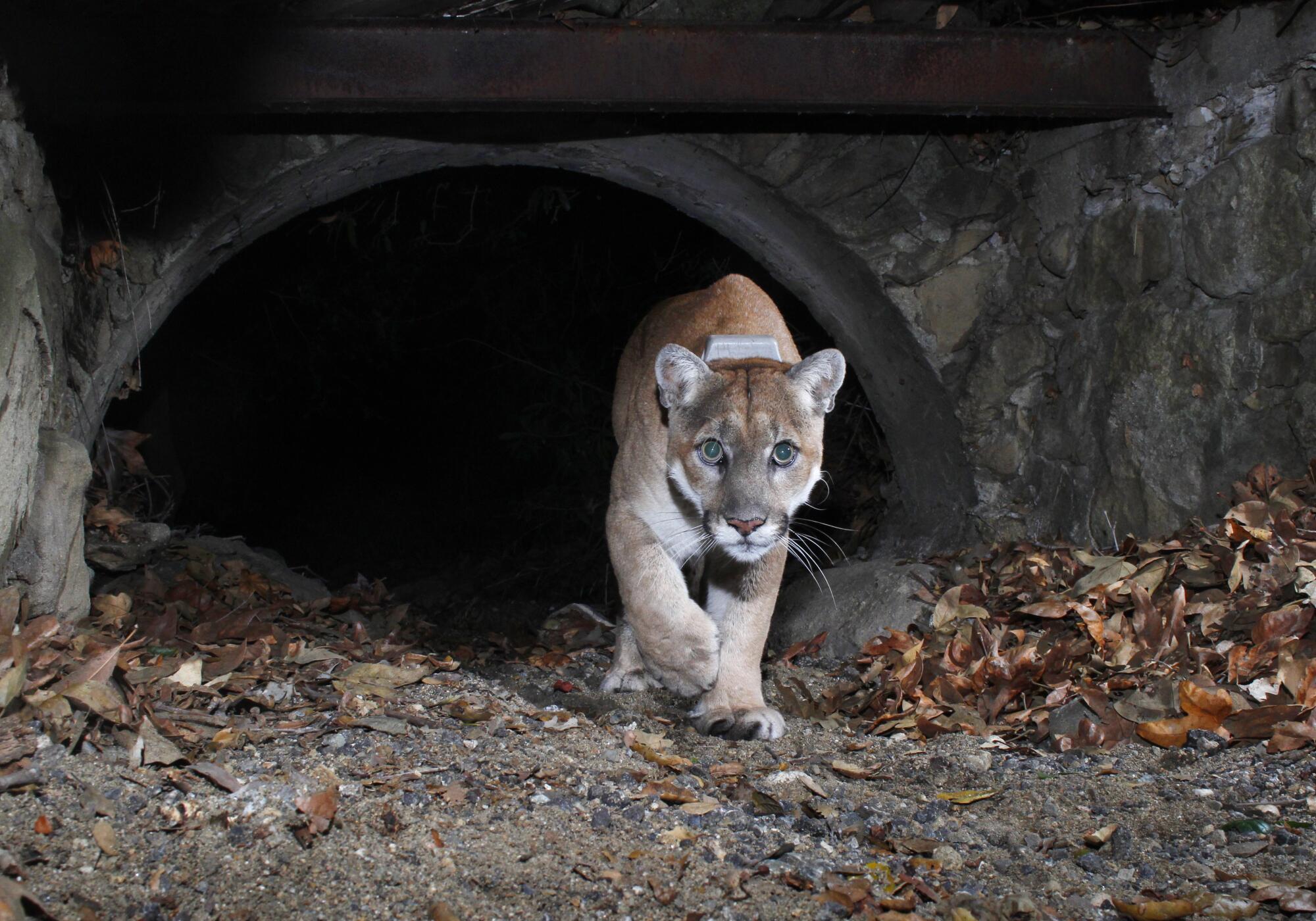
P-22 walks out of a drain pipe in Griffith Park at 1:09 a.m. Dec.19, 2016, more than four years after he was first spotted in the park.
(Miguel Ordeñana)
In 2019, Car and Driver reported that the Chevrolet Suburban had gotten a star on the boulevard — “the first inanimate object to be so honored,” according to the publication, because “Chevy’s largest SUV has been in more than 1,750 films, and has made an appearance in a movie every year since 1960.” But that “star” was just a publicity stunt, Martinez said.
It was never actually installed on Hollywood Boulevard’s Walk of Fame. It was on private property, she said, and later, Chevrolet took the star on the road to display at shows.
Pratt disagrees with the idea that P-22 doesn’t qualify as an entertainer.
“He IS more Hollywood than any celebrity — the Brad Pitt of the cougar world. But did Brad actually sleep under the Hollywood sign at night?” Pratt said via text, referring to a famous Steve Winter photo of P-22 walking under the Hollywood sign at night.
That point is certainly debatable, but it’s hard to imagine a Hollywood script more dramatic and poignant than P-22’s life story.
He was born in the Santa Monica Mountains around 2010, and he must have had many adorable moments as a frolicking cub. But things got dark when he approached adulthood and had to flee his home to escape death from an older, stronger and very territorial male — his father, P-1 — whom researchers believe had already killed one of his mates and at least two of his cubs in the past.
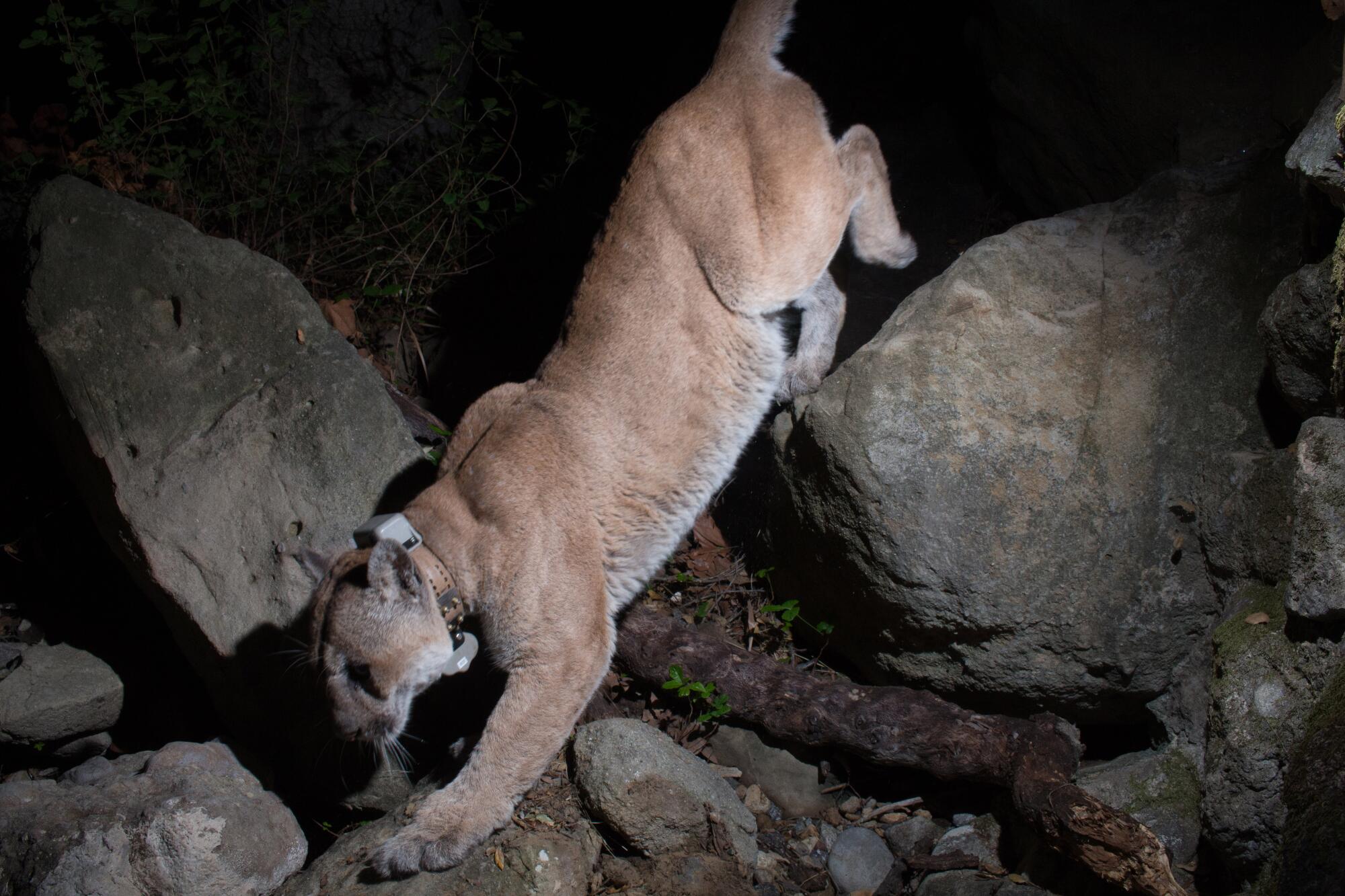
A remote camera set by Miguel Ordeñana, a researcher at the Natural History Museum of Los Angeles County, captured P-22 climbing down some rocks in Griffith Park.
(Miguel Ordeñana / Natural History Museum)
This is the way for male cougars, highly territorial creatures that prefer a “home range” of more than 100 square miles for hunting and mating. It’s complicated in Los Angeles, however, because those green spaces are crisscrossed with freeways that have led to the deaths of many other cougars that attempted to roam.
P-22 got lucky, however. The young tawny cougar with the broad, handsome features headed east for nearly 50 miles to escape his father, wandering through whatever green spaces he could find “and probably more than few backyards,” Pratt said.
Researchers believe he followed the backbone of the Santa Monica Mountains, crossing the 405 Freeway and then likely following the narrow green space along Mulholland Drive, Pratt said, to the 101 Freeway. Sometime in early February 2012, researchers believe he wandered off the Mulholland Scenic Parkway at the Jerome C. Daniel Overlook above the Hollywood Bowl and crossed the 101 to enter Griffith Park in the shadow of the Hollywood sign.

A map showing the 50-mile route researchers believe P-22 took between his birthplace in the Santa Monica Mountains to Griffith Park.
(Kate Keeley / National Wildlife Federation)
His entry was noticed almost immediately on Feb. 12, 2012, thanks to cameras set up by the Friends of Griffith Park to document wildlife there. “The Friends were doing a study with Miguel Ordeñana [of the Natural History Museum of Los Angeles County], and he was checking the cameras, zipping through thousands of photos of mostly skunks and coyotes and then he was like, ‘Oh, my God. Is that a mountain lion?,’” Pratt said last week. “It was like seeing Big Foot in Griffith Park. What a moment.”
It wasn’t long after that biologists were able to collar P-22 to track his movements, and for the next 10 years, he thrilled and sometimes terrified the community with infrequent sightings such as the time he decided to hang out under the crawl space of a family home in Los Feliz in 2015.
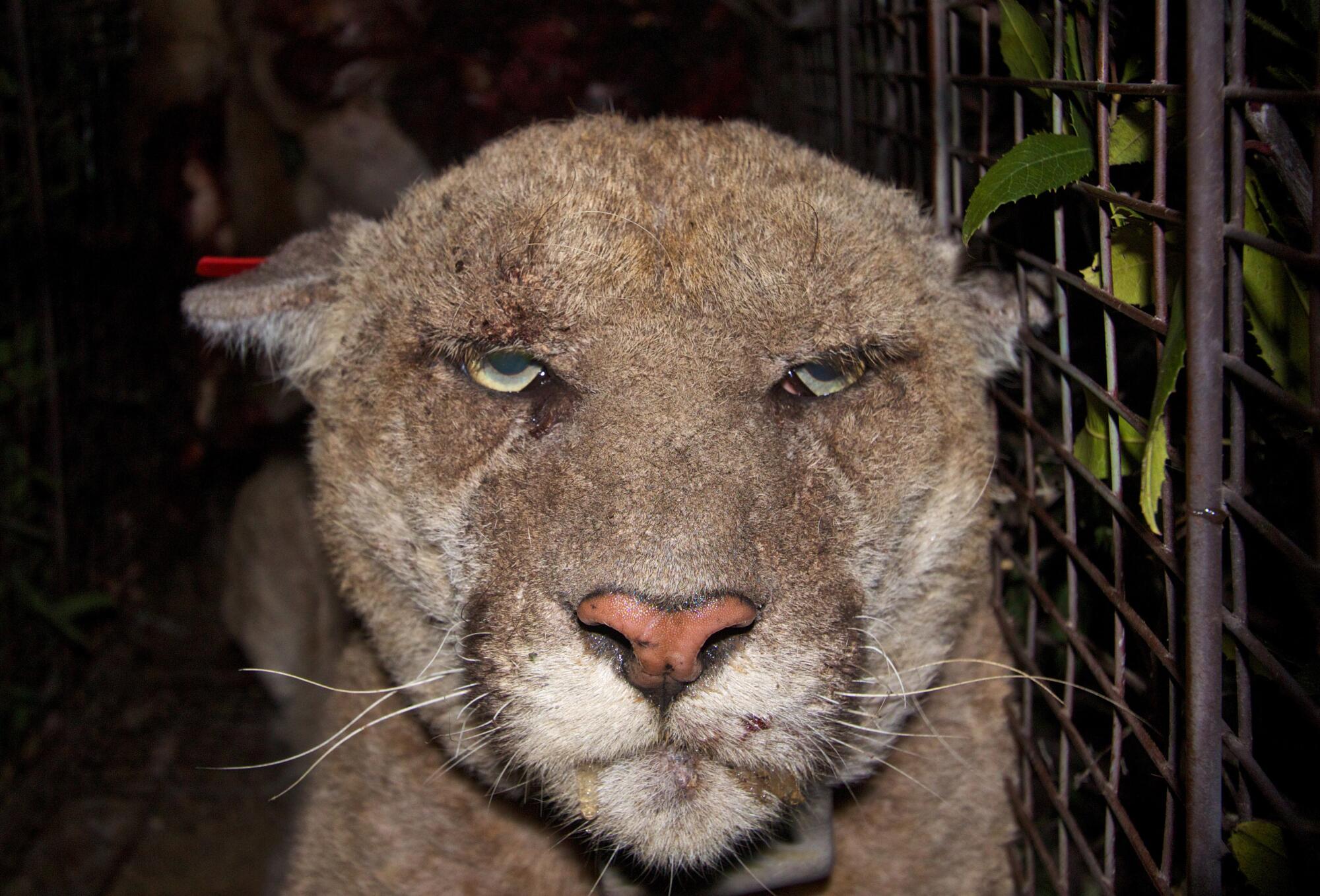
In March 2014, scientists captured P-22 after noticing crusting on his hair and skin and treated him for mange.
(National Park Service)
He was treated for a bad case of mange and other maladies in 2014, but he never found a mate, as far as scientists could discover, although Pratt holds out hope that his DNA will turn up in some young cougar someday. And he never left his tiny (at least for male cougars) territory around Griffith Park, which is just 6.5 square miles. He was basically trapped by human development, Pratt said, but there were plenty of deer there attracted by the many human-made “celebrity gardens” in the homes around the park. So even if P-22 was unlucky in love, his belly was likely full.
More important, though, was the way P-22 inspired people to recognize the plight of wildlife cut off from natural roaming grounds by freeways. His story helped make the Wallis Annenberg Wildlife Crossing a reality, Pratt said. It’s under construction now in Agoura Hills with a scheduled opening in late 2025 or early 2026.
P-22 was hit by a car sometime in December 2022, and when doctors captured him to check his injuries on Dec. 12, they discovered he also had several untreatable health issues, including second-stage kidney failure, Pratt said. He was euthanized five days later, on Dec. 17, 2022, causing a great outpouring of grief, along with stories, documentaries, songs and festivals to celebrate his life. And his story inspired bipartisan legislation to create wildlife corridors around the state, Pratt said.
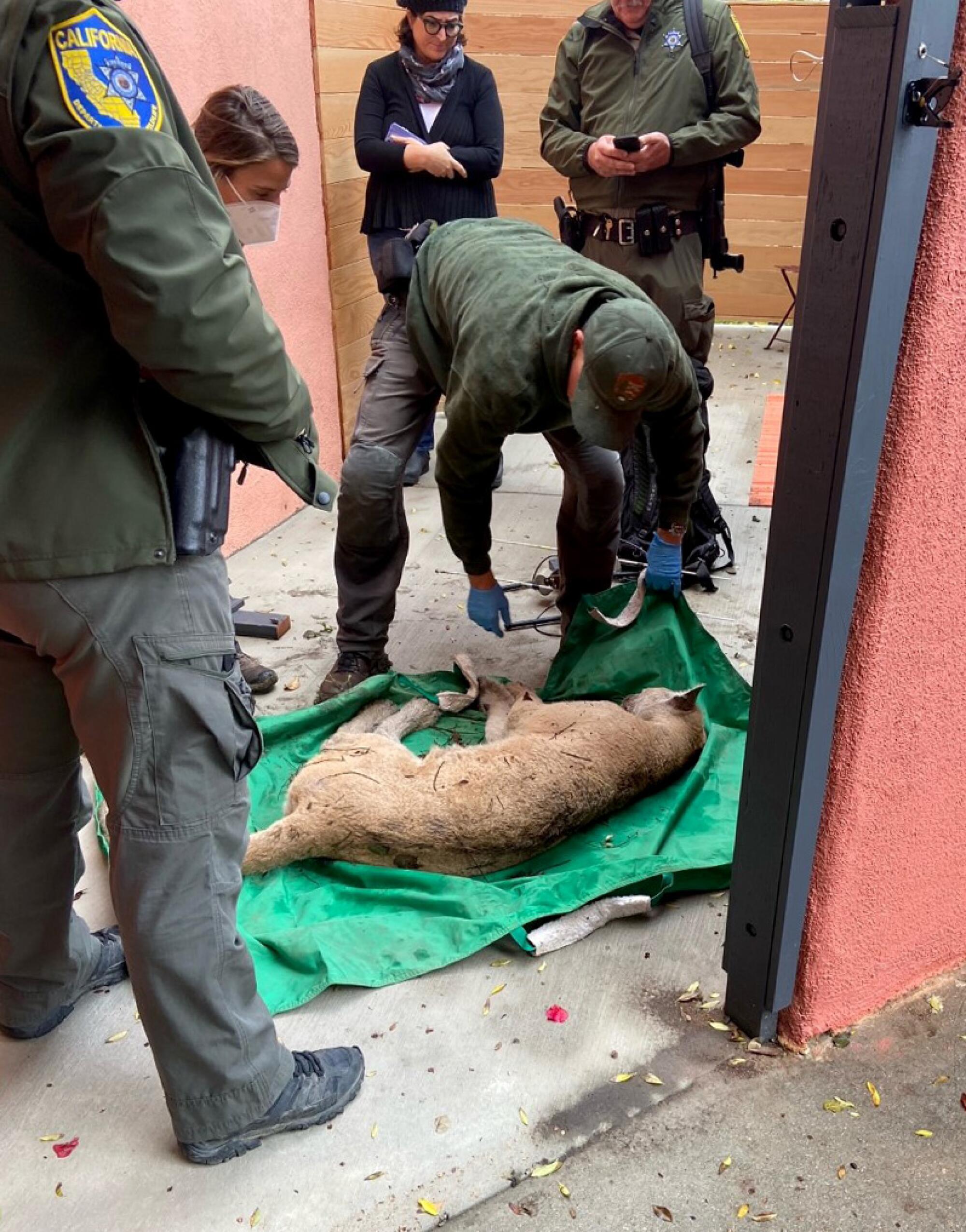
California Department of Fish and Wildlife captured a sickly and injured P-22 in the backyard of a home in the Los Feliz area of Los Angeles on Dec. 12, 2022.
(Sarah Picchi)
More than 15,000 people attended the first festival honoring his life last year, and at least 10,000 turned out for this year’s festival last Saturday, she said. It’s a rare Angeleno who doesn’t recognize the name P-22.
Pratt just completed the personal pilgrimage she’s made for the last nine years: following the 50-mile route P-22 took to escape his father and settle in Griffith Park.
With his tracking collar and remote cameras in and out of the park, P-22 was almost as surveilled as the title character in “The Truman Show.” Pratt had always longed to spot him in the wild, but she didn’t meet him face to face until the night before he was euthanized, when she sat outside his enclosure trying to soothe him with words.
“He didn’t have to, but he sat next to me; I could feel his breath,” she said, “and I told him he was a good boy.”
When they couldn’t get him a Walk of Fame star, Pratt commissioned L.A. artist Corie Mattie to give the puma a “star” in a mural on the side of a building at 6421 Hollywood Blvd., between Cahuenga Boulevard and Wilcox Avenue. The mural was officially unveiled Oct. 16.
The bright yellow, black and white mural includes a QR code that allows people with smartphones to project an image of a star honoring P-22 over a blank Walk of Fame star in front of the building. The National Wildlife Federation is also partnering with the Friends of Griffith Park to create a memorial at the park honoring the puma. (Artists can request details by sending an email to p22mountainlion@nwf.org by Dec. 31.)

Months after P-22 was treated for mange in March 2014, he seemed much healthier in this image captured by a remote camera.
(National Park Service)
Despite all this recognition for P-22, Pratt said she won’t give up on getting him his spot on the Walk of Fame.
“The mural is an amazing tribute, but he deserves a star,” Pratt wrote in a text. “You cannot over-memorialize P-22. People in L.A. and all over the world have a deep connection to him that didn’t end with his death. And what a wonderful precedent to have a wild animal on the Walk of Fame to inspire people to help protect the wild world. P-22 is a celebrity. And in Hollywood, celebrities never die.”

For Iris van Herpen, couture is a laboratory as much as a runway. Our chief fashion critic, Vanessa Friedman, takes us inside this Dutch designer’s latest Paris show — from sci-fi-inspired gowns to an audacious attempt at a dress made of charged plasma.
Lifestyle
The BoF Podcast | Decoding Paris Haute Couture: Wonder, Restraint and the Call of the Void


-

 Texas4 minutes ago
Texas Rangers investigating City of Trinidad after water issues, controversial arrests, firings
-

 Utah7 minutes ago
President Trump expected to reduce the size of Utah monuments
-

 Vermont12 minutes ago
Vermont marks fourth straight year of July flooding as recovery drags on
-

 Virginia19 minutes ago
Vance leasing part of multimillion-dollar Virginia farm as an additional residence | CNN Politics
-

 Washington22 minutes ago
Washington State Democratic Party draws criticism over reparations, antisemitism language
-

 Wisconsin27 minutes ago
What’s new to eat and drink at the 2026 Wisconsin State Fair?
-

 West Virginia34 minutes ago
West Virginia to launch school clothing allowance program
-

 Wyoming37 minutes ago
Election Q&A: Laurie Longtine for Wyoming House District 59

