Lifestyle
Junya Watanabe Brings Back the Lumber Sexual at Paris Fashion Week Menswear Show


I had washed up in Brooklyn, circa 2009.
Physically, I was in Paris, sitting at the Junya Watanabe fashion show. But spiritually? Oh boy, I was in Williamsburg in the Obama era.
It was the models in their husky Filson jackets, the buffalo checks, the tan cloth bags, the mondo hiking boots and the dark-wash cuffed jeans.
But most of all, it was the feathered-out mountain man beards. I could practically smell the beard oil. I might as well have been getting my haircut at an $80 barbershop on Driggs Avenue while listening to Arcade Fire and drinking an I.P.A. The lumber sexual, folks, is back.
At least in Mr. Watanabe’s hands. The designer, part of the Comme des Garçons extended universe, is a singular force. Thus far in Paris, he is the only designer plumbing our recent hipstery past for inspiration.
Still, it was more than a little disorienting to see the ghosts of the aughts heritage movement — a wave that sent urban-bound men wild for good ol’ outdoorsy essentials like raw denim, Barbour coats and Filson cruiser jackets — revisiting us so soon. Were it 15 years ago, this collection would have received wall-to-wall coverage on “#menswear” blogs like A Continuous Lean. Fashion trends cycle around fast, but really? This fast?
Backstage, Mr. Watanabe dumped some cold Pacific Northwest water on this notion. Yes, he was familiar with the heritage wave that reared up in America two decades ago. There was a similar movement in Japan, he said through a translator.
But that was “not related to this” show.
Rather, Mr. Watanabe said, this collection was a meditation on how much he revered the four-pocket Filson Mackinaw Cruiser, a hip-length coat that was originally patented by the American outfitter in 1914.
He was, he said, “sharing the classic, good old workwear with Filson,” with whom he partnered on the collection.
Sharing, yes. But also reimagining. Each model in the 41-look show wore some twisted conceptualization of a Mackinaw. They came reconstructed, deconstructed, lengthened to a parka, Frankensteined to a shearling, shaved into a blazer-type thing, given a pumpkin orange back panel and worn over another Mackinaw. All that was missing was a Mackinaw mutated into a jumpsuit.
This being a utilitarian design associated with lumberjacks and hunters, it was possible to wonder if Mr. Watanabe was making a grand statement about returning to nature in the face of artificial intelligence onslaughts and the tech oligarchs conquering the world? After all, the first heritage movement came as an answer to the online start-up boom, when men began to crave something analog, something they could feel with their hands, something they could treat like a tool.
Backstage, though, Mr. Watanabe was not in the mood to wheat paste grand ideas onto this collection. The Filson jacket “exists for a long time,” he said, squelching further questions about this temporal trend or that.
Still, near the conclusion of the show, the words “I see a change on the rise” came through on the soundtrack. To my eyes, it was not a change that Mr. Watanabe was offering, but a return, for on Friday morning, the heritage hipster could once again be spotted coming over the horizon.



By Vanessa Friedman, Gabriel Blanco, Nikolay Nikolov, Laura Salaberry and Bernardo Garcia Elguezabal
April 14, 2026

In 2019, the Bob Baker Marionette Theater needed a lifeline. Forced out of its edge-of-downtown home of more than 55 years, the beloved troupe with its thousands of handcrafted puppets — a saucy black cat in heels, a fish out of water that can’t help but wiggle — ultimately found a new location in a Highland Park theater.
Signing a 10-year lease was a sigh of relief for the company, the result of a lengthy search that included more than 80 spaces and ensured its playful, fanciful shows would continue to be a multigenerational, SoCal tradition. But yearly rises in rent, as well as the looming end of the contract, remained a cause of stress for the nonprofit.
The Bob Baker Marionette Theater can exhale once again.
The saucy black cat puppet in a performance at the Bob Baker Marionette Theater.
(Chloe Rice / Bob Baker Marionette Theater)
The theater’s executive team said it has entered into an agreement to purchase its current location at the corner of York Boulevard and North Avenue 50, which had former incarnations as a movie theater and a Korean church. Once completed, the $5 million acquisition will ensure the theater has a permanent home, a place where skateboarding clowns and leek-haired onions can continue to frolic and dance for decades to come.
“This is monumental for us,” says Alex Evans, the theater’s co-executive director. “It’s been decades of us struggling to survive. Now we’re at this moment where it’s not a struggle. It’s a blossoming moment where our future is set up forever.”
Bob Baker’s Highland Park home was originally built as the York Theater in 1925, hosting movies and vaudeville performances during that era. It most recently housed the Pyong Kang First Congregational Church. Over the years it has also been a barbershop and the site of an organ sales and repair store.
The purchase comes at a celebratory time for the troupe. While its annual Bob Baker Day Festival at the Los Angeles State Historic Park had to be postponed from April 12 to the fall due to a forecast of rain — the historic and fragile puppets cannot be exposed to water — the company still took its show on the road to the Coachella Valley Music & Arts Festival. Its adults-only May fundraising event the Puppet Prom, which typically raises more than $30,000, is nearly sold out, and the theater, which also hosts film screenings and concerts (with puppets, of course), continues to pack in full audiences — partly due to its location in a walkable neighborhood with young families.
And in the coming weeks the theater will launch its first new show in 40 years, “Choo Choo Revue.”
“Now is the time,” says Evans, who notes that while they have built new puppets and tweaked existing shows, this is the first proper new production since 1981’s “Hooray LA!” “We have the staff to implement it. We have a sustainable business to be able to pull off what is going to be close to a half-million-dollar production to mount a new show.”
In going public with its intent to secure the York Boulevard theater, the company is initiating a new round of fundraising. Bob Baker over the last year has raised $4.5 million of the $5 million purchase price. It is seeking $500,000 to close the gap as well as an additional $2 million for what it describes as critical renovations, such as repairing the building’s roof and restrooms.
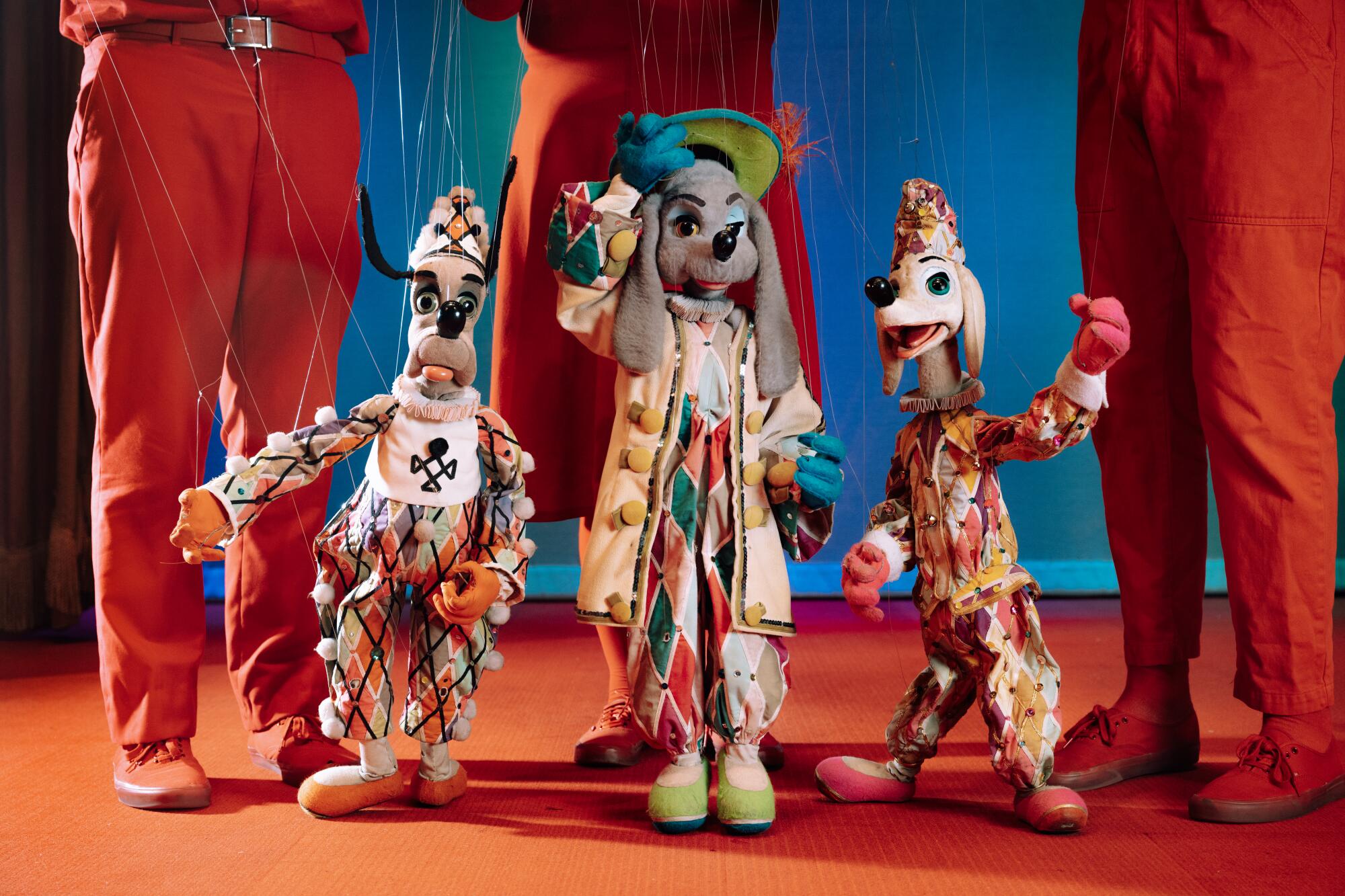
Some of the eccentric canines puppets.
(Chloe Rice / Bob Baker Marionette Theater)
Mary Fagot, Bob Baker’s co-executive director, says the theater has in place a $500,000 loan to ensure the deal closes. Yet Bob Baker does not want to to begin its new era with debt.
“We think it’s an achievable gap,” Fagot says, pointing to community fundraising the theater had to enact to stay afloat during the COVID-19 pandemic. During the days of the shutdown, for instance, the company was able to raise $365,000 in four weeks.
Rising rent, say the co-executive directors, was a key driving factor in the decision to approach the building’s ownership to purchase the space. This year, Bob Baker will pay close to half a million in rent, an amount, says Evans, that is double the theater’s budget when it was in its prior space near downtown L.A. That, coupled with the lease’s impending expiration in a couple of years, acted as a sort of deadline to craft a proposal that could appeal to its building owners.
“We started to have discussions in 2023 with the owners of the building, and those evolved into this becoming a real possibility,” Fagot says. “Then we started the hard work of talking to our biggest supporters about getting behind us.”
Bob Baker, founded in 1963 by its namesake puppeteer, now attracts more than 145,000 audience members per year, including about 20,000 students via school field trips. Funding for the building purchase was secured, in part, by gifts from the Perenchio Foundation, the Kohl Family Foundation, the Ahmanson Foundation, the late Wallis Annenberg, and celebrity donors such as Jack Black and Tanya Haden.

A sidewalk performance outside the Bob Baker Marionette Theater featuring ladybug puppets.
(Genaro Molina / Los Angeles Times)
“I’m proud to have played a small part in helping safeguard such a beloved institution that has enriched Los Angeles for decades,” says Brian Mikail of Capstone Equities, which rents the space to the troupe. The hope when signing the lease, says Mikail, was that Bob Baker could someday be set up to purchase the venue.
The agreement, says, Fagot, is a win-win for both sides.
“I think we were the ideal owners for this space,” Fagot says. “If it’s for any other purpose, it would need a giant transformation, and for us, it’s exactly what we need.”
“Choo Choo Revue” is set to open May 16 and will feature more than 100 brand new, handcrafted puppets. Look, for instance, for a conductor with a clock as a face, dancing luggage and a cicada jug band, among a host of other oddities. Expect, perhaps, a crescent moon in pajamas to be a new favorite. Or maybe audiences will instead fall for the singing mushrooms.
“The show invites audiences to go on a train ride, where the show is looking out of a train window and seeing flights of imagination,” Evans says. “It’s daydreams outside of a window. Windmills run around. It’s weird, fantastical abstractions of what’s possible. The hope is by the end of the show people are inspired to be more creative and to look at the world more beautifully.”
There’s also a clear hunger for the type of whimsical, family-friendly entertainment that the theater provides. Gross revenues topped $3.1 million in 2025, up from $699,211 in 2018, according to its most recent annual report. Fagot says the COVID pandemic only increased the demand for the “special brand of magic” that Bob Baker creates.
“People needed community,” she says. “They just need joy. They need inspiration and creativity and want to do it together, and that is what we do.”

Dan Levy in Big Mistakes.
Spencer Pazer/Netflix
hide caption
toggle caption
Spencer Pazer/Netflix
Dan Levy co-created and starred in the beloved Schitt’s Creek. And now he’s back with a new comedy on Netflix that’s got a very different vibe. In Big Mistakes, Levy and Taylor Ortega play dysfunctional siblings who get drawn deeper and deeper into the world of organized crime, even as their mom – the great Laurie Metcalf – runs for public office.
Subscribe to Pop Culture Happy Hour Plus at plus.npr.org/happyhour

West Hartford Entrepreneur Named Connecticut Small Business Person of the Year – We-Ha | West Hartford News

Tesla wins right to move lawsuits from Delaware to Texas. Here’s why

Doctor accused of fatally removing patient’s wrong organ indicted
Georgia Lottery Mega Millions, Cash 3 results for April 14, 2026

‘Blew this one’: Gov. Green calls out senator as DLE director leaves over pension

Florida High School Football Rankings: Top 25 teams – Oct. 21

How old is Bo Nix? What to know about Oregon quarterback ahead of 2024 NFL Draft

Cleary's 21 help Le Moyne down Central Connecticut State 69-64 in OT

99th annual Pony Swim held in Virginia

Indiana Members Credit Union announced as new anchor tenant at Bottleworks District

Dem fundraising giant in the hot seat as GOP lawmakers demand answers over dodged subpoena

Fifth woman accuses former US lawmaker Eric Swalwell of sexual misconduct

Commercial Ships Transit Strait of Hormuz as U.S. Blockades Iran’s Ports

Video: How Stephen Miller Is Adjusting Trump’s Immigration Agenda

Biden DOJ weaponized FACE Act against pro-life Americans, 882-report alleges
-

 Georgia1 week ago
Georgia House Special Runoff Election 2026 Live Results
-

 Arkansas5 days ago
Arkansas TV meteorologist Melinda Mayo retires after nearly four decades on air
-

 Ohio15 hours ago
‘Little Rascals’ star Bug Hall arrested in Ohio
-

 Pennsylvania1 week ago
Parents charged after toddler injured by wolf at Pennsylvania zoo
-
 Milwaukee, WI1 week ago
Potawatomi Casino Hotel evacuated after fire breaks out in rooftop HVAC system
-

 World1 week ago
Zelenskyy warns US-Iran war could divert critical aid from Ukraine
-

 Austin, TX1 week ago
ABC Kite Fest Returns to Austin for Annual Celebration – Austin Today
-

 Culture1 week ago
Can You Name These Novels Based on Their Characters?