Lifestyle
John Galliano exits Maison Margiela, where he got a 'second chance' after Dior ouster

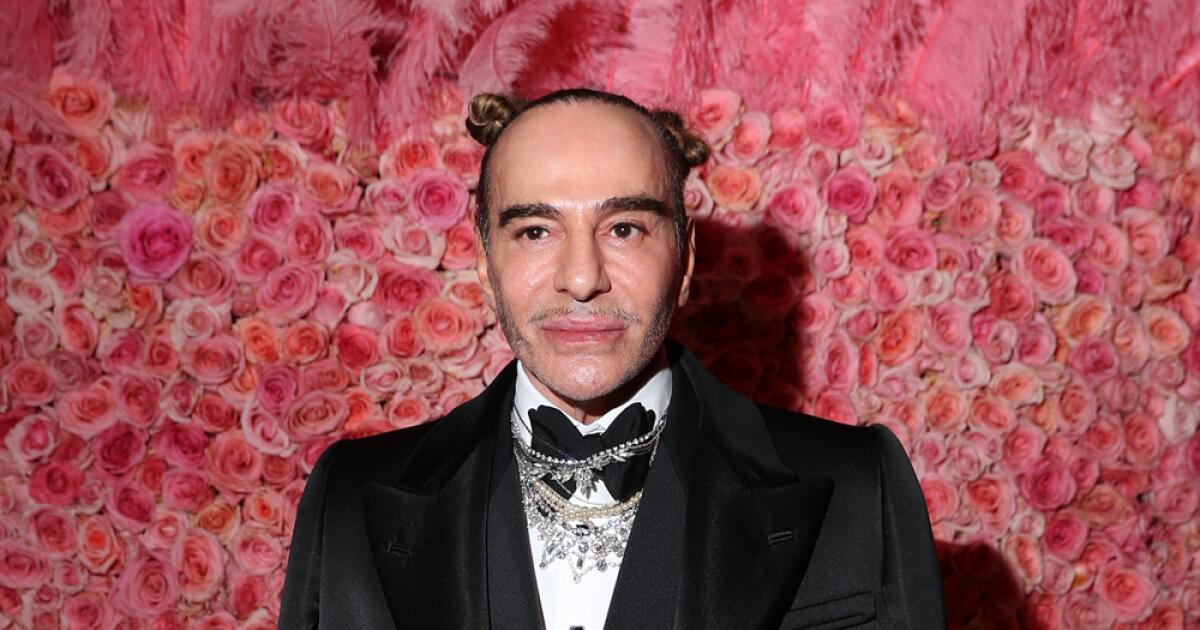
Maison Margiela’s creative director John Galliano, the iconoclastic couturier who previously headed artistry at Givenchy and Christian Dior, is leaving his post at the luxury French fashion house after a decade-long run.
The British designer, 64, announced his goodbye Wednesday via Instagram after employees at Maison Margiela were informed about his exit ahead of the company Christmas party, Women’s Wear Daily reported. Galliano’s departure also marks the end of his groundbreaking partnership with Diesel founder turned Italian fashion mogul Renzo Rosso, whose OTB Group is the parent company to Maison Margiela, Marni and Viktor & Rolf.
In a lengthy statement, the celebrated and controversial artist said he was grateful for “this life-saving creative moment and the safe space we have built together” and the “second chance” that Rosso and Martin Margiela gave him.
“My heart overflows with joyous gratitude, and my soul smiles,” he wrote. “For I am 14 years old today — 14 years sober. Living a life better than I ever dreamt possible.”
Although Galliano did not say what he plans to do next, the flamboyant and theatrical designer said he would share details in due time. Maison Margiela has not yet disclosed who will succeed Galliano, but the company has seen exponential growth in its luxury business since his appointment in 2014. Sales increased by 24% in 2022 and 23% in 2023, Vogue reported.
“The rumors… Everyone wants to know, and everyone wants to dream,” he wrote. “When the time is right, all will be revealed. For now. I take this time to express my immense gratitude. I continue to atone, and I will never stop dreaming. I, too, need to dream.”
Galliano dressed countless celebrities during his tenure, including Kim Kardashian, Zendaya and Gwendoline Christie at the 2024 Met Gala and Miley Cyrus at the Grammy Awards this year, as well as Ariana Grande, Jennifer Lawrence, Rihanna and Katy Perry for other red-carpet events.
In his statement, the only post on his Instagram grid, Galliano reflected on his time at Maison Margiela — formerly Maison Martin Margiela — and how he was given the keys to the kingdom by its ultra-private namesake, who told him “take what you will from the DNA of the House, protect yourself, and make it your own.”
Galliano’s appointment came after a pivotal time in his life and career: The designer, who has been candid about his addictions to drugs and alcohol, had been fired by by Dior and ousted by his own design label after delivering antisemitic and racist rants in Paris in 2010 and 2011, which ultimately played out in French court.
Sometimes referring to his past self in the third person in his two-page statement, Galliano that he “mourned the loss of JG and my previous identity” and that he’s much happier now and strives daily “to be a better version of this person.” He also expressed his gratitude to Rosso for inviting him to assume the position of artistic director at Margiela after that tumultuous period in his life. (Galliano’s body of work was the subject of the 2024 documentary “High & Low.”)
“The greatest, most precious gift he gave me was the opportunity to once again find my creative voice when I had become voiceless. My wings mended, and I better understood the all-consuming act of creativity.” In front of Rosso and Margiela, Galliano said he had an epiphany and was “ready.”
“I would surround myself with like-minded people, strong people who shared the same work ethic. I informed Renzo I would take him up on his kind offer, but my recovery would have to come first — and it did,” he wrote. “Ten years later, I am forever grateful for this safe space to create and build a new family that supports me with courage and dignity. Although little had changed in the industry then, my perspective on it has radically shifted. I begin to see changes all around me: compassion and empathy.”
“I’ll readily admit I’m demanding and difficult to run with when challenged, but look at what we have built,” he wrote. “This is when the family — the fashion industry — is at its best when we collectively support each other, not judge. When we accept, forgive, and help one another see the error of our ways. Being brave enough to unlearn, to re-educate ourselves from the past — for it is societally learnt — to share, empathize, and practice compassion.”
Galliano eased back into the spotlight and debuted his first runway collection for Maison Margiela in January 2015, sending a small couture collection down a London runway in front of a curated audience of 100 people at the end of London’s Men’s Fashion Week. This past January, he was widely applauded for his viral spring 2024 Maison Margiela Artisanal show — the one that showcased Pat McGrath’s viral, glass-like makeup — which WWD described as putting “full-throttle creativity back on the industry agenda” and propelling Galliano “to the very top of the fashion heap.”
“Margiela’s business steadily climbed in recent years as Galliano infused its collections with campy, theatrical innovations, deconstructed designs and a gender-fluid sensibility as well as pushing the craftsmanship and creative impact of its ‘Artisanal’ line to new heights,” Business of Fashion reported. “Sales rose 22% in 2023 even as the wider luxury market slowed.”
The reformed designer on Wednesday touted “slow and ethical fashion” and its influence, as well as the design house’s sociopolitical messaging that he said centers trans and queer rights, gender equality in the workplace, anti-racism and mental health advocacy.
“I celebrate the genderless collections we now produce, reinforced by how they are brought and supported. My co-ed collections, whether Artisinal or [Ready-to-Wear], represent diversity and individuality,” he wrote in his statement. “I celebrate the magical relationships with my muses, who challenge me to create safe spaces where we can dream and make believe. You inspire everything I do. You are my life. All my muses have battled society’s norms and restrictions on gender and body identity. I rejoice in self-expression and freedom. “
He also indicated a desire to “celebrate the joy” he found in the ways he communicated creatively, embracing cultures that celebrate fashion through theater, cinema and digital media.
In a statement to the Associated Press, Rosso lauded Galliano for making Maison Margiela “the most cutting-edge couture house in the world.” He added that the last decade “of incredibly intense work, amazing shows and installations, extraordinary beautiful product, have laid the foundations for the future.”

For Iris van Herpen, couture is a laboratory as much as a runway. Our chief fashion critic, Vanessa Friedman, takes us inside this Dutch designer’s latest Paris show — from sci-fi-inspired gowns to an audacious attempt at a dress made of charged plasma.
Lifestyle
The BoF Podcast | Decoding Paris Haute Couture: Wonder, Restraint and the Call of the Void


-

 New York49 minutes ago
How ‘The Wire’ Star Jamie Hector Spends a Hot Day in Brooklyn
-

 Los Angeles, Ca52 minutes ago
Burglars ransack Sherman Oaks condo building during fumigation
-

 Detroit, MI1 hour ago
Metro Detroit weather forecast, July 10, 2026 — 11 p.m. Update
-

 San Francisco, CA1 hour ago
Classical music series helps reconnect downtown San Francisco community
-

 Dallas, TX1 hour ago
Dallas police officers, paramedics recall saving woman stuck in a ravine for days;
-

 Boston, MA2 hours ago
Red Sox win 7th straight game just hours after landing in New York
-
 Denver, CO2 hours ago
One tree at a time: Denver nonprofit works to close shade gap as heat dome threatens neighborhoods
-

 Seattle, WA2 hours ago
VIDEO: West Seattle Summer Fest 2026 day 1, evening report

