Lifestyle
'It’s a lot of UFO stuff and a lot of healing': Inside L.A.'s wackiest spiritual convention

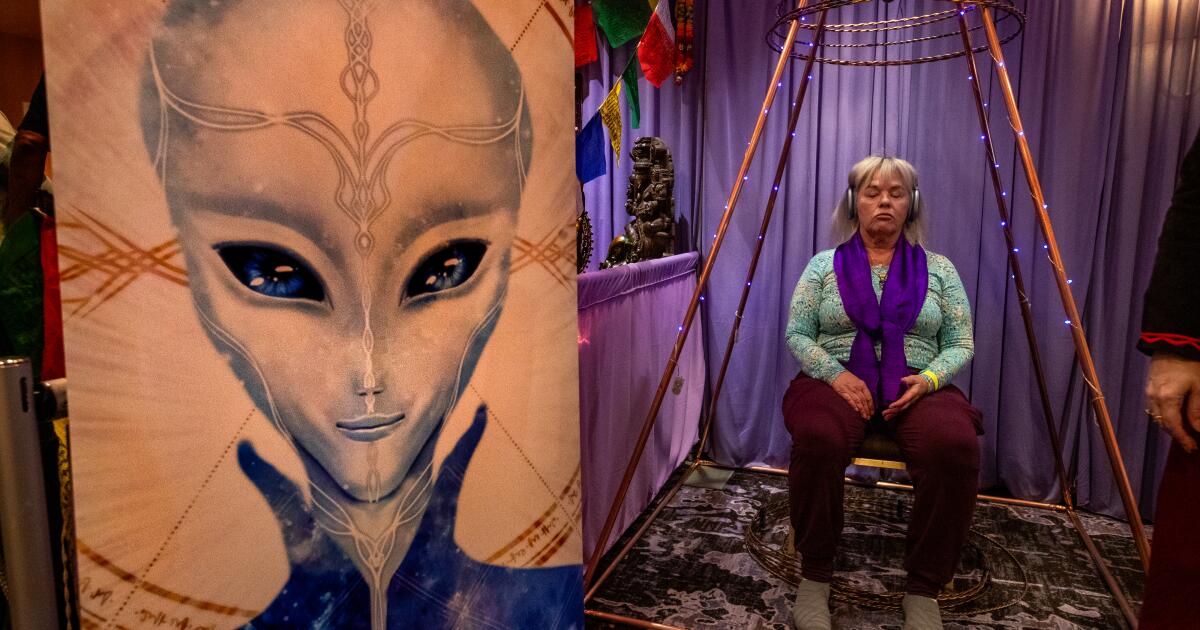
On the first new moon in February, not long after Pluto had entered Aquarius, Shima Moore stood like a priestess in flowing white robes behind a podium in the Los Angeles Ballroom at the LAX Hilton. She was there to officially open the 22nd Conscious Life Expo with a 12th dimensional stargate meditation.
“When we’re in the 12th dimension, we’re more receptive so the angels and ascended masters, nature spirits and our own higher selves can come to us,” she said in a deep, resonant voice as celestial music played softly in the background. It was 10:30 a.m. on a Friday and a crowd of 220 attendees nodded appreciatively.
Moore shared the stage with Asil Toksal, a former advertising executive-turned-channeler, and Viviane Chauvet, a Phoenix-based woman who claims to be a member of an ancient alien race sent to Earth to share her civilization’s wisdom.
Shima Moore, co-founder of the Conscious Life Expo, Asil Toksal, a healer and channel, and Viviane Chauvet, who says she is an interstellar Arcturian being who ascended thousands of years ago, use a Stargate, far right, to conduct a 5D-StarPortal Stargate Activation during the convention’s opening ceremonies.
“I know I look a lot like a human, but that’s the idea,” Chauvet said as members of the audience chuckled. “This was the best way to be a conduit.”
Even an open-minded resident of this most open-minded of cities might balk at these far-out proclamations, but fringe beliefs are business as usual at the annual L.A. convention, which took place Feb. 9-12.
For 22 years, the gathering has been a meetinghouse for astrologers, channelers, aura readers, quantum life coaches, psychics, hypnotists and a growing number of “starseeds” — people like Chauvet who believe they are galactic volunteers that have taken on a human form to help “the children of Gaia.”
“It’s a lot of UFO stuff and a lot of healing,” said Robert Quicksilver, 75, who co-founded the expo in 2003 and has been running it since. “I think of it as offering a Space Age translation of the cosmic wisdom.”
Sacred geometry pendants sold on the Conscious Life Expo’s convention floor.
Justin, an activist who declined to give his last name, spreads the word about his claim that hostile aliens are already here to takeover the Earth, while attending the expo.
Cosmic Contact, a mist that claims to cleanse auras, is one of many healing products on display on at the annual three-day gathering
Over the years, the convention has also become ground zero for many of the wellness trends that have made their way into high-end boutiques, gyms and grocery stores. Today, the same black garlic spread offered at an expo booth may end up on the shelves of Erewhon. Earlier iterations of the event hosted some of the first panels on the use of crystals for healing and helped popularize ancient Eastern practices like acupuncture and tai chi in the West.
But in recent years, the Expo has encountered new challenges. The occasional conspiracy theorist speaker has drawn negative coverage of the convention. And Quicksilver recently began enforcing new standards for who can be featured at the festival. He values free speech but draws the line at promoting QAnon-like rhetoric.
Weighing more heavily on his mind is the future of the Expo itself. Most of the convention’s tried-and-true regulars came of age in the 1960s and ’70s. As they enter their twilight years some have grown too infirm to make the annual trip while others have died. Now, he and his partners are grappling with how to update the conference to ensure that it attracts a new and younger audience, including bringing in speakers less likely to be accused of cultural appropriation and more likely to have hundreds of thousands of followers on TikTok.
“It’s so important for the Expo to transcend generations,” said Quicksilver’s son Michael Satva, 41, who took on more organizing and booking responsibilities this year. “As the boomers retire and move on there are so many amazing younger people in this space pushing the culture forward.”
Irena Kurland of Woodland Hills, left, and Francis Ortiz of Houston, Texas, undergo red light therapy while attending the Conscious Life Expo at the LAX Hilton Hotel in Los Angeles.
Rooted in California
The first seeds for the Conscious Life Expo were planted in the early 1980s, at a separate gathering inspired by the New Age and human potential spiritual movements. The Whole Life Expo was founded in San Francisco in 1982 and soon began traveling to cities like New York, Albuquerque, Denver, Seattle, Las Vegas and Ashland, Ore. It reliably drew its largest audience — up to 20,000 seekers, according to some reports — each year in Los Angeles, where it eventually moved to the same LAX Hilton that hosts the Conscious Life Expo now.
Quicksilver ran a chain of cosmic gift shops called Star Magic in the 1990s and was a regular at the Whole Life Expo. When it ended abruptly in 2001 — the Sept. 11 attacks scared people from gathering in large groups — he created the Conscious Life Expo.
“It just showed up in the field for me to do this,” he said. “I had all the skill sets and I knew all the people.”
Today, the Conscious Life Expo is the largest of its kind in the United States, drawing between 8,000 and 10,000 attendees per year. Past speakers include spiritual leader and presidential also-ran Marianne Williamson and disgraced comedian-turned-self-help guru Russell Brand.
Quicksilver has experimented over the years with bringing the Expo to other locations, including San Francisco and London, but it never caught on outside Southern California, where new religious movements have long found a steady stream of willing believers.
Bastian Trachte of Glendale wears a head pyramid used for meditation and healing.
A woman soaks her feet while doing a “gencel ion cell cleanse.”
Eric Villhauer holds a giant tuning fork used as a sound therapy tool on the forehead of Denise Visco. The forks sell for $1,111, $2,222 and $3,333, based on size and “sound healing modalities.”
An ideological grab bag
Organizers say the Expo was always designed as a clearing house for far out ideas but there have been times when its open-minded, anything-goes attitude has gone too far. Last year, filmmaker Mikki Willis gave a baseless talk on how the COVID industrial complex was used to advance a century-old agenda to overtake America in a basement area of the hotel dubbed “the Rabbit Hole” devoted to “alternative realities and censored world views.” This year, Quicksilver had to cut a speaker from the roster after finding out he had links on his website to a conspiracy theorist who cited a Nazi sympathizer.
“It’s getting too negative, too right wing, too go get your gun kind of s— that doesn’t work at all,” he said. “I’m not doing it again.”
Conspiracy was always a sideline at the convention anyway, he said. More representative of its cosmic carnival ethos are the vendors advertising dolphin and whale wisdom retreats, cat psychic services and crystals carved in the shape of praying mantis heads (designed to help people connect with their “galactic guides”). At Booth 400 in the International Ballroom, Joshua Reff demonstrated his super-size tuning forks that sell for $1,111, $2,222 and $3,333, based on size, and “sound healing modalities.”
Taking it all in can feel like you’re wandering along the far-flung fringes of the spiritual landscape. But Amanda Lucia, a religion professor at UC Riverside who has attended several Conscious Life Expos, doesn’t see it that way.
Instead, she sees similarities between the 250 exhibitors and 200 speakers that come to sell their wares each year and more mainstream belief systems. If you’ve ever bought a supplement to help you sleep better at night, talked with your friends about manifesting your goals or worn a bracelet with the word gratitude engraved on it, then you are engaging with the same themes that thrive at the Expo.
“People who believe they can create their own destiny, people who believe they can contact divine presences — that’s very common across religious traditions,” she said. “California and Los Angeles are the epicenters of it, but it’s a common belief among the general populace.”
Corey Halls of Minneapolis, Minnesota tries out a portable infrared sauna, advertised as a balm for aches and pains, on display at the Conscious Life Expo.
Facing the future
Dannion Brinkley, bestselling author of “Saved by the Light” and a survivor of three near death experiences (including being struck by lightning), has been speaking at the Conscious Life Expo since its inception. He was also a regular at the Whole Life Expo.
Now in his mid-70s, he said these annual gatherings introduced him to a number of tools that he brought to Veterans Affairs as part of his decades’ long work providing hospice care for veterans.
“The VA has tai chi and yoga — aromatherapy is now part of the standard model of care, and they got it from the Conscious Life Expo,” he said. “How do I know? I drove it there.”
With trim white hair and a white mustache, Brinkely looks and sounds like a Southern gentleman. Like many Expo old-timers, he made his name with a New York Times bestselling book. (In his case, it describes a personal encounter with 13 angels and the profound revelations they shared with him while he was clinically dead.)
In recent years, however, the convention has seen an influx of digital-first spiritual influencers who earn their clout from massive social media presences.
“It’s a real generational divide,” Satva said. “For the boomers, it’s all about prestige; for the millennials, it’s all about reach.”
Elizabeth April, 31, is one of the convention’s new, young stars. She alternately describes herself as a YouTuber, life coach, author, channeler or past life regression specialist, depending on who’s asking. Her first book, “You’re Not Dying, You’re Just Waking Up” was published in March 2021, but the legion of fans that stood in line for her workshop at the convention know her from the videos she posts regularly to Instagram (200,000 followers) and YouTube (216,000 subscribers).
Like Brinkley, April’s personal story may be hard for skeptics to swallow. Dressed in ripped black jeans and a T-shirt, she detailed her spiritual journey in an interview on the convention floor.
She claimed to have been clairvoyant as a child, that she was introduced to past life regressions in her teens and that she was abducted by aliens on a meditation retreat in her early 20s.
Mantis crystal skulls for sale at the expo.
(Mel Melcon / Los Angeles Times)
People participate in a “Tesla biocharged meditation” — said to combine the power of Tesla tech, heart based meditation and the quantum field to amplify synergy, vibration and intentions — during the expo.
Feeling isolated, she began publicly sharing her experience on social media and at conferences to lift the fear around aliens and connect with other abductees. Now, she sees it as part of her mission to help fellow starseeds wake up and find their mission.
“We’re all here to make the planet better,” she said. “We’re all needed.”
It’s a universal message of affirmation that has come in many different packages at the Expo since its inception, and one that many still need to hear today.
Back at the opening ceremony, the robe-clad Moore — an astrologer who has helped run the Expo since its beginning — described the convention as a portal that would help attendees step into a whole new experience of their lives.
“This is our family, this is our tribe, these are our kindred spirits,” she said. “You can’t get this energy anywhere else.”


Lifestyle
Vintage-obsessed millennial parents are driving L.A.’s booming kids’ clothing resale market

Kids’ vintage clothing sales are experiencing a remarkable boom at in-person markets and online, where prices for clothes for little ones have shot up on websites including Depop and Poshmark. Millennial parents are looking to outfit their kids in the clothes and TV and film characters they loved (or coveted) when they were kids.
The result? There’s a new generation of kiddos hitting the playground looking incredibly cool. Take Amari Case, a SoCal toddler who spent a Sunday afternoon this spring ambling around a vintage market in a West Hollywood warehouse clad in baggy jeans and a ’90s-era tee emblazoned with the “Dragon Ball Z” character Son Goku.
When she wasn’t scribbling on a Lorax coloring sheet, she’d been cruising around the market with her dad, Aaron Munoz Case, snapping up new pieces destined to make her the flyest kid at the preschool playground.
Neil Wright, from left, Kristine Nite Scalzo and Brandon Rosenblatt, co-founders of Elemeno Kids Vintage Market.
Showing off Amari’s new vintage satin L.A. Raiders jacket and tiny teal Grant Hill Detroit Pistons jersey, Munoz Case, who was also impeccably dressed, noted that while Amari went through a phase at about 18 months where she wanted to dress herself, eventually she gave up and went back to letting her dripped-out dad dictate her wardrobe.
Munoz Case found Amari’s first vintage piece at the Rose Bowl Flea Market and got the bug, going back every month to pick up something to add to his little’s wardrobe.
Trendspotters and researchers say Munoz Case isn’t alone in his quest. The market for kids’ vintage clothing has heated up precipitously over the last few years, perhaps hitting a boiling point in January when an Eeyore romper from the ’90s sold for over $3,000 on EBay. (It was new with tags, but one without tags still went for almost a grand about a month later.)
The thirst for tiny throwbacks is so popular that first-ever, all-kids market Elemeno — named after the “L-M-N-O” bit of “The Alphabet Song” and where Amari was toddling and shopping — drew 17 vendors and over 2,000 attendees over a single weekend in March. (There are plans for another Elemeno Kids Vintage Market pop-up later this year in New York, as well as plans to bring the event back to L.A. sometime next year.)

2

1. Cameron Scalzo, wearing a vintage McDonald’s T-shirt from the ‘90s, and mom Kristine Nite Scalzo. 2. Cameron Scalzo rocks an Avirex jacket from the ‘90s.
Eye Speak Vintage’s Kristine Nite Scalzo, who co-organized the event and is opening an all-kids vintage store in Pasadena this month, says she fell under the kids vintage spell in 2020 when she was pregnant with her son. She’d always been a vintage shopper for herself, so she knew she wanted to pass the passion down to the next generation. She started filling up her son’s closet, and soon enough, she found herself selling her other finds out of a bodega in her garage.
She has a by-appointment space in Pasadena now, where she draws everyone from Rihanna’s stylist to out-of-town moms who make a point to stop by on their way to Disneyland. “The community around kids vintage has really skyrocketed on Instagram over the past six years,” Scalzo says. “We want to know who we’re buying from. We want to know that we’re doing good with buying secondhand. And it’s a hobby for people that can turn into a possible business on the side. Because knowing there’s a big group that’s interested in vintage kids clothes, you can always pass an item [your kid outgrows] to someone else or resell it.”
Scalzo says some parents are out digging through bins at the Goodwill Outlet looking for the perfect piece, while others are content to pay up for, say, a ’90s Simpsons T-shirt or a mini-size Harley-Davidson jacket. Scouring the racks at the Elemeno market, most pieces cost $15 to $40, though there were special pieces pulled to the side in some booths with price tags that could make a parent’s eyes pop. (Think $275 for a set of well-worn Spider-Man overalls from the ’00s or $150 for a pair of Cross Colours denim shorts from the ’90s.)
In kids and adult vintage alike, mint condition is highly valued. No matter the era in which they were raised, kids tend to be messy. They get strawberry juice on their shirts or scuff up the knees on their Bugle Boy jeans. Vintage kids clothes that look pristine are more expensive, and while plain kids clothes do sell, items with characters on them or cool prints tend to draw more attention and dollars.
Brandon Rosenblatt, another of the Elemeno organizers, says he’s had his eye on a specific kids “Back to the Future” shirt for some time, but notes that it typically sells for about $1,000. He’s partial to McKids clothes for his daughter, from McDonald’s short-lived kids clothing brand, noting that he’s even snagged her a vintage official McDonald’s-themed aloha shirt from Hawaii, something he says he’s never seen anywhere else.
1

2

1. Siblings Amora and Milo Castilo wear vintage cowboy hats, jackets and chaps. 2. Thalia Castilo and her kids Amora and Milo.
Other collectors, he says, might be a little less obscure, leaning into mainstream characters such as Strawberry Shortcake or from ’80s and ’90s properties including “The Land Before Time” and “Rugrats.”
“A lot of millennials are having kids — like everyone who’s in their 30s and 40s — and they all want to put their kids in the same IP they grew up in,” Rosenblatt says.
“It’s the thrill of the hunt that gets everyone so excited,” Scalzo says. “Once you find that perfect nostalgic piece, you’re like ‘Holy s—,’ and you just want to chase that feeling again and again.”
Mia De La Rosa, a reseller who was at the Elemeno market, says that like Scalzo, she started buying kids vintage clothes when she was pregnant with her daughter, Liv, who’s 6 now, very into everything on PBS Kids and has a closet full of thrifted vintage garb covered in characters such as D.W., the annoying little sister from the ’90s show “Arthur.”
Everything Liv wears is “completely her style,” De La Rosa says. “She dresses herself every day and she gets compliments on what she’s wearing at school all the time.”
Other vintage-wearing kids — and in particular younger ones — might simply be sporting what their parents like or might just like the look of the shirt even if they don’t know what it’s advertising. (An 8-year-old boy at the Elemeno market, for instance, chose to wear a pristine T-shirt highlighting the ’90s Jim Carrey movie “The Mask” because it featured his favorite color: green.)
Derrick Broaster, a vintage enthusiast turned full-time reseller, says that while he chooses to put himself in clothes from the ’60s and ’70s, he outfits his two sons in clothes from the 2000s. (“How Bow Wow used to dress when he was a kid,” he says.)
Although his younger son tends to rebel against Broaster’s vintage picks, opting for whatever Spider-Man shoes happen to be in his eyeline, his older son has leaned in, letting his dad advise him on what vintage pieces could work and what would be the most stylish.
1

2

1. Julian, left, and Javier Gutierrez show off their vintage clothing. Javier says his mom always tells him to keep his vintage outfits clean. 2. Mom Priscilla Guzman, clockwise, Dad Javier Gutierrez and sons Julian and Javier Gutierrez enjoy the vibe of vintage clothing. Guzman says she’s been buying and selling kids’ vintage since her oldest son was born eight years ago.
Rosenblatt says a good portion of what vintage finds he sees in the market now has returned to the U.S. from places in Central America and South America or Asia where those pieces were likely sent decades ago after they were donated or given away.
“There’s a real underbelly of this vintage game with rag houses getting access to bulk product overseas and letting people sort through it,” he says. “There are companies now that rip through 20, 30 or 40,000 pieces of vintage clothing a week. It’s a really interesting ecosystem.”
For many kids vintage sellers, finding their stock is just as fun and interesting as getting it back into consumers’ hands. “Anywhere we can find clothes, we’re there,” says Matthew Carlos, owner of Long Gone Youth. He started selling vintage clothes 11 years ago, when he was 15, switched to kids vintage at 20 and has spent the last six years scouring flea markets, websites and swap meets.
“The kids market is definitely growing,” he says, “but I still feel like we haven’t even gotten close to where we can go. It’s just getting popular now, but the more events [like Elemeno] we can do, the more it’ll go mainstream.” Even now, some major brands like Gap and OshKosh B’gosh have recognized the interest in some of their styles from the ’80s and ’90s, moving to re-release the looks in limited runs.

Jackie and Frank Oropeza with daughter Rumi Mae shop at Elemeno Kids Vintage Market.
Kids resale is also leaning into streetwear culture. Rosenblatt, who worked in the streetwear industry, says that he’s noticed that a good portion of those interested in kids vintage — particularly, male shoppers — tend to be fans of streetwear brands like Supreme, Fear of God Essentials and Bape. At Elemeno, for instance, a good portion of the parents we saw pushing strollers were well-dressed dads seemingly on solo missions, something you don’t always see at kid-centric events.
“I just want my son to feel like I did as a kid,” said Justin Nguyen, while watching his toddler, Jayden, play with bubbles. “I want him to be happy, carefree and joyful, and I want to be able to spend time with him. My mom and dad were always working, even on the weekends. Now that I’m a dad, taking my son out on weekends to do stuff like this just seems like a blessing.”

Author Julia Elliott won for her short story collection Hellions.
Forrest Clonts/Tin House
hide caption
toggle caption
Forrest Clonts/Tin House
Writer Julia Elliott has won this year’s Carol Shields Prize for Fiction for her short story collection Hellions. The award honors work by women and nonbinary authors in the U.S. and Canada.
Elliott, who also authored the novel The New and Improved Romie Futch and the short story collection The Wilds, is known for blending elements of Southern gothic horror, surrealism and fairy tale. Hellions, published in 2025, includes stories set against backdrops like a plague-stricken medieval convent, a feminist art colony, and small Southern towns.
“This eerie, eclectic, genre-leaping collection takes no half-measures; every sentence of Hellions crackles or crawls,” wrote the prize jury in a statement. “Here, human folly moves against a backdrop of horror and magic … But for all its wildness, there is tremendous control.”
The prize, named after a Pulitzer Prize-winning novelist, awards $150,000 to one winner each year. Novels, short story collections, and graphic novels by women and nonbinary authors are eligible.
This year’s finalists included Quiara Alegría Hudes (The White Hot), Lee Lai (Cannon), Megha Majumdar (A Guardian and a Thief), and Sonya Walger (Lion). They will each receive $12,500.
The Carol Shields Prize went to writer Canisia Lubrin in 2025.
You can listen to actor Donna Lynne Champlin read Elliott’s story “Hellion” on the Death, Sex & Money podcast here.
-

 Cleveland, OH4 minutes ago
All Future Cleveland Cavaliers Draft Picks in 2026, 2027 & Beyond
-

 Austin, TX7 minutes ago
Highly pathogenic virus found in herd of Texas dairy cows
-

 Alabama12 minutes ago
Is Tommy Tuberville an Alabama resident? GOP candidate challenges status
-

 Alaska19 minutes ago
University of Alaska names U.S. Army commander as new UAF chancellor
-

 Arizona22 minutes ago
Diamondbacks Fans Can Now Vote for Arizona’s All-Stars
-

 Arkansas27 minutes ago
Arkansas DFA Agents seize illegal products in Corning
-

 California34 minutes ago
California may take weeks to finalize primary results. ‘This is normal’
-

 Colorado37 minutes ago
Colorado governor vetoes block on surveillance pricing as other states push for bans

