Lifestyle
'It’s a lot of UFO stuff and a lot of healing': Inside L.A.'s wackiest spiritual convention

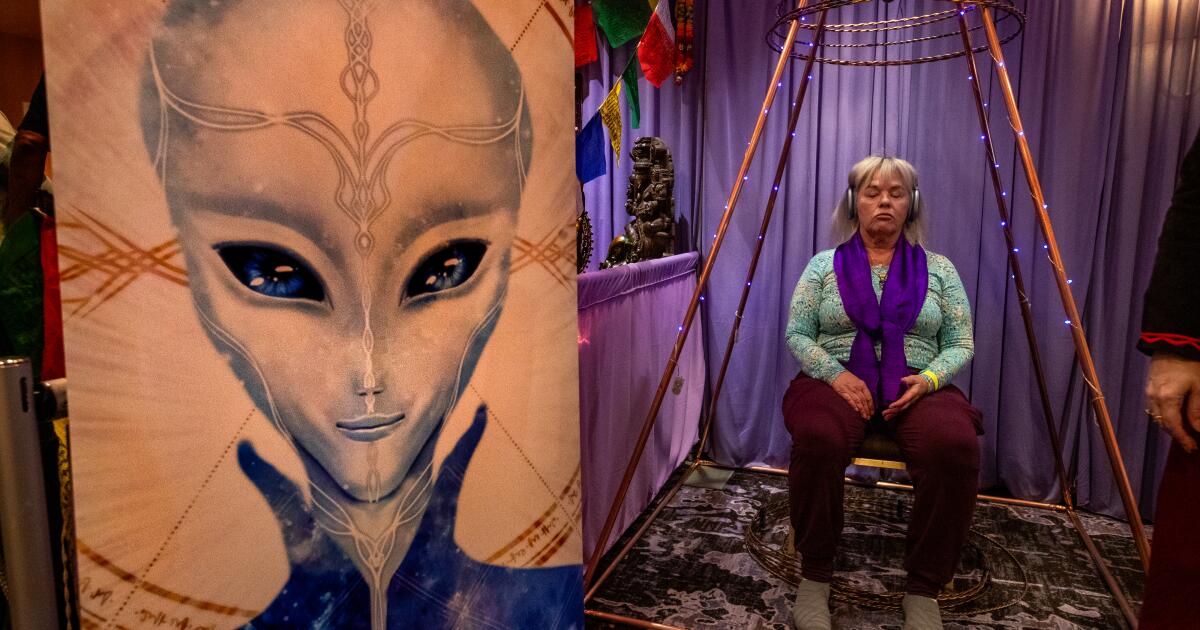
On the first new moon in February, not long after Pluto had entered Aquarius, Shima Moore stood like a priestess in flowing white robes behind a podium in the Los Angeles Ballroom at the LAX Hilton. She was there to officially open the 22nd Conscious Life Expo with a 12th dimensional stargate meditation.
“When we’re in the 12th dimension, we’re more receptive so the angels and ascended masters, nature spirits and our own higher selves can come to us,” she said in a deep, resonant voice as celestial music played softly in the background. It was 10:30 a.m. on a Friday and a crowd of 220 attendees nodded appreciatively.
Moore shared the stage with Asil Toksal, a former advertising executive-turned-channeler, and Viviane Chauvet, a Phoenix-based woman who claims to be a member of an ancient alien race sent to Earth to share her civilization’s wisdom.
Shima Moore, co-founder of the Conscious Life Expo, Asil Toksal, a healer and channel, and Viviane Chauvet, who says she is an interstellar Arcturian being who ascended thousands of years ago, use a Stargate, far right, to conduct a 5D-StarPortal Stargate Activation during the convention’s opening ceremonies.
“I know I look a lot like a human, but that’s the idea,” Chauvet said as members of the audience chuckled. “This was the best way to be a conduit.”
Even an open-minded resident of this most open-minded of cities might balk at these far-out proclamations, but fringe beliefs are business as usual at the annual L.A. convention, which took place Feb. 9-12.
For 22 years, the gathering has been a meetinghouse for astrologers, channelers, aura readers, quantum life coaches, psychics, hypnotists and a growing number of “starseeds” — people like Chauvet who believe they are galactic volunteers that have taken on a human form to help “the children of Gaia.”
“It’s a lot of UFO stuff and a lot of healing,” said Robert Quicksilver, 75, who co-founded the expo in 2003 and has been running it since. “I think of it as offering a Space Age translation of the cosmic wisdom.”
Sacred geometry pendants sold on the Conscious Life Expo’s convention floor.
Justin, an activist who declined to give his last name, spreads the word about his claim that hostile aliens are already here to takeover the Earth, while attending the expo.
Cosmic Contact, a mist that claims to cleanse auras, is one of many healing products on display on at the annual three-day gathering
Over the years, the convention has also become ground zero for many of the wellness trends that have made their way into high-end boutiques, gyms and grocery stores. Today, the same black garlic spread offered at an expo booth may end up on the shelves of Erewhon. Earlier iterations of the event hosted some of the first panels on the use of crystals for healing and helped popularize ancient Eastern practices like acupuncture and tai chi in the West.
But in recent years, the Expo has encountered new challenges. The occasional conspiracy theorist speaker has drawn negative coverage of the convention. And Quicksilver recently began enforcing new standards for who can be featured at the festival. He values free speech but draws the line at promoting QAnon-like rhetoric.
Weighing more heavily on his mind is the future of the Expo itself. Most of the convention’s tried-and-true regulars came of age in the 1960s and ’70s. As they enter their twilight years some have grown too infirm to make the annual trip while others have died. Now, he and his partners are grappling with how to update the conference to ensure that it attracts a new and younger audience, including bringing in speakers less likely to be accused of cultural appropriation and more likely to have hundreds of thousands of followers on TikTok.
“It’s so important for the Expo to transcend generations,” said Quicksilver’s son Michael Satva, 41, who took on more organizing and booking responsibilities this year. “As the boomers retire and move on there are so many amazing younger people in this space pushing the culture forward.”
Irena Kurland of Woodland Hills, left, and Francis Ortiz of Houston, Texas, undergo red light therapy while attending the Conscious Life Expo at the LAX Hilton Hotel in Los Angeles.
Rooted in California
The first seeds for the Conscious Life Expo were planted in the early 1980s, at a separate gathering inspired by the New Age and human potential spiritual movements. The Whole Life Expo was founded in San Francisco in 1982 and soon began traveling to cities like New York, Albuquerque, Denver, Seattle, Las Vegas and Ashland, Ore. It reliably drew its largest audience — up to 20,000 seekers, according to some reports — each year in Los Angeles, where it eventually moved to the same LAX Hilton that hosts the Conscious Life Expo now.
Quicksilver ran a chain of cosmic gift shops called Star Magic in the 1990s and was a regular at the Whole Life Expo. When it ended abruptly in 2001 — the Sept. 11 attacks scared people from gathering in large groups — he created the Conscious Life Expo.
“It just showed up in the field for me to do this,” he said. “I had all the skill sets and I knew all the people.”
Today, the Conscious Life Expo is the largest of its kind in the United States, drawing between 8,000 and 10,000 attendees per year. Past speakers include spiritual leader and presidential also-ran Marianne Williamson and disgraced comedian-turned-self-help guru Russell Brand.
Quicksilver has experimented over the years with bringing the Expo to other locations, including San Francisco and London, but it never caught on outside Southern California, where new religious movements have long found a steady stream of willing believers.
Bastian Trachte of Glendale wears a head pyramid used for meditation and healing.
A woman soaks her feet while doing a “gencel ion cell cleanse.”
Eric Villhauer holds a giant tuning fork used as a sound therapy tool on the forehead of Denise Visco. The forks sell for $1,111, $2,222 and $3,333, based on size and “sound healing modalities.”
An ideological grab bag
Organizers say the Expo was always designed as a clearing house for far out ideas but there have been times when its open-minded, anything-goes attitude has gone too far. Last year, filmmaker Mikki Willis gave a baseless talk on how the COVID industrial complex was used to advance a century-old agenda to overtake America in a basement area of the hotel dubbed “the Rabbit Hole” devoted to “alternative realities and censored world views.” This year, Quicksilver had to cut a speaker from the roster after finding out he had links on his website to a conspiracy theorist who cited a Nazi sympathizer.
“It’s getting too negative, too right wing, too go get your gun kind of s— that doesn’t work at all,” he said. “I’m not doing it again.”
Conspiracy was always a sideline at the convention anyway, he said. More representative of its cosmic carnival ethos are the vendors advertising dolphin and whale wisdom retreats, cat psychic services and crystals carved in the shape of praying mantis heads (designed to help people connect with their “galactic guides”). At Booth 400 in the International Ballroom, Joshua Reff demonstrated his super-size tuning forks that sell for $1,111, $2,222 and $3,333, based on size, and “sound healing modalities.”
Taking it all in can feel like you’re wandering along the far-flung fringes of the spiritual landscape. But Amanda Lucia, a religion professor at UC Riverside who has attended several Conscious Life Expos, doesn’t see it that way.
Instead, she sees similarities between the 250 exhibitors and 200 speakers that come to sell their wares each year and more mainstream belief systems. If you’ve ever bought a supplement to help you sleep better at night, talked with your friends about manifesting your goals or worn a bracelet with the word gratitude engraved on it, then you are engaging with the same themes that thrive at the Expo.
“People who believe they can create their own destiny, people who believe they can contact divine presences — that’s very common across religious traditions,” she said. “California and Los Angeles are the epicenters of it, but it’s a common belief among the general populace.”
Corey Halls of Minneapolis, Minnesota tries out a portable infrared sauna, advertised as a balm for aches and pains, on display at the Conscious Life Expo.
Facing the future
Dannion Brinkley, bestselling author of “Saved by the Light” and a survivor of three near death experiences (including being struck by lightning), has been speaking at the Conscious Life Expo since its inception. He was also a regular at the Whole Life Expo.
Now in his mid-70s, he said these annual gatherings introduced him to a number of tools that he brought to Veterans Affairs as part of his decades’ long work providing hospice care for veterans.
“The VA has tai chi and yoga — aromatherapy is now part of the standard model of care, and they got it from the Conscious Life Expo,” he said. “How do I know? I drove it there.”
With trim white hair and a white mustache, Brinkely looks and sounds like a Southern gentleman. Like many Expo old-timers, he made his name with a New York Times bestselling book. (In his case, it describes a personal encounter with 13 angels and the profound revelations they shared with him while he was clinically dead.)
In recent years, however, the convention has seen an influx of digital-first spiritual influencers who earn their clout from massive social media presences.
“It’s a real generational divide,” Satva said. “For the boomers, it’s all about prestige; for the millennials, it’s all about reach.”
Elizabeth April, 31, is one of the convention’s new, young stars. She alternately describes herself as a YouTuber, life coach, author, channeler or past life regression specialist, depending on who’s asking. Her first book, “You’re Not Dying, You’re Just Waking Up” was published in March 2021, but the legion of fans that stood in line for her workshop at the convention know her from the videos she posts regularly to Instagram (200,000 followers) and YouTube (216,000 subscribers).
Like Brinkley, April’s personal story may be hard for skeptics to swallow. Dressed in ripped black jeans and a T-shirt, she detailed her spiritual journey in an interview on the convention floor.
She claimed to have been clairvoyant as a child, that she was introduced to past life regressions in her teens and that she was abducted by aliens on a meditation retreat in her early 20s.
Mantis crystal skulls for sale at the expo.
(Mel Melcon / Los Angeles Times)
People participate in a “Tesla biocharged meditation” — said to combine the power of Tesla tech, heart based meditation and the quantum field to amplify synergy, vibration and intentions — during the expo.
Feeling isolated, she began publicly sharing her experience on social media and at conferences to lift the fear around aliens and connect with other abductees. Now, she sees it as part of her mission to help fellow starseeds wake up and find their mission.
“We’re all here to make the planet better,” she said. “We’re all needed.”
It’s a universal message of affirmation that has come in many different packages at the Expo since its inception, and one that many still need to hear today.
Back at the opening ceremony, the robe-clad Moore — an astrologer who has helped run the Expo since its beginning — described the convention as a portal that would help attendees step into a whole new experience of their lives.
“This is our family, this is our tribe, these are our kindred spirits,” she said. “You can’t get this energy anywhere else.”


The Kennedy Center, the facade of which remains covered with a tarp, is seen in Washington, DC, on June 28, 2026. A US federal judge asked on June 24 for an explanation for why a tarpaulin continues to cover the facade of the Kennedy Center where President Donald Trump’s name was recently removed. District Judge Christopher Cooper gave the board of trustees of the performing arts venue until the end of July to explain “the purpose for and status of the tarp and scaffolding that Defendants have erected on the front portico of the Center.”
ALEX WROBLEWSKI/AFP via Getty Images
hide caption
toggle caption
ALEX WROBLEWSKI/AFP via Getty Images
More than two weeks ago, President Trump’s name was removed from the Kennedy Center facade though it is still covered by a tarp and the legal battle continues.
On Monday, a U.S. Department of Justice filing on behalf of the Kennedy Center included some surprises. The document was submitted in response to issues raised by lawyers for ex-officio board member Rep. Joyce Beatty of Ohio who is suing to remove President Trump’s name from the center and stop its closure for renovations.
Among the revelations, the Kennedy Center admitted that, during a board meeting on December 18, 2025, Beatty had been “muted and prevented from speaking.” It was at that meeting that the board voted to add President Trump’s name to the center. The filing later acknowledges the congresswoman was “prevented from voicing her opposition.”
The John F. Kennedy Center for the Performing Arts is a living memorial to its namesake. The guidelines for how the theatre complex spends federal dollars are very specific. Among other rules, it states that “no additional memorials or plaques shall be designated or installed.” Beatty argues adding Trump’s name runs afoul of those rules and that any change requires approval from Congress.
According to one of Beatty’s filings, “There was no advance notice in the agenda that the Board would be considering a name change,” a statement the Kennedy Center now does not deny. The center admits that, prior to voting, there was “no discussion about potential risks or downsides of the vote to adopt a secondary name for the Center.” Nor was there a board discussion “about any potential conflict of interest that might result from the vote.”
The center’s lawyers previously contended that if Trump’s name were to be removed, it would “lose money from donors who support” him and “impede the Center’s fundraising efforts.”
Closing for renovations
Earlier this year, Trump announced on social media that the Kennedy Center would close for two years for renovations. He wrote that he made the decision after “a one year review” with “Contractors, Musical Experts, Art Institutions, and other Advisors and Consultants.”
But, according to the center’s lawyers, Trump’s announcement “was made without presenting any plans, analyses, timelines, or funding information to his cotrustees and without any Board vote.”
The Kennedy Center has long denied reporting by The Washington Post that ticket sales plummeted after President Trump became the Center’s board chair. In Monday’s legal filing, the Center admits that, by October 2025, “nearly half of the Center’s tickets were going unsold.”


Paul Tremblay has made a career of pushing the horror genre – and the novel format – in strange and exciting new directions.
In his latest, Dead but Dreaming of Electric Sheep, the author offers an amalgamation of genre elements that can be best described as psychological-dystopian-science-fiction horror. It’s a mouthful, but the narrative does all of that and more in a way that defies categorization.
Julia Flang is a former semiprofessional gamer working two mediocre jobs she dislikes and living in a modest ranch house in a San Fernando Valley suburb with her retired uncle, whom she calls Uncle Fun. Julia likes movies and gaming but there’s little else going on in her life, so when her estranged mother, the CFO of a large tech company, contacts her with a possible job offer – a “once-in-a-lifetime thing” that pays handsomely just for doing the interview – she hesitantly agrees.

The job is relatively simple and perfect for someone with gaming skills: using a controller built into a phone to get a man, who is stuck in a vegetative state, from California to the East Coast. It will require her to learn how to control his body – walking, moving, sitting, standing, using his arms – so she can maneuver him out of the facility where he is located and into cars and planes and through crowded airports. A fan of movies, Julia decides to call the man Bernie – after the movie Weekend at Bernie’s. When the ethics of the job start to bother her, Julia realizes it’s too late and she must go through with it. However, she’s soon contacted by people interested in sabotaging the whole thing, people who, like her, don’t align with the shady interests of conglomerates and those set to make “gobs of money” from this new, somewhat inhuman technology.

As with every Tremblay novel, any synopsis barely scratches the surface. The novel’s chapters alternate between Julia and you (yes, you). Julia’s chapters are “normal” in the sense that they obey a chronological order and have action, basic descriptions of movement and places, and dialogue. The chapters in second person are like fever dreams from a shadow world; the desperate experiences of a man trapped inside his own body with no control of it, no clue what’s happening to him, and only a few fragmented memories of his life. Also, Tremblay uses a similarly fragmented style of storytelling (including words and sentences trapped in boxes and/or “moving” on the page) to keep things interesting but also confusing and creepy.
This novel operates on several different levels and – planes of existence? Bernie has a head full of AI that controls his body, but his consciousness is still there and struggling to regain control, struggling to remember things. There are monsters, leeches, mysterious rabbits, and eerie shadows in his world, but the true horror comes from the lack of control, from being moved around against his will and having no clue what comes next. Bernie is the embodiment of losing control to AI, and when taken together with the commentary of creativity and AI and the meta interludes in which the author takes a wrecking ball to the fourth wall and addresses readers, this is the best anti-Generative AI story horror has produced so far.
Despite the horror of it, this is a very funny novel. Julia is sarcastic and struggles to keep her comebacks in line, but the conversations she has and messages she writes are always entertaining. However, the humor is far from the crown jewel here. That title belongs to a plethora of big ideas Tremblay juggles. The nature of life, death, and consciousness, the evils of conglomerates, inhuman practices in the name of capitalism, and AI, and even what it means to be human are all explored here: “Is Bernie alive? Is he feeling pain? Is he experiencing everything as a prisoner looking through the bars of his body? Has his consciousness been winnowed to a metaphysical keyhole? Where does consciousness begin or end?” There are no definite answers here, but the way Tremblay infuses humanity, love, the importance of relationships, and humor throughout the narrative provides the kind of answers that can’t and don’t need to be spelled out.
A genre-bender full of big ideas that constantly switches between a world full of real or uncomfortably plausible nightmares and a bizarre hellscape in which loss of self, memory, and autonomy are only the tip of the proverbial iceberg, Dead but Dreaming of Electric Sheep is a horrific and terrifyingly disorienting novel that invites readers to consider a future that already started. Tremblay has always been an innovator, but this beautifully written collection of real and imagined grotesqueries cements him not only as one of the most original and exciting voices in horror but also as one of the smartest, most engaging authors in contemporary fiction.
Gabino Iglesias is an author, book reviewer and professor living in Austin, Texas. Find him on X, formerly Twitter, at @Gabino_Iglesias.

-

 North Dakota5 minutes ago
June ND severe weather recap: 5 tornadoes, damaging winds impact numerous towns
-

 Ohio7 minutes ago
‘Pure evil’: Adults arrested after 16 children found in deplorable conditions in Ohio home
-

 Oklahoma12 minutes ago
Oklahoma Lottery Mega Millions, Pick 3 results for June 30, 2026
-

 Oregon20 minutes ago
What the Supreme Court’s transgender sports ruling means for Oregon
-

 Pennsylvania22 minutes ago
10-year-old stabbed Dollar Tree employee during robbery in Pennsylvania, police say
-

 Rhode Island27 minutes ago
Three generations killed during driving lesson after car plunges into river
-

 South-Carolina35 minutes ago
South Carolina Lottery Mega Millions, Pick 3 results for June 30, 2026
-

 South Dakota37 minutes ago
Vermillion’s Reuvers commits to South Dakota

