Lifestyle
I worked out with an AI trainer at L.A.’s 'first full-scale AI-powered gym.' Here's how it went


The genius knows all. It knows my height, my weight, my hydration, my cardio stamina — even, regrettably, my body’s visceral fat percentage. I’m standing on a bioelectrical impedance device — which looks a lot like a scale but with metal handles and metal foot pads — and it’s sending low-grade, painless electrical signals through my hands and feet to measure my muscle, fat and water. The percentages of each are then fed into an AI program.
Welcome to Fred Fitness, which touts itself as L.A.’s “first full-scale AI-powered gym.” You might be wondering: What does that even mean? Mostly that AI-powered software, referred to as Genius, is integrated into every piece of cardio and strength equipment at the gym. Throughout your workout, it functions as an ever-present but imperceptible force, sparking beneath the surface, like a digital mycelium network with an agenda: to help you reach your training goal (whether that’s weight loss, strength building or toning) in the most efficient way possible.
The Santa Monica facility opened in mid-February in an 11,500-square-foot former Patagonia store on 4th Street. Fred Fitness CEO Andre Enzensberger says the gym has about 400 members, who pay $150 a month to be bossed around by an algorithm.
Inside Fred Fitnessm an AI gym in Santa Monica.
(Chiara Alexa / For The Times)
At first glance, Fred Fitness looks like nothing more than a high-end gym in a tony neighborhood. It’s airy and bright, with soaring ceilings, exposed wood rafters and leafy hanging plants. On a recent Wednesday afternoon, it was sparsely populated, with just a few dozen members working out on brand-new, still-gleaming treadmills, bikes and elliptical machines. The strength machines use electric motors to create resistance instead of physical weights, so there’s no clanking. It’s relatively quiet but for the whirring of cardio equipment and a blend of lo-fi and electronic pop music on the sound system. Not exactly “The Matrix.”
But the exercise machines at Fred Fitness are tailored to you. They know members’ names and body analysis data, and they’ve configured personalized workout programs customized to their goals and fitness abilities. They’re also gamified, meaning their screens display a “Pac-Man”-like video game that members “play” by moving the weight during reps and sets. Grab the handles of a seated rowing machine, for example, and pull the weight faster or slower to move your on-screen avatar — a ball — up or down within a maze and “eat” coins as you go. Competitive? The gym keeps track of your scores, if you choose to participate, and displays the information on an app and a wall-mounted monitor to encourage a sense of community.

Fred Fitness an AI gym in Santa Monica.
(Chiara Alexa / For The Times)
“I love it because it’s fun and totally automated,” says Keverton Marinho, a 32-year-old new member. “I just play — I don’t have to think about anything.”
The gamification may be fun, but it’s purposeful too, Enzensberger says.
“It helps members train at the correct speed,” he says. “It regulates time under tension, meaning how fast you push or how slow you release the weight. So your workout is more effective.”

-
Share via
There’s no joining fee at Fred Fitness and the month-to-month membership includes access to certified personal trainers — though not unlimited sessions — who consult with members about their AI-generated training programs. Trainers also wander the gym floor, answering questions and offering corrections when they notice someone’s form is off. That human element is critical, Enzensberger says.
“AI is so big right now, but we’re very proud of the human aspect of our gym — the team — and how we complement the AI precision,” he said.
Before joining, potential members undergo a free full-body assessment from Genius to get a fitness baseline. A “body composition analyzer” breaks down fat and lean muscle mass limb by limb and gives stats about foundational muscle strength, base metabolic rate and hydration levels, among other metrics. That information is then interpreted by the AI. Many gyms offer fitness assessments when you sign up for personal training, and luxury health clubs, such as Equinox and Santa Monica’s Love Life, do in-depth health and fitness testing for new members; but most regular gym memberships don’t include fitness assessments.
After the body composition analysis, which measures your metabolism, a human trainer leads the member-to-be through different exercise circuits on machines that measure their strength, cardio and flexibility. There’s also a series of on-screen questions related to workout goals, exercise experience and preferences.
Genius then assigns the member a “biological age” — different from your chronological age in years. It’s like an overall fitness score, says Fred Fitness general manager Miguel Alvino.
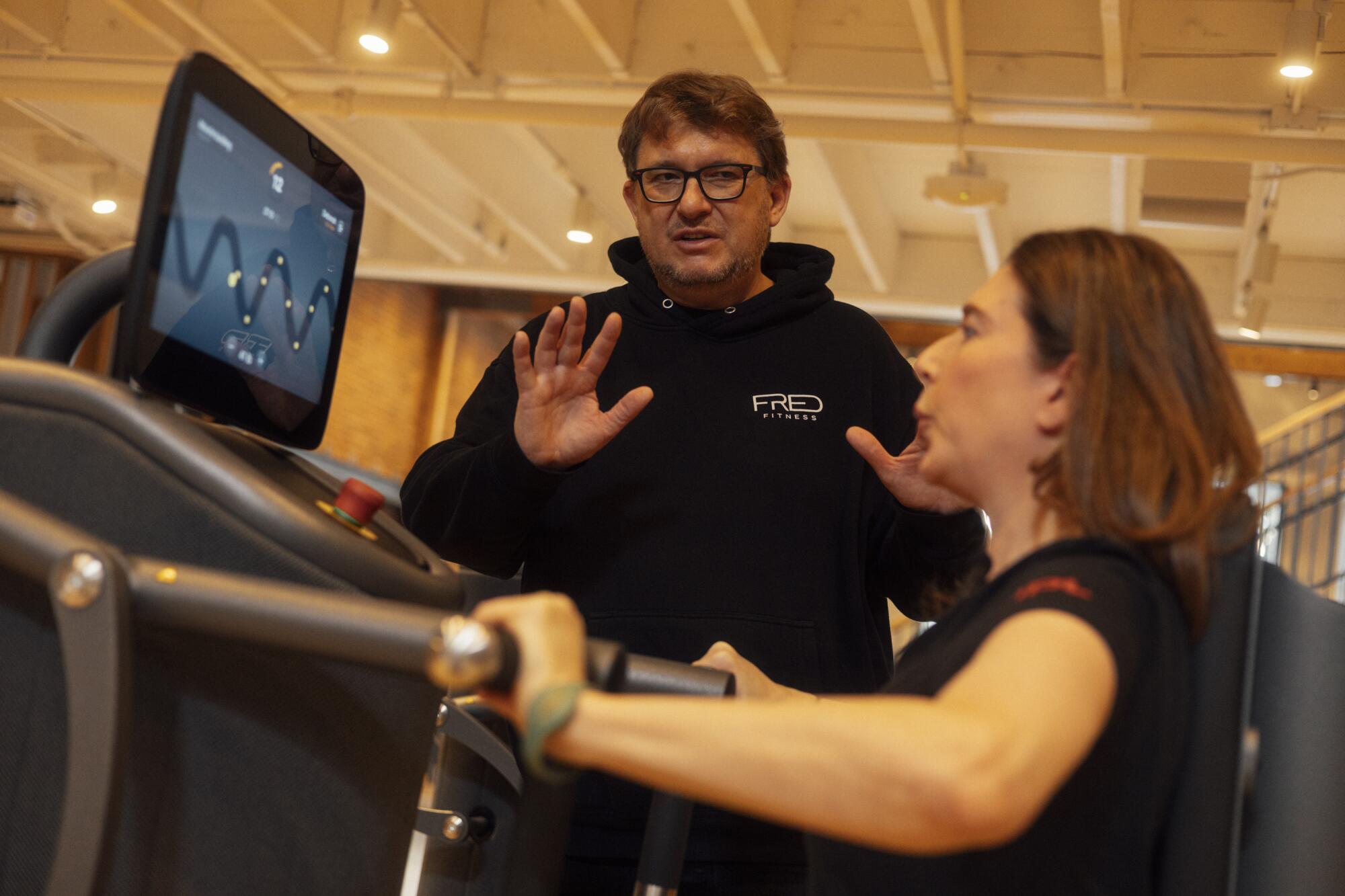
Fred Fitness an AI gym in Santa Monica.
(Chiara Alexa / For The Times)
“It’s a metric we use to give people an idea of where their strength and areas of improvement are compared to their calendar age,” Alvino explains.
From that point on, when you log onto an exercise machine with your wristband, it calls up your personalized training program. The machine then physically adjusts to your height and limb length, raising or lowering its seat and altering the position of its handles according to your body. The AI is also adaptive, utilizing machine learning. So it will evolve with you as you get fitter.
“The machines continue to learn about your capabilities,” Enzensberger says. “And that data is collected and fed into the AI to constantly generate a better training program for you.”
Fred Fitness is the brain child of Andre Enzensberger’s brother, Alfred, who is the president and founder of Munich-based Clever Fit, a fitness franchise with more than 500 locations throughout Europe. Alfred Enzensberger partnered with Philipp Roesch-Schlanderer, CEO of EGYM, a global fitness technology company also based in Munich, in 2023 to create a full AI gym. EGYM wrote Genius, which was deployed in August 2024. They brought in Andre Enzensberger as CEO.
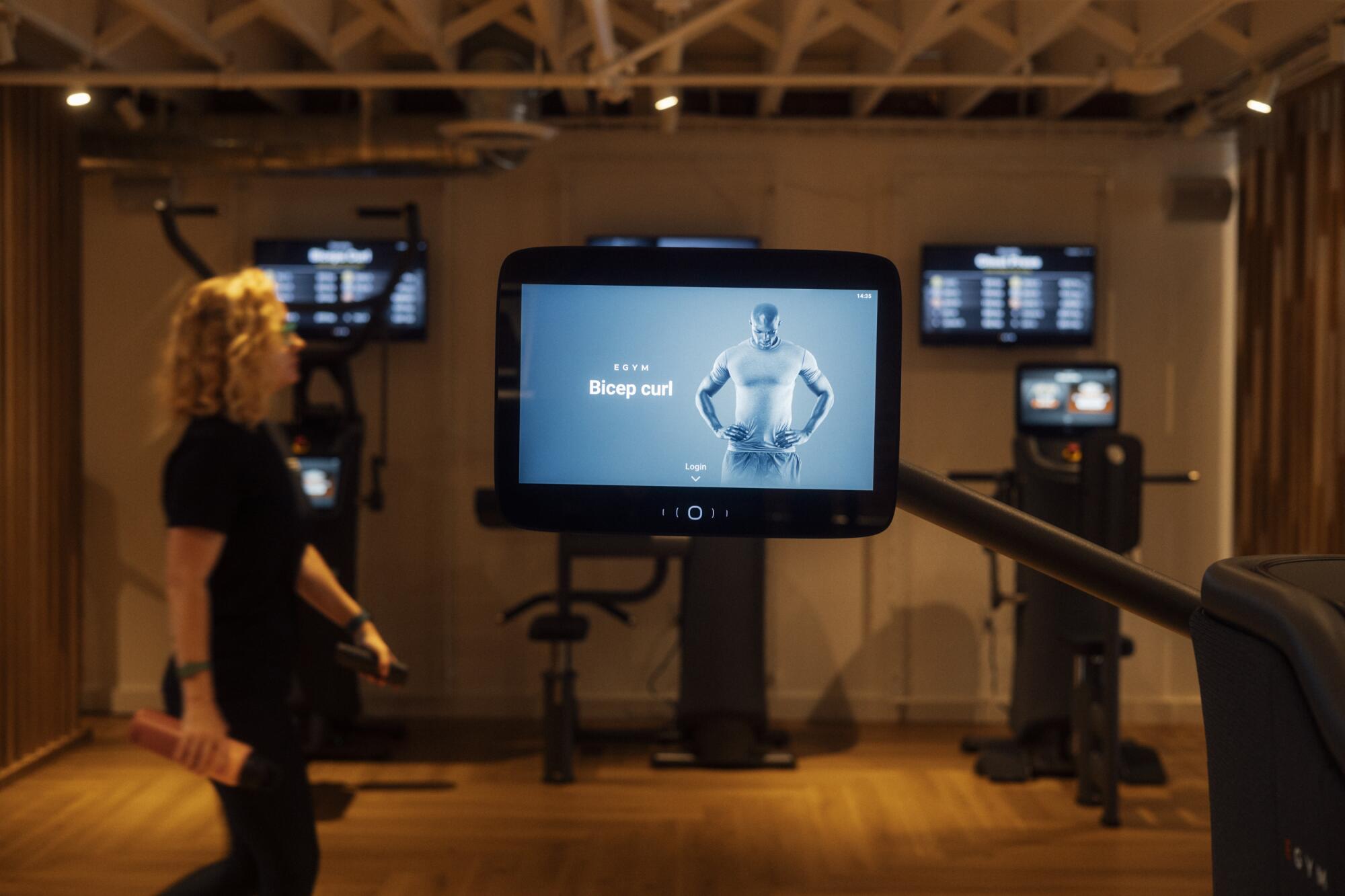
Fred Fitness an AI gym in Santa Monica.
(Chiara Alexa / For The Times)
There are other gyms with smart or AI-powered equipment in Southern California, such as L.A.’s EōS Fitness (with equipment from EGYM) and Smart Fit Method in Orange County. But at Fred Fitness, “Every piece of machinery is tied into the network,” Andre Enzensberger says. “We’re utilizing what the AI system can do on a much larger, fuller scale.”
Los Angeles was the ideal city in which to launch the venture, given its history as a hub for fitness and tech culture, he says. “We wanted to embrace the open-mindedness of the people of Los Angeles. Fred Fitness is groundbreaking and requires people who want to experience training in a new way.”
I enjoyed Genius’ guidance during my workout. The treadmill set itself to a lower speed than I normally run at, though at a higher incline, because Genius knew my exercise goal was strength building, not weight loss. And I loved the gamification element of the weight-lifting machines, even going so far as to laugh out loud mid-rep — though I wonder whether the game would get old over time. But in the end, what keeps me coming back to a gym is the promise of a sauna or steam after my workout. And Fred Fitness, unfortunately, doesn’t provide those amenities, which was disappointing.
But growth is on the horizon. A second Fred Fitness is now underway in downtown Culver City — it’s planning to open in early 2026 — and the company hopes to open four additional facilities within three to five years. The locations under consideration are downtown L.A., West Hollywood and Glendale.
“This is just a modern gym that’s fun to use — and people love it because it takes the guesswork out,” Enzensberger says. “Everything is fully guided.”




Jessie Buckley has been nominated for an Academy Award for best actress for her portrayal of William Shakespeare’s wife in Hamnet.
Kate Green/Getty Images
hide caption
toggle caption
Kate Green/Getty Images
Actor Jessie Buckley says she’s always been drawn to the “shadowy bits” of her characters — aspects that are disobedient, or “too much.” Perhaps that’s what led her to play Agnes, the wife of William Shakespeare, in Hamnet.
Buckley says the film, which is based on Maggie O’Farrell’s 2020 novel, offered a chance to counter a common narrative about the playwright’s wife: that she “had kept him back from his genius,” Buckley says.

But, she adds, “What Maggie O’Farrell so brilliantly did, not just with Agnes and Shakespeare’s wife, but also with Hamnet, their son, was to bring these people … and give them status beside this great man. … [And] give the full landscape of what it is to be a woman.”
The film is nominated for eight Academy Awards, including best actress for Buckley. In it, she plays a woman deeply connected to nature, who faces conflicts in her marriage, as well as the death of their son Hamnet.
Buckley found out she was pregnant a week after the film wrapped. She’s since given birth to her first child, a daughter.

“The thing that this story offered me, that brought me into this next chapter of my life as a mother was tenderness,” she says. “A mother’s tenderness is ferocious. To love, to birth is no joke. To be born is no joke. And the minute something’s born into the world, you’re always in the precipice of life and death. That’s our path. … I wanted to be a mother so much that that overrode the thought of being afraid of it.”

Jessie Buckley stars as Agnes and Joe Alwyn plays her brother Bartholomew in Hamnet.
Courtesy of Focus Features/Courtesy of Focus Features
hide caption
toggle caption
Courtesy of Focus Features/Courtesy of Focus Features
Interview highlights
On filming the scene where she howls in grief when her son dies
I didn’t know that that was going to happen or come out, it wasn’t in the script. I think really [director] Chloé [Zhao] asked all of us to dare to be as present as possible. Of course, leading up to it, you’re aware this scene is coming, but that scene doesn’t stand on its own. By the time I’d met that scene, I had developed such a deep bond with Jacobi Jupe, who plays Hamnet, and [co-stars] Paul [Mescal] and Emily Watson, and all the children and we really were a family. And Jacobi Jupe who plays Hamnet is such an incredible little actor and an incredible soul, and we really were a team. …

The death of a child is unfathomable. I don’t know where it begins and ends. Out of utter respect, I tried to touch an imaginary truth of it in our story as best I could, but there’s no way to define that kind of grief. I’m sure it’s different for so many people. And in that moment, all I had was my imagination but also this relationship that was right in front of me with this little boy and that’s what came out of that.
On what inspired her to pursue singing growing up
I grew up around a lot of music. My mom is a harpist and a singer and my dad has always been passionate about music, so it was always something in our house and always something that was encouraged. … Early on, I have very strong memories of seeing and hearing my mom sing in church and this quite intense mercurial conversation that would happen between her, the story and the people that would listen to her. And at the end of it, something had been cracked between them and these strangers would come up with tears in their eyes. And I guess I saw the power of storytelling through my mom’s singing at a very young age, and that was definitely something that made me think I want to do that.
On her first big break performing as a teen on the BBC singing competition I’d Do Anything — and being criticized by judges about her physical appearance
I was raw. I hadn’t trained. I had a lot to learn and to grow in. I was only 17. I think there was part of their criticism which I think was destructive and unfair when it became about my awkwardness, or they would say I was masculine and send me to kind of a femininity school. … They sent me to [the musical production of] Chicago to put heels on and a leotard and learn how to walk in high heels, which was pretty humiliating, to be honest, and I’m sad about that because I think I was discovering myself as a young woman in the world and wasn’t fully formed. … I was different. I was wild, I had a lot of feeling inside me. I could hardly keep my hands beside myself and I think to kind of criticize a body of a young woman at that time and to make her feel conscious of that was lazy and, I think, boring.
On filming parts of the 2026 film The Bride! while pregnant
I really loved working when I was pregnant. I thought it was a pretty wild experience, especially because I was playing Mary Shelley and I was talking about [this] monstrosity, and here I was with two heartbeats inside me. Becoming a mom and being pregnant did something, I think, for me. My experience of it, it’s so real that it really focuses [me to be] allergic to fake or to disconnection.
Since my daughter has come and I know what that connection is and the real feeling of being in a relationship with somebody … as an actress, it’s very exciting to recognize that in yourself and really take ownership of yourself.
I’m excited to go back and work on this other side of becoming a mother in so many ways, because I’ve shed 10 layers of skin by loving more and experiencing life in such a new way with my daughter. I’m also scared to work again because it’s hard to be a mother and to work. That’s like a constant tug because I love what I do and I’m passionate and I want to continue to grow and learn and fill those spaces that are yet to be filled — and also be a mother. And I think every mother can recognize that tug.
On the possibility of bringing her daughter to travel with her as she works
I haven’t filmed for nearly a year and I cannot wait. I’m hungry to create again. And my daughter will come with me. She’s seven months, so at the moment she can travel with us and it’s a beautiful life. And she meets all these amazing people and I have a feeling that she loves life and that’s a great thing to see in a child. And I hope that’s something that I’ve imparted to her in the short time that she’s been on this earth is that life is beautiful and great and complex and alive and there’s no part of you that needs to be less in your life. You might have to work it out, but it’s worth it.
Lauren Krenzel and Susan Nyakundi produced and edited this interview for broadcast. Bridget Bentz, Molly Seavy-Nesper and Beth Novey adapted it for the web.

Bruce Campbell
I’m Battling Cancer
Published
Bruce Campbell has revealed he has cancer, but says it’s a type that’s treatable, though not curable.
“The Evil Dead” actor shared the news Monday in a message to fans, writing, “Hi folks, these days, when someone is having a health issue, it’s referred to as an ‘opportunity,’ so let’s go with that — I’m having one of those.” He continued, “It’s also called a type of cancer that’s ‘treatable’ not ‘curable.’ I apologize if that’s a shock — it was to me too.”

Campbell said he wouldn’t go into further detail about his diagnosis, but explained his work schedule will be changing. “Appearances and cons and work in general need to take back seat to treatment,” he wrote, adding he plans to focus on getting “as well as I possibly can over the summer.”
As a result, Campbell says he has to cancel several convention appearances this summer, noting, “Treatment needs and professional obligations don’t always go hand-in-hand.”
He says his plan is to tour this fall in support of his new film, “Ernie & Emma,” which he stars in and directs.
Ending on a determined note, Campbell told fans, “I am a tough old son-of-a-bitch … and I expect to be around a while.”

Neve Campbell in Scream 7.
Paramount Pictures
hide caption
toggle caption
Paramount Pictures
The OG Scream Queen Neve Campbell returns. Scream 7 re-centers the franchise back on Sidney Prescott. She has a new life, a family, and lots of baggage. You know the drill: Someone dressing up as the masked slasher Ghostface comes for her, her family and friends. There’s lots of stabbing and murder and so many red herrings it’s practically a smorgasbord.
Follow Pop Culture Happy Hour on Letterboxd at letterboxd.com/nprpopculture

War in the Middle East: Iran’s broad retaliation in the Gulf • FRANCE 24 English

Bruce Campbell announces cancer diagnosis; ‘Fear not,’ he tells fans

Vigil held for 2-year-old girl killed in SF Mission Bay crash

Dallas Fed says ‘older, experienced workers’ likely have less cause for concern about AI job displacement

Miami Heat-Brooklyn Nets Injury Report, Betting Lines, How to Watch, Lineups & More

Florida High School Football Rankings: Top 25 teams – Oct. 21

Cleary's 21 help Le Moyne down Central Connecticut State 69-64 in OT

How old is Bo Nix? What to know about Oregon quarterback ahead of 2024 NFL Draft

99th annual Pony Swim held in Virginia

Indiana Members Credit Union announced as new anchor tenant at Bottleworks District
War in the Middle East: Iran’s broad retaliation in the Gulf • FRANCE 24 English

Trump sends official notification to Congress on strikes against Iran

Unexpected birth brings hope to near-extinct Amazon tribe

Supreme Court blocks redrawing of New York congressional map, dealing a win for GOP

Map: Earthquake Shakes Central California
-

 World5 days ago
Exclusive: DeepSeek withholds latest AI model from US chipmakers including Nvidia, sources say
-

 Massachusetts6 days ago
Mother and daughter injured in Taunton house explosion
-

 Denver, CO6 days ago
10 acres charred, 5 injured in Thornton grass fire, evacuation orders lifted
-

 Louisiana1 week ago
Wildfire near Gum Swamp Road in Livingston Parish now under control; more than 200 acres burned
-

 Politics1 week ago
OpenAI didn’t contact police despite employees flagging mass shooter’s concerning chatbot interactions: REPORT
-

 Technology1 week ago
Stellantis is in a crisis of its own making
-

 Oregon4 days ago
2026 OSAA Oregon Wrestling State Championship Results And Brackets – FloWrestling
-

 Technology1 week ago
Arturia’s FX Collection 6 adds two new effects and a $99 intro version