Connect with us

Lifestyle

How to see the lost art of rebel Disney imagineer Rolly Crump in L.A.

Published

on

How to see the lost art of rebel Disney imagineer Rolly Crump in L.A.
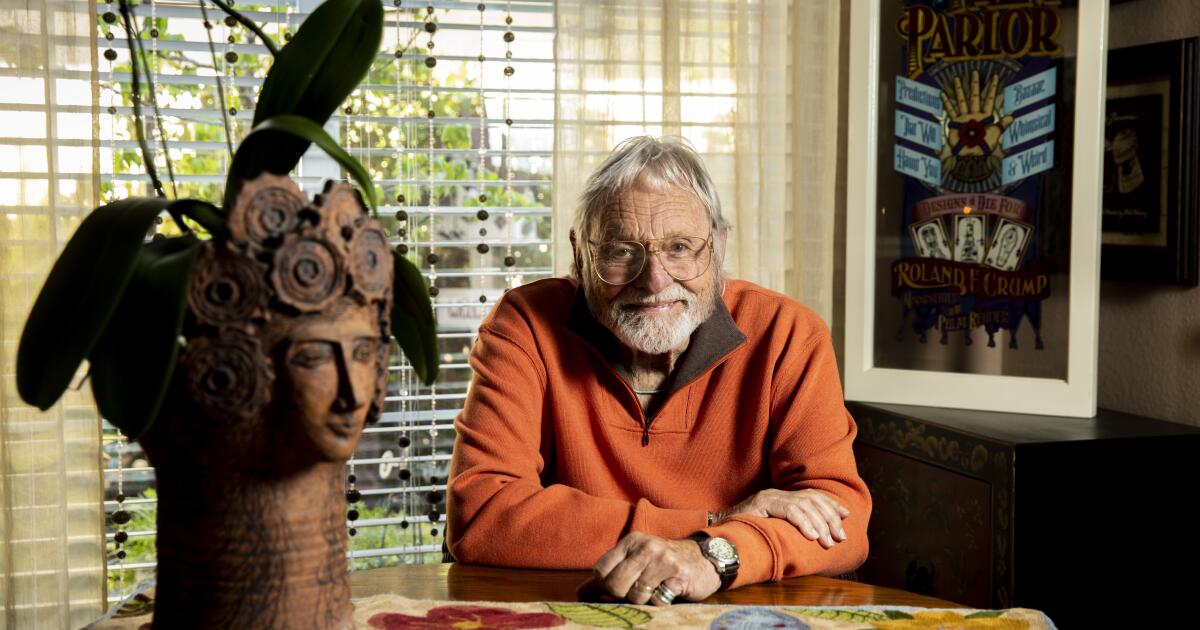
Rolly Crump had an outsized reputation. A rebel in the Disney fold. A beatnik. An unapologetic tell-it-like-it-is you-know-what.

Crump, who died last year at the age of 93, also forever changed the look of Disneyland. His art can be found in the Enchanted Tiki Room and, along with close friend and fellow artist Mary Blair, throughout It’s a Small World.

Crump’s style possessed a larger-than-life whimsy and circus-like loudness, and it caught the eye of Walt Disney, who plucked Crump from animation and one day assigned him what would become arguably the most recognizable clock in Southern California. The timepiece is the anchor of the façade of Disneyland’s It’s a Small World.

Rolly Crump designed a poster for West Hollywood folk club the Unicorn. The poster is part of a new exhibition dedicated to showing off Crump’s early work.

(From Christopher Crump)

Advertisement

This week, an assortment of Crump’s lesser-known personal work will be on display at West Hollywood gallery Song-Word Art House. The show, dubbed “Crump’s The Lost Exhibition,” is curated by Rolly’s son, Christopher, who followed in his father’s footsteps to work for Walt Disney Imagineering, the division of the company responsible for theme park design. “The Lost Exhibition” will draw heavily on Crump’s late-1950s and early-1960s work, specifically his series of folk-house-inspired, rock ’n’ roll-style posters.

The event is open to the public Friday through Sunday, and the gallery is near the original location of one of Crump’s old hangs, folk club the Unicorn. A poster Crump drew for the venue will be a centerpiece of the exhibit. Christopher cites the freewheeling nature of the ’50s folk scene as a large influence on his father’s art, which had the sort of bold colors and intricate, line-heavy work one sees in a tattoo parlor.

Other posters show off Crump’s acidic yet silly sense of humor, such as what he called his “dopers,” that is, art that humorously celebrated drugs in the style of Beat generation barroom posters (“Be a man who dreams for himself,” reads a painting cheerleading opium).

Outside of his work at Disney, Crump continued to work on eccentric Pop art throughout his career. A comic strip-inspired 1967 poster for psychedelic rock group the West Coast Pop Art Experimental Band belongs to the collection of New York’s Museum of Modern Art. A print will be shown at Song-Word.

Advertisement

Crump stayed with Disney through 1970, although he would return multiple times before retiring in 1996. He also designed an attraction for Knott’s Berry Farm, briefly ran his own design firm and had a short-lived store, Crump’s, dedicated to his art. In 2017, Crump had a postcareer exhibition at the Oceanside Museum of Art, but Christopher sees “The Lost Exhibition” as a chance to explore his father’s lesser-known early work, before Crump would work on such attractions as the Haunted Mansion and It’s a Small World, the latter of which had its premiere at the 1964 World’s Fair.

“This is a personal thing for me,” Christopher says. “This is the exhibition that never happened. He should have done this. He should have had more gallery shows. The only real gallery stuff was when he had the Crump’s shop on Ventura Boulevard, but he never had a formal gallery show.”

Christopher, who will be on hand all three days to share tales about his father, spoke to The Times about the show. This interview has been edited for length and clarity.
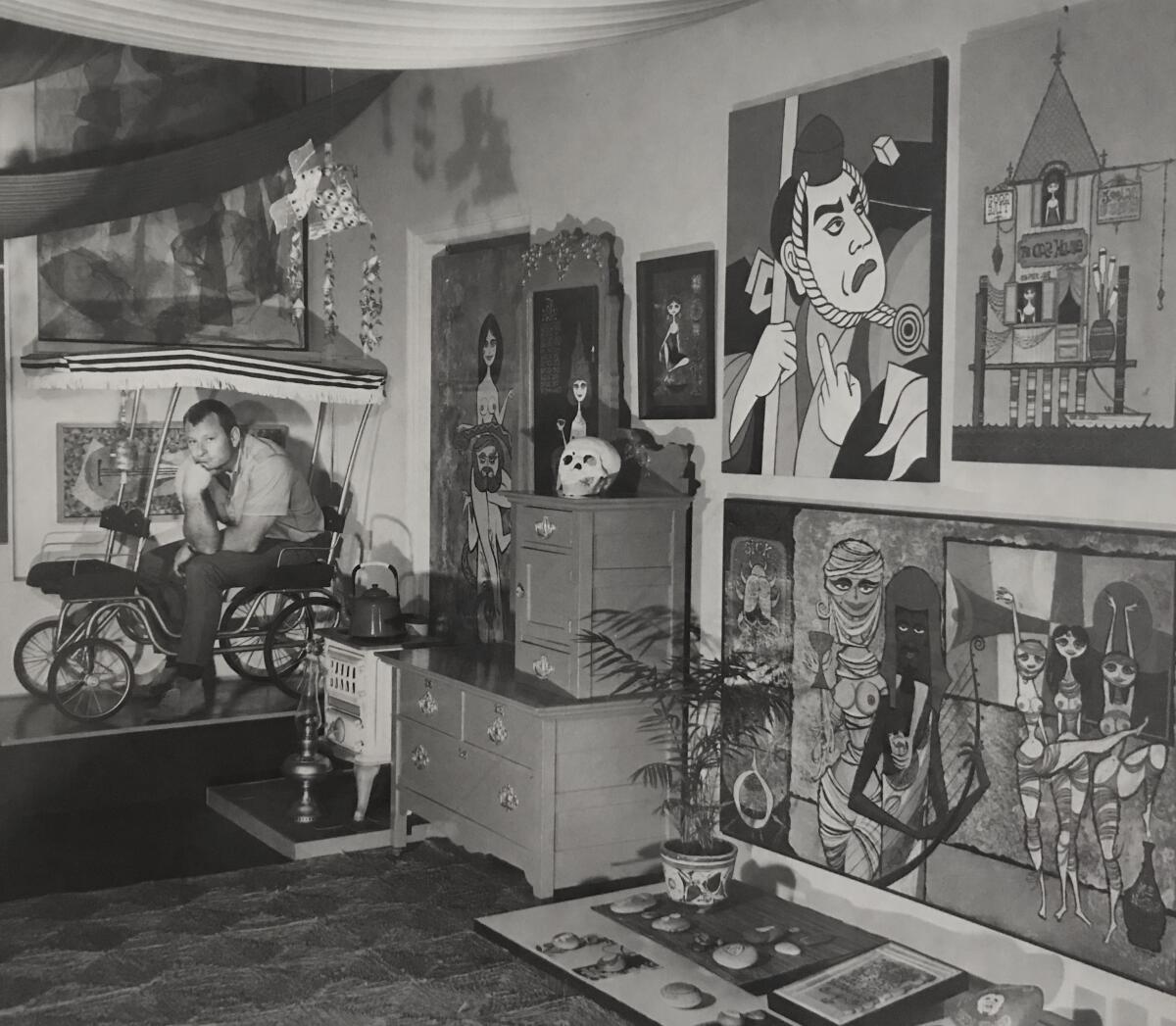
Rolly Crump, in a small carriage at the back of a shop with knickknacks and art.

Rolly Crump in his shop, Crump’s, which son Christopher said was a short-lived operation on Ventura Boulevard.

(From Christopher Crump)

Advertisement

Your dad started working for the Walt Disney Co. in 1952. You were born in 1954. This exhibit places a particular emphasis on artwork from that era. When did you first become aware of your father’s work?

He was drawing all the time. He supported me as a model maker, and I had a desk and tools and he bought me kits. I started building models when I was 6 years old. I watched him draw. But later, I recognized that this huge body of work of his, he was doing all the time. He hung out with [animator-artist] Walter Peregoy a lot. Walter Peregoy would get up at 4 a.m. and draw and paint. And that started hitting me. Dad had two jobs — he was working in animation and he was working in construction on the weekends, and he was knocking out all this artwork and mobiles. When someone calls themselves an artist, they don’t have a choice. It is constant. It is all the time.

You have to also think about culture. Dad wasn’t changing diapers, cooking, cleaning and washing up and all that stuff. Men didn’t do that. It wasn’t like there was something wrong with him, but it wasn’t until later where it was like, “Hey, Dad, you have to help out with the chores.” Whatever the hell Dad wanted to do, he’d do it, so in Dad’s case, he would paint, draw, sculpt and make mobiles. He was going to keep satisfying that itch of having to do that stuff.

And everybody would help. My mom did a lot of painting on my dad’s stuff. He drew it, and said, “Paint that red. Paint that green.” I remember doing colors on paintings, and this was in the early to mid ’60s. We were all part of Dad’s little art machine.

In collecting this poster art, what impresses you today? What do you appreciate about the personal work he was doing while working in animation? I remember your dad saying he felt insecure as an animator.
Advertisement
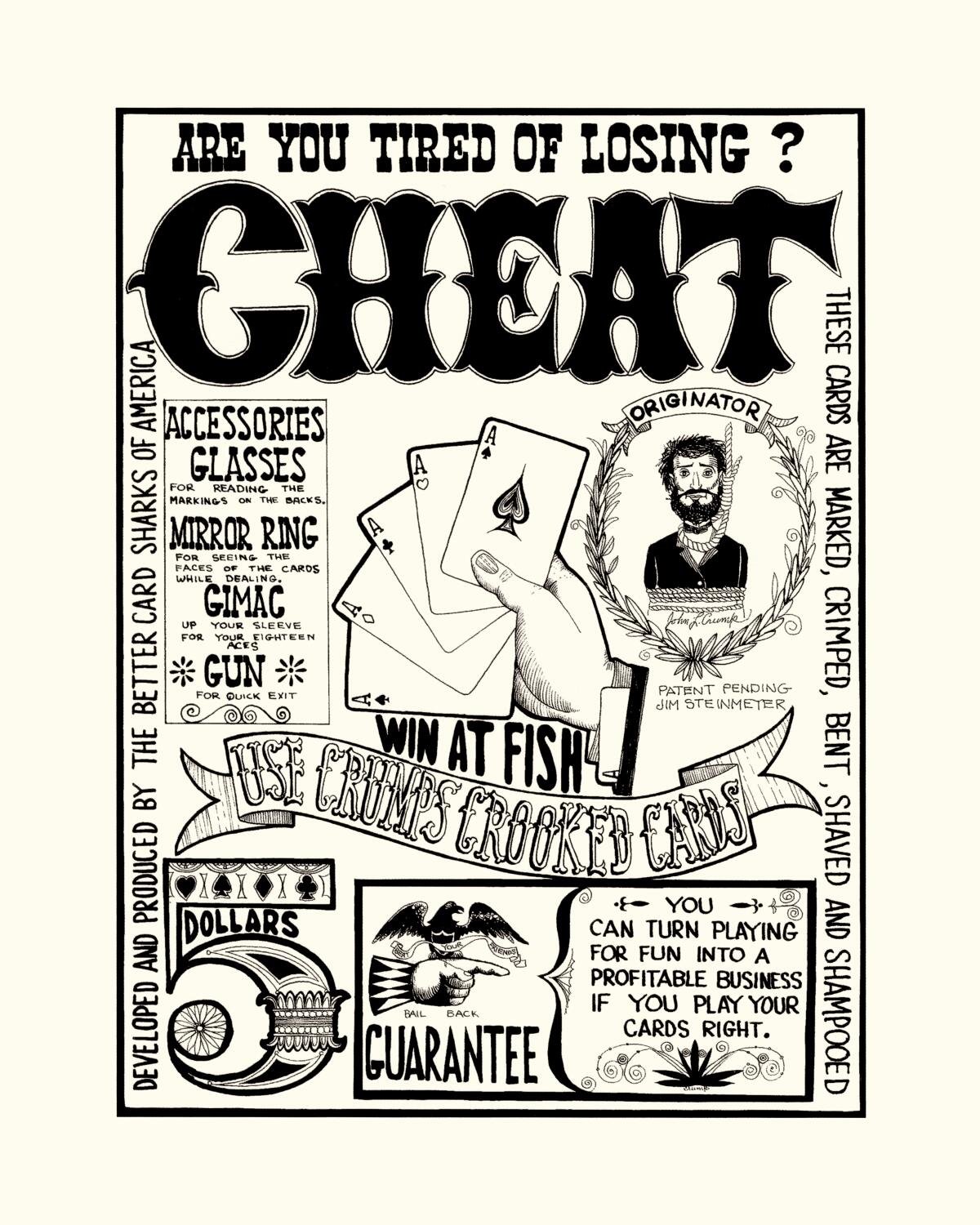
A poster with tips on how to cheat at card games.

A Rolly Crump-designed poster that’s part of an exhibition of the artist’s early work.

(From Christopher Crump)

These [animation] artists — Walter Peregoy, Dale Barnhart, Frank Armitage, and of course, Ward Kimball and Marc Davis — these guys were all amazing. Dad would say, “I knew how to use a pencil.” He could draw, but he had no formal education in the arts. These guys influenced him and he learned from them, but he needed to find his voice. I captured an interview recently — somebody sent it to me — of him giving a talk, and Dad told this great story about wanting to learn how to paint, to become an artist. He was trying to mimic Walt Peregoy’s style, and it wasn’t working. He was getting really frustrated.

He talked about going to an art show at the studio, and he saw a piece of a bunch of gargoyles sitting on a log flying kites. And the light bulb went off. He said, “I can do that.” Dad’s got a funky sense of humor, and the animation world was all about getting people to laugh, so he went home and he painted lobsters drinking martinis. And that was the first painting he did where he took the idea of telling a little story and making sure it was funny. That kick-started him.

What I’ve always loved about your father’s personal work is that there’s a free-flowing nature to it. You see that even in the poster for the Unicorn. It feels improvised, jazzy.

Advertisement

And what I think, and I’ve heard him say this, he was always looking for something different, and then to put some twist on it. When you think about the folk era, when it was really hot — burning hot — it was hobos on freighters writing songs about social injustice. These were “stick it to the man” people. All these things influenced him — the idea of folk music and freedom of expression.
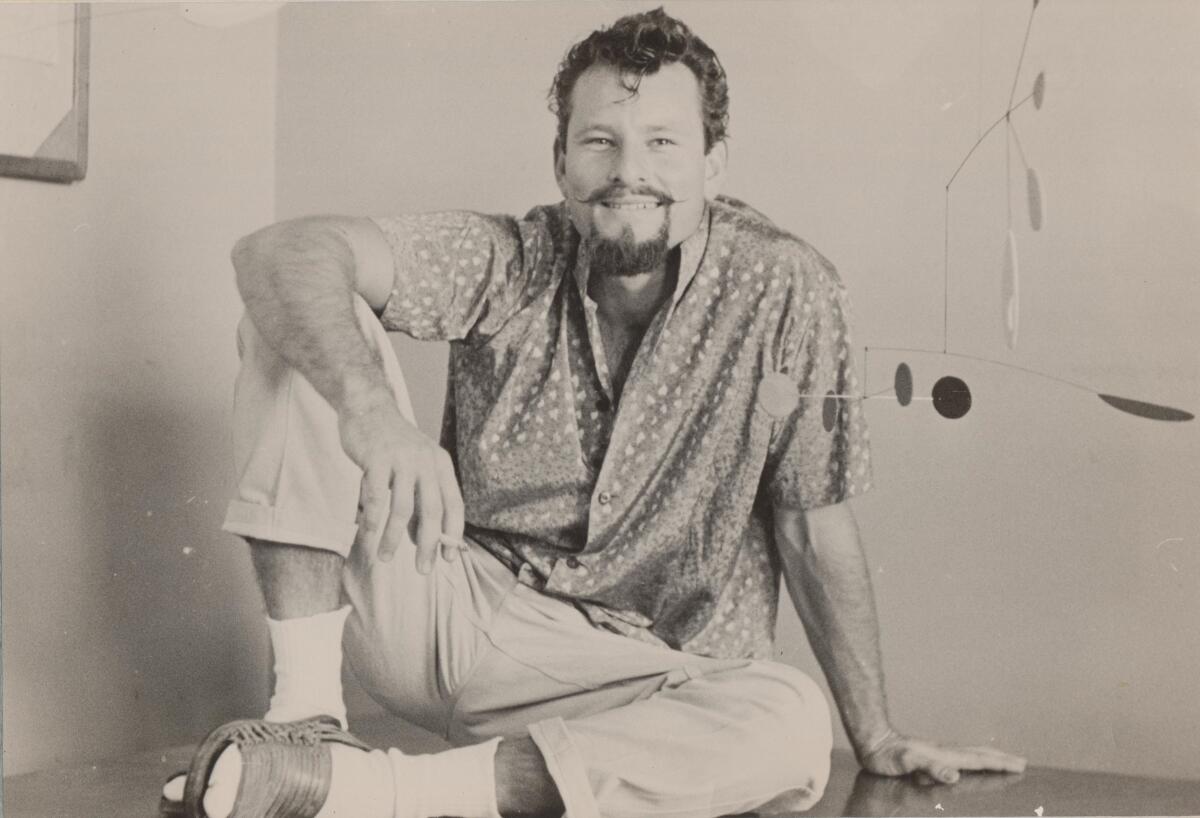
A young goateed man in an open-collared shirt and sandals.

Rolly Crump in 1957, when the artist was working in animation at the Walt Disney Co.

(From Christopher Crump)

Like, there was no way he could paint like those other guys. But he found his voice, and these posters became more satirical. It’s kind of mock advertising but very tongue-in-cheek. I’ll be playing a soundtrack of a lot of the music Dad had in his collection at home. So it’s a 4½-hour compilation of Miles Davis, Nina Simone, Peter, Paul and Mary, Quincy Jones, Harry Belafonte, Wes Montgomery — all the stuff we listened to the house or I heard in his Porsche listening to the jazz station.

How do you connect what we’ll see in this show with his best-known Disney work on It’s a Small World or the Enchanted Tiki Room?

Advertisement

Because he was drawing every day, his line work, his composition, his technical chops as an artist got better. That led to how he was able to come up with stuff in the Tiki Room, the toys in Small World. He didn’t wake up and roll out of bed one morning and become really good. There was a gradual development of who he was. Then he got to a confidence level. He knew who he was and he was unapologetic about it.

“Crump’s The Lost Exhibition”

He started watching how Walt [Disney] behaved and he found his groove with Walt. He waited a few years before he really started becoming opinionated, and then once Walt started listening to him, it annoyed all the other Imagineers. They were all singing and dancing. “Whatever Walt wants.” Rolly wasn’t a dancer. How could this crazy beatnik character be Disney? It’s like musicians. It’s the chops. You mentioned the jazz thing — jazz is about improvisation. Jazz is about going with however the flow is going and following your crazy ideas. Walt believed in Dad’s crazy ideas.

Advertisement

And yet those crazy ideas helped define the tone of Disneyland. Modern theme parks are very much aligned with the look of film and television, yet there are multiple times, say, on It’s a Small World, where it’s very clear what Rolly’s influence was.

My wife didn’t know much about Disney. She rides It’s a Small World — and my dad had been doing birthday cards and Christmas cards — and she looked up at It’s a Small World and said, “Oh my God, it’s my father-in-law.” And that’s kind of my thought. This was all developed and worked out, and by the time the World’s Fair hit, and the ’60s hit, he had a good eight or nine years of messing around, and now he’s blossoming. Now he’s got a stage to work on.

So I’m talking about the ’50s and early ’60s before all that. What was it that happened to him that developed him and developed his confidence to be able to be that big-time guy?

It’d be like in music. He played a lot of little clubs before he hit the big stages. My vibe is to just kind of have people remember how artists become what they become.

Advertisement

Lifestyle

Harrison Ford isn’t retiring: ‘I really wouldn’t know what to do with myself’

Published

on

Harrison Ford isn’t retiring: ‘I really wouldn’t know what to do with myself’

“I’m happy to be the age I am, and have no impulse to hide it,” says Harrison Ford. He’s shown above accepting the Screen Actors Guild Life Achievement Award in Los Angeles on March 1.

Valerie Macon/AFP via Getty Images


hide caption

toggle caption

Advertisement

Valerie Macon/AFP via Getty Images

After playing some of the most recognizable and beloved characters in cinematic history, Harrison Ford is not interested in retiring. “Without my work, I really wouldn’t know what to do with myself,” the 83-year-old actor says. “I really do love the work. … It constantly changes, and the people change, and the mission and the opportunity change, and it just makes for an interesting way to live your life.”

Ford initially struggled to find his footing in Hollywood. He worked on-and-off as a carpenter for years before landing the breakthrough role of Han Solo in the original Star Wars film. He went on to star in the Star Wars sequels, as well as the Indiana Jones movies and Blade Runner — all the while frequently performing his own action scenes.

“I don’t want to have to hide the face of the character because it’s a stunt guy,” he says. “I want [the audience] to feel the blow. I want them to see the anxiety. I want them to be there when the decision is made or when the decision is missed. I just want them to be there.”

Advertisement

In the current Apple TV series, Shrinking, Ford plays a therapist named Paul who’s been diagnosed with Parkinson’s disease. Thus far, he says, the show’s writers haven’t shared with him the progression of Paul’s disease. Instead, he says, “Like a true Parkinson’s patient, I don’t really know what’s coming. … I’m sort of living with the symptoms I have been last described as having.”

Recently, Ford teared up while accepting a recognition for lifetime achievement at the Actor Awards. “That speech that I wrote was not crafted to be emotional; it just happened to me,” he says. “I feel slightly embarrassed by it, because I have enough experience with these things to want to be able to manage not to be overcome.”

Interview highlights 

On being asked to help in Star Wars auditions while on a carpentry job at Francis Ford Coppola‘s office

I was there sweeping up. I was just finishing the job when George Lucas walked in [who Ford knew from appearing in Lucas’ last film, American Graffiti] … and I’m standing there in my carpenter’s work belt, sweeping up the floor. It turned out to be a fortuitous occasion, because weeks later I would end up being asked if I would do them a favor and read with the other actors who were being considered for the parts. … I never was told that I was ever to be considered, and then at the end of the process, I guess they ended up with two groups of three people that were in final consideration. I’ve always been amused that in the second group, the character of Han Solo would have been played by Chris Walken. I would have loved to see that.

On his most famous ad-lib in a film

Advertisement

[It’s] the line in Star Wars where Princess Leia tells me that she loves me and I say, “I know,” instead of saying “I love you too,” which is the scripted line. Simply the impulse was to be more in character. And George Lucas, who had written the line, was not so happy that I didn’t give him the original version. But I really felt strongly about it. So he made me sit next to him when he previewed the film in a public movie theater in San Francisco and it got … a good laugh. And so he accepted it and left it in.

On seeing Star Wars for the first time on screen

I was blown away. I mean, I was really shocked by the power of the film. We shot in England and our English crew were not used to something like Star Wars, and so they were pretty sure that it was going to be a disaster. And we weren’t far from that opinion, ourselves, the actors.

On performing an emergency landing while flying solo in a vintage World War II airplane

Let’s just start by saying that it was a mechanical failure. … It was a 74-year-old airplane, and I was 74 years old at the time. .. Four hundred feet in the air above the airport, the engine quit. And it’s my home airport, and I was familiar with the surrounding terrain, which is cluttered with houses, wires and cars, and people. So I turned to a golf course that was there. …

Advertisement

In my ear was the very clear voice of one of my aviation mentors who always, when talking about mechanical failures or other kinds of failures, the advice was to “fly the airplane as far into the crash as possible.” You think about this thing when you’re a pilot, you think about the potential, the possibility of it happening, and of course you train. So when it happened, it was not really a surprise, and I thought I knew what I had to do to handle it, so I just started doing the things that needed to be done. … I don’t remember actually being scared. [My injuries] were more than described in the newspaper, but I’m over them all, thank you. I got my license back and continue to fly. … I am not a thrill seeker. I am a very conservative pilot. It’s not that I do crazy stuff for the fun of it.

On objecting to the Vietnam War draft 

I was facing being drafted and I hired a lawyer to represent me to the draft board. I had to explain why I might qualify as a conscientious objector. I explained that I did not have a history of religious affiliation. My mother was Jewish, my father Catholic. … I was raised Democrat. I’m quite happy to accept other people’s versions of God, but I found in a Protestant theologian named Paul Tillich, a sentence that said: If you have trouble with the word God, take whatever is central and most meaningful to your life and call that God.

And to me that was life itself, the complexity, the biodiversity, the incredible integration and complexity of nature, to me seemed to be the same thing as God. And so I prepared an explanation that was probably so unusual that it found the edge of a desk and had a lot of things piled on top of it because it didn’t fit a niche. They never got back to me, basically. The draft board never got back to me.

Lauren Krenzel and Nico Gonzalez Wisler produced and edited this interview for broadcast. Bridget Bentz, Molly Seavy-Nesper and Beth Novey adapted it for the web.

Advertisement

Continue Reading

Lifestyle

His portrait of MLK in a hoodie went viral. Now he shares a message in his Downtown Disney art

Published

on

His portrait of MLK in a hoodie went viral. Now he shares a message in his Downtown Disney art

There’s a hidden door in Downtown Disney. Only this one isn’t meant to be walked through.

Flanking a stage near the monorail station, you’ll find a glistening white tower, the work of artist and activist Nikkolas Smith, who has adopted the term “artivist.” At first glance, the tower — one of Downtown Disney’s most striking works — appears to be a nod to Disneyland’s Midcentury art, for its curved lines and space-age optimism wouldn’t be out of place in Tomorrowland.

That’s there, says Smith, but there are also a number of more subtle inspirations.

The tower is a nod to five Black architects, trailblazers whose creations sometimes went unnoticed or overlooked. And that’s why at the base of the structure is a looping opening meant to signify a half-open doorway.

Downtown Disney’s Legacy Tower touches on the styles of different Black architects as it rises into the sky.

Advertisement

(Gary Coronado / For The Times)

Smith shares a distressing anecdote. “They had to learn how to read drawings upside down, because they weren’t allowed to sit next to the white clients,” Smith says, adding they also had to endure unequal pay. “So I was incorporating things like the half doorway to symbolize their struggle.”

Officially designated as the Legacy Tower, Smith himself fixates on that word — “legacy.” The term, he says, represents a thematic constant across his work. A regular collaborator on a number of Walt Disney Co. projects and a former architect with Walt Disney Imagineering, the division of the company focused on theme park experiences, Smith is something of a connector. His canvas art, full of fast-moving brush work, is often rooted in the past while urgently seeking to draw links to the present.

A portrait of Martin Luther King Jr. in a hoodie.

Artist Nikkolas Smith went viral for his portrait of Martin Luther King Jr. in a hoodie, a tribute to slain teenager Trayvon Martin.

(Nikkolas Smith)

Advertisement

His 2025 children’s book, “The History of We,” tells the story of how humanity can trace its roots to Africa. And one of his best-known pieces is of Martin Luther King Jr. in a hoodie, meant to evoke the image of Trayvon Martin, the slain 17-year-old whose death inspired a social justice movement. The work went viral in 2013 while Smith was still working for Imagineering. It altered his career trajectory.

“It was like, ‘I cannot just make art about churros and rides right now,’” Smith says. “There’s a time for that, and there’s also a time to talk about this.” He references his portraits related to the killings of Black men, many at the hands of police officers, such as Philando Castile and Michael Brown.

“At the end of the day, Disney understood that,” Smith adds. “They understood that I needed to make art that was extremely important at the moment, about justice or the lack of justice.”

Smith left Disney in 2019 after 11 years but has maintained a close relationship with the company, so much so that Imagineering called upon Smith to design the tower, which opened in 2023.

Advertisement
Three people chat in front of an earth-toned tower.

Artist Nikkolas Smith, left, chats with guests Ricky Yost and Martina Yost of Aubrey, Texas, who recognized Smith from a recent Disney cruise excursion.

(Gary Coronado / For The Times)

As the Legacy Tower spirals toward the sky, its patterns and and lattice work nod to the likes of James H. Garrott, Robert A. Kennard, Roy A. Sealey, Ralph A. Vaughn and Paul Revere Williams. All were active in Los Angeles — Williams, for instance, was a pivotal designer on the LAX Theme Building — and Smith interlaces decorative flourishes in varying styles that twist around one another to work up the Legacy Tower’s pointed spheres.

The door of the Legacy Tower symbolizes perseverance, Smith says. “They made it through, despite all of the obstacles they had to go through.”

Smith had studied the architects while a student at Hampton University, and has documented on his Instagram their various stylings, which range from restrained to whimsical to ornate. A section referencing Vaughn is modern minimalism, whereas an area dedicated to Sealey is full of jagged, pointed linework. All of it is held together via a coiling design that feels full of movement.

Advertisement
Legacy Tower patterns and lattice spirals toward the sky.

The patterns of the Legacy Tower are nods to the likes of James H. Garrott, Robert A. Kennard, Roy A. Sealey, Ralph A. Vaughn and Paul Revere Williams.

(Gary Coronado / For The Times)

“How can I show humanity’s interconnected future? That’s the idea,” Smith says. “There’s this African theme of Sankofa. If we look toward our future, we have to look at the past and value and appreciate the past. I thought it would be great if I could really commemorate some Black designers and architects as the foundation and backstory of the tower. And I was also thinking about these breezeway block patterns that you see in Leimert Park.”

And yet it also feels like something that belongs in the park. Smith says he looked at some Tomorrowland designs.

“A Midcentury Modern vibe was Walt,” Smith says, referring to park patriarch Walt Disney. “That was Walt’s thing. It all connects. I love that people can hopefully now connect both things. You can connect Tomorrowland and Walt with Paul Revere Williams.”

Advertisement

It’s clearly Smith’s favorite design of his for Disney, although it’s not the only space at the resort that features his artistry. During his decade-plus with Imagineering he regularly worked on teams that focused on projects at Disney California Adventure, which this year is celebrating its 25th anniversary. He was heavily involved, he says, in the evolution of Avengers Campus, contributed to a small promenade stage in Pixar Pier and helped envision the facade of Guardians of the Galaxy — Mission: Breakout!, which transformed the former Tower of Terror into a sci-fi structure.

Nikkolas Smith says elements of Downtown Disney's Legacy Tower symbolize perseverance.

Nikkolas Smith says elements of Downtown Disney’s Legacy Tower symbolize perseverance.

(Gary Coronado / For The Times)

Smith looks back fondly at his years at Imagineering, specifically calling out his time on the Guardians project. The former fake hotel is now full of glistening bronze pipes, a retro futurist look that former Imagineer Joe Rohde, who led the design, has said takes influence from the high-tech aesthetic of architect Renzo Piano, who worked on France’s Pompidou Centre.

“How much can we add to it? How much can we get away with gluing onto this thing?” Smith says of the Guardians facade. “What is the right amount of ‘Guardians of the Galaxy,’ without being too much? Without scaring people on the freeway?”

Advertisement

Today, Smith continues to focus on social justice work, and has also collaborated with filmmaker Ryan Coogler, such as completing concept designs for his Oscar-nominated film “Sinners.” Smith’s 2023 children’s book “The Artivist” documents the importance of creating art that’s in conversation with the world, believing it’s not only a source for education but for empathy. Smith’s weekly paintings speak out often against the current administration, and Smith has been particularly vocal on the ICE raids.

A painting of a city street with lightly political art demanding clean food and water on the buildings.

A selection from “The Artivist,” an illustrated book from Nikkolas Smith.

(Nikkolas Smith)

“Some people say that all art is activism, but I feel that some of the best art that is created is art that has a message,” Smith says. “And hopefully that message has to do with the humanity of all people, and for me, I like to focus on marginalized communities, and how we can value the humanity of everybody. That’s why I make picture books about the origins of humanity and the origins of this country.”

The Leimert Park resident says his wife and young son regularly visit the Disneyland Resort. And when he does, Smith says, he always takes a moment to stop by the Pixar Pier stage that he contributed to, which is often used for character meet and greets.

Advertisement

“They were team projects, and I do go up to them with so much pride,” he says. “I go up to the Pixar Pier promenade stage, and I just go up to it and touch it. … The beautiful thing about Disney is these creations are usually around for a lifetime.”

It turns out you can take the artivist out of Disney, but you can’t fully take the Disney out of the artivist.

Advertisement
Continue Reading

Lifestyle

Out of work and with 2 teens, this mom may lose food stamps under Trump’s changes

Published

on

Out of work and with 2 teens, this mom may lose food stamps under Trump’s changes

Mara is a single mother of two in Minnesota. She and her family have depended on SNAP benefits to make ends meet.

Caroline Yang for NPR


hide caption

toggle caption

Advertisement

Caroline Yang for NPR

Although Mara is unemployed, she is busier than ever.

When she is not taking care of her two children, Mara is at her desk applying for jobs. She is surveying her belongings to see what she can pawn off to buy toiletries. Or she is sifting through bills, calculating which ones can wait and which need to be paid right away.

Soon, Mara, a single mom in Minnesota, may have another task on her busy schedule: figuring out how to afford food for her and her family.

Advertisement

That’s because of new work requirements for people receiving aid from the Supplemental Nutrition Assistance Program, also known as SNAP or food stamps.

“It would be so beyond hard” to lose SNAP benefits, Mara said. “Without SNAP, there’s no funds for food.” Mara asked for her last name to be withheld given the stigma tied to receiving government assistance. She is also worried that speaking publicly will affect her chances of getting a job.

Previously, SNAP recipients with children under 18 were exempt from work requirements mandating that recipients work, volunteer or participate in job training at least 80 hours a month. But now, under President Trump’s One Big Beautiful Bill Act, that exemption only applies to those with children under 14 — which is how old Mara’s youngest child turned in December.

Mara poses for a portrait at CareerForce, a resource for job seekers in Minnesota.

“It would be so beyond hard” to lose SNAP benefits, Mara said.

Caroline Yang for NPR


hide caption

Advertisement

toggle caption

Caroline Yang for NPR

The Trump administration has argued that the mission of the nation’s largest anti-hunger program has failed.

Advertisement

“SNAP was intended to be temporary help for those who encounter tough times. Now, it’s become so bloated that it is leaving fewer resources for those who truly need help,” the White House said in a statement in June.

But policy experts say the SNAP changes do not fully take into account the unique challenges faced by single parents like Mara or the sluggish job market in many parts of the country. They argue that losing food assistance will only create more barriers for recipients struggling to find work.

The timeline for implementing the new SNAP policy varies based on state and county. In Mara’s home state of Minnesota, recipients who don’t qualify for an exemption or meet work requirements will be at risk of losing assistance as early as April 1. Others may have more months depending on when they next need to certify they are eligible for benefits.

Over 100 job applications

Mara imagined she would have a job by now.

It was August when she was let go from her part-time administrative assistant role due to her workplace restructuring. Since then, Mara estimates that she has applied for over 100 positions. She has also attended job fairs and taken free workshops on resume writing.

Advertisement

She has been working since high school, she said, but “ I’ve never been out of work for more than one month, so it’s very difficult.”

Mara spends time working at the computer at CareerForce, a resource for job seekers in Minnesota, on March 4.

Mara spends time working at the computer at CareerForce, a resource for job seekers in Minnesota, on March 4.

Caroline Yang for NPR


hide caption

toggle caption

Advertisement

Caroline Yang for NPR

Although she misses her old job, Mara said it didn’t pay enough to support her and her kids, so she relied on SNAP benefits.

Many recipients are part of the low-wage labor market, where job security is often unpredictable and turnover tends to be high, according to Lauren Bauer, a researcher at the Brookings Institution who has studied SNAP extensively.

“SNAP is supposed to be there to help people smooth that and not let the bottom fall out when they experience job loss,” she said. “And this policy doesn’t account for that at all.”

Advertisement

Mara’s lowest point came in November when the government shutdown led to disruptions in SNAP benefits. Not only was she searching for a new job, but she was constantly figuring out where to get her family’s next meal.

“I might be looking for food stuff during the day when I should have been looking for a job,” she said. “Then, I’m trying to make up that time in the evening after my kids go to bed.”

During the pause, Mara turned to food banks, which revealed other challenges. First, food pantries do not always provide enough for an adult and two growing teenagers, she said. Second, they often lack gluten-free foods, which is essential for her daughter who has celiac disease, an autoimmune disorder that causes digestive problems if gluten is consumed. Gluten-free products tend to be more expensive.

If Mara loses access to SNAP again because of the new work requirements, she fears another stretch of long days spent looking for the right food and enough to feed her family.

“I would be so reliant on looking for food shelves or food banks,” she said. “There would not be time to even live.”

Advertisement

“We’re going to see increases in poverty. We’re going to see increases in food insecurity”

The Congressional Budget Office estimates that roughly 2.4 million people will lose food benefits in a typical month over the next decade as a result of the new SNAP requirements — including 300,000 parents like Mara with children 14 or older.

Gina Plata-Nino, the SNAP director at the nonprofit Food Research & Action Center, says many of the affected recipients will be single mothers who make up a majority of single parent households in the U.S. She added that the changes target a group that often lacks or struggles to afford a support system to help care for their children.

“How can they have a full-time job when they need to pick up their children [for] various activities?” she said. “And they are working — just not enough hours because they need to be there present for their children.”

Mara shops for groceries at a local discount grocery store.

Mara shops for groceries at a local discount grocery store.

Caroline Yang for NPR


hide caption

Advertisement

toggle caption

Caroline Yang for NPR

The new law also imposes work requirements on veterans, homeless people, young adults aging out of foster care, and able-bodied adults without dependents from ages 55 to 64.

Advertisement

It also toughened the criteria for waiving work requirements for recipients in areas with high unemployment. Previously, there were multiple ways to determine a weak labor market and secure a waiver. Now, it only applies to places with an unemployment rate above 10%. (Alaska and Hawaii have a different measure.)

For those who fail to meet the work requirement, SNAP provides assistance for up to three months within a three-year span. But Bauer from the Brookings Institution argues that it is not enough and the impact of SNAP changes will be widespread.

“We’re going to see increases in poverty. We’re going to see increases in food insecurity. We’re going to see increasing strain on the charitable food sector,” she said.

Mara holds her favorite anchor ring, which carries the inscription, "God for me provide thee."

Mara holds her favorite anchor ring, which carries the inscription, “God for me provide thee.”

Caroline Yang for NPR


hide caption

Advertisement

toggle caption

Caroline Yang for NPR

As anxiety hangs over her head, Mara tries to put on a brave face for her children. She does not want them to worry, explaining that her recent struggles have reminded her how tough life can get as an adult.

Advertisement

“I remind them it’s not their responsibility and they’re not accountable for me or for what’s happening,” she said. “I say, just know you get to be a kid.”

Continue Reading

Trending