Lifestyle
How to have the best Sunday in L.A., according to Kenny Scharf

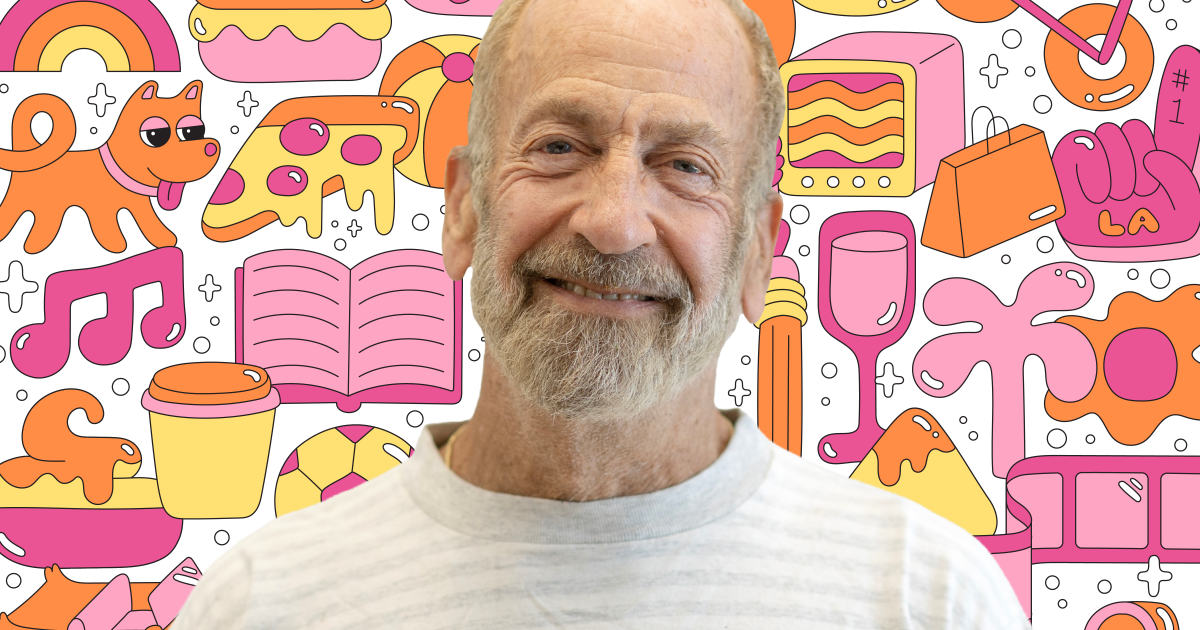
There is no such thing as a day of rest for artist Kenny Scharf, not even Sunday. “I wake up super early. It’s still dark outside,” the Los Angeles native says.
Rising before the sun anchors his active day. “I always have to keep moving,” Scharf says. “Otherwise, I’ll get very depressed.”
An avid hiker and swimmer, Scharf, 67, also maintains a disciplined yoga practice and cycles daily from his Culver City home to his Inglewood studio. There almost everything serves as a canvas, including painted trash doubling as decor and the silkscreened couch on which he’s seated.

In Sunday Funday, L.A. people give us a play-by-play of their ideal Sunday around town. Find ideas and inspiration on where to go, what to eat and how to enjoy life on the weekends.
“I don’t like to waste good paint and silkscreen ink. Why wash it? We apply it everywhere until we use it up,” Scharf says.
Scharf, who grew up in the Valley before making his way to New York City, first gained acclaim in the ‘80s East Village art scene alongside his friends and contemporaries Jean-Michel Basquiat and Keith Haring, his former roommate. The trio also befriended Andy Warhol, who predicted Scharf’s fame.
Renowned for his self-coined “pop surrealism,” Scharf often populates his bold, colorful work with grinning cartoon faces, elastic blobs, and sci-fi creatures floating through cosmic landscapes. Anxieties about overconsumption and environmental degradation lie beneath the playfulness.
Like their creator, Scharf’s works are always on the move, either rolling down the street on the cars he’s painted — featured in his recently published book “Karbombz!” — or traveling to forthcoming exhibitions in Wuhan, Tokyo and Paris.
This interview has been lightly edited and condensed for length and clarity.
5:30 a.m.: Wake up and feed the cats.
My cats, Cutie and Socks — one’s a tabby and the other is a tuxedo cat — wake me up by mewing and walking on me. They’re like, “Hey, I’m hungry.” So I get up and crack open the cans. They like that disgusting, smelly canned food. And then they go out into the yard.
I got the cats because I went to New York for a show. I was gone for five days and I live next to a park, so there are a lot of animals. I came back and my entire house was overrun by mice. I was like, “What the hell am I gonna do? I need cats.” The mice are gone and now I have these cats. They’re so cute and so much fun. They take over my life.

6 a.m.: Detox
I make lemon and hot water. It’s a good way to start the day and clear out the toxins. Right now, I have a lot of citrus because Ed Ruscha’s studio is across the street from my house, and in the back of the studio he has a citrus farm. I go there, especially during this time of year, and get bags of citrus. It’s like a farm community in the middle of L.A. I love L.A. because you can surround yourself with trees and gardens and kind of pretend that you’re not living in a giant metropolitan area.
8:30 a.m.: Iyengar yoga
An Iyengar yoga instructor comes to my house. I find Iyengar is great for aging. You use ropes and gravity to hang and do different things, using your body weight so you can relax into the positions. I also have a swing to go upside down on. When people walk into my living room, they go, “What’s going on here?” because of the ropes on the wall.
In the summer, I’ll go to the beach in Venice and swim in the ocean. It’s wonderful when I’m out in the water. It’s cathartic and cleansing, and sometimes I see dolphins. I’ll go early in the morning before the crowds come.

11:30 a.m.: Mar Vista Farmers’ Market
It’s fun to go there with my daughter Zena, who’s a chef, and my grandkids. We stroll around and get food. All the food stands are delicious. I grew up here in L.A., so I’m into Mexican food. I don’t really want to eat American food. I’m not into hamburgers. I want all the stuff with the culture. I like hot and spicy.
I also buy apples and berries, whatever I can’t grow, because I grow my own food at home.
And I buy stuff from an Indian man who sells Chyawanprash, which is kind of a jam. It’s really concentrated and like an elixir. He also sells Shilajit, which almost looks like tar. You put a little bit under your tongue and it dissolves, and it’s got like every single mineral in it.

2 p.m.: Painting at the studio
I’m painting seven days a week, but I really love coming here on Sundays because nobody’s here and the phone doesn’t ring. Sometimes, my granddaughter, Lua, will come. She paints. Upstairs at the studio I have a little painting area with easels for my grandkids, but my grandson, Jet, isn’t that into painting. I do my work, and Lua’s up there keeping herself busy painting, and it’s great.
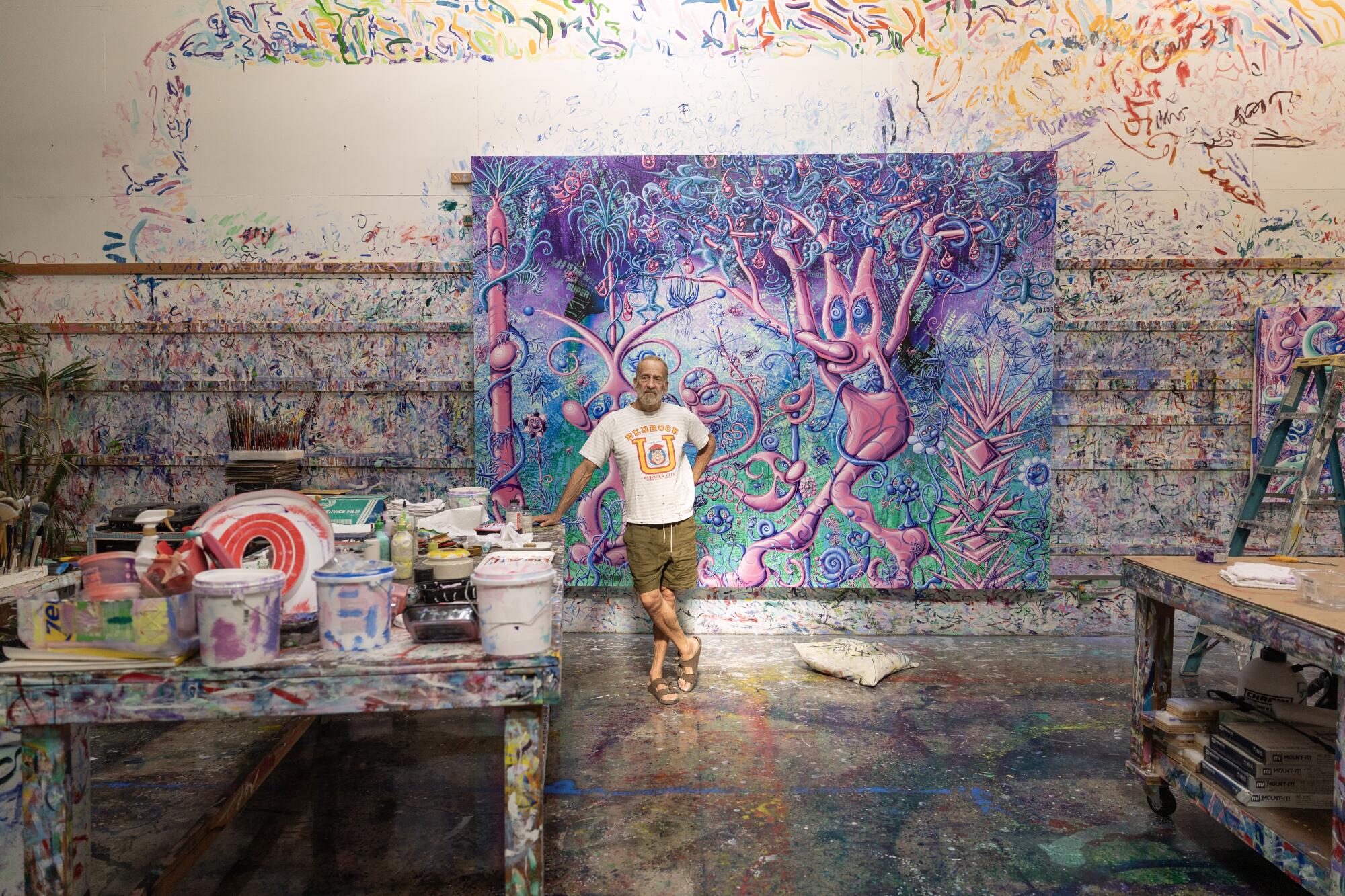
Kenny Scharf in his paint-splattered studio he bikes to every day.
(Myung J. Chun / Los Angeles Times)
5 p.m.: Hike
The easiest one is right behind my house. It goes up to the top of the Baldwin Hills Scenic Overlook where the [Culver City] Stairs go. It’s one of the best views in all of L.A. You can see from the airport to the ocean, downtown, Mount Baldy. You can see almost all the way to Palm Springs, Mount San Gorgonio. The view is amazing.
We also hike a lot in Kenneth Hahn [State Recreation Area].
My grandkids often like to go on a waterfall hike, so there are a couple in Malibu. There are also a couple over in the San Gabriel [Mountains]. We’ll get into the car and drive an hour and hike.
6:30 p.m.: Dinner at a restaurant
Zena, Lua and Jet live close to me, so we have dinner together at least three or four times a week. Because Zena’s a chef, we don’t go out to eat that often, but sometimes we go to a restaurant called Madre that I love. It’s on National [Boulevard]. The food is so good. They often have squash blossoms. They fry them and put a little cheese in them.
I also love Gjelina in Venice. Sometimes I take people from Europe there because it is quintessential California. All the food they make is from the farmers market, so you get a tomato salad with incredible tomatoes.

8 p.m.: Read
I just finished Patti Smith’s latest book, “Bread of Angels.” It’s beautiful. I love her. I saw her perform at Disney Hall recently, and she was selling this book. I actually saw her perform at the Santa Monica Civic [Auditorium] when I was 19. I’d been wanting to move to New York for a lot of reasons, but when I saw her performance, it was, “I’m moving there.” There was so much energy in her.

9 p.m.: Bedtime
Usually I’m in bed by 9 and asleep by 10. When I was young, I was very involved in nightlife. I was working in nightclubs, all of my friends were in nightclubs, so I lived that big time. But now I’m jaded. I don’t want to sound above it all, but I don’t see anything going on that I’m getting excited about the way it was. And I’m not a nostalgic person, so I choose not to go out. I’m happier getting a good night’s sleep.


Author Julia Elliott won for her short story collection Hellions.
Forrest Clonts/Tin House
hide caption
toggle caption
Forrest Clonts/Tin House
Writer Julia Elliott has won this year’s Carol Shields Prize for Fiction for her short story collection Hellions. The award honors work by women and nonbinary authors in the U.S. and Canada.
Elliott, who also authored the novel The New and Improved Romie Futch and the short story collection The Wilds, is known for blending elements of Southern gothic horror, surrealism and fairy tale. Hellions, published in 2025, includes stories set against backdrops like a plague-stricken medieval convent, a feminist art colony, and small Southern towns.
“This eerie, eclectic, genre-leaping collection takes no half-measures; every sentence of Hellions crackles or crawls,” wrote the prize jury in a statement. “Here, human folly moves against a backdrop of horror and magic … But for all its wildness, there is tremendous control.”
The prize, named after a Pulitzer Prize-winning novelist, awards $150,000 to one winner each year. Novels, short story collections, and graphic novels by women and nonbinary authors are eligible.
This year’s finalists included Quiara Alegría Hudes (The White Hot), Lee Lai (Cannon), Megha Majumdar (A Guardian and a Thief), and Sonya Walger (Lion). They will each receive $12,500.
The Carol Shields Prize went to writer Canisia Lubrin in 2025.
You can listen to actor Donna Lynne Champlin read Elliott’s story “Hellion” on the Death, Sex & Money podcast here.

new video loaded: The Fashion References in ‘Cats: The Jellicle Ball’

By Helen Shaw, Vanessa Friedman, Léo Hamelin, Laura Salaberry and Sutton Raphael
June 2, 2026

At around 1 in the morning at the Sassafras Saloon in Hollywood, four masc lesbians in cowboy hats and chaps were dancing on top of the bar while bartenders attempted to continue making espresso martinis beneath them.
One performer crawled into the crowd and between the spread legs of an audience member, licking the air between their thighs. Another wrapped a belt around their girlfriend’s neck while thrusting against her to Bon Jovi’s “You Give Love a Bad Name.” The ravenous audience, almost entirely women, fluttered dollar bills all around, while easily filling the saloon’s 300-person capacity.
Across Los Angeles, countless strip clubs and revue shows were unfolding at that same hour, though none quite like this and likely few provoking this level of frenzy. The night had all the riotous energy of a scene from “Coyote Ugly,” with the choreographed masculinity of “Magic Mike.” Playing on the latter’s name, this was the doing of Magic Mascs, an all-masc lesbian and translesbian revue, by sapphics for sapphics.
Skye Valentinez, from left, Alexa Legend, Daddii Syd and King Captain are members of Magic Mascs, an all-masc lesbian and translesbian collective, that started in February.
“Our idea was to give lesbians what men get all the time at a strip club, but instead of just sitting around and singing ‘Pink Pony Club,’ actually going wild,” said group founder Daddii Syd, a.k.a. Syd Latimore.
The performers, self-described “daddies” — Daddii Syd, Alexa Legend, Skye Valentinez and King Captain — formed Magic Mascs in February. The performance at the Saloon was their third overall, but the group has already become an institution within lesbian nightlife in Los Angeles. They will make their debut during a Pride Month performance on Friday at Womxn Pride’s rooftop party in downtown L.A.
The members come from professional dance backgrounds. King Captain entered dance school at age 12 and taught dance for nearly a decade. Daddii Syd has danced since childhood. Alexa Legend spent years go-go dancing across clubs in the city before joining the troupe. Skye Valentinez, the baby of the group — cherub-faced, smiling through braces — is the newest to performing, though she steps into it naturally, exhibiting the same living, breathing caricature of masculinity as the rest of them.
“No one’s trying to be cisgender,” King Captain makes clear. “We’re not trying to be the kind of men who are born into and fed by patriarchy,” Daddii Syd added. “We’re redefining masculinity.”

King Captain gets their underwear stuffed with dollar bills from the crowd.
Magic Mascs’ success follows a broader trend of lesbians confidently stepping into masculinity before hungry eyes. In the past year, performative masc competitions have appeared across the country, with lesbians — hair slicked back and carabiners dangling from their Carhartt jeans — showing off in front of leering crowds. Magic Mascs feels like a more professionalized version of that phenomenon, less tongue-in-cheek — just tongue.
“We always knew there was a huge hunger for this,” Daddii Syd said.
Their first performance, in San Diego, sold out fast.
“I knew right away we were onto something special,” Daddii Syd said.
Videos of the troupe traveled far across sapphics’ algorithms, especially clips of King Captain, whose devoted fan base — known collectively as “The Castle” — make arduous trips just to see them in the flesh. One fan drove more than 20 hours from Dallas to San Diego to see Magic Mascs. Another sent an edible fruit bouquet from Australia.
Backstage, every gesture from the troupe was ultra-confident. Captain, wearing briefs stuffed with a sock full of rice, talked to me with a leg cocked on the footrest of my stool. Daddii Syd, Alexa Legend and Skye Valentinez stood pelvis-forward, hands behind their heads, flexing ropey muscles. They loved the camera, eyeing it like prey while tipping the brims of their cowboy hats. (“You guys are like the modern-day Beatles,” our photographer said.)

King Captain gets the Hollywood crowd into a frenzy during a recent show.
Everything in the show revolved around their hips. The performers rolled and glided before delivering sudden, mechanical thrusts powerful enough to rattle nearby glasses. Their bodies were taut with effort and exaggerated lust. Daddii Syd performed with her girlfriend Jamie in matching plaid, not leaving much to the imagination as they licked whipped cream off each other.
Alexa Legend, who described herself as shy offstage, eventually stripped down to nipple pasties and a cowboy hat, firing confetti from her crotch into the crowd. King Captain swerved their hips like a powerful mechanical bull. “Oh, Captain, my captain,” someone in the crowd said, hand pressed dramatically to her forehead.
They paid particular attention to a woman in a wheelchair in the crowd — typical of their performances — asking if they could sit on the wheelchair. They received keen consent. “That was, um, very nice,” she told me after, still a little lost for words.
“We’re huge on consent,” Daddii Syd said. At the start of the show, they told the crowd to cross their arms in a Wakanda Forever pose if they didn’t wish to be touched. They checked in constantly while moving through the crowd, leaning close to ask questions like, “Is this OK?” and “Anywhere you don’t like to be touched?”
Captain learned these habits through work in intimacy coordination and under the mentorship of Tonia Sina, among the first professional intimacy coordinators in Hollywood. That ethos of care extended beyond their interactions with the audience and into the way they interacted with one another offstage.

“We want everyone in the crowd to feel gorgeous,” King Captain said before the recent show at Sassafras Saloon in Hollywood.

King Captain, left, and Lauren Henson, a stage kitten for the Magic Mascs, perform together on the bar.
Forming a sanctuary for themselves was just as important to the troupe as emboldening others’ desire. “It’s hard to find other masc friends,” Daddii Syd said. “Everybody’s weirdly competitive and trying to sabotage each other.” King Captain agreed, asking: “Why can’t we all be daddies at the same time?”
Daddii Syd and King Captain, who are both in their 30s, had little butch representation or friendship growing up and they have now become something like father figures to Alexa Legend and Skye Valentinez, who are in their 20s.
“We have to protect each other,” King Captain said. “We have to look out for each other.”
Daddii Syd put her arm around Skye Valentinez and said: “Look at this beautiful baby we have.”
That tenderness carried straight into the night. There was a striking seriousness to the whole performance, which spanned from just past 10 p.m. to 2 a.m. Unlike a bachelorette party or the typical male revue, there was no giggling in the room, and no wink of camp from the performers. Here was a rare claim to unabashed public sapphic desire; it was given the scale and seriousness routinely afforded to heterosexual display, like the gleeful bravado of a man striding into Hooters.
By the end of the night at Sassafras Saloon, the performers had stripped down nearly to nothing, pouring water over themselves while the audience roared. The atmosphere felt like one of collective release, a recognition that masculinity and desire don’t belong only to men — that a group of four masc lesbians can be horny, inspire horniness and ultimately stir a hysteria that once greeted Channing Tatum or even the Beatles.
It was the magnitude of the response that night at the Saloon, as on every other night they’ve performed, that’s inspiring their next moves: total domination in sum. The troupe is already planning a national tour through Florida, Dallas and Sacramento, though Daddii Syd’s ambitions extend much further.
“The idea,” she told me, “is to go global. Like a boy band.”
-
 Sports8 minutes ago
Nelly Korda, Michelle Wie West and more: Who to watch at U.S. Women’s Open
-

 World20 minutes ago
EU launches major tech push to break US and China dependence
-
 News43 minutes ago
California’s primary for governor is undecided as candidates vie to be in the top two
-

 Los Angeles, Ca2 hours ago
California primary election results: governor and L.A. mayor races
-

 Detroit, MI2 hours ago
Another bribery scandal hits Detroit. It involves the People Mover
-

 San Francisco, CA3 hours ago
What’s Worth More Than Cash in San Francisco Real Estate? Anthropic Stock
-

 Dallas, TX3 hours ago
Dallas weighs $500 million‑plus repair plans as City Hall’s future comes up for debate
-

 Miami, FL3 hours ago
Miami biotech executive was followed into his condo by man who allegedly threw him from 25th floor

