Lifestyle
'House of the Dragon' Season 2 finale: Before dragons dance, they gotta stretch

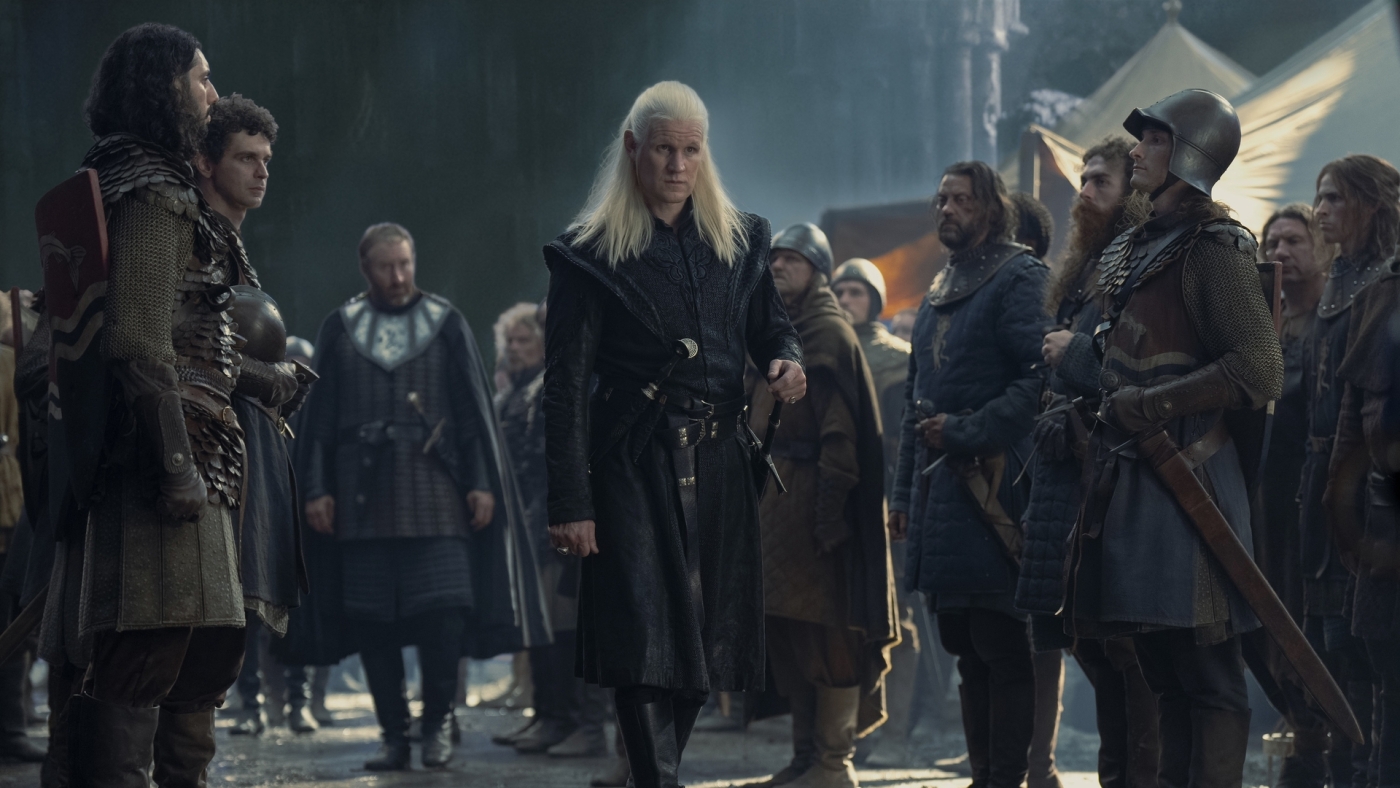
Daemon (Matt Smith) sissies that walk.
Ollie Upton/HBO
hide caption
toggle caption
Ollie Upton/HBO
This is a recap of the most recent episode of HBO’s House of the Dragon. It contains spoilers. That’s what a recap is.
Credits! And a pretty sizable amount of thread is newly devoted to the Red Sowing – last week’s dragonrider recruitment drive. (Red Sewing joke goes here.)
On behalf of Team Green, Tyland Lannister meets with representatives of the Triarchy (sing along with me: the Free Cities of Myr, Lys and Tyrosh, which lie on, or just off, the continent of Essos across the Narrow Sea). They agree to give him an armada of 100 warships to break Rhaenyra’s blockade of the bay in exchange for control of the Stepstones – the same place they fought Daemon and Corlys for control over, back in season one. But they will only do so if Tyland can best their admiral, Sharako Lohar, in a mud fight. High stakes diplomacy meets Stripes.
On an overlook above the town of Sharp Point, Aemond regards its burning ruins, which he’s just had Vhagar flick her Bic at. Sharp Point lies at the tip of a peninsula sticking up into Blackwater Bay, not too far from the islands of Driftmark and Dragonstone. Which is important, because, as predicted, Aemond didn’t deal well with getting chased away by Rhaenyra’s new dragons last week and has immediately taken it out on the nearest thing he could, which in this case is the entire populace of the Westerosi equivalent of Provincetown. Aemond looks upon his handiwork with smug satisfaction, although in fairness that’s kind of just his face.
Larys, whose official title is Master of Whisperers but could easily be Guy Who Can Read The Writing on the Damn Wall or Dude Whose Like Entire Gig is Knowing Which Way the Wind’s Blowing, tells a bedridden King Aegon that they need to leave King’s Landing yesterday. There’s a fun bit of back and forth between them, as Larys tries to sell Aegon on running away to Essos and waiting it all out, only to one day return in glory. But Aegon, always a creature of carnal appetites, can’t see past the damage that’s been done to his body, which he describes in such detail it’ll put you off sausage breakfast sandwiches for a week.

Larys (Matthew Needham) tells Aegon (Tom Glynn-Carney) to put his best foot forward.
Liam Daniel/HBO
hide caption
toggle caption
Liam Daniel/HBO
Let’s check in on Rhaena for an update: Desperately seeking dragon. Still. Again. Some more.
On Dragonstone, Jacaerys happens upon Ulf and Hugh. Ulf behaves like the Shakesperian comic character he’s written to be, and gets a little overfamiliar with the Prince, lumping himself in with him overtheir shared ability to ride dragons and have brown hair. Hugh, who’s used to being looked down upon by royals, attempts to smooth things over.
We’re all born naked; the rest is dragon
Over on Driftmark, Rhaenyra asks Corlys for any intel on Addam, but he’s not forthcoming. “I’ve had little to do with him,” he says, speaking truthfully. We get a helpful new dragoncount, if you need to update your Dance of the Dragons Scorecard. Rhaenyra’s got six. Aemond has only Vhagar, and two others: The dragon Tessarion, belonging to the oft-mentioned-but-not-yet-seen Daeron Targaryen off in Oldtown, on the other side of the continent. But Tessarion is very young and untested. There’s also Dreamfyre – she’s fierce, and almost 100 years old. But she belongs to Queen Helaena, who doesn’t ride her often.


Rhaenyra makes some noises about hoping her dragon advantage will act as a deterrent, so she won’t have to go to war. Still, she says this. After everything that’s happened, if you can believe it. Because I’m not certain I can.
Over at Harrenhal, the Riverlords armies are mustering, and Daemon is doing a West(eros) Wing walk-and-talk with Ser Alfred Broome. You remember him – he was the pouty jamoke on Rhaenyra’s Small Council who was always second-guessing her, so she sent him off to check in on Daemon.
In the weirwood courtyard, Ser Alfred tells Daemon that he has the support he needs to overthrow Rhaenyra and declare himself king. Which, if you haven’t been following SIX! EPISODES! worth of frustratingly repetitive dream-visions, is something that Daemon wants. Or does he? Daemon’s reaction is unreadable. This whole exchange was witnessed, Polonius-behind-the-arras-like, by a lurking Ser Simon Strong.

Aemond (Ewan Mitchell) and Alicent (Olivia Cooke) don’t see eye to eye.
Theo Whiteman/HBO
hide caption
toggle caption
Theo Whiteman/HBO
Alicent has returned from last week’s aimless (pointless?) touch-grass walkabout to talk soothingly and motherly to Helaena. Just then, Aemond swoops in to demand Helaena mount up Dreamfyre and head to the front. Alicent attempts to shame him for turning Sharp Point into Smoky Stub in a fit of pique. She tells him they’re better than that, though I’d be surprised if she still manages to believe it.

Criston Cole (Fabien Frankel) mopes like his s’more fell into the fire.
Theo Whiteman/HBO
hide caption
toggle caption
Theo Whiteman/HBO
On the road from King’s Landing to Harrenhal, Criston Cole is even mopier and moonier than baseline. He’s told Ser Gwayne that he’s slept with his sister the Queen, and Gwayne’s anger causes Criston to wax faux-poetic about honor and desire and dragons. “We march towards our annihilation,” he says. And millions of TV viewers whisper “From your mouth…” in unison.
On Dragonstone, Rhaenyra hosts a dinner party for her dragonriders, both old (Jacaerys and Baela) and new (Addam, Hugh and Ulf). Ulf has the table manners of the Steward of Gondor. She informs them that they will attack the Green strongholds of Oldtown (seat of House Hightower) and Lannisport (seat of House Lannister) in two days’ time.
But just as Ulf is ramming still another squab down his gullet, a raven from our precious, precious jewel Ser Simon Strong informs Rhaenyra that Daemon might be turning on her.

“I would like to propose a toast!” Rhaenyra (Emma D’arcy) launches into “Ladies Who Lunch” as her dragonriders look on.
Ollie Upton/HBO
hide caption
toggle caption
Ollie Upton/HBO
Daemon come and me wanna go home
At Harrenhal, Daemon follows Alys Rivers to the godswood, where he places his hand on a weirwood tree, which proceeds to weep sap all over him. He gets a series of visions very like what ol’ Bran McGuffin Stark used to get on Game of Thones. Greensight, it’s called, if you need to check the wiki.

The visions are familiar to GoT watchers: The three-eyed raven, the red comet, Daenerys and her three dragons, the White Walkers. But there’s a new bit: Rhaenyra, sitting on the Iron Throne. Queen Helaena, who as we know is given to prophetic visions herself, is here, too. She tells him that it’s all just a story, and he’s only a part of it. Which: Way to go meta, girl! And also, that’s a dangerous thing to tell someone who’s bringing as much delusional Main Character energy as Daemon is. “You know what you must do,” she tells him.
At the Red Keep, Aemond once again tries to convince Helaena to mount up. She refuses, and tells him that she saw him turn Aegon into a charcoal briquette over Rook’s Rest. He denies it, but she goes on – Aegon will be king again, on a wooden throne, while Aemond will be dead – lost in the God’s Eye (the mysterious lake on which Harrenhal sits). He takes this about as well as you’d imagine, which is not very well at all.

Aemond (Ewan Mitchell) and Helaena (Phia Saban) discuss hey wait never mind check out that cool sconce guys!
Ollie Upton/HBO
hide caption
toggle caption
Ollie Upton/HBO
Rhaenyra and Addam fly to Harrenhal. Rhaenyra lands, but Addam stays on Seasmoke and just sort of circles the block like he’s looking for parking. Ser Simon Strong greets her and leads her inside, where the armies are gathered. Daemon approaches her, and the show does a good bit of faffing around, trying to keep us in suspense over what he will do. Ultimately, he bends the knee, but not before telling her, in re: The Prophecy of The Prince Who Was Promised, Girl, I get it now.
Everyone kneels, even that grumpiest of Gus-es, Ser Alfred Broome.
In what I dearly hope is our final scene at the Driftmark docks set, Alyn finally confronts Corlys about abandoning him, his brother and their mother. It’s a well-written, well-delivered monologue that neatly articulates that Alyn wants nothing to do with any noble favors that Corlys might bestow out of a sense of guilt. Corlys looks chastened, or at least sad, which makes sense for a guy who’s lost a son, a daughter and a wife.

Either Corlys (Steve Toussaint) feels regretful over neglecting his children for decades or the tuna salad’s repeating on him.
Ollie Upton/HBO
hide caption
toggle caption
Ollie Upton/HBO
Rhaena: Still looking. Spots a dragon in the distance, yes, but: Still looking, looking still.
Rhaenyra is back on Dragonstone, watching Ulf and Hugh LARP-ing How to Train Your Dragon.
She frets to Mysaria about what she will be unleashing when the dragons go to war, which is the one note that her character has been hammering away at all season long. Could have sworn she was done with all this hand-wringing after her wildly improbable meet up with Alicent earlier in the season, or else what was all that for?
Alicent, her aim is true
Speaking of! Guess who’s come knock-knock-knocking on Dragonstone’s door! Why, it’s Alicent, of course! Because the show has built itself around the characters of Alicent and Rhaenyra, it has to keep finding excuses for them to get together, regardless of any minor distractions like, for example, reality. And logic. And storytelling.
“Why are you here?” asks Rhaenyra, not once but twice, because Alicent spends a lot of time whingeing about her life of duty, her desire to be free. The upshot of it all is this: She tells Rhaenyra that Aemond is taking Vhagar to Harrenhal to attack Daemon, which will leave King’s Landing undefended. Rhaenyra can seize King’s Landing in three days’ time: Alicent and Helaena will order the soldiers to stand down, and throw the gates of the city open to her so Rhaenyra can take the throne.
She attempts to wheedle a promise out of Rhaenyra to spare Aegon’s life, but Rhaenyra is having none of it. Atta girl.
All that’s missing is some hair-metal on the soundtrack
We get a “Dragonriders Suiting Up” montage straight out of a Schwarzenegger movie – tight shots of jerkins and greaves and pauldrons and whatnot.
We see the Hightower army on the march, as Tessarion(!) flies overhead. He’s being ridden by Daeron, one assumes, though they haven’t cast an actor for that role yet, so for now we get a teeny CGI rider. Team Green One standing by.
We see the Stark army marching across the Twins. (Remember the season premiere? When Cregan Stark pledged a handful of graybeards to Jacaerys? Well, they’re here now, and those beards are very, very gray indeed.) (They say an army travels on its stomach – this one travels on its orthopedic inserts.) Team Green Two standing by.
We see the Lannister army, in their fancy golden armor, nearing Harrenhal. Team Green Three standing by.
We see Tyland Lannister and Sharako Lohar’s fleet sailing toward Rhaenyra’s blockade. Team Green Four standing by.
We see Aegon and Larys sneaking out of King’s Landing in a raven wagon. (Look, I don’t know what you call it. It’s a wagon, and it’s filled with ravens.) Team Green Five, ducking out.
We also see Daemon stepping out of Harrenhal and surveying his troops. Team Black One, standing by.
Corlys and Alyn sail out to their fleet’s newly rechristened flagship, The Queen Who Never Was. Team Black Two, standing by.

Interspersed with all that, a quick shot of Otto Hightower, waking up in what looks to be a prison cell?
And, yes, finally, Rhaena. Finding her dragon. What a twist. Never saw it coming. I’m sure you were all on tenterhooks.
Parting Thoughts
- Well that was a strangely muted, talky episode for a season finale, wasn’t it? Sure, it resolved some of the season’s central conflicts – Daemon’s ambition, Alicent’s aimlessness – but after last week’s barn-burner (and serf-burner) of an episode, this season climax qualifies as anti-.
- I should just steel myself for many, many more scenes of Alicent and Rhaenyra getting together, shouldn’t I? Even when circumstances, not to mention all laws of God and Man, would logically prevent it? Like at the height of some battle, Rhaenyra looks down from raining fire on a brace of hapless soldiers only to see Alicent waving at her from behind a tree all “Psst! Rhae-Rhae! Can I steal you away for a minute?”
- Jefferson Hall, who plays both Tyland and Jason Lannister, has solid comic timing, and the show’s happy to lean into it. Which is why we got all that putatively funny business with Sharako – the mud-wrestling, the indecent proposal, all of it. He’s great at looking uncomfortable.
- My sweet babboo Ser Simon Strong made it through the whole season with his head! Good for him! And it was his tattle-tale nature that brought Daemon and Rhaenyra together for their rapprochement. Just when you couldn’t love the guy any more, he goes and ties up a plot thread that’s been dangling all season long.
- Thanks for reading along, everyone. And please thank my editor Clare Lombardo, who corrected my countless misspelling of these ridiculous names and spent her valuable time poring over Targaryen family trees to fact-check me.
- See you in, I’m guessing, 2026!



From left: Noah Wyle plays Dr. Michael “Robby” Robinavitch, the senior attending physician, and Fiona Dourif plays Dr. Cassie McKay, a third-year resident, in a fictional Pittsburgh emergency department in the HBO Max series The Pitt.
Warrick Page/HBO Max
hide caption
toggle caption
Warrick Page/HBO Max
The first five minutes of the new season of The Pitt instantly capture the state of medicine in the mid-2020s: a hectic emergency department waiting room; a sign warning that aggressive behavior will not be tolerated; a memorial plaque for victims of a mass shooting; and a patient with large Ziploc bags filled to the brink with various supplements and homeopathic remedies.
Scenes from the new installment feel almost too recognizable to many doctors.
The return of the critically acclaimed medical drama streaming on HBO Max offers viewers a surprisingly realistic view of how doctors practice medicine in an age of political division, institutional mistrust and the corporatization of health care.
Each season covers one day in the kinetic, understaffed emergency department of a fictional Pittsburgh hospital, with each episode spanning a single hour of a 15-hour shift. That means there’s no time for romantic plots or far-fetched storylines that typically dominate medical dramas.
Instead, the fast-paced show takes viewers into the real world of the ER, complete with a firehose of medical jargon and the day-to-day struggles of those on the frontlines of the American health care system. It’s a microcosm of medicine — and of a fragmented United States.

Many doctors and health professionals praised season one of the series, and ER docs even invited the show’s star Noah Wyle to their annual conference in September.
So what do doctors think of the new season? As a medical student myself, I appreciated the dig at the “July effect” — the long-held belief that the quality of care decreases in July when newbie doctors start residency — rebranded “first week in July syndrome” by one of the characters.
That insider wink sets the tone for a season that Dr. Alok Patel, a pediatrician at Stanford Medicine Children’s Health, says is on point. Patel, who co-hosts the show’s companion podcast, watched the first nine episodes of the new installment and spoke to NPR about his first impressions.
To me, as a medical student, the first few scenes of the new season are pretty striking, and they resemble what modern-day emergency medicine looks and sounds like. From your point of view, how accurate is it?
I’ll say off the bat, when it comes to capturing the full essence of practicing health care — the highs, the lows and the frustrations — The Pitt is by far the most medically accurate show that I think has ever been created. And I’m not the only one to share that opinion. I hear that a lot from my colleagues.
OK, but is every shift really that chaotic?
I mean, obviously, it’s television. And I know a lot of ER doctors who watch the show and are like, “Hey, it’s really good, but not every shift is that crazy.” I’m like, “Come on, relax. It’s TV. You’ve got to take a little bit of liberties.”
As in its last season, The Pitt sheds light on the real — sometimes boring — bureaucratic burdens doctors deal with that often get in the way of good medicine. How does that resonate with real doctors?
There are so many topics that affect patient care that are not glorified. And so The Pitt did this really artful job of inserting these topics with the right characters and the right relatable scenarios. I don’t want to give anything away, but there’s a pretty relatable issue in season two with medical bills.
Right. Insurance seems to take center stage at times this season — almost as a character itself — which seems apt for this moment when many Americans are facing a sharp rise in costs. But these mundane — yet heartbreaking — moments don’t usually make their way into medical dramas, right?
I guarantee when people see this, they’re going to nod their head because they know someone who has been affected by a huge hospital bill.
If you’re going to tell a story about an emergency department that is being led by these compassionate health care workers doing everything they can for patients, you’ve got to make sure you insert all of health care into it.
As the characters juggle multiple patients each hour, a familiar motif returns: medical providers grappling with some heavy burdens outside of work.
Yeah, the reality is that if you’re working a busy shift and you have things happening in your personal life, the line between personal life and professional life gets blurred and people have moments.
The Pitt highlights that and it shows that doctors are real people. Nurses are actual human beings. And sometimes things happen, and it spills out into the workplace. It’s time we take a step back and not only recognize it, but also appreciate what people are dealing with.
2025 was another tough year for doctors. Many had to continue to battle misinformation while simultaneously practicing medicine. How does medical misinformation fit into season two?
I wouldn’t say it’s just mistrust of medicine. I mean that theme definitely shows up in The Pitt, but people are also just confused. They don’t know where to get their information from. They don’t know who to trust. They don’t know what the right decision is.
There’s one specific scene in season two that, again, no spoilers here, but involves somebody getting their information from social media. And that again is a very real theme.
In recent years, physical and verbal abuse of healthcare workers has risen, fueling mental health struggles among providers. The Pitt was praised for diving into this reality. Does it return this season?
The new season of The Pitt still has some of that tension between patients and health care professionals — and sometimes it’s completely projected or misdirected. People are frustrated, they get pissed off when they can’t see a doctor in time and they may act out.
The characters who get physically attacked in The Pitt just brush it off. That whole concept of having to suppress this aggression and then the frustration that there’s not enough protection for health care workers, that’s a very real issue.
A new attending physician, Dr. Baran Al-Hashimi, joins the cast this season. Sepideh Moafi plays her, and she works closely with the veteran attending physician, Dr. Michael “Robby” Robinavitch, played by Noah Wyle. What are your — and Robby’s — first impressions of her?
Right off the bat in the first episode, people get to meet this brilliant firecracker. Dr. Al-Hashimi, versus Dr. Robby, almost represents two generations of attending physicians. They’re almost on two sides of this coin, and there’s a little bit of clashing.
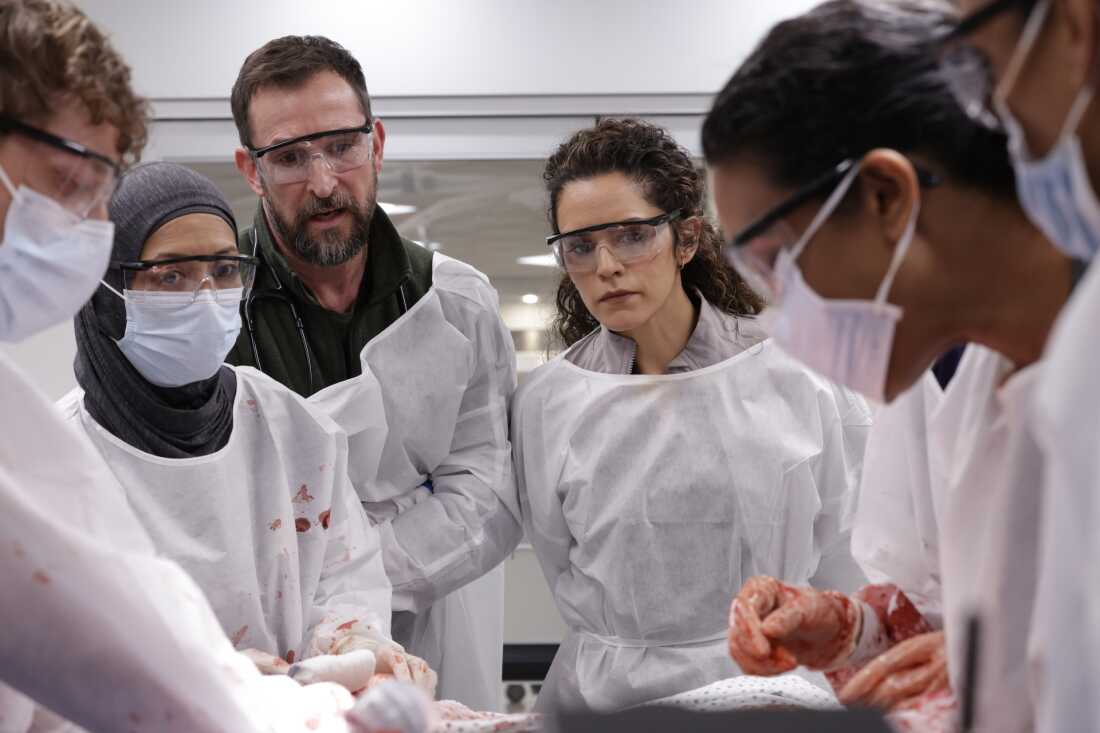
Sepideh Moafi, fourth from left, as Dr. Baran Al-Hashimi, the new attending physician, huddles with her team around a patient in a fictional Pittsburgh teaching hospital in the HBO Max series The Pitt.
Warrick Page/HBO Max
hide caption
toggle caption
Warrick Page/HBO Max
Part of that clash is her clear-eyed take on artificial intelligence and its role in medicine. And she thinks AI can help doctors document what’s happening with patients — also called charting — right?
Yep, Dr. Al-Hashimi is an advocate for AI tools in the ER because, I swear to God, they make health care workers’ lives more efficient. They make things such as charting faster, which is a theme that shows up in season two.
But then Dr. Robby gives a very interesting rebuttal to the widespread use of AI. The worry is that if we put AI tools everywhere, then all of a sudden, the financial arm of health care would say, “Cool, now you can double how many patients you see. We will not give you any more resources, but with these AI tools, you can generate more money for the system.”
The new installment also continues to touch on the growing corporatization of medicine. In season one we saw how Dr. Robby and his staff were being pushed to see more patients.
Yes, it really helps the audience understand the kind of stressors that people are dealing with while they’re just trying to take care of patients.
In the first season, when Dr. Robby kind of had that back and forth with the hospital administrator, doctors were immediately won over because that is such a big point of frustration — such a massive barrier.
There are so many more themes explored this season. What else should viewers look forward to?
I’m really excited for viewers to dive into the character development. It’s so reflective of how it really goes in residency. So much happens between your first year and second year of residency — not only in terms of your medical skill, but also in terms of your development as a person.
I think what’s also really fascinating is that The Pitt has life lessons buried in every episode. Sometimes you catch it immediately, sometimes it’s at the end, sometimes you catch it when you watch it again.
But it represents so much of humanity because humanity doesn’t get put on hold when you get sick — you just go to the hospital with your full self. And so every episode — every patient scenario — there is a lesson to learn.
Michal Ruprecht is a Stanford Global Health Media Fellow and a fourth-year medical student.


Two fiction books about good friends coming from different circumstances. Two biographies of people whose influence on American culture is, arguably, still underrated. One Liza Minnelli memoir. These are just a handful of books coming out in the first few months of 2026 that we’ve got our eye on.
Fiction

Autobiography of Cotton, by Cristina Rivera Garza, Feb. 3
Garza, who won a Pulitzer in 2024 for memoir/autobiography, actually first published Autobiography of Cotton back in 2020, but it’s only now getting an English translation. The book blends fiction with the author’s own familial history to tell the story of cotton cultivation along the U.S.-Mexico border.

Crux, by Gabriel Tallent, Jan. 20
Tallent’s last novel, My Absolute Darling, was a harrowing coming of age story about a teenage girl surviving her abusive survivalist father. But it did find pockets of beauty in the outdoors. Tallent’s follow up looks to be similarly awestruck by nature. It’s about two young friends, separated by class and opportunity, but bound together by a love of rock climbing.

Half His Age, by Jennette McCurdy, Jan. 20
The former iCarly actress’ bracing and brutally honest memoir, I’m Glad My Mom Died, was a huge hit. It spent weeks on bestseller’s lists, and is being adapted into a series for Apple TV+. Now McCurdy’s set to come out with her fiction debut, about a teenage girl who falls for her high school creative writing teacher.

Kin, by Tayari Jones, Feb. 24
Similarly to Crux, Kin also follows two friends across the years as options and opportunities pull them apart. The friends at the center of this book are two women who grew up without moms. Jones’ last novel, 2018’s An American Marriage, was a huge hit with critics.

Seasons of Glass & Iron: Stories, by Amal El-Mohtar, March 24
El-Mohtar is an acclaimed science-fiction writer, and this book is a collection of previously published short stories and poetry. Many of the works here have been honored by the big science-fiction/fantasy awards, including the titular story, which is a feminist re-telling of two fairy tales.
Nonfiction

A Hymn to Life: Shame Has to Change Sides, by Gisèle Pelicot, Feb. 17
Pelicot’s story of rape and sexual assault – and her decision to wave anonymity in the trial – turned her into a galvanizing figure for women across the world. Her writing her own story of everything that happened is also a call to action for others to do the same.

Cosmic Music: The Life, Art, and Transcendence of Alice Coltrane, by Andy Beta, March 3
For decades, the life and work of Alice Coltrane has lived in the shadow of her husband, John Coltrane. This deeply researched biography hopes to properly contextualize her as one of the most visionary and influential musicians of her time.

Football, by Chuck Klosterman, Jan. 20
One of our great essaysists and (over?) thinkers turns his sights onto one of the last bits of monoculture we’ve got. But in one of the pieces in this collection, Klosterman wonders, how long until football is no longer the summation of American culture? But until that time comes, there’s plenty to dig into from gambling to debates over the true goat.

Kids, Wait Till You Hear This! by Liza Minnelli, with Michael Feinstein, March 20
Minnelli told People that previous attempts at telling her story “didn’t get it right,” so she’s doing it herself. This new memoir promises to get into her childhood, her marriages, and her struggles with substance abuse.

Tom Paine’s War: The Words that Rallied a Nation and the Founder of Our Time, by Jack Kelly, Jan. 6
If you haven’t heard, it’s a big birthday year for America. And it’s a birthday that might not have happened if not for the words of Thomas Paine. This new book from historian Jack Kelly makes the argument that Paine’s words are just as important and relevant to us today.

Brain Health Challenge: Doctor Appointments for Your Mind and Body
Doctors says ‘The Pitt’ reflects the gritty realities of medicine today

Xbox’s Towerborne is switching from a free-to-play game to a paid one

Venezuela teeters as guerrilla groups, cartels exploit Maduro power vacuum

Trump plans to meet with Venezuela opposition leader Maria Corina Machado next week

Florida High School Football Rankings: Top 25 teams – Oct. 21

Cleary's 21 help Le Moyne down Central Connecticut State 69-64 in OT

How old is Bo Nix? What to know about Oregon quarterback ahead of 2024 NFL Draft

99th annual Pony Swim held in Virginia

Video: ‘It Didn’t Have to Happen This Way:’ U.Va. Faculty Call for Review of Police Response to Protests
Trump plans to meet with Venezuela opposition leader Maria Corina Machado next week

Trump says meeting Iran’s ‘Crown Prince’ Pahlavi would not be appropriate

Federal immigration agents shoot 2 people in Portland, Oregon, police say

Video: What Trump Told Us About the ICE Shooting

Trump calls for $1.5T defense budget to build ‘dream military’
-

 Detroit, MI5 days ago
2 hospitalized after shooting on Lodge Freeway in Detroit
-

 Technology3 days ago
Power bank feature creep is out of control
-

 Dallas, TX4 days ago
Defensive coordinator candidates who could improve Cowboys’ brutal secondary in 2026
-

 Health5 days ago
Viral New Year reset routine is helping people adopt healthier habits
-

 Nebraska2 days ago
Oregon State LB transfer Dexter Foster commits to Nebraska
-

 Iowa2 days ago
Pat McAfee praises Audi Crooks, plays hype song for Iowa State star
-
 Nebraska2 days ago
Nebraska-based pizza chain Godfather’s Pizza is set to open a new location in Queen Creek
-
 Entertainment2 days ago
Spotify digs in on podcasts with new Hollywood studios