Lifestyle
Get high (legally) at the massive new weed oasis inside the California State Fair

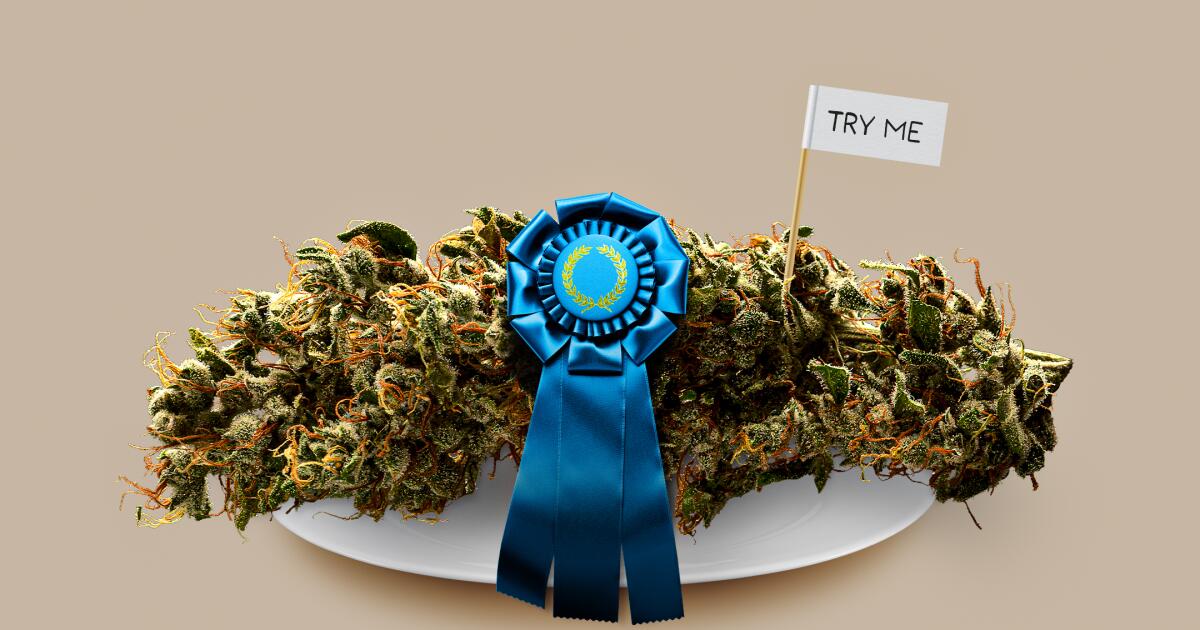
For the first time in the 170-year history of the California State Fair, which is scheduled to open July 12 in Sacramento, visitors will be able to do something they haven’t been able to do there before — legally anyway. They will be able to purchase and consume cannabis on-site.
The plans, announced Tuesday by Embarc, the fair’s partner on the project, include having a dispensary and 30,000-square-foot outdoor consumption lounge space at Cal Expo that will allow fair-goers who are 21 and older (and in possession of a valid government-issued photo ID) to buy and try award-winning cannabis.
“When people come to the state fair, they can try the best wine, cheese and craft-brewed beer. That’s already in place,” California State Fair Chief Executive Tom Martinez told The Times. “This was just the natural next step that the legislature and our board of directors is taking.”
The first step came in 2022 when a cannabis exhibit and awards program were added to the fair lineup. It was a chance to showcase the once-demonized plant alongside the rest of the state’s agricultural bounty. “Over the last two years, we’ve had 160,000 people come through that educational exhibit,” Martinez said.
This time around, visitors to the exhibit hall filled with cannabis educational and farm displays will be able to scan QR codes next to displays of this year’s California State Fair Cannabis Award winners and add the goods to an online shopping cart. Then items can be purchased at the checkout at a dispensary just outside. Those who wish to partake can then navigate a few hundred feet farther away and get their smoke on.
Both the dispensary and consumption lounge will be run by Embarc, a Northern California company that’s carved out a niche in the cannabis event space. (The company has organized weed-themed events and spaces for the California Roots Festival and Outside Lands Music Festival, among others).
“‘Designated smoking area’ is the required terminology,” said Embarc’s Chief Executive and co-founder Lauren Carpenter. “But that makes it sound like people standing around outside of a building smoking. This is intended to be experiential and fully built out and produced with a stage where we will have a ceremony for our [cannabis] award winners. [And] right now, our theme is ‘oasis’ — because, in case you missed it, it’s really hot in Sacramento — and our intention is to make this a respite.”
How many visitors to the fair might avail themselves of the 500-person-capacity smoking lounge? “I’m prepared for anything,” Carpenter said. “But based on my back-of-the-napkin math and data from other events we’ve been involved with, we anticipate thousands and thousands of shoppers a day.”
Those thousands and thousands of potential shoppers will be able to shop some 300 different THC-containing products, including many of the 98 freshly crowned winners of 2024 California State Cannabis Awards.
Set to be announced June 26, the 49 silver and 49 gold medals will be awarded in three flower categories (sun-grown, mixed-light and indoor) and 16 product categories (new this year, they include things such as edibles, pre-rolls and concentrates).
In addition, nine “Best of California” Golden Bear awards will be announced at an Oscar-style ceremony scheduled to take place at the fair on July 27.
Know before you go
This year’s California State Fair runs from July 12 to 28. Daily hours for the dispensary and lounge, award winners and additional information will be posted to the 2024 California State Cannabis Awards website at castatefaircannabisawards.com as available.
If you’re planning to get fried in the land of deep-fried everything, there are a few things you’ll need to know: First, you’ll only be able to consume cannabis products purchased on-site. Second, the lounge will provide rolling papers and expects to have an assortment of other smoking paraphernalia to use, so leave your favorite smoking gear at home. And last, while the dispensary and lounge will be open for most of the fair’s run, there are three dates to be aware of: July 12 and 13 (no inhalable consumption will be allowed on those days) and July 19 when the dispensary will be closed.


A promo image of Peter Sagal, Jason Narducy, and Alzo Slade
NPR and James Richards IV/NPR and Jason Narducy
hide caption
toggle caption
NPR and James Richards IV/NPR and Jason Narducy
This week, we’re live in Milwaukee with musician Jason Narducy. Plus, panelists Alonzo Bodden, Adam Burke, and Negin Farsad talk the World Cup, Love Island, and new rules for summer travel.

Lost luggage? Tarmac delays? Rental-car blues? No whining about measly travel headaches with the mother of all bad-trip sagas looming on the big screen.
“The Odyssey,” Christopher Nolan’s epic take on the Trojan War’s fallout, debuts July 17. Spoiler alert, if you somehow avoided Homer in community college: Nobody, save biblical Job, has had more misery hurled at them.
Outflanked by cruel and fickle gods at every turn, legendary Greek hero Odysseus outsmarted a one-eyed giant, suffered through the bewitching Sirens’ song and braved the Underworld’s dead denizens. He battled oversize cannibals, outmaneuvered a witch and lost scores of men at every turn. Then made it back to Ithaca after 10 years only to find his home overrun by suitors wooing his wife.
It’s a tale packed with bad decisions, failure, heartbreak and death. Perfect story fodder, given how much we love bad-trip stories. We consume lists of the worst airports and wonder at accounts of illness-plagued cruises. We scroll through videos starring unruly passengers or mangled bags, and read about the last resting place for lost luggage.
Hollywood has created a whole franchise around road trips gone wrong. Think of “The Hangover” or “Sideways” or “Little Miss Sunshine.” Screenwriter-director John Hughes perfected the big-screen comedic treatment of travel gone south with classics such as “Home Alone,” “National Lampoon’s Vacation” and “Planes, Trains and Automobiles.”
Let’s not even talk about the “three-hour tour” that left Gilligan and friends stranded on a deserted island for 98 episodes, or how Jack Dawson’s voyage ended aboard 1997’s “Titanic.”
A significant body of evidence even indicates that travel makes us sick. Trip-related problems are so common, in fact, that consumer advocate Christopher Elliott has stitched an entire career out of resolving them — from timeshare scams to horrible airline customer service and beyond.
Still, we keep buying tickets and packing our bags to sail into the great unknown, across Homer’s wine-dark sea. Why? Elliott attributes it to what he terms “traveler’s amnesia.”
“It amazes me that travelers are not up in arms about the way they get treated,” he said. “They take a trip, have a terrible experience, and forget about everything that went wrong and only remember what went right.”
He suggests that avoiding a bad trip starts with choosing companies noted for strong customer service. He cited some name-brand examples: Marriott for hotels, Alaska Airlines, and Enterprise Rent-A-Car. He avoids cruises as much as possible.
Which is funny, because when I think about cruising, I don’t revisit the miserable 36 hours that norovirus confined us in our cabin. I instead recall coasting past a flotilla of icebergs in Alaska’s Glacier Bay.
When I think about Mexico, I don’t wallow in memories involving Montezuma and his gastrointestinal revenge. But I do cherish thoughts of snorkeling with playful sea lion pups.
And when I consider airports, I blot the memory of the woman next to me at Gate 66 who insists on blaring a video call at maximum volume. Instead, wielding my noise-canceling earbuds, Odysseus-like, I plan to smother this screeching sound to preserve my sanity. But before I can insert them, a voice speaks to me.
To all of us, to be technically correct, since it emanates from the speakers of Los Angeles International Airport’s Terminal 6.
“It’s time to play TSA’s favorite game!” says the voice, mimicking a game-show host’s hustle. “You lost it, we found it!”
The speaker explained that someone had left a laptop computer at a checkpoint. The two were reunited moments later, which set my feet in motion, wondering whose voice it was. There at the checkpoint I met Carl Revis, a TSA supervisory officer with a penchant for comedy.
“You don’t have to be a jerk to get things done,” he told me. “I think reaching people through comedy is a lot easier than screaming and yelling at them.”
Taken together, my trip recollections probably qualify me as living proof of Elliott’s traveler’s amnesia theory. The final diagnosis should be clear soon. I’m retiring from full-time work this year, and people inevitably ask what’s next.
It’s not completely clear, I tell them. But I’ll definitely have more time to travel. Maybe sail across the Aegean … what could go wrong?

Azar Nafisi on the set of Eran Riklis’ Reading Lolita in Tehran
Marie Gioanni/Greenwich Entertainment
hide caption
toggle caption
Marie Gioanni/Greenwich Entertainment
A new film version of Azar Nafisi’s critically-praised, worldwide bestselling memoir, Reading Lolita in Tehran, is now in theatres.
The film shows a group of women meeting clandestinely in Nafisi’s home in the mid-1990s, to read forbidden books. They read classics of the West, like Madame Bovary, The Great Gatsby, Pride and Prejudice, and Lolita.
Education had become dangerous and even deadly during the Islamic Revolution, and reading forbidden books was Nafisi’s way to fight back.
The film, directed by Eran Riklis, begins with Nafisi as a university professor and ends with her exiled from her homeland. Nafisi told Scott Simon about the experience of seeing herself and her story depicted on the big screen, “I feel towards it the way I feel towards my children.”
The film is directed by Eran Riklis and won the the Audience Award and a special jury prize at the 2024 Rome Film Festival.
It stars Iranian actors Goldshifteh Farahani, Zar Amir Ebrahimi, and Mina Kavani. Like the author, some of the actors are exiled from Iran.

Actor Golshifteh Farahani stars as Azar Nafisi in Eran Riklis’ Reading Lolita in Tehran.
Greenwich Entertainment
hide caption
toggle caption
Greenwich Entertainment
“These girls were very different, one from the other,” Nafisi said of the students who studied with her in Tehran. Remembering them now, and seeing them depicted on the screen, Nafisi saw anew the power of great literature.
“Outside the classroom, they probably wouldn’t talk to one another. But in that class, they learned to communicate and to connect,” she said.
Through the stories in the books, Nafisi said each woman could find more and become more herself. “It reached a sort of magic,” she said.
The magic was brutally broken by a government that was desperate to quiet the voices of dissenters. Nafisi’s homeland changed quickly into a place she barely recognized
“This wasn’t my land,” she told Simon. “This was a country ruled by a regime that stoned people to death.”
When the religious hardliners in the government banned women from appearing in public without a headscarf, the film shows Nafisi, played by Goldshifteh Farahani, agonizing in front of a mirror with a black headscarf.
“The expression on her face is fear, because by and by, she disappears into this garment,” Nafisi said. For some, the headscarf was a symbol of the place of women in society, but for Nafisi the stakes were even higher.
“This is not a political fight. This is an existential one,” she said. “Our identity as human beings, as women, has been taken away from us.”
When fighting against covering her hair became too dangerous, Nafisi found small ways to rebel. “I never wore my scarf properly. I would always show a few strands out of the scarf to tell them, ‘You don’t own me.’”
Nafisi’s book about fighting the Iranian Revolution through the simple act of reading was an international bestseller, won numerous literary awards, and was named as one of the “100 Best Books of the Decade” by The Times (London).
Nafisi now lives in Washington, D.C., and continues to make a passionate case for the role of artists and writers in society.
She shared with Simon an illustrative story from the beginning of Islamic Revolution. The new leaders tore down the statues of the king and the royal family and changed the names of streets. But when they tried to bring down the statue of Persian poet Abul-Qâsem Ferdowsi, and erase his place of honor within the culture, the people opposed it.
“I thought how fantastic that they can bring down the statue of the Shah, but they can’t touch the poet,” she said.
-

 Fitness1 minute ago
Busy Dads Should Focus on These 3 Pillars To Improve Their Fitness – Here’s Why They Work
-

 Movie Reviews13 minutes ago
Movie Review: EVIL DEAD BURN – Assignment X
-

 World21 minutes ago
Family demands answers in death of young Black man in Mississippi
-
Lifestyle1 hour ago
Love Island and Pre-Teen Punks with Jason Narducy : Wait Wait… Don’t Tell Me!
-

 Technology1 hour ago
Oregon’s Attorney General withdraws effort to delay Paramount and Warner Bros. merger
-

 World1 hour ago
Gunfire shatters Toronto Latin street festival, leaving at least 2 dead and multiple wounded
-

 Politics1 hour ago
Sen. Lindsey Graham dead at 71 after ‘brief and sudden’ illness, office says
-

 Health1 hour ago
Last American to use an iron lung dies at 78 years old after childhood polio diagnosis

