Lifestyle
George Takei 'Lost Freedom' some 80 years ago – now he's written that story for kids


Illustrations copyright © 2024 by Michelle Lee

Illustrations copyright © 2024 by Michelle Lee
George Takei was just 4 years old when when President Franklin D. Roosevelt signed Executive Order 9066:
“I hereby authorize and direct the Secretary of War, and the Military Commanders… to prescribe military areas in such places and of such extent as he or the appropriate Military Commander may determine, from which any or all persons may be excluded…”
It was Feb. 19, 1942. Japan had attacked Pearl Harbor two months earlier; For looking like the enemy, Japanese and Japanese American people in the U.S. were now considered “enemy combatants” and the executive order authorized the government to forcibly remove approximately 125,000 people from their homes and relocate them to prison camps around the country.
Star Trek actor George Takei has written about this time in his life before — once in an autobiography, then in a graphic memoir, and now in his new children’s book, My Lost Freedom.
It’s about the years he and his mom, dad, brother and baby sister spent in a string of prison camps: swampy Camp Rohwer in Arkansas, desolate Tule Lake in northern California. But first, they were taken from their home, driven to the Santa Anita racetrack and forced to live in horse stalls while the camps were being built.
“The horse stalls were pungent,” Takei remembers, “overwhelming with the stench of horse manure. The air was full of flies, buzzing. My mother, I remember, kept mumbling ‘So humiliating. So humiliating.’”
He says, “Michelle’s drawing really captured the degradation our family was reduced to.”
Illustrations copyright © 2024 by Michelle Lee
Illustrations copyright © 2024 by Michelle Lee
Michelle is Michelle Lee, the illustrator — and researcher — for the book. Lee relied heavily on Takei’s text and his excellent memory, but it was the research that both agree really brought the art to life.
“I’m telling it from the perspective of a senior citizen,” Takei, 87, laughs. “I really had to wring my brains to try to remember some of the details.”
So Takei took Lee to the Japanese American National Museum in Los Angeles, where he is a member of the board. They had lunch in Little Tokyo, got to know each other, met with the educational director, and looked at the exhibits. Then Lee started digging into the archives.
“I looked for primary sources that showed what life was like because I feel like that humanizes it a lot more,” Lee explains. She found some color photographs taken by Bill Manbo, who had smuggled his camera into the internment camp at Heart Mountain in Wyoming. “While I was painting the book, I tried as much to depict George and his family just going about their lives under these really difficult circumstances.”
Takei says he was impressed with how Lee managed to capture his parents: his father, the reluctant leader and his mother, a fashion icon in her hats and furs. “This has been the first time that I’ve had to depict real people,” Lee adds.
To get a feel for 1940s fashion, Lee says she looked at old Sears catalogues. “What are people wearing? All the men are wearing suits. What kind of colors were clothes back then.”
Crown Books for Young Readers
Crown Books for Young Readers
But a lot of information has also been lost — Lee wasn’t able to see, for example, where Takei and his family lived in Arkansas because the barracks at Camp Rohwer have been torn down — there’s a museum there now. “I didn’t actually come across too many photos of the interior of the barracks,” says Lee. “The ones I did come across were very staged.”
She did, however, find the original floor plans for the barracks at Jerome Camp, also in Arkansas. “I actually printed the floorplan out and then built up a little model just to see what the space was actually like,” Lee says. “I think it just emphasized how small of a space this is that whole families were crammed into.”
One illustration in the book shows the work that Takei’s mother put in to make that barrack — no more than tar paper and boards stuck together — a home.
“She gathered rags and tore them up into strips and braided them into rugs so that we would be stepping on something warm,” Takei remembers. She found army surplus fabrics and sewed curtains for the windows. She took plant branches that had fallen off the nearby trees and made decorative sculptures. She asked a friendly neighbor to build a table and chairs.
“You drew the home that my mother made out of that raw space, Takei tells Lee. “That was wonderful.”
Illustrations copyright © 2024 by Michelle Lee
Illustrations copyright © 2024 by Michelle Lee
Michelle Lee painted the art for My Lost Freedom using watercolor, gouache and colored pencils. Most of the illustrations have a very warm palette, but ever-present are the barbed wire fences and the guard towers. “There’s a lot of fencing and bars,” Lee explains. “That was kind of the motif that I was using throughout the book… A lot of vertical and horizontal patterns to kind of emphasize just how overbearing it was.”
Takei says one of his favorite drawings in the book is a scene of him and his brother, Henry, playing by a culvert.
“Camp Rohwer was a strange and magical place,” Takei writes. “We’d never seen trees rising out of murky waters or such colorful butterflies. Our block was surrounded by a drainage ditch, home to tiny, wiggly black fishies. I scooped them up into a jar.
One morning they had funny bumps. Then they lost their tails and their legs popped out. They turned into frogs!”
“They’re just two children among many children who were imprisoned at these camps,” says Lee, “and to them, perhaps, aspects of being there were just fun.” The illustration depicts both childlike wonder and — still, always — a sense of foreboding. Butterflies fly around a barbed wire fence. A bright sun shines on large, dark swamp trees. Kids play in the shadow of a guard tower.
“There’s so much that you tell in that one picture,” says Takei. “That’s the art.”
“So many of your memories are of how perceptive you are to things that are going on around you,” adds Lee, “but also still approaching things from a child’s perspective.”
Illustrations copyright © 2024 by Michelle Lee
Illustrations copyright © 2024 by Michelle Lee
Even though the events in My Lost Freedom took place more than 80 years ago, illustrator Michelle Lee and author George Takei say the story is still very relevant today.
“These themes of displacement and uprooting of communities from one place to another — these are things that are constantly happening,” says Lee. Because of war and because of political decisions … those themes aren’t uncommon. They’re universal.”
Takei agrees. “People need to know the lessons and learn that lesson and apply it to hard times today. And we hope that a lot of people get the book and read it to their children or read it to other children and act on it.”
He’s done his job, he says, now the readers have their job.




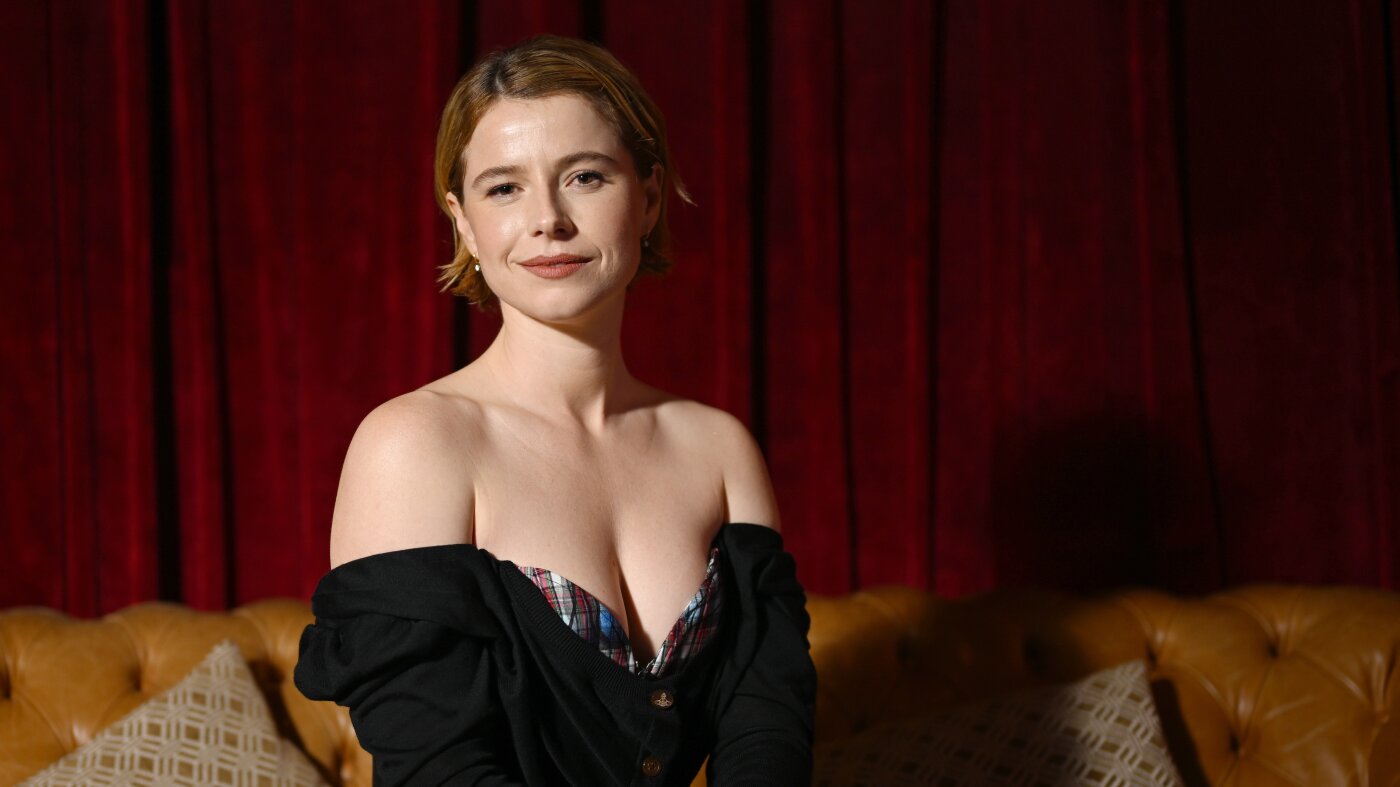
Jessie Buckley has been nominated for an Academy Award for best actress for her portrayal of William Shakespeare’s wife in Hamnet.
Kate Green/Getty Images
hide caption
toggle caption
Kate Green/Getty Images
Actor Jessie Buckley says she’s always been drawn to the “shadowy bits” of her characters — aspects that are disobedient, or “too much.” Perhaps that’s what led her to play Agnes, the wife of William Shakespeare, in Hamnet.
Buckley says the film, which is based on Maggie O’Farrell’s 2020 novel, offered a chance to counter a common narrative about the playwright’s wife: that she “had kept him back from his genius,” Buckley says.

But, she adds, “What Maggie O’Farrell so brilliantly did, not just with Agnes and Shakespeare’s wife, but also with Hamnet, their son, was to bring these people … and give them status beside this great man. … [And] give the full landscape of what it is to be a woman.”
The film is nominated for eight Academy Awards, including best actress for Buckley. In it, she plays a woman deeply connected to nature, who faces conflicts in her marriage, as well as the death of their son Hamnet.
Buckley found out she was pregnant a week after the film wrapped. She’s since given birth to her first child, a daughter.

“The thing that this story offered me, that brought me into this next chapter of my life as a mother was tenderness,” she says. “A mother’s tenderness is ferocious. To love, to birth is no joke. To be born is no joke. And the minute something’s born into the world, you’re always in the precipice of life and death. That’s our path. … I wanted to be a mother so much that that overrode the thought of being afraid of it.”

Jessie Buckley stars as Agnes and Joe Alwyn plays her brother Bartholomew in Hamnet.
Courtesy of Focus Features/Courtesy of Focus Features
hide caption
toggle caption
Courtesy of Focus Features/Courtesy of Focus Features
Interview highlights
On filming the scene where she howls in grief when her son dies
I didn’t know that that was going to happen or come out, it wasn’t in the script. I think really [director] Chloé [Zhao] asked all of us to dare to be as present as possible. Of course, leading up to it, you’re aware this scene is coming, but that scene doesn’t stand on its own. By the time I’d met that scene, I had developed such a deep bond with Jacobi Jupe, who plays Hamnet, and [co-stars] Paul [Mescal] and Emily Watson, and all the children and we really were a family. And Jacobi Jupe who plays Hamnet is such an incredible little actor and an incredible soul, and we really were a team. …

The death of a child is unfathomable. I don’t know where it begins and ends. Out of utter respect, I tried to touch an imaginary truth of it in our story as best I could, but there’s no way to define that kind of grief. I’m sure it’s different for so many people. And in that moment, all I had was my imagination but also this relationship that was right in front of me with this little boy and that’s what came out of that.
On what inspired her to pursue singing growing up
I grew up around a lot of music. My mom is a harpist and a singer and my dad has always been passionate about music, so it was always something in our house and always something that was encouraged. … Early on, I have very strong memories of seeing and hearing my mom sing in church and this quite intense mercurial conversation that would happen between her, the story and the people that would listen to her. And at the end of it, something had been cracked between them and these strangers would come up with tears in their eyes. And I guess I saw the power of storytelling through my mom’s singing at a very young age, and that was definitely something that made me think I want to do that.
On her first big break performing as a teen on the BBC singing competition I’d Do Anything — and being criticized by judges about her physical appearance
I was raw. I hadn’t trained. I had a lot to learn and to grow in. I was only 17. I think there was part of their criticism which I think was destructive and unfair when it became about my awkwardness, or they would say I was masculine and send me to kind of a femininity school. … They sent me to [the musical production of] Chicago to put heels on and a leotard and learn how to walk in high heels, which was pretty humiliating, to be honest, and I’m sad about that because I think I was discovering myself as a young woman in the world and wasn’t fully formed. … I was different. I was wild, I had a lot of feeling inside me. I could hardly keep my hands beside myself and I think to kind of criticize a body of a young woman at that time and to make her feel conscious of that was lazy and, I think, boring.
On filming parts of the 2026 film The Bride! while pregnant
I really loved working when I was pregnant. I thought it was a pretty wild experience, especially because I was playing Mary Shelley and I was talking about [this] monstrosity, and here I was with two heartbeats inside me. Becoming a mom and being pregnant did something, I think, for me. My experience of it, it’s so real that it really focuses [me to be] allergic to fake or to disconnection.
Since my daughter has come and I know what that connection is and the real feeling of being in a relationship with somebody … as an actress, it’s very exciting to recognize that in yourself and really take ownership of yourself.
I’m excited to go back and work on this other side of becoming a mother in so many ways, because I’ve shed 10 layers of skin by loving more and experiencing life in such a new way with my daughter. I’m also scared to work again because it’s hard to be a mother and to work. That’s like a constant tug because I love what I do and I’m passionate and I want to continue to grow and learn and fill those spaces that are yet to be filled — and also be a mother. And I think every mother can recognize that tug.
On the possibility of bringing her daughter to travel with her as she works
I haven’t filmed for nearly a year and I cannot wait. I’m hungry to create again. And my daughter will come with me. She’s seven months, so at the moment she can travel with us and it’s a beautiful life. And she meets all these amazing people and I have a feeling that she loves life and that’s a great thing to see in a child. And I hope that’s something that I’ve imparted to her in the short time that she’s been on this earth is that life is beautiful and great and complex and alive and there’s no part of you that needs to be less in your life. You might have to work it out, but it’s worth it.
Lauren Krenzel and Susan Nyakundi produced and edited this interview for broadcast. Bridget Bentz, Molly Seavy-Nesper and Beth Novey adapted it for the web.

Bruce Campbell
I’m Battling Cancer
Published
Bruce Campbell has revealed he has cancer, but says it’s a type that’s treatable, though not curable.
“The Evil Dead” actor shared the news Monday in a message to fans, writing, “Hi folks, these days, when someone is having a health issue, it’s referred to as an ‘opportunity,’ so let’s go with that — I’m having one of those.” He continued, “It’s also called a type of cancer that’s ‘treatable’ not ‘curable.’ I apologize if that’s a shock — it was to me too.”
Campbell said he wouldn’t go into further detail about his diagnosis, but explained his work schedule will be changing. “Appearances and cons and work in general need to take back seat to treatment,” he wrote, adding he plans to focus on getting “as well as I possibly can over the summer.”
As a result, Campbell says he has to cancel several convention appearances this summer, noting, “Treatment needs and professional obligations don’t always go hand-in-hand.”
He says his plan is to tour this fall in support of his new film, “Ernie & Emma,” which he stars in and directs.
Ending on a determined note, Campbell told fans, “I am a tough old son-of-a-bitch … and I expect to be around a while.”

Neve Campbell in Scream 7.
Paramount Pictures
hide caption
toggle caption
Paramount Pictures
The OG Scream Queen Neve Campbell returns. Scream 7 re-centers the franchise back on Sidney Prescott. She has a new life, a family, and lots of baggage. You know the drill: Someone dressing up as the masked slasher Ghostface comes for her, her family and friends. There’s lots of stabbing and murder and so many red herrings it’s practically a smorgasbord.
Follow Pop Culture Happy Hour on Letterboxd at letterboxd.com/nprpopculture

Alleged criminal history of missing mom found after 24 years catches up with her

Millionaire philanthropist allegedly gunned down by worker in female wig; ambushes Maryland trooper: police

War in the Middle East: Iran’s broad retaliation in the Gulf • FRANCE 24 English

Bruce Campbell announces cancer diagnosis; ‘Fear not,’ he tells fans

Vigil held for 2-year-old girl killed in SF Mission Bay crash

Florida High School Football Rankings: Top 25 teams – Oct. 21

Cleary's 21 help Le Moyne down Central Connecticut State 69-64 in OT

How old is Bo Nix? What to know about Oregon quarterback ahead of 2024 NFL Draft

99th annual Pony Swim held in Virginia

Indiana Members Credit Union announced as new anchor tenant at Bottleworks District
War in the Middle East: Iran’s broad retaliation in the Gulf • FRANCE 24 English

Trump sends official notification to Congress on strikes against Iran

Unexpected birth brings hope to near-extinct Amazon tribe

Supreme Court blocks redrawing of New York congressional map, dealing a win for GOP

Map: Earthquake Shakes Central California
-

 World5 days ago
Exclusive: DeepSeek withholds latest AI model from US chipmakers including Nvidia, sources say
-

 Massachusetts6 days ago
Mother and daughter injured in Taunton house explosion
-

 Denver, CO6 days ago
10 acres charred, 5 injured in Thornton grass fire, evacuation orders lifted
-

 Louisiana1 week ago
Wildfire near Gum Swamp Road in Livingston Parish now under control; more than 200 acres burned
-

 Technology1 week ago
Stellantis is in a crisis of its own making
-

 Oregon4 days ago
2026 OSAA Oregon Wrestling State Championship Results And Brackets – FloWrestling
-

 Technology1 week ago
Arturia’s FX Collection 6 adds two new effects and a $99 intro version
-

 News1 week ago
Video: How Lunar New Year Traditions Take Root Across America