Lifestyle
For once — a true crime story that isn't focused on the killer


Woman of the Hour is Anna Kendrick’s feature directorial debut. She also stars as Sheryl.
Leah Gallo/Netflix
hide caption
toggle caption
Leah Gallo/Netflix
In a lot of true crime stories, no one is treated as more interesting than the criminal at the center. Mildly interesting are the police, the journalists, and the family involved. But not the person who got hurt, let alone the people who just barely didn’t get hurt.
In the new Netflix film Woman of the Hour, however, there’s little interest in the thinking or the life of real-life convicted serial killer Rodney Alcala. Alcala appeared on The Dating Game in 1978, where he won a date with aspiring actress Cheryl Bradshaw. But once she met him, Bradshaw got the creeps. She refused to go out with him. Alcala was later convicted of murders committed both before and after the show.
Woman of the Hour stars Anna Kendrick as Sheryl (the spelling is changed, perhaps to underscore that this is a loose interpretation of the real story beyond those basics; the real Bradshaw has remained largely private). Kendrick also directed the movie, her feature debut, from a script by Ian McDonald. This Sheryl is frustrated by her stalled acting career, and particularly by the open lack of respect she’s shown at auditions where men talk to each other about her appearance and her worth as if she weren’t there. She’s about to bail on Los Angeles altogether when her agent gives her news: There’s a job. As a bachelorette on The Dating Game. Hesitantly, Sheryl decides to do it.

Interspersed with Sheryl’s story is that of Alcala, played by Daniel Zovatto, as he lures women into vulnerable positions and then strangles them. If he has reasons, we don’t know them. If he has a past, we don’t see it. He exists here as a menace, as a threat that cannot be understood – it simply has to be navigated.
The film is not interested at all in examining what makes a killer do what he does, as if there is something to unlock that will make it seem reasonable to remove a woman’s pantyhose, wrap them around her neck, and squeeze until she’s dead. Instead, it is interested in the women, and in the social forces that facilitate crimes like these – particularly the ones that allow them to continue even after they could be stopped. Does misogyny motivate violence against women? Of course. Does it enable violence against women in a practical sense by closing off their paths to safety? In this story, yes.
Sheryl’s discomfort from the minute she arrives at the studio goes unnoticed by the callous host (Tony Hale) and just about everyone else – except the woman doing her makeup, who puffs powder onto her face and winkingly assures her it’s OK to do whatever she wants, because she owes the show nothing. It’s the first affirmation she’s had that she does not need to be trapped by the circumstances. Elsewhere, we meet Laura (Nicolette Robinson), a young woman who attends the Dating Game taping with her boyfriend, recognizes Alcala as the man who brutalized a friend of hers, and tries to get someone to pay attention. Laura’s certainty that Alcala is the man who killed her friend is treated either patronizingly (by her boyfriend) or cruelly (by a security guard at the studio). The police give her the runaround. And even after Sheryl becomes convinced that Alcala is dangerous while sharing a drink with him after the taping, she has a difficult time getting herself to safety.
What Kendrick plays so well here is the impossible calculus that can confront a woman (or any person) in her position when she’s frightened by a man (or any person). Do you ignore the hairs that stand up on the back of your neck, because you might be imagining it? Do you pacify him, keep him calm, just try to be nice until you can run? Or do you turn, steel yourself, and tell him to leave you the [heck] alone? When are the risks of being gentle greater than the risks of screaming? Because the film jumps around in time through Alcala’s crimes, we see not only Sheryl’s efforts to make herself safe, but also the efforts of a young runaway (Autumn Best) who does decide to get in his car, and thus has even fewer options.
Kendrick’s direction effectively builds the sense of dread that surrounds this man who is not particularly special, other than that he kills women. There are times when killers — perhaps Ted Bundy is the best example — are recreated on film as if they have a special aura, something mysterious that gives them power over others. Rodney Alcala, in this story, is just a murderer, and the script maintains that being a murderer does not, in and of itself, make you interesting. And he doesn’t keep wiggling out of trouble because he’s brilliant. He keeps wiggling out of trouble largely because the society he lives in is, in many ways, on his side. And contrary to the underpinnings of many crime shows and films, the police do not act with great urgency every time a woman is brutalized. If this version of Rodney has a skill, it’s weaponizing his victims’ desire to be polite and friendly, and getting them to miss the last real chance they have to get away.
There’s a very well done shot near the end of the film in which Sheryl walks across a parking lot, the sounds of her shoes clacking on the pavement. If you have taken that walk, and many of you have, you will recognize it immediately. The whole film, really, is about that walk — and about the mix of luck, choices and a functioning society that might help you take it soon enough to save your life.
This piece also appeared in NPR’s Pop Culture Happy Hour newsletter. Sign up for the newsletter so you don’t miss the next one, plus get weekly recommendations about what’s making us happy.
Listen to Pop Culture Happy Hour on Apple Podcasts and Spotify.

For Iris van Herpen, couture is a laboratory as much as a runway. Our chief fashion critic, Vanessa Friedman, takes us inside this Dutch designer’s latest Paris show — from sci-fi-inspired gowns to an audacious attempt at a dress made of charged plasma.
Lifestyle
The BoF Podcast | Decoding Paris Haute Couture: Wonder, Restraint and the Call of the Void


-

 Detroit, MI36 seconds ago
Metro Detroit weather forecast, July 10, 2026 — 11 p.m. Update
-

 San Francisco, CA11 minutes ago
Classical music series helps reconnect downtown San Francisco community
-

 Dallas, TX16 minutes ago
Dallas police officers, paramedics recall saving woman stuck in a ravine for days;
-

 Boston, MA25 minutes ago
Red Sox win 7th straight game just hours after landing in New York
-
 Denver, CO31 minutes ago
One tree at a time: Denver nonprofit works to close shade gap as heat dome threatens neighborhoods
-

 Seattle, WA38 minutes ago
VIDEO: West Seattle Summer Fest 2026 day 1, evening report
-

 San Diego, CA41 minutes ago
The World’s Number One Wellness Retreat is Right in Our Backyard
-
 Milwaukee, WI46 minutes ago
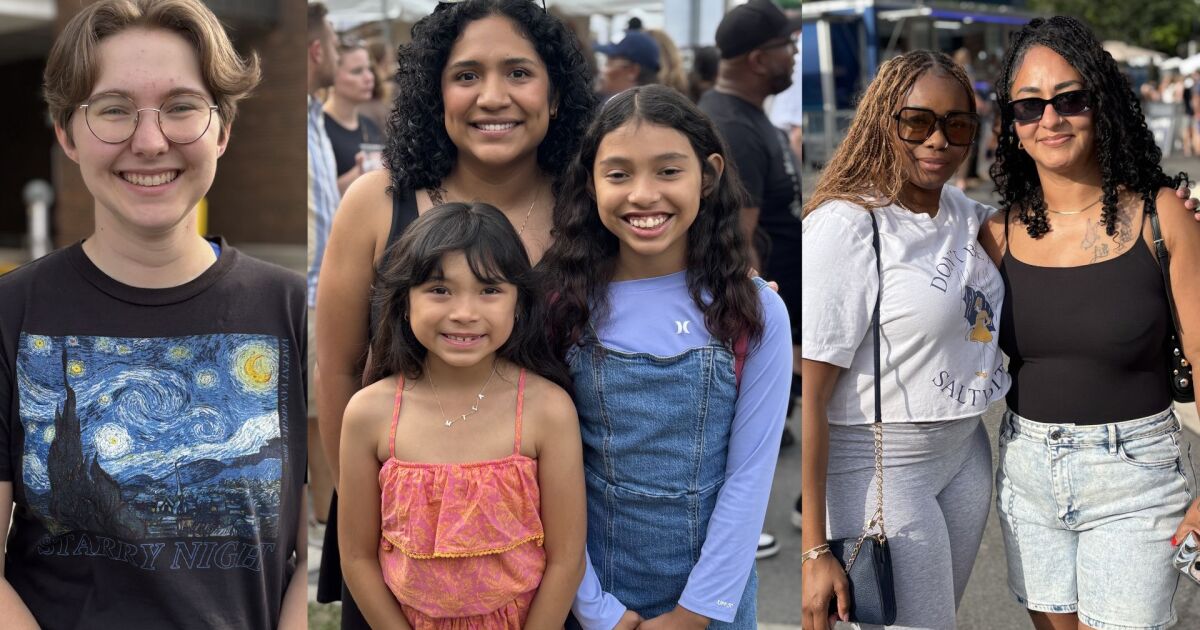
Festivalgoers say Milwaukee’s summer events fill a gap in downtown entertainment

