Lifestyle
Food holds special meaning on the Lunar New Year. Readers share their favorite dishes


NPR readers share the dishes they love most for the Lunar New Year.
Jing Gao; Alvina Chu; Amy Fedun; Beth Rogers-Ho; Alice Young; Elsy MektrakarnNguyen; Sarah Low; Anh Therese McCauley
hide caption
toggle caption
Jing Gao; Alvina Chu; Amy Fedun; Beth Rogers-Ho; Alice Young; Elsy MektrakarnNguyen; Sarah Low; Anh Therese McCauley

NPR readers share the dishes they love most for the Lunar New Year.
Jing Gao; Alvina Chu; Amy Fedun; Beth Rogers-Ho; Alice Young; Elsy MektrakarnNguyen; Sarah Low; Anh Therese McCauley
More than a billion people worldwide will celebrate the Lunar New Year on Saturday as they usher in the Year of the Dragon. It’s called Tet in Vietnam, Tsagaan Sar in Mongolia and Seollal in Korea. Whether it’s celebrated in Asia or abroad, the annual holiday is a time for many to honor elders, spend time with family, reflect on the past year and wish for a lucky year ahead.
Candied coconut, or mut dua, is a common dish seen at Vietnamese New Year celebrations.
Suzanne Nuyen
hide caption
toggle caption
Suzanne Nuyen
Candied coconut, or mut dua, is a common dish seen at Vietnamese New Year celebrations.
Suzanne Nuyen
Like most holidays, a bountiful spread of food is essential to Lunar New Year festivities. In my Vietnamese household, rice cakes called banh chung and candied fruits called mut are as essential to the New Year as turkey and mashed potatoes are to Thanksgiving. Traditional foods vary across Asian cultures. Some have even evolved as Asian diaspora communities invite others to share in their traditions.
I wanted to know what dishes NPR readers couldn’t go without on the Lunar New Year. These were some of the dishes that stood out as favorites, plus one special recipe a reader created for her grandchildren.
Responses have been edited for length and clarity
Banh chung
Banh chung and banh tet are quintessential parts of a Vietnamese Lunar New Year meal.
Suzanne Nuyen
hide caption
toggle caption
Suzanne Nuyen
Banh chung and banh tet are quintessential parts of a Vietnamese Lunar New Year meal.
Suzanne Nuyen
Making banh chung involves a labor intensive process. Often, the entire family is roped in to help.
Suzanne Nuyen
hide caption
toggle caption
Suzanne Nuyen
Making banh chung involves a labor intensive process. Often, the entire family is roped in to help.
Suzanne Nuyen
Vietnam’s quintessential Lunar New Year dish is a labor of love. Banana leaves are meticulously washed, then wrapped around sticky rice filled with pork belly and mung beans. The cakes are boiled for hours before they’re ready to eat. It often takes a whole family to make the dish.
For Yolanda Vo, the dish reminds her of her refugee parents, who brought their tradition to the U.S. nearly 50 years ago. Sahra Nguyen watches her mom make the “shockingly laborious” cakes every year. She wrote that she sees her mom’s love for her family in her dedication to making the dish. “I feel deeply grateful for the opportunity to enjoy each bite because I know it’s one of her biggest displays of love,” wrote Nguyen.
Hot pot
Alvina Chu loves hot pot for the new year because “the meal gathers us around the pot to commune with each other and enjoy our favorite bites.”
Alvina Chu
hide caption
toggle caption
Alvina Chu
Alvina Chu loves hot pot for the new year because “the meal gathers us around the pot to commune with each other and enjoy our favorite bites.”
Alvina Chu
Amy Fedun’s special hot pot includes whole grilled or baked fish and lamb chops.
Amy Fedun
hide caption
toggle caption
Amy Fedun
Amy Fedun’s special hot pot includes whole grilled or baked fish and lamb chops.
Amy Fedun
There are endless varieties of Hot pot across Asia. It’s also known as Chinese fondue or huoguo in China. In Vietnam, it’s called lau. In Japan: shabu-shabu. All the dishes involve cooking meats, noodles and vegetables communally in a pot of broth.
“It gathers the family around a single pot to linger and commune with each other,” Alvina Chu wrote. “Everyone gets to pick what they like — and the prep is no-stress for mom!”
Amy Fedun wrote that she loves a steamy pot on cold days. She tops her special hotpot with a whole grilled or baked fish, then stacks grilled lamb chops cut to look like bear paws on top of the fish. “There’s a [Mandarin] saying that literally goes, ‘you can’t have both fish and bear paw,’ meaning you have to make a choice between two desirable things,” wrote Fedun “Well, here at my new year’s table, you get to enjoy both.”
Fresh fruit
In Vietnam, a display of fresh fruit represents gratitude to your ancestors on the new year.
Suzanne Nuyen
hide caption
toggle caption
Suzanne Nuyen
In Vietnam, a display of fresh fruit represents gratitude to your ancestors on the new year.
Suzanne Nuyen
Anh Therese McCauley thinks durian is a “weird fruit,” but loves it on the Lunar New Year regardless.
Anh Therese McCauley
hide caption
toggle caption
Anh Therese McCauley
Anh Therese McCauley thinks durian is a “weird fruit,” but loves it on the Lunar New Year regardless.
Anh Therese McCauley
The highlight of Anh Therese McCauley’s Lunar New Year meals is when her mother brings out the durian fruit. It’s an acquired taste. Its smell has been described as similar to a gas leak. But many covet its custardy taste and texture, calling it “crème brûlée on a tree.” “It’s such a weird fruit, but we can claim it as ours in the Asian diaspora, and I can’t help but love that,” McCauley wrote.
Jessica Hoang’s Vietnamese fruit of choice is the mang cau, or custard apple. Her grandma always had it in her home during the new year. Her mother would tell her stories of growing up eating the fruit in Vietnam and using the seeds to play a marbles game. “My grandma was an intimidating woman — tough, cold and not afraid to be direct,” Hoang wrote. “But her way of showing she cared was giving us food and telling us to eat. In those moments, for a few minutes, a young me was able to be close to my grandma.”
Hainanese chicken
Elsy MektrakarnNguyen’s family always includes Hainan chicken rice as part of their Lunar New Year table.
Elsy MektrakarnNguyen
hide caption
toggle caption
Elsy MektrakarnNguyen
Elsy MektrakarnNguyen’s family always includes Hainan chicken rice as part of their Lunar New Year table.
Elsy MektrakarnNguyen
Elsy MektrakarnNguyen’s family has its roots in Hainan, China, just as this chicken and rice dish does. Hainanese migrants took the recipe with them when they migrated across Southeast Asia. The meal of poached chicken and garlic rice cooked in the chicken’s broth is now an iconic fixture in Singaporean street food.
MektrakarnNguyen’s family moved to Thailand before her mother was born. Though the new year, or Songkran, is celebrated there in April, her family continued to celebrate the Lunar New Year. Hainanese chicken, or khao man gai in Thai, was often part of the table of offerings to their ancestors.
“The garlic rice was precooked with LOTS of garlic and chicken fat,” she wrote. “My house would smell of garlic for days after cooking it. The smells of my childhood.”
Braised pork belly
Thit kho trung, or caramelized pork belly with eggs, is Kimberly Huynh’s favorite Lunar New Year dish. She loves how the meat falls apart after hours of braising.
Suzanne Nuyen
hide caption
toggle caption
Suzanne Nuyen
Thit kho trung, or caramelized pork belly with eggs, is Kimberly Huynh’s favorite Lunar New Year dish. She loves how the meat falls apart after hours of braising.
Suzanne Nuyen
Like many of the dishes mentioned above, a version of braised pork belly appears on many Lunar New Year tables across Asia. In Vietnam, hard-boiled eggs are added to the dish called thịt kho trứng. “Thịt kho paired with white rice is so comforting,” Kimberly Huynh wrote. “It braises for hours and it just falls apart when it’s ready to be eaten.”
Carrie Huang, from Taipei, Taiwan, enjoys a similar dish from Hangzhou, China called Dongpo pork. She wrote that the layers in the pork belly “represent seasons of the year and the good times and challenging times, similar to the rings inside the trunk of a tree showing the tough years and the good years.”
Jai
Sarah Low isn’t the biggest fan of jai, but she makes it because it reminds her of her culture and her late grandparents.
Sarah Low
hide caption
toggle caption
Sarah Low
Sarah Low isn’t the biggest fan of jai, but she makes it because it reminds her of her culture and her late grandparents.
Sarah Low
Sarah Low wrote that she used to hate jai, also known as Buddha’s delight or lo han jai. Still, she makes this vegetarian dish every year to remember her late grandparents and the culture she grew up in. “It’s a dish that is so different than what I cook all year long,” she wrote. “It’s a great way to remember the past and be mindful of the present.”
As for whether she still hates it? “I find I appreciate the flavors, but it’s never going to be my favorite,” Low wrote.
Rice cake soup
A view of Tteokguk during the Korean Food Foundation Luncheon at Bann on February 1, 2011 in New York City.
Mike Coppola/Getty Images
hide caption
toggle caption
Mike Coppola/Getty Images
A view of Tteokguk during the Korean Food Foundation Luncheon at Bann on February 1, 2011 in New York City.
Mike Coppola/Getty Images
It’s not Korean New Year, or seollal, without this rice cake soup called tteokguk. The coin-shaped rice cakes are thought to bring prosperity and riches, and its white color symbolizes a fresh start to the New Year.
Myung Armstrong garnishes her tteokguk with seaweed and julliened egg omelette. She wrote that the warm, savory beef broth and soft, chewy rice cakes bring “very happy memories making it with my mother.”
Dumplings
Mikayla Sanford’s makes Tibetan momos every year for the new year. Sometimes, her family can make hundreds of them.
Mikayla Sanford
hide caption
toggle caption
Mikayla Sanford
Mikayla Sanford’s makes Tibetan momos every year for the new year. Sometimes, her family can make hundreds of them.
Mikayla Sanford
Dumplings originated in Northern China and spread around the world. They are thought to bring fortune in the new year because they’re shaped like ancient Chinese money. Zhong dumplings, one of the most iconic street snacks of Chengdu, China, are a key part of Jing Gao’s Lunar New Year table.
Mikayla Sanford’s dumpling of choice are momos. They hail from Tibet, where the Lunar New Year is known as Losar. “Tibetan’s never had much flour or meat, so momos were always prepared for special occasions,” she wrote. “My family has been making them since I was a child. We even get together with huge steaming vats to make hundreds of momos during the new year.”
RECIPE: Alice Young’s “No Fuss Grandchildren’s Chinese Dumplings”
This recipe was provided by Alice Young.
Alice Young’s “No Fuss Grandchildren’s Chinese Dumplings”
Alice Young
hide caption
toggle caption
Alice Young
Alice Young’s “No Fuss Grandchildren’s Chinese Dumplings”
Alice Young
Alice Young has a unique dumpling recipe that she calls “No Fuss Grandchildren’s Chinese Dumplings.” She spent decades as a law partner and wrote that she had to be “creative and quick” with her food. She created this recipe for her “young, blue-eyed and blonde grandchildren.” They live in North Carolina, where Chinese communities are scarce. To adapt, Young’s recipe uses ingredients that are easy to find and childproof.
Alice Young came up with her dumpling recipe using ingredients that are easy to find in North Carolina and steps that her grandchildren can follow along with.
Alice Young
hide caption
toggle caption
Alice Young
Alice Young came up with her dumpling recipe using ingredients that are easy to find in North Carolina and steps that her grandchildren can follow along with.
Alice Young
Ingredients:
- rotisserie or any cooked chicken or meat or sausage, or firm tofu, diced
- chopped green onions or chives or cabbage, or a mix
- mayonnaise or vegenaise
- hoisin sauce
- oyster sauce
- sesame seed oil
- wonton wrappers
Directions:
- In a medium-size bowl mix equal portions of chicken/meat/tofu and chopped greens.
- Add mayonnaise, hoisin sauce, and a splash of oyster sauce and sesame oil until the mixture has the consistency of a sticky filling and tastes good to the sampling grandchild.
- Put a teaspoon of filling in a wonton wrap, lightly wet the edges of the wrap with water on your fingertips, and seal each dumpling in either a triangle or with a crimped edge, depending on the skill and interest of the grandchild.
- Optional- if the grandchild is forewarned and is not likely to swallow a small toy gold coin, sneak one into one of the dumplings as a lucky dumpling.
- Boil a pot of water and drop the finished dumplings in and cook for 6 minutes, until the dumpling wraps are cooked
- For fried dumplings. heat a pan with peanut or almond oil on medium heat, and fry the dumplings for 5 minutes until crispy on the bottom, add a splash of water and cover for 1-2 minutes until the water has evaporated and the dumpling wraps are cooked.
- Serve with soy sauce mixed with rice vinegar and sugar.


If you’re struggling to use up leftovers like a half-eaten rotisserie chicken, turn the assignment into a creative exercise, says chef Margaret Li. It’ll make the cooking process more fun and less guilt-driven.
Pulse/Getty Images/Corbis RF Stills
hide caption
toggle caption
Pulse/Getty Images/Corbis RF Stills
On a recent weeknight, I opened up my fridge and found an assortment of half-eaten or ignored food.
That included takeout that I didn’t find appetizing enough to eat for lunch. A rotisserie chicken with most of the meat picked off. A couple of raw vegetables from the farmers market that were starting to wilt.
“There’s nothing to eat,” I told myself. Yet even I knew that was ridiculous. There was plenty of food in my fridge. I just didn’t feel inspired to cook with it.
So I asked some chefs for guidance. How could I more consistently use leftovers and the other ingredients I tend to overlook?
Start with a mindset shift, says Margaret Li, chef and co-author of the cookbook Perfectly Good Food: A Totally Achievable Zero Waste Approach to Home Cooking. Think about cooking with leftovers as a creative, experimental exercise, not a guilt-driven one.
“It ends up being this fun game where you are creating something from what seems like nothing and solving this puzzle, and then you get to eat it,” she says.
There are other good reasons to use up your food scraps. Nationally, about a quarter of food products go to waste, according to the nonprofit ReFED. In my own household, where we spend about $200 a week on groceries, that means I might be throwing out the equivalent of $50 of food — an unnecessary burden on my wallet, not to mention the environment.
The chefs I spoke to had some practical tips about using up more of the food we buy. Here are a few that I put to the test.
Find your “hero recipes”
Build up an arsenal of go-to recipes that are flexible enough to use up just about any ingredient. Li calls them “hero recipes.”
I tried one of these from her cookbook, called “Make-It-Your-Own Stir-Fry.” (Scroll down for the recipe.) It includes loose ingredients like “1 pound crisp-crunchy vegetables” or “4 cups leafy greens.”
In the spirit of the recipe, I pulled vegetables out of my fridge at random and did not measure them out. The sauce was a simple mixture of soy sauce, vinegar, sugar and water. By the time I topped my bowl with chopped scallions, the dish looked like a gourmet meal, not an afterthought.
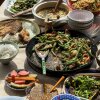
Other ideas: “You could put anything in a frittata, and it’ll be great,” says Tamar Adler, chef and author of The Everlasting Meal Cookbook: Leftovers A-Z.
Or, if you have day-old rice on hand, cook it alongside other ingredients to make fried rice. “Saute some aromatics — ginger, garlic, onion — in oil,” Adler says. Then add your rice and whatever leftover bits you have, like the rotisserie chicken and older produce I had in my fridge.
“Just take the approach of making it more flavorful and crispy and then spicy, and then usually adding a squeeze of lemon,” Adler says.
Label your leftovers
Keep a permanent marker and painter’s tape in your kitchen to label and date your leftovers, Li says. “That is a classic chef’s method for knowing what something is and when it was made. That saves you the guessing game.”
Adler takes the concept a step further and labels her leftovers with their intended use. Leftover blueberries are labeled “muffins-to-be on Tuesday,” she says. “I really like doing that — assigning the destiny of the food.”

So after a night of Ethiopian takeout, when we ended up with an entire container of leftover injera, I followed Adler’s advice and thought about what it might become in the future.
I imagined scrambling the spongy, tangy bread with eggs, akin to scrambling matzo into matzo brei. “Injera for eggs,” I wrote on the container. Sure enough, their destiny was fulfilled the following morning.

Li keeps a dedicated bag in her freezer just for scraps from which to make chicken or vegetable stock. That bag houses carrot peels, the ends of onions, extra garlic cloves and chicken bones.
Flavia Morlachetti/Getty Images/Moment RF
hide caption
toggle caption
Flavia Morlachetti/Getty Images/Moment RF
Don’t forget your odds and ends
Adler encouraged me to never, ever throw away the stems of herbs. Stems don’t get as much glory as tender, pretty leaves, but they still have the same herby taste.
“I’m going to chop these herbs up or stick them in a blender with a clove of garlic,” she says. Then add olive oil. “And then it’s just gonna be my base sauce for everything.”
So I foraged a few varieties of half-cut herbs from my refrigerator drawers, most of them sad looking and unidentifiable.
I threw out the stems that had turned brown and gooey and put the rest in a blender. I added garlic on Adler’s instructions, nuts and kale for bulk, and plenty of olive oil and salt. Then, on a whim, I added a splash of olive juice for brightness.
The result was somewhere between a pesto and a chimichurri, and it elevated that night’s otherwise routine dinner. And Adler was right: Once the stems were blended, it tasted exactly the same as the leaves. (The same idea applies for broccoli stems in a cheesy broccoli soup, Li says.)
Li likes to keep her odds and ends organized with an “Eat Me First” box in her fridge. That’s where she keeps half-used lemons, leftover coconut milk or produce that’s starting to get wrinkly. “You kind of have an idea for, OK, here’s where you look first,” she says.
Don’t strive for perfection
Cooking these meals did feel like a game, as Li had suggested. It brought me unexpected joy to use up as many existing ingredients as possible — to the point where I often spent much longer in the kitchen because I kept thinking of new ideas: If I turn these wrinkly sweet potatoes into a soup, then I can caramelize this half-cut onion for a topping, and then I can use the leftover soup as a sauce tomorrow …
Did I cook more often, though? Probably not. My cooking energy burned brighter but fizzled out after a few nights, at which point I ordered takeout.
So I was glad to hear Li’s take: If you’re too hard on yourself, you’re not going to enjoy it at all. “ I try not to be too obsessive about eating absolutely everything,” she says. If my takeout was truly terrible, I’m allowed to toss it or, better yet, compost it.
If you really want to use up everything, you can always chuck ingredients into the freezer. Li has dedicated freezer bags for different dishes, like vegetable scraps for soups or fruit discards for smoothies. (She labels them, of course.)
And how does that smoothie taste? It’s “delicious,” she says, “even if it’s made up of all the things that have been rejected in the past,” she says.
Recipe: Make-It-Your-Own Stir-Fry
Excerpted from Perfectly Good Food: A Totally Achievable Zero Waste Approach to Home Cooking. Copyright ©2023 by Irene Li and Margaret Li. Used with permission of the publisher, W. W. Norton & Company, Inc. All rights reserved.
Sauce
- 1 tablespoon soy sauce
- 1 tablespoon water
- 1 teaspoon sugar
- 1 teaspoon black vinegar, rice vinegar, lime juice, or other acid
- 1 tablespoon neutral oil, or enough to lightly coat the bottom of your wok or skillet
- 1 garlic clove, thinly sliced or minced, or more as desired
- ½-inch piece fresh ginger, minced or grated (optional)
- Pinch chili flakes or 1 small chile pepper, diced (optional)
- 4 cups leafy greens, torn into bite-size pieces, or 1 pound crisp-crunchy vegetables, cut into chunks
- Kosher salt
Stir the sauce ingredients together in a small bowl and set by the stove.
Heat a wok or large skillet over high heat until just smoking, then add the neutral oil and tilt to coat the bottom of the pan.
Add the garlic, ginger (if using), and chili flakes (if using) and stir-fry for 10 seconds. Add the greens and/or vegetables, in stages as necessary, and toss in the garlicky oil, then add the sauce and cook to your liking, stirring frequently.
Vegetable chunks may need 4 to 7 minutes — if you want to speed up the process, cover the pot so the vegetables steam for a minute or two, then uncover and toss again. Sturdy greens may need 3 to 5 minutes to get tender (we like to let them sit for a bit and char for extra texture).
Lighter leaves will need less than a minute to wilt down. Stir in a spoonful of any additional sauce you like, season with salt to taste, then sprinkle with your favorite garnishes and a generous drizzle of sesame oil.
A sprinkle of crunch is a great way to finish a stir-fry. Our favorites include crushed cashews or peanuts, toasted sesame seeds, thinly sliced scallions, and fried onions or shallots.
Your turn: What are your favorite go-to leftover recipes?
We’d love to hear from you! Share your recipe with us at lifekit@npr.org with your full name. We may publish it on NPR.org.
The story was edited by Malaka Gharib. The visual editor is CJ Riculan. We’d love to hear from you. Leave us a voicemail at 202-216-9823, or email us at LifeKit@npr.org.
Listen to Life Kit on Apple Podcasts and Spotify, and sign up for our newsletter. Follow us on Instagram: @nprlifekit.

Stephen Malkmus & the Jicks perform onstage during day two of the Boston Calling Music Festival at Boston City Hall Plaza on September 26, 2015 in Boston, Massachusetts. (Photo by Mike Lawrie/Getty Images)
Mike Lawrie/Getty Images
hide caption
toggle caption
Mike Lawrie/Getty Images
This week’s show was recorded in Chicago with host Peter Sagal, judge and scorekeeper Alzo Slade, Not My Job guest Stephen Malkmus and panelists Emmy Blotnick, Joyelle Nicole Johnson, and Gianmarco Soresi. Click the audio link above to hear the whole show.
Who’s Alzo This Time
Pool Problems; Don’t Forget to Hydrate; The Rise of Hot Podium Guy
Panel Questions
TSA Gets A Dressing Down
Bluff The Listener
Our panelists tell three stories about game shows in the news, only one of which is true.
Not My Job: Stephen Malmus, lead singer and guitarist for Pavement, answers our questions about road construction
Indie rock legend and founder of Pavement, Stephen Malkmus, joins us to play a game called, “Pavement repairs are underway!” Three questions about road construction.
Panel Questions
The Battle Over A Home Sale; The Best Three Words To Get Over A Loss and Out of a Meeting?; A New Job in the Dating World
Limericks
Alzo Slade reads three news-related limericks: Good News For Gym Slobs; Cruisin’ For A Tattooin’; Fringe Food Benefits
Lightning Fill In The Blank
All the news we couldn’t fit anywhere else
Predictions
Our panelists predict what will find after the reflecting pool is emptied

When Julio Miranda-Martin began his apartment search, he had one nonnegotiable: He wanted a dedicated dining room to entertain his friends. He was scouring Zillow in 2025 when a listing for a railroad-style, one-bedroom on the edge of West Hollywood came up that included the requisite dining room. It was also walking distance to his part-time job as a marketing coordinator at furniture store Lawson-Fenning. More importantly, at $2,500 a month it was within his budget.
-
Share via
Miranda-Martin met with his landlord the same day he found the listing, who told him he looks like his son. Feeling like finding this 950-square-foot apartment was kismet, Miranda-Martin signed the lease and set about creating a sophisticated and color-saturated sanctuary. Miranda-Martin decided he needed to make two major investments before moving in: painting the walls and changing the lighting. “I was finally able to move into a place that I actually like, not just out of necessity. I was like, let’s make it feel like my own,” says Miranda-Martin, who refers to the space as his “living canvas.”

In this series, we spotlight L.A. rentals with style. From perfect gallery walls to temporary decor hacks, these renters get creative, even in small spaces. And Angelenos need the inspiration: Most are renters.
The apartment is on the second floor of a fourplex, up a windowless staircase. Miranda-Martin embraced the lack of light and painted it a high-gloss crimson. Without natural light, he hard-wired sconces found on Facebook Marketplace that recall ornamental 18th century candlesticks. They cast a dim but moody light throughout the staircase, ending with an ornate mirror at the top. The mirror shows a glimpse of the apartment’s interior in its reflection when Miranda-Martin opens the door. “Every time people walk in, especially at night, it’s such a dramatic entry,” he explains. “It’s very cinematic,” agrees friend and co-worker Kristin Reeder, who is often a guest at his soirees, “like something from ‘Eyes Wide Shut.’ ”
1

2

3

1. Julio Miranda-Martin’s apartment decor starts in the bold staircase that leads to his door. 2. A mirror at the top of the staircase offers extra depth. 3. Julio Miranda-Martin fills the bookshelf in his dining room with books and treasures.
In contrast, the living room offers a calmer palette of sky blues and earthy browns. Miranda-Martin tends to choose paint colors based on the light. The living room, with abundant west-facing windows brings in soft, bright light. Miranda-Martin painted it with Benjamin Moore’s Navajo, a flat white, as a backdrop to the softer hues of the furniture he designed at his furniture and lighting company, Studio MM. “It adds a stillness,” he says.
The room is anchored by a large velvet couch in a rich brown. The modular couch is anchored on each side with Art-Deco influenced side tables, lamps and light blue slipper chairs he designed, setting up a cozy tableau for hosting his friends. Pale pink cushioned ottomans provide additional seating that can easily be moved around the room to accommodate additional guests.

A velvet couch acts as a statement piece in the apartment living room.
(Etienne Laurent/For the Times)
French doors separate the living room from the dining room. The chartreuse-infused dining room returns to a more dramatic colorway. With less natural light, Miranda-Martin wanted to play up the idea of dining-room-as-treehouse, reflecting the second-floor foliage visible from the small windows. Rather than trying to brighten the room, he leaned into the moodiness by buying inexpensive, USB battery-powered spotlights that are mounted on the ceiling with magnets. Taking an alcohol marker, he tinted the lights a soft amber, allowing him to highlight the art in the room without adding harsh overhead lighting.

The dining room is meant to reflect the foliage just outside the window.
(Etienne Laurent/For the Times)
A shell-adorned mirror anchors the wall facing the windows and built-in shelving, making the room feel larger. Miranda-Martin sourced two shell-shaped sconces that flank the mirror at an estate sale in San Francisco. Most of the art and home decor comes from Facebook Marketplace and Craigslist, or is thrifted from local stores. Estate sales are also a source, though Miranda-Martin feels the rising popularity of these sales in Los Angeles has led to an increase in pricing. “They’ve gotten so over the top now in L.A. [They’re] super expensive. You’re not really gonna find a deal,” he laments, citing the armed security checking bags recently at some of the hottest estate sales.
In addition to changing the lighting and painting the walls, Miranda-Martin prioritized the window treatments, with pinch pleat curtains from Ikea. “Drapery can just make a space feel super elevated,” he advises. He prefers a mix of new and vintage decor, balancing both for an eclectic but deeply personal look to his home. He tries not to overthink his aesthetic choices. “I think it’s very instinctual. I’m not really thinking, ‘Is this in good taste or is this going to be weird?,’ ” he says.
Down the hall, the bedroom’s mostly white design theme returns to a more serene composition, providing a quiet sanctuary. Miranda-Martin removed the headboard from his bed, making it seem like it’s floating between the night tables he designed. “Everything feels sort of streamlined and smooth,” says Miranda-Martin. Like the living room, the bedroom is painted the same flat white but the quality of the eastern light filtering into the bedroom casts a buttery glow.
1

2

3

1. Ceramics fill inset shelves in the kitchen. 2. A glass case in the apartment corridor between the dining room and the bedroom. 3. With its lighter decor, the bedroom was meant to be a sanctuary.
The small kitchen retains its midcentury charm, but open shelving above the counter provides an airier, more contemporary cupboard to show off Miranda-Martin’s dish and glassware collection. The easier access comes in handy when he’s entertaining. His apartment is the perfect pre-game space for him and his friends before a night on the town. He tries to make sure he pre-batches cocktails before his guests arrive.
He also likes to host more elaborate dinner parties and game nights. He attributes his love of entertaining to his upbringing as an only child in Downey. “I like hosting because I enjoy being around more people than when I was growing up,” explains Miranda-Martin. His goal, ultimately, is to bring together disparate groups of people from different spheres in a space everyone will feel comfortable in. Dinner parties at Miranda-Martin’s “feel like an event,” says Reeder. “It’s something you’re excited for and you want to get dressed up for.”
“I’m kind of going through a phase right now where I need to be around people,” admits Miranda-Martin. “I think I just hate being alone.”
-

 Wyoming59 seconds ago
Many Of Wyoming’s Seldom-Seen Snakes Aren’t That Rare, They Just Like To Hide
-

 Crypto8 minutes ago
Lost your crypto access code? Be wary, there‘s a scam for that too
-

 Finance11 minutes ago
From employee perks to asset management: Hitechzone expands into finance | CTech
-

 Fitness16 minutes ago
Foundation Friday: Building bright futures & mental health through fitness
-

 Movie Reviews26 minutes ago
Hollywood Pariah Kevin Spacey Opens in a Straight to Video Movie with 25 Producers, 1 Review, No Theaters, No Press – Showbiz411
-
World38 minutes ago
Rescue Workers and Aid Arrive in Venezuela, Official Says
-
Lifestyle1 hour ago
This mindset shift can help you get better at using up your leftovers
-

 Technology1 hour ago
TMD’s keyless bike lock is a $280 solution to a $60 problem

