Lifestyle
First look: Disneyland's original Haunted Mansion returns with a heartbreaking new scene


When Disneyland’s Haunted Mansion reopens Saturday in its classic, non-holiday form it will essentially mark the completion of a nearly yearlong refurbishment project, one that added significant backstory and lore to one of the resort’s most famed and mysterious attractions.
A fixture at the park since its 1969 opening, the Haunted Mansion has been the subject of regular tinkering, its illusions evolving and changing as technology — and culture — advances.
This update will be no different. One of the Mansion’s signature scenes has been remade, and now has a much more somber story to tell.
Walt Disney Imagineering, the secretive arm of the company devoted to theme park experiences, has once again revisited the ride’s trademark attic scene, long home to a tortured bride. There’s still a bride, but she’s never quite looked or acted like this.
It’s not the only major change to an attraction developed during the Walt Disney era. An expanded queue has added narrative-focused gardens and a greenhouse to where guests will wait in line, while a new gift shop adjacent to the ride’s exit expands on the storyline of Mademe Leota, seen in the attraction as a disembodied floating head in a séance scene. Imagery at ride’s end, in which a “ghost will follow you home,” has also been updated.

Walt Disney Imagineering has unveiled a new version of the Haunted Mansion bride, this one appearing to float while holding a candelabra. A beating red heart is seen in her chest, a nod to earlier versions of the figure.
(Richard Harbaugh / Disneyland Resort)
As for the would-be honeymooner in the attic, she’s now utilizing the latest in projection technology, appearing to float before guests as she holds a three-pronged physical candelabra, giving corporeal depth to her ethereal glow, which hovers away from a shattered window of a wall. Her blindingly red heart, in a nod to the park’s original vision of the bride, still beats in time to an elongated, gloomy rendition of Richard Wagner’s “Bridal Chorus.”
Disneyland’s Haunted Mansion has for about 55 years stood as a love letter to humanity’s most hedonistic tendencies. Gluttony, greed, sloth, lust and even murder have been on display in its cryptic halls. We’re all going to bite it in the end, the Mansion seems to tell us, so let’s live it up. There are no gilded gates here, but there is one heck of a party, complete with serenading busts, ballroom dancers, excitable opera singers, drunken buffoonery and portraits locked in an endless duel.
And now there’s heartbreak.

The new bride in the Haunted Mansion appears to float, and she is surrounded by pictures of past loves. The men gradually disappear in each portrait, creating a sense of constant loss.
(Richard Harbaugh / Disneyland Resort)
In an exclusive preview of the revamped scene on Tuesday morning at Disneyland, where operations have not been interrupted by the L.A. area fires, I stood across from the new bride for a number of minutes. I marveled at how the hidden-in-the-floor projections allow the ghost to levitate, but also increasingly felt a sense of mourning. Like many locals, my emotions are heightened at the moment, but I was also struck at how much more clearly defined the bride’s face is now, appearing grief-stricken and lovesick. I tell Kim Irvine, the longtime creative director with Imagineering at Disneyland, that unlike the previous bridal scene, here I’m feeling a sense of sorrow.
That’s intentional, Irvine says, noting the team wanted to heighten the “sadness in her face.”
“We thought, what if we change the story back a little bit to the original story that the Imagineers had about a lost bride in the attic mourning the loss of her husbands,” she says. “It was a sad thing. It was a story about lost love.”
The last time the attic received a major overhaul was in the mid-2000s, and that figure, known as the “black widow bride,” had more aggressive, sinister story to tell. Holding an axe, she was portrayed as a murderous, wealth-seeking seductress who had beheaded her husbands, evident by their heads disappearing from the wedding portraits scattered around the attic. Those pictures are still present, only now the full bodies of the men vanish — leaving their departure up to the imagination.
Irvine says the attic scene was redone, in part, because the projection technology on the prior figure had become so outdated as to necessitate regular maintenance. But rather than update what was there, Irvine saw an opportunity to add a greater contrast with the more festive waltz in the prior room as well as to embellish the Mansion’s tale.
The candelabra, for instance, that the character is holding is identical to the one visible floating in an earlier hall scene, now implying the bride is broodingly wandering the Mansion. Additionally, the candelabra will appear a third time, materializing in a cemetery crypt in the ride’s final act.

The expanded Haunted Mansion grounds are filled with an abundance of details and new fixtures — some slightly spooky, others more mystical.
(Richard Harbaugh / Disneyland Resort)
“The bride that used to be in there was an axe murderer, and in this day and age we have to be really careful about the sensitivities of people,” Irvine says. “We were celebrating someone chopping off her husband’s heads, and it was a weird story. I know the fans — some will like it and some will say, ‘Oh, you changed something again.’ That’s our job. That’s what we’re here for.”
Irvine knows the vast Disneyland fanbase will be paying close attention. As one of Disneyland’s most celebrated attractions, and one created by a cadre of Walt’s original Imagineers, fan attachment to the Haunted Mansion is strong.

The expanded grounds of the Haunted Mansion are dedicated to various characters found inside the attraction, including a section of the gardens inspired by Madame Leota.
(Richard Harbaugh / Disneyland Resort)
And the Disney faithful are especially protective of the Haunted Mansion. To wit: an online controversy erupted earlier this winter when it was discovered that the new shop adjacent to the ride contained a piece of art that was created by artificial intelligence. The presence of AI art felt particularly egregious knowing the value Imagineering places on authentic, hand-crafted work.
The moment clearly weighed on Irvine. “How they can find one thing out of all this cool stuff,” Irvine says of the fan outcry, trailing off as she stood in the shop full of artfully created oddities and references to tarot and mysticism. She stresses that the AI art was a temporary placeholder, noting there are many objects coming to the shop — more paintings and tapestries among them — that are in the process of being fireproofed before final install.
“They felt like it would be appropriate for a short time until they could put something else in,” Irvine says of the ill-fated art. “They never intended to do anything bad, and it is gone now. We’re going to bring something back in that is hand-painted, like all of these other pieces are.”
Irvine’s connection to the Mansion runs deep, and is extremely personal. A veteran with Imagineering for nearly 55 years, Irvine just may be the only living creative at the company who worked with and was mentored by Walt’s initial team of designers, including that of her mother, Leota Toombs, one of the first women to work for Imagineering and the inspiration for Madame Leota.

A painting of Madame Leota, inspired by the late, real-life Imagineer Leota Toombs, hangs in the Haunted Mansion’s gift shop. Toombs was the mother of Kim Irvine, the Imagineer who oversaw recent additions to the Mansion and its grounds.
(Richard Harbaugh / Disneyland Resort)
In the shop, officially designated as Madame Leota’s Somewhere Beyond, hangs a portrait of Toombs in her Haunted Mansion guise. The painting was inspired by one of Irvine’s photos of her mother, and if you look closely you’ll spot Kim’s face in the crystal ball that Leota is holding. “That’s what she was seeing into the future,” Irvine says.
Such hidden details abound — instruments that appear to hover, a chair in the shape of the Mansion’s “Doombuggy” ride vehicle and nods to Leota’s spiritual connection to cats. The low-hanging chandelier one spies when first entering the shop used to dangle inside the Mansion itself, having to be removed when more illusions were added.
“We made this in the early ’80s to go over the crystal ball before it floated,” Irvine says. At the time, Imagineering wanted to update a relatively “common” chandelier with a spookier, spider web-inspired look.

A chandelier that hangs in the Haunted Mansion gift shop was once found inside the attraction itself.
(Richard Harbaugh / Disneyland Resort)
The shop, Irvine says, has been in the works for about a decade. It’s designed as a carriage house, and the story is Madame Leota has taken it over as a live-in space. Irvine says it’s created to rhyme with the Mansion, particularly in its color scheme, utilizing the same tones of green and white, only with different places of emphasis. If the design is less ornate, Irvine notes that’s purposeful, pointing out Antebellum carriage houses were “a little bit knocked down.”
Its size was a challenge. “To shoehorn anything into tiny Disneyland is really hard,” Irvine says, adding, “a lot of people in merchandising would have preferred it was bigger.”
The changes to the queue were driven, in part, by other forces as well, namely to ensure the winding line was up to modern ADA standards and to better handle bottlenecks for Disneyland’s current crowds. Here, too, Irvine looked to expand on the Mansion’s narrative, creating multiple sections with different tones — an ever-so-slightly purple-hued garden is Madame Leota’s space, and a more contemplative area is dedicated to the master of the house, a former sea captain whose narrative has shifted over the years.
A sense of sadness permeates that part of the garden — mermaids drape their hair over the light fixtures, and contrasting female statuaries — one prideful and one sorrowful — are meant to nod to his less than ideal romantic relationships. “His love, his life, his lady, was the sea,” Irvine says.

An area of the expanded Haunted Mansion queue is dedicated to the master of the house, who, according to the attraction’s lore, is said to have been a sea captain. The space is one built for reflection.
(Richard Harbaugh / Disneyland Resort)
Leota’s spot is more irreverent. Of particular interest is a not-so-hidden conduit that runs up the side of the centerpiece tree. Here, Irvine created a tribute to late Imagineer Rolly Crump, known for his whimsical art and one of the first artists to work on the Mansion. “Rolly Crump used to do a thing he called the ‘Egyptian eye,’” Irvine says. “A lot of his drawings for the Mansion have that, so I hand-painted it on the conduit to make it look like a snake and put his initials on the top.”
The gardens are a mix of original and found objects. Irvine stops to point out some Imagineering crafted grates, which hide utilities with astrological flourishes, and says she scoured antique shops from “Pasadena to Temecula” looking for items that would fit. She’s happy to share where she collected a piece. A pair of sleeping lions, for instance, Irvine found in the back pages of a catalog for a Chicago statue company, and two iron griffins were hiding in the corner of an Alhambra marble shop.
Irvine says she isn’t bothered when fans discover where an item was procured. “It would be impossible for us to make everything,” Irvine says.
As Irvine walks the ground, pointing out various weeping trees and plants, she also spots areas to continue to tinker. She wonders if a grassy nook in front the Mansion is too pristine as she laments the fact that a fountain relocated from nearby New Orleans Square is no longer pumping water, noting such complex construction wasn’t in the budget. She points to an iron horse on an utility box, quickly adding the direction of the face and handle may someday need to be changed.
And there may still be more work to do inside the Mansion. When Imagineering last made updates to the attraction in 2021, Irvine’s team spoke of potentially removing the hanging corpse in the stretching room, noting such an image could be triggering for some guests. “We’re still looking at that,” Irvine says. “That one is complicated, structurally … One thing at a time.”
For a palace dedicated to the dead, the Haunted Mansion remains a living entity.



Wyle, who spent 11 seasons on ER, returns to the hospital in The Pitt. Now in Season 2, the HBO series has earned praise for its depiction of the medical field. Originally broadcast April 21, 2025.
Hear The Original Interview
Television
After years of avoiding the ER, Noah Wyle feels ‘right at home’ in ‘The Pitt’

TMZ Live Stream
Come Into Our Office and Watch News Happen!!!
Published
We want you to be a part of TMZ, so every weekday, between 9:30 AM and 11:30 AM PT, we take you inside our newsroom via live stream.
You never know what you’re gonna get … a big story that breaks, an argument erupts in the room, or someone’s just joking around.
Your comments are a big part of the stream, and the staff spends a lot of time speaking directly to you. Every day is different!
We also use our live stream to produce our “TMZ Live” TV show.

From left: Noah Wyle plays Dr. Michael “Robby” Robinavitch, the senior attending physician, and Fiona Dourif plays Dr. Cassie McKay, a third-year resident, in a fictional Pittsburgh emergency department in the HBO Max series The Pitt.
Warrick Page/HBO Max
hide caption
toggle caption
Warrick Page/HBO Max
The first five minutes of the new season of The Pitt instantly capture the state of medicine in the mid-2020s: a hectic emergency department waiting room; a sign warning that aggressive behavior will not be tolerated; a memorial plaque for victims of a mass shooting; and a patient with large Ziploc bags filled to the brink with various supplements and homeopathic remedies.
Scenes from the new installment feel almost too recognizable to many doctors.
The return of the critically acclaimed medical drama streaming on HBO Max offers viewers a surprisingly realistic view of how doctors practice medicine in an age of political division, institutional mistrust and the corporatization of health care.
Each season covers one day in the kinetic, understaffed emergency department of a fictional Pittsburgh hospital, with each episode spanning a single hour of a 15-hour shift. That means there’s no time for romantic plots or far-fetched storylines that typically dominate medical dramas.
Instead, the fast-paced show takes viewers into the real world of the ER, complete with a firehose of medical jargon and the day-to-day struggles of those on the frontlines of the American health care system. It’s a microcosm of medicine — and of a fragmented United States.

Many doctors and health professionals praised season one of the series, and ER docs even invited the show’s star Noah Wyle to their annual conference in September.
So what do doctors think of the new season? As a medical student myself, I appreciated the dig at the “July effect” — the long-held belief that the quality of care decreases in July when newbie doctors start residency — rebranded “first week in July syndrome” by one of the characters.
That insider wink sets the tone for a season that Dr. Alok Patel, a pediatrician at Stanford Medicine Children’s Health, says is on point. Patel, who co-hosts the show’s companion podcast, watched the first nine episodes of the new installment and spoke to NPR about his first impressions.
To me, as a medical student, the first few scenes of the new season are pretty striking, and they resemble what modern-day emergency medicine looks and sounds like. From your point of view, how accurate is it?
I’ll say off the bat, when it comes to capturing the full essence of practicing health care — the highs, the lows and the frustrations — The Pitt is by far the most medically accurate show that I think has ever been created. And I’m not the only one to share that opinion. I hear that a lot from my colleagues.
OK, but is every shift really that chaotic?
I mean, obviously, it’s television. And I know a lot of ER doctors who watch the show and are like, “Hey, it’s really good, but not every shift is that crazy.” I’m like, “Come on, relax. It’s TV. You’ve got to take a little bit of liberties.”
As in its last season, The Pitt sheds light on the real — sometimes boring — bureaucratic burdens doctors deal with that often get in the way of good medicine. How does that resonate with real doctors?
There are so many topics that affect patient care that are not glorified. And so The Pitt did this really artful job of inserting these topics with the right characters and the right relatable scenarios. I don’t want to give anything away, but there’s a pretty relatable issue in season two with medical bills.
Right. Insurance seems to take center stage at times this season — almost as a character itself — which seems apt for this moment when many Americans are facing a sharp rise in costs. But these mundane — yet heartbreaking — moments don’t usually make their way into medical dramas, right?
I guarantee when people see this, they’re going to nod their head because they know someone who has been affected by a huge hospital bill.
If you’re going to tell a story about an emergency department that is being led by these compassionate health care workers doing everything they can for patients, you’ve got to make sure you insert all of health care into it.
As the characters juggle multiple patients each hour, a familiar motif returns: medical providers grappling with some heavy burdens outside of work.
Yeah, the reality is that if you’re working a busy shift and you have things happening in your personal life, the line between personal life and professional life gets blurred and people have moments.
The Pitt highlights that and it shows that doctors are real people. Nurses are actual human beings. And sometimes things happen, and it spills out into the workplace. It’s time we take a step back and not only recognize it, but also appreciate what people are dealing with.
2025 was another tough year for doctors. Many had to continue to battle misinformation while simultaneously practicing medicine. How does medical misinformation fit into season two?
I wouldn’t say it’s just mistrust of medicine. I mean that theme definitely shows up in The Pitt, but people are also just confused. They don’t know where to get their information from. They don’t know who to trust. They don’t know what the right decision is.
There’s one specific scene in season two that, again, no spoilers here, but involves somebody getting their information from social media. And that again is a very real theme.
In recent years, physical and verbal abuse of healthcare workers has risen, fueling mental health struggles among providers. The Pitt was praised for diving into this reality. Does it return this season?
The new season of The Pitt still has some of that tension between patients and health care professionals — and sometimes it’s completely projected or misdirected. People are frustrated, they get pissed off when they can’t see a doctor in time and they may act out.
The characters who get physically attacked in The Pitt just brush it off. That whole concept of having to suppress this aggression and then the frustration that there’s not enough protection for health care workers, that’s a very real issue.
A new attending physician, Dr. Baran Al-Hashimi, joins the cast this season. Sepideh Moafi plays her, and she works closely with the veteran attending physician, Dr. Michael “Robby” Robinavitch, played by Noah Wyle. What are your — and Robby’s — first impressions of her?
Right off the bat in the first episode, people get to meet this brilliant firecracker. Dr. Al-Hashimi, versus Dr. Robby, almost represents two generations of attending physicians. They’re almost on two sides of this coin, and there’s a little bit of clashing.
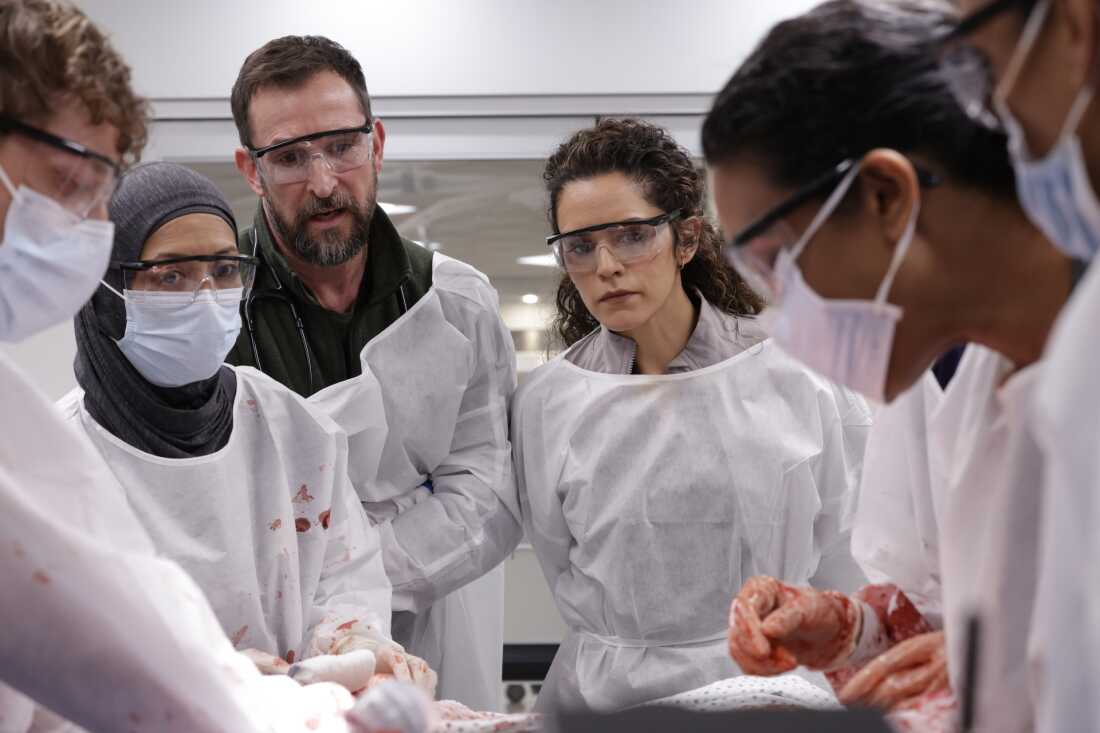
Sepideh Moafi, fourth from left, as Dr. Baran Al-Hashimi, the new attending physician, huddles with her team around a patient in a fictional Pittsburgh teaching hospital in the HBO Max series The Pitt.
Warrick Page/HBO Max
hide caption
toggle caption
Warrick Page/HBO Max
Part of that clash is her clear-eyed take on artificial intelligence and its role in medicine. And she thinks AI can help doctors document what’s happening with patients — also called charting — right?
Yep, Dr. Al-Hashimi is an advocate for AI tools in the ER because, I swear to God, they make health care workers’ lives more efficient. They make things such as charting faster, which is a theme that shows up in season two.
But then Dr. Robby gives a very interesting rebuttal to the widespread use of AI. The worry is that if we put AI tools everywhere, then all of a sudden, the financial arm of health care would say, “Cool, now you can double how many patients you see. We will not give you any more resources, but with these AI tools, you can generate more money for the system.”
The new installment also continues to touch on the growing corporatization of medicine. In season one we saw how Dr. Robby and his staff were being pushed to see more patients.
Yes, it really helps the audience understand the kind of stressors that people are dealing with while they’re just trying to take care of patients.
In the first season, when Dr. Robby kind of had that back and forth with the hospital administrator, doctors were immediately won over because that is such a big point of frustration — such a massive barrier.
There are so many more themes explored this season. What else should viewers look forward to?
I’m really excited for viewers to dive into the character development. It’s so reflective of how it really goes in residency. So much happens between your first year and second year of residency — not only in terms of your medical skill, but also in terms of your development as a person.
I think what’s also really fascinating is that The Pitt has life lessons buried in every episode. Sometimes you catch it immediately, sometimes it’s at the end, sometimes you catch it when you watch it again.
But it represents so much of humanity because humanity doesn’t get put on hold when you get sick — you just go to the hospital with your full self. And so every episode — every patient scenario — there is a lesson to learn.
Michal Ruprecht is a Stanford Global Health Media Fellow and a fourth-year medical student.

Some flu measures decline, but it’s not clear this severe season has peaked

‘Weight Loss Has Never Been About Calories’: How This Low-Insulin Diet Helped Lillie, 58, Drop 70 Lbs!

Video: Read These 3 Books Before Watching the Movie

After years of avoiding the ER, Noah Wyle feels ‘right at home’ in ‘The Pitt’

Video: A Viral Beauty Test Doesn’t Hold Water

Florida High School Football Rankings: Top 25 teams – Oct. 21

Cleary's 21 help Le Moyne down Central Connecticut State 69-64 in OT

How old is Bo Nix? What to know about Oregon quarterback ahead of 2024 NFL Draft

99th annual Pony Swim held in Virginia

Video: ‘It Didn’t Have to Happen This Way:’ U.Va. Faculty Call for Review of Police Response to Protests

AOC accuses Vance of believing ‘American people should be assassinated in the street’
Mercosur: How Macron’s domestic weakness undercut his Brussels clout

National Park Service will void passes with stickers over Trump’s face

Trump plans to meet with Venezuela opposition leader Maria Corina Machado next week

Trump says meeting Iran’s ‘Crown Prince’ Pahlavi would not be appropriate
-

 Detroit, MI6 days ago
2 hospitalized after shooting on Lodge Freeway in Detroit
-

 Technology3 days ago
Power bank feature creep is out of control
-

 Dallas, TX4 days ago
Defensive coordinator candidates who could improve Cowboys’ brutal secondary in 2026
-

 Health5 days ago
Viral New Year reset routine is helping people adopt healthier habits
-

 Iowa3 days ago
Pat McAfee praises Audi Crooks, plays hype song for Iowa State star
-

 Nebraska2 days ago
Oregon State LB transfer Dexter Foster commits to Nebraska
-
 Nebraska3 days ago
Nebraska-based pizza chain Godfather’s Pizza is set to open a new location in Queen Creek
-
 Entertainment2 days ago
Spotify digs in on podcasts with new Hollywood studios