Lifestyle
Figure skating season ends with redemption and heartbreak. What do fans watch next?


Ilia Malinin celebrates after winning his third Figure Skating World Championships in Prague on Saturday.
Michal Cizek/AFP via Getty Images
hide caption
toggle caption
Michal Cizek/AFP via Getty Images
American figure skater Ilia Malinin won his third consecutive world title this weekend, just weeks after missing the podium at the Winter Olympics.
The self-proclaimed “Quad God” was a heavy medal favorite going into Milan, but finished in eighth place after an uncharacteristic series of stumbles, which he later blamed on the pressure and expectations.

Six weeks after one of the most shocking twists of the Olympics, Malinin rebounded with a literal roar at the World Championships in Prague. He delivered two clean, quad-heavy programs to win gold by over 20 points, capping off the season on a note as high as his infamous jumps.
“I felt relieved that the season’s finally done after a long up and down for this whole season,” Malinin told U.S. Figure Skating, calling worlds a “change in mindset” from the Olympics. “All I wanted to do was skate for myself, enjoy every moment on the ice and just have fun out there, and that’s exactly what I did.”
Malinin skated the same routines that he brought to Italian ice — in the individual and the team event, in which he helped Team USA win gold — minus the visible nerves and mistakes. He earned a personal best score in his short program on Thursday to enter the second half of the competition in first place.
And he held onto that lead with a dazzling free skate on Saturday, even as he played it safe by his own standards.
Malinin wowed the crowd with his signature backflip and “raspberry twist” sideways spin, and landed five quadruple jumps. It’s an eye-popping number, but not his upper limit: He made history at a competition in December by landing all seven jumps as quads.
He fell short of that all-time high score but still won handily, by 22.73 points, becoming the first U.S. skater to three-peat at worlds since Nathan Chen.
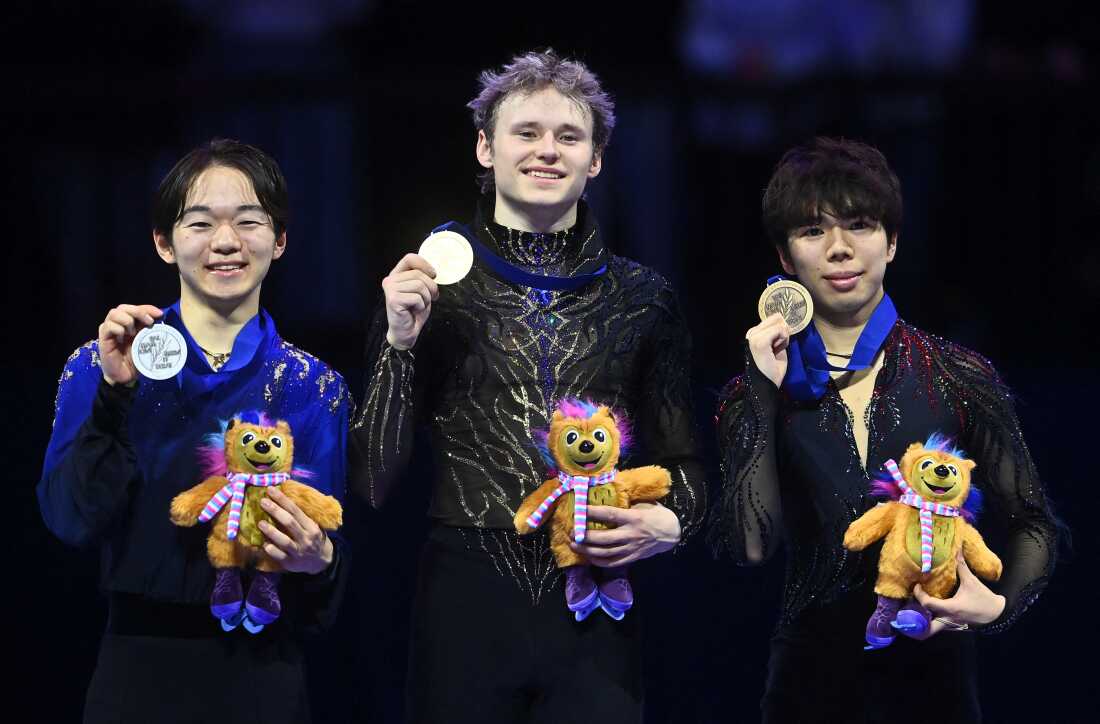
Men’s world medalists Yuma Kagiyama, Ilia Malinin and Shun Sato (L-R) celebrate on the podium in Prague, Czech Republic on Saturday.
Michal Cizek/AFP via Getty Images
hide caption
toggle caption
Michal Cizek/AFP via Getty Images
Japan’s Yuma Kagiyama won silver and Shun Sato won bronze, in a repeat of the Olympic podium. (Mikhail Shaidorov, the panda-cosplaying Kazakh skater who shocked the world and himself with a gold medal in Milan, withdrew from worlds as is common practice for freshly-crowned Olympic champions who tend to prioritize rest, recovery and other obligations.)
“This was a competition where I wanted to just relieve all the pressure from the Olympics, to just come here with a fresh new mindset and just enjoy everything that I love about this sport,” Malinin told Olympics.com, adding that it was “probably one of the easier world championships I’ve been to” for that reason.
Malinin didn’t attempt a quadruple axel — the jump that only he can do — in competition in Prague, as was the case in Milan. But he did bust one out at the exhibition gala on Sunday, to onlookers’ surprise and delight.

There, Malinin was crowned the International Skating Union’s “Trailblazer on Ice” for his record-breaking seven-quad program (he also won “best costume” at its awards show later that day). The 21-year-old from Virginia, who is also the four-time reigning U.S. champion, reflected on the highs and lows of his season in an interview shortly afterward.
“Part of it was just knowing that it’s part of the deal,” Malinin said. “It’s part of what we signed up to do as figure skaters and athletes … There’s always going to be disappointing times and things that don’t go your way, but we always have to learn to get up and use that as motivation or information to understand what we can do better in the future, and that’s exactly what I did.”
A mixed bag for other Americans
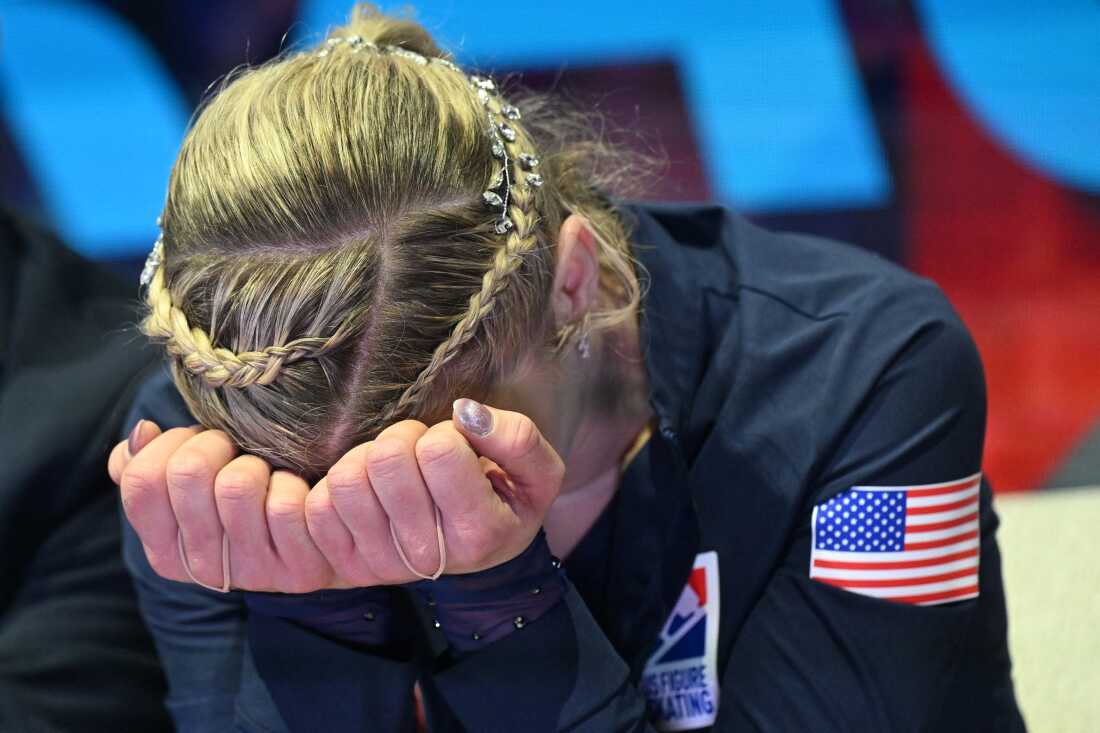
Amber Glenn was emotional after a series of mistakes in her free skate in Prague, where she ultimately placed sixth in women’s singles.
Michal Cizek/AFP via Getty Images
hide caption
toggle caption
Michal Cizek/AFP via Getty Images
Malinin wasn’t the only American aiming for redemption after Milan.
Amber Glenn, the reigning three-time U.S. champion who is beloved for her outspoken LGTBQ and mental health advocacy, had hoped to recover from her Olympic disappointment.
The medal favorite missed the podium in Milan due to a costly mistake in her short program that put her in 12th place. She followed it up with a sensational free skate that catapulted her into a fifth-place finish.
Unfortunately for Glenn, the reverse happened in Prague.

She nailed her short program — including the jump that gave her trouble at the Olympics — and headed into the free skate in third place. On Friday, she started strong with a triple axel but under-rotated several jumps as a pained crowd cheered her to the end of the song, at which point she knelt down on the ice, covering her face.
Glenn finished in sixth place overall, but quickly took to social media to reassure her fans.
“I’m okay! If anything I’m mentally, emotionally, physically exhausted after a season of extreme highs and lows,” wrote the 26-year-old. “I did what I set out to do 6 years ago. Land a Triple axel and go to the Olympics and nothing will take that away from me.”
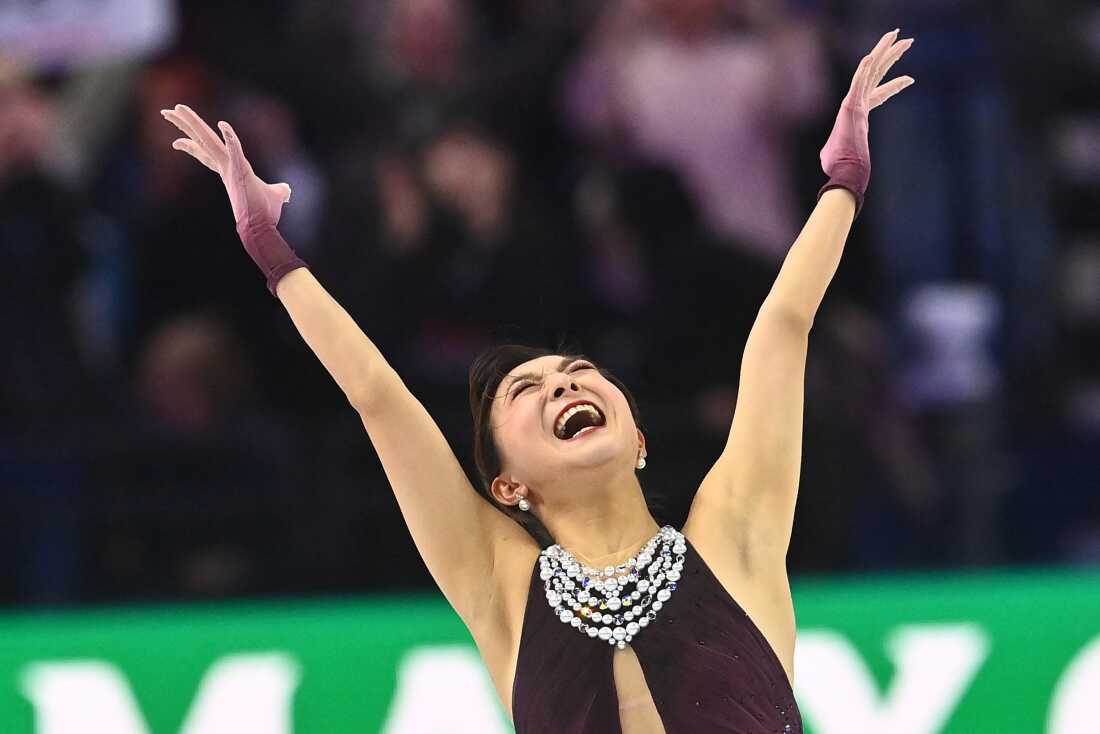
Japan’s Kaori Sakamoto reacts after her triumphant farewell free skate on Friday. She leaves Prague with her fourth and final world title.
Michael Cizek/AFP via Getty Images
hide caption
toggle caption
Michael Cizek/AFP via Getty Images
The women’s gold medal went to beloved Japanese skater Kaori Sakamoto, who now retires as the four-time reigning world champion. She earned a personal best score in the final skate of her competitive career, to an Édith Piaf medley including “Non, Je Ne Regrette Rien” — “I regret nothing.”
The 25-year-old, who is known for her endearingly emotive reactions to her scores, jumped up and ran around the “kiss and cry” before breaking down in relieved tears as her coach plied her with tissues.

Sakamoto was a favorite for gold, having won three straight world titles, until American Alysa Liu broke her streak last year and then won gold to her silver at the Olympics. Sakamoto has spoken about being disappointed with her results in Milan.
“This season was much harder than I had ever imagined,” Sakamoto told Olympics.com after her win in Prague. “There were times when things didn’t go the way that I wanted, but at the end, really at the end of this season, everything came together. I’m very happy to be able to put this closure on my career.”
Sakamoto’s fellow Japanese skater Mone Chiba finished second, and Nina Pinzarrone of Belgium finished third. Just off the podium in fourth place was Isabeau Levito of the U.S. — a marked improvement from her 12th-place spot in Milan.
(Reigning Olympic champion Liu didn’t compete; she was busy with post-gold medal opportunities like presenting Taylor Swift with the Artist of the Year Award at the iHeartRadio Music Awards.)
In ice dance, American duo Emilea Zingas and Vadym Kolesnik won bronze in their world championship debut, capping off a breakthrough season that saw them finish fifth at the Olympics.
According to U.S. Figure Skating, this is the 11th straight World Championships where at least one U.S. ice dance duo has won a medal. The most recent three went to Madison Chock and Evan Bates, who withdrew from worlds after taking silver at the Olympics.
What’s next for figure skaters (and their fans)

Alysa Liu, pictured presenting Taylor Swift with an award at the iHeartRadio Music Awards in Los Angeles on Thursday, started her off-season early after her Olympic victory.
Jon Kopaloff/Getty Images
hide caption
toggle caption
Jon Kopaloff/Getty Images
The World Championship marks the end of competition for the 2025-2026 figure skating season and this “quad,” as the skating community refers to the four-year cycle culminating in a Winter Olympics.
This is the window, especially in an Olympic year, when skaters traditionally take at least some time off to rest and recover.
Many will return to the rink later this spring for shows and tours. The most prominent one, Stars on Ice, will visit cities throughout the U.S. from mid-April through the end of May. Malinin, Liu, Glenn, Leviteau, Chock and Bates are already on the roster.
“I’m definitely going to celebrate this moment by doing a bunch of shows and starting so many new projects off the ice and on the ice,” Malinin said this weekend.
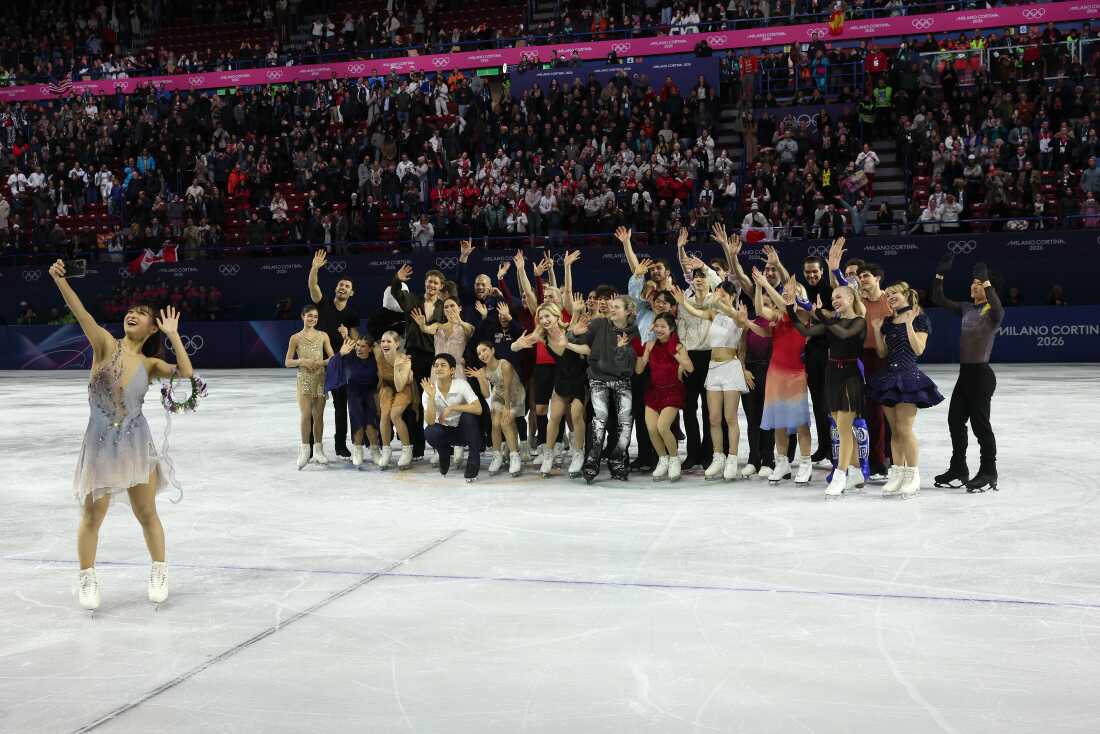
Kaori Sakamoto takes a selfie with fellow figure skaters at the Olympics exhibition gala in Milan last month.
Jamie Squire/Getty Images
hide caption
toggle caption
Jamie Squire/Getty Images
Summertime is when skaters typically develop new skills and routines (and change coaches as needed) for the upcoming season, which officially starts on July 1.
U.S. Figure Skating has announced nearly two dozen qualifying events across the country from July through October, with its finals in November serving as one of the main pipelines to the U.S. Figure Skating Championships. Those will be held in Salt Lake City in January 2027.

There are also six International Skating Union (ISU) Grand Prix events every season, each hosted by a different country, including the U.S. This Grand Prix season will kick off with “Skate America” in Everett, Wash., in late October, and culminate in a final that is typically held in December (details for the upcoming season have not yet been announced).
The second half of the season, in early 2027, sees other major ISU events, including European Championships, which are headed to Lausanne, Switzerland, in late January. There’s also the Four Continents Figure Skating Championships, featuring top skaters from America, Asia, Africa and Oceania. World Championships in Tampere, Finland, will cap it all off in March 2027.


Lifestyle
Vintage-obsessed millennial parents are driving L.A.’s booming kids’ clothing resale market

Kids’ vintage clothing sales are experiencing a remarkable boom at in-person markets and online, where prices for clothes for little ones have shot up on websites including Depop and Poshmark. Millennial parents are looking to outfit their kids in the clothes and TV and film characters they loved (or coveted) when they were kids.
The result? There’s a new generation of kiddos hitting the playground looking incredibly cool. Take Amari Case, a SoCal toddler who spent a Sunday afternoon this spring ambling around a vintage market in a West Hollywood warehouse clad in baggy jeans and a ’90s-era tee emblazoned with the “Dragon Ball Z” character Son Goku.
When she wasn’t scribbling on a Lorax coloring sheet, she’d been cruising around the market with her dad, Aaron Munoz Case, snapping up new pieces destined to make her the flyest kid at the preschool playground.
Neil Wright, from left, Kristine Nite Scalzo and Brandon Rosenblatt, co-founders of Elemeno Kids Vintage Market.
Showing off Amari’s new vintage satin L.A. Raiders jacket and tiny teal Grant Hill Detroit Pistons jersey, Munoz Case, who was also impeccably dressed, noted that while Amari went through a phase at about 18 months where she wanted to dress herself, eventually she gave up and went back to letting her dripped-out dad dictate her wardrobe.
Munoz Case found Amari’s first vintage piece at the Rose Bowl Flea Market and got the bug, going back every month to pick up something to add to his little’s wardrobe.
Trendspotters and researchers say Munoz Case isn’t alone in his quest. The market for kids’ vintage clothing has heated up precipitously over the last few years, perhaps hitting a boiling point in January when an Eeyore romper from the ’90s sold for over $3,000 on EBay. (It was new with tags, but one without tags still went for almost a grand about a month later.)
The thirst for tiny throwbacks is so popular that first-ever, all-kids market Elemeno — named after the “L-M-N-O” bit of “The Alphabet Song” and where Amari was toddling and shopping — drew 17 vendors and over 2,000 attendees over a single weekend in March. (There are plans for another Elemeno Kids Vintage Market pop-up later this year in New York, as well as plans to bring the event back to L.A. sometime next year.)

2

1. Cameron Scalzo, wearing a vintage McDonald’s T-shirt from the ‘90s, and mom Kristine Nite Scalzo. 2. Cameron Scalzo rocks an Avirex jacket from the ‘90s.
Eye Speak Vintage’s Kristine Nite Scalzo, who co-organized the event and is opening an all-kids vintage store in Pasadena this month, says she fell under the kids vintage spell in 2020 when she was pregnant with her son. She’d always been a vintage shopper for herself, so she knew she wanted to pass the passion down to the next generation. She started filling up her son’s closet, and soon enough, she found herself selling her other finds out of a bodega in her garage.
She has a by-appointment space in Pasadena now, where she draws everyone from Rihanna’s stylist to out-of-town moms who make a point to stop by on their way to Disneyland. “The community around kids vintage has really skyrocketed on Instagram over the past six years,” Scalzo says. “We want to know who we’re buying from. We want to know that we’re doing good with buying secondhand. And it’s a hobby for people that can turn into a possible business on the side. Because knowing there’s a big group that’s interested in vintage kids clothes, you can always pass an item [your kid outgrows] to someone else or resell it.”
Scalzo says some parents are out digging through bins at the Goodwill Outlet looking for the perfect piece, while others are content to pay up for, say, a ’90s Simpsons T-shirt or a mini-size Harley-Davidson jacket. Scouring the racks at the Elemeno market, most pieces cost $15 to $40, though there were special pieces pulled to the side in some booths with price tags that could make a parent’s eyes pop. (Think $275 for a set of well-worn Spider-Man overalls from the ’00s or $150 for a pair of Cross Colours denim shorts from the ’90s.)
In kids and adult vintage alike, mint condition is highly valued. No matter the era in which they were raised, kids tend to be messy. They get strawberry juice on their shirts or scuff up the knees on their Bugle Boy jeans. Vintage kids clothes that look pristine are more expensive, and while plain kids clothes do sell, items with characters on them or cool prints tend to draw more attention and dollars.
Brandon Rosenblatt, another of the Elemeno organizers, says he’s had his eye on a specific kids “Back to the Future” shirt for some time, but notes that it typically sells for about $1,000. He’s partial to McKids clothes for his daughter, from McDonald’s short-lived kids clothing brand, noting that he’s even snagged her a vintage official McDonald’s-themed aloha shirt from Hawaii, something he says he’s never seen anywhere else.
1

2

1. Siblings Amora and Milo Castilo wear vintage cowboy hats, jackets and chaps. 2. Thalia Castilo and her kids Amora and Milo.
Other collectors, he says, might be a little less obscure, leaning into mainstream characters such as Strawberry Shortcake or from ’80s and ’90s properties including “The Land Before Time” and “Rugrats.”
“A lot of millennials are having kids — like everyone who’s in their 30s and 40s — and they all want to put their kids in the same IP they grew up in,” Rosenblatt says.
“It’s the thrill of the hunt that gets everyone so excited,” Scalzo says. “Once you find that perfect nostalgic piece, you’re like ‘Holy s—,’ and you just want to chase that feeling again and again.”
Mia De La Rosa, a reseller who was at the Elemeno market, says that like Scalzo, she started buying kids vintage clothes when she was pregnant with her daughter, Liv, who’s 6 now, very into everything on PBS Kids and has a closet full of thrifted vintage garb covered in characters such as D.W., the annoying little sister from the ’90s show “Arthur.”
Everything Liv wears is “completely her style,” De La Rosa says. “She dresses herself every day and she gets compliments on what she’s wearing at school all the time.”
Other vintage-wearing kids — and in particular younger ones — might simply be sporting what their parents like or might just like the look of the shirt even if they don’t know what it’s advertising. (An 8-year-old boy at the Elemeno market, for instance, chose to wear a pristine T-shirt highlighting the ’90s Jim Carrey movie “The Mask” because it featured his favorite color: green.)
Derrick Broaster, a vintage enthusiast turned full-time reseller, says that while he chooses to put himself in clothes from the ’60s and ’70s, he outfits his two sons in clothes from the 2000s. (“How Bow Wow used to dress when he was a kid,” he says.)
Although his younger son tends to rebel against Broaster’s vintage picks, opting for whatever Spider-Man shoes happen to be in his eyeline, his older son has leaned in, letting his dad advise him on what vintage pieces could work and what would be the most stylish.
1

2

1. Julian, left, and Javier Gutierrez show off their vintage clothing. Javier says his mom always tells him to keep his vintage outfits clean. 2. Mom Priscilla Guzman, clockwise, Dad Javier Gutierrez and sons Julian and Javier Gutierrez enjoy the vibe of vintage clothing. Guzman says she’s been buying and selling kids’ vintage since her oldest son was born eight years ago.
Rosenblatt says a good portion of what vintage finds he sees in the market now has returned to the U.S. from places in Central America and South America or Asia where those pieces were likely sent decades ago after they were donated or given away.
“There’s a real underbelly of this vintage game with rag houses getting access to bulk product overseas and letting people sort through it,” he says. “There are companies now that rip through 20, 30 or 40,000 pieces of vintage clothing a week. It’s a really interesting ecosystem.”
For many kids vintage sellers, finding their stock is just as fun and interesting as getting it back into consumers’ hands. “Anywhere we can find clothes, we’re there,” says Matthew Carlos, owner of Long Gone Youth. He started selling vintage clothes 11 years ago, when he was 15, switched to kids vintage at 20 and has spent the last six years scouring flea markets, websites and swap meets.
“The kids market is definitely growing,” he says, “but I still feel like we haven’t even gotten close to where we can go. It’s just getting popular now, but the more events [like Elemeno] we can do, the more it’ll go mainstream.” Even now, some major brands like Gap and OshKosh B’gosh have recognized the interest in some of their styles from the ’80s and ’90s, moving to re-release the looks in limited runs.

Jackie and Frank Oropeza with daughter Rumi Mae shop at Elemeno Kids Vintage Market.
Kids resale is also leaning into streetwear culture. Rosenblatt, who worked in the streetwear industry, says that he’s noticed that a good portion of those interested in kids vintage — particularly, male shoppers — tend to be fans of streetwear brands like Supreme, Fear of God Essentials and Bape. At Elemeno, for instance, a good portion of the parents we saw pushing strollers were well-dressed dads seemingly on solo missions, something you don’t always see at kid-centric events.
“I just want my son to feel like I did as a kid,” said Justin Nguyen, while watching his toddler, Jayden, play with bubbles. “I want him to be happy, carefree and joyful, and I want to be able to spend time with him. My mom and dad were always working, even on the weekends. Now that I’m a dad, taking my son out on weekends to do stuff like this just seems like a blessing.”

Author Julia Elliott won for her short story collection Hellions.
Forrest Clonts/Tin House
hide caption
toggle caption
Forrest Clonts/Tin House
Writer Julia Elliott has won this year’s Carol Shields Prize for Fiction for her short story collection Hellions. The award honors work by women and nonbinary authors in the U.S. and Canada.
Elliott, who also authored the novel The New and Improved Romie Futch and the short story collection The Wilds, is known for blending elements of Southern gothic horror, surrealism and fairy tale. Hellions, published in 2025, includes stories set against backdrops like a plague-stricken medieval convent, a feminist art colony, and small Southern towns.
“This eerie, eclectic, genre-leaping collection takes no half-measures; every sentence of Hellions crackles or crawls,” wrote the prize jury in a statement. “Here, human folly moves against a backdrop of horror and magic … But for all its wildness, there is tremendous control.”
The prize, named after a Pulitzer Prize-winning novelist, awards $150,000 to one winner each year. Novels, short story collections, and graphic novels by women and nonbinary authors are eligible.
This year’s finalists included Quiara Alegría Hudes (The White Hot), Lee Lai (Cannon), Megha Majumdar (A Guardian and a Thief), and Sonya Walger (Lion). They will each receive $12,500.
The Carol Shields Prize went to writer Canisia Lubrin in 2025.
You can listen to actor Donna Lynne Champlin read Elliott’s story “Hellion” on the Death, Sex & Money podcast here.
-
Lifestyle9 minutes ago
We’re having a main character summer. Are you? : It’s Been a Minute
-

 Technology17 minutes ago
Microsoft AI chief Mustafa Suleyman says there are three labs that matter — and he wants Microsoft to be the fourth.
-

 World24 minutes ago
US ally Kuwait condemns ‘brutal and ongoing Iranian attacks’ after airport was hit
-

 Politics27 minutes ago
Spencer Pratt surges to runoff in LA mayor’s race after angry voters send message to Karen Bass
-

 Health32 minutes ago
One extra serving of processed meat a day linked to higher cancer risk
-

 Sports39 minutes ago
AJ Brown trade outcome: Dianna Russini paid a heavy price while Mike Vrabel emerged unscathed
-

 Technology42 minutes ago
Could your Samsung phone replace your passport?
-
 Business47 minutes ago
Rent-hike ban to protect fire victims ends despite gouging concerns

