Lifestyle
Cortina d’Ampezzo mixes Olympic legacy with Alpine glamour


The illuminated bell tower of the Basilica Minore dei Santi Filippo e Giacomo stands at the heart of Cortina d’Ampezzo, Italy, as evening settles over the valley. Once a small village of farmers and shepherds, this storied town has evolved into the “Pearl of the Dolomites,” a renowned luxury destination. Surrounded by the limestone peaks of the UNESCO World Heritage Dolomites, the town’s historic center remains a “living room” for celebrities and high society.
Valerio Muscella for NPR
hide caption
toggle caption
Valerio Muscella for NPR
CORTINA D’AMPEZZO, Italy — Walking the main thoroughfare of Cortina D’Ampezzo is a glamorous experience. It is as if every designer brand has decided it needs to be represented in this small town more than 4,000 feet up in the Italian Alps. In a few short steps, you pass shops for Dior, Fendi, Gucci, Prada and more. Among passers-by, fur coats are in fashion.
Cortina has been in the international spotlight in recent weeks as a host to many of the Olympic and Paralympic Winter Games. But this storied town has a much longer history of fame and fortune that has led to various nicknames like Pearl or Queen of the Dolomites.

A window display for the luxury fashion brand Fendi illuminates a central street in Cortina d’Ampezzo, adjacent to a large outdoor sculpture of a skier. The town’s main thoroughfare is a glamorous hub where premier designer brands like Dior, Gucci and Prada are represented.
Valerio Muscella for NPR
hide caption
toggle caption
Valerio Muscella for NPR

On the mountain slopes nearby, skiers stop for hot chocolate or an alcoholic spritz at an Alpine lodge where they are served by Riccardo Fiore, the grandson of the region’s winter sport champions. His grandmother, Yvonne Rüegg, is an Olympic gold medalist in giant slalom. His grandfather was the trainer of Alberto Tomba — one of history’s greatest Alpine skiers, who learned on these very slopes. “Tomba still stops by here all the time,” he says.

Riccardo Fiore, grandson of Olympic gold medalist Yvonne Rüegg, poses inside his family’s Alpine lodge in the Dolomites.
Valerio Muscella for NPR
hide caption
toggle caption
Valerio Muscella for NPR

American actor Sylvester Stallone (right) and director Renny Harlin on the set of Harlin’s film Cliffhanger.
Leonello Bertolucci/Sygma via Getty Images
hide caption
toggle caption
Leonello Bertolucci/Sygma via Getty Images
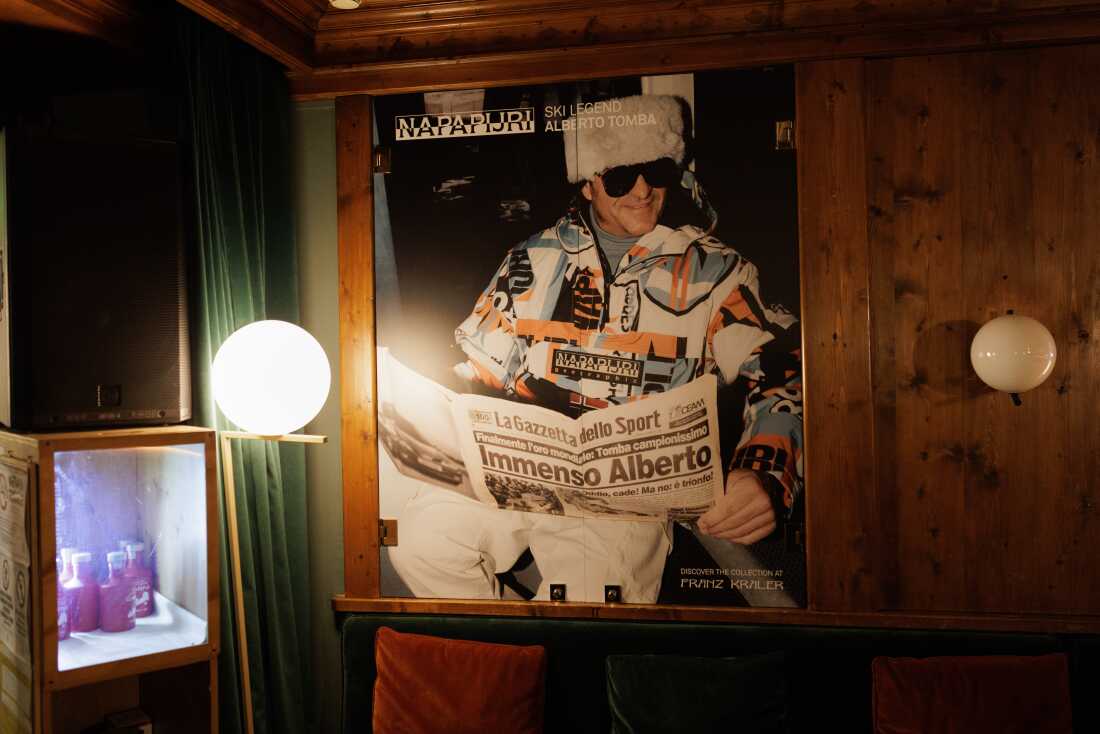
A large-scale photograph of Italian skiing legend Alberto Tomba, wearing a traditional fur hat and reading a sports newspaper with the headline “Immenso Alberto,” is displayed in a wood-paneled interior in Cortina d’Ampezzo. Tomba, one of history’s greatest Alpine skiers, learned to race on these slopes under the guidance of local trainers, further cementing the town’s status as a historical cradle of international winter sports.
Valerio Muscella for NPR
hide caption
toggle caption
Valerio Muscella for NPR
For Fiore, there’s nothing unusual about serving drinks to famous individuals. He names well-known Italian politicians, actors and singers he has spotted in the lodge. And there are international names who visit Cortina, too — Sylvester Stallone, who filmed scenes from the 1993 action movie Cliffhanger here, Snoop Dogg, Justin Timberlake and Ridley Scott, to name a few.
“Many celebrities you barely recognize,” he says. “They try to disguise themselves, as they don’t want to attract too much attention.”
Nonetheless, Cortina has earned another nickname — the “celebrities’ living room.” The Hotel de la Poste bar, with its wood-paneled ceiling and walls, was a favorite haunt of American writer Ernest Hemingway. A small plaque honors him on a wall by the corner table he occupied for countless hours in the 1940s. And the hotel has preserved the room he stayed in — visitors can look in to see his typewriter.

“His room is a time capsule,” says Servane Giol, author of The Queen of the Dolomites, a book about the history of Cortina.
“I found some amazing letters from Hemingway explaining how he was a bit against ski lifts, because he believed it was better for the legs to be warmed up by climbing the mountains and skiing down,” Giol says. “This really made me laugh; to think that somebody could be against ski lifts.”

Servane Giol, renowned expert in Venetian art and lifestyle, poses in the historic wood-paneled Stube of the Hotel de la Poste. Giol, who has dedicated her work to preserving the cultural and aesthetic heritage of the region, sits beside an old painted pendulum clock, a symbol of the hospitality and Ampezzo tradition that the hotel has represented since 1804.
Valerio Muscella for NPR
hide caption
toggle caption
Valerio Muscella for NPR

American writer Ernest Hemingway, wearing a hunter waistcoat, stands behind a bar counter and pours gin in Cortina d’Ampezzo in 1948.
Archivio Cameraphoto Epoche/Hulton Archive/Getty Images
hide caption
toggle caption
Archivio Cameraphoto Epoche/Hulton Archive/Getty Images
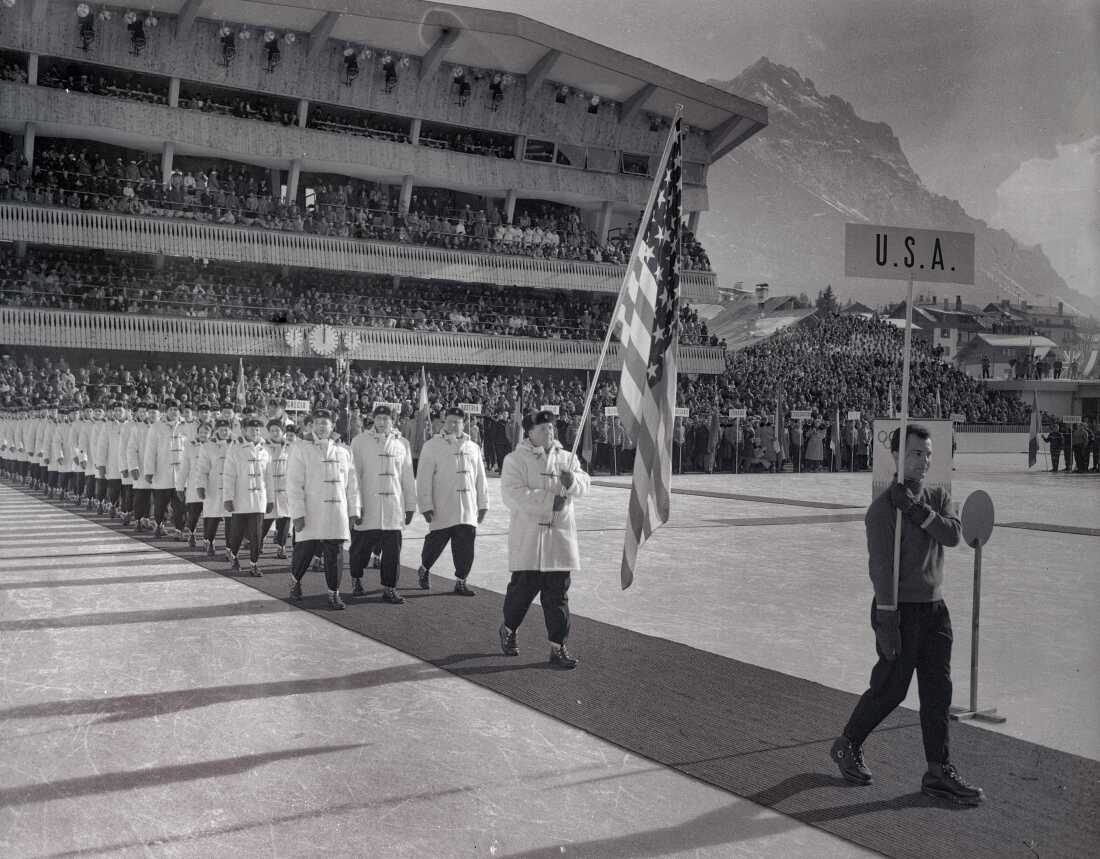
Members of the U.S. Olympic teams walk during the procession into Cortina’s huge ice stadium for opening ceremonies launching 11 days of competition in the 1956 Winter Olympics.
Bettmann Archive/Getty Images
hide caption
toggle caption
Bettmann Archive/Getty Images
Giol says Cortina, once a small village of farmers and shepherds, became famous in the 1920s, when it was visited by the then king of Belgium, who loved to climb the jagged limestone Dolomite peaks that surround it. His daughter then married an Italian crown prince. “Between the 1920s and the 1940s, Cortina was actually the chicest place to be. You’ve got very glamorous royal families,” she says.
It became a destination for Italy’s wealthy. And then in 1956, Cortina hosted the first-ever Winter Olympics to be televised. Archive footage shows grainy black-and-white images of the opening ceremony, described by the news anchor as the “spectacle of peace.” Olympic participants from 32 countries took part in the Games that saw athletes speeding down the mountain slopes or shooting down the bobsled track built at the edge of the town.
The television broadcasts internationalized Cortina’s fame. Hollywood films were shot here — including the first Pink Panther movie, as well as the 1981 film For Your Eyes Only, with actor Roger Moore as James Bond. It includes a high-octane chase, as Bond skis down the mountainside pursued by assassins on motorbikes who shoot at him, the bullets zinging past as he slaloms and performs a somersault on skis.

English actor Roger Moore poses as 007, with a Lotus Esprit Turbo, on the set of the James Bond film For Your Eyes Only in Cortina d’Ampezzo, Italy, in March 1981.
Keith Hamshere/Moviepix/Getty Images
hide caption
toggle caption
Keith Hamshere/Moviepix/Getty Images
Today, the Dolomites are a UNESCO heritage site and their beauty attracts celebrities and huge numbers of other tourists — many lured by images shared on social media of the turquoise Alpine lakes and stunning peaks.
And more crowds came in February and March to watch the Olympics and Paralympics. This time, the Games relied almost entirely on artificial snow. As winters become shorter and warmer because of climate change, there are also questions about the future of this ski resort town.
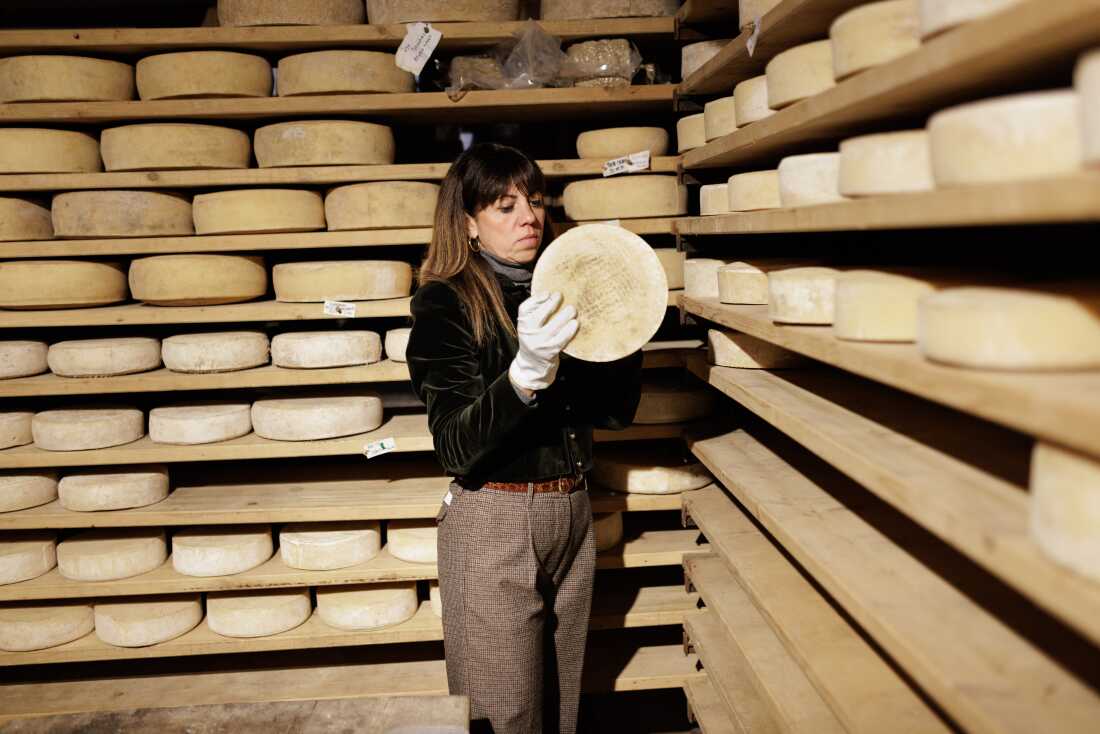
Ludovica Rubbini, co-founder of the Michelin-starred restaurant SanBrite, inspects a wheel of artisanal cheese inside the establishment’s aging cellar. The “agricucina” project emphasizes the traditional preservation and maturation of local dairy products, showcasing the deep connection between the restaurant’s kitchen and its own farm production in the Dolomites.
Valerio Muscella for NPR
hide caption
toggle caption
Valerio Muscella for NPR
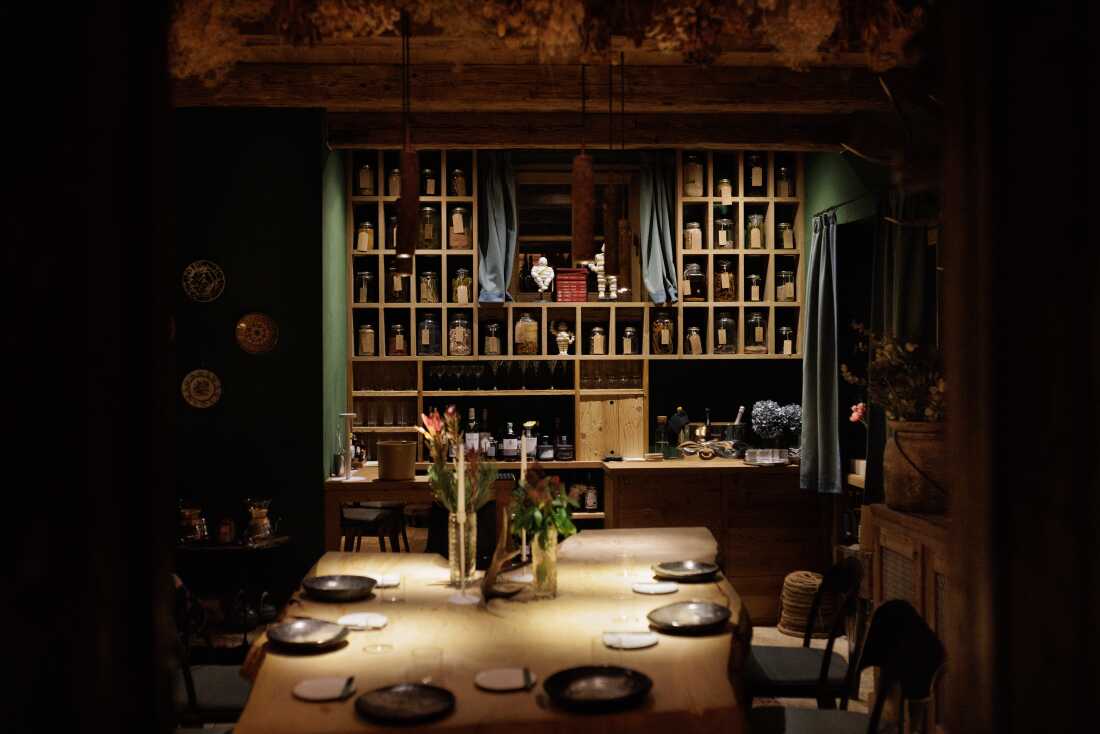
A table setting awaits customers at SanBrite restaurant.
Valerio Muscella for NPR
hide caption
toggle caption
Valerio Muscella for NPR
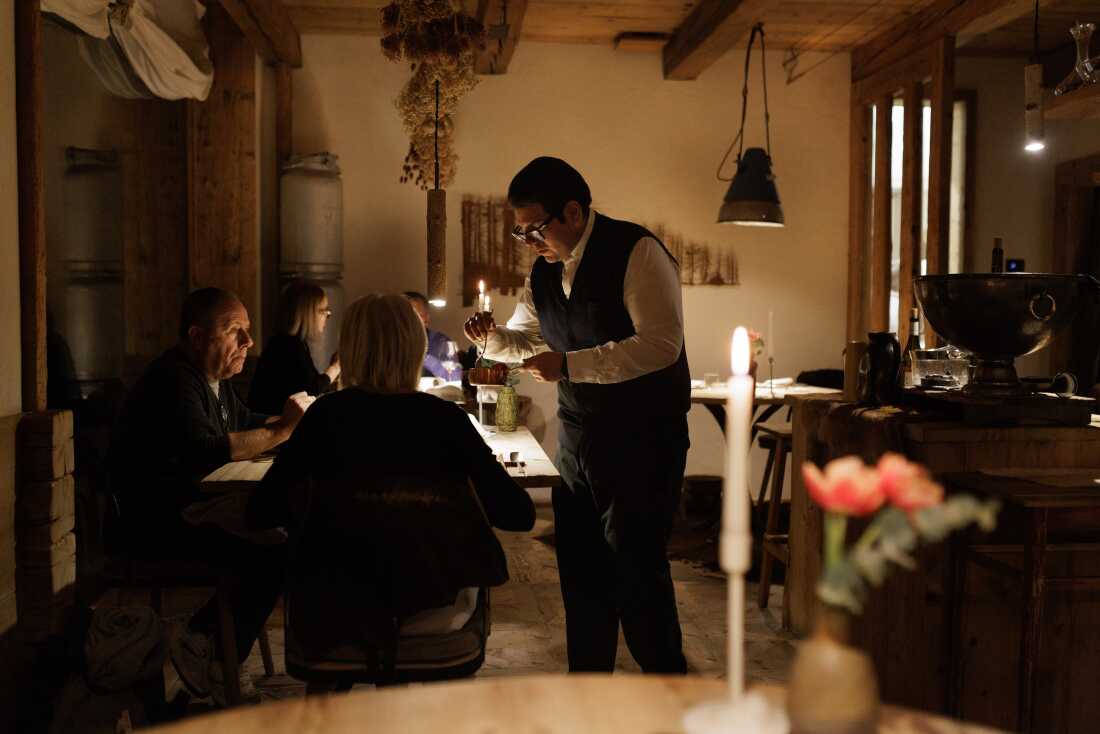
A waiter provides tableside service for guests in the dining room of the Michelin-starred restaurant SanBrite. The establishment, known for its “agricucina” philosophy, combines a refined mountain atmosphere with traditional Cortinese architectural elements, emphasizing a direct connection between local ingredients and high-end hospitality in the heart of the Dolomites.
Valerio Muscella for NPR
hide caption
toggle caption
Valerio Muscella for NPR
But Cortina is changing, too. More people come for summer hiking and for unique fine dining, like that offered by Ludovica Rubbini and her husband, Riccardo Gaspari, whose restaurant SanBrite has earned a Michelin star, as well as the guide’s “green star” for the sustainable agricultural and locally grown ingredients the couple uses on its farm.
In the cozy restaurant, where dried flowers hang from the walls and lights include lamps used during the 1956 Olympics, waiters tell guests at this fine-dining restaurant about the cows that provided the home-churned butter that is served in large pots for sourdough bread.
The dishes are inspired by the mountains and woodland of the area. They include a Jerusalem artichoke cigar served on a bed of moss and filled with the cream of the artichoke, mushrooms and marinated shallots. And a dessert made to look like a frozen lake, with a panna cotta base and layer of frozen water and elderflower, and yogurt powder as a dusting of snow.
“We were out for a walk, and Riccardo crouched by the frozen lake tapping it and examining it,” Rubbini says, remembering the day her husband was inspired to develop this perfect winter dessert.
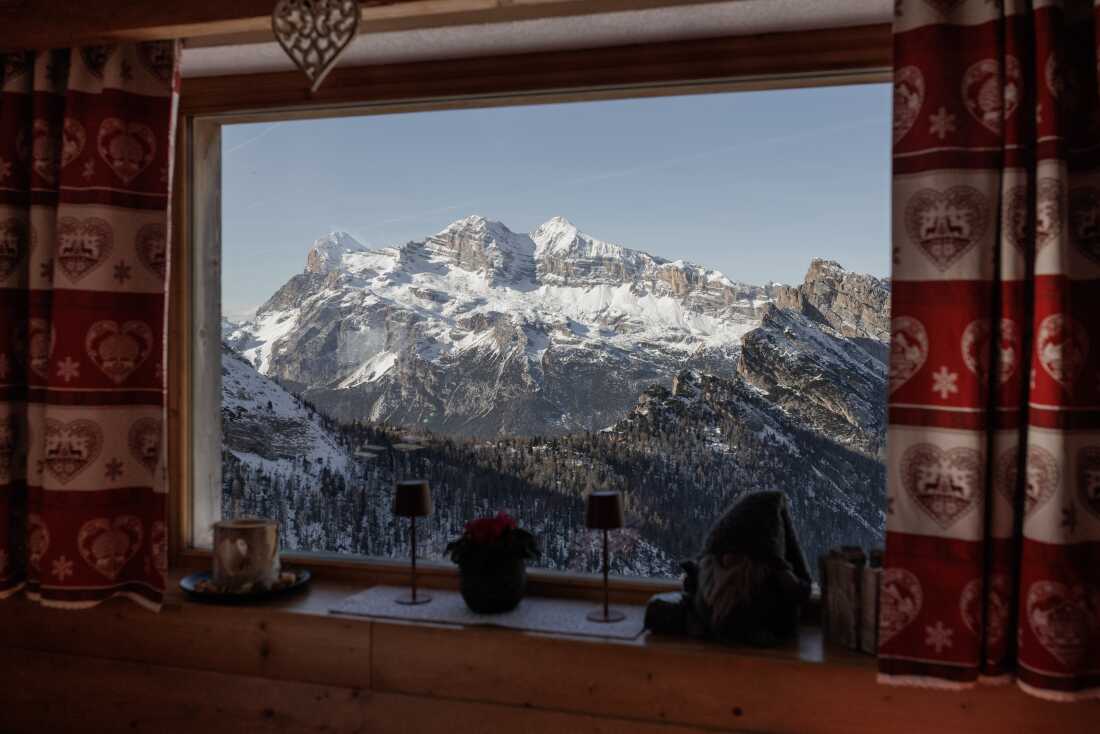
The snow-capped peaks of the Tofane massif are framed through a window of a rifugio, a kind of traditional mountain hut, decorated with typical heart-patterned Ampezzo textiles. These high-altitude lodgings serve as essential rest areas for skiers and hikers, offering a blend of rustic hospitality and panoramic views that define the winter experience in the Dolomites.
Valerio Muscella for NPR
hide caption
toggle caption
Valerio Muscella for NPR


Lifestyle
Vintage-obsessed millennial parents are driving L.A.’s booming kids’ clothing resale market

Kids’ vintage clothing sales are experiencing a remarkable boom at in-person markets and online, where prices for clothes for little ones have shot up on websites including Depop and Poshmark. Millennial parents are looking to outfit their kids in the clothes and TV and film characters they loved (or coveted) when they were kids.
The result? There’s a new generation of kiddos hitting the playground looking incredibly cool. Take Amari Case, a SoCal toddler who spent a Sunday afternoon this spring ambling around a vintage market in a West Hollywood warehouse clad in baggy jeans and a ’90s-era tee emblazoned with the “Dragon Ball Z” character Son Goku.
When she wasn’t scribbling on a Lorax coloring sheet, she’d been cruising around the market with her dad, Aaron Munoz Case, snapping up new pieces destined to make her the flyest kid at the preschool playground.
Neil Wright, from left, Kristine Nite Scalzo and Brandon Rosenblatt, co-founders of Elemeno Kids Vintage Market.
Showing off Amari’s new vintage satin L.A. Raiders jacket and tiny teal Grant Hill Detroit Pistons jersey, Munoz Case, who was also impeccably dressed, noted that while Amari went through a phase at about 18 months where she wanted to dress herself, eventually she gave up and went back to letting her dripped-out dad dictate her wardrobe.
Munoz Case found Amari’s first vintage piece at the Rose Bowl Flea Market and got the bug, going back every month to pick up something to add to his little’s wardrobe.
Trendspotters and researchers say Munoz Case isn’t alone in his quest. The market for kids’ vintage clothing has heated up precipitously over the last few years, perhaps hitting a boiling point in January when an Eeyore romper from the ’90s sold for over $3,000 on EBay. (It was new with tags, but one without tags still went for almost a grand about a month later.)
The thirst for tiny throwbacks is so popular that first-ever, all-kids market Elemeno — named after the “L-M-N-O” bit of “The Alphabet Song” and where Amari was toddling and shopping — drew 17 vendors and over 2,000 attendees over a single weekend in March. (There are plans for another Elemeno Kids Vintage Market pop-up later this year in New York, as well as plans to bring the event back to L.A. sometime next year.)

2

1. Cameron Scalzo, wearing a vintage McDonald’s T-shirt from the ‘90s, and mom Kristine Nite Scalzo. 2. Cameron Scalzo rocks an Avirex jacket from the ‘90s.
Eye Speak Vintage’s Kristine Nite Scalzo, who co-organized the event and is opening an all-kids vintage store in Pasadena this month, says she fell under the kids vintage spell in 2020 when she was pregnant with her son. She’d always been a vintage shopper for herself, so she knew she wanted to pass the passion down to the next generation. She started filling up her son’s closet, and soon enough, she found herself selling her other finds out of a bodega in her garage.
She has a by-appointment space in Pasadena now, where she draws everyone from Rihanna’s stylist to out-of-town moms who make a point to stop by on their way to Disneyland. “The community around kids vintage has really skyrocketed on Instagram over the past six years,” Scalzo says. “We want to know who we’re buying from. We want to know that we’re doing good with buying secondhand. And it’s a hobby for people that can turn into a possible business on the side. Because knowing there’s a big group that’s interested in vintage kids clothes, you can always pass an item [your kid outgrows] to someone else or resell it.”
Scalzo says some parents are out digging through bins at the Goodwill Outlet looking for the perfect piece, while others are content to pay up for, say, a ’90s Simpsons T-shirt or a mini-size Harley-Davidson jacket. Scouring the racks at the Elemeno market, most pieces cost $15 to $40, though there were special pieces pulled to the side in some booths with price tags that could make a parent’s eyes pop. (Think $275 for a set of well-worn Spider-Man overalls from the ’00s or $150 for a pair of Cross Colours denim shorts from the ’90s.)
In kids and adult vintage alike, mint condition is highly valued. No matter the era in which they were raised, kids tend to be messy. They get strawberry juice on their shirts or scuff up the knees on their Bugle Boy jeans. Vintage kids clothes that look pristine are more expensive, and while plain kids clothes do sell, items with characters on them or cool prints tend to draw more attention and dollars.
Brandon Rosenblatt, another of the Elemeno organizers, says he’s had his eye on a specific kids “Back to the Future” shirt for some time, but notes that it typically sells for about $1,000. He’s partial to McKids clothes for his daughter, from McDonald’s short-lived kids clothing brand, noting that he’s even snagged her a vintage official McDonald’s-themed aloha shirt from Hawaii, something he says he’s never seen anywhere else.
1

2

1. Siblings Amora and Milo Castilo wear vintage cowboy hats, jackets and chaps. 2. Thalia Castilo and her kids Amora and Milo.
Other collectors, he says, might be a little less obscure, leaning into mainstream characters such as Strawberry Shortcake or from ’80s and ’90s properties including “The Land Before Time” and “Rugrats.”
“A lot of millennials are having kids — like everyone who’s in their 30s and 40s — and they all want to put their kids in the same IP they grew up in,” Rosenblatt says.
“It’s the thrill of the hunt that gets everyone so excited,” Scalzo says. “Once you find that perfect nostalgic piece, you’re like ‘Holy s—,’ and you just want to chase that feeling again and again.”
Mia De La Rosa, a reseller who was at the Elemeno market, says that like Scalzo, she started buying kids vintage clothes when she was pregnant with her daughter, Liv, who’s 6 now, very into everything on PBS Kids and has a closet full of thrifted vintage garb covered in characters such as D.W., the annoying little sister from the ’90s show “Arthur.”
Everything Liv wears is “completely her style,” De La Rosa says. “She dresses herself every day and she gets compliments on what she’s wearing at school all the time.”
Other vintage-wearing kids — and in particular younger ones — might simply be sporting what their parents like or might just like the look of the shirt even if they don’t know what it’s advertising. (An 8-year-old boy at the Elemeno market, for instance, chose to wear a pristine T-shirt highlighting the ’90s Jim Carrey movie “The Mask” because it featured his favorite color: green.)
Derrick Broaster, a vintage enthusiast turned full-time reseller, says that while he chooses to put himself in clothes from the ’60s and ’70s, he outfits his two sons in clothes from the 2000s. (“How Bow Wow used to dress when he was a kid,” he says.)
Although his younger son tends to rebel against Broaster’s vintage picks, opting for whatever Spider-Man shoes happen to be in his eyeline, his older son has leaned in, letting his dad advise him on what vintage pieces could work and what would be the most stylish.
1

2

1. Julian, left, and Javier Gutierrez show off their vintage clothing. Javier says his mom always tells him to keep his vintage outfits clean. 2. Mom Priscilla Guzman, clockwise, Dad Javier Gutierrez and sons Julian and Javier Gutierrez enjoy the vibe of vintage clothing. Guzman says she’s been buying and selling kids’ vintage since her oldest son was born eight years ago.
Rosenblatt says a good portion of what vintage finds he sees in the market now has returned to the U.S. from places in Central America and South America or Asia where those pieces were likely sent decades ago after they were donated or given away.
“There’s a real underbelly of this vintage game with rag houses getting access to bulk product overseas and letting people sort through it,” he says. “There are companies now that rip through 20, 30 or 40,000 pieces of vintage clothing a week. It’s a really interesting ecosystem.”
For many kids vintage sellers, finding their stock is just as fun and interesting as getting it back into consumers’ hands. “Anywhere we can find clothes, we’re there,” says Matthew Carlos, owner of Long Gone Youth. He started selling vintage clothes 11 years ago, when he was 15, switched to kids vintage at 20 and has spent the last six years scouring flea markets, websites and swap meets.
“The kids market is definitely growing,” he says, “but I still feel like we haven’t even gotten close to where we can go. It’s just getting popular now, but the more events [like Elemeno] we can do, the more it’ll go mainstream.” Even now, some major brands like Gap and OshKosh B’gosh have recognized the interest in some of their styles from the ’80s and ’90s, moving to re-release the looks in limited runs.

Jackie and Frank Oropeza with daughter Rumi Mae shop at Elemeno Kids Vintage Market.
Kids resale is also leaning into streetwear culture. Rosenblatt, who worked in the streetwear industry, says that he’s noticed that a good portion of those interested in kids vintage — particularly, male shoppers — tend to be fans of streetwear brands like Supreme, Fear of God Essentials and Bape. At Elemeno, for instance, a good portion of the parents we saw pushing strollers were well-dressed dads seemingly on solo missions, something you don’t always see at kid-centric events.
“I just want my son to feel like I did as a kid,” said Justin Nguyen, while watching his toddler, Jayden, play with bubbles. “I want him to be happy, carefree and joyful, and I want to be able to spend time with him. My mom and dad were always working, even on the weekends. Now that I’m a dad, taking my son out on weekends to do stuff like this just seems like a blessing.”

Author Julia Elliott won for her short story collection Hellions.
Forrest Clonts/Tin House
hide caption
toggle caption
Forrest Clonts/Tin House
Writer Julia Elliott has won this year’s Carol Shields Prize for Fiction for her short story collection Hellions. The award honors work by women and nonbinary authors in the U.S. and Canada.
Elliott, who also authored the novel The New and Improved Romie Futch and the short story collection The Wilds, is known for blending elements of Southern gothic horror, surrealism and fairy tale. Hellions, published in 2025, includes stories set against backdrops like a plague-stricken medieval convent, a feminist art colony, and small Southern towns.
“This eerie, eclectic, genre-leaping collection takes no half-measures; every sentence of Hellions crackles or crawls,” wrote the prize jury in a statement. “Here, human folly moves against a backdrop of horror and magic … But for all its wildness, there is tremendous control.”
The prize, named after a Pulitzer Prize-winning novelist, awards $150,000 to one winner each year. Novels, short story collections, and graphic novels by women and nonbinary authors are eligible.
This year’s finalists included Quiara Alegría Hudes (The White Hot), Lee Lai (Cannon), Megha Majumdar (A Guardian and a Thief), and Sonya Walger (Lion). They will each receive $12,500.
The Carol Shields Prize went to writer Canisia Lubrin in 2025.
You can listen to actor Donna Lynne Champlin read Elliott’s story “Hellion” on the Death, Sex & Money podcast here.
-

 New Mexico57 seconds ago
Cumbres & Toltec to begin summer season June 9
-

 North Carolina3 minutes ago
‘Bonsai in the Blue Ridge’ exhibit brings dozens of displays to North Carolina Arboretum
-

 North Dakota9 minutes ago
And he’s off
-

 Ohio16 minutes ago
The purge? Ohio moves to downgrade non-domiciled CDLs
-

 Oklahoma19 minutes ago
What Oklahoma Does Better Than Texas and Why It Matters
-

 Oregon24 minutes ago
Amid warnings of future cuts, University of Oregon trustees approve next year’s budget
-

 Pennsylvania31 minutes ago
State Awards Contract To Resurface Major Doylestown Borough Street
-

 Rhode Island34 minutes ago
Shifting Sands in Rhode Island – Rhode Island Monthly

