Lifestyle
Centuries-old cherries were found at George Washington's home. What can they tell us?

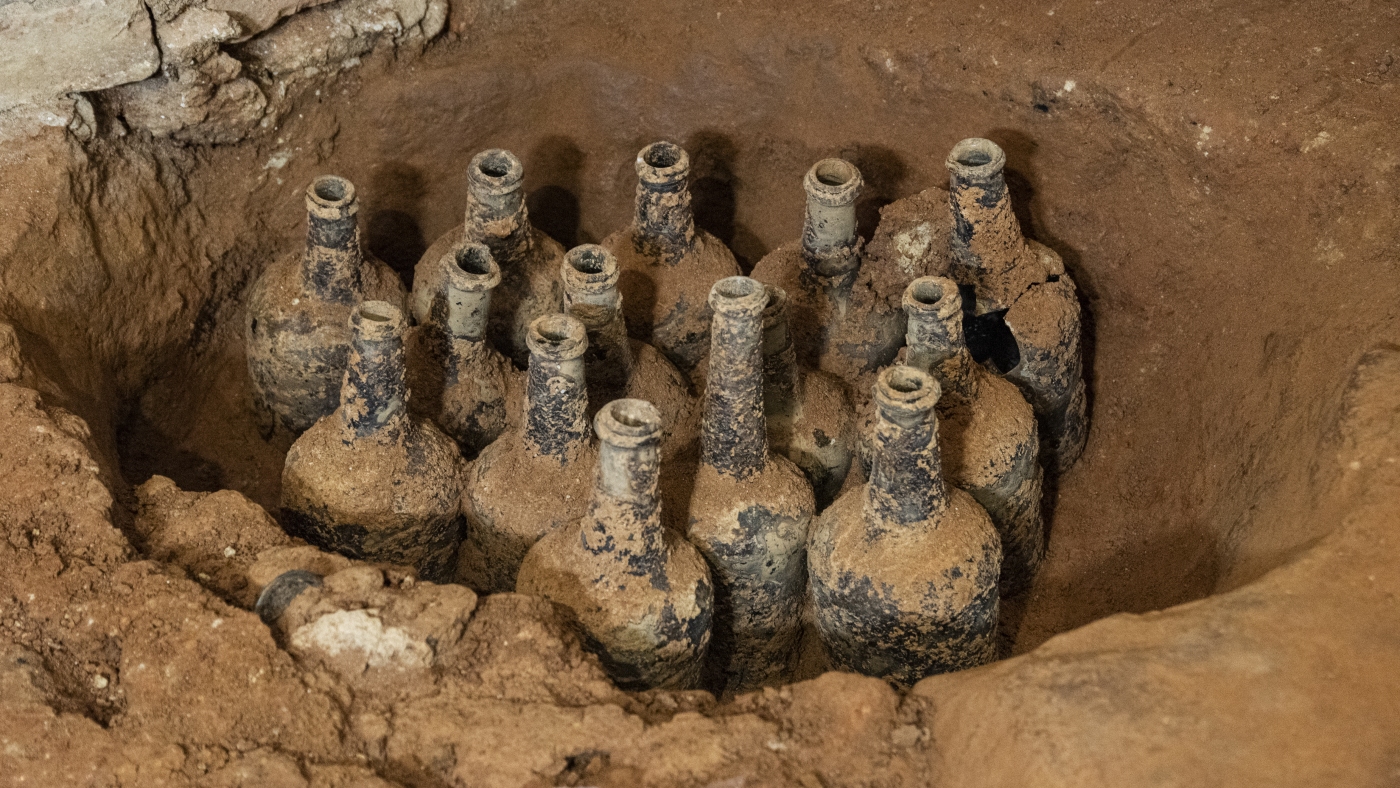
Archaeologists on a multi-year restoration project found 35 bottles of cherries and berries in five different pits in the Mount Vernon cellar.
George Brown/Mount Vernon Ladies’ Association
hide caption
toggle caption
George Brown/Mount Vernon Ladies’ Association
Archeologists at George Washington’s historic Virginia home have unearthed more than two dozen bottles of cherries and berries dating back to the 18th century in a particularly juicy find.
Officials first announced in April that they had discovered two glass jars of cherries, liquid and pits while excavating the cellar of Mount Vernon, the residence, plantation and final resting place of the nation’s first president.
Further sweetening the deal, last week they announced the discovery of 35 more fruit-filled vessels. Officials say 29 of the bottles are intact and contain “perfectly preserved cherries and berries, likely gooseberries or currants.”
“To our knowledge, this is an unprecedented find and nothing of this scale and significance has ever been excavated in North America,” Mount Vernon President and CEO Doug Bradburn said in a statement.
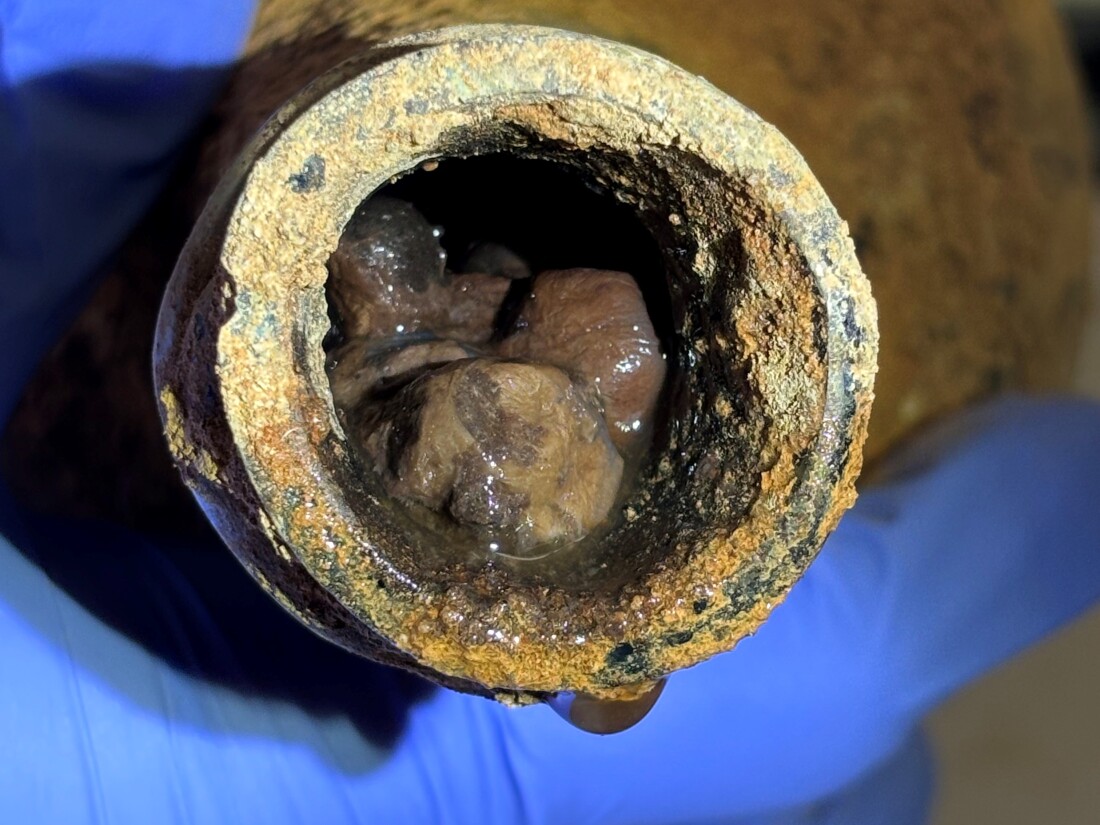
A view of preserved cherries inside one of the bottles found at Mount Vernon.
Mount Vernon Ladies’ Association
hide caption
toggle caption
Mount Vernon Ladies’ Association
The bottles, whose shapes are characteristic of styles from the 1740s and 1750s, were discovered in five storage pits throughout the cellar.
“These artifacts likely haven’t seen the light of day since before the American Revolution, perhaps forgotten when George Washington departed Mount Vernon to take command of the Continental Army,” Bradburn added.
That was in 1775.
Archaeologists revisited the site as part of a privately funded $40 million preservation project, aimed at ensuring Mount Vernon’s structural integrity and slated for completion in 2026 — just in time for America’s 250th birthday.
Now, fresh off this well-preserved discovery, researchers hope that modern technology will allow them to learn more about the cherries and, by extension, the world from which they came.

Jason Boroughs, the principal archaeologist at Mount Vernon, called the discovery “beyond extraordinary.” He told NPR and WBUR’s Here & Now in April that “intact 18th-century food remains is just not something that’s typically found.”
The cherries, he added, can serve as a window into the environment and cuisine of the period, as well as the entire Mount Vernon community — and not just the first first family.
“The bottles and the contents are actually material items that were connected to real lives and real people in the past,” Boroughs said. “They may have been intended for the Washingtons’ table, but they were certainly picked and packaged and stored by members of the enslaved community here.”
The cherries can teach us about life at Mount Vernon
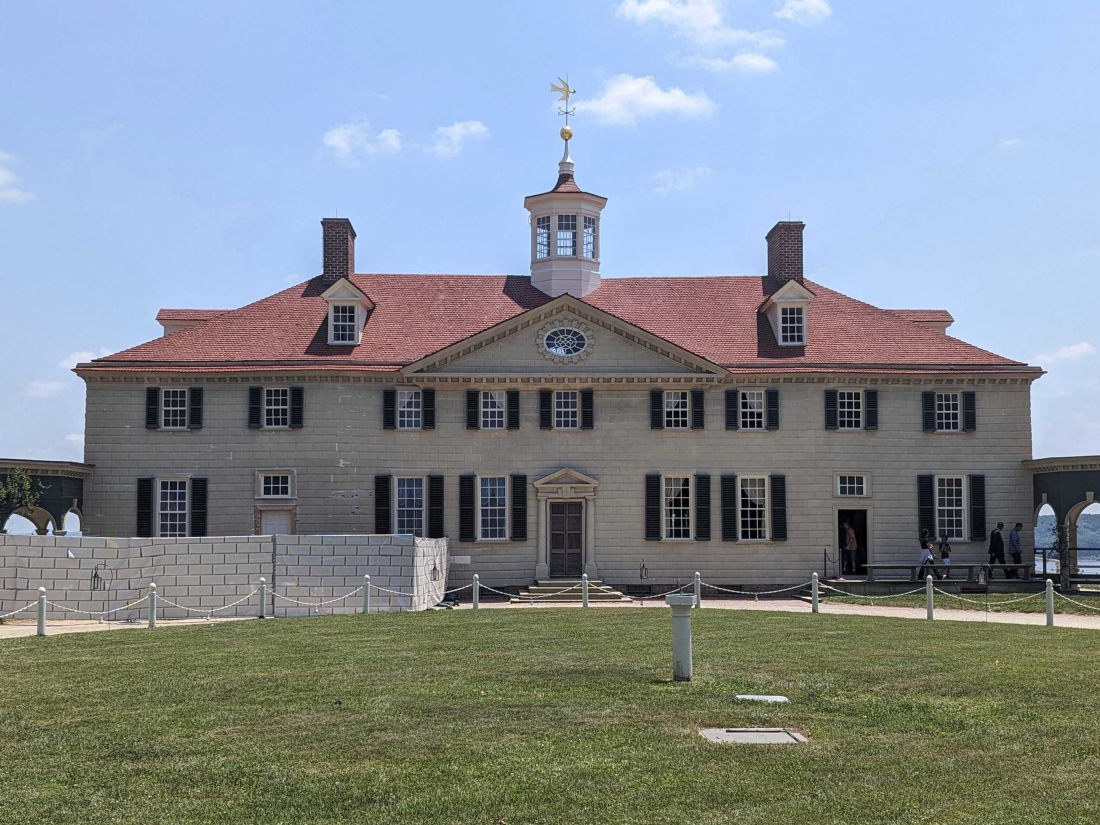
George Washington’s residence in Mount Vernon, Va.,
Nathan Ellgren/AP
hide caption
toggle caption
Nathan Ellgren/AP
Boroughs said this month the bottles and their contents are a “testament to the knowledge and skill of the enslaved people who managed the food preparations from tree to table” at Mount Vernon.
At least 577 enslaved people lived at Mount Vernon during the course of Washington’s life, according to the institution. Washington left instructions in his will for the eventual emancipation of those he owned.
Among them was Doll, who was 38 in 1759 when Martha Washington brought her and her five children to the estate and placed her in charge of the kitchen.
Doll likely no longer had a formal work assignment in her later years, but continued to “use the kitchen to distill rose and mint water for medicinal purposes and to dry fruits such as cherries,” historians say.
In fact, a 1795 letter from Martha Washington to her niece, Fanny Bassett, appears to acknowledge Doll’s expertise in that area.
Martha Washington, writing from Philadelphia to Bassett, who lived at Mount Vernon, mentions that she would like “some of the morelly cherrys” dried, adding, “I should think old Doll cannot have forgot how to do them.”
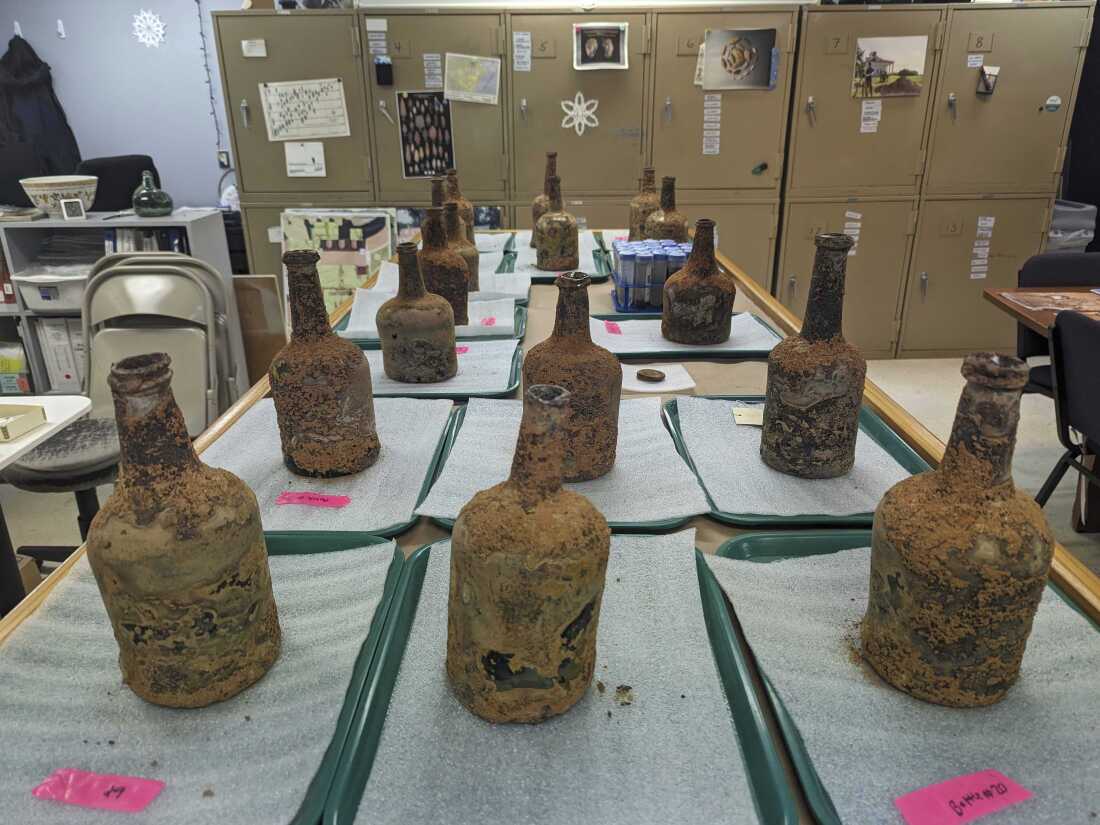
18th-century bottles that contained fruit sit inside an archaeology lab near George Washington’s residence in Mount Vernon, Va., on Monday.
Nathan Ellgren/AP
hide caption
toggle caption
Nathan Ellgren/AP
It’s not the only clue that the Washingtons were fans of cherries.
Historians at Mount Vernon say the family often enjoyed a popular brandy-based drink called “Cherry Bounce,” made from cherry juice infused with spices over the course of two weeks.
Washington was apparently such a fan of the cordial that, as general, he packed a “canteen” of it — as well as Madeira and port — for a 1784 journey across the Allegheny Mountains.
Boroughs told Here & Now that there is also evidence — including from letters and diaries of Chesapeake planters — that families in the area would enjoy bowls of preserved cherries with meals.
“So it’s quite likely that these bottles had been on the Washingtons’ table more than once,” he said.
The 18th-century preservation process involved placing the cherries in dry bottles, corking them and then burying them under heavy clay, to protect the fleshy fruits from elements like mold and fungus.
Normally, Boroughs said, they were only intended to be stored as such for about a year.
“But it’s because of the way that they were placed in the ground and there they remained until this year that they were able to survive, basically, the ravages of time,” he explained.
Scientists hope the discovery might bear fruit
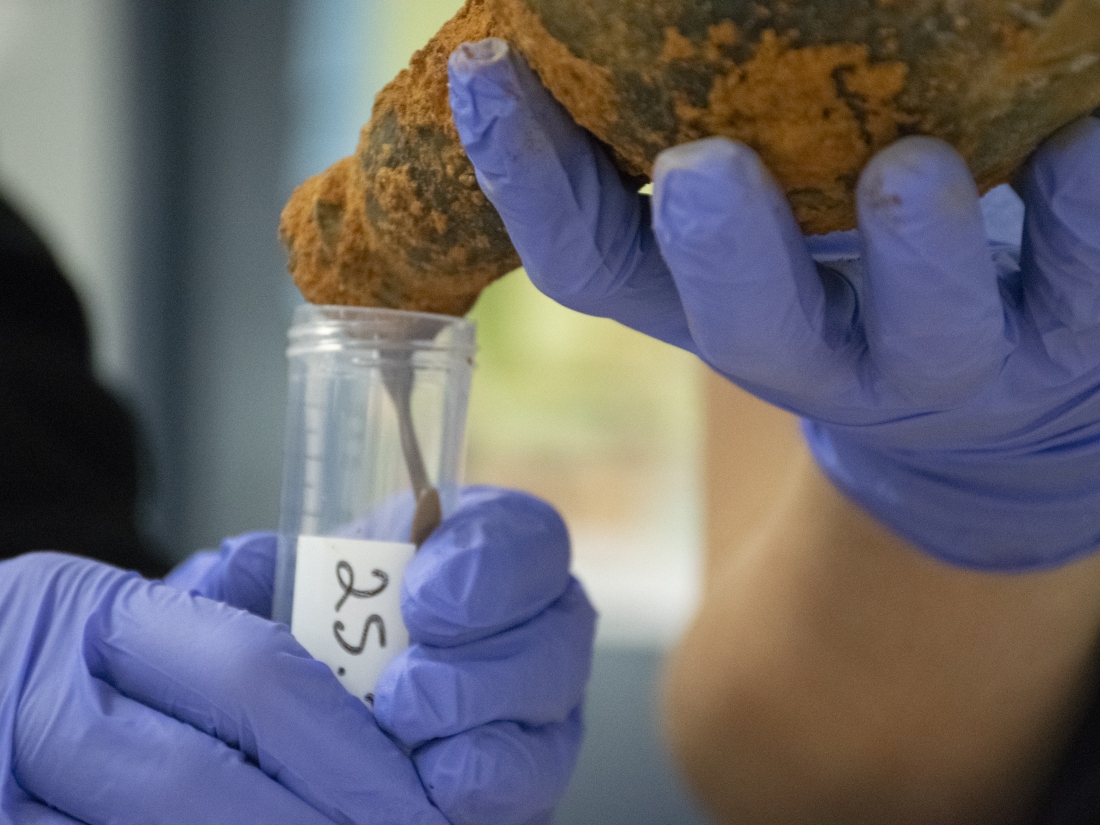
Fruit substance is carefully extracted from a bottle.
Tess Ostoyich/Mount Vernon Ladies’ Association
hide caption
toggle caption
Tess Ostoyich/Mount Vernon Ladies’ Association
Experts have extracted the contents of the bottles and refrigerated them at Mount Vernon, where they will undergo scientific analysis. The bottles themselves are “slowly drying” in the lab and will be sent off-site for conservation, officials say.
Mount Vernon is partnering with the United States Department of Agriculture’s Agricultural Research Service (ARS) to analyze the 250-year-old produce.
Benjamin Gutierrez, a plant geneticist and the apple and tart cherry curator at the USDA-ARS Plant Genetic Resources Unit in New York, told NPR that the first thing his team did was advise the archeologists on how to extract the substance from the bottles in the hopes of best “capturing that moment of the last hands that put them in the earth.”
“We had anxiety,” he said. “You hear ‘fruit remains’ and you’re picturing what’s in the back of your fridge, right? It’s slowly degrading now that it’s out in the open, we’ve got to get to this before it turns to pulp.”
Gutierrez says their main priority is to extract DNA from the cherry tissue and compare it to their robust tart cherry database to try to identify — or at least narrow down — which variety the Washingtons grew and enjoyed at Mount Vernon. That could, in turn, shed light on how the Virginia climate has changed since.
Researchers suspect the cherries are of a tart variety, with a relatively acidic composition that likely helped aid in their preservation.
So far, Gutierrez says they have identified 54 cherry pits and 23 stems from sifting through just the first two vessels — which would suggest that each bottle was at least originally chock full of some 50 to 70 cherries.
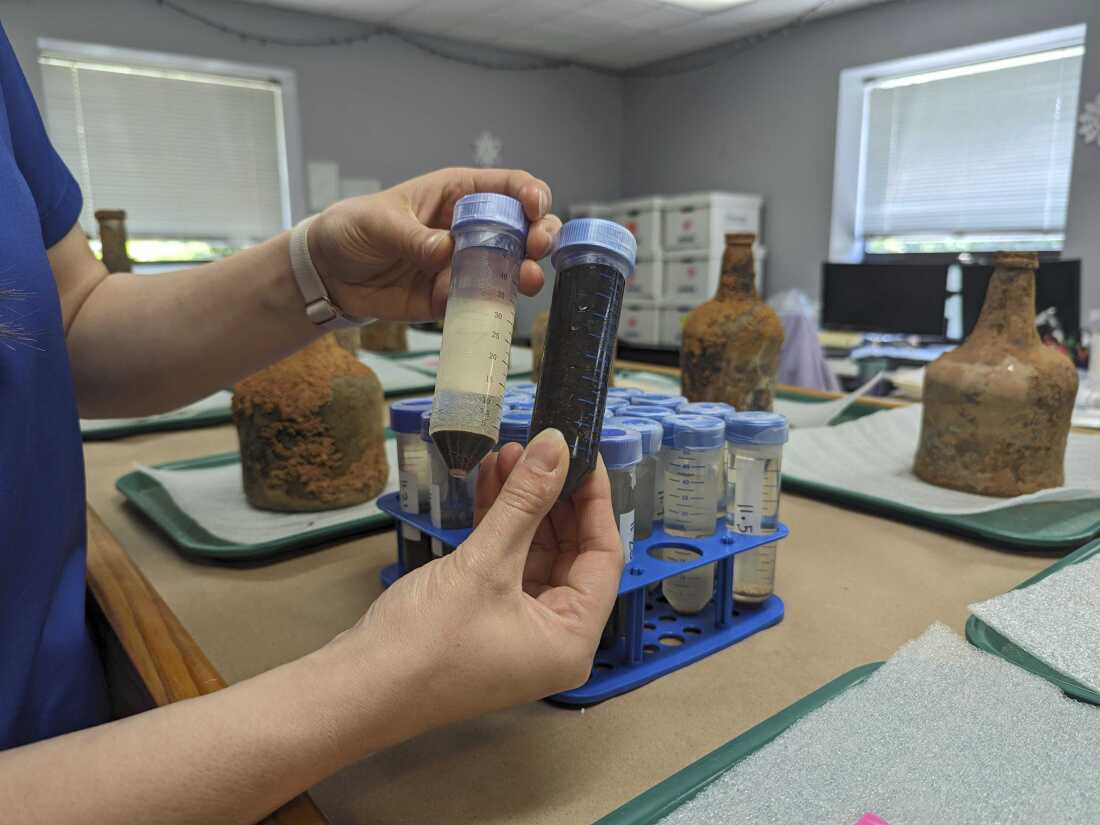
Curator Lily Carhart holds up different samples of liquid they extracted from a few dozen bottles.
Nathan Ellgren/AP
hide caption
toggle caption
Nathan Ellgren/AP
The sheer amount of material, he adds, means researchers can be a little bit more “adventurous” in what they do to some of it while carefully preserving the rest.
“Who knows in another 100 years what other tests they might want to do,” he says.
In the nearer-term, his team hopes to have more answers within six months or a year. One of the biggest questions is whether they can germinate seeds from any of the cherry pits to grow a new tree.
Gutierrez says it’s somewhat of a long shot, since many of the pits are waterlogged. And even if germination is possible, the seeds wouldn’t produce the same exact “mother tree,” but rather the next generation of it.
Still, he says, it would be really something to plant a new tree out of historic cherry pits.
“We work so much with heirloom groups conserving grandma’s apple tree in their backyard,” he adds. “Fruit somehow captures our imagination and our culture more than any other crop, I feel like.”
And one could argue that would be the cherry on top for Washington of all people, given one of the most enduring myths about him centers on chopping down that very type of tree.








An underwater view shows US’ Lilly King competing in a heat of the women’s 200m breaststroke swimming event during the Paris 2024 Olympic Games at the Paris La Defense Arena in Nanterre, west of Paris, on July 31, 2024. (Photo by François-Xavier MARIT / AFP) (Photo by FRANCOIS-XAVIER MARIT/AFP via Getty Images)
François-Xavier Marit/Getty Images
hide caption
toggle caption
François-Xavier Marit/Getty Images
This week’s show was recorded in Bloomington, Indiana with host Peter Sagal, judge and scorekeeper Bill Kurtis, Not My Job guest Lilly King and panelists Alonzo Bodden, Josh Gondelman, and Faith Salie. Click the audio link above to hear the whole show.
Who’s Bill This Time
State of the Union is Hot; The Tribal Council Convenes Again; A Glow Up In the Doll Aisle
Panel Questions
The Toot Tracker
Bluff The Listener
Our panelists tell three stories about a travel hack in the news, only one of which is true.
Not My Job: Olympic Swimmer Lilly King answers our questions about Lil’ Kings
Olympic Swimmer Lilly King plays our game called, “Lilly King meet these Lil’ Kings” Three questions about short kings.
Panel Questions
Cleaning Out The Cabinet; Bedtime Stacking
Limericks
Bill Kurtis reads three news-related limericks: Getting Cozy With Cross Country Skiing; Pickleball’s New Competition; Bees Get Freaky
Lightning Fill In The Blank
All the news we couldn’t fit anywhere else
Predictions
Our panelists predict, after American Girls, what’ll be the next toy to get an update.

Law Roach
Zendaya and Tom’s Wedding Already Happened …
Y’all Missed It!!!
Published
Zendaya and Tom Holland are married … so claims her longtime stylist, Law Roach.
Here’s the deal … the celebrity stylist — who started styling Zendaya way back in 2011 — spoke to Access Hollywood on the Actors Awards red carpet where he sang out “The wedding has already happened, you missed it.”
Waiting for your permission to load the Instagram Media.
The AH reporter asks in shock if that’s true … and, Law responds by saying it’s “very true” before walking off.
This isn’t the first time Tom and Zendaya’s relationship status has made headlines on a red carpet … remember at the Golden Globes in 2025, Zendaya had a ring on that finger — and, the next day, we found out the two were engaged.
TMZ.com
Zendaya and Tom met on the set of “Spider-Man: Homecoming” in 2016, started dating a couple years later and went public with their relationship in 2021.
We’ve reached out to Tom and Zendaya’s teams … so far, no word back.

Online prediction market platforms allow people to place bets on wide-ranging subjects such as sports, finance, politics and currents events.
Photo Illustration by Scott Olson/Getty Images
hide caption
toggle caption
Photo Illustration by Scott Olson/Getty Images
The rise of prediction markets means you can now bet on just about anything, right from your phone. Apps like Kalshi and Polymarket have grown exponentially in President Trump’s second term, as his administration has rolled back regulations designed to keep the industry in check. Billions of dollars have flooded in, and users are placing bets on everything from whether it will rain in Seattle today to whether the US will take over control of Greenland. Who’s winning big on these apps? And who is losing? NPR correspondent Bobby Allyn joins The Sunday Story to explain how these markets came to be and where they are going.
This episode was produced by Andrew Mambo. It was edited by Liana Simstrom and Brett Neely. Fact-checking by Barclay Walsh and Susie Cummings. It was engineered by Robert Rodriguez.
We’d love to hear from you. Send us an email at TheSundayStory@npr.org.
Listen to Up First on Apple Podcasts and Spotify.

Prep talk: Birmingham’s Slava Shahbazyan celebrates winning state wrestling title

Pakistan calls troops, orders 3-day curfew as 24 killed in pro-Iran rallies

US says Kuwait accidentally shot down 3 American jets

Utah mom in upscale ski community killed husband to fund romance and lavish lifestyle, DA says

Ilhan Omar doesn’t have any regrets for her ‘unavoidable’ outburst at State of the Union

Florida High School Football Rankings: Top 25 teams – Oct. 21

Cleary's 21 help Le Moyne down Central Connecticut State 69-64 in OT

How old is Bo Nix? What to know about Oregon quarterback ahead of 2024 NFL Draft

99th annual Pony Swim held in Virginia

Indiana Members Credit Union announced as new anchor tenant at Bottleworks District
Pakistan calls troops, orders 3-day curfew as 24 killed in pro-Iran rallies
US says Kuwait accidentally shot down 3 American jets

House Republicans push Johnson to go to war with Senate over SAVE Act

Israel FM says Europe too divided, slams Spanish PM

Satellite images provide view inside Iran at war
-

 World4 days ago
Exclusive: DeepSeek withholds latest AI model from US chipmakers including Nvidia, sources say
-

 Massachusetts5 days ago
Mother and daughter injured in Taunton house explosion
-

 Denver, CO5 days ago
10 acres charred, 5 injured in Thornton grass fire, evacuation orders lifted
-

 Louisiana1 week ago
Wildfire near Gum Swamp Road in Livingston Parish now under control; more than 200 acres burned
-

 Technology1 week ago
YouTube TV billing scam emails are hitting inboxes
-

 Politics1 week ago
OpenAI didn’t contact police despite employees flagging mass shooter’s concerning chatbot interactions: REPORT
-

 Technology1 week ago
Stellantis is in a crisis of its own making
-

 News1 week ago
World reacts as US top court limits Trump’s tariff powers