Lifestyle
Can a ‘speed roommating’ event help you find a perfect match in L.A.?


Inside a dim New Orleans-style bar in Hollywood, dozens of strangers mingle under the thump of pop music while nursing complimentary cocktails. Each person is sporting a name tag along with a personality sticker, or a few, that best captures their vibe. Neat freak. Plant parent. Night owl. Craft beer aficionado.
The scene reads like a friendly singles mixer, but listen to their conversations and it’s clear the chemistry they are hoping for isn’t romantic. They are here to find the perfect roommate.
Participants mingle around the bar area during SpareRoom’s “speed roommating” event at the Sassafras Saloon in Hollywood.
(Kendra Frankle / For The Times)
Hosted by rental platform SpareRoom, the monthly “speed roommating” event connects people who are renting rooms with those who are looking for one in a low-key, in-person setting — no endless online profiles to fill out, no awkward interviews. Loosely based on speed dating, sans the timed interactions, attendees put on name tags indicating either “I need a room” or “I need a roommate” along with their ideal budget and neighborhoods. Then they wander freely. One woman passed out fliers for a furnished studio in downtown L.A. with air conditioning, a Murphy bed, an in-unit washer and dryer and streaming TV. Another woman showed people her rental on an iPad.
Pris Liora, 40, who was looking for someone to rent the extra room in her Koreatown apartment, didn’t prepare any questions for potential housemates, saying she just wanted to do a vibe check. Her only deal breakers? “No pets, no children, no cigarette smoking and no secret cocaine problem,” she says with a laugh.
With the average rent for a studio starting about $1,688 per month, $2,166 for a one-bedroom apartment and roughly $2,983 for a two-bedroom apartment in Los Angeles, according to Apartments.com, more people are embracing shared living arrangements. Rupert Hunt, founder and CEO of SpareRoom, says they’re doing so not only to cut expenses, but also to foster community. The company’s mixers can help spark those connections, he believes — they’ve been hosting speed roommating events in L.A. since June, following successful events in London, San Francisco and New York.

“There’s something so immediate about the event,” says Rupert Hunt, founder and CEO of SpareRoom.
(Kendra Frankle / For The Times)
“There’s something so immediate about the event,” Hunt says. “You meet 10 people in the time it would take you to meet one the traditional way.”
Hunt even found a housemate for himself at one of the mixers. “I love sharing,” says Hunt, who notoriously rented out two rooms in his New York City apartment for just $1. “I think I’m a better version of myself. I think I get a bit lazy if I’m living on my own.”
At the event, Aeris DeLeon, who was wearing a sticker with the phrase “foodie,” says her mother was the person who told her about the speed roommating event. The 25-year-old was temporarily living in Bakersfield but recently moved back home to L.A.
“It was just dead over there and I was just home sick, and it wasn’t really working out for me,” she says.


Upon arrival, attendees can pick out personality stickers with phrases like coffee addict, plant lover and early bird. (Kendra Frankle / For The Times)
She decided to attend the event because it’s more “personable than just going on Craigslist or Facebook, and it’s the best [way] to weed out scammers,” she says. Her mission was to find an apartment that cost $1,300 a month max with someone preferably close in age.
James Caton, 68, was just getting started in his search for a room. After learning that his apartment building — where he’s lived for nearly a decade — might be sold, he jumped into action.
“To me, as soon as you find out, it’s better to go ahead and start looking for something,” says Caton, who attended the mixer with his childhood friend who was looking to rent a room.
SpareRoom’s speed roommating events are free with an RSVP, and each person receives two complimentary drinks along with a one month trial of SpareRoom premium.

Speed roommating is free to attend and comes with complimentary drinks.
(Kendra Frankle / For The Times)
Even if attendees didn’t find a roommate at the event, several of them continued their conversations late into the evening. Some even stayed for karaoke at the bar. It seemed that in a world where talking about finances can be seen as taboo, having a space to openly discuss rent prices, how to deal with nightmare landlords and housemates and other grievances was its own win, a moment when they could feel a bit less alone.



From left: Noah Wyle plays Dr. Michael “Robby” Robinavitch, the senior attending physician, and Fiona Dourif plays Dr. Cassie McKay, a third-year resident, in a fictional Pittsburgh emergency department in the HBO Max series The Pitt.
Warrick Page/HBO Max
hide caption
toggle caption
Warrick Page/HBO Max
The first five minutes of the new season of The Pitt instantly capture the state of medicine in the mid-2020s: a hectic emergency department waiting room; a sign warning that aggressive behavior will not be tolerated; a memorial plaque for victims of a mass shooting; and a patient with large Ziploc bags filled to the brink with various supplements and homeopathic remedies.
Scenes from the new installment feel almost too recognizable to many doctors.
The return of the critically acclaimed medical drama streaming on HBO Max offers viewers a surprisingly realistic view of how doctors practice medicine in an age of political division, institutional mistrust and the corporatization of health care.
Each season covers one day in the kinetic, understaffed emergency department of a fictional Pittsburgh hospital, with each episode spanning a single hour of a 15-hour shift. That means there’s no time for romantic plots or far-fetched storylines that typically dominate medical dramas.
Instead, the fast-paced show takes viewers into the real world of the ER, complete with a firehose of medical jargon and the day-to-day struggles of those on the frontlines of the American health care system. It’s a microcosm of medicine — and of a fragmented United States.

Many doctors and health professionals praised season one of the series, and ER docs even invited the show’s star Noah Wyle to their annual conference in September.
So what do doctors think of the new season? As a medical student myself, I appreciated the dig at the “July effect” — the long-held belief that the quality of care decreases in July when newbie doctors start residency — rebranded “first week in July syndrome” by one of the characters.
That insider wink sets the tone for a season that Dr. Alok Patel, a pediatrician at Stanford Medicine Children’s Health, says is on point. Patel, who co-hosts the show’s companion podcast, watched the first nine episodes of the new installment and spoke to NPR about his first impressions.
To me, as a medical student, the first few scenes of the new season are pretty striking, and they resemble what modern-day emergency medicine looks and sounds like. From your point of view, how accurate is it?
I’ll say off the bat, when it comes to capturing the full essence of practicing health care — the highs, the lows and the frustrations — The Pitt is by far the most medically accurate show that I think has ever been created. And I’m not the only one to share that opinion. I hear that a lot from my colleagues.
OK, but is every shift really that chaotic?
I mean, obviously, it’s television. And I know a lot of ER doctors who watch the show and are like, “Hey, it’s really good, but not every shift is that crazy.” I’m like, “Come on, relax. It’s TV. You’ve got to take a little bit of liberties.”
As in its last season, The Pitt sheds light on the real — sometimes boring — bureaucratic burdens doctors deal with that often get in the way of good medicine. How does that resonate with real doctors?
There are so many topics that affect patient care that are not glorified. And so The Pitt did this really artful job of inserting these topics with the right characters and the right relatable scenarios. I don’t want to give anything away, but there’s a pretty relatable issue in season two with medical bills.
Right. Insurance seems to take center stage at times this season — almost as a character itself — which seems apt for this moment when many Americans are facing a sharp rise in costs. But these mundane — yet heartbreaking — moments don’t usually make their way into medical dramas, right?
I guarantee when people see this, they’re going to nod their head because they know someone who has been affected by a huge hospital bill.
If you’re going to tell a story about an emergency department that is being led by these compassionate health care workers doing everything they can for patients, you’ve got to make sure you insert all of health care into it.
As the characters juggle multiple patients each hour, a familiar motif returns: medical providers grappling with some heavy burdens outside of work.
Yeah, the reality is that if you’re working a busy shift and you have things happening in your personal life, the line between personal life and professional life gets blurred and people have moments.
The Pitt highlights that and it shows that doctors are real people. Nurses are actual human beings. And sometimes things happen, and it spills out into the workplace. It’s time we take a step back and not only recognize it, but also appreciate what people are dealing with.
2025 was another tough year for doctors. Many had to continue to battle misinformation while simultaneously practicing medicine. How does medical misinformation fit into season two?
I wouldn’t say it’s just mistrust of medicine. I mean that theme definitely shows up in The Pitt, but people are also just confused. They don’t know where to get their information from. They don’t know who to trust. They don’t know what the right decision is.
There’s one specific scene in season two that, again, no spoilers here, but involves somebody getting their information from social media. And that again is a very real theme.
In recent years, physical and verbal abuse of healthcare workers has risen, fueling mental health struggles among providers. The Pitt was praised for diving into this reality. Does it return this season?
The new season of The Pitt still has some of that tension between patients and health care professionals — and sometimes it’s completely projected or misdirected. People are frustrated, they get pissed off when they can’t see a doctor in time and they may act out.
The characters who get physically attacked in The Pitt just brush it off. That whole concept of having to suppress this aggression and then the frustration that there’s not enough protection for health care workers, that’s a very real issue.
A new attending physician, Dr. Baran Al-Hashimi, joins the cast this season. Sepideh Moafi plays her, and she works closely with the veteran attending physician, Dr. Michael “Robby” Robinavitch, played by Noah Wyle. What are your — and Robby’s — first impressions of her?
Right off the bat in the first episode, people get to meet this brilliant firecracker. Dr. Al-Hashimi, versus Dr. Robby, almost represents two generations of attending physicians. They’re almost on two sides of this coin, and there’s a little bit of clashing.
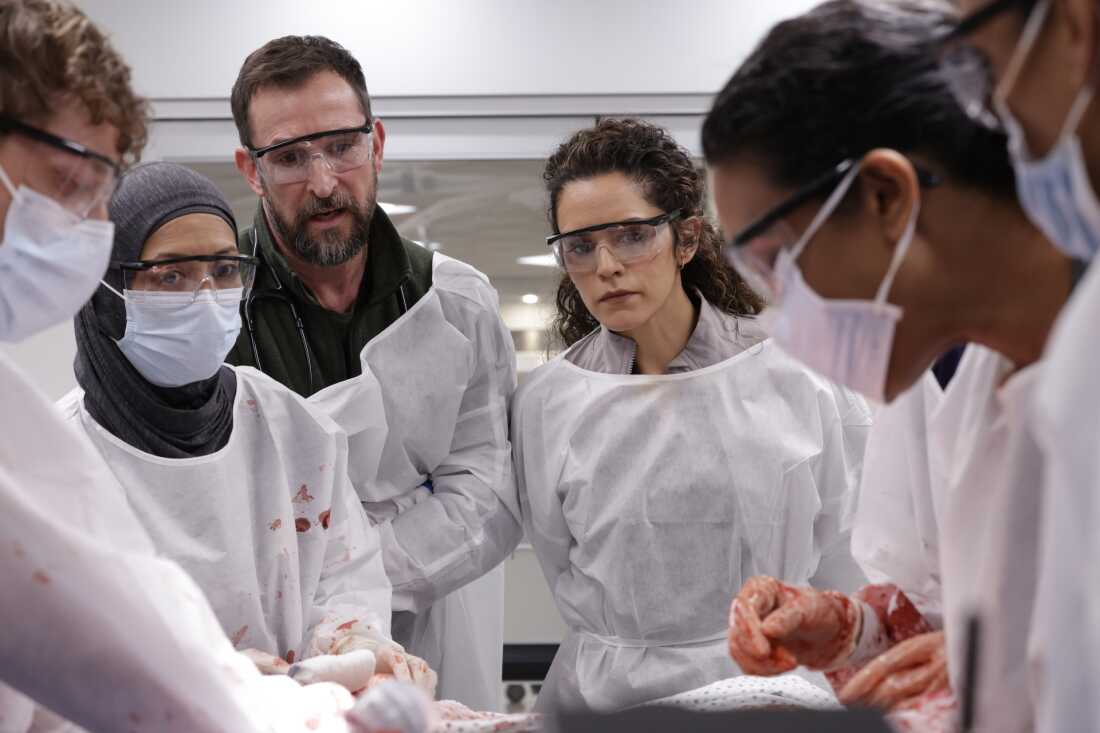
Sepideh Moafi, fourth from left, as Dr. Baran Al-Hashimi, the new attending physician, huddles with her team around a patient in a fictional Pittsburgh teaching hospital in the HBO Max series The Pitt.
Warrick Page/HBO Max
hide caption
toggle caption
Warrick Page/HBO Max
Part of that clash is her clear-eyed take on artificial intelligence and its role in medicine. And she thinks AI can help doctors document what’s happening with patients — also called charting — right?
Yep, Dr. Al-Hashimi is an advocate for AI tools in the ER because, I swear to God, they make health care workers’ lives more efficient. They make things such as charting faster, which is a theme that shows up in season two.
But then Dr. Robby gives a very interesting rebuttal to the widespread use of AI. The worry is that if we put AI tools everywhere, then all of a sudden, the financial arm of health care would say, “Cool, now you can double how many patients you see. We will not give you any more resources, but with these AI tools, you can generate more money for the system.”
The new installment also continues to touch on the growing corporatization of medicine. In season one we saw how Dr. Robby and his staff were being pushed to see more patients.
Yes, it really helps the audience understand the kind of stressors that people are dealing with while they’re just trying to take care of patients.
In the first season, when Dr. Robby kind of had that back and forth with the hospital administrator, doctors were immediately won over because that is such a big point of frustration — such a massive barrier.
There are so many more themes explored this season. What else should viewers look forward to?
I’m really excited for viewers to dive into the character development. It’s so reflective of how it really goes in residency. So much happens between your first year and second year of residency — not only in terms of your medical skill, but also in terms of your development as a person.
I think what’s also really fascinating is that The Pitt has life lessons buried in every episode. Sometimes you catch it immediately, sometimes it’s at the end, sometimes you catch it when you watch it again.
But it represents so much of humanity because humanity doesn’t get put on hold when you get sick — you just go to the hospital with your full self. And so every episode — every patient scenario — there is a lesson to learn.
Michal Ruprecht is a Stanford Global Health Media Fellow and a fourth-year medical student.


Two fiction books about good friends coming from different circumstances. Two biographies of people whose influence on American culture is, arguably, still underrated. One Liza Minnelli memoir. These are just a handful of books coming out in the first few months of 2026 that we’ve got our eye on.
Fiction

Autobiography of Cotton, by Cristina Rivera Garza, Feb. 3
Garza, who won a Pulitzer in 2024 for memoir/autobiography, actually first published Autobiography of Cotton back in 2020, but it’s only now getting an English translation. The book blends fiction with the author’s own familial history to tell the story of cotton cultivation along the U.S.-Mexico border.

Crux, by Gabriel Tallent, Jan. 20
Tallent’s last novel, My Absolute Darling, was a harrowing coming of age story about a teenage girl surviving her abusive survivalist father. But it did find pockets of beauty in the outdoors. Tallent’s follow up looks to be similarly awestruck by nature. It’s about two young friends, separated by class and opportunity, but bound together by a love of rock climbing.

Half His Age, by Jennette McCurdy, Jan. 20
The former iCarly actress’ bracing and brutally honest memoir, I’m Glad My Mom Died, was a huge hit. It spent weeks on bestseller’s lists, and is being adapted into a series for Apple TV+. Now McCurdy’s set to come out with her fiction debut, about a teenage girl who falls for her high school creative writing teacher.

Kin, by Tayari Jones, Feb. 24
Similarly to Crux, Kin also follows two friends across the years as options and opportunities pull them apart. The friends at the center of this book are two women who grew up without moms. Jones’ last novel, 2018’s An American Marriage, was a huge hit with critics.

Seasons of Glass & Iron: Stories, by Amal El-Mohtar, March 24
El-Mohtar is an acclaimed science-fiction writer, and this book is a collection of previously published short stories and poetry. Many of the works here have been honored by the big science-fiction/fantasy awards, including the titular story, which is a feminist re-telling of two fairy tales.
Nonfiction

A Hymn to Life: Shame Has to Change Sides, by Gisèle Pelicot, Feb. 17
Pelicot’s story of rape and sexual assault – and her decision to wave anonymity in the trial – turned her into a galvanizing figure for women across the world. Her writing her own story of everything that happened is also a call to action for others to do the same.

Cosmic Music: The Life, Art, and Transcendence of Alice Coltrane, by Andy Beta, March 3
For decades, the life and work of Alice Coltrane has lived in the shadow of her husband, John Coltrane. This deeply researched biography hopes to properly contextualize her as one of the most visionary and influential musicians of her time.

Football, by Chuck Klosterman, Jan. 20
One of our great essaysists and (over?) thinkers turns his sights onto one of the last bits of monoculture we’ve got. But in one of the pieces in this collection, Klosterman wonders, how long until football is no longer the summation of American culture? But until that time comes, there’s plenty to dig into from gambling to debates over the true goat.

Kids, Wait Till You Hear This! by Liza Minnelli, with Michael Feinstein, March 20
Minnelli told People that previous attempts at telling her story “didn’t get it right,” so she’s doing it herself. This new memoir promises to get into her childhood, her marriages, and her struggles with substance abuse.

Tom Paine’s War: The Words that Rallied a Nation and the Founder of Our Time, by Jack Kelly, Jan. 6
If you haven’t heard, it’s a big birthday year for America. And it’s a birthday that might not have happened if not for the words of Thomas Paine. This new book from historian Jack Kelly makes the argument that Paine’s words are just as important and relevant to us today.

North Carolina Democrats, Republicans share takes on deadly ICE shooting in Minneapolis

Tony Osburn’s 27 helps Omaha knock off North Dakota 90-79

Northeast Ohio Weather: High wind, very warm, showers, and storms today

Oklahoma storms bring widespread damage, tornadoes in Purcell and Shawnee

Oregon to investigate Border Patrol shooting of couple in Portland | CNN

Florida High School Football Rankings: Top 25 teams – Oct. 21

Cleary's 21 help Le Moyne down Central Connecticut State 69-64 in OT

How old is Bo Nix? What to know about Oregon quarterback ahead of 2024 NFL Draft

99th annual Pony Swim held in Virginia

Video: ‘It Didn’t Have to Happen This Way:’ U.Va. Faculty Call for Review of Police Response to Protests

Trump plans to meet with Venezuela opposition leader Maria Corina Machado next week

Trump says meeting Iran’s ‘Crown Prince’ Pahlavi would not be appropriate

Federal immigration agents shoot 2 people in Portland, Oregon, police say

Video: What Trump Told Us About the ICE Shooting

Trump calls for $1.5T defense budget to build ‘dream military’
-

 Detroit, MI5 days ago
2 hospitalized after shooting on Lodge Freeway in Detroit
-

 Technology3 days ago
Power bank feature creep is out of control
-

 Dallas, TX4 days ago
Defensive coordinator candidates who could improve Cowboys’ brutal secondary in 2026
-

 Health5 days ago
Viral New Year reset routine is helping people adopt healthier habits
-

 Nebraska2 days ago
Oregon State LB transfer Dexter Foster commits to Nebraska
-

 Iowa2 days ago
Pat McAfee praises Audi Crooks, plays hype song for Iowa State star
-
 Nebraska3 days ago
Nebraska-based pizza chain Godfather’s Pizza is set to open a new location in Queen Creek
-
 Entertainment2 days ago
Spotify digs in on podcasts with new Hollywood studios