Lifestyle
A prison art show at Lincoln's Cottage critiques presidents' penal law past


The Prison Reimagined: Presidential Portrait Project exhibition features artwork by incarcerated artists critiquing the U.S. justice system and is on display at President Lincoln’s Cottage in Washington, D.C.
Catie Dull/NPR
hide caption
toggle caption
Catie Dull/NPR

The Prison Reimagined: Presidential Portrait Project exhibition features artwork by incarcerated artists critiquing the U.S. justice system and is on display at President Lincoln’s Cottage in Washington, D.C.
Catie Dull/NPR
Caddell Kivett was watching the inauguration of President Biden on Jan. 20, 2021, when the thread of an idea began to form.
He was inspired by Amanda Gorman, who took the podium and read her poem The Hill We Climb, which says, in part:
“We’ve learned that quiet isn’t always peace, and the norms and notions of what ‘just’ is isn’t always justice. …”
It was then that he really started thinking, Kivett told NPR.
“Some of the words of that poem just really touched how I feel about our country,” he said.
And those feelings are complicated, to say the least.
Kivett, 53, is serving an 80-year prison sentence for assault-related charges.
He’s spent about 14 years incarcerated in North Carolina at the mercy of the U.S. criminal justice system and policies established by U.S. presidents, including Biden.
When the inauguration ceremony concluded, Kivett returned to his cell at Nash Correctional Institution in Nashville, N.C., where he’s been for the past eight years. He began to mull over a “kind of improbable idea” as the words of Gorman’s poem, “The norms and notions of what ‘just’ is isn’t always justice,” cycled through his mind.
He said he considered: What if there was a way to harness the voices of the incarcerated to critique this so-called justice system and to challenge the idea of what true justice in America could look like?
“Most people on the outside don’t know what is going on in here,” Kivett said. “And so, we just accept that this is how things are to be done and the correct response to people who commit harms or violence is to just lock them away.”
Caddell Kivett’s brainchild, Prison Reimagined: Presidential Portrait Project, launched at President Lincoln’s Cottage in Washington, D.C., this month.
Tracey Thornton/Janie Ritter
hide caption
toggle caption
Tracey Thornton/Janie Ritter
He is surrounded by artists at Nash Correctional and considered ways to take that talent and use it to push forward these questions and ideas, he said.
These thoughts that started as just a flicker in his mind in 2021 took years and complex coordination with advocates from Justice Arts Coalition, such as founder and director Wendy Jason and programs assistant Janie Ritter, to come to fruition. But this month Kivett’s brainchild, an exhibit titled Prison Reimagined: Presidential Portrait Project, was revealed to the public at President Lincoln’s Cottage in Washington, D.C.
The exhibit of 46 pieces of art and writing was curated by the Committee of Incarcerated Writers and Artists, whose members all currently live within the carceral system across the U.S. In addition to Justice Arts Coalition, a group that supports imprisoned artists, the exhibit was coordinated by staff at Lincoln’s Cottage.
The exhibit, which costs visitors between $4 and $10, will continue through Feb. 19. It may later head to a few more venues but that’s yet to be confirmed. The pieces, however, can be bought once the current exhibit has finished with all proceeds going directly to the artists.
The art pieces include different takes on portraits of U.S. presidents, among them Presidents Richard Nixon, Ronald Reagan, Bill Clinton and Barack Obama and put these leaders’ records on criminal justice under the microscope.
The exhibition focuses on various presidents, including Presidents Bill Clinton, Ronald Reagan, Joe Biden (bottom left) and Richard Nixon.
Catie Dull/NPR
hide caption
toggle caption
Catie Dull/NPR
The exhibition focuses on various presidents, including Presidents Bill Clinton, Ronald Reagan, Joe Biden (bottom left) and Richard Nixon.
Catie Dull/NPR
The difficulties of coordinating the exhibit from behind bars
Wendy Jason is the founder and director of the Justice Arts Coalition in Takoma Park, Md.
Catie Dull/NPR
hide caption
toggle caption
Catie Dull/NPR
Wendy Jason is the founder and director of the Justice Arts Coalition in Takoma Park, Md.
Catie Dull/NPR
From the moment Kivett reached out to the Justice Arts Coalition in early 2021, the wheels started turning, even if slowly, and not without some hurdles. Ritter, nonetheless, worked to ensure that Kivett kept agency over the project.
“It was his idea. I wanted him to make the decisions,” she said. “And, of course, a lot of the decisions couldn’t be made from inside. They had to be facilitated outside.”
Discussing the framework of the project with one another was among the challenges because Kivett has limited ability to call or email from his cell. And the artists whom Ritter and Jason contacted to contribute to the project are located in prisons throughout the country and rely heavily on snail mail to correspond.
Watercolor paintings, mixed media collages and colored pencil portraits are now hanging in Lincoln’s Cottage.
Catie Dull/NPR
hide caption
toggle caption
Catie Dull/NPR
Watercolor paintings, mixed media collages and colored pencil portraits are now hanging in Lincoln’s Cottage.
Catie Dull/NPR
Gradually, the artists began sending in their work to the group’s headquarters in Takoma Park, Md.
To get these works to Kivett and his Committee of Incarcerated Artists and Writers at Nash, who were selecting the best pieces to exhibit, Ritter had to send 8-and-a-half-by-11 sized photos of all of each piece and copies of the written submissions.
“At the same time, our mail system here was going under a transformation from paper to digital, which created a whole new slew of hurdles for us to get past,” Kivett said.
Later on, Callie Hawkins, the executive director of Lincoln’s Cottage, sent a copy of their floor plan to guide the committee in choosing where to display each piece.
“It’s a massive space,” Hawkins said. “I was blown away by their ideas for placement and groupings. And literally all our team did was place it on the wall where they directed us to.”
Janie Ritter is the programs assistant for Justice Arts Coalition. She wanted to ensure Kivett kept agency over the exhibition.
Catie Dull/NPR
hide caption
toggle caption
Catie Dull/NPR
Janie Ritter is the programs assistant for Justice Arts Coalition. She wanted to ensure Kivett kept agency over the exhibition.
Catie Dull/NPR
Kivett said it was hard not to feel discouraged during the process.
But, he said, “This project is a testament to what can be accomplished if you don’t let discouragement stop your momentum.”
Kivett hopes as visitors come to view the exhibit that they leave with a deeper understanding of the direct impacts of mass incarceration to critique the idea of whether incarceration is the true path to justice and that they’re motivated to take concerns directly to their politicians to make change.
“I hope everyone realizes that they’re all stakeholders. And I want them to realize what their individual part is in this process. And I hope they leave our show charged to do their part,” Kivett said.
“Continuing to just cage people for harms committed in our country is not making us safer and not making us better as a nation,” he said.
He recommends rerouting money that is being put into prisons and jails into communities that need it the most rather than continuing to invest in the carceral system as it is now.
President Lincoln’s Cottage offers a poignant venue
A portrait of President Bill Clinton and a collage of drawings of President George W. Bush are on display at Lincoln’s Cottage.
Catie Dull/NPR
hide caption
toggle caption
Catie Dull/NPR
A portrait of President Bill Clinton and a collage of drawings of President George W. Bush are on display at Lincoln’s Cottage.
Catie Dull/NPR
Watercolor paintings, mixed media collages and colored pencil portraits are now hanging in Lincoln’s Cottage in what was the president’s former library, dining room and bedroom some 160 years ago.
Some of the pieces are of Lincoln himself.
A mixed media collage created by Robert Spence incorporates photos of Black Lives Matters protests surrounding a portrait of Lincoln. Spence writes of this piece, “There are so many hidden (and not so hidden) racial biases and struggles that still exist in America. I wonder what President Lincoln would say if he was alive today. ‘What happened to America?’ “
Other pieces target Lincoln’s more recent successors.
The works reflect on how each administration and the policies they signed into law have impacted prisoners and contributed to the current state of the U.S. criminal justice system, which has locked up almost 2 million people — a disproportionate number of whom are Black Americans.
A mixed media work featuring a portrait of President Abraham Lincoln is on display at the exhibition.
Catie Dull/NPR
hide caption
toggle caption
Catie Dull/NPR
A mixed media work featuring a portrait of President Abraham Lincoln is on display at the exhibition.
Catie Dull/NPR
Like former President Bill Clinton and his signing of the 1994 Crime Bill. Critics of this bill have said it is responsible for this mass incarceration of Black Americans.
Artist Mike Tran used this event to inspire his painting on Clinton.
Tran writes, “The 3 Strikes Law (the 1994 Crime Bill), designed as a crime deterrent, serves to prove how inadequate the ‘rehabilitation’ system is. Rehabilitation is not putting a person in a box for life. It is helping that person realize why they did what they did, who they harmed with their actions, and replacing those behaviors with prosocial thoughts and beliefs.”
Tran painted a skewed version of Clinton’s presidential portrait, writing:
“I wanted to weave these ideas into President Clinton’s portrait, as he was instrumental in the passing of this law. I wanted the symbolism in the piece to be subtle, hence the three small cigars on his collar and intentional blurring of the American Flag, but once you realize them, you can’t look away.”
Not all pieces put the presidents in a seemingly negative light.
In a portrait by Brian Hindson, he contemplates on his complex feelings about Trump, who signed the First Step Act into law in 2018. This law, among many other things, lowered prison sentences for certain nonviolent offenders.
Hindson, who at the time of finishing his painting spent 15 years in the federal prison system, writes after that law passed he saw that “people were leaving in droves” and that overcrowding in the federal prison system “was actually being addressed.”
That leaves Hindson with contradictory feelings about Trump. He painted Trump’s face split and divided into different pieces, each painted a different color.
“As controversial, polarizing, and divisive as Trump was and can be, he’s the only President that did something that benefitted every federal inmate. The style I picked was my fractured art. All the pieces make him up. All the bad stuff too. Much like all of us, it’s pieces of us. All the pieces make the whole,” Hindson wrote.
A six-panel installation by artists Yuri Kadamov, Aquilla Barnette and Lezmond Mitchell depicts President Barack Obama.
Catie Dull/NPR
hide caption
toggle caption
Catie Dull/NPR
A six-panel installation by artists Yuri Kadamov, Aquilla Barnette and Lezmond Mitchell depicts President Barack Obama.
Catie Dull/NPR
The exhibit’s largest piece is a 72-by-40-inch, six-panel installation that hangs in the center of the cottage’s sitting room wall.
It’s an eye-catching portrait with an even more striking story.
The subject of the piece is obvious: former President Obama. Except his face is distorted with puzzle pieces missing from his face.
It reflects the three artists’ broken hopes of Obama reforming the criminal justice system and granting clemency to men on death row — a dream of the three men who painted it, they wrote.
The artists, Yuri Kadamov, Aquilla Barnette, and Lezmond Mitchell, managed to work together on this piece without ever sharing the same space. The three men slid canvases under the steel doors of their cells and handed it off to a fellow inmate who would pass the work on to the next collaborator.
The piece, however, was never fully finished.
Mitchell, who was the only Native American on federal death row, was executed on Aug. 26, 2020, at the age of 38 for first-degree murder.
Callie Hawkins is the executive director at President Lincoln’s Cottage. Her team worked with Kivett on arranging and hanging the artwork in the president’s former library, dining room and bedroom.
Catie Dull/NPR
hide caption
toggle caption
Catie Dull/NPR
Callie Hawkins is the executive director at President Lincoln’s Cottage. Her team worked with Kivett on arranging and hanging the artwork in the president’s former library, dining room and bedroom.
Catie Dull/NPR
It’s significant given that this incomplete portrait sits in a building that represents what Hawkins calls “that unfinished work” of Lincoln’s legacy.
“[Lincoln] recognized in his own lifetime, that his role was just to push the boulder a little further up the hill, and there he was going to fall short, that others who came after him were going to fall short,” she said. “And then it was going to take everyone to continue this ideal, this promise.”
The site of the cottage is at the highest point of Washington, D.C. It was the seasonal home of the 16th president and his family. While at the cottage in 1862 (then called the Soldiers Home), Lincoln developed the Preliminary Emancipation Proclamation in an upstairs bedroom, Hawkins said.
This was “legally supposed to free slaves in America,” Ritter said.
“Mass incarceration in the U.S. has been referred to as the New Jim Crow. I think it’s such an interesting tension to have artwork created by folks who are still inside, who do slave labor, in the room where Lincoln quite literally wrote out his thoughts for freeing those people in America,” she said.
The Proclamation was enshrined in the 13th Amendment by 1865. It says that “Neither slavery nor involuntary servitude, except as a punishment for crime whereof the party shall have been duly convicted, shall exist within the United States, or any place subject to their jurisdiction.”
A portrait of President Abraham Lincoln sits on a mantel at Lincoln’s Cottage.
Catie Dull/NPR
hide caption
toggle caption
Catie Dull/NPR
A portrait of President Abraham Lincoln sits on a mantel at Lincoln’s Cottage.
Catie Dull/NPR
Kivett said this amendment provides this “loophole” for those convicted of a crime. He said involuntary servitude is still legal for convicted felons, who when incarcerated, are forced into work that pays little to nothing in prisons across the country.
Hawkins said it was important for the cottage to be a part of this exhibit as it offered an important point to hold important conversations around rectifying injustice — a goal of the museum.
“It’s really important to [Lincoln’s Cottage] to not put Lincoln on a pedestal. To take him down, to interrogate him, his policies, and to really be honest about where that leaves us today,” she said.
For Kivett, the project and its themes are the embodiment of years of focus and passion on social justice issues while in prison.
It’s part of what gives him purpose and goals for the future while inside, he said.
“The big picture of the project is to let people on the outside know that we are still people, and that we are still connected somehow in our humanity.”


Once rivals on the tennis court, Martina Navratilova, left, and Chris Evert have become close friends in retirement. They are pictured above at the French Open in 1986.
Trevor Jones/Getty Images Europe
hide caption
toggle caption
Trevor Jones/Getty Images Europe
Chris Evert and Martina Navratilova were the most successful women’s tennis champions of their generation. Both were 18-time Grand Slam tournament winners — and each other’s greatest rivals.
Evert, a Florida native, became a tennis star in her teens. Navratilova was born in communist Czechoslovakia, and emerged as a player after Evert was established. They first faced off during a match in Akron, Ohio, in 1973, when Evert was 18, and Navratilova was 16. Evert won, but Navratilova left an impression.
“I remember thinking to myself, holy cow, when this young girl gets into better shape, she is going to be a force to be reckoned with,” Evert says. “She had so much talent. Her hands were quick, she had a big first serve, she had a big forehand, and she just was so powerful.”

Two years later, on the day she lost a semifinals match to Evert at the U.S. Open, Navratilova defected to the U.S. In the years that followed, her tennis game improved. Though she and Evert had initially been friendly, the friendship cooled as their rivalry heated up.
“Playing Chris was difficult because how can you not like Chris? What’s not to admire?” Navratilova says. “She was like the epitome of cool.”
The new Netflix documentary Chris & Martina: The Final Set tells the story of how Evert and Navratilova re-established their friendship and how they both faced cancer in retirement. Evert was diagnosed with ovarian cancer in 2021; Navratilova was diagnosed with throat and breast cancer in 2022.
“I can’t get away from her,” Evert jokes. “We had a 15-year career, and then we got cancer at the same time. It really is freaky, but I always say: If I want someone to be in the trenches with me, it’s Martina because she has been so supportive and so understanding.”

Navratilova agrees: “We have such a level of trust that we know whatever we say to each other, it stays there. We give each other the best advice we know how to. And there is no ulterior motive, no playing games.”
At the time that this interview was taped, Evert and Navratilova were both in remission from cancer. But late last week, Evert disclosed she’d recently been diagnosed with a recurrence of ovarian cancer.

“We know whatever we say to each other, it stays there,” Martina Navratilova says of her friendship with Chris Evert.
Netflix
hide caption
toggle caption
Netflix
Interview highlights
On supporting each other through cancer
Evert: There are a lot of phone calls between us. … I don’t cook, but Martina would bake bread for me, and her wife Julia would cook, make some chicken soup. … I got a lot of food from Martina. She got a necklace from me.
Navratilova: I get jewelry from Chris, she gets food from me.
Evert: Martina’s and my relationship — because we’ve had one for 50 years — is not the type where we have to talk to each other every day to maintain the closeness. I always knew she was there. She always knew I was there if we needed to talk, and that was that.
On the weakness they experienced with cancer
Navratilova: Chris’ diagnosis and treatment was much more life-threatening than mine, percentage wise, but my treatment was more difficult physically. … I was in New York for seven weeks and I literally sat on a yoga mat, maybe half an hour of the seven weeks, and did some stretching. I couldn’t even do the down dog pose because I would have fallen down. I had absolutely zero strength left.
Evert: The chemo kicked my butt, let’s put it that way. … It left me very weak, very, very weak. After chemo I would have three or four days of intense nausea and I just would feel tingling in my body and it just wasn’t nice. I didn’t have the energy. To walk six blocks was a big deal for me. And it was foreign. You know, it felt like it wasn’t my body, for sure.
On watching the old footage of their matches together for the documentary
Navratilova: For me, it was fun watching with Chris, because we had different reactions to what happened on the court. But what impressed me is how well we played with those wooden rackets. Because you know what? Those rackets are not easy to play with. But you try to put yourself in there physically, what it was like, mentally, what it is like. And it’s like, “Oh, I should have gone down the line,” or, “I can’t believe I missed that shot.” Or “Chris, you had such a great pass.” It was amazing. So it was impressive. … I wish I could still have that six-pack, but anyhow.

Evert: I remember feeling genuinely happy for her. I remember it was her first Wimbledon. That’s always been her dream since she defected. Her family couldn’t be there to watch her. She was all alone. And I just was happy for it. And I knew that this was gonna be one of many for her to win.
On defecting to the U.S. in 1975 when she was 18 years old
Navratilova: I was thrilled to be in the States. I always loved American cars. And when you ordered a ham sandwich, you got, like, two inches of ham and two slices of bread. Whereas growing up, you had thick bread and one slice of ham. So I thought I was in heaven. And it was $2.30 for that sandwich. I still remember it. I couldn’t believe how much ham I was getting.
Lauren Krenzel and Nico Gonzalez Wisler produced and edited this interview for broadcast. Bridget Bentz, Molly Seavy-Nesper and Beth Novey adapted it for the web.


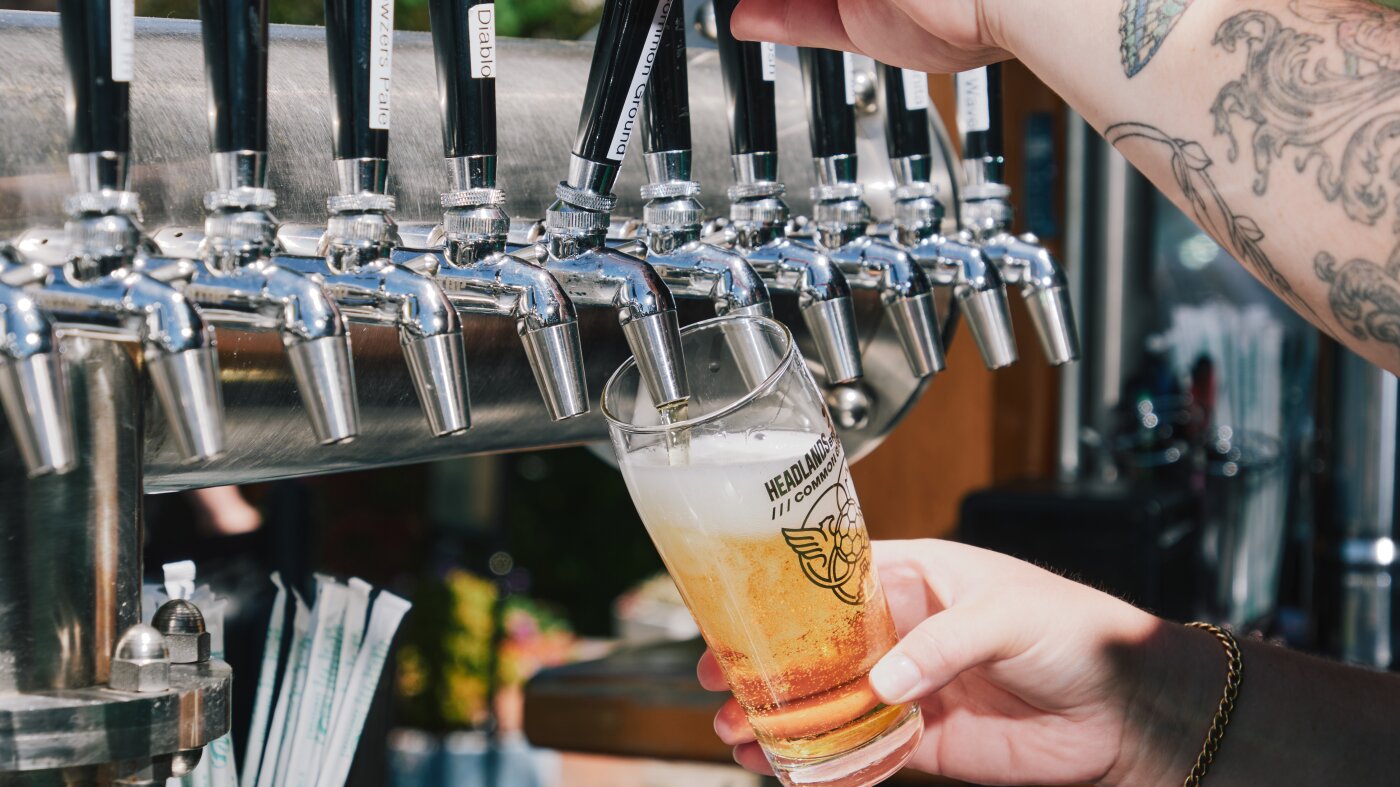
Headlands Brewing launched its World Cup-themed beer Common Ground ahead of the first World Cup game in June.
Justin Gellerson for NPR
hide caption
toggle caption
Justin Gellerson for NPR
The British betting company William Hill predicts that soccer fans will throw back more than 5 million pints of beer in stadiums and fan zones during this year’s World Cup. And that number doesn’t even account for the millions of pints being poured in bars as fans tune in to the global soccer event.
But while international soccer crowds are focusing on goals and penalties, a trio of craft breweries from the tournament’s three host nations are using the tournament to brew something increasingly rare: cross-border solidarity.

A shared recipe with local spin
The collaboration began months ago over a flurry of video chats and emails. The beermakers at Rey Árbol Brewing Co. in Mexico, Headlands Brewing in the United States, and Cabin Brewing Co. in Canada set out to design a single, unified recipe representing the brewing traditions of all three nations.
“It’s a Mexican lager,” said Alejandro Gomez, founder of Rey Árbol.
“That’s like a West Coast IPA,” said Ryan Frank, chief operating officer and brewmaster for Headlands.
“And up in Canada, most of our beers are hop driven,” said Haydon Dewes, co-founder of Cabin. “So we thought, let’s go for a dry-hopped Mexican lager.”
While all three breweries share the exact same recipe, each is giving the final product a distinct local spin, including unique, regionally designed labels. A four-pack of the U.S version costs $15.99. Frank said Headlands has produced about 130 cases of the limited-run brew.
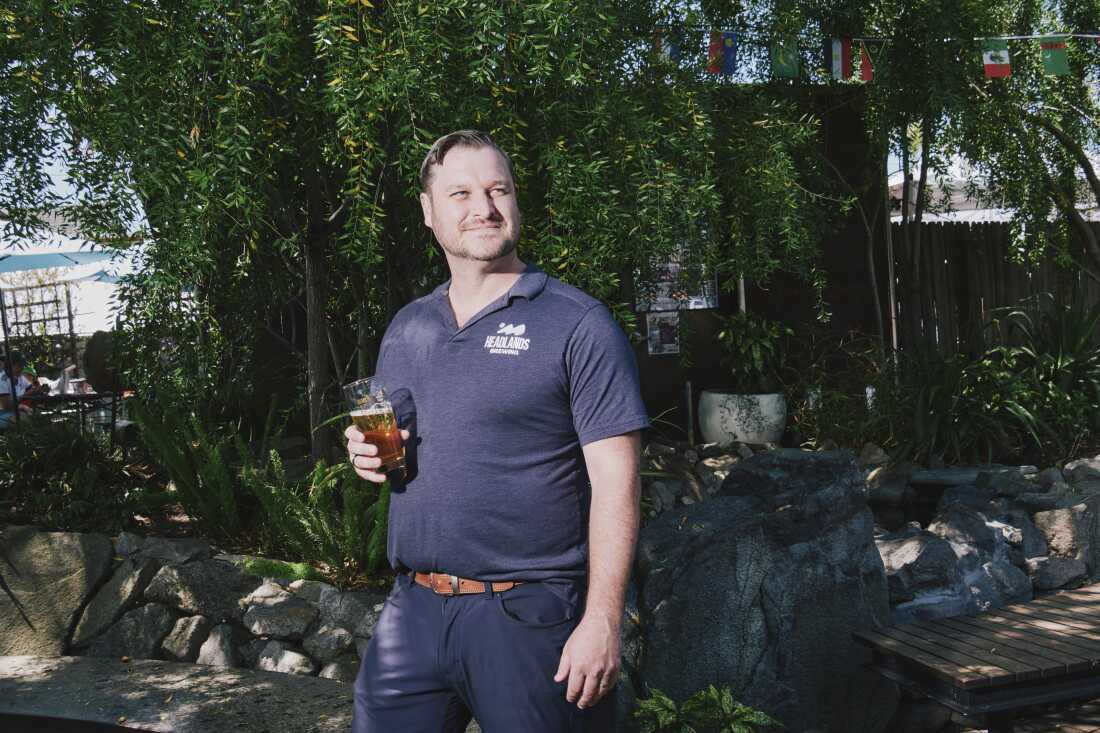
Headlands Brewing COO and brewmaster Ryan Frank drinks a Common Ground beer in Berkeley, Calif., on June 11.
Justin Gellerson for NPR
hide caption
toggle caption
Justin Gellerson for NPR
For the brewers, however, the project is less about marketing and more about connection: They named the multinational beer “Common Ground.”
“When I go to California or Canada, they will treat me like family,” Gomez said.
“It makes the world feel so much smaller,” said Dewes.
“It’s about building bridges and knowing what’s important in life,” said Frank. “And for us, that’s soccer and beer.”
Geopolitical friction in the taproom
The official rhetoric surrounding World Cup 2026 mirrors the brewers’ optimism, with promotional materials promising a tournament where billions are “united as individuals, united as billions.”
Yet this idealistic messaging stands in sharp contrast to a prickly geopolitical reality. Tensions between the U.S., Mexico and Canada have mounted over trade tariffs and auto manufacturing standards as the three nations renegotiate long-standing trade agreements.
The independent brewers behind Common Ground are feeling that friction firsthand through the rising costs of aluminum cans and raw ingredients.
“There are 15% tariffs slapped on any European-grown hops, which are really critical to some of our core brands,” Frank said.

Headlands Brewing brewmaster Ryan Frank and CEO Austin Sharp share a Common Ground beer in Berkeley, Calif., ahead of the first World Cup game on June 11.
Justin Gellerson for NPR
hide caption
toggle caption
Justin Gellerson for NPR
The political discord hasn’t just been confined to trade boards.
When signing an executive order to establish a White House Task Force for the World Cup in March 2025, President Trump suggested that cross-border hostilities might actually benefit the tournament. “Oh, I think it’s gonna make it more exciting,” the president said.
A bittersweet reminder
Tension on the soccer field is one thing; between nations, it’s another.
“It’s true that when it comes to the actual soccer, we’ve developed a very healthy, vibrant rivalry between the three countries,” said Andrés Martinez, the author of The Great Game: A Tale of Two Footballs and America’s Quest to Conquer Global Sport and co-director of Arizona State University’s Great Game Lab, which studies the intersection of sports, media and geopolitics. “But we’re also linked together in this very symbiotic relationship.”
Martinez said that when the U.S., Canada and Mexico initially launched their collaborative bid to host the World Cup back in 2017, the political climate was warmer.
“It was meant to showcase these tight bonds that had developed between the three countries,” Martinez said.

The makers of Common Ground used a shared recipe, but all created their own distinct packaging for the beer: Canada’s Cabin Brewing Co.; Mexico’s Rey Árbol Brewing Co.; the United States’ Headlands Brewing.
Cabin Brewing Company, Rey Árbol Brewing Company, Headlands Brewing
hide caption
toggle caption
Cabin Brewing Company, Rey Árbol Brewing Company, Headlands Brewing
But relations have soured since then, making cross-border business collaborations like Common Ground an anomaly rather than the norm for this tournament.
“To see craft beers across the three countries coming together like this, it’s a bittersweet reminder of what we were hoping to see a lot more of,” Martinez said.
Finding the real common ground
If trade wars and political posturing are looming large in Washington, D.C., Ottawa and Mexico City, they feel a world away at Headlands Brewing’s busy North Berkeley location.
As fans gathered to watch a crucial match between Mexico and South Africa at the start of the tournament, the sunny patio erupted into cheers and shrieks of “Goal!” when Mexico found the back of the net.

Headlands Brewing hosts a screening of the first World Cup game on June 11 in Berkeley, Calif.
Justin Gellerson for NPR
hide caption
toggle caption
Justin Gellerson for NPR
Hovering over a pint of the collaborative brew, soccer fan Roberto Mandujano reflected on the cross-border experiment.
“Three different ways, three different taste buds come together to make something cool,” he said.
When asked about the underlying political tensions between the host nations, Mandujano shrugged off the discord.
“We live in a world where everyone wants to make everything political,” Mandujano said. “But I think we’re all here for soccer. So I guess that’s the common ground.”
-

 San Francisco, CA1 minute ago
Anza expedition celebrates 250th anniversary in San Francisco
-

 Dallas, TX4 minutes ago
Preston Hollow residents oppose proposed $800 million mixed-use development in Dallas, survey reveals
-

 Miami, FL9 minutes ago
Bradley Beal to Miami Heat rumors draw skepticism
-

 Boston, MA16 minutes ago
Boston Pops surprise travelers at Logan Airport with July 4th preview performance
-

 Denver, CO18 minutes ago
Denver Broncos Crack Top 10 in NFL Uniform Rankings
-

 Seattle, WA24 minutes ago
PHOTOS: Visiting all 12 stops during this year’s West Seattle Garden Tour
-

 Milwaukee, WI34 minutes ago
Milwaukee Barbecue: A Legacy of Smoke
-

 Atlanta, GA39 minutes ago
Georgia Haitian communities face sudden July 27 deportation deadline

