Health
Keto vs. Atkins Diet: Same Theory, Different Approach | Woman's World


Sign Up
Create a free account to access exclusive content, play games, solve puzzles, test your pop-culture knowledge and receive special offers.
Already have an account? Login
Forgot your password?
Get back to the Sign In
Use left and right arrow keys to navigate between menu items.
Use escape to exit the menu.



NEWYou can now listen to Fox News articles!
A new report by the American Heart Association (AHA) included some troubling predictions for the future of women’s health.
The forecast, published in the journal Circulation on Wednesday, projected increases in various comorbidities in American females by 2050.
More than 59% of women were predicted to have high blood pressure, up from less than 49% currently.
The review also projected that more than 25% of women will have diabetes, compared to about 15% today, and more than 61% will have obesity, compared to 44% currently.
As a result of these risk factors, the prevalence of cardiovascular disease and stroke is expected to rise to 14.4% from 10.7%.
The prevalence of cardiovascular disease and stroke in women is expected to rise to 14.4% from 10.7% by 2050. (iStock)
Not all trends were negative, as unhealthy cholesterol prevalence is expected to drop to about 22% from more than 42% today, the report stated.
CLICK HERE TO DOWNLOAD THE FOX NEWS APP
Dr. Elizabeth Klodas, a cardiologist and founder of Step One Foods in Minnesota, commented on these “jarring findings.”
“The fact that on our current trajectory, cardiometabolic disease is projected to explode in women within one generation should be a huge wake-up call,” she told Fox News Digital.
NEARLY 90% OF AMERICANS AT RISK OF SILENT DISEASE — HERE’S WHAT TO KNOW
“Hypertension, diabetes, obesity — these are all major risk factors for heart disease, and we are already seeing what those risks are driving. Heart disease is the No. 1 killer of women, eclipsing all other causes of death, including breast cancer.”
Cardiovascular disease is the leading cause of death for women in the U.S. and around the world. (iStock)
Klodas warned that heart disease starts early, progresses “stealthily,” and can present “out of the blue in devastating ways.”
The AHA published another study on Thursday revealing one million hospitalizations, showing that heart attack deaths are climbing among adults below the age of 55.
The more alarming finding, according to Klodas, is that young women were found more likely to die after their first heart attack than men of the same age.
DOCTOR SHARES 3 SIMPLE CHANGES TO STAY HEALTHY AND INDEPENDENT AS YOU AGE
“This is all especially tragic since heart disease is almost entirely preventable,” she said. “The earlier you start, the better.”
Children can show early evidence of plaque deposition in their arteries, which can be reversed through lifestyle changes if “undertaken early enough and aggressively enough,” according to the expert.
Moving more is one part of protecting a healthy heart, according to experts. (iStock)
Klodas suggested that rising heart conditions are associated with traditional risk factors, like smoking, high blood pressure, high cholesterol, diabetes, obesity and a sedentary lifestyle.
CLICK HERE FOR MORE HEALTH STORIES
Doctors are also seeing higher rates of preeclampsia, or high blood pressure during pregnancy, as well as gestational diabetes. Klodas noted that these are sex-specific risk factors that don’t typically contribute to complications until after menopause.
The best way to protect a healthy heart is to “do the basics,” Klodas recommended, including the following lifestyle habits.
CLICK HERE TO SIGN UP FOR OUR HEALTH NEWSLETTER
Klodas especially emphasized making improvements to diet, as the food people eat affects “every single risk factor that the AHA’s report highlights.”
“High blood pressure, high blood sugar, high cholesterol, excess weight – these are all conditions that are driven in part or in whole by food,” she said. “We eat multiple times every single day, which means what we eat has profound cumulative effects over time.”
“Even a small improvement in dietary intake, when maintained, can have a massive positive impact on health,” a doctor said. (iStock)
“Even a small improvement in dietary intake, when maintained, can have a massive positive impact on health.”
The doctor also recommends changing out a few snacks per day for healthier choices, which has been proven to “yield medication-level cholesterol reductions” in a month.
TEST YOURSELF WITH OUR LATEST LIFESTYLE QUIZ
“Keep up that small change and, over the course of a year, you could also lose 20 pounds and reduce your sodium intake enough to avoid blood pressure-lowering medications,” Klodas added.
“Women should not view the AHA report as inevitable. We have power over our health destinies. We just need to use it.”
Related Article


Use left and right arrow keys to navigate between menu items.
Use escape to exit the menu.
Sign Up
Create a free account to access exclusive content, play games, solve puzzles, test your pop-culture knowledge and receive special offers.
Already have an account? Login

NEWYou can now listen to Fox News articles!
Nearsightedness (myopia) is skyrocketing globally, with nearly half of the world’s population expected to be myopic by 2050, according to the World Health Organization.
Heavy use of smartphones and other devices is associated with an 80% higher risk of myopia when combined with excessive computer use, but a new study suggests that dim indoor lighting could also be a factor.
For years, scientists have been puzzled by the different ways myopia is triggered. In lab settings, it can be induced by blurring vision or using different lenses. Conversely, it can be slowed by something as simple as spending time outdoors, research suggests.
Nearsightedness occurs when the eyeball grows too long from front to back, according to the American Optometric Association (AOA). This physical elongation causes light to focus in front of the retina rather than directly on it, making distant objects appear blurry.
The study suggests that myopia isn’t caused by the digital devices themselves, but by the low-light environments where they are typically used. (iStock)
Researchers at the State University of New York (SUNY) College of Optometry identified a potential specific trigger for this growth. When someone looks at a phone or a book up close, the pupil naturally constricts.
COMMON VISION ISSUE COULD LEAD TO MISSED CANCER WARNING, STUDY FINDS
“In bright outdoor light, the pupil constricts to protect the eye while still allowing ample light to reach the retina,” Urusha Maharjan, a SUNY Optometry doctoral student who conducted the study, said in a press release.
CLICK HERE TO DOWNLOAD THE FOX NEWS APP
“When people focus on close objects indoors, such as phones, tablets or books, the pupil can also constrict — not because of brightness, but to sharpen the image,” she went on. “In dim lighting, this combination may significantly reduce retinal illumination.”
High-intensity natural light prevents myopia because it provides enough retinal stimulation to override the “stop growing” signal, even when pupils are constricted. (iStock)
The hypothesis suggests that when the retina is deprived of light during extended close-up work, it sends a signal for the eye to grow.
In a dim environment, the narrowed pupil allows so little light through that the retinal activity isn’t strong enough to signal the eye to stop growing, the researchers found.
CLICK HERE TO SIGN UP FOR OUR HEALTH NEWSLETTER
In contrast, being outdoors provides light levels much brighter than indoors. This ensures that even when the pupil narrows to focus on a nearby object, the retina still receives a strong signal, maintaining healthy eye development.
CLICK HERE FOR MORE HEALTH STORIES
The team noted some limitations of the study, including the small subject group and the inability to directly measure internal lens changes, as the bright backgrounds used to mimic the outdoors made pupils too small for standard equipment.
Researchers believe that increasing indoor brightness during close-up work could be a simple, testable way to slow the global nearsightedness epidemic. (iStock)
“This is not a final answer,” Jose-Manuel Alonso, MD, PhD, SUNY distinguished professor and senior author of the study, said in the release.
TEST YOURSELF WITH OUR LATEST LIFESTYLE QUIZ
“But the study offers a testable hypothesis that reframes how visual habits, lighting and eye focusing interact.”
The study was published in the journal Cell Reports.
Related Article

Video: Pakistan Launches Airstrikes on Afghanistan

Video: The Web of Companies Owned by Elon Musk
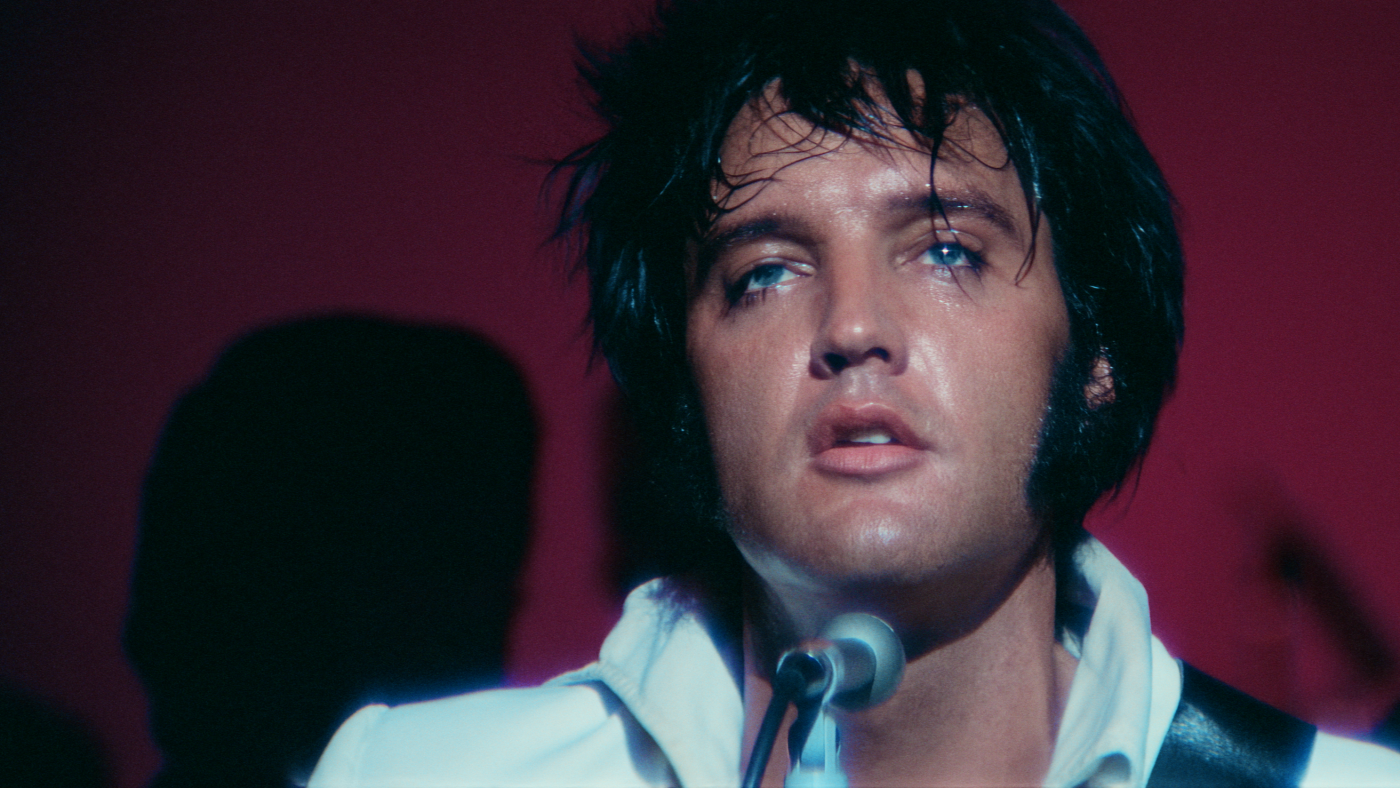
Baz Luhrmann will make you fall in love with Elvis Presley

Here’s your first look at Kratos in Amazon’s God of War show

State Dept authorizes non-essential US Embassy personnel in Jerusalem to depart ahead of possible Iran strikes

Florida High School Football Rankings: Top 25 teams – Oct. 21

Cleary's 21 help Le Moyne down Central Connecticut State 69-64 in OT

How old is Bo Nix? What to know about Oregon quarterback ahead of 2024 NFL Draft

99th annual Pony Swim held in Virginia

Indiana Members Credit Union announced as new anchor tenant at Bottleworks District

Where Iran’s ballistic missiles can reach — and how close they are to the US

Has India’s influence in Afghanistan grown under the Taliban?

Bill Clinton to testify before House committee investigating Epstein links

Read Judge Schiltz’s Order

Vulnerable House Dem lashes out at Trump’s ‘racist’ SOTU challenge: ‘That was uncomfortable’
-

 World2 days ago
Exclusive: DeepSeek withholds latest AI model from US chipmakers including Nvidia, sources say
-

 Massachusetts2 days ago
Mother and daughter injured in Taunton house explosion
-

 Montana1 week ago
2026 MHSA Montana Wrestling State Championship Brackets And Results – FloWrestling
-

 Oklahoma1 week ago
Wildfires rage in Oklahoma as thousands urged to evacuate a small city
-

 Louisiana4 days ago
Wildfire near Gum Swamp Road in Livingston Parish now under control; more than 200 acres burned
-

 Technology6 days ago
YouTube TV billing scam emails are hitting inboxes
-

 Denver, CO2 days ago
10 acres charred, 5 injured in Thornton grass fire, evacuation orders lifted
-

 Technology6 days ago
Stellantis is in a crisis of its own making