Fitness
Inside the Exclusive, Obsessive, Surprisingly Litigious World of Luxury Fitness


This article was featured in the One Story to Read Today newsletter. Sign up for it here.
Each day, thousands of women, myself included, engage in a ritual. We flail our arms like orchestra conductors. We wiggle our rib cages. We get down on all fours and raise our knees to our ears. We roll on the floor. For up to 90 minutes, gathered together at studios or in front of our laptops, we perform The Method. We “do Tracy Anderson.”
The workout is not Pilates. It includes dance cardio, but it is not dance cardio. Though some moves are inspired by ballet, it is not the Bar Method. Anderson, who rose to fame training celebrities such as Gwyneth Paltrow and Madonna, does not wish to be referred to as a trainer. She describes herself as a “self-made scholar” and an artist who has created a “canon of work.” The movements, she told me, are a combination of choreography (“being creative with the biomechanics of what’s possible in our body”) and science (understanding movement from “a body and energy perspective”).
Wander around the Hamptons or Tribeca and you might notice solitary men in T-shirts explaining their solitude: MY WIFE IS AT TRACY. Ordinary people like me can do prerecorded workouts online for $90 a month, but membership at one of Anderson’s studios is a status symbol, the fitness equivalent of waterfront property. Her empire includes eight locations: in Manhattan (one in Tribeca and one in Midtown), the Hamptons (one in Water Mill and one in Sag Harbor), Los Angeles (one in Studio City and one in Santa Monica), and Madrid. Her newest studio is in Bozeman, Montana.
Studio membership costs upwards of $10,000 a year. Many clients spend far more, opting for private sessions designed by the Prescription Team. If you want to train with Anderson in person, you can book a spot during “Vitality Week” (actually a long weekend) for $5,000. I know one woman—a successful entrepreneur married to an even more successful financier—who budgets $36,000 a year for her Tracy Anderson body. (For the record: She looks amazing.)
In addition to legions of rich wives and women who work in the beauty and fashion industries, fans of The Method include celebrities and entrepreneurs: Tracee Ellis Ross, Jennifer Lopez, the power Realtor Claudia Saez-Fromm, the New York City political lobbyist Suri Kasirer. When the cash-strapped developer Brandon Miller committed suicide last year, many blamed it on the pressure that he and his wife felt to keep up with their Hamptons neighbors. She did Tracy Anderson every morning.
I’ve heard rumors of powerful women threatening to blacklist people from joining the studio. I’ve heard that byzantine rules govern the hierarchy of spots near the front of the class. For years, the tabloids have been full of stories about feuds between Anderson and former trainers she believes stole her moves. She built an empire on the perception that she was a glamorous fitness doll, and now she doesn’t want to be perceived as a glamorous fitness doll. She wants to be taken seriously.
Anderson’s goal is to transform how people think about the mind and the body, and to prove that her workout is her own intellectual property, both an art and a science. She’s created “thousands” of moves, she told me, and “done actual studies.” She compared herself to Leonardo da Vinci, who, just like her, “used his scientific knowledge to enhance his art.”
Tracy Anderson devotees can buy clothes in her workout line, or her exact ankle weights, or Tracy Anderson magazine, which includes testimonials from famous studio members, plant-based recipes created by a team of chefs, and photos of Anderson modeling thousand-dollar designer sweaters over workout gear. Her Instagram features slick videos of Tracy Anderson, the trainer, performing Tracy Anderson, The Method, while wearing Tracy Anderson, the brand. Yet there is very little of Tracy Anderson, the person, available. She existed for me—as she does for so many others—in her workout videos as a silent body in motion, upon which we could project our feelings about our own bodies.
And then, one day last November, I came face-to-face with her. This was no ordinary celebrity sighting. For years, I’d been emulating this woman’s every move. When she wiggled, I wiggled. When she shook her hips, I shook my hips. When she went into a full split and rolled backwards onto the floor before scissoring her legs in the air, I … waited for the next exercise.
Anderson greeted me at the door of her house in Brentwood, California, followed by a pack of beautiful dogs, including a cavapoo, standard poodles, and another breed I couldn’t place. It turned out to be the product of the male cavapoo and a female poodle that had fallen “madly in love,” according to Anderson. When they “anatomically could not express themselves to their fullest ability,” Anderson asked science to step in. “They deserve to be helped because they were trying so hard to procreate that his, like, his male parts were bleeding.” The poodle was artificially inseminated, and they went on to have eight puppies.
Her way of speaking—warm and Midwest-earnest—makes even something as outrageous as doggy IVF seem like a gesture of compassion. In that moment, all I felt was happiness for those dogs. Shouldn’t we all be able to express our love?
Anderson grew up on a small ranch in Noblesville, Indiana, surrounded by goats, geese, and turkeys. Her mother ran a dance studio. Her father worked in his family’s furniture business, but was also a poet and chess enthusiast. Anderson described the household as “sometimes middle-class, sometimes not.” One day she’d be told she could buy new school clothes; the next, she’d be told the family was out of money and she’d have to return them. Her parents had dueling ambitions for their daughter. Because she was good at chess, her father imagined her as a future lawyer. But because she excelled at dance, her mother imagined her on Broadway. For a time, her mother’s plan won out.
At 18, she moved to New York to study at the American Musical and Dramatic Academy. It was the early ’90s. She found a job at the Gap and lived on $5 ATM withdrawals and H&H bagels with mustard and tomato because she couldn’t afford turkey. Just 5 feet tall, Anderson didn’t have the “dancer’s body” she was told she needed. She dieted, considered taking up smoking, and eventually, demoralized, left school.
She got engaged to the former NBA player and Hoosier legend Eric Anderson, whom she had met while playing a cheerleader in the movie Blue Chips. In a few years, they were married; living in Indiana with their son, Sam; and running a facility for youth sports and dance. They were young and inexperienced, and fell behind on rent and closed the facility. They opened a Pilates studio, then closed that too. In February 2005, judges ordered the Andersons to pay $334,375 in unpaid bills. In April, they filed for bankruptcy.
But Anderson also co-owned another studio that had a branch in Los Angeles, and she was developing her theories around fitness. She had long been fascinated by Olympians, such as swimmers and gymnasts, whose physiques were shaped by the repetitive motions of their sports, and wondered if she could design a series of movements to shape the dancer’s body that had long evaded her. After what she describes as a period of research and study, she came up with a program to strengthen the major muscle groups while working smaller “accessory” muscles through a series of repetitive rotations and movements. In L.A., she introduced clients to a piece of modified Pilates equipment she called the Hybrid Body Reformer. One of these clients happened to be the wife of Gwyneth Paltrow’s agent at the time, Anderson told me. Paltrow, who’d recently had a baby, complimented the woman on her body. When Anderson tells her own story, this is usually where she begins.
Anderson has been famous since 2008. That year, in London, paparazzi photographed her with Madonna and Paltrow, both in sweaty workout gear. Suddenly, she was not just a trainer to the stars but the trainer to the stars. These were the glory days of celebrity magazines and gossip blogs, and Anderson was ubiquitous, proselytizing about how to get J.Lo’s butt or Gwyneth’s … anything. “I’m giving you Gwyneth’s legs right now,” she told a beauty reporter during a workout. “Trim and Trimmer!” a headline read.
In 2008, Paltrow invested in Anderson’s business. Anderson started planning another studio in New York and headed to London, to train and tour with Madonna. That same year, she and Eric divorced, and she released the Tracy Anderson Method: Mat Workout DVD, which laid out her fully developed theories for the first time.
“Genetically, we are all shaped differently, and we all have our own set of problem areas,” she says in the introduction. “The good news is it’s completely possible to reengineer your muscular structure any way you want”: to get “teeny tiny” arms and “feminine” abs and thighs without “bulking.” Central to the workout was silent instruction—she demonstrates the moves without speaking—and a near-torturous number of reps with very, very light weights.
The celebrity-lifestyle-obsessed late aughts were an ideal environment for what Anderson was selling. Fixating on “problem areas” was seen not as self-loathing, but as self-empowerment. Talking explicitly about working hard just to get skinny sounds awkward now that we live in an era that celebrates wellness and body positivity. Anderson seems to regret her role in the 2000s skinny-industrial complex, when she would tell people, “Let’s go; you can get teeny tiny!” But she said she had no choice: “I had to contribute to it too, or else nobody would do my workout.” Besides, “you can’t change a culture before it’s ready.”
Now any one of Anderson’s clients could be on Ozempic or Wegovy if she wanted to, and Anderson has to offer something beyond thinness. But although the way she talks about the moves has changed, the moves themselves have not.
Clients go to her because they “know that their body’s going to look the best that it can look,” she told me. “And they’re not going to go anywhere else, because they know how smart I am.”
Anderson is 50, a thrice-married mother of two. She doesn’t like to talk about hard times, but she’s definitely had them. Eric Anderson died in 2018 of a heart attack. “He was such an incredible human being and he was such an incredible father,” she told me. She said she always thought they might end up back together someday. Having to tell Sam that his father was dead was “the worst moment of my actual entire life.”
Two years after Eric died, during the early days of the coronavirus pandemic, the father of Anderson’s younger child, Penelope, died too, of a brain tumor. “I did not have the relationship with Penny’s dad that I had with Eric,” she told me. But she took Penelope to see him before he died, and thanked him for the gift of their daughter: “Penny’s part of both of us. And she’s extraordinary.”
When I pressed her to say more about what she’d learned from her experiences of loss, she told me she’d become “very understanding of people’s journeys”—even “the people that steal from me.” She said she always asks herself, “Gosh, what happened to them as a child? ”
The fact that Anderson has experienced death and divorce, debt and failure, is one reason I was drawn to her. I could relate. I divorced as a young woman, and I ran a small business through the Great Recession, and I was sick to my stomach for years worrying about the possibility of bankruptcy. Starting a business, losing a business, starting a new one—this is what entrepreneurs do. I also knew from experience that if you’ve spent years fighting for your business’s survival, you don’t take kindly to anyone you see as stepping on your turf.
I came to Tracy Anderson sometime in 2009 or 2010. My grandfather, who’d raised me, had just died, and I had been working frantically to save my company. In the process there had been a lot of stress eating and crying on my sofa, and the resulting weight gain created a new wave of sadness as I felt lost inside myself and my grief. I had seen Anderson in celebrity magazines and turned to one of her DVDs.
The Method made me thinner. But it also made me feel incredible. The choreography was so unusual—and the work so intense—that it required my full concentration, which eased my anxiety and helped me feel present in my body. Unlike yoga, where you were constantly being instructed, or fitness classes, where you were being “motivated,” Anderson didn’t talk at all, something I found incredibly soothing.
I have strayed over the years. I craved the dark, loud music of SoulCycle; I wanted to try running a marathon. I was making a TV show and was so sedentary, for so long, I developed sciatica and a slipped disk. But I’ve always come back to Tracy Anderson. (“Most of them always come back,” she told me.)
Anderson herself interested me, but I was hardly a member of the #TAmily, as fans have branded themselves online. (The hashtag is shared, a bit awkwardly, by the Tamil diaspora.) You’ll see gushing comments about how Anderson changes women’s lives, or questions about what brand of sneakers she’s wearing. “What a gift to learn from you,” one fan wrote on Instagram. “You talk to us like that beautiful sister that loves you so much and wants the very best for you,” wrote another.
Anderson says she doesn’t want to be a guru. Of the women who credit her with changing their lives, she said: “No, no, no, no, no. You don’t have me to thank; you have you to thank.” But in many ways, she encourages her clients’ feelings of intimacy. Occasionally, she’ll get on Zooms with dozens of studio members that are then preserved in a section of her website called “Conversations.” Women ask Anderson for advice on their diets and workouts and lives, but for a lot of the time, Anderson simply listens. If her Instagram videos are slickly produced, these calls are remarkably DIY. And long. One call last year ran for five hours.
Other aspects of the business remain frustratingly (or charmingly) mom-and-pop. Products—such as Kenko, four-pound minimalist weights made of Canadian maple—appear with great fanfare and then are rarely spoken of again. Members who pay (a lot!) to livestream classes often complain that they start late. Had someone forgotten to turn on the camera?
Many of Anderson’s peers have been bought out by wealthy corporations or private-equity firms. Barry’s (formerly Barry’s Bootcamp) was co-founded by Barry Jay in 1998 and is now owned by Princeton Equity Group, among others. SoulCycle was founded in 2006 by a spin instructor, Ruth Zukerman, and two of her clients before it was acquired by Equinox in 2011. Even CrossFit—known for its spartan gyms—was taken over by Berkshire Partners.

“To me, being bought someday by private equity is not in my—I don’t even hold space for that,” Anderson told me. “I’ve had people with their M.B.A.s mess up my business,” she said. “Fancy educations—Wharton on there, Stanford on there, Harvard on there.” But they didn’t have the right mindset, she said. Was she a control freak? “I’ll tell you what I was,” she replied. “I was a wild fucking stallion.”
Now she is married to Chris Asplundh, a scion of the Pennsylvania-based billion-dollar tree-trimming empire Asplundh Tree Expert. (Mehmet Oz is a relative through marriage; he used his in-laws’ address for his voter registration before his failed bid for a Pennsylvania U.S. Senate seat.) Asplundh bought out Anderson’s other investors. “This is a family business now,” she told me.
Anderson’s employees describe themselves as a family, too. Steven Beltrani, the company’s president, walked her down the aisle when she married Asplundh. Employees’ Instagram accounts are full of loving posts about one another. But every family has its fissures.
Megan Roup was hired to work for Anderson in 2011. Roup was a member of the #TAmily for six years—schooled in The Method and given access to training manuals and Anderson’s celebrity contacts. All of these surely proved valuable when Roup left and opened the Sculpt Society, a mostly online fitness class.
Roup quickly amassed many clients, some of whom—including the Victoria’s Secret model Shanina Shaik—had formerly trained with Anderson. When the pandemic forced fitness online, more people found their way to Roup. Anyone familiar with Anderson would recognize many of her signature moves in Roup’s workouts. Roup’s website stated that she had “seen something missing in the fitness industry,” and sought to fill this void. Anderson saw contractual violation and theft—and the latest in a long string of betrayals.
For nearly as long as Anderson has been famous, she has worried about her former trainers stealing her moves and clients. For good reason. By 2014, so many Anderson apostates were operating in New York City alone that one blogger took the trouble to rate them according to their “Level of Tracy-ness.” Anderson describes herself as “low conflict.” But most anyone who does her workouts and listens to the chats she delivers after class will be familiar with her bitterness toward the “rip-off trainers” who keep “stealing” her work. The frustration, at times, sounds more like paranoia.
Anderson didn’t name names publicly, but the tabloids were happy to report on her scuffles: The Daily Mail, for example, quoted an anonymous source saying that Nicole Winhoffer, who launched a DVD collection with Madonna’s backing, was “overweight” before she started training with Anderson, and that she didn’t “understand the reasons behind the moves, just the motions.”
In 2022, Anderson brought a lawsuit against Roup and her business through her parent company, Tracy Anderson Mind and Body, for breach of contract and copyright infringement, among other claims. Anderson attributed her new aggressiveness toward Roup to finding “my voice,” and the wisdom she’d gained in her 40s. Also likely helpful was the cash infusion her new husband offered the business.
But by bringing the case to court, Anderson has subjected her own workout to new scrutiny. When I set out to profile one of the most famous women in fitness, I never imagined I would have to learn so much about copyright law. Yet here we are. Copyright is designed to protect creative expression. Performance choreography is considered creative expression and has been protected by copyright law since the 1970s. Physical fitness is not. In their defense, Roup and her team relied on a copyright-infringement case brought against rival studios by Bikram Choudhury, the inventor of a series of yoga poses performed in a hot room. The court had dismissed Choudhury’s case on the rationale that the poses involved were not creative art, but “functional” movement.
A federal judge in California tossed out Anderson’s copyright claim for similar reasons. Anderson calls her program a “method,” the judge pointed out, and methods are exempt from creative-copyright protection. In addition, he wrote, Anderson says her Method is the result of research and markets it as “designed for the purpose of improving clients’ fitness and health.” Functional movements, in other words, just like Choudhury’s.
Anderson ultimately settled with Roup on the breach-of-contract count for an undisclosed amount, but she is appealing the copyright decision. Amanda Barkin, an IP attorney at FKKS in New York who has been observing the case, told me that Anderson’s accusations will be hard to prove. Roup is “allegedly incorporating these choreography and other elements from The Method that she learned through, like, the confidential employee handbook,” Barkin told me, but those moves are also “all over TikTok, so I don’t know how confidential a lot of it is.”
I wondered, when speaking with Barkin and reading the court summation, if I detected a whiff of dismissal. At the end of the day, these are just women’s workouts—things of vanity—so what’s the big deal? A male attorney, writing about the case on the FKKS blog in 2023, noted that although Anderson faced an uphill battle, at least she had the glutes for it.
In a statement, Roup’s lawyer, Nathaniel Bach, called Anderson’s lawsuit “ill-conceived and frivolous” and insisted that Roup had “developed The Sculpt Society on her own.” But the judge’s decision to toss out the copyright claim, he wrote, was “a significant victory both for Megan and the whole fitness industry, as the Court’s rulings reaffirm that no one can claim ownership over physical exercise or dance cardio.”
Whether or not some of Roup’s moves are based on Anderson’s Method, the big question is if anyone can invent and own a fitness move in the first place. Evan Breed was a professional dancer for 10 years before she became one of Anderson’s master trainers. She told me she could understand why Anderson would object to someone “copying exactly the choreography of her dance cardio.” But that doesn’t apply to the more basic movements—the arm workouts and the muscular-structure work done on the mat. Dancers like her—and like Anderson and Roup—“grew up doing those rib isolations, moving your ribs side to side, moving the hips side to side.” The arm exercises, she said, are essentially what you do while warming up for a ballet class.
Anderson isolated the movements and shifted them down to a mat. But they did not come out of nowhere. Perhaps those Anderson accuses of theft feel they’re only doing what she did herself, and continuing her practice of reinterpretation.
Why, I wondered, did Anderson keep emphasizing her workout as a research-driven method, if that was exactly what was going to hurt her copyright case? Why did she insist on having it both ways? Maybe it was that original tension—between the Broadway chorus girl and the sharp attorney—playing out all over again.
There’s nothing particularly unusual about a trainer arguing that their program is more effective than others, but Anderson’s emphasis on her own research is notable. She started out with insights, she said, but she wanted proof. And so, in 2001, she began what she frequently refers to as “the study” or her “clinical study,” gathering “five years of quantitative and qualitative data from 150 women.”
She recruited mothers who would drop their kids off at the Indiana youth center that she and Eric opened, along with other women, and provided them with choreography to shrink their problem areas. After the center shut down, she told me, she kept following up with the same women: For five years, every 10 days she would measure them in more than 28 different places and provide them with new moves. What she discovered in that process, she says, is the foundation of her Method.
Anderson insists that clients are coming to her because of this research. And it’s why she doesn’t feel bad about charging so much for it.
And yet the study is not, of course, an actual clinical study—it was not performed by independent researchers and was not submitted for peer review at an academic journal. When I followed up with Beltrani, the president, to ask if Anderson could share the data with me, he told me they were proprietary.
Even so, Anderson argues that only the close-minded would ignore her findings because she’s an outsider to the scientific establishment. What bothers her most is the idea that others are copying her moves without properly understanding the science. “To create my life’s work has taken so much research, so much focus, so many people believing in me financially. For me to be able to test, experiment, create, and do this, and for anybody, especially a woman, to come in, work for me, learn from me, leave, take me off their résumé, and steal from me?” Anderson’s voice was full of passion as she called this “morally bankrupt.”
Although Anderson wouldn’t send me any of her data, she said, when pressed, that they included records in notebooks and Polaroid shots. She also agreed to put me in touch with one of the women she’d trained in the early days of her career.
Julie McComb is a mom and teacher with a bakery business in Westfield, Indiana, and she’s remained friendly with Anderson ever since she started training with her in the mid-2000s. Back then, McComb was new to the area, and Anderson was Indiana famous.
Chatting with her dentist during an appointment one day, McComb mentioned that she liked to work out. The dentist said, “I have to tell you about this girl. She’s amazing. She’s fabulous. She’s the best in the area.” She has “this whole philosophy,” the dentist added, “and she’s done all this research.”
“I remember her lifting my shirt up,” McComb told me, and Anderson saying, “ ‘Oh, we’re going to take care of this, and we’re going to do this, and we’re going to shrink this in, and get this smaller,’ and her hands were all over my body.” McComb started to laugh, she told me, because “my problem areas were always—even when I was in high school—the sides of my hips. I said, ‘Tracy, there’s nothing we can do about this.’ ”
But Anderson made her personalized workout routines every couple of weeks, and she used a tape measure to track her progress, “and Tracy literally took me from a size eight to a size zero.”
When McComb became pregnant with her son, she did The Method all through the pregnancy. Anderson recommended her own ob-gyn. It was such an incredibly easy birth, in McComb’s telling, that she looked up at the doctor, surprised that it was over already. “He laughed,” she told me. “And he says, ‘Julie, that’s because you’ve been working out with Tracy Anderson.’ ”
McComb had known that Anderson was gathering research but wasn’t aware that the measurements she took from her were part of the “study” she’s been talking about ever since. But she didn’t seem to mind. She told me she’d had a minor stroke and some surgeries for a heart arrhythmia a few years back, and had largely stopped exercising. She’d gotten back into The Method after that, but then dropped off again. She would have liked to do online workouts, but she and her family had moved into a smaller house and there wasn’t enough space. She feels bad about gaining weight, she told me, but what she truly misses is how The Method made her feel, and “the environment and the sisterhood that we all had when we were there.”
She said, “It was more than a workout.”
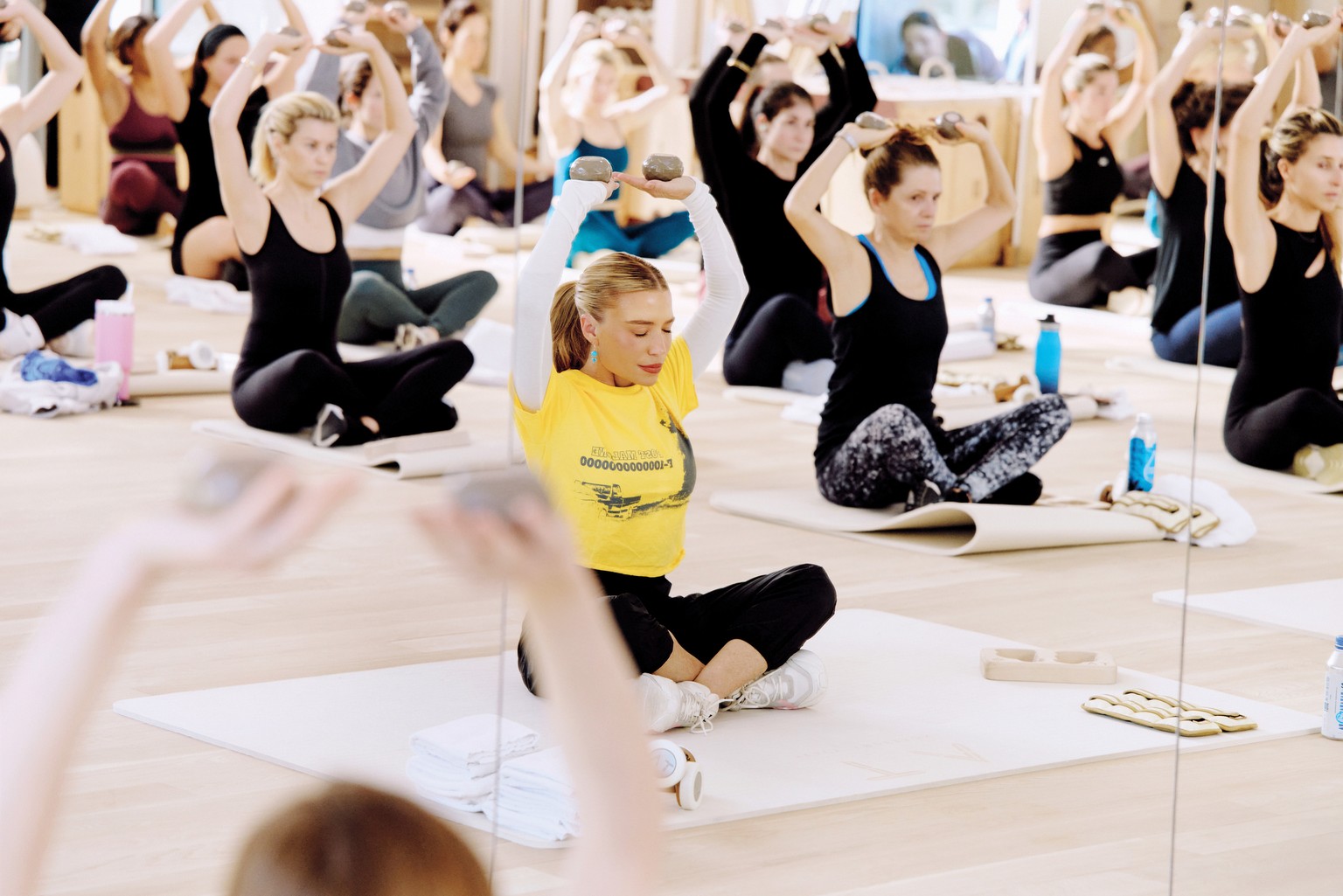
For months leading up to my visit to Brentwood, Anderson had been promoting her latest product, HeartStones—a set of 2.8-pound beveled spheres beset with a circle of rose quartz that were meant to be lifted through a series of slow-burn, tai chi–like movements. They were made of iron, and they were going for $375. I could not imagine why even the most devoted of devotees would buy them. “Sis you have lost your damn mind,” read one comment on Instagram. I hoped to ask Anderson about the HeartStones during our meeting.
But first we talked about climate change, and inequality, and the reelection of Donald Trump. Anderson rarely discusses politics publicly. She knows that she serves women on both sides of the partisan divide. When she posted on Instagram about supporting Kamala Harris last fall, one angry user wrote on her website that Anderson had “abused her position,” adding that she was supposed to be “a trainer, not a guru.”
But Anderson sees politics as a wellness issue. “I cannot stand the hate. I cannot stand the division,” she told me. “That is so unhealthy for us.” Over lunch (a vegan fried-green-tomato salad) she talked about “how our nervous systems as women have been epigenetically so compromised” by living in a “system that is so corrupt and unfair.” Then we had to pause: A package from Goop had been delivered in the mail.
She went on to talk about how she had “creatively unlocked” women and enabled them to learn to “hear their bodies” and their “nervous systems” so that, when a woman’s husband asks, “What’s for dinner tonight, honey?” she can say: “Fuck you. Get your own fucking dinner.” She also expressed a wish that she could make her workouts more accessible to “people that are making a difference, like teachers, you know what I mean? Nurses, people who are underpaid and making a difference? They need it.” (She didn’t offer any specifics, however, for how she might do this.)
We talked, at last, about the HeartStones: She recommends that anyone who wants to lose weight start with the HeartStones, “because they have to hear their body.” They have to stop hating their bodies, their metabolism, “the fact that exercise might have been challenging for them.” If they hate themselves, they will “always feel miserable. They will not feel better even if they’re thinner.” It seemed like sound advice, though I still had no idea how the weights themselves were supposed to achieve these goals. I think she could tell I was skeptical.
When it was time for me to leave, Anderson packed up some gluten-free chocolate cake that her chef had made and some flowers that had been on the table and—oh, also, why not throw these in?—a set of HeartStones from her personal stash. She asked her husband to walk me to my car, and it was only on the drive home that I realized I’d just accepted a gift of significant value from the subject of a profile—something forbidden by the ethical codes of journalism. I had to return the HeartStones! But this was Los Angeles; I was already on the 405—I couldn’t just turn around. I decided that I would mail them back.
But not before I tried them. I wanted to dismiss them as silly and frivolous and overpriced. They certainly didn’t transform how I think about myself or my metabolism. But holding them had the soothing quality of a weighted blanket; the movements slowed my breathing and opened my chest and back. When friends came over, I would show them the HeartStones, tell them the price, watch them laugh, and then make them hold them. I’d show them a few movements. They’d mimic me mimicking Tracy. No one wanted to give them back. Including me: I forked over the money to keep my weights.
Like much of what Anderson is selling, the HeartStones remain a mystery to me. If they have any grounding in science, I have no idea what it is. But they feel nice, and my arms look better.
Anderson is still appealing the case against Roup, though when we spoke a few months ago, she expressed some doubts. She didn’t really care about Roup, she told me; she cared about fighting a system that tries to “narrow artists.” What if, she suggested, “I want to make a Broadway show about what I’m doing?” Then she could copyright the products of her creative genius, and no one could rip off her moves anymore.
I’m still not sure if she was kidding.
This article appears in the July 2025 print edition with the headline “The Tracy Anderson Way.”

Fitness
At 72, Oprah swears by this specific move for full-body strength – here’s why it’s so effective

Oprah Winfrey, 72, has been vocal about her weight loss journey in recent years, revealing that maintaining fitness, particularly through strength training, has been crucial while using GLP-1s. Such is her love for these newfound fitness habits that she even did a 72-minute workout to celebrate her 72nd birthday earlier this year.
Now, the talk show host has taken to Instagram to share with her followers a specific strength move that has quickly become a staple in her routine: kettlebell swings.
Why are kettlebell swings effective?
‘Kettlebell swings are one of the most efficient movements because they combine strength, power and cardiovascular conditioning in one exercise,’ says Alice Jordan, a women’s strength and hormone health coach. ‘They target the posterior chain – glutes, hamstrings and lower back – which is especially important for women as we age, helping to improve posture, reduce back pain and support metabolism.’
Jordan adds that kettlebell swings ‘also elevate the heart rate quickly, making them ideal for busy women who want maximum results in minimal time,’ and that when incorporated into your routine correctly, they ‘can improve fat loss, core stability and overall functional strength, which carries over into everyday movement and injury prevention.’
Another key benefit that makes kettlebell swings such an effective movement for women as they age? ‘They help build explosive strength and bone density – both crucial for women during and after menopause.’
How to do kettlebell swings
It’s important to take the time to properly learn the right technique – as Oprah said she did. Alongside the video she posted on Instagram of her performing the exercise, Oprah wrote ‘I first saw other people doing kettlebell swings so skillfully that I didn’t attempt them for at least a year! Now Trainer Peter is always right by my side to course correct me so I’m doing them right – and I think I finally got the swing of them.’
Explaining how to do kettlebell swings, Jordan says that ‘the movement should come from the hips, not the lower back or shoulders. Think about pushing your hips back, keeping your spine neutral, and then powerfully driving the hips forward. This helps target the glutes and reduces the risk of injury.’
When it comes to ensuring that you choose the right weight, Jordan adds that a ‘good starting point for most women is a kettlebell between 6-10kg – but the key is that it should feel challenging enough to drive the hips forward without using the arms.’
‘If you can easily lift it with your shoulders, it’s usually too light. Many beginners actually benefit from going slightly heavier so they learn proper hip hinge mechanics,’ she flags.
How often to do kettlebell swings
So, how often should you do the move per week? ‘For beginners, I’d typically recommend starting with 2-3 sets of 10-15 reps, focusing on good technique and plenty of rest between sets,’ says Jordan. ‘The priority early on is learning the hip hinge and building confidence with the movement, rather than pushing volume too quickly.’
Doing this 2-3 times per week works well for most beginners, she adds, as it ‘allows enough time to recover while still building strength, power and cardiovascular fitness.’ When your technique and fitness improve, you ‘can gradually increase either the number of sets or include swings as part of full-body workouts.’
‘It’s also helpful for beginners to keep sessions relatively short and stop before fatigue affects form, as this reduces the risk of injury and helps reinforce good movement patterns.’
Common mistakes to avoid
Jordan says common mistakes to avoid include:
- Turning the swing into a squat rather than a hinge
- Lifting the kettlebell with the arms instead of letting momentum and hip power do the work
- Rounding the back and going too heavy too quickly
It really is important to be patient and take some time to get your form exactly right – as it will mean you’ll get the most out of the exercise in the long run.

Hannah Bradfield is a Senior Health and Fitness Writer for Women’s Health UK. An NCTJ-accredited journalist, Hannah graduated from Loughborough University with a BA in English and Sport Science and an MA in Media and Cultural Analysis. She has been covering sports, health and fitness for the last five years and has created content for outlets including BBC Sport, BBC Sounds, Runner’s World and Stylist. She especially enjoys interviewing those working within the community to improve access to sport, exercise and wellness. Hannah is a 2024 John Schofield Trust Fellow and was also named a 2022 Rising Star in Journalism by The Printing Charity. A keen runner, Hannah was firmly a sprinter growing up (also dabbling in long jump) but has since transitioned to longer-distance running. While 10K is her favoured race distance, she loves running or volunteering at parkrun every Saturday, followed, of course, by pastries. She’s always looking for fun new runs and races to do and brunch spots to try.

If your day begins with a HIIT class and ends with the saintly glow of “I’ve been good,” you’re not alone. Regular movement can lighten stress, settle anxiety, and generally make the world feel a little less like a group chat on deadline. But for a small group of gym-goers, exercise addiction isn’t a punchline or a humblebrag — it’s a real behavioural pattern that can quietly bulldoze daily life.
Researchers in Budapest have suggested that for around 0.3 to 0.5% of gym-goers, working out and the quest for ultimate wellness can tip into unhealthy obsession. And a separate study from Anglia Ruskin University found the risk rises sharply for people with a history of eating disorders — with researchers reporting you’re nearly four times more likely to experience exercise addiction if you’ve previously had anorexia or bulimia.
It’s an uncomfortable twist, because exercise is supposed to be the good bit. The socially approved coping mechanism. The one that gets likes, not concerned phone calls.
Why “Healthy” Can Be a Convenient Disguise
Wellness culture has a curious magic trick: it can make rigid rules look like discipline. Eight hours’ sleep becomes a badge of honour. “Clean eating” becomes a personality. And a workout missed can feel, for some, less like a rest day and more like a moral failure.
That’s what makes compulsive exercise hard to spot — especially during or after recovery from disordered eating. To friends and family, it can look like someone has “sorted themselves out.” Under the surface, the engine can be the same: fear, control, anxiety — just with different gym kit.
As Eating Disorders Awareness Week begins (March 2–8), we spoke to experts about wellness, disordered exercise, and the additional risks for those with a history of eating disorders.
Can Eating Disorders Be Replaced by Exercise Addiction?
Kerrie Jones, a psychotherapist specialising in eating disorders and clinical director of treatment centre Orri, says eating disorders and exercise addiction often share the same roots — and the same function.
“Eating disorders, like exercise addiction, arise when we have lived through an experience – or lots of different experiences – that have taught us that we’re not safe in our day-to-day lives,” she says.
“Obsessing about food, weight or exercise is a behavioural mechanism that has developed as a means of keeping us feeling safe and in control when otherwise we’d feel overwhelmed with fear and anxiety.”
Jones explains that these behaviours can narrow a person’s focus to what feels measurable and manageable — calories, reps, weight, shape — while masking the deeper fear underneath.
“We call these ‘maladaptive’ coping mechanisms, as they develop through seemingly good intentions, but to the detriment of our longer-term physical and mental health.
“Sometimes, when people reach a point in their recovery where they are stable and functioning, they may move from an obsessive relationship to food, to an obsessive relationship to exercise.”
And because exercise is widely applauded — and often actively encouraged — the behaviour can stick around far longer than people realise.
“It’s a much more socially accepted and idolised means of maintaining obsessive behavioural patterns,” says Jones, which means it can linger for years before someone seeks help.
What Drives Exercise Addiction Psychologically?
There’s rarely one neat cause. It’s more often an overlap of biology, social pressure, past experiences, and psychology — with a particular role for trauma and learned patterns of control.
“There’s no one reason or cause why someone might develop an eating disorder or exercise addiction, however, it’s often a combination of social, genetic and psychological factors,” says Jones. “Commonly, we find a negative life experience or traumatic experience at the root.”
Chartered psychologist and Healthspan ambassador Dr Meg Aroll says more research is needed specifically on exercise addiction, but we already know a lot about how behavioural addictions operate — particularly the loop of compulsive thoughts and repeated behaviours.
“We know that it’s important to change patterns of ruminative and compulsive thoughts in people with behavioural addictions, which is why treatments such as cognitive behavioural therapy are likely to be of help.”
In plain terms: it’s not about willpower. It’s about patterns — and treating what’s driving them.
Signs to Watch For: When Training Turns Compulsive
There’s no single template for exercise addiction. People don’t present in one uniform way, and “looking fit” tells you precisely nothing about what’s happening mentally.
But there are common warning signs, especially when exercise becomes less about wellbeing and more about relief, guilt, or control.
Jones says a person might:
- Feel guilt and shame about missing exercise routines
- Keep secrecy around how much they’re exercising
- Continue to workout when ill, exhausted or injured
- Prioritise exercise repeatedly over family, friends, work, and recovery
That last point matters. Training that regularly trumps relationships, rest, or basic health isn’t “dedication.” It’s a red flag waving in fluorescent gym lighting.
Does Social Media Make It Worse?
Social media can be supportive — community can be a lifeline — but it can also validate compulsive habits. A life organised entirely around workouts can look, online, like “motivation,” when the reality might be anxiety management dressed up as routine.
“For people who are predisposed to eating disorders or behavioural addictions, wellness culture can appear to support and condone this type of maladaptive behaviour,” says Aroll.
“However, on its own, wellness and social media culture is not to blame – someone with such conditions will have a complex combination of factors in their life leading to their symptoms, which should be investigated fully and treated professionally.”
Jones adds that if you know you have an addictive personality, it’s worth curating your feed with intent — and unfollowing content that escalates guilt, restriction, body obsession, or punishment narratives.
What To Do If You’re Worried About Someone
The hardest part is saying something — and the most important part is saying it well. Jones recommends addressing it directly, but with care around timing, tone, and what you focus on.
“It’s important to broach the topic with them directly as their physical and mental health may be severely at risk,” says Jones. “Pick a time to talk when emotions aren’t running high, and where possible, try and avoid talking about exercise specifically or the more symptomatic aspects of exercise addiction or their eating disorder.
“Instead, focus your questions and concerns on how they’re feeling, underneath their day-to-day activities.
“Keep in mind that there are specialists out there who can help and the charity Beat has numerous resources on how to have a difficult conversation with someone.”
In other words: aim beneath the behaviour, toward the emotion.
Do We Need a Broader Conversation About “Healthy”?
Here’s the tricky bit. Health professionals rightly champion exercise for physical and mental health. But for people recovering from eating disorders — or with a vulnerability to compulsive behaviours — messaging can land differently. “More is better” can become a permission slip for harm.
“I think there needs to be a broader conversation about what it means to be ‘healthy’ and to live a ‘healthy lifestyle’,” says Jones. “What works for some, may not work for others, particularly if they’ve suffered with an eating disorder in the past and would have trouble maintaining a normal relationship to exercise and food.”
Jones says clinicians assessing physical health need to consider personal history and the intention behind the behaviour.
“If possible, we need to investigate the intention associated with exercise and unpick the feelings that arise before, during and after exercising.”
That’s the real measuring stick. Not calories burned, not streaks kept alive, not the smug serenity of a kale smoothie. If movement helps you live more freely, it’s doing its job. If it’s tightening the cage — especially in recovery — it’s time to call it what it may be: exercise addiction, and something that deserves proper support, not applause.
Fitness
I’ve seen some bizarre exercises online. If I were an influencer, this is the one workout I’d recommend | Devi Sridhar

Are you still keeping up with your 2026 resolution to exercise more? Or perhaps you’re just trying to survive the winter doldrums, with exercise the last thing on your mind. Whatever it is, social media is alight with fitness influencers showing off all kinds of bizarre and viral exercise trends.
Take squats, a core exercise move. Those don’t seem good enough any more, so now we have Zercher squats (holding a barbell in your elbow crease like a metal baby), squats on vibration plates, squats while throwing a heavy ball and on and on. Some of these exercises may in fact be good, some useless, but because influencers can’t be seen to be doing the same thing every day, the key thing is that they’re novel and can be sold as “the little-known secret exercise that everyone should be doing”.
Then there’s adding a gimmick to an existing exercise. There’s goat yoga, puppy yoga and – my favourite new trend from the US – snake yoga, in which snakes such as pythons slither around the room and on to mats and yogis while they’re in downward dog thinking about spiritual intentions or, more likely, what’s for dinner. The marketing is that being around snakes in yoga can help overcome a fear of snakes while also building flexibility. Cross two things off your to-do list at once!
Here’s my public health take: fear of snakes is rational. About 5.4 million people are bitten by snakes each year. Evolution spent thousands of years instilling that fear in us – for good reason.
Why do bizarre fitness trends go viral, and why do they appeal to something within us? I think it has to do with boredom, the need for novelty and Fomo. Exercise can feel boring: going out running for the same 5k or heading to the gym to the same equipment and space. This is true also for yoga, which can feel slow and lack excitement.
The idea of trying something new is appealing, plus there is a constant push by certain fitness influencers implying that they know something we don’t. Some of them play on health anxiety and a desire to optimise with the “best” exercise to maximise your time and results: how to get a six-pack in two weeks or how to lose 10kg in five days (both pretty much impossible, by the way). Plus they’re telling us to buy a supplement or try a new juice cleanse that will be the missing piece to make us feel better by March.
Fitness trends sell that hope of feeling better. Take Hyrox, a hybrid endurance event where super-fit people pay good money to push sleds, throw wall balls, burpee-jump across the room and run between various stations. It’s impressive to watch and looks great on social media – which feels essential these days – and it’s a clear way to show your friends how fit you are. But it also reflects the push towards extreme, complicated and injury-prone exercise.
I’m going to say something you don’t want to hear, especially if you love Hyrox or snake yoga: none of this is necessary. If your goal is to feel strong, move better, stay pain free and live longer, you need three things: cardio exercises, resistance training and mobility training.
You don’t need weights, reptiles or cameras. It sounds simple, but what makes exercise hard isn’t the actual movement. It’s finding the time and routine to make it sustainable and part of your daily life. Which brings me to the most untrendy thing I can offer you: a 13-minute workout you can do anywhere, with or without weights. This is my default on busy days, and when I’m at home I have an 8kg sandbag on hand to add in.
All you need is a timer on your watch or phone. Start with three minutes of cardio to get warm and your heart rate up, whether it’s jogging on the spot, jumping jacks or just marching. Then it’s three minutes of legs, rotating between five each of narrow squats, broad squats, backward lunges, forward lunges and calf raises. Then on to three minutes of upper body, moving between five each of narrow push-ups, wide push-ups and tricep dips. Time to move on to core with a one-minute plank (either on your hands or forearms) and one minute of glute bridges (lifting your hips off the floor while lying on your back). For the final two minutes, just stretch out, whether that’s standing and reaching for your toes, lying on your back and moving your legs right and left like windshield wipers or sitting cross-legged and folding forward.
That’s it. Do this a couple of times a week if you can. Will you see it go viral on socials? No. Will it get sponsored by a supplement company? No. Will it increase your healthy life expectancy and make you feel happier? Public health evidence suggests yes. The real challenge, it turns out, isn’t finding the latest hack or trend. It’s sticking with a (snake-free) routine, even when the novelty wears off and 2026 resolutions fade from memory.

Supreme Court blocks redrawing of New York congressional map, dealing a win for GOP

Oregon Dems block effort to alert ICE before illegal immigrant murderers are released

Terrifying moment caught on camera as road collapse suddenly swallows vehicles at busy intersection

Jasmine Crockett campaign reportedly kicked Atlantic writer out of rally for being a ‘top-notch hater’

Atlanta-area police blast parents over vodka martini packed in school lunch: ‘That is NOT apple juice’

Florida High School Football Rankings: Top 25 teams – Oct. 21

Cleary's 21 help Le Moyne down Central Connecticut State 69-64 in OT

How old is Bo Nix? What to know about Oregon quarterback ahead of 2024 NFL Draft

99th annual Pony Swim held in Virginia

Indiana Members Credit Union announced as new anchor tenant at Bottleworks District
Supreme Court blocks redrawing of New York congressional map, dealing a win for GOP

Map: Earthquake Shakes Central California

Gas prices could jump as Middle East tensions threaten global oil supply

Pakistan calls troops, orders 3-day curfew as 24 killed in pro-Iran rallies

US says Kuwait accidentally shot down 3 American jets
-

 World5 days ago
Exclusive: DeepSeek withholds latest AI model from US chipmakers including Nvidia, sources say
-

 Massachusetts5 days ago
Mother and daughter injured in Taunton house explosion
-

 Denver, CO5 days ago
10 acres charred, 5 injured in Thornton grass fire, evacuation orders lifted
-

 Louisiana1 week ago
Wildfire near Gum Swamp Road in Livingston Parish now under control; more than 200 acres burned
-

 Technology1 week ago
YouTube TV billing scam emails are hitting inboxes
-

 Politics1 week ago
OpenAI didn’t contact police despite employees flagging mass shooter’s concerning chatbot interactions: REPORT
-

 Technology1 week ago
Stellantis is in a crisis of its own making
-

 News1 week ago
World reacts as US top court limits Trump’s tariff powers