This article was featured in the One Story to Read Today newsletter. Sign up for it here.
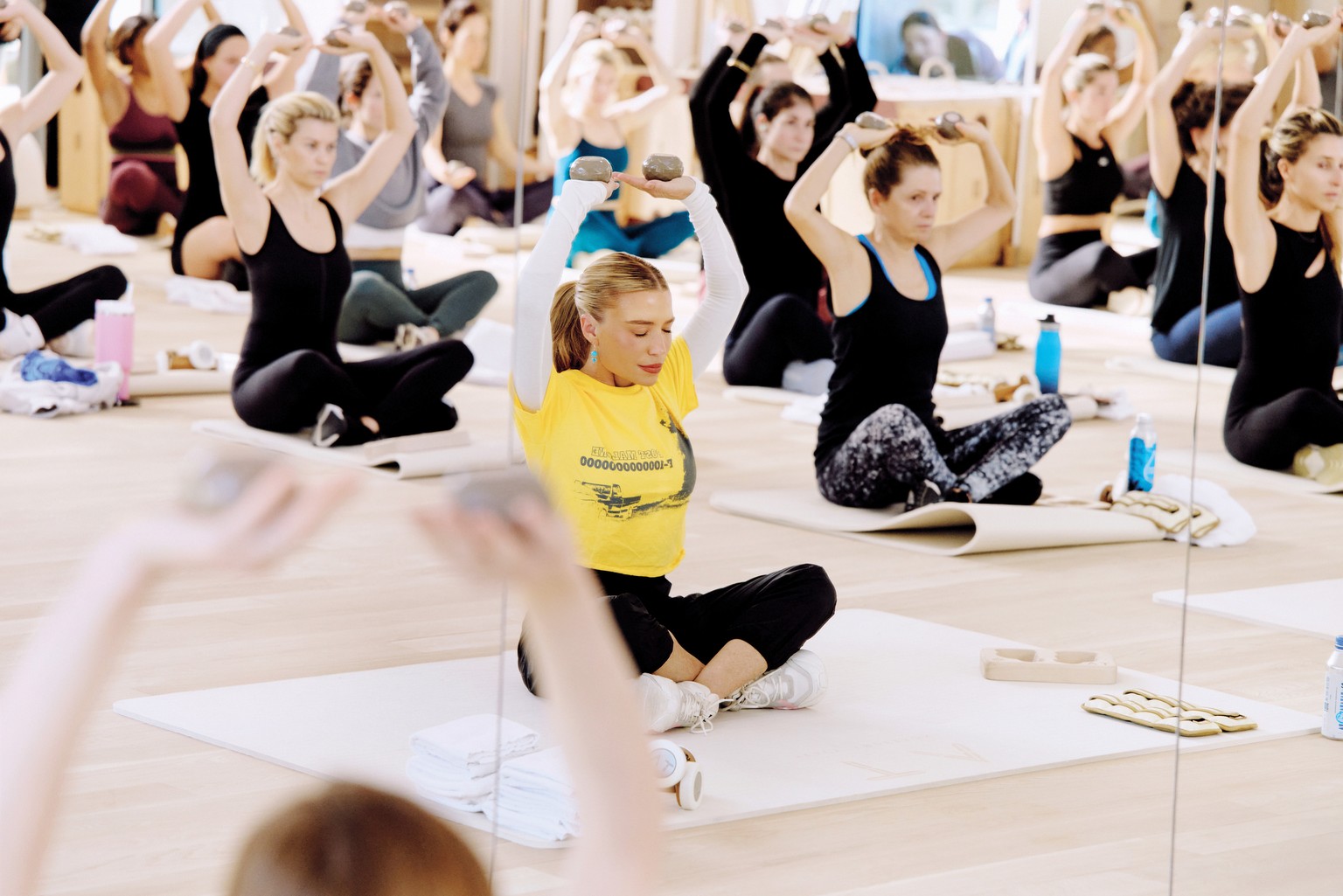
Each day, thousands of women, myself included, engage in a ritual. We flail our arms like orchestra conductors. We wiggle our rib cages. We get down on all fours and raise our knees to our ears. We roll on the floor. For up to 90 minutes, gathered together at studios or in front of our laptops, we perform The Method. We “do Tracy Anderson.”
The workout is not Pilates. It includes dance cardio, but it is not dance cardio. Though some moves are inspired by ballet, it is not the Bar Method. Anderson, who rose to fame training celebrities such as Gwyneth Paltrow and Madonna, does not wish to be referred to as a trainer. She describes herself as a “self-made scholar” and an artist who has created a “canon of work.” The movements, she told me, are a combination of choreography (“being creative with the biomechanics of what’s possible in our body”) and science (understanding movement from “a body and energy perspective”).
Explore the July 2025 Issue
Check out more from this issue and find your next story to read.
View More
Wander around the Hamptons or Tribeca and you might notice solitary men in T-shirts explaining their solitude: MY WIFE IS AT TRACY. Ordinary people like me can do prerecorded workouts online for $90 a month, but membership at one of Anderson’s studios is a status symbol, the fitness equivalent of waterfront property. Her empire includes eight locations: in Manhattan (one in Tribeca and one in Midtown), the Hamptons (one in Water Mill and one in Sag Harbor), Los Angeles (one in Studio City and one in Santa Monica), and Madrid. Her newest studio is in Bozeman, Montana.
Advertisement
Studio membership costs upwards of $10,000 a year. Many clients spend far more, opting for private sessions designed by the Prescription Team. If you want to train with Anderson in person, you can book a spot during “Vitality Week” (actually a long weekend) for $5,000. I know one woman—a successful entrepreneur married to an even more successful financier—who budgets $36,000 a year for her Tracy Anderson body. (For the record: She looks amazing.)
In addition to legions of rich wives and women who work in the beauty and fashion industries, fans of The Method include celebrities and entrepreneurs: Tracee Ellis Ross, Jennifer Lopez, the power Realtor Claudia Saez-Fromm, the New York City political lobbyist Suri Kasirer. When the cash-strapped developer Brandon Miller committed suicide last year, many blamed it on the pressure that he and his wife felt to keep up with their Hamptons neighbors. She did Tracy Anderson every morning.
I’ve heard rumors of powerful women threatening to blacklist people from joining the studio. I’ve heard that byzantine rules govern the hierarchy of spots near the front of the class. For years, the tabloids have been full of stories about feuds between Anderson and former trainers she believes stole her moves. She built an empire on the perception that she was a glamorous fitness doll, and now she doesn’t want to be perceived as a glamorous fitness doll. She wants to be taken seriously.
Xochitl Gonzalez: In the age of Ozempic, what’s the point of working out?
Anderson’s goal is to transform how people think about the mind and the body, and to prove that her workout is her own intellectual property, both an art and a science. She’s created “thousands” of moves, she told me, and “done actual studies.” She compared herself to Leonardo da Vinci, who, just like her, “used his scientific knowledge to enhance his art.”
Advertisement
Tracy Anderson devotees can buy clothes in her workout line, or her exact ankle weights, or Tracy Anderson magazine, which includes testimonials from famous studio members, plant-based recipes created by a team of chefs, and photos of Anderson modeling thousand-dollar designer sweaters over workout gear. Her Instagram features slick videos of Tracy Anderson, the trainer, performing Tracy Anderson, The Method, while wearing Tracy Anderson, the brand. Yet there is very little of Tracy Anderson, the person, available. She existed for me—as she does for so many others—in her workout videos as a silent body in motion, upon which we could project our feelings about our own bodies.
And then, one day last November, I came face-to-face with her. This was no ordinary celebrity sighting. For years, I’d been emulating this woman’s every move. When she wiggled, I wiggled. When she shook her hips, I shook my hips. When she went into a full split and rolled backwards onto the floor before scissoring her legs in the air, I … waited for the next exercise.
Anderson greeted me at the door of her house in Brentwood, California, followed by a pack of beautiful dogs, including a cavapoo, standard poodles, and another breed I couldn’t place. It turned out to be the product of the male cavapoo and a female poodle that had fallen “madly in love,” according to Anderson. When they “anatomically could not express themselves to their fullest ability,” Anderson asked science to step in. “They deserve to be helped because they were trying so hard to procreate that his, like, his male parts were bleeding.” The poodle was artificially inseminated, and they went on to have eight puppies.
Her way of speaking—warm and Midwest-earnest—makes even something as outrageous as doggy IVF seem like a gesture of compassion. In that moment, all I felt was happiness for those dogs. Shouldn’t we all be able to express our love?
Anderson grew up on a small ranch in Noblesville, Indiana, surrounded by goats, geese, and turkeys. Her mother ran a dance studio. Her father worked in his family’s furniture business, but was also a poet and chess enthusiast. Anderson described the household as “sometimes middle-class, sometimes not.” One day she’d be told she could buy new school clothes; the next, she’d be told the family was out of money and she’d have to return them. Her parents had dueling ambitions for their daughter. Because she was good at chess, her father imagined her as a future lawyer. But because she excelled at dance, her mother imagined her on Broadway. For a time, her mother’s plan won out.
Advertisement
At 18, she moved to New York to study at the American Musical and Dramatic Academy. It was the early ’90s. She found a job at the Gap and lived on $5 ATM withdrawals and H&H bagels with mustard and tomato because she couldn’t afford turkey. Just 5 feet tall, Anderson didn’t have the “dancer’s body” she was told she needed. She dieted, considered taking up smoking, and eventually, demoralized, left school.
She got engaged to the former NBA player and Hoosier legend Eric Anderson, whom she had met while playing a cheerleader in the movie Blue Chips. In a few years, they were married; living in Indiana with their son, Sam; and running a facility for youth sports and dance. They were young and inexperienced, and fell behind on rent and closed the facility. They opened a Pilates studio, then closed that too. In February 2005, judges ordered the Andersons to pay $334,375 in unpaid bills. In April, they filed for bankruptcy.
But Anderson also co-owned another studio that had a branch in Los Angeles, and she was developing her theories around fitness. She had long been fascinated by Olympians, such as swimmers and gymnasts, whose physiques were shaped by the repetitive motions of their sports, and wondered if she could design a series of movements to shape the dancer’s body that had long evaded her. After what she describes as a period of research and study, she came up with a program to strengthen the major muscle groups while working smaller “accessory” muscles through a series of repetitive rotations and movements. In L.A., she introduced clients to a piece of modified Pilates equipment she called the Hybrid Body Reformer. One of these clients happened to be the wife of Gwyneth Paltrow’s agent at the time, Anderson told me. Paltrow, who’d recently had a baby, complimented the woman on her body. When Anderson tells her own story, this is usually where she begins.
Anderson has been famous since 2008. That year, in London, paparazzi photographed her with Madonna and Paltrow, both in sweaty workout gear. Suddenly, she was not just a trainer to the stars but the trainer to the stars. These were the glory days of celebrity magazines and gossip blogs, and Anderson was ubiquitous, proselytizing about how to get J.Lo’s butt or Gwyneth’s … anything. “I’m giving you Gwyneth’s legs right now,” she told a beauty reporter during a workout. “Trim and Trimmer!” a headline read.
In 2008, Paltrow invested in Anderson’s business. Anderson started planning another studio in New York and headed to London, to train and tour with Madonna. That same year, she and Eric divorced, and she released the Tracy Anderson Method: Mat Workout DVD, which laid out her fully developed theories for the first time.
Advertisement
Tracy Anderson and Gwyneth Paltrow at a 2019 event in London for Paltrow’s wellness and lifestyle company, Goop (Darren Gerrish / Getty)
“Genetically, we are all shaped differently, and we all have our own set of problem areas,” she says in the introduction. “The good news is it’s completely possible to reengineer your muscular structure any way you want”: to get “teeny tiny” arms and “feminine” abs and thighs without “bulking.” Central to the workout was silent instruction—she demonstrates the moves without speaking—and a near-torturous number of reps with very, very light weights.
The celebrity-lifestyle-obsessed late aughts were an ideal environment for what Anderson was selling. Fixating on “problem areas” was seen not as self-loathing, but as self-empowerment. Talking explicitly about working hard just to get skinny sounds awkward now that we live in an era that celebrates wellness and body positivity. Anderson seems to regret her role in the 2000s skinny-industrial complex, when she would tell people, “Let’s go; you can get teeny tiny!” But she said she had no choice: “I had to contribute to it too, or else nobody would do my workout.” Besides, “you can’t change a culture before it’s ready.”
Now any one of Anderson’s clients could be on Ozempic or Wegovy if she wanted to, and Anderson has to offer something beyond thinness. But although the way she talks about the moves has changed, the moves themselves have not.
Clients go to her because they “know that their body’s going to look the best that it can look,” she told me. “And they’re not going to go anywhere else, because they know how smart I am.”
Anderson is 50, a thrice-married mother of two. She doesn’t like to talk about hard times, but she’s definitely had them. Eric Anderson died in 2018 of a heart attack. “He was such an incredible human being and he was such an incredible father,” she told me. She said she always thought they might end up back together someday. Having to tell Sam that his father was dead was “the worst moment of my actual entire life.”
Advertisement
Two years after Eric died, during the early days of the coronavirus pandemic, the father of Anderson’s younger child, Penelope, died too, of a brain tumor. “I did not have the relationship with Penny’s dad that I had with Eric,” she told me. But she took Penelope to see him before he died, and thanked him for the gift of their daughter: “Penny’s part of both of us. And she’s extraordinary.”
When I pressed her to say more about what she’d learned from her experiences of loss, she told me she’d become “very understanding of people’s journeys”—even “the people that steal from me.” She said she always asks herself, “Gosh, what happened to them as a child?”
The fact that Anderson has experienced death and divorce, debt and failure, is one reason I was drawn to her. I could relate. I divorced as a young woman, and I ran a small business through the Great Recession, and I was sick to my stomach for years worrying about the possibility of bankruptcy. Starting a business, losing a business, starting a new one—this is what entrepreneurs do. I also knew from experience that if you’ve spent years fighting for your business’s survival, you don’t take kindly to anyone you see as stepping on your turf.
I came to Tracy Anderson sometime in 2009 or 2010. My grandfather, who’d raised me, had just died, and I had been working frantically to save my company. In the process there had been a lot of stress eating and crying on my sofa, and the resulting weight gain created a new wave of sadness as I felt lost inside myself and my grief. I had seen Anderson in celebrity magazines and turned to one of her DVDs.
The Method made me thinner. But it also made me feel incredible. The choreography was so unusual—and the work so intense—that it required my full concentration, which eased my anxiety and helped me feel present in my body. Unlike yoga, where you were constantly being instructed, or fitness classes, where you were being “motivated,” Anderson didn’t talk at all, something I found incredibly soothing.
Advertisement
I have strayed over the years. I craved the dark, loud music of SoulCycle; I wanted to try running a marathon. I was making a TV show and was so sedentary, for so long, I developed sciatica and a slipped disk. But I’ve always come back to Tracy Anderson. (“Most of them always come back,” she told me.)
Read: The workout that actually makes me happy
Anderson herself interested me, but I was hardly a member of the #TAmily, as fans have branded themselves online. (The hashtag is shared, a bit awkwardly, by the Tamil diaspora.) You’ll see gushing comments about how Anderson changes women’s lives, or questions about what brand of sneakers she’s wearing. “What a gift to learn from you,” one fan wrote on Instagram. “You talk to us like that beautiful sister that loves you so much and wants the very best for you,” wrote another.
Anderson says she doesn’t want to be a guru. Of the women who credit her with changing their lives, she said: “No, no, no, no, no. You don’t have me to thank; you have you to thank.” But in many ways, she encourages her clients’ feelings of intimacy. Occasionally, she’ll get on Zooms with dozens of studio members that are then preserved in a section of her website called “Conversations.” Women ask Anderson for advice on their diets and workouts and lives, but for a lot of the time, Anderson simply listens. If her Instagram videos are slickly produced, these calls are remarkably DIY. And long. One call last year ran for five hours.
Other aspects of the business remain frustratingly (or charmingly) mom-and-pop. Products—such as Kenko, four-pound minimalist weights made of Canadian maple—appear with great fanfare and then are rarely spoken of again. Members who pay (a lot!) to livestream classes often complain that they start late. Had someone forgotten to turn on the camera?
Advertisement
Many of Anderson’s peers have been bought out by wealthy corporations or private-equity firms. Barry’s (formerly Barry’s Bootcamp) was co-founded by Barry Jay in 1998 and is now owned by Princeton Equity Group, among others. SoulCycle was founded in 2006 by a spin instructor, Ruth Zukerman, and two of her clients before it was acquired by Equinox in 2011. Even CrossFit—known for its spartan gyms—was taken over by Berkshire Partners.
Anderson at her home on Long Island, New York, March 2025 (Caroline Tompkins for The Atlantic)
“To me, being bought someday by private equity is not in my—I don’t even hold space for that,” Anderson told me. “I’ve had people with their M.B.A.s mess up my business,” she said. “Fancy educations—Wharton on there, Stanford on there, Harvard on there.” But they didn’t have the right mindset, she said. Was she a control freak? “I’ll tell you what I was,” she replied. “I was a wild fucking stallion.”
Now she is married to Chris Asplundh, a scion of the Pennsylvania-based billion-dollar tree-trimming empire Asplundh Tree Expert. (Mehmet Oz is a relative through marriage; he used his in-laws’ address for his voter registration before his failed bid for a Pennsylvania U.S. Senate seat.) Asplundh bought out Anderson’s other investors. “This is a family business now,” she told me.
Anderson’s employees describe themselves as a family, too. Steven Beltrani, the company’s president, walked her down the aisle when she married Asplundh. Employees’ Instagram accounts are full of loving posts about one another. But every family has its fissures.
Megan Roup was hired to work for Anderson in 2011. Roup was a member of the #TAmily for six years—schooled in The Method and given access to training manuals and Anderson’s celebrity contacts. All of these surely proved valuable when Roup left and opened the Sculpt Society, a mostly online fitness class.
Roup quickly amassed many clients, some of whom—including the Victoria’s Secret model Shanina Shaik—had formerly trained with Anderson. When the pandemic forced fitness online, more people found their way to Roup. Anyone familiar with Anderson would recognize many of her signature moves in Roup’s workouts. Roup’s website stated that she had “seen something missing in the fitness industry,” and sought to fill this void. Anderson saw contractual violation and theft—and the latest in a long string of betrayals.
Advertisement
For nearly as long as Anderson has been famous, she has worried about her former trainers stealing her moves and clients. For good reason. By 2014, so many Anderson apostates were operating in New York City alone that one blogger took the trouble to rate them according to their “Level of Tracy-ness.” Anderson describes herself as “low conflict.” But most anyone who does her workouts and listens to the chats she delivers after class will be familiar with her bitterness toward the “rip-off trainers” who keep “stealing” her work. The frustration, at times, sounds more like paranoia.
Anderson didn’t name names publicly, but the tabloids were happy to report on her scuffles: The Daily Mail, for example, quoted an anonymous source saying that Nicole Winhoffer, who launched a DVD collection with Madonna’s backing, was “overweight” before she started training with Anderson, and that she didn’t “understand the reasons behind the moves, just the motions.”
In 2022, Anderson brought a lawsuit against Roup and her business through her parent company, Tracy Anderson Mind and Body, for breach of contract and copyright infringement, among other claims. Anderson attributed her new aggressiveness toward Roup to finding “my voice,” and the wisdom she’d gained in her 40s. Also likely helpful was the cash infusion her new husband offered the business.
But by bringing the case to court, Anderson has subjected her own workout to new scrutiny. When I set out to profile one of the most famous women in fitness, I never imagined I would have to learn so much about copyright law. Yet here we are. Copyright is designed to protect creative expression. Performance choreography is considered creative expression and has been protected by copyright law since the 1970s. Physical fitness is not. In their defense, Roup and her team relied on a copyright-infringement case brought against rival studios by Bikram Choudhury, the inventor of a series of yoga poses performed in a hot room. The court had dismissed Choudhury’s case on the rationale that the poses involved were not creative art, but “functional” movement.
A federal judge in California tossed out Anderson’s copyright claim for similar reasons. Anderson calls her program a “method,” the judge pointed out, and methods are exempt from creative-copyright protection. In addition, he wrote, Anderson says her Method is the result of research and markets it as “designed for the purpose of improving clients’ fitness and health.” Functional movements, in other words, just like Choudhury’s.
Advertisement
Anderson ultimately settled with Roup on the breach-of-contract count for an undisclosed amount, but she is appealing the copyright decision. Amanda Barkin, an IP attorney at FKKS in New York who has been observing the case, told me that Anderson’s accusations will be hard to prove. Roup is “allegedly incorporating these choreography and other elements from The Method that she learned through, like, the confidential employee handbook,” Barkin told me, but those moves are also “all over TikTok, so I don’t know how confidential a lot of it is.”
I wondered, when speaking with Barkin and reading the court summation, if I detected a whiff of dismissal. At the end of the day, these are just women’s workouts—things of vanity—so what’s the big deal? A male attorney, writing about the case on the FKKS blog in 2023, noted that although Anderson faced an uphill battle, at least she had the glutes for it.
In a statement, Roup’s lawyer, Nathaniel Bach, called Anderson’s lawsuit “ill-conceived and frivolous” and insisted that Roup had “developed The Sculpt Society on her own.” But the judge’s decision to toss out the copyright claim, he wrote, was “a significant victory both for Megan and the whole fitness industry, as the Court’s rulings reaffirm that no one can claim ownership over physical exercise or dance cardio.”
Whether or not some of Roup’s moves are based on Anderson’s Method, the big question is if anyone can invent and own a fitness move in the first place. Evan Breed was a professional dancer for 10 years before she became one of Anderson’s master trainers. She told me she could understand why Anderson would object to someone “copying exactly the choreography of her dance cardio.” But that doesn’t apply to the more basic movements—the arm workouts and the muscular-structure work done on the mat. Dancers like her—and like Anderson and Roup—“grew up doing those rib isolations, moving your ribs side to side, moving the hips side to side.” The arm exercises, she said, are essentially what you do while warming up for a ballet class.
Anderson isolated the movements and shifted them down to a mat. But they did not come out of nowhere. Perhaps those Anderson accuses of theft feel they’re only doing what she did herself, and continuing her practice of reinterpretation.
Advertisement
Why, I wondered, did Anderson keep emphasizing her workout as a research-driven method, if that was exactly what was going to hurt her copyright case? Why did she insist on having it both ways? Maybe it was that original tension—between the Broadway chorus girl and the sharp attorney—playing out all over again.
There’s nothing particularly unusual about a trainer arguing that their program is more effective than others, but Anderson’s emphasis on her own research is notable. She started out with insights, she said, but she wanted proof. And so, in 2001, she began what she frequently refers to as “the study” or her “clinical study,” gathering “five years of quantitative and qualitative data from 150 women.”
Anderson leads a workout at her Water Mill, New York, studio employing her new HeartStones weights. (Caroline Tompkins for The Atlantic)
She recruited mothers who would drop their kids off at the Indiana youth center that she and Eric opened, along with other women, and provided them with choreography to shrink their problem areas. After the center shut down, she told me, she kept following up with the same women: For five years, every 10 days she would measure them in more than 28 different places and provide them with new moves. What she discovered in that process, she says, is the foundation of her Method.
Anderson insists that clients are coming to her because of this research. And it’s why she doesn’t feel bad about charging so much for it.
And yet the study is not, of course, an actual clinical study—it was not performed by independent researchers and was not submitted for peer review at an academic journal. When I followed up with Beltrani, the president, to ask if Anderson could share the data with me, he told me they were proprietary.
Even so, Anderson argues that only the close-minded would ignore her findings because she’s an outsider to the scientific establishment. What bothers her most is the idea that others are copying her moves without properly understanding the science. “To create my life’s work has taken so much research, so much focus, so many people believing in me financially. For me to be able to test, experiment, create, and do this, and for anybody, especially a woman, to come in, work for me, learn from me, leave, take me off their résumé, and steal from me?” Anderson’s voice was full of passion as she called this “morally bankrupt.”
Advertisement
Although Anderson wouldn’tsend me any of her data, she said, when pressed, that they included records in notebooks and Polaroid shots. She also agreed to put me in touch with one of the women she’d trained in the early days of her career.
Julie McComb is a mom and teacher with a bakery business in Westfield, Indiana, and she’s remained friendly with Anderson ever since she started training with her in the mid-2000s. Back then, McComb was new to the area, and Anderson was Indiana famous.
Chatting with her dentist during an appointment one day, McComb mentioned that she liked to work out. The dentist said, “I have to tell you about this girl. She’s amazing. She’s fabulous. She’s the best in the area.” She has “this whole philosophy,” the dentist added, “and she’s done all this research.”
“I remember her lifting my shirt up,” McComb told me, and Anderson saying, “ ‘Oh, we’re going to take care of this, and we’re going to do this, and we’re going to shrink this in, and get this smaller,’ and her hands were all over my body.” McComb started to laugh, she told me, because “my problem areas were always—even when I was in high school—the sides of my hips. I said, ‘Tracy, there’s nothing we can do about this.’ ”
But Anderson made her personalized workout routines every couple of weeks, and she used a tape measure to track her progress, “and Tracy literally took me from a size eight to a size zero.”
Advertisement
When McComb became pregnant with her son, she did The Method all through the pregnancy. Anderson recommended her own ob-gyn. It was such an incredibly easy birth, in McComb’s telling, that she looked up at the doctor, surprised that it was over already. “He laughed,” she told me. “And he says, ‘Julie, that’s because you’ve been working out with Tracy Anderson.’ ”
McComb had known that Anderson was gathering research but wasn’t aware that the measurements she took from her were part of the “study” she’s been talking about ever since. But she didn’t seem to mind. She told me she’d had a minor stroke and some surgeries for a heart arrhythmia a few years back, and had largely stopped exercising. She’d gotten back into The Method after that, but then dropped off again. She would have liked to do online workouts, but she and her family had moved into a smaller house and there wasn’t enough space. She feels bad about gaining weight, she told me, but what she truly misses is how The Method made her feel, and “the environment and the sisterhood that we all had when we were there.”
She said, “It was more than a workout.”
For months leading up to my visit to Brentwood, Anderson had been promoting her latest product, HeartStones—a set of 2.8-pound beveled spheres beset with a circle of rose quartz that were meant to be lifted through a series of slow-burn, tai chi–like movements. They were made of iron, and they were going for $375. I could not imagine why even the most devoted of devotees would buy them. “Sis you have lost your damn mind,” read one comment on Instagram. I hoped to ask Anderson about the HeartStones during our meeting.
But first we talked about climate change, and inequality, and the reelection of Donald Trump. Anderson rarely discusses politics publicly. She knows that she serves women on both sides of the partisan divide. When she posted on Instagram about supporting Kamala Harris last fall, one angry user wrote on her website that Anderson had “abused her position,” adding that she was supposed to be “a trainer, not a guru.”
Advertisement
But Anderson sees politics as a wellness issue. “I cannot stand the hate. I cannot stand the division,” she told me. “That is so unhealthy for us.” Over lunch (a vegan fried-green-tomato salad) she talked about “how our nervous systems as women have been epigenetically so compromised” by living in a “system that is so corrupt and unfair.” Then we had to pause: A package from Goop had been delivered in the mail.
She went on to talk about how she had “creatively unlocked” women and enabled them to learn to “hear their bodies” and their “nervous systems” so that, when a woman’s husband asks, “What’s for dinner tonight, honey?” she can say: “Fuck you. Get your own fucking dinner.” She also expressed a wish that she could make her workouts more accessible to “people that are making a difference, like teachers, you know what I mean? Nurses, people who are underpaid and making a difference? They need it.” (She didn’t offer any specifics, however, for how she might do this.)
We talked, at last, about the HeartStones: She recommends that anyone who wants to lose weight start with the HeartStones, “because they have to hear their body.” They have to stop hating their bodies, their metabolism, “the fact that exercise might have been challenging for them.” If they hate themselves, they will “always feel miserable. They will not feel better even if they’re thinner.” It seemed like sound advice, though I still had no idea how the weights themselves were supposed to achieve these goals. I think she could tell I was skeptical.
When it was time for me to leave, Anderson packed up some gluten-free chocolate cake that her chef had made and some flowers that had been on the table and—oh, also, why not throw these in?—a set of HeartStones from her personal stash. She asked her husband to walk me to my car, and it was only on the drive home that I realized I’d just accepted a gift of significant value from the subject of a profile—something forbidden by the ethical codes of journalism. I had to return the HeartStones! But this was Los Angeles; I was already on the 405—I couldn’t just turn around. I decided that I would mail them back.
But not before I tried them. I wanted to dismiss them as silly and frivolous and overpriced. They certainly didn’t transform how I think about myself or my metabolism. But holding them had the soothing quality of a weighted blanket; the movements slowed my breathing and opened my chest and back. When friends came over, I would show them the HeartStones, tell them the price, watch them laugh, and then make them hold them. I’d show them a few movements. They’d mimic me mimicking Tracy. No one wanted to give them back. Including me: I forked over the money to keep my weights.
Advertisement
Like much of what Anderson is selling, the HeartStones remain a mystery to me. If they have any grounding in science, I have no idea what it is. But they feel nice, and my arms look better.
Anderson is still appealing the case against Roup, though when we spoke a few months ago, she expressed some doubts. She didn’t really care about Roup, she told me; she cared about fighting a system that tries to “narrow artists.” What if, she suggested, “I want to make a Broadway show about what I’m doing?” Then she could copyright the products of her creative genius, and no one could rip off her moves anymore.
I’m still not sure if she was kidding.
This article appears in the July 2025 print edition with the headline “The Tracy Anderson Way.”
“Forget living longer, exercise can make life easier right now”—a 72-year-old fitness influencer and marathon runner shares two accessible ways to start moving
Retirement is often a time when people slow down, but in Christine Hobson’s case, she’s speeding up. When her daughter persuaded her to join a running club so she wouldn’t get bored, she had no idea she’d get the fitness bug and run 125 marathons in total, visiting all seven continents.
And the 72-year-old former teacher has plans to run the North Pole marathon in 2027.
Hobson, who believes that exercise is the best anti-aging hack, tells Fit&Well: “I think what makes you old is not doing anything and just being sedentary, sitting around watching TV all the time. I really believe the less you move, the less you’re able to move, so when I retired at almost 61, I decided that my new job was to get fit.
Latest Videos From
“Aging isn’t just about age—if you make life easier now, the future will look after itself,” she says.
Hobson, who strength trains too, has since become a fitness influencer, amassing over 132,000 followers on Instagram, where she shares workouts and her thoughts on exercise.
“I get loads of messages from people who are scared to exercise because they don’t want to fall over and get injured,” she says. “But getting stronger builds your confidence and means that you can do the things you want without needing help. It’s not about living forever. And it’s never too late to start. You’ve got to start from where you are.”
Here shares her two best tips for getting started with fitness, whatever your age.
Start your week with achievable workout ideas, health tips and wellbeing advice in your inbox.
1. Perform the sit-to-stand exercise
Hobson says an essential exercise to incorporate into your day is the sit-to-stand—a move that involves sitting and standing up from a chair without using your hands.
To build your strength, Hobson suggests doing the sit-to-stand 10 times each time you walk past a chair in your house. Once you’ve got the technique, she recommends trying it from a lower chair or couch to make it more challenging.
Advertisement
“The sit-to-stand is critical,” says Hobson. “If you can do that, that’s the thing that’s going to keep you independent in your own home. Because if you live alone and you can’t get up, then how are you going to look after yourself independently? The next thing will be that you can’t get out of your bed, and then you’re in trouble.”
Hobson began with the sit-to-stand exercise, and has progressed to squat with a 35kg barbell and deadlift 75kg.
Many people think motivation will just appear, says Hobson, but she says: “There’s no such thing as motivation really. It’s discipline. It’s building a habit. You’ve got to book your workouts in like a meeting at work, which is what I did when I retired. I prioritized fitness like a job.
“I also have my workout clothes ready to make sure I exercise—even if I’m planning to do it later in the day. I get dressed so I can’t talk myself out of it.”
Advertisement
2. Walk a mile a day
If you’re totally new to exercise, or returning after a long break, Hobson says walking is an excellent place to start.
“We are a species that is supposed to move, and even a short 20-minute walk will support your heart, your ability to control your blood sugar levels, and help you mentally and physically,” she says.
Her trick is to listen to audiobooks while she walks to encourage her to go further.
“This is how I started before I ran my first marathon,” she says. “I walked a mile a day and I really forced myself to do it come rain or shine. After about five or six weeks I found that I wanted to go more.
“And one of the things that helped was listening to audiobooks. If I got home and I had got to an exciting bit in the book I would have to go back out again to hear the next chapter so it would make me walk a bit further.”
Advertisement
Hobson describes herself as a run-walker, saying she has completed all her marathons that way. “I started exercising for something to do when I retired. Now I do it because it makes life easier.”
CrossFit means a lot of things to a lot of people – because it’s made up of a lot of things.
Since the rise of the fitness giant, countless brands, events and training methods have sprung up around it – not claiming to be CrossFit, but looking suspiciously CrossFit-esque.
There are, however, a handful of things that are uniquely CrossFit: the ‘Girls’ benchmark workouts. The Hero WODs and, of course, its signature rep schemes.
Chief among them is ’21-15-9′.
The 21-15-9 rep scheme may just be the single most CrossFit thing in existence. But what exactly is it? Where did it come from? And why might it actually be better at building muscle in a hurry than its conditioning roots would have you believe?
Advertisement
Let’s have a look.
What Is 21-15-9?
If you’ve never encountered it before, the format couldn’t be simpler. Choose two exercises (occasionally more) and perform 21 reps of each, then 15 reps of each, then nine reps of each, completing the entire workout as quickly as possible – with good form.
Probably the best-known example is ‘Fran’: 21 thrusters and pull-ups, followed by 15 of each, then nine. On paper it doesn’t look especially intimidating. In practice, it’s one of the most feared benchmark workouts in fitness.
Where Did it Come From?
Unlike many modern training methods, 21-15-9 didn’t come out of a study. It came from the gym floor.
CrossFit founder Greg Glassman has explained that the format emerged through years of coaching and experimentation in the 1990s. Rather than chasing a perfect sets-and-reps prescription, he was looking for a workout that allowed athletes to maintain a high power output from start to finish.
Advertisement
The thinking is surprisingly elegant. You begin with 21 reps while fresh. By the time you reach the set of 15, your ability to produce force has already fallen. By the final nine, you’re significantly more fatigued – but the workload has dropped by almost the same amount.
Instead of grinding through increasingly miserable sets of the same length, the workout ‘meets you where you are’, reducing the work required as your capacity declines. The result is a workout that encourages you to keep moving instead of standing around trying to recover.
The numbers themselves are also remarkably practical. Forty-five total reps per movement provides plenty of training volume without turning the session into an endurance slog, while every set divides neatly into thirds if you need to break it up.
(Although I’ve got to be honest, I’m a 20-15-10-5 man myself, just for the sake of round numbers.)
Why Does it Work So Well?
Although there isn’t research showing that 21-15-9 is somehow the magic formula, there are obvious reasons why it consistently produces brutally effective workouts.
Advertisement
Descending reps help maintain intensity. As fatigue accumulates, reducing the target allows movement quality, bar speed and overall work rate to stay higher than they would if you simply repeated the same number of reps over and over.
It also tends to land in a physiological sweet spot. Most 21-15-9 workouts take between three and eight minutes, depending on the movements and the athlete. That’s long enough to create a serious cardiovascular challenge while still requiring meaningful force production throughout. You’re taxing your anaerobic systems hard while relying on your aerobic system to help you recover just enough to keep going.
Finally, there’s the psychological trick. The hardest-looking part comes first. Once you’ve survived the opening 21, every remaining round appears more manageable. ‘Only 15 left.’ Then, ‘Just nine.’ In reality, you’re becoming more fatigued with every rep, but the shrinking target keeps you attacking the workout instead of pacing too conservatively.
Why it Might be Surprisingly Good for Building Muscle
Perhaps the biggest misconception about 21-15-9 is that it’s ‘just cardio with weights’.
Choose the right load and something interesting happens. Very few athletes complete every round unbroken. Instead, the workout naturally evolves into a series of short, broken sets separated by only a few seconds of rest.
Advertisement
Your 21 might become 11-5-5. Your 15 becomes 8-4-3. Your final nine might stay unbroken – or become 5-4.
In effect, you’ve accidentally turned the workout into a form of rest-pause training.
Those brief pauses allow just enough recovery to squeeze out more high-quality repetitions before fatigue catches up again. By the latter stages of each mini-set, you’re repeatedly working very close to failure, recruiting the high-threshold motor units with the greatest potential for muscle growth.
It’s a similar principle to rest-pause training, myo-reps and cluster sets: all methods used to accumulate hypertrophy-friendly volume while keeping the load relatively heavy and the rest periods brutally short.
You’re basically speed-running a large number of hard, growth-stimulating reps in a very small window of time. Could this help explain why elite CrossFit athletes often carry an impressive amount of muscle despite spending relatively little time performing traditional bodybuilding splits?
Advertisement
It’s certainly plausible, although the ‘elite’ part often selects for athletes with the greatest muscle-building potential.
Much of their training isn’t simply conditioning. It’s high-density resistance training performed under accumulating fatigue, with only fleeting recovery between efforts. In other words, they’re often doing something bodybuilders have deliberately programmed for decades: packing a lot of hard work into a very short period of time.
That’s not to say 21-15-9 is superior to a well-designed hypertrophy programme. If your sole goal is building muscle, there are more efficient ways to do it.
But if you’re looking for a workout that develops fitness, tests your mettle and still provides a meaningful stimulus for strength and size, it’s easy to see why this deceptively simple rep scheme has remained one of CrossFit’s defining fingerprints for more than 20 years.
Best Bodyweight 21-15-9 Workout: ‘JT’
If you’re looking for an interesting twist on the 21-15-9 format, look no further than Hero WOD ‘JT’, which concentrates the muscle-building potential of the format into a brutal upper-body workout.
Advertisement
Created in honour of Petty Officer 1st Class Jeff Taylor, who was killed in Afghanistan in 2006, the workout strips away barbells altogether and relies solely on three bodyweight movements:
21-15-9 reps of:
Don’t let the lack of equipment fool you. The volume – 45 reps of each movement, 135 reps in total – combined with the descending rep scheme makes this a brutal upper-body test, hammering the shoulders, chest and triceps while demanding serious muscular endurance.
Better still, it perfectly demonstrates one of the biggest strengths of 21-15-9. As fatigue mounts and the sets naturally fragment, the workout begins to resemble one giant rest-pause set, allowing you to accumulate a huge number of hard, near-failure reps in less than 10 minutes.
If your goal is building an impressive upper body while developing serious work capacity, there are few bodyweight workouts that deliver quite so much bang for your buck, making ‘JT’ one of my personal favourites.
Advertisement
If there’s one thing Kori Sampson knows, it’s how to optimise your body composition for performance. To tap into his knowledge as an elite athlete and coach, we asked him to create a 4-week plan to help you move faster, recover quicker and keep pushing when the fatigue sets in – all while improving your muscle-to-fat ratio.
Ready to build muscle, burn fat and come out the other side looking, feeling and performing better? Click here to get 14 days of free access to the plan via the Men’s Health app.
The concept of ‘exercise snacking’ has never been more popular. Not only is it convenient and accessible, but there is solid scientific evidence that short bursts of physical activity can yield real benefits for our health. But can a swimming workout be an effective ‘exercise snack’?
A study published in the European Heart Journal found that just 15 to 20 minutes of vigorous physical activity a week (almost as low as two minutes a day) was enough to significantly lower the risk of heart disease, cancer and early death. The study defined vigorous activity as any exercise that leaves you out of breath and raises your heart rate, including swimming.
But does ‘exercise snacking’ really work in the pool? Unlike a short run, walk, or online workout at home, going for a swim requires a bit of effort beyond the swim itself, so we often want to spend longer in the pool to make the most of it. However, head of swim for David Lloyd Clubs, Nuala Muir-Cochrane, believes short swims are worth it: “If you only have 10 minutes, consistency matters more than volume. Even two or three short swims per week can improve swim fitness noticeably,” she says.
With that in mind, I added some 10-minute swims to my routine of strength training and yoga workouts for two weeks to see if it made any difference to my health and fitness. Here’s what I discovered, plus what experts told me about optimising a short swim to either energise, recover or relax.
Benefits of 10-minute swimming workouts
1. Aids muscle recovery
To make the most of my short pool sessions, I often paired them with a gym visit, realising that I’ll need a post-workout shower anyway, so I may as well take a dip first. According to Francesca Bagshaw, performance physiologist at Nuffield Health’s Manchester Institute of Health and Performance, a short swim is perfect for recovering after the gym, a run or exercise class because it combines low-impact movement with increased circulation.
Advertisement
“After a hard session, muscles can feel stiff and fatigued due to microscopic muscle damage, inflammation and metabolite build-up,” she explains. “Gentle swimming helps stimulate blood flow without placing additional mechanical stress on joints and muscles,” Francesca recommends keeping the intensity low to moderate if recovery is your goal, to promote mobility, relaxation and circulation, without additional fatigue.
Samantha Russo, master swim coach for Virgin Active, adds, “In the pool, the water holds most of your bodyweight, so your joints get a break, but your muscles are still working gently through a big range of motion. Because water gives soft resistance in every direction, an easy swim is like active stretching with a built-in massage for the muscles, so you loosen up rather than lock up.”
Sign up to our free daily email for the latest royal and entertainment news, interesting opinion, expert advice on styling and beauty trends, and no-nonsense guides to the health and wellness questions you want answered.
2. Supports muscle building
Water is around 800 times denser than air, making swimming (or any movement in water) an effective resistance workout. Your muscles need to work harder to propel the body through the water, and multiple muscle groups will be involved, including those in your arms, legs, back and core.
Advertisement
My fortnight of short swims probably didn’t help me gain muscle – the resistance of the water never changes, so practising progressive overload (gradually increasing the weight, as I can in the gym) isn’t possible. I would have to either increase my speed, distance or duration to do this. But I felt that my short swims did support gains from strength training in the gym. Maintaining muscle has been useful for staying strong, not just for my gym workouts, but also for my yoga classes and occasional run.
10 minutes might not seem like a long time, but if you’re headed for the shower anyway, why not throw in a quick workout?
(Image credit: Kerry Law / Future)
3. Boosts energy levels
While it isn’t my preferred timeslot, I would sometimes schedule a short, pacier swim in the morning to boost my mental and physical energy before work. If you prefer morning workouts, you might find that adding a short, fast swim after the gym or an exercise class will energise you for the day ahead.
Advertisement
Samantha is a fan of morning swims: “In the morning, your circulation and nervous system are still in ‘low power mode’, and a short swim acts like a full-body wake-up call,” she says. “The cold water stimulates your skin and nerves, your breathing and heart rate increase, and more oxygen-rich blood is pushed to your brain and muscles. That mix of oxygen, movement and endorphins clears brain fog and lifts your mood far better than a cup of coffee.”
Francesca adds, “For best results, morning swims should be kept relatively short and refreshing rather than exhaustive, particularly before work or further training later in the day.”
4. Lowers stress levels
Much has been discovered about the effects of immersion in water, and how it can induce an ultra-calming ‘blue mind’state. This is partly why I favour an evening swim, not just to avoid the busiest times at the pool, but to lower my cortisol levels and put a full stop to the day. This can have a calming effect on the nervous system, explains Francesca.
“Steady, rhythmic swimming encourages controlled breathing patterns and can help shift the body toward a more parasympathetic, ‘rest and digest’, state. This reduces physiological arousal and can lower stress levels after a busy day,” she says.
Advertisement
“Warm or temperate water can reduce muscle tension and promote peripheral vasodilation [widening of the blood vessels], helping the body feel physically calmer. The repetitive nature of swimming has a meditative effect for many people, supporting mental decompression and reduced cognitive stress.”
Samantha adds that some may find evening swims contribute to a better night’s sleep: “Your core body temperature rises slightly in the water, then drops as you shower and dry off, and that drop is a natural signal to your brain that it’s time for bed.”
5. Burns calories
The number of calories you burn during a swim will depend on various factors, including the duration, distance, intensity and your bodyweight. For example, according to Harvard Medical School data, someone who weighs 155lb could expect to burn approximately 200 calories over a 30-minute low-intensity swim, rising to 360 calories for a high-intensity 30-minute swim.
Just 10 minutes of swimming will amount to a third of that calorie burn, but the ‘afterburn’ – or excess post-exercise oxygen consumption (EPOC) – may help burn a few more. The ‘afterburn’ concept suggests that we consume more oxygen to help our bodies restore and repair following intense exercise, essentially burning calories at a greater rate. However, research suggests this amounts to just a handful of extra calories burnt.
However, I can be confident that spending an extra 10 minutes swimming in the evening burns more calories than my alternative (usually sitting on the sofa watching TV). It’s the same for a 10-minute walking workout.
Advertisement
10-minute swimming workouts to try
Multi-stroke sprint swimming workout
Nuala recommends this swim workout for beginner-intermediate level swimmers. “It improves cardiovascular fitness without the need for a long session, while using different muscle groups through the stroke changes. The easy swim at the end helps recovery and reduces stiffness,” she says.
How to do it:
For the first five minutes, alternate between front crawl, breaststroke and backstroke for one length each.
On every fourth length, sprint at your near maximum effort. Maintain controlled technique even when swimming faster.
For the final five minutes, cool down with gentle continuous swimming with whichever stroke feels most relaxed. Focus on long strokes with steady breathing and low effort.
Maintaining form is crucial, says Nuala: “For front crawl, keep your head still and look slightly downward rather than forwards; in breaststroke, glide briefly after each kick rather than rushing the strokes; and for backstroke, keep your hips high and do small continuous kicks.”
Varied swimming workout
Cheryl Pottinger, swim teacher for Better, suggests this 10 minute routine which goes up and down the speed scale over 300m (in a standard 25m pool).
How to do it:
Warm up with one length of front crawl, followed by one length of breaststroke at normal pace.
For your main set, swim front crawl with a 10 second rest after each practice, starting with one length at your maximum speed.
Follow it with two lengths at 80% of your maximum speed.
Shift down a gear for the next three lengths at normal pace.
Swim the next two lengths at 80% of your maximum speed.
Finish this section with one length at maximum speed.
Cool down with one length in a stroke of your choice at normal pace.
Recovery swim
As a gentle short swim to aid relaxation after a gym session, Cheryl recommends this sequence. It incorporates the lesser known side stroke, which is relaxed, energy efficient and builds core stability as it forces your midsection to engage as you balance on one side.
How to do it:
Advertisement
Warm up with one length of front crawl and one length of breaststroke at a relaxed pace.
Swim the next two lengths in side stroke, one length on the right side and one on the left. This stroke requires balancing on one side of the body, reaching forward with one arm while the other pulls back, and scissor kicking the legs. “Focus on the power in the muscles during the pull and kick, and the stretching of the muscles during the glide,” says Cheryl. Watch a demo here.
Finish with one length of steady-paced breaststroke, and a final length of head-first sculling (lie on your back using your arms to propel you backwards).
Tips for making the most of a 10-minute swimming workout
Make it your post-gym habit: All the effort involved in travelling to and from the pool, let alone changing in and out of clothes, may not feel worth it for just 10 minutes in the pool. So, I often tacked it onto the end of my regular gym session. If your gym has a pool, make the most of it and view it as part of your workout ‘cool down’ and recovery before showering and heading home.
Tailor your swim to the time of day: There are still benefits to be had if you take a relaxing swim in the morning, or a higher intensity swim in the evening, but you might be working against your energy levels. As Francesca recommends, a pacier swim early in the day can boost alertness, while a lighter intensity swim in the evening can aid post-workout recovery and sleep.
Choose quieter pool times: This goes for however long you wish to spend swimming, but having a lane all to yourself allows you to follow a plan without compromise. I find evenings are best for me but check your local pool timetable to avoid sharing space with unexpected aqua aerobic classes or school swimming lessons.
Bring a poolside kit bag: With just 10 minutes in the pool, you don’t have time to keep nipping back to your locker to fetch forgotten kit. Have a small kit bag pre-packed with anything you might need (think spare hairclips and hairbands, anti-fog goggle spray, kickboard and pull buoy if you’re using them), and keep it at the end of your lane (make sure it isn’t a trip hazard).