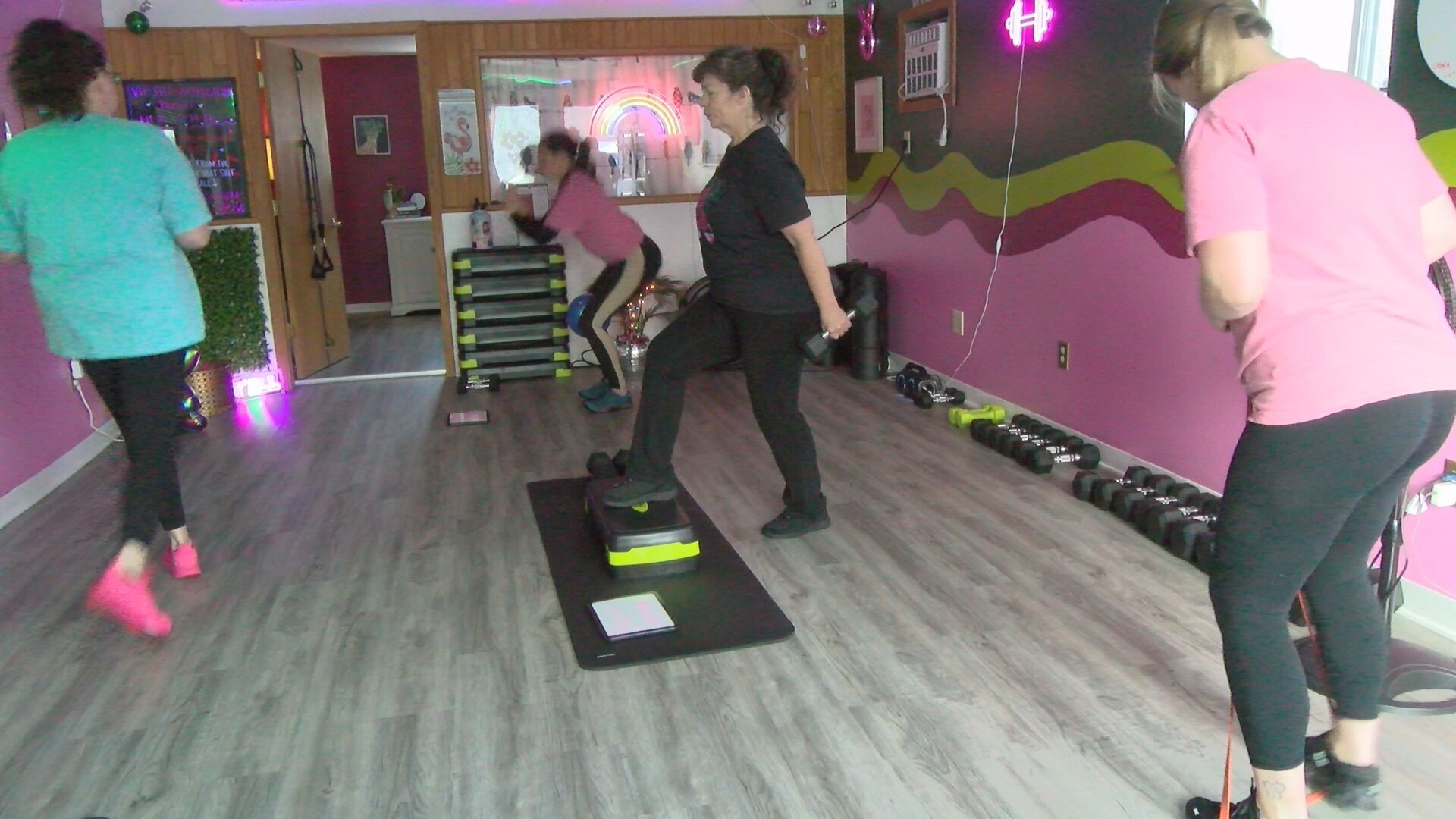
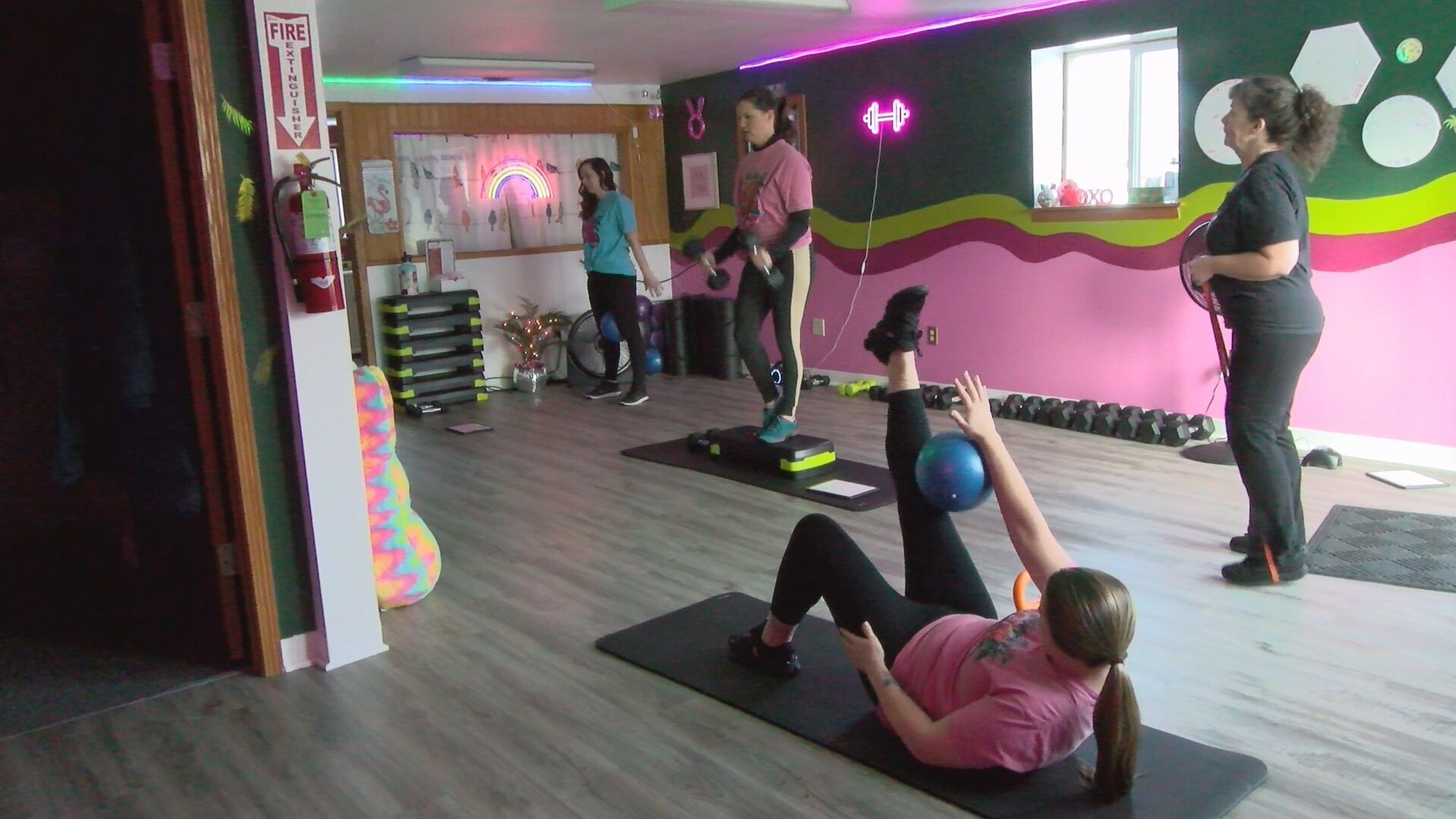
RHINELADER (WJFW) – Everyone knows exercising is good for you, but it can be intimidating to know where to start. A Rhinelander gym recently celebrated one year of motivating people of all shapes and sizes.
Resident Melissa Bayne-Allison wanted a workout space that was safe and fun, so that exercising was not something to dread but to look forward to.
Advertisement
“I wanted to create a space that was fun and that was exciting and would create,” said Bayne-Allison, “it would create consistency for people and make sure that they continued to show up for themselves.”
She started Club Vybz just over a year ago out of her home in Rhinelander, but it wasn’t quite meeting her goal.
“My husband and I drove past here and there was a for rent sign in the window and I had kind of been contemplating opening a space like this,” she said, “but I just didn’t know how to get that going.”
Advertisement
Despite that initial hesitancy, the new space has welcomed in many more people.
Bayne-Allison said, “people really come together, they joke around, they share things with people, you know people come in here and because this is a vulnerable position to be in, working out people do tend to share more about their lives in that and with that comes community and that’s really what this place is about.”
Club Vybz has 40 active members. Since opening, Bayne-Allison has seen how it helps people outside of the club.
Advertisement
She said, “some people come in here and their confidence might be low and coming in here and accomplishing a workout that they maybe didn’t think that they could do is really rewarding for them and that is a confidence booster and it does really help them go out into the community and do more for themselves.”
There’s one more thing she wants the community to know about Club Vybz.
“The hardest part of the workout is walking through the door, just show up for yourself, if you’re scared, come in, check it out, if the green light is on and the blue door is open, I’m here.”
Club Vybz Fitness is located in Rhinelander on Courtney Street. Hours for exercise classes are posted on the Club Vybz Facebook page.
It’s easy to overcomplicate your fitness routine, especially when you’re being bombarded by information on social media about how to optimise every aspect of your workouts. But improving your fitness and building strength doesn’t have to be complicated – as a new reel from fitness icon Suzi Jalowsky shows.
The 60-year-old shared how just 30 minutes of walking daily paired with three simple strength workouts can help women over 40 ‘look better, feel better and stay strong’ as they age.
‘This works,’ she wrote in the caption. ‘Consistency with the basics will take you where you want to be. We often look for complicated solutions, but the basics are what truly change your body.’
Suzi Jalowsky’s strength routine
To add to the simplicity of the workout, Jalowsky uses just two 12lb (roughly 5kg) dumbbells throughout – so you don’t need to spend hundreds of pounds on expensive equipment to get started.
The workout
How to do the moves
Stand with your feet hip-width apart and a slight bend in your knees.
Hinge at your hips until your chest is almost parallel to the floor, keeping your back flat and your shoulders down.
Hold a dumbbell in each hand with your palms facing each other and your arms hanging below your shoulders.
With a slight bend in your elbows, raise the weights out to shoulder height, squeezing your upper back and shoulder blades together.
Lower the dumbbells back to the starting position with control.
Stand with your feet shoulder-width apart, holding a dumbbell in each hand.
Bend over while bracing your core and keeping your back straight and chin tucked.
Draw the dumbbells towards your waist, keeping the elbow tucked into your side.
To complete the rep, extend the arms back to the starting position.
Stand with your feet hip-width apart, hands on your hips.
Take a big step back with your right leg, crossing it behind your left. Bend your knees and lower your hips until your left thigh is nearly parallel to the floor. Keep your torso upright and your hips and shoulders as square as possible to the wall in front of you.
Return to start. Then repeat on the other side.
Start with a dumbbell in each hand, arms down and palms facing your body.
Rotate each hand so your palms face forwards. Keeping a slight bend in the knees, activate your glutes.
Engaging your core to avoid any sway in the hips, bend your arms, lifting one of weights to chest height in a slow, controlled movement.
Keep your shoulders relaxed and down, and keep your head, neck and spine neutral. Don’t arch your back.
In another slow, controlled movement, lower the weight back down to your thighs by straightening your arms while raising the other one to your chest. Repeat.
Stand with your knees bent and lean forward slightly, with a dumbbell in each hand.
Keeping your back straight, bend your dumbell-holding arm 90 degrees at the elbow so your triceps are aligned with your back and your biceps are perpendicular to the floor.
Engage your core and your triceps and hinge at the elbow, lifting the dumbbell up and back as you try and straighten your arm. Your triceps should stay still; only your elbow moves.
Guide the weight upward until your arm is straight, pause, then lower back down slightly to begin your pulses.
Stand with your feet slightly wider than shoulder width apart, evenly distribute your weight, and turn your toes out to 10 and 2 o’clock. Hold a dumbbell in each hand.
Keep your core tight and chest tall as you inhale, bend your knees, and sink your hips down until your thighs are parallel to the floor.
Exhale as you drive through your feet back to an upright standing position.
Upright row
Stand with your feet shoulder-width apart, holding the dumbbells with straight arms in front of your legs. Your palms should face your body.
Engage your abs. Keep your chest up and eyes forward.
Lift the dumbbells up to mid-chest height or just below your chin. Keep your dumbbells close to your body by raising your elbows up and out to the sides.
Pause at the top, then lower with control to the beginning.
Serve the platter
Stand with your feet hip-width apart, holding a dumbbell in each hand.
Bend your elbows to 90 degrees, tucking them tightly against your waist with your palms facing upwards.
Slowly extend your arms out in front, raising them to shoulder height.
Pull your elbows pack to the starting position.
Start with your feet together, holding a dumbbell in both hands at your sides. Shift your weight to your left leg, with your knee slightly bent.
Hinge at your hips to bring your chest down while raising your right leg behind you until your body is in a line from your head to your right foot.
Reverse back to the starting position and repeat, then switch sides.
Star jump with squat
Start by standing with your feet shoulder-width apart and a single dumbbell held with both your hands in front of your chest.
In one movement, jump your feet out to the side and press the dumbbell over your head.
Jump your feet back in, bring the dumbbell back to your chest and lower into a squat. Continue by jumping your feet out to the side again and repeating the movement.
One of our most frequently asked questions here at Women’s Health? How to build muscle and burn fat at the same time. So, we asked superstar trainer Oyinda Okunowo exactly how to do it. In this 4-week plan – created exclusively for Women’s Health COLLECTIVE members – you’ll get the workouts and nutrition guidance needed to help you on your way to better body composition. Tap the link below to unlock 14 days of free access to Oyinda’s plan and start training today.
Get the plan
Advertisement
Lauren Geall is deputy site editor for Women’s Health UK and Men’s Health UK. She graduated from Exeter University with a BA in English Literature before studying an MA in Magazine Journalism at City, University London. She’s been writing about health, fitness and wellbeing for over five years, with a total of seven years in digital journalism. Prior to her current role, she worked at Stylist as the acting health and fitness editor. As well as being a keen runner, Lauren is passionate about women’s sport and can often be found cheering on Arsenal Women at the Emirates or keeping tabs on the Red Roses’ latest win.
Sue Barker may have stepped away from professional tennis in 1985 at the age of 29, but she’s continued to prioritise fitness and movement.
‘During the winter, I try to exercise at least three times a week at the gym, and in the summer I like to get outdoors. I love jogging, cycling and walking my dogs,’ the 1976 French Open champion and former world No. 3 told Express.
She shares her varied routine – which includes cardio, strength training and plenty of everyday movement (also known as non-exercise activity thermogenesis, or NEAT) – with her husband.
‘As a rule, Lance and I do a lot of exercise – we have two dogs to walk [twice a day], we cycle a lot and have a personal trainer we see a couple of times a week,’ the former long-time Wimbledon presenter told Sheerluxe.
‘So, I do keep fit. Lance plays golf and I’m thinking of taking it up, but I’ve been saying that for quite a few years…’
Advertisement
Despite retiring from both tennis and broadcasting, she remains drawn back to the court.
‘Going back to Wimbledon [in 2023] reignited my love for the game, so I’m going to play there on the grass,’ she added.
Sue Barker uses exercise to stay fit for life
Movement plays a central role in her approach to healthy ageing and maintaining her independence.
‘It’s vitally important to me that, even later in life, I stay fit and focused,’ she told Express. ‘For me, it’s a question of self-preservation. While I can’t fight time, I can help myself stay fit and focused through good nutrition and a healthy lifestyle.’
She also remains keen to embrace new experiences and make the most of the years ahead.
Advertisement
‘I can’t wait to see where my life is going to go from now on. Age is but a number,’ she told Riverstone Living. ‘I want to go out and do all sorts of things – I want to travel, I want to keep living life to the absolute full.’
How Sue Barker first fell in love with sport
Her love of staying active started at home.
‘My father was very sporty and played a lot of tennis,’ she told Sheerluxe. ‘He was also a very good golfer and, as a family, we did a lot of active things together like rowing and swimming. My siblings did all sorts of sports too and I learned to play tennis mainly with my sister.’
Playing tennis in an era before modern recovery methods and training techniques helped forge her into a resilient athlete.
‘We didn’t have the facilities and the training and the technique that goes with it now – the stretching, the ice baths,’ the former champion recalled.
Advertisement
‘We wore Green Flash tennis shoes that didn’t have any sponge in them at all, and we were using wooden rackets. Every part of your body ached.’
One of our most frequently asked questions here at Women’s Health? How to build muscle and burn fat at the same time. So, we asked superstar trainer Oyinda Okunowo exactly how to do it. In this 4-week plan – created exclusively for Women’s Health COLLECTIVE members – you’ll get the workouts and nutrition guidance needed to help you on your way to better body composition. Tap the link below to unlock 14 days of free access to Oyinda’s plan and start training today.
What if you could put on a suit that did your workout for you, a way to exercise without much time or effort? That’s the premise and promise of a hot and fast growing fitness niche called Electro Muscle Stimulation (EMS) training. Recent years have seen a slew of bestselling books focused on longevity, lifespan and wellspan, and almost universally, the doctors and researchers behind these have identified the extreme importance of growing muscle mass as we age, while singling out a specific health danger, visceral fat. The EMS workouts promise to tackle both of these hot button health issues and help users with more muscle, less fat, and to do it in sessions of 20 minutes or less a couple of times a week.
What Is EMS?
Can It Help You Get More Muscle, Less Fat?
EMS gyms, classes and workouts are relatively new and still largely off the public radar in the United States, but they have been popular in Europe and other parts of the world for decades. The oversimplified explanation of the concept is that an electric impulse causes an involuntary contraction of your muscle similar to but more intense than what you experience while lifting weights or doing other strength training, giving your muscle the exercise without you doing much. In the 1960s sports scientists in the former Soviet Union discovered that EMS could boost muscle strength quickly and used it to train elite athletes for the Olympics, and an article on this history in the Physical Therapy & Rehabilitation Journal reported that one Russian scientist found force gains of 40% in the elite athletes using the technology.
The first full body suits for EMS training werre invented in Germany, where the fitness trend is very popular. This is star German actress Laura Preiss doing her workout in a Berlin park. (Photo by Jens Kalaene/picture alliance via Getty Images)
dpa/picture alliance via Getty Images
In the 1980s medical devices using EMS for physical therapy and rehabilitation became commonplace, and if you’ve had knee or shoulder surgery you might already be familiar with the technology. In the beginning of this century the first full (mostly) body suits for workouts were introduced in Germany, spawning a massive new fitness trend—today there are thousands of EMS gyms across Europe and other parts of the world.
But as Brendan Kennedy, owner of EMS fitness brand Katalyst told me, in Europe these are sold as consumer electronics, whereas in the U.S. they are FDA-regulated medical devices, which greatly limited access for Americans. Katalyst was the first suit to get FDA clearance for sale to U.S. consumers and the first you could buy, while recent EMS gym chains in this country such as Body20, Manduu and Iron BodyFit provide class participants with suits. Katalyst has a model more similar to Peloton, where they sell the suit for use at home and support it with a robust app full of digitally connected classes, broken into four categories, strength, recovery, cardio and power, with many sub-options in each, such as abs or upper body.
Advertisement
In recent years technology has greatly changed the exercise and fitness industries. As a health minded person who wrote a bestselling book about food and what we eat, and whose life and work has been closely associated with outdoor sports, these are subjects I pay a lot of attention to. I recently wrote here at Forbes about the boom in high-tech exercise recovery, as well as an article about a science-driven fitness and longevity resort retreat in Palm Springs, and an AI enabled all in one home strength training platform. So, the promise of EMS training, supported by many recent scientific and medical studies, and tons of anecdotal evidence, got my attention.
A complete at home EMS training kit from Katalyst, the first company in the US cleared by the FDA to sell to consumers.
Katalyst
Fast, Low Impact Strength Training For More Muscle, Less Fat
The commonality between the at home approach and the studio classes is that just about all providers target workouts of 25 minutes or less, and as the Body20 website explains, “EMS training activates up to 90% of your muscle fibers in just 20 minutes, offering a fast, efficient way to build strength, improve endurance, and achieve your fitness goals.” Manduu classes are 15-minutes, and the brand claims that “When the brain sends a signal to a muscle, only about 65% of muscle fiber is activated. By contrast, the external EMS stimulus penetrates nearly 100% of muscle tissue. This produces a workout that is simultaneously ultra-low impact and incredibly effective, gentle yet intense.” IronBody Fit comes from Europe (France), has 250 studios worldwide, and claims that 25 minutes of EMS equals a 4-hour conventional strength training session. Most basic Katalyst classes are 20-minutes long, but their extensive library also has lower intensity recovery and cardio add-ons of 5 or 10 minutes and these can be combined to suit users’ goals.
In the U.S., EMS sessions are especially popular with professional athletes and celebrities, and USA Today reported that actor Tom Holland used it to get ripped to play Spider Man and Kendall and Kyle Jenner did an EMS workout on The Kardashians, while supermodel Cindy Crawford was an early investor in Katalyst. Some of the biggest sports stars including Usain Bolt, Rafael Nadal and Christiano Ronaldo have been cited using EMS workouts. George Clooney bought the Katalyst system and told Esquire in 2025 that “My arms are twice the size they’ve ever been. It’s crazy.” There are multiple specialty EMS gyms in New York and Los Angeles, but it is still between hard to impossible to find elsewhere in this country, which is the big appeal of Katalyst, the first at-home product, and one that has been growing for years. In addition, with gym classes often running around $100 a session, the payback on a complete Katalasyt system ($3000) is less than four months.
Katalyst’s Kennedy is a lifetime fitness junkie and self-proclaimed “gym rat” who has done long distance cycling events and Ironman Triathlons. But he told me that since getting hooked on EMS he has not done a conventional weightlifting gym session in four years—and for the first time in his life, in his Fifties, has “six-pack abs.”
Advertisement
This is how most people going to a gym to do weight or strength training do it: the old fashioned way.
getty
It was his wife, a former professional ballet dancer, who discovered the company and EMS workouts. “She was essentially a professional athlete, extremely fit and had just had our first child. She was looking for something to give her that same workout and feeling of a satisfaction and she loved it. I had been going to gyms for 40 years, but during COVID gyms closed, and Katalyst was just getting FDA clearance to sell to consumers so we bought suits in 2021, and took them with us when we traveled around the world, and about a year ago we decided to buy Katalyst.” The portability of the lightweight package combined with the quick time frame of workouts and suitability to just about any hotel room make it extra appealing to frequent travelers.
“Everything we are learning about longevity tells us that strength is essential, at any age, but after we hit 40 or 50 it starts to decline. Same for people on GLP-1 drugs, and we’ve seen doctors telling people they put on those to get a Katalyst suit. It’s a way for people who don’t have time to go to the gym or don’t like going to the gym to get an extremely efficient workout in a short period of time, with a much lower chance of getting hurt.”
This is EMS strength training the Katalsyt way.
Katalyst
Whether at home or in a class setting, EMS workouts typically involve a series of light bodyweight movements, such as bicep curls or overhead presses with no weights, squats and standing “crunches.” The workouts require no weights or other accessories, though Kennedy says he sometimes uses very light dumbbells to help maintain better technical form, and his wife likes to use resistance bands. Workouts can be done entirely while standing in front of the screen, with no laying on the floor. It sounds too good to be true.
Advertisement
“Most fitness innovation is portability, ‘you can do this at home now’ or information, ‘you should do this,’ or motivation, ‘go do this,’ or entertainment that is distracting,” said Kennedy. “Katalyst has elements of that but the main thing that is different is that whether you are using some fancy piece of equipment on the wall or a fancy bike, you’re still doing the thing, you have to exert the effort. Katalyst is doing the thing to you. That’s really the key. I can have a workout on a day when I don’t necessarily want to workout and once I put on the suit I’m working out whether I want to or not, and in 20 minutes I’m getting the equivalent of a three to four hour weight workout. If I’m in the gym and do a curl, I’m using about 50% of my bicep. Even the best, most professional weightlifters might get to 55%. With Katalsyt, no matter how trained I am it’s firing 90% of that muscle. In a 20-minute workout, its four seconds on and four seconds off, so there are 150 impulses, and 26 pads for different muscle groups. That’s 3900 muscle impulses, but for me to do 3900 reps at the gym would take me at least four hours. It’s extremely efficient.”
Recent Studies on EMS Training
Numerous studies have shown the muscle and strength building effects of EMS compare favorably to considerably longer and more arduous traditional strength training sessions, and several also cite fat and visceral fat reductions. One conference paper aimed specifically at this followed a study group that did two 20-minute EMS workouts a week (basically what Katalyst recommends) for 10 weeks who were carefully measured before and after. The conclusion? “After 10 weeks of body weight training with WB-EMS, there is a significant difference in visceral fat between pre-test and post-test (P
A study available at the National Library of Medicine titled “Effects of Whole-Body Electromyostimulation versus High-Intensity Resistance Exercise on Body Composition and Strength: A Randomized Controlled Study,” compared doing a low-impact, low-effort EMS workout with a much more energetic HIT (High Intensity Training) strength workout in the gym. This was chosen because as the study says, HIT is widely considered the most efficient gym workout, “the gold standard reference HIT, for improving body composition and muscle strength.” Both groups exercised for 16 weeks with HIT participants doing workouts “to failure” and the study found nearly identical gains in muscle mass and strength, and concluded that, “In summary, WB-EMS can be considered as a time-efficient but pricy option to HIT-resistance exercise for people aiming at the improvement of general strength and body composition.”
Even most EMS proponents don’t claim that you can’t get as good a workout the old fashioned way, and most of the scientific literature I’ve found supports that, the notion that EMS is on par with longer and more strenuous traditional strength workouts. The advantage is that it’s much faster, much less strenuous, low impact, and if you don’t need to leave home and don’t need to have a room dedicated to machines and weight plates, you are much more likely to actually do it, which is a huge stumbling block in American health and fitness.
Another study, “Muscle Hypertrophy and Architectural Changes in Response to Eight-Week Neuromuscular Electrical Stimulation Training in Healthy Older People,” found EMS to be a “useful mean for combating age-related sarcopenia,” or loss of muscle mass and strength while ageing, and noted that, “Neuromuscular electrical stimulation (NMES), the application of an electric current to muscles in order to trigger muscle contractions, has been long used as an alternative intervention to resistance training in order to improve or attenuate muscle mass and strength losses. NMES has proven to be efficient across different populations, ranging from healthy adults and athletes to people with muscle weakness.”
Advertisement
Finally, a 2023 meta-analysis of 23 studies on EMS in Medicine Journal “concluded that WB-electromyostimulation has significant positive effects on muscle mass, body fat, strength, and power.” Those are all good things to have positive effects on.
I have been doing a lot of different kinds of exercise for decades and have been constantly tweaking and refining my workouts based on the latest research into health, fitness and ageing, and if it works as fans claim, I’m eager to add EMS to my routine. After all, I’m in the demographic that wants more muscle, less fat. Most of the studies I’ve read run from 8-16 weeks, so I’m going to give that a try with the Katalyst workouts, as where I live there is no gym-based class alternative. I’ll do it while using a smart scale with bioelectrical impedance analysis to track my muscle mass, body fat and visceral fat, and we’ll see how it goes.