Fitness
A three-pronged approach to exercise – Harvard Health
There’s no question that getting regular exercise ranks as one of the leading strategies — if not the best one — for preventing heart disease. All forms of physical activity, even in small doses, can make a difference. But if you’re looking to optimize your cardiovascular health, a regimen that includes three types of movement may be the way to go, according to a 2024 review article in Trends in Cardiovascular Medicine.
The foundation of this exercise triad is moderate-intensity aerobic (cardio) exercise like brisk walking, one of the go-to options for meeting the federal activity guidelines (see “Exercise recommendations and examples”). Moderate activity benefits your heart by burning calories and boosting metabolism, which helps control weight. But you can reap additional benefits by adding vigorous aerobic activity (the type that really gets your heart pumping) along with muscle-strengthening exercises.
Exercise recommendations and examplesAim for at least 150 minutes of moderate-intensity activity or at least 75 minutes of vigorous-intensity activity (or an equivalent combination of the two). Do strength training at least two days per week — even 10 to 15 minutes per session can be effective. Your age, baseline fitness level, and health conditions all affect what workout is best for you. Ask your doctor for help creating a safe three-part workout to optimize your heart health. |
|
|
Moderate-intensity exercise |
Vigorous-intensity exercise |
|
Walking, level surface, 2.5–4.5 mph |
Walking, level surface, 4.5 mph or faster, or walking briskly uphill |
|
Hiking, level surface |
Jogging or running, or hiking uphill |
|
Bicycling, level terrain, 5–10 mph |
Bicycling, 10 mph or faster, or up hills |
|
Stationary bike (indoor), moderate pace |
Spinning class (indoor cycling) |
|
Tennis, doubles |
Tennis, singles |
|
Swimming, recreational |
Swimming, steady laps |
|
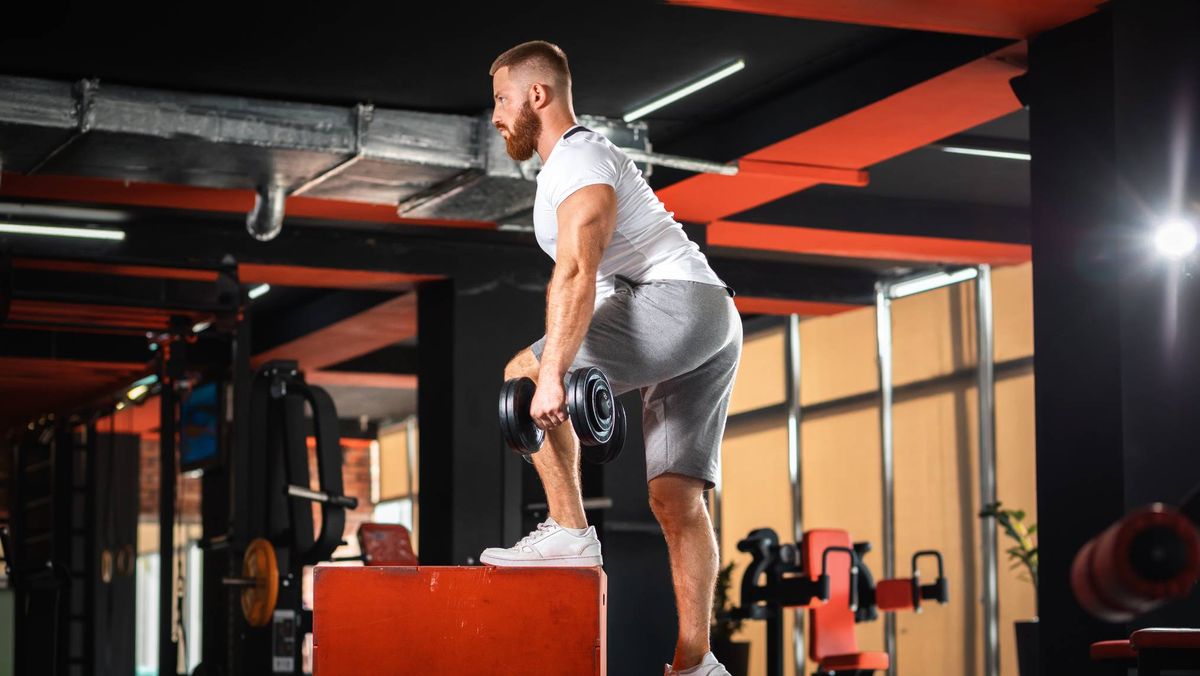
Muscle-building exercise (also called strength, weight, or resistance training) |
|
|
|
How aerobic exercise helps
“People who run or do similar types of vigorous exercise may have experienced a ‘runner’s high’ either during or after their workout,” says Dr. Tim Churchill, a cardiologist at the Cardiovascular Performance Program at Harvard-affiliated Massachusetts General Hospital. That’s because your body releases feel-good chemicals known as endorphins and endocannabinoids in response to intense exercise.
Any kind of aerobic exercise, whether moderate or vigorous, also helps dampen the body’s “fight or flight” response, which plays a role in chronic stress and anxiety. Aerobic exercise also spurs the release of adrenalin and related hormones that stimulate receptors in the heart to beat more frequently and forcefully. Over time, the heart becomes more efficient, requiring less effort to send blood through the body. And as more blood circulates through the body, blood vessels expand slightly and become more flexible.
Why muscle-building matters
Including muscle-building exercises in your weekly routine has a synergistic effect with aerobic exercise that can further enhance your heart health. Strength training can make your body more efficient at burning fat for energy. It also helps improve how your body responds to insulin, the hormone responsible for regulating blood sugar levels, Dr. Churchill says. That can help prevent or improve diabetes, a potent risk factor for heart disease. Strength training also promotes the production of nitric oxide, a molecule that relaxes and widens blood vessels. “Your arteries are then better able to relax, which helps to maintain normal blood pressure,” says Dr. Churchill.
As the review article notes, combining strength with moderate-intensity and some vigorous aerobic exercise leads to greater reductions in resting heart rate, blood pressure, body weight, and body fat percentage than doing single forms of exercise. “Exercise clearly improves a lot of specific markers related to cardiovascular disease. But when you add up all those individual effects, it still only accounts for about 50% of the overall health benefit related to doing regular physical activity,” says Dr. Churchill. The elusive remaining 50% is why the decades-long quest to create “exercise in a pill” will probably never materialize, he adds.
Image: © Pyataeva Irina/Getty Images
Fitness
Alexandra Daddario, 40, relies on this underrated crunch upgrade for strong abs – here’s how to do it properly
From enduring some serious physical prep for Baywatch to working consistently with elite trainer Patrick Murphy, Alexanda Daddario’s dedication to fitness is well-documented. She often shares insights on social media, and in a recent Instagram post, the White Lotus star gave an insight into how she trains her core with one powerhouse movement: the reverse crunch into shoulder stand.
Why is it so good? Most traditional ab exercises require repetitive spinal flexion – the process of pulling your chest down toward your knees, like in a standard crunch. This isolates only the upper section of your abs, and for women who spend hours sitting at a desk, it can reinforce a slouched, rounded posture.
Daddario’s movement flips the mechanics entirely since you actively curl your pelvis up toward your chest. In doing so, you target not only your upper abs, but the lower portion and your obliques (the sides) simultaneously, all while keeping your chest open and your neck unstrained. This translates into a much stronger core, better posture and crucial lower back protection. Research also shows that a controlled posterior tilt – the lower-body curl that initiates Daddario’s move – recruits a significantly higher percentage of deep core muscle fibres than traditional crunches.
Daddario then drives her hips directly up into a vertical shoulder stand. This completely removes momentum from the equation (meaning you can’t “cheat”) and forces your abs – particularly your obliques – to balance your body and prevent you from tipping sideways.
She then takes it one step further into a Pilates plow position with her legs overhead, before reversing the movement and, again, using her abs to control the lowering of her entire lower body as she slowly unrolls her spine down onto the mat. The plow portion is optional (and super advanced); the slow, controlled, lowering phase, which happens whether you move into plow or not, is where the magic happens, challenging your core through both lifting and resisting gravity. Inspired? Here’s exactly how to do the move with good form, and how many reps and sets to aim for.
How to do a reverse crunch into shoulder stand
- Lie on your back (either on a mat, or on a reformer Pilates machine, like Daddario, with your arms anchored tightly to the floor.
- Engage your core to curl your knees toward your chest, then fluidly press your feet straight up toward the ceiling, lifting your hips and lower back off the floor.
- Slowly lower down, one vertebra at a time. Aim for 3 sets of 6-8 controlled reps.
Optional progression:
- As you reach shoulder stand with your legs extended to the ceiling, slowly start to lower your toes toward the floor over your head. Your weight should rest entirely on your shoulders and upper back – not your neck.
- Keeping your legs straight, use your core to extend them straight back up to the ceiling, then control the descent by rolling your spine down one vertebra at a time, with your legs remaining straight.
One of our most frequently asked questions here at Women’s Health? How to build muscle and burn fat at the same time. So, we asked superstar trainer Oyinda Okunowo exactly how to do it. In this 4-week plan – created exclusively for Women’s Health COLLECTIVE members – you’ll get the workouts and nutrition guidance needed to help you on your way to better body composition. Tap the link below to unlock 14 days of free access to Oyinda’s plan and start training today.
GET THE PLAN
As Women’s Health UK’s fitness director and a qualified Pilates and yoga instructor, Bridie Wilkins has been passionately reporting on exercise, health and nutrition since the start of her decade-long career in journalism.
After earning a first-class degree in journalism and NCTJ accreditation, she secured her first role at Look Magazine, where she launched the magazine’s health and fitness column, Look Fit, before going on to become Health and Fitness writer at HELLO!
Since, she has written for Stylist, Glamour, Cosmopolitan, Marie Claire, Elle, The Metro, Runner’s World and Red. Today, she oversees all fitness content across Women’s Health online and in print, spearheading leading cross-platform franchises, such as ‘Fit At Any Age’, which showcases the women proving that age is no barrier to exercise.
She has also represented the brand on BBC Radio London, plus various podcasts and Substacks – all with the aim to encourage more women to exercise and show them how. Outside of work, find her trying the latest Pilates studio, testing her VO2 max for fun (TY, Oura), or posting workouts on Instagram.
Fitness
Built Strong: Fitness forges unbreakable father-son bond
Fathers often share special bonds with their children. For 80-year-old Chanka Ramrattan, that bond is a shared love for fitness and exercise with his 46-year-old son Nari.
The Rousillac resident recalled that he began exercising at the age of 14, lifting weights and taking long walks, a passion that remains with him today. During his time working as a clerk at Texaco, he said he would walk from Forest Reserve to his Rousillac home, a distance of approximately 12 kilometres.
“I have done every marathon in Trinidad; you name a marathon, I could tell you. Miami Marathon, Tobago Sea-to-Sea, which is the most difficult marathon that I’ve ever done. I even have a trophy where I got the fastest speed walking man, and I have all my medals,” he recounted.
Chanka’s last marathon was a virtual one in 2021. Since then, his doctor has advised him to slow down because of his age. Now, he spends his time at the Health and Fitness Gym in Debe and South Oropouche about three times a week, walking marathons of his own on the treadmill.
“I do cardio walking for one hour, and I do weight training for one hour. Then, I go in the sea and I swim and dive for one hour,” he noted.
Chanka firmly believes regular exercise has contributed to his longevity and said he plans to keep going.
“Exercise is very important, and I like exercise. You go to Miami, and you’ll see 90-year-olds and 100-year-olds in the gym, walking, and even going to marathons. That’s because if you don’t exercise, you feel lethargic, you feel down. And you also have to read a lot. So, you exercise the brain, and you exercise the body,” Chanka advised.
His son Nari believes that perseverance was one of the most important lessons his father passed on to his children, along with a love of fitness and exercise.
“When you are looking at your dad, and your mom, and you are seeing them exercising and you are seeing them fit, why would you not want to do the same thing? So, it was instilled in all of us, myself and my two siblings. That exercising became a routine. My bigger sister, she would run, and my smaller sister would do cardio,” Nari explained.
The engineer and businessman recalled starting to exercise and lift weights with his father and uncle from a young age, crediting the experience with shaping the discipline and fitness mindset he still follows today.
However, in 2016, he faced a big obstacle after he hit his head during a diving accident, damaging his C6 and C7 vertebrae and spinal cord.
“I was 37 at the time when I got into the accident. I lost all feeling in my body. The person that you see in front of you now is not the person I was three years ago. I actually couldn’t move at all; I could only move my toe. It took a lot of hard work and will, to come out of that situation. Eventually, I started to transfer from my wheelchair to a bed, to a car. I even built a machine for me to stand up with a harness, and it pulls me up in the air so I can stand up straight. So, I used that for two years to get my body back to where it is,” Nari explained.
Nari, who is currently a quadriplegic, said he was only able to make progress through persistence and support from his loved ones. Chanka admitted that period was one of the most difficult experiences of his life as a parent.
“I wouldn’t like to explain that, that is a different thing altogether. He was in Mount Hope for six months, we had to go every day. It was a real trying thing, but you know, he is on the way to recovery. His mother wants to see everything good for him. For me, she will treat me second class and she will treat them first class, and she is right. Because the ones that are able to walk, you give them less attention because they are tending to themselves. You have to give more attention to the one that needs attention,” he acknowledged.
But their bond through exercising didn’t change. During COVID-19, Nari said his father returned to weightlifting under his son’s guidance.
“When my dad was trapped in the house and he couldn’t go anywhere, he was very miserable. So, we had a schedule where he and I would use the weights that I have at home, and I would tell him what to do. He actually got a six-pack during COVID. So, we stayed home and exercised with my wife and all too. After, I realised now I could start back to go to gym,” Nari reflected.
Chanka said his son’s determination continues to inspire him.
“When you see somebody who is a bit incapacitated and they’re exercising, they give you inspiration. Like if that man could do that, I could do that too. I wish Nari all the best. He is adhering to all his exercises, and he has a will that you won’t get in your next life. It’s probably my genes passed on to him,” Chanka shared.
Nari said none of that would have been possible without his father’s influence.
“Dad, I just want to tell you, thank you very much for being in our lives. You give us the encouragement to go day to day, and just keep being who you are, because you have a strong will, strong mind, and that is what keeps us going every day,” he said.
Fitness
Angela Rippon, 81, reveals the one exercise she never skips for strong legs: ‘I do it every morning without fail’
At 81, Angela Rippon is one of the UK’s most energetic and active broadcasters. A long-time advocate for movement, the former ballet dancer has often credited simple, consistent habits with helping her stay strong, mobile and independent as she gets older. And among her daily rituals is one surprisingly simple exercise she swears by: pliés.
‘I’ll do 20 pliés in the morning, because that’s really good for your balance, your knees, your posture, your core strength, for everything,’ she told Good Housekeeping. ‘Ballet is a wonderful thing for keeping your legs in good shape. It builds the right muscles in your calves and thigh. I go to class whenever I can. I’m a great advocate for dance being the best form of exercise for your mind and your body.’
Pliés are an easy move that require no equipment and Rippon’s 20 reps take less than a minute to do, yet experts agree that they can offer a host of benefits, from improving balance and posture to building lower-body strength and supporting healthy joints. As Women’s Health Fashion Editor and dance instructor Isabelle Knevett says, ‘Plies strengthen the legs, glutes and inner thighs simultaneously. They also require core activation in order to maintain an upright posture, which helps train your balance and stability.’
Research backs Rippon’s morning habit, too. A 2024 study found that a 10-week classical ballet programme improved lower-body strength and physical function in women over 50, suggesting ballet-inspired movements may help support mobility and independence as we age.
And Angela has one more non-negotiable within her morning routine: stretching. ‘I do it every day without fail. Even if I’m on a really tight schedule and in a very small hotel room. Think about a cat. A cat might sleep for five hours, but when they get up, they stretch absolutely everything. I feel that after I’ve been sleeping, that’s what I need to do to get everything moving again.’
As for its benefits for longevity, a recent study published in the Scandinavian Journal of Medicine & Science in Sports found that greater flexibility was associated with a lower risk of early death, while other research found that a 10-minute at-home stretching routine can counteract significant decreases in strength, flexibility and jumping performance caused by low physical activity levels. Consider us influenced.
One of our most frequently asked questions here at Women’s Health? How to build muscle and burn fat at the same time. So, we asked superstar trainer Oyinda Okunowo exactly how to do it. In this 4-week plan – created exclusively for Women’s Health COLLECTIVE members – you’ll get the workouts and nutrition guidance needed to help you on your way to better body composition. Tap the link below to unlock 14 days of free access to Oyinda’s plan and start training today.
GET THE PLAN
As Women’s Health UK’s fitness director and a qualified Pilates and yoga instructor, Bridie Wilkins has been passionately reporting on exercise, health and nutrition since the start of her decade-long career in journalism.
After earning a first-class degree in journalism and NCTJ accreditation, she secured her first role at Look Magazine, where she launched the magazine’s health and fitness column, Look Fit, before going on to become Health and Fitness writer at HELLO!
Since, she has written for Stylist, Glamour, Cosmopolitan, Marie Claire, Elle, The Metro, Runner’s World and Red. Today, she oversees all fitness content across Women’s Health online and in print, spearheading leading cross-platform franchises, such as ‘Fit At Any Age’, which showcases the women proving that age is no barrier to exercise.
She has also represented the brand on BBC Radio London, plus various podcasts and Substacks – all with the aim to encourage more women to exercise and show them how. Outside of work, find her trying the latest Pilates studio, testing her VO2 max for fun (TY, Oura), or posting workouts on Instagram.
-
Finance5 minutes agoProtecting Bolivia’s forest watersheds with sustainable finance
-
Fitness12 minutes agoAlexandra Daddario, 40, relies on this underrated crunch upgrade for strong abs – here’s how to do it properly
-
Movie Reviews27 minutes agoMovie Review – In the Hand of Dante (2025)
-
World30 minutes ago
Brazil's Flavio Bolsonaro Plans to Testify Against Proposed US Tariffs
-
News42 minutes agoVideo: Mamdani Allies Sweep New York Primaries
-
Lifestyle1 hour ago4 ways to design a dreamy summer, according to a happiness expert
-
Education1 hour agoVideo: School Year Cut Short and Aid Delivery Slowed Amid Fuel Crisis in Cuba
-
Technology1 hour agoOur favorite Prime Day deals you can shop on day two