Finance
Trump’s tariff revenue has already topped $22 billion in May


President Trump’s tariffs continued to be felt by importers in May with a measure of government receipts for “Customs and Certain Excise Taxes” already topping $22.3 billion this month, according to Treasury Department data.
The monthly total is likely to rise only slightly in the coming days, with importers often depositing their tariff duties largely in a single day. A massive deposit of more than $16.5 billion appeared in government coffers on May 22.
May’s total so far has already topped April’s full-month haul of $17.4 billion — not to mention March’s haul of $9.6 billion.
It was a continuation of revenue spikes seen during Trump’s second term in office, which dwarfed recent history and Trump’s first term.
All told, more than $92 billion has flowed into government coffers since Jan. 1.
May’s surge in revenue came as many of Trump’s duties were only felt for an entire month after his biggest tariffs — 10% duties on nearly every country in the world — took effect on April 5.
The haul also came after other new concessions from Trump this month that saw a slashing of tariffs on China and a limited lowering of duties on the UK.
Trump added Tuesday in a social media post that more duties could be coming, saying of his decision to delay 50% tariffs on Europe for now, “Remember, I am empowered to ‘SET A DEAL’ for Trade into the United States if we are unable to make a deal.”
Read more: What Trump’s tariffs mean for the economy and your wallet
The president is also threatening new tariffs in the weeks and months ahead, including new sector-specific tariffs to be announced on items such as semiconductors and pharmaceuticals and possible tariffs aimed at companies like Apple (AAPL) and Samsung (005930.KS).
The data is significant but could be slightly overstated, with the Treasury Department reporting both customs duties and certain excise taxes as a single category from the Department of Homeland Security.
Excise taxes are different from customs duties. More precise data for only customs duties is expected to be available in a few weeks. But customs duties have historically made up the lion’s share of the combined figure.
Trump himself has regularly touted the surge of government tariff receipts, suggesting the US government is on its way to a repeat of an era in US history that ended more than a century ago when tariffs made up a significant portion of government revenues.
“We’re going to make a lot of money [from tariffs] and that money’s going to be used to reduce taxes,” Trump said on April 23. “We’re going to get big, big tax breaks.”



Regions Financial Corp. has completed its acquisition of Montgomery-based investment banking firm The Frazer Lanier Company, expanding its municipal finance and corporate investment banking services.
The Birmingham-based financial company announced Thursday that the acquisition has officially closed. Founded in 1976, Frazer Lanier provides investment banking services specializing in municipal and corporate securities and has served corporations, cities, counties and local boards throughout its history.
According to Regions, the acquisition is intended to strengthen the bank’s capital markets capabilities while enhancing services for public sector and institutional clients across its multi-state footprint.
Frazer Lanier has built its business by serving as an underwriter or placement agent for tax-exempt and taxable bonds, helping public entities and organizations access financing.
“Two of our top priorities at Regions Bank are strategically expanding our services and investing in top-tier banking talent,” John Turner, chairman, president and CEO of Regions Financial Corp., said in a news release. “By welcoming experienced bankers from Frazer Lanier to the Regions family, we are connecting Regions’ clients with even greater capabilities while advancing our long-term strategy for growth.”
As part of the acquisition, Frazer Lanier will be integrated into Regions Bank’s Capital Markets division within the company’s Corporate Banking group.
Brian Willman, head of Corporate Banking for Regions, said the two organizations share a similar approach to serving clients.
“Frazer Lanier has built trust by staying close to clients and helping them navigate important decisions,” Willman said. “Together, we can expand that model by bringing more ideas, more capabilities and more connectivity to clients across our markets.”
Regions said the acquisition will expand its municipal finance and investment banking capabilities, strengthen its services for cities, counties and other public entities, and provide clients with broader access to financing and capital markets solutions.
Financial terms of the acquisition were not disclosed.

MOBILE, Ala. (WALA) – A Mobile County grand jury has indicted the former finance director for the city of Semmes on ethics and theft charges.
Heather Renee Davis, who also previously served as city clerk for the city of Satsuma, faces a 12-count indictment. Ten of the counts are ethics violations.
Allegations
Prosecutors allege Davis improperly used her public positions in Semmes and Satsuma for personal gain, including misappropriating public money and resources.
Two counts accuse her of first-degree theft by deception involving amounts over $2,500. One count is tied to the city of Semmes and one to the city of Satsuma.
Arrest and bond
Jail records show Davis was arrested and later released after posting a $60,000 bond.
Copyright 2026 WALA. All rights reserved.

Today’s installment of campaign-related news items from across the country.
* When it comes to campaign finance laws, both parties’ campaign committees have faced restrictions on how much money they could spend in coordination with candidates’ campaigns. Those limits are now effectively gone.
As MS NOW’s Jordan Rubin explained, “The Supreme Court’s GOP-appointed majority ruled for Republicans in their campaign finance challenge to restrictions on political parties spending on ads with input from the party’s candidate.”
A Punchbowl News report added that the ruling, written by Justice Brett Kavanaugh, “handed Republicans a massive win” and is likely to “usher in the biggest change to campaign finance law since the Citizens United decision.”
The same report went on to note that Tuesday’s high court ruling “allows for unrestricted coordination between candidates and party committees. That means committees, like the NRSC or the DCCC, can run unlimited TV ads with allied candidates. More importantly, they can also buy those ads at the much cheaper rate offered to candidates. … Tuesday’s SCOTUS ruling will also eradicate the need for independent expenditure arms at party committees.”
Republicans already enjoyed a significant financial advantage over Democrats. The Republican-appointed justices just made it easier for the GOP to capitalize on that advantage.
* In Colorado’s closely watched Democratic primaries, incumbent Sen. John Hickenlooper fended off a challenge from the left, but some of his colleagues weren’t as fortune: Democratic socialist Melat Kiros ended long-serving Rep. Diana DeGette’s career in Denver’s congressional district, while state Attorney General Phil Weiser scored a major upset by defeating incumbent Sen. Michael Bennet in a gubernatorial primary.
* In the race for North Carolina’s open Senate seat, former Democratic Gov. Roy Cooper leads former Republican National Committee Chairman Michael Whatley in the latest New York Times/Siena poll, 50% to 43%, pointing to a possible pickup opportunity for Democrats.
-

 Lifestyle6 minutes ago
Why Chanel Is Acquiring Charvet
-
 Politics9 minutes ago
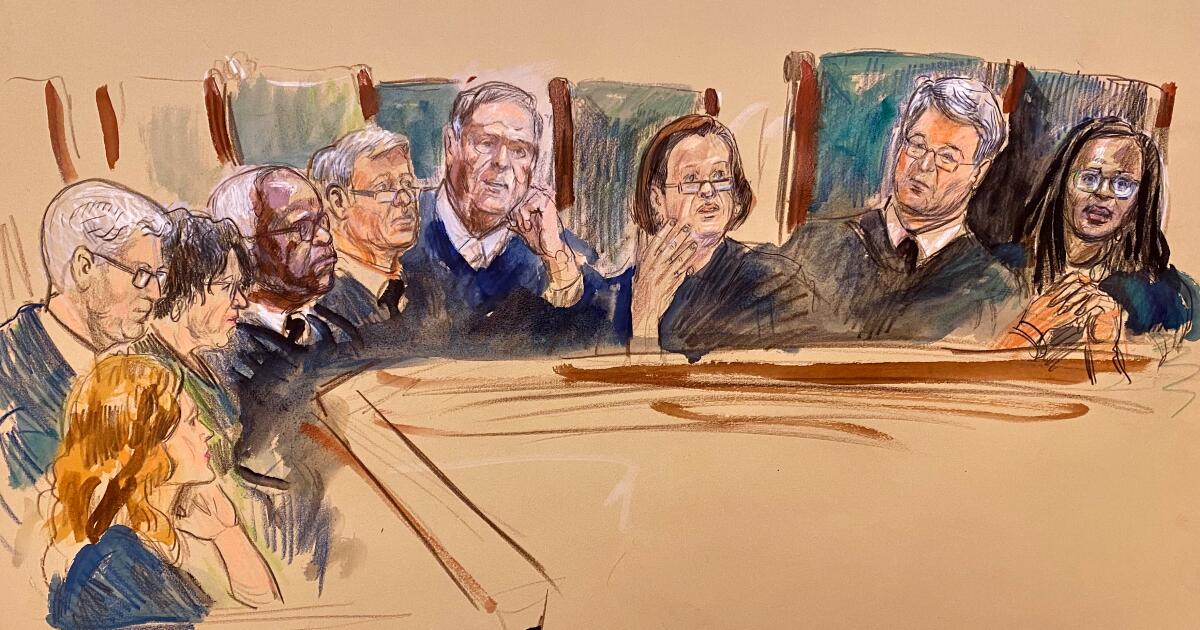
How Roberts led a fractured Supreme Court to wins for the right and defeats for Trump
-
 Science14 minutes ago
Contributor: Alcohol should be stigmatized like smoking
-
 Sports21 minutes ago
Thousand Oaks native Claire Liu finally reaches Wimbledon’s third round, will face Coco Gauff
-

 World29 minutes ago
Could water become a flashpoint between Islamabad and New Delhi?
-
 News54 minutes ago
Ukraine latest / Limits of military might / Can major powers regain dominance? : Sources & Methods
-

 Los Angeles, Ca2 hours ago
Juvenile charged with murder after 4-month-old Claremont infant thrown to her death
-

 Detroit, MI3 hours ago
Silence from Jalen Duren’s camp is what the Pistons want to hear

