Connect with us

Finance

Transition finance needs ‘realism’, not reliance on private capital alone, says Prudential chair

Published

on

Transition finance needs ‘realism’, not reliance on private capital alone, says Prudential chair

Speaking at a panel on financing the energy transition during Temasek’s Ecosperity week, veteran financier Shriti Vadera said governments continue to rely on the unrealistic assumption that private capital alone can close the climate financing gap, even as many projects in developing economies remain commercially unviable without stronger policy support and public-sector intervention.

“There’s a sort of convenient untruth that the private sector is going to spontaneously combust and find ways of providing capital when it can’t go to things that are essentially not commercial,” said Vadera, who is chair of UK-based insurer Prudential plc and the World Bank Private Sector Investment Lab.

Her comments came as a vast majority of clean energy investment today remains heavily concentrated in a handful of major economies despite growing global momentum behind the low-carbon transition.

While investment in renewable energy and green technologies has accelerated sharply in China, Europe and previously the US, financing flows into emerging and developing economies continue to lag far behind what is needed to meet climate targets.

Vadera said emerging markets excluding China now account for roughly 30 to 40 per cent of global emissions, yet climate financing into these economies remains deeply insufficient.

Advertisement

She cited estimates showing emerging and developing economies require around US$1.3 trillion annually in transition financing for emerging markets, compared to roughly US$200 billion currently flowing into the sector.

The financing shortfall is particularly acute when it comes to allowing investors to participate in transition financing via equity, or the buying of shares, said Vadera. She described this lack of risk-bearing capital as the “biggest problem” facing transition projects.

“There’s a lot more debt [available], but the real problem is that 80 to 90 per cent of the financing is available in debt. The start of any capital stack at any project is the risk-bearing capital, and that is in much shorter supply,” she said.

Vadera highlighted that many climate discussions continue to overestimate the willingness of institutional investors to absorb risks tied to emerging market infrastructure, particularly where currency volatility, illiquid markets and inconsistent regulations remain unresolved challenges.

To unlock the trillions in private financing available in the capital markets, investments need to be rated, liquid and tradable, she said.

Advertisement

Vadera also called for the creation of standardised financial structures that allow climate-related debt to be packaged, traded and distributed more efficiently across global markets.

One such model currently being explored by the World Bank’s Private Sector Investment Lab involves creating originate-to-distribute models that pool loans and structure them into investable assets, while also standardising documentation, securitisation frameworks and debt issuance practices across multilateral development banks and domestic financial institutions.

The aim is to turn transition financing into a recognisable asset class that institutional investors can more easily access.

“That is the nearest thing we have to a solution that will be at the scale that is needed,” she said.

However, she stressed that financial engineering alone will not solve the problem.

Advertisement

For hard-to-abate sectors such as steel, cement and industrial decarbonisation, projects may never become commercially competitive without carbon pricing or direct public support.

“However much structuring you do, they’re not going to be bankable,” Vadera said.

Stronger policies and financing reform

Other speakers at the panel echoed the need for stronger policy frameworks alongside financing reforms.

Adair Turner, chair of the Energy Transitions Commission, said although the world has made substantial progress in scaling clean energy investment globally, many hard-to-abate sectors remain structurally more expensive to decarbonise than existing fossil fuel-based systems.

These sectors include green hydrogen, steelmaking, cement production and carbon capture technologies, where low-carbon alternatives continue to face higher upfront and operating costs.

Advertisement

“No amount of clever financial design will make things bankable unless there are carbon prices or regulation as a framework,” he said.

He noted that a growing number of renewable energy technologies have now reached cost competitiveness due to rapid technological advancements and manufacturing scale-up over the past decade.

The cost of solar photovoltaic systems and batteries, for example, has fallen by roughly 95 per cent over the past 15 years, helping make solar-plus-storage systems cheaper than new coal or gas-fired power generation in some markets.

The falling costs have also accelerated the economic viability of electric vehicles and industrial electrification technologies, particularly for low-temperature industrial processes such as food processing, textiles and manufacturing.

However, Turner cautioned against assuming that international capital alone would solve the financing challenge, as most transition financing would ultimately have to come from domestic savings mobilisation and stronger local capital markets.

Advertisement

He said policymakers must also address foreign exchange risks associated with renewable infrastructure projects in emerging markets, many of which generate revenue in local currencies but rely heavily on foreign-denominated financing.

Annual global investment in the green transition has doubled from around US$1 trillion in 2020 to approximately US$2 trillion today with much of that growth concentrated in China, Europe and the US. 

Ma Jun, chairman of Green Finance Committee of China Society for Finance and Banking highlighted China’s extensive green finance system that has helped support the rapid scaling of renewable technologies and clean manufacturing, offering an example of how coordinated policy and financial system design can accelerate deployment.

China has established the largest green banking system in the world, with roughly US$7 trillion in outstanding green loans. It has also developed one of the world’s largest green bond markets.

This deep domestic financing base has enabled large-scale investment into solar, wind, electric vehicles, batteries and other clean technologies, supporting both domestic deployment and global supply chains.

Advertisement

Ma said that technology deployment may now matter more than financing cost reductions, given the steep learning curves in clean technologies.

“Technology is more important. While finance can optimise and reduce costs by one to two per cent, the right technologies can cut costs by as much as 50 per cent,” he said.

He also stressed the importance of developing interoperable green taxonomies and stronger local green financial systems across emerging economies, to ensure that capital is consistently directed towards credible transition activities.

According to Ma, many developing countries still allocate only a small share of domestic bank lending towards green projects, leaving major financing capacity untapped.

He suggested that strengthening domestic green financial systems could unlock significantly more transition finance without relying excessively on foreign capital inflows.

Advertisement
Continue Reading
Click to comment

Leave a Reply

Your email address will not be published. Required fields are marked *

This site uses Akismet to reduce spam. Learn how your comment data is processed.

Finance

SixCap Healthcare Finance Appoints Carroll as Senior Relationship Manager

Published

on

SixCap Healthcare Finance Appoints Carroll as Senior Relationship Manager

SixCap Healthcare Finance added Dan Carroll as senior relationship manager, reporting to the company’s co-founder and chief investment officer, Dan Whitwer.

Carroll brings more than 20 years of commercial finance, portfolio management and healthcare asset-based lending experience to SixCap. Throughout his career, he has managed complex healthcare lending relationships, led portfolio management teams, overseen loan closings and partnered closely with borrowers to support growth while maintaining disciplined credit management.

Most recently, Carroll held leadership positions at Siena, CNH Finance and Triumph Healthcare Finance, building extensive expertise in healthcare lending, credit analysis, loan structuring, risk management and client relationship management.

In his new role, Carroll will oversee borrower relationships across SixCap’s growing healthcare portfolio, working closely with clients to provide proactive portfolio management, responsive service and financing solutions that evolve alongside their businesses.

“We’re thrilled to welcome Dan to the SixCap team,” Whitwer said. “I’ve had the privilege of working alongside Dan and have seen firsthand the integrity, experience and thoughtful approach he brings to every client relationship. He understands healthcare, he understands asset-based lending and, most importantly, he understands the value of building lasting partnerships. As our portfolio continues to grow, Dan’s leadership and commitment to exceptional client service make him a tremendous addition to our team.”

Advertisement
Continue Reading

Finance

Big financing steps forward for The 78, Foundry Park projects

Published

on

Big financing steps forward for The 78, Foundry Park projects

Two of Chicago’s most pivotal but challenging undeveloped sites — Foundry Park on the North Side and the vacant South Loop parcel known as The 78 — moved forward in a big way Wednesday before the City Council adjourned for a summer recess.

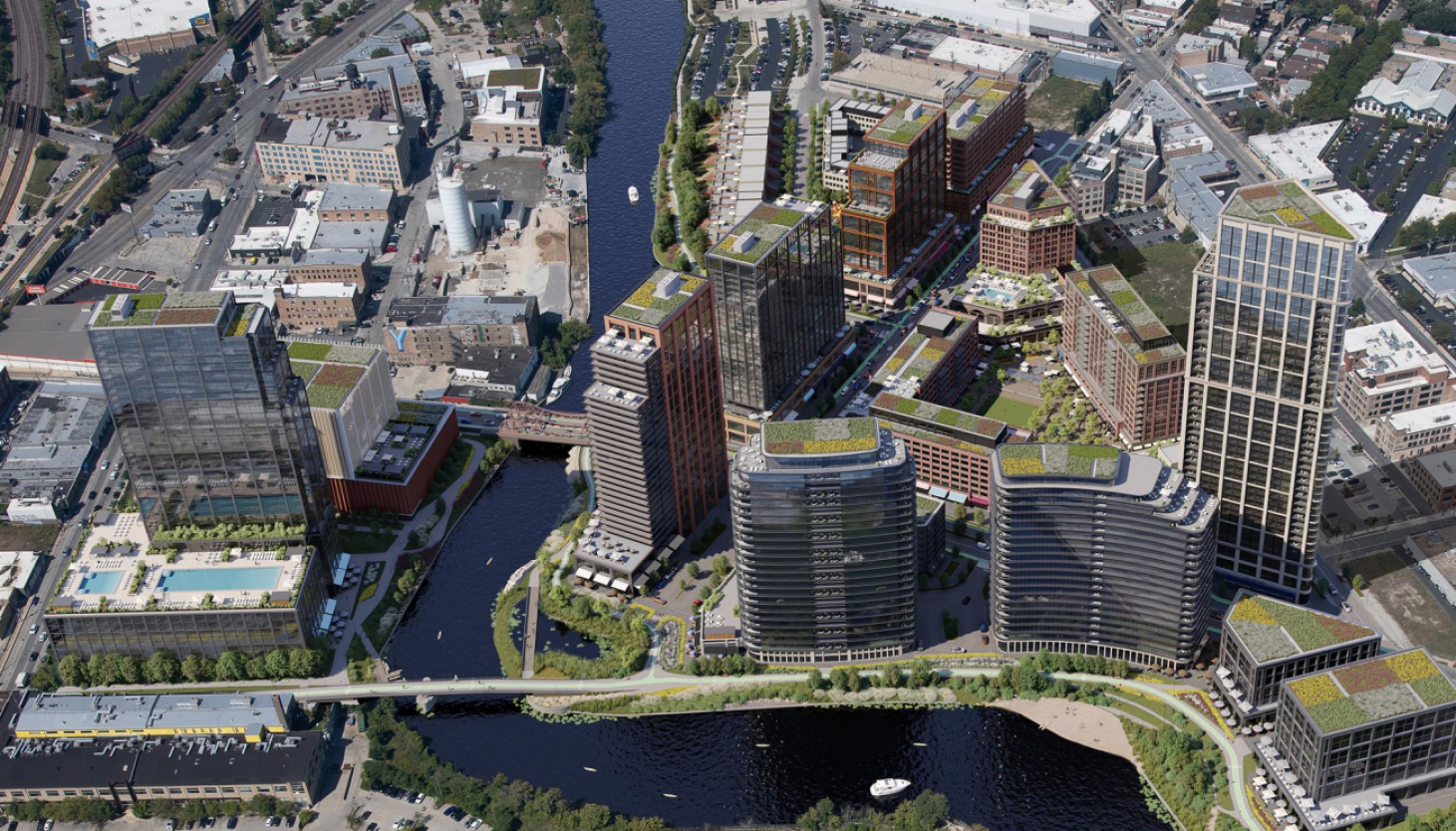
Mayor Brandon Johnson introduced a $201.6 million tax increment financing subsidy for JDL Development’s scaled back vision for North Side industrial land along the Chicago River that once was supposed to be home to the Lincoln Yards megaproject.

And despite a slew of concerns from Council members, the full Council approved a $425 million TIF for The 78, a reference to Chicago’s unofficial 78th community area. The subsidy will bankroll public improvements needed for the South Loop development, anchored by a $750 million soccer stadium privately financed by Chicago Fire billionaire owner Joe Mansueto.

Downtown Ald. Bill Conway (34th), whose adjacent TIF is being raided to help The 78, again refused to go along with the $250.1 million piece of the infrastructure package that will primarily be used to build a 1,200-space parking garage. The $216 million garage will serve as the “podium” for an open-air plaza and future high-rise development on the air rights above the garage.

Referring to the Bears’ long-running stadium saga, Conway said Wednesday he appreciates the Fire “not trying to move to Hammond, Indiana, and become the Hammond Sparks.” But he said he “cannot look the taxpayers in the eye and tell them” he supported spending “$250 million to build a stadium parking garage and plaza.”

Advertisement

Finance Chair Pat Dowell, whose 3rd Ward includes The 78, has argued that the podium “brings the site to grade at Roosevelt Road” and is the key to “unlocking the site from the isolation that has stalled every previous development proposal.”

Deputy Planning Commissioner Jeff Cohen made that same point Wednesday, with a new wrinkle.

“The idea here is to incorporate that garage into the podium,” Cohen said. “It’s addressing a design and development plan that allows for all of the land within The 78 to be open for investment, rather than having to have either temporary or permanent surface parking lots to accommodate the car traffic.”

An artist’s rendering of the planned Chicago Fire soccer stadium at The 78 in the South Loop.

Advertisement

Related Midwest & Gensler

The $201.6 million subsidy proposed for Foundry Park pales by comparison to the $1.3 billion that former Mayor Rahm Emanuel once proposed for Lincoln Yards. That massive subsidy became a political lightning rod, with the avalanche of criticism led by the Chicago Teachers Union and then-union organizer Brandon Johnson.

The $201.6 million subsidy that Johnson introduced at Wednesday’s Council meeting is more likely to be criticized for being too little.

It will support just over 25% of the $800 million worth of roads, bridges, utilities and mass transit improvements that 2nd Ward Ald. Brian Hopkins has said were mandated as part of the Lincoln Yards plan.

Advertisement

Foundry Park developer Jim Letchinger acknowledged that there is “other infrastructure that the neighborhood would like to see done that is not possible right now.”

But Letchinger added it’s a start that includes the long-promised extension of the popular 606 Trail. “If you don’t start with something that’s achievable, you can’t achieve anything.”

“We have a plan to actually start building and creating revenue right away in conjunction with building our infrastructure … A lot of parks. Massive riverwalk. Ten acres of public open space. Very usable, very engaging,” Letchinger said Wednesday.

“As we continue to build, since we’re not using anywhere near all the increment that we’re creating, the other increment can go toward other projects that the neighborhood would like to see — whether it’s to build a bridge or fixing Elston Avenue, or anything else that they’re anxious about,” he said.

Public improvements promised to residents, but not covered by the $201.6 million subsidy, include another bridge crossing the Chicago River and a realignment of Elston Avenue, which Letchinger called a positive move in the long run, but a “massive undertaking” complicated by cost and property control.

Advertisement

“No private developer can realign Elston. It’s impossible. The city is the only one that can do that, and they’re working on it. There’s plans for it. But it will take a very long time,” Lechtinger said.

Ald. Scott Waguespack (32nd) said there is “one bridge that a lot of people still want,” but it goes through private properties owned by Ozinga Ready Mix Concrete and several other owners.

“The city would have to do it as a taking [of property], and that would be in the hundreds of millions of dollars. So they took that off the table because … that bridge wasn’t necessary at this time,” Waguespack told the Chicago Sun-Times.

Letchinger’s plan for roughly 34 vacant acres of the site calls for up to 3,737 residences, 20% of them designated as affordable to comply with the city’s set-aside rules. The new design includes low- to mid-rise buildings, some for offices, grouped near open space and riverfront access. Buildings would get ground-floor retail, and one is slated as a boutique hotel.

The project’s reduced density has drawn praise from residents. And Waguespack said he’s satisfied with the reduced public subsidy.

Advertisement

“In the future if there’s more needed, we could go back and do it. But this is much more grounded in a realistic infrastructure project that will still satisfy all the needs of connecting the neighborhoods,” Waguespack said.

Hopkins said he views the scaled-down subsidy and the infrastructure projects as “wholly inadequate” and a broken promise to Lincoln Park and Bucktown residents.

“Lincoln Yards provided for two bridges with the possibility of a third. Foundry Park has zero,” Hopkins said. “I don’t want to move on a vague verbal promise that we might consider adding a bridge later. The time to add it is now while the redevelopment agreement is still pending. And the fact that it was omitted is tragic. Also, the [Elston-Armitage] intersection redesign and the new Metra station seems to have fallen by the wayside.”

Also at Wednesday’s meeting, Johnson proposed a tax break for Chicago’s booming film and television industries — by reducing the 15% personal property lease transaction tax to 11%.

The tax has been raised twice in recent years and was the biggest piece of the revenue package that helped balance the $16.7 billion budget for 2026. It has exceeded revenue projections by $40.3 million through June 30, allowing Johnson to offer the break in hopes of attracting more film and TV productions to Chicago.

Advertisement

The City Council also followed a trail blazed by Gov. JB Pritzker and his counterparts in six other states by prohibiting present and former city employees — and elected officials — from using insider information to bet on prediction markets. Apps including Kalshi and Polymarket are used to place bets on everything from election winners and the number of candidates entering a specific race for office, to budgetary and foreign policy decisions by elected officials.

Championed by Ald. Timmy Knudsen (43rd), the ordinance prohibits current or former city officials, appointees and employees from using “confidential information or any non-public information, including the identity of the subject of an investigation” to either participate in prediction markets or “assist any other person” placing those bets.

The Council also confirmed Johnson’s appointment of Dr. Garth Walker as the city’s public health commissioner.

Continue Reading

Finance

The average cost of fertility treatments and how to plan for them

Published

on

The average cost of fertility treatments and how to plan for them

Covering the cost of fertility treatment can feel like yet another hurdle in a process that is already physically and emotionally draining. Not only do you have to go through the testing and medical procedures involved, you can also end up paying tens or even hundreds of thousands of dollars.

For families who want to have kids or women who want to afford themselves a little more time, though, this can feel like a price well worth paying. But the process may necessitate some financial planning. Research can also go a long way, as insurance companies increasingly offer coverage.

Continue Reading
Advertisement

Trending