Finance
Teacher using 'Lattimore Bucks' to teach personal finance

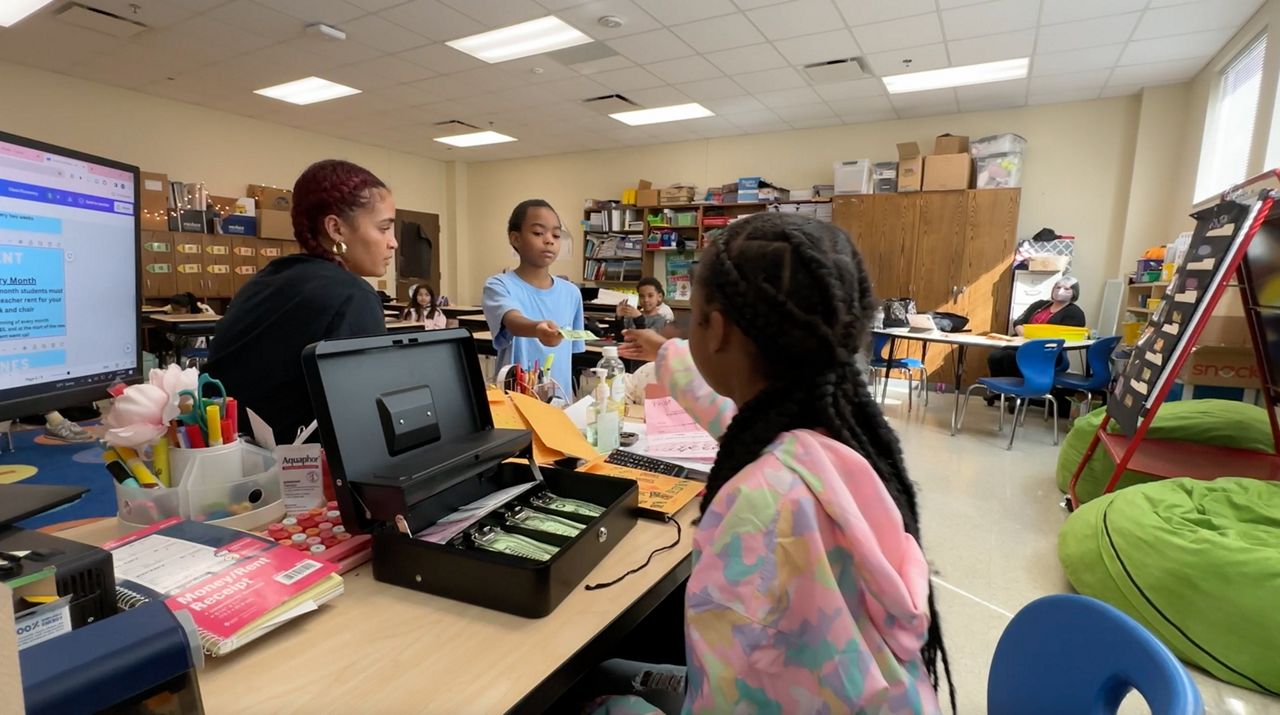
CHARLOTTE, N.C. — Every Monday, Renaissance West STEAM Academy math teacher Shelby Lattimore starts her class by charging her students for their seats, not with U.S. currency but with “Lattimore Bucks.” It’s a project she started last year as a way to improve attendance.
“It’s not just about having them here,” Lattimore said. “It’s about having them here for the whole day from start to finish, ready to rock and roll. On top of the fact, just to get them accountable for their behavior and taking accountability for certain things in the classroom.”
Each student is assigned a job in the classroom, which rotates every two weeks.
“These are their jobs,” Lattimore said. “If they’re underlined, they get paid $10. So those are the harder jobs they have to do every day. And then the ones that are not underlined, like this one, he just has to change my calendar. He just has to change the day on the board, like once in the morning so he doesn’t get paid as much.”
With their salaries, her students pay their rent for their seats.
“Their rent was inflated as of January, from $5 to $7,” Lattimore said.
And if students misbehave, they’re fined.
“Like if you purposely lose your pencil, rip your notebook, things of that sort and then of course disrespect,” Lattimore said. “And their fines are a dollar.”
The more Lattimore Bucks they save, the more rewards they can buy. That is, as long as they have enough to pay their rent.
“Let’s say they have $10, but they want to buy lunch with a friend. If I do 10 minus 5, you’re not, you don’t have $7 for your next rent. So they cannot buy anything past their rent that they have to keep in their wallet,” Lattimore said.
While the project may have started to improve effort in the classroom, Lattimore says it’s morphed into a much bigger lesson for her students.
“Some of their parents, you know, thank me all the time,” Lattimore said. “We talk about all the time in Charlotte, generational poverty is a huge statistic here, especially in the kids and the families that we serve in my school.”
She’s instilling lessons of personal finance and budgeting into the lessons every day.
“So just starting the mindset of how can I hold onto money? How can I make long-term decisions with my money? It all starts from a very young age in a safe environment before they’re out in the real world,” Lattimore said.
It’s done in hopes of setting up her students for the future.
“Even my students from last year, they are telling me that they’re saving their money, and they’re budgeting their Christmas money for a pair of sneakers or whatever they want,” Lattimore said. “So they’re holding onto the lesson. So I can only imagine a couple of years from now when they’re adults, how that will affect their family.”
Lattimore says other teachers she knows have started similar programs in their own classrooms. She says the concept can be used at any school for any grade level as a simple way to teach basic finances.



Fifty years ago, the U.S. Supreme Court struck down campaign spending limits in the landmark decision Buckley v. Valeo, finding the curbs violated First Amendment free-speech protections. Since then, several rulings, including the 2010 Citizens United case, which ended restrictions on election donations by corporations, nonprofits, and labor unions, have further loosened campaign finance regulations.
In this interview, which has been edited and condensed for length and clarity, Nicholas Stephanopoulos, Kirkland & Ellis Professor of Law at Harvard Law School, spoke about the recent ruling by the Supreme Court that lifted restrictions on how much money political parties can spend in coordination with candidates, its downside and potential upside, and its possible impact on the midterm elections.
Can you explain what the recent campaign finance ruling means? How is it going to affect political parties?
The recent decision is a not a huge blockbuster like some other campaign finance cases we’ve seen in recent years. That’s because the decision only involves limits on political parties’ coordinated expenditures with candidates, and that pool of money, both today and potentially in the future, is not enormous.
Before this ruling, parties could spend whatever they want, even before they could coordinate a lot of expenditures with candidates. Now they can just coordinate somewhat more. So, the stakes here were sort of moderate.
The two things the decision means above all are these: On the negative side, it’ll be easier now for a corrupt donor [to skirt individual donation limits] to funnel more money to a candidate using a party as the conduit or the vehicle for that contribution. On the positive side, parties are permanent, important political institutions, and now somewhat more money might flow to parties instead of super PACs and dark money groups and other more problematic organizations.
Nicholas Stephanopoulos.
Harvard Law School
Justice Elena Kagan, who dissented from this ruling, said this decision would increase the likelihood of “political corruption.” Do you agree?
First of all, notice that Kagan isn’t challenging the fundamentals of campaign finance law. She’s not claiming that money isn’t speech. She’s not claiming that all campaign finance regulations should be upheld. She’s fully arguing within the current court’s doctrinal framework. She thinks that the law at issue is necessary to prevent corruption.
Kagan points out that, with a little bit of bookkeeping, it should be fairly straightforward now for a donor to give effectively half a million dollars to a candidate channeled through a party, as opposed to the $7,000 the donor is allowed to give directly to the candidate.
With much bigger sums that can now be given through a party to a candidate, there’s the possibility of more quid pro quo corruption. A candidate isn’t likely to do very much in return for $7,000 but a candidate may do quite a bit more in return for $500,000. So I think we’ll see somewhat more corruption in politics as a result of today’s decision.
What’s the idea behind “money is speech,” which has been at the core of most campaign finance decisions since the 1970s?
The premise that money is speech, or at least it enables political speech, means that it can be covered by the First Amendment. That premise underlies all campaign finance doctrine since the 1970s.
It’s a controversial doctrine. Individual justices over the years have pointed out that money is not speech, and merely enabling speech is not the same thing as being speech itself. All campaign finance decisions since the 1970s have assumed that regulations of political funding involved the First Amendment because there’s a close enough connection to political speech, and even the progressive justices in the 1990s and 2000s still accepted that the First Amendment was involved here.
The implication of fully endorsing the position that money isn’t speech is that all of these cases would quickly fall by the wayside. If money isn’t speech and there’s no First Amendment issue presented here, then Congress can regulate campaign finance however Congress wants to, without any possible First Amendment problem. But that view has never been the view of the majority of the court.
Can you compare the impact of this recent ruling to that of the 2010 Citizens United case?
Citizens United involved independent spending by corporations, by unions, and the court said that there’s no valid justification for limiting any independent campaign spending, whether it’s by candidates, rich individuals, parties, corporations, or unions.
The current case involves the somewhat less-explosive issue of coordinated expenditures. Citizens United was a sweeping decision, striking down a very important federal law and opening the door to huge new sums to be spent in politics. This decision isn’t like that. It doesn’t involve independent spending. It only involves one actor, political parties, not the whole range of actors. The stakes are a lot lower than the Citizens United case.
With this ruling, the Supreme Court overruled a 2001 decision, which upheld the same limits on coordinate expenditures with candidates. How do you explain that?
The 2001 case was decided by the court when it was at its most pro-regulatory in the campaign finance context. What changed since 2001 is the composition of the court.
The critical change was when Sandra Day O’Connor retired in 2006, and Sam Alito replaced her. Alito has always been a skeptic of campaign finance regulations, whereas O’Connor, especially toward the end of her time on the court, was willing to uphold a lot of campaign finance regulations.
Almost everything that’s followed since then, Citizens United in 2010, McCutcheon in 2014, and other decisions striking down campaign finance laws, happened not because the world of politics changed or because there was some big insight on the court. It happened because the court became more conservative and what had been a five-four pro-regulation majority became a five-four anti-regulation majority.
It’s no surprise that the current court, which is now six-three against campaign finance regulation, doesn’t like a decision from this earlier period.
Will this ruling impact the midterm elections?
In the near term, this will somewhat benefit the Republican Party committees that have more funds at their disposal because they have just happened to raise a lot more money recently than the Democratic Party entities.
However, even before this decision, all of those Republican entities could still spend their money however they wanted to, so it’s not that big of a change for them. I think Democrats will direct more of their donors to give some more money to party organizations. There might be a short-term benefit for Republicans, but I don’t think this will cause a great imbalance in the system going forward.
Overall, I’m not incredibly alarmed by this ruling. We’re still going to have in place various other laws and precautions that will stop some corruption.
It’s bad for our system to allow super PACs and dark-money groups to become the leading actors in campaign finance. I’d rather have the money in parties’ hands than in super PACs or dark-money groups’ hands. I don’t think the doors are really open for that much additional corruption here. I think there’s a non-trivial silver lining in strengthening political parties, which are valuable institutions.

Breaking a six-month record, the investment banking giant capitalizes on a surging wave of global megadeals.
Goldman Sachs said it had advised on more than $1 trillion of announced global mergers and acquisitions so far this year, the fastest any investment bank has reached that milestone in a six-month period, citing data from capital markets data provider Dealogic.
The bank attributed the milestone to a string of marquee mandates, including serving as co-financial adviser to Dominion Energy on its roughly $67 billion sale to rival utility NextEra Energy, announced last month, along with other major transactions.
Rise of the Megadeal
Goldman reported that its investment banking fees rose 48%, to $2.8 billion in the first quarter. It’s a reflection of the “K-shaped” M&A market, where megadeals are the dominant force, but deal volumes are declining, and mid-market activity is subdued.
Data compiled by PwC revealed that the global M&A market is on track to reach $4 trillion in 2026, a 13% annual increase, with major sales estimated to account for 48% of deal value worldwide, a significant expansion from two years ago.
“Goldman has been the global leader in M&A advisory fees for more than 90 consecutive quarters. The fact that it’s reaping benefits from a moment of megadeal activity simply proves the strength of its franchise,” said Mark Narron, senior director at Fitch Ratings. “However, advisory revenues are generally a small share of total revenues. In 2021, which was Goldman’s record year for advisory, advisory revenues contributed only 10% of total revenues.”
Fitch says it’s difficult to forecast whether Goldman’s advisory revenues will continue to climb, given the cyclical nature of advisory fees and uneven regional M&A trends — with most deal activity still concentrated in the U.S.
Fitch expects M&A activity to be sensitive to market conditions, economic growth, geopolitical events, and interest rates. Global growth is estimated to decelerate to 2.8% this year, according to the latest OECD economic outlook report. Inflationary pressures are rising in advanced and emerging economies due to energy shocks from the Iran conflict. Prices in the G20 economies are expected to climb to 4% in 2026. In a “prolonged disruption” scenario, inflation could rise further, which may prompt hawkish interest rate responses from central banks.
Peter Taberner is a contributing writer based in the U.K.

MADISON, Wis. (Civic Media) – Lt. Gov. Sara Rodriguez, a Democratic candidate for governor, fired her campaign manager Sunday after discovering problems with campaign finance filings, her campaign said.
The campaign said the person was terminated effective immediately following an internal review that found “serious mismanagement and inaccuracies” in reports they prepared. Staff identified the issues late last week and alerted Rodriguez, who then moved to secure campaign accounts and remove the staffer.
The campaign said it plans to contact the Wisconsin Ethics Commission on Monday to correct the filings ahead of a key reporting deadline Wednesday.
Full statement below.
“The Sara Rodriguez for Wisconsin campaign has terminated its campaign manager, effective today, after discovering serious mismanagement and inaccuracies in campaign finance filings she prepared. An initial review found that the manager filed inaccurate and incomplete campaign finance reports. The campaign will be in contact with the Wisconsin Ethics Commission first thing Monday morning to ensure the inaccuracies are corrected. The moment Sara learned of these inaccuracies, she acted swiftly and decisively removed her. The campaign will continue to build support to win in August and beat Tom Tiffany in November.”
-

 Oklahoma4 minutes ago
Drones Highlight Boom in the Valley – Choctaw Nation of Oklahoma
-

 Oregon10 minutes ago
Oregon State Police seek witnesses to Hwy 20E crash involving black Chevy Silverado
-

 Pennsylvania16 minutes ago
Pennsylvania man who brought gun to
-

 Rhode Island22 minutes ago
Rhode Island State Police Task Force Arrests 2 On Gun Charges: Cops
-

 South-Carolina28 minutes ago
Earmarks, property tax relief continue to stall SC budget discussions
-

 South Dakota34 minutes ago
Special Interview: South Dakota AG Jackley on 10 bills, deepfakes, suppressors and the Mayday case
-

 Tennessee40 minutes ago
This Tennessee school system credits AI with improving student TCAP scores. Here’s how
-

 Texas46 minutes ago
Texas Quietly Fixed One Problem That Used to Cost the Longhorns Games

