Where does the club stand on the financial front? Search online and you’ll find very different narratives. One camp headlines the record‑breaking €1 billion in revenue and the near‑zero net debt once you strip out the stadium loan. The other camp warns about a stadium renovation bill that has swelled past €1 billion, a concert‑noise fiasco, and the stringent transfer policy means the club is in a more precarious position than they let on pubilcly. The reality? Real Madrid’s finances are as solid as they have ever been. The groundwork laid since 2020 has left the club with ample headroom to invest this summer—if the board decides to pull the trigger.
Post‑COVID, Real Madrid’s front office has quietly built one of the sturdiest balance sheets in all of sport. To gauge the club’s true health, focus on three core metrics:
Player Salaries as a Percentage of Revenue
Call it discipline, “strategic restrain”, “hyper-selective recruitment” — however you want to spin it, Madrid have been laser focused on maintaining a rigid and hierarchical wage structure that grows in tandem with revenue. This was no easy feat, particularly during the pandemic, where revenues declined 15-20% and wages remained flat or increased. This put tremendous pressure on all clubs, including Madrid:
Advertisement
(Click to Expand)
A critical financial benchmark in football is the salary-to-revenue ratio—essentially, how much of a club’s total revenue is spent on player salaries. During the COVID seasons, Real Madrid hit alarmingly high levels, surpassing 70%, well above the recommended maximum threshold set by the European Club Association.
But following the 2021/2022 season, stadium revenues returned to normal and hefty contracts for Bale, Hazard, and Marcelo dropped off the books. Since then, Real Madrid have consistently remained at or below the gold-standard 50% mark. Today, the club spends around 45% of its revenue on wages—an impressive figure, especially considering Kylian Mbappé’s arrival. This disciplined approach ensures financial health and flexibility as the club’s revenues continue to climb.
Advertisement
Player Amortization (I.E. Transfer Fees) as a Percentage of Revenue
Maintaining a healthy wage structure is important, but clubs must also carefully manage how they spend on transfers. That brings us to the concept of amortization—which is just a fancy way of spreading a player’s transfer fee evenly over the length of their contract. For example, if Madrid signs a player for €100 million on a five-year contract, the cost booked per financial year is €20 million.
In practical terms, this means that if Real Madrid has a €100 million “war chest” for summer signings, spending that entire sum on one player doesn’t use up the entire summer budget immediately. Instead, the critical factor is how that signing impacts the club’s amortization expenses over multiple years. Like salaries, amortization costs are typically measured as a percentage of a club’s overall revenue, helping gauge long-term financial stability.
Advertisement
(Click to Expand)
In 2020‑21, heavy spending on Hazard, Jovic, Militao, Mendy, and Reinier pushed amortisation to 23 % of revenue, flirting with the 25 % red line. At its peak, amortization in both 2020 and 2021, was considered unsustainable in the long run. Five seasons of measured deals have cut that figure to ~14 %, again beating the industry benchmark.
The Key to Sucess: Growing Revenues
Every revenue stream within Real Madrid’s control—matchday, sponsorships, commercial partnerships—has grown 2 to 3 times over the past four years. The one area that’s remained relatively flat? Broadcasting revenue, or in simpler terms, TV rights (cue frustration with UEFA and La Liga).
The club understands its global value and has consistently found ways to monetize it—hence the ongoing tension with those governing bodies. At the end of the day, revenue growth has been the single biggest driver behind Madrid’s financial strength. The more the club earns, the more it can responsibly invest in wages and transfers without surpassing the metrics mentioned above.
Advertisement
(Click to Expand)
Advertisement
Now for the elephant in the room: What about the stadium costs? What about the concert mess and the lost revenue? Didn’t the club just spend over a billion euros and now risk losing hundreds of millions in return?
Let’s keep it simple: No, the lost concert revenue isn’t even a blip on the radar. If you zoom in on the 2024/25 season in the revenue breakdown, you’ll find a red dotted line marked at €10 million—that’s the estimated impact from the paused concerts. It accounts for less than 4% of projected stadium revenue.
The bigger hit falls on Legends, the events company Madrid partnered with to host non-sporting events. There’s a chance the club renegotiates that deal to be a good partner, or even adds to its loan to fund noise-cancellation infrastructure—but neither option would meaningfully affect the broader revenue outlook. The stadium remains a revenue driver, not a drag. The club never expected concerts to be the primary revenue driver of the stadium—sponsorships, VIP hospitality, and matchday enhancements are the key levers.
Cash Flow and Coverage on Debt Payments
So, Madrid’s revenues are growing rapidly, the wage bill is under control, and spending on transfers has been carefully managed through balanced amortization. With those pillars in place, the next big question naturally shifts to debt—how much is owed, and how well is it being managed?
Advertisement
(Click to Expand)
The stadium renovation required a €1.2 billion loan, split into three tranches—all secured at below 3% interest, an incredibly favorable rate, especially by today’s standards. Despite the size of the loan, Madrid locked in 30-year terms and makes annual payments of around €40 million.
Advertisement
On the other side of the ledger, the club generates €100–300 million in annual cash flow (think of this like your checking account: money coming in and out), and keeps a healthy cash reserve of €85–250 million (a safety buffer, or savings account).
Importantly, Madrid carries virtually no debt outside of the stadium loan, which means its debt coverage ratio—how easily the club can make its payments—is extremely strong.
Bottom line: The stadium is not a financial burden. Quite the opposite—it’s a long-term revenue engine and a major catalyst behind Madrid’s ongoing financial growth.
Summer 2025
Despite the doom-and-gloom headlines—and the inevitable recycled line about “injured players returning as new signings”—Real Madrid have more than enough room to invest in the squad this summer.
Salary-to-Revenue Ratio: ~45% (target
Amortization-to-Revenue Ratio: ~14% (target
Cash Flow: €100–300M per year
Stadium Debt Service: €40M per year, secured at
Concert Revenue Impact: ~€10M,
Net Debt (Excluding Stadium): Essentially zero
If revenue climbs to the projected €1.3 billion (barring unforeseen economic headwinds), the club could spend €100 million in transfer fees (assuming a standard five-year contract for amortization) and still remain within the ideal 15% amortization-to-revenue ratio. On top of that, Madrid could add €30 million in annual wages and comfortably stay under the 50% salary-to-revenue threshold.
And that’s without factoring in potential player sales, which would only add more flexibility.
Advertisement
The bottom line? Madrid’s financial house is in order. The club has executed exceptionally well over the past five years and now has the tools—financial and structural—to strengthen the sporting project. The internal metrics they aim to stay within still leave plenty of room for meaningful reinforcements this summer
Sending a child to college marks an important milestone for families, bringing both new opportunities and natural questions. It’s often the first time students manage money independently while balancing classes, new responsibilities and newfound freedom. This transition also creates a valuable opportunity for parents to guide and teach their children how to build strong financial habits.
While it’s easy to focus on major expenses like tuition and housing, the everyday financial behaviors students develop during this time can shape their future long after graduation. College presents an ideal environment to introduce foundational financial skills in a real-world setting where the stakes are manageable, but the lessons are meaningful. The following areas highlight key lessons parents can help reinforce as their child begins this new chapter.
Understanding cash flow matters more than ever
For many students, college marks the first time money is not simply “there” when they need it. Whether funds come from a checking account, part-time work, or family support, learning how to track income and expenses is essential. Teaching students to understand the difference between fixed costs, like rent or meal plans, and flexible spending, like entertainment or dining out, can help them avoid running short before the semester ends. A simple budget can be a helpful tool that builds awareness and confidence.
Credit is powerful
Credit cards are often heavily marketed to young adults, but few understand how credit really works. College-bound students should recognize that credit is not additional income; interest can accumulate quickly, and payment history plays a critical role. Developing habits like paying balances on time, keeping utilization measured, and regularly reviewing statements can help build strong credit rather than costly missteps. These early behaviors often shape long-term financial health.
Saving is not just for later — it supports flexibility
Students may assume saving can wait until after graduation, but even modest savings during college can serve an important purpose. Emergency expenses, unexpected travel home, or gaps between part-time income can derail finances quickly without a cushion. Understanding the value of saving, even in small amounts, helps students experience firsthand how preparation creates options and reduces stress.
Advertisement
Financial decisions reflect values
College is often when young adults begin defining what matters most to them. Encouraging students to think about how they spend money, and why, can help align spending with personal priorities. Whether it means minimizing debt, prioritizing experiences, or saving for future goals, learning to make intentional choices fosters independence and accountability.
The goal is not perfection, but to equip students with practical tools and a healthy relationship with money as they enter adulthood. For parents, this means maintaining open conversations, setting realistic expectations, and providing ongoing guidance that can help build confidence in financial decision-making. For families navigating this transition, a financial advisor can provide clarity, outline long-term implications, and help balance education goals with future financial independence.
Bronwyn L. Martin is a Financial Advisor and Chartered Financial Consultant with Martin’s Financial Consulting Group, a financial wealth advisory practice of Ameriprise Financial Services LLC. in Kennett Square, Pa. and Havre de Grace, Md. She specializes in fee-based financial planning and asset management strategies and has been in practice for over 25 years. To contact her: www.ameripriseadvisors.com/bronwyn.x.martin.
New York City, NY, July 11, 2026 (GLOBE NEWSWIRE) — Recently, the US financial market has been undergoing a new round of structural changes. With the continued surge in investment in artificial intelligence (AI), a large amount of international capital is flowing into US technology companies, while the US Treasury market faces pressure from factors such as widening fiscal deficits, increased bond supply, and persistently high long-term yields.
The market generally believes that global capital allocation patterns are changing, and the US financial market is thus entering a new stage of development. For decades, the US current account deficit has primarily relied on overseas official institutions purchasing US Treasury bonds for financing, a mechanism that has long supported the international status of the US dollar.
However, as global central banks gradually diversify their asset allocation, coupled with the continued expansion of the US fiscal deficit, some overseas investors are beginning to reduce their allocation to US Treasury bonds, preferring to invest in growth industries such as artificial intelligence and semiconductors.
AI Drives Financial Market Innovation
Driven by the wave of artificial intelligence, the US technology sector continues to attract international capital inflows. A recent study by Deutsche Bank indicates that in recent years, inflows of foreign capital into the US stock market have continued to grow, while inflows into US Treasury bonds have slowed relatively, creating a significant gap that indicates capital is gradually shifting towards technological innovation.
Advertisement
Meanwhile, US long-term Treasury yields remain high, and the market continues to focus on fiscal financing pressures, interest rate policy, and the future trajectory of the US dollar. Analysts believe that under the new capital flow pattern, the correlation between the technology industry, the stock market, and the US dollar is constantly strengthening, and artificial intelligence is becoming a key factor driving the development of the US financial market.
Against this backdrop, EX DeFi announced the launch of its AI-driven automated trading technology, combining artificial intelligence, big data analytics, and automated execution to provide users with a more intelligent and efficient trading experience.
According to EX DeFi, the system can analyze market prices, transaction data, technical indicators, and other multi-dimensional information in real time, and automatically execute trades based on user-preset strategies, improving market analysis efficiency while helping to optimize strategy execution processes.
Advertisement
EX DeFi stated that it will continue to advance its artificial intelligence technology research and development, continuously improving data analysis capabilities, automation levels, and platform performance to provide users with more intelligent and convenient trading assistance tools.
The Application of AI in Fintech Continues to Expand
In recent years, artificial intelligence (AI) has become a key development area for global financial institutions and technology companies. From massive data analysis and market trend identification to risk management and strategy optimization, AI is continuously improving the intelligence level of financial services.
Currently, EX DeFi’s technological research and development is mainly focused on the following areas:
AI Market Data Analysis
Advertisement
Automated Trading Technology
Intelligent Risk Management
System Monitoring and Performance Optimization
Platform Infrastructure Upgrades
The company stated that it will continue to invest in research and development to continuously improve its AI analysis capabilities and enhance the overall operational efficiency and technical performance of the platform.
Advertisement
Continuously Improving the Platform Security System
Regarding platform security, EX DeFi has established a multi-layered security system covering data encryption, multi-factor authentication (2FA), real-time monitoring, automatic anomaly detection, and intelligent risk control, continuously improving platform stability and user account security.
The company stated that it will continue to optimize its security architecture and technology system in the future, using AI-assisted risk monitoring to continuously improve the platform’s reliability and overall service quality.
Accessing the Platform
Users can create an account through EX DeFi’s official website to explore available AI-driven trading solutions.
Advertisement
The company stated that registered users can view different types of AI-powered trading contract services and determine whether the technology aligns with their individual profit goals and risk tolerance.
Users should carefully read all relevant information before using any AI-powered fintech service.
About EX DeFi
EX DeFi is a fintech platform focused on AI applications, automated trading technology, and market data analysis. It is committed to providing users with smarter and more efficient trading and investment solutions through AI, big data analytics, and automation technologies.
Looking ahead, as AI continues to develop in the fintech field, EX DeFi stated it will continue to increase investment in technology research and development, continuously improving its AI analysis capabilities, platform infrastructure, and automated service system to provide users with a more intelligent, secure, and efficient fintech service experience.
Advertisement
For more information on EX DeFi’s trading technology, please visit:
There are plenty of AI stocks whose valuations have surged amid the current AI boom. There are now three companies worth at least $4 trillion, six companies worth at least $2 trillion, and 15 companies worth at least $1 trillion. And of the 15 companies worth at least a trillion, 13 are tech companies.
One of the newest members of the trillion-dollar club is Micron(MU 1.05%), which had a market cap of $1.07 trillion as of the market close on July 8. The stock is up more than 660% in the past 12 months and 200% this year, making investors a lot of money along the way — including President Donald Trump.
Trump’s 2025 financial disclosure showed that he owned between $1.67 million and $6.65 million in Micron stock. Should Trump’s stake in Micron be a sign that investors should follow his lead?
Image source: The Motley Fool.
At the right place at the right time
Trump’s stake in Micron is noteworthy given the company’s $250 million commitment to the president’s “Trump Account.” But when you set that aside, the investment in Micron is a matter of striking while the iron is hot.
Advertisement
Micron is a memory chip maker and has found itself at the right place at the right time during the current AI boom. As AI hyperscalers such as Amazon, Microsoft, and Alphabet have spent billions building out data centers and other AI infrastructure, there has been a shortage of memory hardware that these data centers rely on to operate.
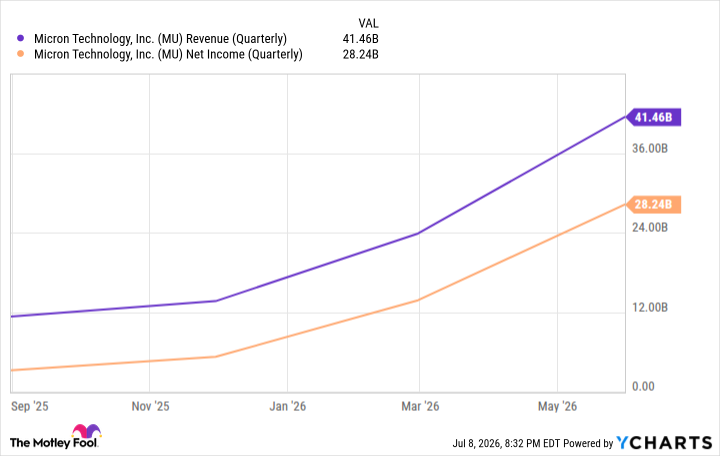
Given the high demand and short supply, Micron has been able to considerably raise prices and improve its profits and margins (though it has been accused of collusion and price-fixing). In the past year, Micron’s revenue has increased by 266%, while its net income has surged by 782%.
MU Revenue (Quarterly) data by YCharts
Unsurprisingly, the unique position Micron has found itself in — both financially and in terms of market position — has attracted many investors hoping to capitalize on it. And based on the president’s latest disclosure, he’s been one of those investors.
Today’s Change
(-1.05%) $-10.39
Advertisement
Current Price
$981.25
Key Data Points
Market Cap
$1.1TMarket cap calculated using publicly traded shares outstanding only. Does not include unlisted, private, or dual-class non-traded shares. Implied market cap may vary.Market cap calculated using publicly traded shares outstanding only. Does not include unlisted, private, or dual-class non-traded shares. Implied market cap may vary.
Day’s Range
$954.13 – $998.00
Advertisement
52wk Range
$103.38 – $1255.00
Volume
859.4K
Avg Vol
Advertisement
51.2M
Gross Margin
72.60%
Dividend Yield
0.05%
Advertisement
Should you follow Trump’s lead?
You shouldn’t invest in Micron simply because the president did. It’s true his stake in the company means he has a vested interest in making sure the stock does well, but you don’t want to blindly follow his moves simply for that reason.
You should, however, consider investing in Micron because its unique market position is bound to last for the foreseeable future. But even when supply meets demand, and Micron can’t command the premium it’s currently charging, the company will still have long-term agreements in place.
It’s operating in a cyclical industry that’s riding the high end, but it’s still a solid company with good long-term potential. It’s likely to be highly volatile along the way, but I trust its trajectory.



:no_upscale()/cdn.vox-cdn.com/uploads/chorus_asset/file/25979368/Player_Amortization.jpg)
:no_upscale()/cdn.vox-cdn.com/uploads/chorus_asset/file/25979383/Revenue_Breakdown.jpg)
:no_upscale()/cdn.vox-cdn.com/uploads/chorus_asset/file/25979406/Debt.jpg)