
Connect with us

Finance

Idaho Secretary of State updates campaign finance website

Published

on

Idaho Secretary of State updates campaign finance website

TWIN FALLS, Idaho (KMVT/KSVT) —With election season fast approaching political campaigns will be ramping up and so will their donations.

Secretary of state Phil McGrane’s office keeps a record of campaign finance as required by law, and its website has been recently redone.

The new system provides more information to the public by giving you the ability to search for a candidate, see how much they’ve raised, and where the campaign donations are coming from.

Showing how much of is coming from corporations and private donors from the community and some may surprise you.

Secretary of State Phil McGrane says, “It’s Idaho politics but not all the money is coming from Idaho. We have people from across the country investing in our elections. I like to joke one of the presentations I’ve had is we’ve had donations from Baton Rouge Louisiana coming into the Boise mayor’s race and donations as far as Alaska. It’s interesting to be able to see this more clearly and for the public it helps inform who is influencing their public officials. “

Advertisement

Dashboards and information can be found on the Secretary of State’s website.

Finance

Artificial Intelligence is Reshaping the US Financial Market; EX DeFi Launches AI-Driven Trading Technology

Published

on

Artificial Intelligence is Reshaping the US Financial Market; EX DeFi Launches AI-Driven Trading Technology

New York City, NY, July 11, 2026 (GLOBE NEWSWIRE) — Recently, the US financial market has been undergoing a new round of structural changes. With the continued surge in investment in artificial intelligence (AI), a large amount of international capital is flowing into US technology companies, while the US Treasury market faces pressure from factors such as widening fiscal deficits, increased bond supply, and persistently high long-term yields.

The market generally believes that global capital allocation patterns are changing, and the US financial market is thus entering a new stage of development. For decades, the US current account deficit has primarily relied on overseas official institutions purchasing US Treasury bonds for financing, a mechanism that has long supported the international status of the US dollar.

However, as global central banks gradually diversify their asset allocation, coupled with the continued expansion of the US fiscal deficit, some overseas investors are beginning to reduce their allocation to US Treasury bonds, preferring to invest in growth industries such as artificial intelligence and semiconductors.

AI Drives Financial Market Innovation

Driven by the wave of artificial intelligence, the US technology sector continues to attract international capital inflows. A recent study by Deutsche Bank indicates that in recent years, inflows of foreign capital into the US stock market have continued to grow, while inflows into US Treasury bonds have slowed relatively, creating a significant gap that indicates capital is gradually shifting towards technological innovation.

Advertisement

Meanwhile, US long-term Treasury yields remain high, and the market continues to focus on fiscal financing pressures, interest rate policy, and the future trajectory of the US dollar. Analysts believe that under the new capital flow pattern, the correlation between the technology industry, the stock market, and the US dollar is constantly strengthening, and artificial intelligence is becoming a key factor driving the development of the US financial market.

Against this backdrop, EX DeFi announced the launch of its AI-driven automated trading technology, combining artificial intelligence, big data analytics, and automated execution to provide users with a more intelligent and efficient trading experience.

According to EX DeFi, the system can analyze market prices, transaction data, technical indicators, and other multi-dimensional information in real time, and automatically execute trades based on user-preset strategies, improving market analysis efficiency while helping to optimize strategy execution processes.

Advertisement
Continue Reading

Finance

Trump’s Financial Disclosure Revealed a $1.67 Million Micron Stock Stake | The Motley Fool

Published

on

Trump’s Financial Disclosure Revealed a .67 Million Micron Stock Stake | The Motley Fool

There are plenty of AI stocks whose valuations have surged amid the current AI boom. There are now three companies worth at least $4 trillion, six companies worth at least $2 trillion, and 15 companies worth at least $1 trillion. And of the 15 companies worth at least a trillion, 13 are tech companies.

One of the newest members of the trillion-dollar club is Micron (MU 1.05%), which had a market cap of $1.07 trillion as of the market close on July 8. The stock is up more than 660% in the past 12 months and 200% this year, making investors a lot of money along the way — including President Donald Trump.

Trump’s 2025 financial disclosure showed that he owned between $1.67 million and $6.65 million in Micron stock. Should Trump’s stake in Micron be a sign that investors should follow his lead?

Image source: The Motley Fool.

At the right place at the right time

Trump’s stake in Micron is noteworthy given the company’s $250 million commitment to the president’s “Trump Account.” But when you set that aside, the investment in Micron is a matter of striking while the iron is hot.

Advertisement

Micron is a memory chip maker and has found itself at the right place at the right time during the current AI boom. As AI hyperscalers such as Amazon, Microsoft, and Alphabet have spent billions building out data centers and other AI infrastructure, there has been a shortage of memory hardware that these data centers rely on to operate.

Given the high demand and short supply, Micron has been able to considerably raise prices and improve its profits and margins (though it has been accused of collusion and price-fixing). In the past year, Micron’s revenue has increased by 266%, while its net income has surged by 782%.
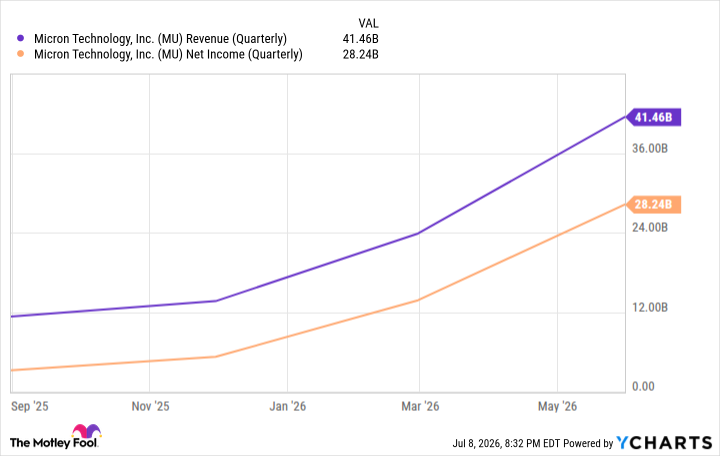
MU Revenue (Quarterly) Chart

MU Revenue (Quarterly) data by YCharts

Unsurprisingly, the unique position Micron has found itself in — both financially and in terms of market position — has attracted many investors hoping to capitalize on it. And based on the president’s latest disclosure, he’s been one of those investors.

Micron Technology Stock Quote

Today’s Change

(-1.05%) $-10.39

Advertisement

Current Price

$981.25

Should you follow Trump’s lead?

You shouldn’t invest in Micron simply because the president did. It’s true his stake in the company means he has a vested interest in making sure the stock does well, but you don’t want to blindly follow his moves simply for that reason.

You should, however, consider investing in Micron because its unique market position is bound to last for the foreseeable future. But even when supply meets demand, and Micron can’t command the premium it’s currently charging, the company will still have long-term agreements in place.

It’s operating in a cyclical industry that’s riding the high end, but it’s still a solid company with good long-term potential. It’s likely to be highly volatile along the way, but I trust its trajectory.

Continue Reading

Finance

New changes to financial aid will be minor for UND students, bigger for loan borrowers in repayment

Published

on

New changes to financial aid will be minor for UND students, bigger for loan borrowers in repayment

GRAND FORKS — Student loan repayment options and federal PLUS loans are seeing the biggest changes with the implementation of the federal One Big Beautiful Bill Act, said the director of student finance at the University of North Dakota.

Matt Lukach said students will see minor changes, but most of the work to make the alterations will fall upon UND’s system.

“It’s going to create work on our end, though, because all these changes will be manual, so we will have a lot more work on the back end. But hopefully, our students won’t see too much of a change from past years,” he said.

On Wednesday, July 1, changes to federal student aid programs from the OBBBA went into effect. Of the changes, Luckach sees the removal of the SAVE (Saving on a Valuable Education) loan repayment plan, the removal of the Graduate PLUS Loan Program and the alteration to the Parent PLUS Loan Program and scheduled reductions for federal loans at the undergraduate level as the most significant.

For undergraduate loans, students previously could get their full federal loan even if they were not a full-time student taking 12 credits. Following the changes, loans will be pro-rated down, depending on how many credits a student is taking. Most of UND’s undergraduate students are full-time students, Lukach said. For part-time students, UND will work to make adjustments to loan offers early so they won’t be as affected if they need to find alternative funding. UND already makes schedule reductions for Pell Grant funding.

Advertisement

A big change that may affect graduate students is the removal of the federal Graduate PLUS Loan Program. Some graduate students have used it to fund living expenses and pay for shortfalls while they finish their program. Graduate borrowers who have had a PLUS loan disbursed before July 1, 2026, while enrolled in a program, can continue to borrow for three academic years or the remainder of their program, whichever is less. Newer graduate students won’t be able to get the loans, and Lukach has seen movement in the private loan sector to balance this.

“We have had a lot of traffic, a lot of movement in the private loan sector in the last year to come up with options to help fill that gap of graduate PLUS loans,” he said. “The private educational loan industry is doing a pretty good job of coming up with some really comparable options to that loan.”

The Parent PLUS Loan Program won’t be going away, but it will be capped. Eligible parents can borrow a maximum of $20,000 per aid year per dependent student. In the past there was no cap, but Lukach said there wasn’t a high percentage of parents borrowing more than $20,000.

In Lukach’s opinion, the financial aid changes will be minor to current and incoming students. The bigger changes, he said, are in student loan repayment.

The SAVE plan, PAYE (Pay As You Earn) plan and the ICR (Income-Contingent Repayment) plan all are being phased out. Loan servicers are reaching out to current borrowers notifying them they have to choose different plans, though they can pay through the ICR plan until July 1, 2028. Their other options include a new tiered standard repayment plan and the new Repayment Assistance Plan.

Advertisement

RAP allows borrowers to pay monthly payments of 1-10% of the borrower’s income based on their adjusted gross income, with a minimum monthly payment of $10.

“I honestly don’t know what the effects of these new plans will be yet, because we’ve not heard from anybody, and they just went into effect,” Lukach said. “I’m sure we’ll see some chatter in the next few months on that (RAP) to see if it looks good, bad, the same. It’s hard to tell if it will be a benefit or a detriment to those people who are on the SAVE plan. We’re real early in this.”

New borrowers who borrow loans on or after July 1, 2026, have the options of the new tiered repayment plan or RAP.

Same as any other year, Lukach offers students this advice: Make a financial plan and know what is needed.

UND also has a monthly payment plan to cover gaps between a student’s charges and their financial aid, something Lukach has noticed students use more over the years. Overall, he’s seeing students be more fiscally responsible.

Advertisement

“It’s a good sign,” he said. “It means we have really high-quality students at the University of North Dakota, which I really, really love.”

Continue Reading
Advertisement

Trending
