Finance
Gulke: What's Causing All the Volatility in Commodity and Financial Markets?

For the week, May corn was 1¼¢ higher, December corn lost ½¢ and May soybeans dropped 11¢. November soybeans lost 8½¢, May soybean meal was up $11.30 per short ton and May soybean oil fell 300 points. May Chicago wheat was 11 ¼¢ lower, May Kansas City wheat was up 7½¢ and May Minneapolis wheat lost 5¼¢. December cotton was down 253 points and June DOW futures lost 963 points.
It was another interesting week in the markets with increasing volatility in the commodity complex and the stock indices. Where is all the volatility coming from? Jerry Gulke, president of the Gulke Group points to a couple possible clues.
The April WASDE was a disappointment as Gulke says USDA failed to make some key adjustments to the supply and demand tables. First, the 50-million-bushel drop in U.S. corn ending stocks failed to account for the disappearance in the Quarterly Stocks Report.
However, USDA also kicked the can down the road on the South American crop leaving Brazil corn production at 124 million metric tons, 13 million above Conab. They also left Brazil soybean production at 155 million metric tons verses Conab’s 146.5 million.
USDA punted on Argentina’s soybean production leaving it at 50 mmt. The agency did lower their corn estimate by 1 mmt, but the Rosario Grain Exchange cut the crop 6.5 mmt to only 50.5 million.
Gulke says this is a big divergence.
“Some people are going there that are boots on the ground and are saying yes, we have a problem in Brazil and now we have issues in Argentina with disease and insects,” he says. “At some point in time, we’re going to find out that I’m wrong, other people that are commenting on it now are wrong and USDA was right. Or USDA is going to have to bite the bullet somehow and say yeah, the crop turned out to not be as good as we first thought.”
So, when will USDA rectify this discrepancy? Gulke says it’s hard to know, but USDA officials have told him they aren’t in the business of speculating. So, he thinks they’re scared to make a prediction without hard evidence.
However, he says, if he is right, “What did it cost the American farmer? Because price discovery wouldn’t have pushed the prices to lows we saw at the end of February.”
Gulke says volatility is also coming from the plunge in the stock market which is down nearly 1,900 points the past two weeks. He says the charts were providing sell signals or a correction back in February, and now it is finally coming to fruition. The uncertainty of a Middle East war and thoughts that interest rates will stay higher for longer due to stubborn inflation are also factors.
As a result, traders and investors are liquidating their positions, and that is spilling over to the commodity sector. It is part of the reason the grains rallied Friday and the livestock, metals and other softs melted down.
So how much of a correction does Gulke expect in the Dow Jones Industrial Average? He says there is likely more to come as nervous investors take profits and either head to the sidelines or look for other bargains or safe havens in the market.
“Any time you have a move higher 50% of the time, you’re going to get a 50% correction, 60% of the time you’re going to get a 38% correction and a third of the time you’re going to get a two-thirds correction,” he says.
With money coming out of the stock market, will it look for a new home? Could it move into the grain markets and produce a rally and fund short covering? Gulke says it might be too early to tell.


Central banks are scaling back on the dollar as institutional bullion buying climbs to record highs.
In the World Gold Council’s (WGC) latest annual survey of central banks, 83% of respondents expect to increase their gold holdings over the next year. That’s up from 76% in 2025. This surge in demand is due to the U.S. dollar’s waning preeminence in global reserves and the growing number of international crises.
Almost three-quarters of central banks predict a lower share of global reserves held in greenbacks over the next five years, and a record 45% say they plan to increase their institutional bullion reserves over the next 12 months, up from 43% last year.
Gold Overtakes Bonds as Ultimate Safe Haven
Gold recently overtook U.S. government bonds as the world’s top reserve asset, according to the June 16 report. The survey polled 76 central banks between February and May; most responses were received after the recent Mideast hostilities began. Greenbacks accounted for 42% of total reported reserves, including gold and foreign exchange, in the third quarter of last year, according to the International Monetary Fund.
A record 90% of those polled by the WGC say gold’s performance during volatile periods is a key reason for acquiring more of it. Similarly, 82% say they value gold for portfolio diversification, and 84% value it as a long-term store of value.
The metal’s role in hedging geopolitical risk is especially important among central bankers in developing and emerging markets, with 85% citing this factor.
Half of respondents seeking to procure more gold say they will finance such purchases through domestic purchase programs denominated in local currency, while 38% say they would buy more gold by selling existing reserve assets.
Global Shift in Gold Storage Strategy
Central banks also appear to be rethinking their gold storage strategy. The survey found that 9% of central banks increased domestic storage over the past year, while 10% say they diversified their overseas storage locations.
The Bank of England remains the most popular gold storage location, cited by 57% of respondents, while the Swiss National Bank saw a sharp drop in preference, from 12% to 6% in 2025.
In the past four years, central banks have, on average, acquired 1,000 tonnes of gold annually, double the 500-tonne average of the previous decade. Mainland China’s bullion stores totaled 74.96 million troy ounces in late May, up 320,000 from April, marking the 19th consecutive month of increase, according to the People’s Bank of China.
Ajay Shamdasani is a contributing writer based in Hong Kong.

SixCap Healthcare Finance added Dan Carroll as senior relationship manager, reporting to the company’s co-founder and chief investment officer, Dan Whitwer.
Carroll brings more than 20 years of commercial finance, portfolio management and healthcare asset-based lending experience to SixCap. Throughout his career, he has managed complex healthcare lending relationships, led portfolio management teams, overseen loan closings and partnered closely with borrowers to support growth while maintaining disciplined credit management.
Most recently, Carroll held leadership positions at Siena, CNH Finance and Triumph Healthcare Finance, building extensive expertise in healthcare lending, credit analysis, loan structuring, risk management and client relationship management.
In his new role, Carroll will oversee borrower relationships across SixCap’s growing healthcare portfolio, working closely with clients to provide proactive portfolio management, responsive service and financing solutions that evolve alongside their businesses.
“We’re thrilled to welcome Dan to the SixCap team,” Whitwer said. “I’ve had the privilege of working alongside Dan and have seen firsthand the integrity, experience and thoughtful approach he brings to every client relationship. He understands healthcare, he understands asset-based lending and, most importantly, he understands the value of building lasting partnerships. As our portfolio continues to grow, Dan’s leadership and commitment to exceptional client service make him a tremendous addition to our team.”

Two of Chicago’s most pivotal but challenging undeveloped sites — Foundry Park on the North Side and the vacant South Loop parcel known as The 78 — moved forward in a big way Wednesday before the City Council adjourned for a summer recess.
Mayor Brandon Johnson introduced a $201.6 million tax increment financing subsidy for JDL Development’s scaled back vision for North Side industrial land along the Chicago River that once was supposed to be home to the Lincoln Yards megaproject.
And despite a slew of concerns from Council members, the full Council approved a $425 million TIF for The 78, a reference to Chicago’s unofficial 78th community area. The subsidy will bankroll public improvements needed for the South Loop development, anchored by a $750 million soccer stadium privately financed by Chicago Fire billionaire owner Joe Mansueto.
Downtown Ald. Bill Conway (34th), whose adjacent TIF is being raided to help The 78, again refused to go along with the $250.1 million piece of the infrastructure package that will primarily be used to build a 1,200-space parking garage. The $216 million garage will serve as the “podium” for an open-air plaza and future high-rise development on the air rights above the garage.
Referring to the Bears’ long-running stadium saga, Conway said Wednesday he appreciates the Fire “not trying to move to Hammond, Indiana, and become the Hammond Sparks.” But he said he “cannot look the taxpayers in the eye and tell them” he supported spending “$250 million to build a stadium parking garage and plaza.”
Finance Chair Pat Dowell, whose 3rd Ward includes The 78, has argued that the podium “brings the site to grade at Roosevelt Road” and is the key to “unlocking the site from the isolation that has stalled every previous development proposal.”
Deputy Planning Commissioner Jeff Cohen made that same point Wednesday, with a new wrinkle.
“The idea here is to incorporate that garage into the podium,” Cohen said. “It’s addressing a design and development plan that allows for all of the land within The 78 to be open for investment, rather than having to have either temporary or permanent surface parking lots to accommodate the car traffic.”
An artist’s rendering of the planned Chicago Fire soccer stadium at The 78 in the South Loop.
Related Midwest & Gensler
The $201.6 million subsidy proposed for Foundry Park pales by comparison to the $1.3 billion that former Mayor Rahm Emanuel once proposed for Lincoln Yards. That massive subsidy became a political lightning rod, with the avalanche of criticism led by the Chicago Teachers Union and then-union organizer Brandon Johnson.
The $201.6 million subsidy that Johnson introduced at Wednesday’s Council meeting is more likely to be criticized for being too little.
It will support just over 25% of the $800 million worth of roads, bridges, utilities and mass transit improvements that 2nd Ward Ald. Brian Hopkins has said were mandated as part of the Lincoln Yards plan.
Foundry Park developer Jim Letchinger acknowledged that there is “other infrastructure that the neighborhood would like to see done that is not possible right now.”
But Letchinger added it’s a start that includes the long-promised extension of the popular 606 Trail. “If you don’t start with something that’s achievable, you can’t achieve anything.”
“We have a plan to actually start building and creating revenue right away in conjunction with building our infrastructure … A lot of parks. Massive riverwalk. Ten acres of public open space. Very usable, very engaging,” Letchinger said Wednesday.
“As we continue to build, since we’re not using anywhere near all the increment that we’re creating, the other increment can go toward other projects that the neighborhood would like to see — whether it’s to build a bridge or fixing Elston Avenue, or anything else that they’re anxious about,” he said.
Public improvements promised to residents, but not covered by the $201.6 million subsidy, include another bridge crossing the Chicago River and a realignment of Elston Avenue, which Letchinger called a positive move in the long run, but a “massive undertaking” complicated by cost and property control.
“No private developer can realign Elston. It’s impossible. The city is the only one that can do that, and they’re working on it. There’s plans for it. But it will take a very long time,” Lechtinger said.
Ald. Scott Waguespack (32nd) said there is “one bridge that a lot of people still want,” but it goes through private properties owned by Ozinga Ready Mix Concrete and several other owners.
“The city would have to do it as a taking [of property], and that would be in the hundreds of millions of dollars. So they took that off the table because … that bridge wasn’t necessary at this time,” Waguespack told the Chicago Sun-Times.
Letchinger’s plan for roughly 34 vacant acres of the site calls for up to 3,737 residences, 20% of them designated as affordable to comply with the city’s set-aside rules. The new design includes low- to mid-rise buildings, some for offices, grouped near open space and riverfront access. Buildings would get ground-floor retail, and one is slated as a boutique hotel.
The project’s reduced density has drawn praise from residents. And Waguespack said he’s satisfied with the reduced public subsidy.
“In the future if there’s more needed, we could go back and do it. But this is much more grounded in a realistic infrastructure project that will still satisfy all the needs of connecting the neighborhoods,” Waguespack said.
Hopkins said he views the scaled-down subsidy and the infrastructure projects as “wholly inadequate” and a broken promise to Lincoln Park and Bucktown residents.
“Lincoln Yards provided for two bridges with the possibility of a third. Foundry Park has zero,” Hopkins said. “I don’t want to move on a vague verbal promise that we might consider adding a bridge later. The time to add it is now while the redevelopment agreement is still pending. And the fact that it was omitted is tragic. Also, the [Elston-Armitage] intersection redesign and the new Metra station seems to have fallen by the wayside.”
Also at Wednesday’s meeting, Johnson proposed a tax break for Chicago’s booming film and television industries — by reducing the 15% personal property lease transaction tax to 11%.
The tax has been raised twice in recent years and was the biggest piece of the revenue package that helped balance the $16.7 billion budget for 2026. It has exceeded revenue projections by $40.3 million through June 30, allowing Johnson to offer the break in hopes of attracting more film and TV productions to Chicago.
The City Council also followed a trail blazed by Gov. JB Pritzker and his counterparts in six other states by prohibiting present and former city employees — and elected officials — from using insider information to bet on prediction markets. Apps including Kalshi and Polymarket are used to place bets on everything from election winners and the number of candidates entering a specific race for office, to budgetary and foreign policy decisions by elected officials.
Championed by Ald. Timmy Knudsen (43rd), the ordinance prohibits current or former city officials, appointees and employees from using “confidential information or any non-public information, including the identity of the subject of an investigation” to either participate in prediction markets or “assist any other person” placing those bets.
The Council also confirmed Johnson’s appointment of Dr. Garth Walker as the city’s public health commissioner.
-
 Politics4 minutes ago
A new piece of Democrats’ midterm strategy: Being ‘practical’
-
 Science10 minutes ago
After wildfires destroyed 95% of this California tribe’s forests, members uncovered 1,200 ancestral sites
-
 Sports16 minutes ago
World Cup championship and third-place game: Start times and how to watch
-

 World28 minutes ago
Rule of Law in Hungary shows ‘radical change’ under Magyar, EU says
-

 News58 minutes ago
Where Wildfire Smoke Is The Worst Right Now—And What To Do About It
-

 Los Angeles, Ca3 hours ago
LADWP begins long-term repairs after West Hollywood water main rupture
-

 Detroit, MI3 hours ago
Livestream: Mayor Sheffield, Detroit health chief to address wildfire smoke threat
-
 San Francisco, CA3 hours ago
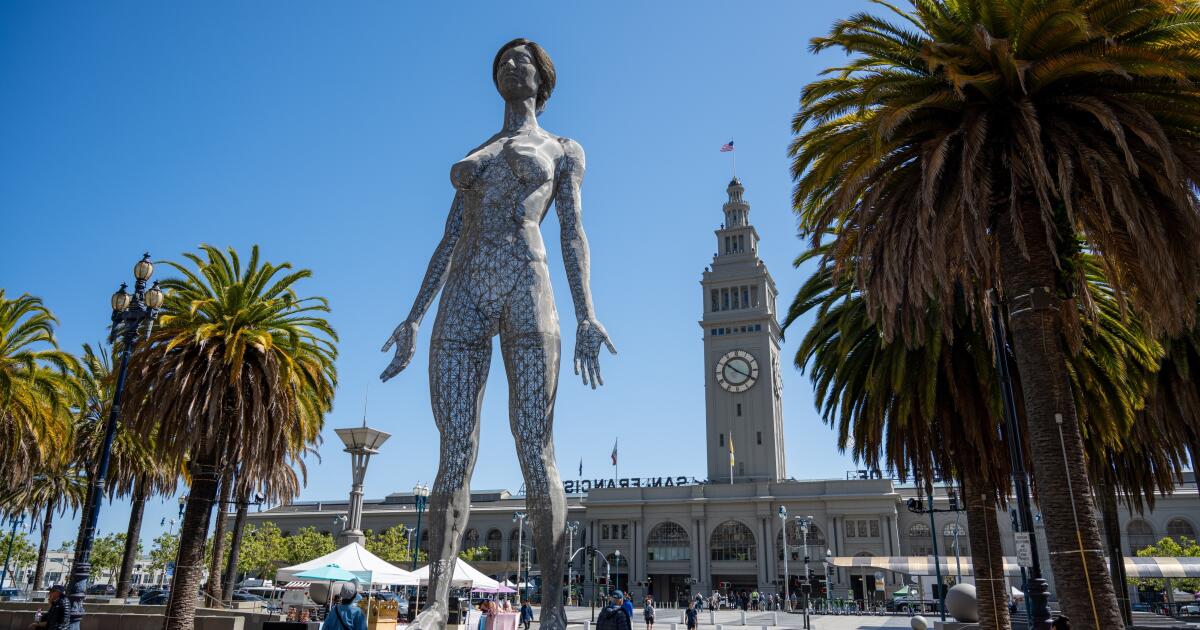
A sculpture of a giant naked woman goes on sale in San Francisco. Bring a crane

