The article from the Wall Street Journal titled “Why My Generation Is Turning to Financial Nihilism” by Kyla Scanlon argues that Gen Z is embracing high-risk financial behavior out of despair and detachment. Of course, it is essential to recognize that Kyla, although well-intentioned, is a young twenty-something influencer with limited real-life experience, and sees things for “her generation” through a very narrow lens of “recency bias.”
Let’s start with understanding that “Financial Nihilism” is a term used to describe an attitude where people believe financial decisions are meaningless because the system is rigged, the future is hopeless, or traditional paths to wealth are broken. The term “Financial Nihilism” was first coined in 2020 by Demetri Kofinas, a podcaster, who used it to describe his belief that speculative assets lack intrinsic value, driven by a loss of faith in traditional economic systems.
However, while this phrase has gained popularity in recent years, particularly following the GameStop short squeeze, crypto mania, and the rise of meme trading, it disappeared when all of that collapsed in 2022. However, after three years of unprecedented market gains in every asset class, from stocks to cryptocurrencies to precious metals, “Financial Nihilism” has resurfaced to rationalize “speculative excess” and justify abandoning long-term investment strategies that have withstood the “sands of time.”
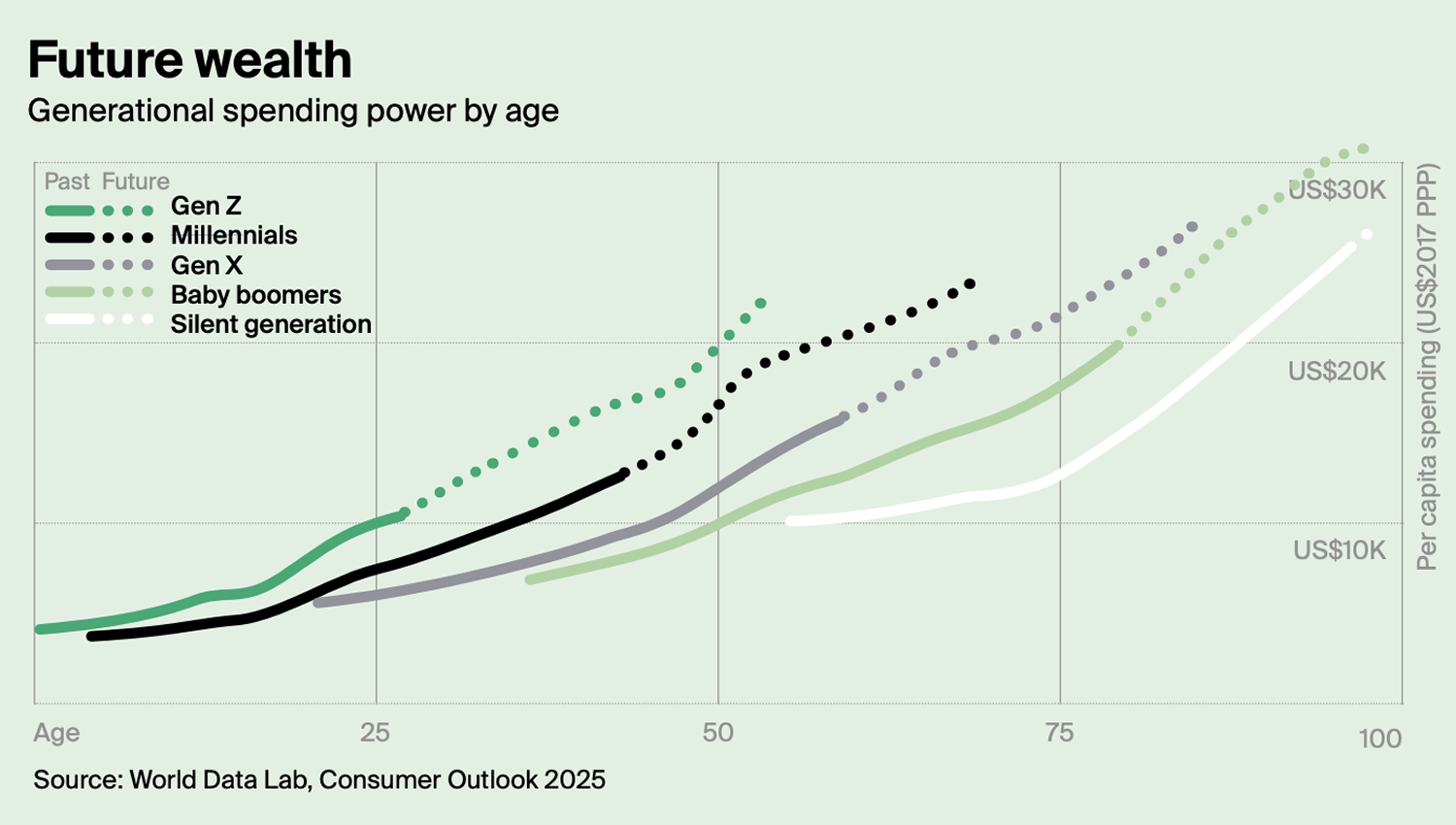
While Kyla produced a bombastic article to gain social media exposure by suggesting that Gen Z and Millennials no longer believe in saving, investing, or following traditional financial paths, the data shows something very different.
Over half of Gen Z holds investments in traditional financial products, according to FINRA and the CFA Institute.
A2023 Vanguard report showed Gen Z participants in retirement plans were increasing contributions, not fleeing traditional investing.
Charles Schwab’s Modern Investor Study found Gen Z prefers low-cost ETFs and index funds, strategies built around long-term returns.
Pew Research data shows that Gen Z and Millennials are investing at earlier ages than previous generations.
None of these behaviors is nihilistic. They are practical and reflect economic constraints, not philosophical despair.
Yes, there is undoubtedly a pool of young investors throwing “caution to the wind” and aggressively investing in speculative assets to “get rich quick.” But even my children, at the ripe old age of 22, think they are unique and different and that no one understands their challenges. We parents, of course, have “no idea” about their situation. Of course, this is the problem with our youth who have no real-world experience or a sense of history. We, the “old people,” were the ones speculating on Dot.com investments in the late 90s, just before it all went bust. As I wrote in“Retail Investors Flood The Market,”
Advertisement
“Is it 1999 or 2007? Retail investors flood the market as speculation grows rampant with a palpable exuberance and belief of no downside risk. What could go wrong?
Do you remember this commercial?
That commercial aired just 2 months shy of the beginning of the “Dot.com” bust. We “youngsters” at the time thought Warren Buffett was an idiot for avoiding technology stocks because “he didn’t get it.”
Turns out he was right.
But that wasn’t the first time that we youngsters had to learn the risks of chasing “hot investments,” and why “this time is NEVER different.” The following E*Trade commercial aired during Super Bowl XLI in 2007. The following year, the financial crisis set in, markets plunged, and once again, investors lost 50% or more of their wealth by refusing to listen to the warnings.
Advertisement
Why this trip down memory lane? (Other than the fact that the commercials are hilarious to watch.) Because what is happening today is NOT “Financial Nihilism,” it is the typical outcome of exuberance seen during strongly trending bull market cycles.
While young people, like Kyla, may think that “this time is different,” they lack the historical experience to support such a conclusion. Ask anyone who has lived through two “real” bear markets, and the imagery of people trying to “daytrade” their way to riches is all too familiar. The recent surge in speculative excess, leverage, and greed is not a new phenomenon.
With that said, let’s examine the issues with Kyla’s article and why “Financial Nihilism” is a myth.
“Meme Stocks and Crypto Aren’t Jokes Anymore. They’re Cries for Help.”
I loved this line from her diatribe as it suggests that Gen Z uses risky financial products as an emotional outlet. She implies that young people are not seeking returns but rather relief from feelings of hopelessness. While that framing sells well, it doesn’t hold up under scrutiny. While speculative assets like cryptocurrency and meme stocks attract younger buyers, that’s not proof of despair. Instead, it reflects broader exposure to digital markets, higher risk tolerance, easy access to trading (via platforms like Robinhood), leverage, and the rise of a gambling mentality.
But this is a newer development.
Advertisement
“Historically, access to capital markets was highly mediated, available only to institutions or individuals who had the time, money and resources to manage their assets with the help of brokers and financial advisors. Today, market data is readily accessible online and new technologies have significantly reduced the cost of trading and other barriers to entry. This means that more people can trade, at any time, from anywhere.” – World Economic Forum
Since 2016, the volume recorded at platforms that match orders from brokerages, a proxy for retail activity, has posted its third consecutive annual increase, rising by 15%. Meanwhile, the average daily volume of US-listed stocks has been ~12.0 billion shares since 2019, which is ~75% above the levels seen over the prior six years. Most notably, just over the last 12 months, daily volume has averaged a massive 16.7 billion shares.
Yes, retail investors are piling into the market. But why wouldn’t they after watching 15 years of market returns that are 50% above historical norms, and seeming “no risk” for speculative activities?
However, there is a difference between risk appetite and recklessness. As noted above, the data indicate that Gen Z is starting to engage with investing at a younger age than previous generations, and many hold investments for the long term while utilizing digital tools to experiment with their investments. That may include crypto or options, but it’s not a binary between discipline and nihilism.
Emotional narratives about “cries for help” obfuscate the data. Investors in their 20s often take more risk because they have longer time horizons. But where they are going wrong is through the amount of speculative risk and gambling behaviors they have adopted without financial guidance and education.
As noted above, “youngsters” gambling with investments is not new. Every generation throughout history has speculated on risk assets through every bull market cycle. But, unfortunately, regardless of age, speculative bubbles all ended the same way.
Gen Z didn’t “reinvent” the market; they are just entering a market that incentivizes risk-taking. Until it doesn’t.
“People My Age Don’t Think the System Works, So Why Follow Its Rules?”
Scanlon asserts that Gen Z has lost faith in traditional finance and institutions, and assumes systemic distrust is translating into a rejection of personal responsibility.
That isn’t an argument. It’s an excuse for “victimization.”In other words, my personal financial situation is not a result of my personal behaviors, spending habits, work ethic, or savings process, but it’s the “system’s fault.” Yet there is vast data to the contrary, showing that successful young individuals who follow the tried-and-true process of financial pathways succeed. Do they have as much wealth as their parents? Of course, they don’t, because they haven’t had the time to accumulate it. However, they are early on the path to success, which will likely outpace their peers.
Advertisement
Furthermore, this argument falsely equates skepticism with nihilism. Many young investors distrust centralized finance due to real-world events, including the 2008 crash, rising debt burdens, and stagnant wages. But rejecting blind trust in institutions is not the same as rejecting financial logic. Despite disillusionment, Gen Z invests at higher rates than Millennials did at the same age, according to Pew and the WEF. They also save a larger share of their income, using digital apps and platforms to automate their financial behavior.
Yes, Gen Z tends to distrust the government and financial media, but do you blame them, given the garbage that is produced daily on social media and YouTube by people with an agenda to promote? While skepticism fuels caution, it is not chaos. Gen Z is more likely to question fees, demand transparency, and seek passive investment tools, and that’s a smart move. Traditional rules of finance, such as saving consistently, spending less than you earn, and investing for the long term, are still followed; they just don’t generate “media-grabbing headlines.”
Calling this behavior “Financial Nihilism” misses the point. Gen Z is engaging with markets on its own terms, and while not all methods are necessarily healthy, it represents adaptation, not rejection.
“If the Future Feels Doomed, Why Not YOLO Trade Into It?”
Lastly, Kyla suggests that existential dread leads young people to treat the market like a casino. The idea is that if nothing matters, risk doesn’t either. This is the article’s weakest argument. While social and economic pressures are real, they are not driving widespread self-destruction. They are driving innovation in how people build and manage their wealth.
The idea behind this line is that young people, facing what feels like a bleak financial future, are throwing caution to the wind to gamble on crypto, options, and meme stocks to build wealth fast, rather than creating “lasting wealth.” This is where the term “YOLO trading” comes in, making aggressive bets with the mindset that there’s nothing to lose. However, as noted above, there is certain logic to that mindset, given that over the last 15 years, every market downturn has been met by either fiscal or monetary interventions. Repeated bailouts of bad investment decisions have created a “moral hazard” in the marketplace.
There’s truth here, but only part of it.
Yes, a subset of young investors is engaging in reckless speculation. They take on excessive risk, invest in volatile assets, and often trade on hype rather than fundamentals. Many borrow money to do it. This group exists, and their outcomes won’t be good. Some will lose money, and likely most will wipe themselves out entirely. The market is unforgiving when paired with leverage, inexperience, and emotional trading.
Here is a great example of the “YOLO” trading fallacy. Since the end of the “Meme Stock” craze in 2021, retail investors on Robinhood have made no money, even after accounting for the $4-5 billion wipeout in the January rout. That’s 5 years of their investing time horizon gone, whereas just investing in the S&P 500 index would have produced far superior results.
Advertisement
But this behavior doesn’t define the generation. It represents the tail end of the distribution—the loudest, not the largest.
What’s left out of Kyla’s article is what happens after the eventual realization that “trading” is a losing exercise over the long term. Early losses are the price of financial education, and, hopefully, if they survive financially, they will change their approach and revert to more traditional principles that have endured over the decades. In other words, they grow up and learn from the experience just as every great investor in history has.
The future is not doomed. But it is fragile for those who ignore risk. Financial outcomes depend on staying in the game long enough to benefit from compounding. If you blow yourself up in your 20s, you lose that opportunity.
The lesson is simple. Speculation is fun while you are winning, but that is not “Financial Nihilism.” It is simply greed masquerading as investing. However, the people who win in the long term are not gamblers. They’re grinders. They keep costs low, automate savings, and make decisions that allow them to survive market cycles. That’s not as flashy as YOLO trading, but that is how wealth is built.
What Gen Z Should Do: Build Survivability, Not Sensation
Despite the bad headlines, most young people are serious about their money. But seriousness alone doesn’t build wealth. The key is survivability, the ability to stay in the game long enough to benefit from compounding returns.
Do yourself and your financial future a favor: turn off bombastic, emotionally charged headlines and focus on what matters for building long-term wealth. Crucially, whether you agree with the current financial and economic system or not, learn to take advantage of it.
The only thing YOU can change is YOUR future. So stop worrying about things you can not control.
Advertisement
To get there, start here.
Turn off the social media, influencers, and other financial goblins and focus on your goals and behaviors.
Keep fixed expenses low
Build cash reserves that cover 6 months of spending
Use retirement accounts like Roth IRAs early
Allocate most of their portfolio to index funds or ETFs
Limit risky bets to no more than 5% of their total assets
Learn through action, not theory, and track everything
Avoid the leverage period.
The goal is not to outperform every year or get rich quickly. The goal is to stay solvent long enough for your savings to generate a return.
Financial nihilism is a myth. What’s real is volatility, income pressure, and distrust. The response shouldn’t be disengagement, but rather financial discipline. Long-run wealth isn’t about hope; it’s about repeatable behaviors that work consistently through market cycles.
The biggest problem for most young investors is the lack of research on the stocks they buy. They are only buying them “because they were going up.”
However, when the “season does change,” the “fundamentals” will matter, and they matter a lot.
Such is something most won’t learn from “social media” influencers.
Advertisement
As Ray Dalio once quipped:
“The biggest mistake investors make is to believe that what happened in the recent past is likely to persist. They assume that something that was a good investment in the recent past is still a good investment. Typically, high past returns simply imply that an asset has become more expensive and is a poorer, not better, investment.”
Investing is a game of “risk.”
It is often stated that the more “risk” you take, the more money you can make. However, the actual definition of risk is “how much you will lose when something goes wrong.”
Following the “Dot.com crash,” many individuals learned the perils of “risk” and “leverage.”
Unfortunately, for Gen-Z’ers, such is a lesson that is still waiting to be learned.
The up-and-coming fintech scored a pair of fourth-quarter beats.
Diversified fintech Chime Financial(CHYM +12.88%) was playing a satisfying tune to investors on Thursday. The company’s stock flew almost 14% higher that trading session, thanks mostly to a fourth quarter that featured notably higher-than-expected revenue guidance.
Sweet music
Chime published its fourth-quarter and full-year 2025 results just after market close on Wednesday. For the former period, the company’s revenue was $596 million, bettering the same quarter of 2024 by 25%. The company’s strongest revenue stream, payments, rose 17% to $396 million. Its take from platform-related activity rose more precipitously, advancing 47% to $200 million.
Image source: Getty Images.
Meanwhile, Chime’s net loss under generally accepted accounting principles (GAAP) more than doubled. It was $45 million, or $0.12 per share, compared with a fourth-quarter 2024 deficit of $19.6 million.
Advertisement
On average, analysts tracking the stock were modeling revenue below $578 million and a deeper bottom-line loss of $0.20 per share.
In its earnings release, Chime pointed to the take-up of its Chime Card as a particular catalyst for growth. Regarding the product, the company said, “Among new member cohorts, over half are adopting Chime Card, and those members are putting over 70% of their Chime spend on the product, which earns materially higher take rates compared to debit.”
Today’s Change
(12.88%) $2.72
Current Price
$23.83
Advertisement
Key Data Points
Market Cap
$7.9B
Day’s Range
$22.30 – $24.63
52wk Range
Advertisement
$16.17 – $44.94
Volume
562K
Avg Vol
3.3M
Advertisement
Gross Margin
86.34%
Double-digit growth expected
Chime management proffered revenue and non-GAAP (adjusted) earnings before interest, taxes, depreciation, and amortization (EBITDA) guidance for full-year 2026. The company expects to post a top line of $627 million to $637 million, which would represent at least 21% growth over the 2024 result. Adjusted EBITDA should be $380 million to $400 million. No net income forecasts were provided in the earnings release.
It isn’t easy to find a niche in the financial industry, which is crowded with companies offering every imaginable type of service to clients. Yet Chime seems to be achieving that, as the Chime Card is clearly a hit among the company’s target demographic of clientele underserved by mainstream banks. This growth stock is definitely worth considering as a buy.
ROCHESTER, N.Y. — Student athletes are now earning real money thanks to name, image, likeness deals — but with that opportunity comes the need for financial preparation.
Noah Collins Howard and Dayshawn Preston are two high school juniors with Division I offers on the table. Both are chasing their dreams on the field, and both are navigating something brand new off of it — their finances.
“When it comes to NIL, some people just want the money, and they just spend it immediately. Well, you’ve got to know how to take care of your money. And again, you need to know how to grow it because you don’t want to just spend it,” said Collins Howard.
What You Need To Know
High school athletes with Division I prospects are learning to manage NIL money before they even reach college
Glory2Glory Sports Agency and Advantage Federal Credit Union have partnered to give young athletes access to financial literacy tools and credit-building resources
Financial experts warn that starting money habits early is key to long-term stability for student athletes entering the NIL era
Preston said the experience has already been eye-opening.
“It’s very important. Especially my first time having my own card and bank account — so that’s super exciting,” Preston said.
Advertisement
For many young athletes, the money comes before the knowledge. That’s where Glory2Glory Sports Agency in Rochester comes in — helping athletes prepare for life outside of sports.
“College sports is now pro sports. These kids are going from one extreme to the other financially, and it’s important for them to have the tools necessary to navigate that massive shift,” said Antoine Hyman, CEO of Glory2Glory Sports Agency.
Through their Students for Change program, athletes get access to student checking accounts, financial literacy courses and credit-building tools — all through a partnership with Advantage Federal Credit Union.
“It’s never too early to start. We have youth accounts, student checking accounts — they were all designed specifically for students and the youth,” said Diane Miller, VP of marketing and PR at Advantage Federal Credit Union.
The goal goes beyond what’s in their pocket today. It’s about building habits that will protect them for life.
Advertisement
“If you don’t start young, you’re always catching up. The younger you start them, the better off they’re going to be on that financial path,” added Nihada Donohew, executive vice president of Advantage Federal Credit Union.
For these athletes, having the right support system makes all the difference.
“It’s really great to have a support system around you. Help you get local deals with the local shops,” Preston added.
Collins-Howard said the program has given him a broader perspective beyond just the game.
“It gives me a better understanding of how to take care of myself and prepare myself for the future of giving back to the community,” Collins-Howard said.
Advertisement
“These high school kids need someone to legitimately advocate their skills, their character and help them pick the right space. Everything has changed now,” Hyman added.
NIL opened the door. Programs like this one make sure these athletes walk through it — with a plan.
With the introduction of the Employee Ownership Development Act , Illinois is poised to create the largest dedicated public investment vehicle for employee ownership in the country.
State Rep. Will Guzzardi’s bill, HB4955, would authorize the Illinois Treasury to deploy a portion of the state’s non-pension investment portfolio into employee ownership-focused investment funds.
That would represent a substantial investment of institutional capital in building wealth for Illinois workers and seed a capital market for employee ownership in the process. And because the fund is carved out of the state investment pool, it doesn’t require a single dollar of appropriations from the legislature.
Silver tsunami
The timing of the Employee Ownership Development Fund could not be more urgent. More than half of Illinois business owners are over 55 years old and are set to retire in the coming decade. When these owners sell their firms, financial buyers and competitors are often the default exit – if owners don’t simply close the business for lack of a buyer.
Each of these traditional paths risks consolidation, job loss and offshoring of investment and production. These are major disruptions to the communities that have long sustained these businesses. Without a concerted strategy, business succession is an economic development risk hiding in plain sight, and one that threatens local employment, supply chain resilience, and the tax base of communities across the country.
Advertisement
Employee ownership offers another path. Decades of empirical research show that employee-owned firms grow faster, weather economic downturns better (with fewer layoffs and lower rates of closure), and provide better pay and retirement benefits.
The average employee owner with an employee stock ownership plan, or ESOP, has nearly 2.5 times the retirement wealth of non-ESOP participants. That comes at no cost to the employee and is generally in addition to a diversified 401(k) retirement account.
Because businesses are selling to local employees, employee ownership transitions keep businesses rooted in their communities. This approach can support a place-based retention strategy for state economic policymakers.
Capital gap
Despite the remarkable benefits of employee ownership and bipartisan support from policymakers, a lack of private capital has impeded the growth of employee ownership: In the past decade, new ESOP formation has averaged just 269 firms per year.
Most ESOP transactions ask the seller to be the bank, relying heavily on sellers to finance a significant portion of the sale themselves, often waiting five to 10 years to fully realize their proceeds. Compared to financial and strategic buyers who offer sellers their liquidity upfront, employee ownership sales are structurally uncompetitive in the M&A market.
Advertisement
A small but growing ecosystem of specialized fund managers has begun to fill this gap. They deploy subordinated debt and equity-like capital to provide sellers the liquidity they need, while supporting newly employee-owned businesses with expertise and growth capital (see for example, “Apis & Heritage helps thousands of B and B Maintenance workers become owners”).
This approach is a recipe for scale, but the market remains nascent and undercapitalized relative to the generational pipeline of businesses approaching succession. To mature, the market needs anchor institutional investors willing to commit capital at scale.
State treasurers and other public investment officers could be those institutional investors. Collectively managing trillions of dollars in state assets, they have the portfolio scale, time horizons and fiduciary obligation to earn market returns while advancing state economic development.
Illinois’ blueprint
Just as federal credit programs helped catalyze the home mortgage and venture capital industries in the 20th century, state treasurers and comptrollers now have the opportunity to help build the employee ownership capital market in the 21st.
Illinois shows us how. The state’s Employee Ownership Development Act is modeled on proven investment strategies previously authorized by the legislature and pioneered by State Treasurer Michael Frerichs. The Illinois Growth and Innovation Fund and the FIRST Fund each ring-fence 5% of the state investment portfolio for investments in private markets and infrastructure, respectively, deployed through professional fund managers. Both have generated competitive returns while catalyzing billions of dollars in private co-investment in Illinois.
Advertisement
The Employee Ownership Development Fund would apply that same architecture to employee ownership. The Treasurer would invest indirectly by capitalizing private investment funds deploying a range of credit and equity. The funds, in turn, would invest a multiple of the state’s commitment in employee ownership transactions.
The employee ownership field has matured to a point that is ready for institutional capital. The evidence base is robust. The fund management ecosystem is growing. And the business succession pipeline is larger than it will be for generations.
Yet the field still lacks the publicly enabled financing interventions that have historically built new markets in this country. State treasurers, city comptrollers and other public investment officers have the tools and resources at their disposal to provide that catalytic, market-rate investment to enable the employee ownership market to scale.
Julien Rosenbloom is a senior associate at the Lafayette Square Institute.
Guest posts on ImpactAlpha represent the opinions of their authors and do not necessarily reflect the views of ImpactAlpha.