Finance
Financial Experts: Best Money They Ever Spent on Their Children’s Future


In addition to being a good career choice, finance professions may offer the individuals who pursue them extra information and sometimes opportunities that help them to make great financial choices not only for their clients, but for their own children.
Learn More: I’m a Financial Advisor: 10 Most Awesome Things You Can Do for Your Finances in 2025
Find Out: 4 Subtly Genius Moves All Wealthy People Make With Their Money
From investments to life experiences, financial experts understand better than most the importance of the tools, literal and figurative, that children need to do well in life.
Two financial experts explained the best money they spent on their children’s future.
Melanie Musson, a mother of six and a financial expert with InsuranceProviders.com, said that buying a home turned out to be an incredible piece of her children’s financial stability.
Buying a home is tough for anyone, Musson said, especially when you live where real estate is expensive and you’re barely keeping up with the cost of living, but it’s worth it.
“We bought our first home before we had children, and while we hoped to have children, we were not buying the house for them. As it turned out, that property became our children’s home. It was a place of security.”
Read Next: I’m a Financial Advisor: My Wealthiest Clients All Do These 3 Things
That first home allowed them to build equity over 15 years that allowed them to buy a forever home for their children that they could have never afforded had they not started somewhere. But it also conferred other benefits.
“Owning a home keeps your housing payments stable when income increases. So, when you earn more money, you can do things that directly benefit your children, like investing in a 529 college plan, which is our primary avenue of spending money for our children’s futures.”
They invested roughly $200,000 initially but saw a significant return on that investment.
In addition to providing equity that could be passed on to their children, Musson said, “It kept housing costs the same for years so that as we earned more, we could invest more directly into our children’s futures instead of having our housing costs creep up and absorb the extra.”
While they did suffer through equity loss during the housing crash of 2008, she said the benefits of having stability “started immediately.”
Every situation is different, but she said, generally, “investing in a family home is a good route to take to enable you to build stability.”
For Julien B. Morris, CFP, principal and founder of Concierge Wealth Management, the best money he spent was not directly a financial one, but sending his 9-year-old daughter to Jewish overnight camp.



A select team of students from the University of St. Thomas’ Cameron School of Business has officially launched its bid for the FY 2025–2026 Texas Region CFA (Certified Financial Analyst) Institute Research Challenge, a prestigious competition often referred to as the “Investment Olympics” for university students.
The CFA Institute Research Challenge is an annual competition that provides university students with hands-on mentoring and intensive training in financial analysis. The competition tests students’ analytical, valuation, report writing and presentation skills, challenging them to take on the role of real-world research analysts. The 2025–2026 cycle involves more than 6,000 students from more than1,000 universities worldwide.
Representing UST, the team is comprised of Team Captain Chih Jung Ting, MSF; Vice-Captain Daria Kostyukova, BBA/MSF; Reginald Paolo Laudato, BBA/MSF; Simon Wong, BBA in Finance; and Anjali Sebastian, BBA in Finance.

The team of five students has been selected to conduct an exhaustive equity analysis of a target company, competing against top-tier universities from around the Texas area.
“Taking part in the CFA Research Challenge has been the most intense and rewarding experience of my academic career,” said Chih Jung Ting, team captain. “We aren’t just reading case studies anymore—we are digging into real balance sheets, forecasting real economic shifts, and learning how to defend our ideas under pressure. It’s given us a true taste of what it means to be an analyst.”
The team is supported by Department Chair of Economics and Finance Dr. Joe Ueng, CFA, and faculty advisor Dr. Dan Hu. Assisting the team was industry mentor Matt Caire, CFA, CFP®, CMT from Vaughan Nelson, a seasoned professional who provides guidance on the intricacies of equity research.
“Our participation in the CFA Research Challenge is a testament to the caliber of our students and the strength of our curriculum,” said Dr. Ueng. “By applying advanced financial theory to a live market scenario, our students demonstrate that they are not just learners, but emerging professionals ready to contribute to the global financial community. We are incredibly proud of their dedication to academic excellence.”
Dr. Sidika Gülfem Bayram, the Cullen Foundation Endowed Chair of Finance and UST associate professor of Finance said participating in the CFA Research Challenge this year creates a pivotal moment for UST students.
“I’m impressed to see our students apply their curriculum knowledge to meet the depth and vast nature of the analysis required in such a fierce competition,” Dr. Bayram said. “I’m so proud of the effort the students put into the challenge.”
This year, the team has been tasked with analyzing Green Brick Partners, a publicly traded company in the consumer cyclical sector. During the past several months, the students have dedicated more than 150 hours to conducting a deep-dive analysis of the company’s business model and industry position, interviewing company management and financial experts, building complex financial models to determine the stock’s intrinsic value, and compiling an “Initiation of Coverage” report with a buy, sell or hold recommendation.
“Participating in the CFA Research Challenge allows our students to bridge the gap between classroom theory and the fast-paced world of investment management,” said Dr. Hu. “It demands a level of rigor and professional ethics that prepares them for the highest levels of the finance industry.”
The team will presented its findings and defended its recommendation before a panel of judges from leading investment firms at the CFA Society local final in late February. Winners of the local competition will advance to the subregional and regional rounds, with the goal of reaching the global finals in May 2026.
';

Nantucket’s municipal finance director Brian Turbitt has announced his resignation and will leave his position with the town on April 21st.
“With mixed emotion, I have submitted my resignation from the position of Town of Nantucket Director of Municipal Finance, effective April 21, to pursue an opportunity off-island,” Turbitt wrote in a message to the Current. “I have thoroughly enjoyed working with Town Manager Libby Gibson and her administration during the past 12 years and am extremely proud of all we have accomplished as a team. My time on Nantucket has been the experience of a lifetime, and one for which I am truly grateful and will never forget.”
Turbitt told the Current that despite his resignation, he will still attend the Annual Town Meeting in his current role on May 4th. Turbitt often presents and defends many of the town’s budget requests during the meeting, which falls just weeks after his scheduled departure date.
As the town’s chief financial officer, Turbitt oversees the town’s budget, guiding the $170 million operation. Turbitt has been with the town since 2014, but his 12-year tenure will end next month.
Finance
300 years of wars show they are ‘always disaster times’ for holders of government debt because of inflation and financial repression | Fortune

Government bonds, especially Treasuries, have long been seen as a safe haven during recessions, geopolitical calamities, and other market-moving disasters that create uncertainty.
But after looking at 300 years of U.S. and U.K. history, the Center for Economic Policy Research found that wars and pandemic-scale emergencies have pummeled holders of debt.
“The historical evidence reveals a striking pattern: government bonds have repeatedly generated substantial real losses during these extreme episodes,” authors Zhengyang Jiang, Hanno Lustig, Stijn Van Nieuwerburgh, and Mindy Xiaolan wrote. “They have even underperformed equities and real estates which are traditionally regarded as risky assets.”
That’s because wars typically triggered large increases in government spending, averaging about 7% of GDP annually during the first four years, and tax hikes alone were rarely sufficient for financing needs, they added.
The finding comes as the U.S. is waging war on Iran while the national debt has exploded to $39 trillion. The Pentagon is seeking more than $200 billion in a budget request for the conflict, sources told the Washington Post.
Across their dataset, the CEPR authors calculated that bondholders suffered average real losses of roughly 14% during the first four years of conflicts. The losses were so steep that they reduced the real value of government debt outstanding.
To add insult to injury, cumulative bond returns were more than 20% below the cumulative returns on stocks and real estate, the opposite of how those assets perform during financial crises or recessions.
“Whenever there is a major war, we observe a sharp decline in the bond performance — wars are always disaster times for bondholders,” they warned. “Similarly, the bondholders also suffered large losses during the ‘war on Covid-19.’”
Center for Economic Policy Research
A key factor in bond losses is inflation, according to CEPR, which said the cumulative rate averaged about 20% in the first four years of wars.
In fact, during the current U.S.-Israel war on Iran, Treasuries and government debt from other countries have sold off sharply as surging oil prices have raised expectations for elevated inflation while budget deficits are also seen worsening. Since the war began three weeks ago, the U.S. 10-year yield has soared more than 40 basis points.
But profligate spending wasn’t the only way inflation weighed on bonds. The think tank said it was often the result of policy choices to reduce debt burdens without explicitly defaulting, such as by suspending gold standard commitments.
Another reason bonds perform so poorly during wars is so-called financial repression, or government policies that curb borrowing costs by influencing financial markets. That prevents bond yields from keeping pace with inflation.
For example, the Federal Reserve implemented yield-curve control, capped Treasury rates, and launched massive bond buying during World War II.
CEPR’s findings have particular relevance for U.S. debt as Treasuries continue to form the foundation of the global financial system with the dollar serving as the world’s reserve currency.
That status has allowed the U.S. to borrow more cheaply than investors would otherwise allow. Meanwhile, the interest on U.S. debt is now the fastest-growing budget item and is already at $1 trillion a year. CEPR said its report presents governments with an important tradeoff.
“Protecting taxpayers from large spending shocks may require shifting part of the burden onto bondholders through inflation or financial repression,” it said. “Economic theory suggests that such policies may be optimal when taxation is highly distortionary. However, they also reduce the safety of government debt and may raise borrowing costs over time if investors anticipate these risks.”
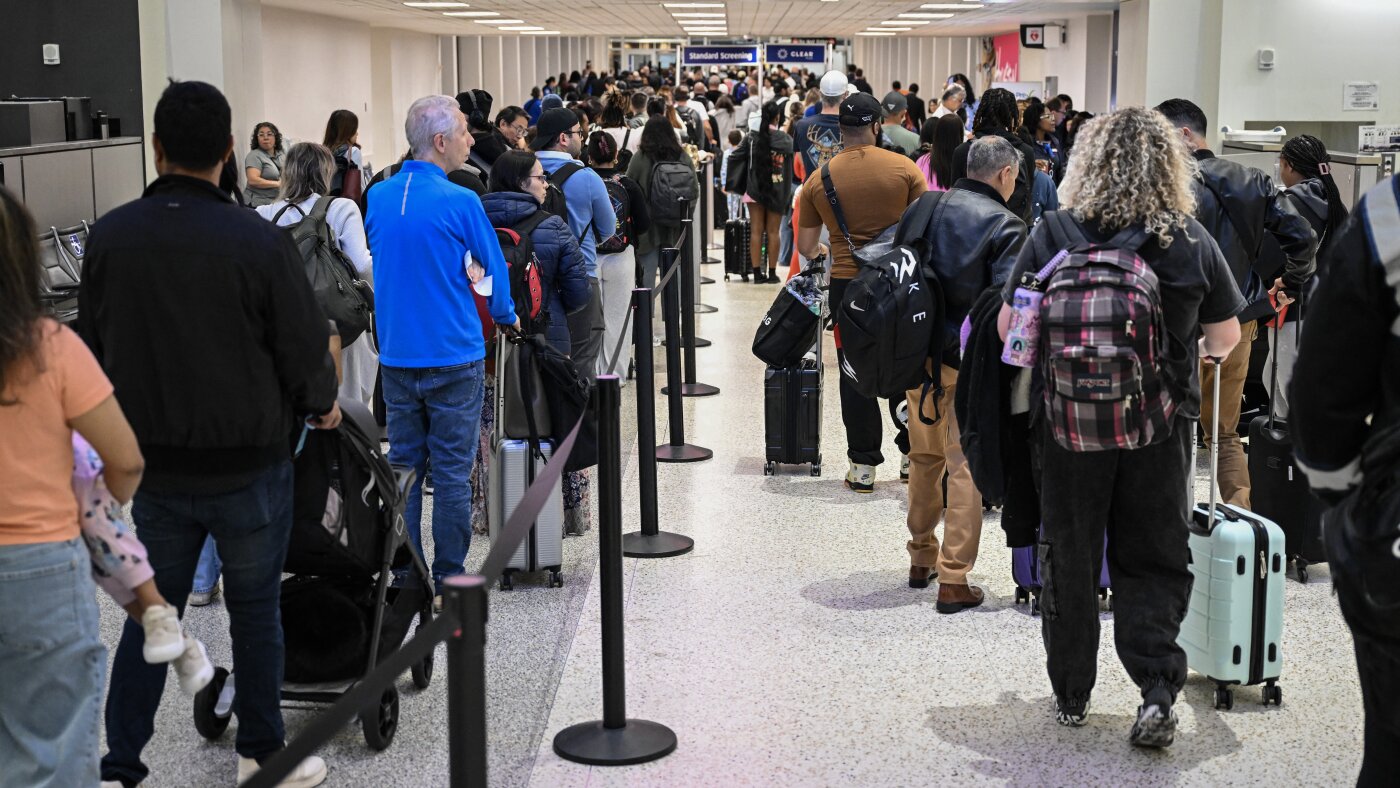
Airport security lines are long. Here’s what to know if you’re flying

Video: Video of Justin Timberlake’s Traffic Stop in 2024 Released

Detroit killer-for-hire becomes convicted liar-for-hire

5 Top-Rated Brunch Spots In San Francisco With Breathtaking Coastal Views – Islands

DAL@MIN Postgame: Jamie Benn | Dallas Stars

Florida High School Football Rankings: Top 25 teams – Oct. 21

How old is Bo Nix? What to know about Oregon quarterback ahead of 2024 NFL Draft

Cleary's 21 help Le Moyne down Central Connecticut State 69-64 in OT

99th annual Pony Swim held in Virginia

Indiana Members Credit Union announced as new anchor tenant at Bottleworks District
Airport security lines are long. Here’s what to know if you’re flying

Schumer gambit fails as DHS shutdown hits 36 days and airport lines grow

Iranian ballistic missile explodes near Israeli nuclear plant

Trump threatens to deploy ICE to airports amid Homeland Security shutdown

Alabama student reportedly fell to his death in Barcelona waters by accident
-

 Detroit, MI3 days ago
Drummer Brian Pastoria, longtime Detroit music advocate, dies at 68
-

 Oklahoma1 week ago
Family rallies around Oklahoma father after head-on crash
-

 Nebraska1 week ago
Wildfire forces immediate evacuation order for Farnam residents
-

 Georgia6 days ago
How ICE plans for a detention warehouse pushed a Georgia town to fight back | CNN Politics
-

 Alaska7 days ago
Police looking for man considered ‘armed and dangerous’
-

 Minnesota1 week ago
Many with Minnesota ties make Forbes list of world’s richest people
-
 Science1 week ago
Federal EPA moves to roll back recent limits on ethylene oxide, a carcinogen
-
 Science1 week ago
H5N1 bird flu spreads to sea otters and sea lions along San Mateo coast, wildlife experts say