






Entertainment
Wrexham in the Premier League? Rob McElhenney and Ryan Reynolds seek a Hollywood finish
When “Welcome to Wrexham,” the Emmy-winning FX docuseries, kicks off its third season Thursday (streaming the next day on Hulu), our intrepid heroes are preparing for their first season in the fourth tier of English soccer after 15 years in the semipro National League.
Funding the team’s rise, and saving the down-on-its-luck Welsh city where the club plays, was the whole point of the series when actors Rob McElhenney (“It’s Always Sunny in Philadelphia”) and Ryan Reynolds (“Deadpool”) came up with the idea of buying Wrexham AFC during the pandemic.
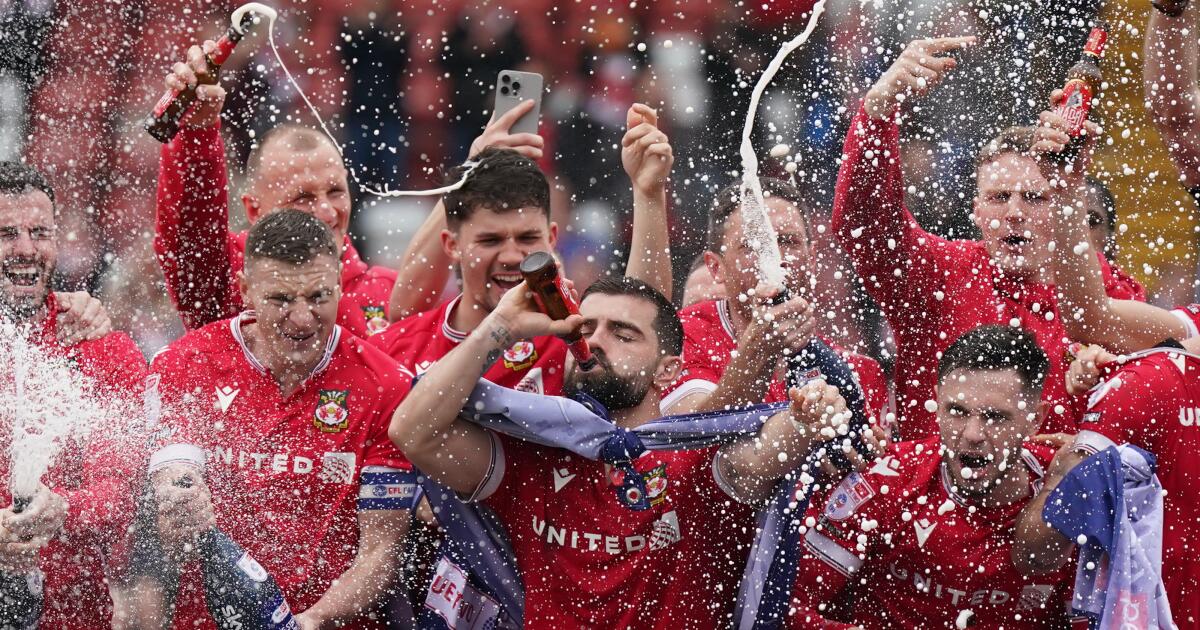
So when the club, the third-oldest professional team in the world, was promoted last April — and, spoiler alert, was promoted again this month to the third-tier League One — shouldn’t that have been a wrap? Wasn’t that the time to roll credits?
Not necessarily. Because now the goal has changed.
“That’s the beauty of sport. You just don’t know where it’s going to end,” said McElhenney, a hardcore fan of Philadelphia’s professional sports teams. “Our ultimate goal is to build a sustainable model that will allow us to not only get to the Premier League, but sustain in the Premier League and eventually win the Premier League and be in the Champions League.”
To put that in perspective, in U.S. sports that would be like taking a rookie-league baseball team and turning it into the New York Yankees — if baseball had promotion and relegation, which it does not. So there really is no comparison.
But since McElhenney and Reynolds come from a world of make believe, where nothing is impossible, why not dream big? Well, for one thing this isn’t a Hollywood script in which the guy gets the girl and evil never wins. There’s no guarantee “Welcome to Wrexham” will have a happy ending.
But it wouldn’t be wise to bet against that.
“That’s part of the gambit here. You’re surrendering to fate,” Reynolds said. “You can’t write the script in advance. You can only work as hard as humanly possible to put the best club and infrastructure out on the onto that pitch and that’s what makes it compelling. That we don’t have that kind of control.
“And in football, not unlike life, anything can happen.”
Also in football, not unlike life, spending a lot of money can sure improve your odds. And McElhenney and Reynolds have spent a lot of money. It cost them more than $2.5 million to buy the team and another $4.7 million to buy back the freehold of the team’s historic stadium, according to published reports.
They spent on players too. Paul Mullin, the league’s leading scorer in Wrexham’s final two seasons in the fifth-tier National League, and teammate Ben Tozer each made more than $5,000 a week, about three times the league’s average wage. Two others reportedly made $3,700 a week.
That was steep in the National League, one that had been made up of small-town teams often owned by local businessmen who weren’t backed by Hollywood studios. But it’s perfectly legal, too, since the league does not have a salary cap or fair play protections.
“At the moment, there’s no level playing field,” Jim Parmenter, chairman of National League club Dover, told the Athletic last spring.
In the first episode of Season 2, McElhenney and Reynolds are told Wrexham lost $12 million in their first season despite leading the league in attendance. Yet they kept spending to buy promotion to League 2 later that same season, something for which they make no apologies.
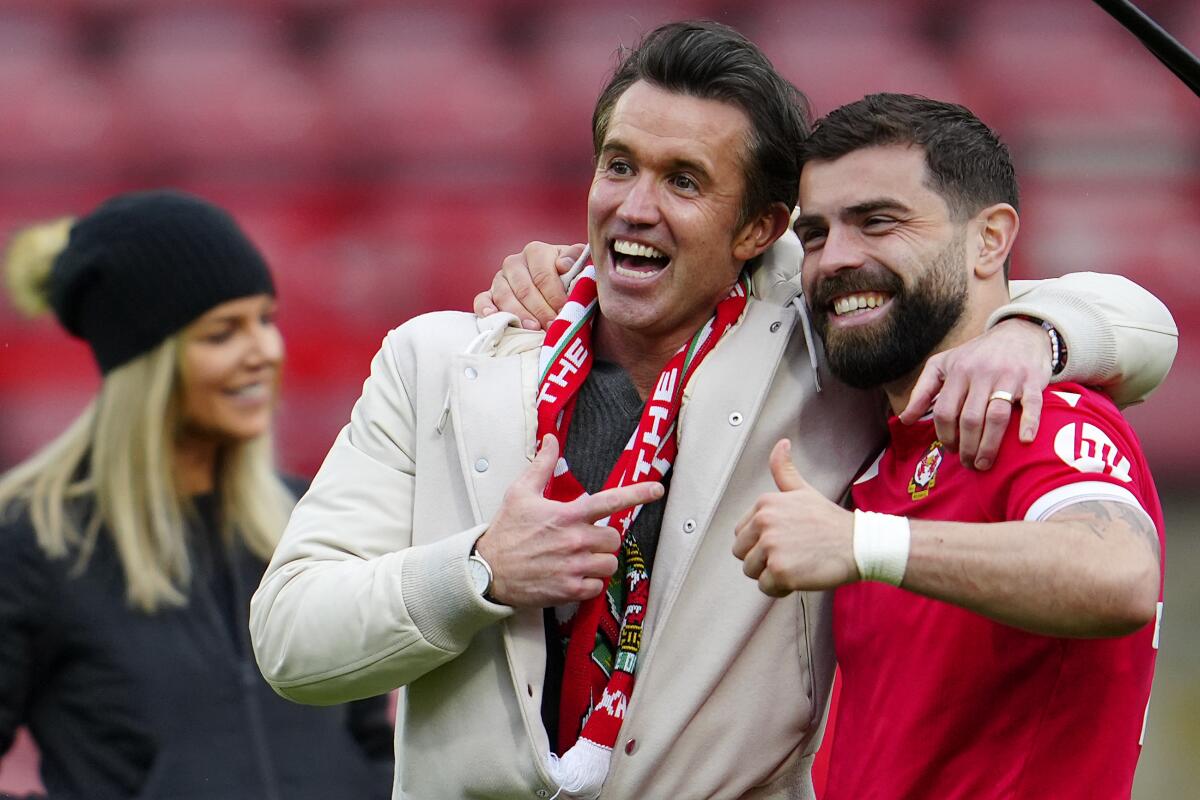
Wrexham co-owner Rob McElhenney, left, celebrates with Wrexham’s Elliot Lee after a match against Stockport on Saturday.
(Jon Super / Associated Press)
“The rules and regulations around these leagues are really prescriptive,” Reynolds said. “You have a very clear set of boundaries and rules to work within. And I think every team is encouraged to to work as hard as you possibly can and do whatever you could possibly can within those margins.
“That’s exactly what we’ve been doing with Wrexham. You can loath me, you can loath Rob, but it’s pretty damn hard to root against this town and what they’ve been through for so many decades and what this club has meant to this town. So we will do anything humanly possible to see that Wrexham continues to progress and grow in the in the world football community.”
Besides, Wrexham isn’t the only club or community that has benefited. According to the the Athletic, 22 the 72 teams in the Championship, League One and League Two — at the second, third and fourth levels of English soccer — are either wholly owned by or have minority investors hailing from the U.S. with 14 of them experiencing new investment since the actors took control at Wrexham in February 2021.
Thanks to the focus of the docuseries, the profile of League 2 has never been higher. And that’s meant higher salaries, more interest and larger crowds, with three teams topping 10,800 a game heading into last weekend, about double the league average last season.
The TV show, Wrexham’s summer tour of the U.S. — a trip that will be repeated this July — plus sponsorship deals with United Airlines and others could push Wrexham’s turnover this season to more than $25 million, nearly four times what it was just two years ago. That’s a rising tide that will lift all the boats in League 2 — and, presumably, next season in League 1.
It’s already lifted Wrexham — the team and the town, which were struggling through some rough times when McElhenney and Reynolds took their gamble, riding to the rescue and lifting the hopes and self-confidence of both.
“You know, there’s just no sure things. It’s why they have the great expression giant killers in this sport,” Reynolds said. “I think the thing that I’m most surprised by in this whole experience, aside from how forthcoming and vulnerable the folks in Wrexham have been telling their story, is how romantic this game is.
“Prior to Wrexham most of my football exposure came from watching the Canadian national women’s team. I saw glimpses of it with those women fighting for their country and their sport. But boy have I seen it in Wrexham and in this sport in general.
“It’s just the most romantic thing in the world.”
Why would anyone want to see that end?
⚽ You have read the latest installment of On Soccer with Kevin Baxter. The weekly column takes you behind the scenes and shines a spotlight on unique stories. Listen to Baxter on this week’s episode of the “Corner of the Galaxy” podcast.
Movie Reviews
Movie Review 2025 with 11 Films of the Year
Image: Wicked: For Good – Movie Poster
Another year is drawing to a close, and it’s time for our cinema review! In 2025, we saw many franchises return to the big screen, along with sequels to cult classics and new adaptations of legendary stories. From sci-fi and horror to musical adaptations, a wide range of genres offered fresh releases. Whether all of it was truly great is for everyone to decide individually – here is our trailer recap!
While Disney continues to push its live-action remake strategy (Snow White, Lilo & Stitch), Pixar at least delivered a brand-new animated feature with Elio.
When it comes to video game adaptations, several titles were released this year – most notably the Minecraft adaption A Minecraft Movie starring Jack Black and Jason Momoa, the second installment of Five Nights at Freddy’s, and the Until Dawn film, which was heavily criticized by the community.
In Germany, Bully Herbig delivered a sequel to his comedy Der Schuh des Manitu with Das Kanu des Manitu, bringing the characters from one of his most successful films back to the big screen.
Just before Christmas, James Cameron launched the third part of his hit film series Avatar. Sequels also arrived for Jurassic World, the DCU, the Conjuring universe, and the popular animated film Zootopia.
Director Guillermo del Toro took on a new adaptation of the absolute sci-fi horror cult classic and novel by Mary Shelley: Frankenstein has now been brought back to life by the creator of films such as Pacific Rim and The Shape of Water.
When it comes to adaptations, arguably the most popular musical of the year: with Part 2, the Wicked hype has returned once again.
Entertainment
Why Gen Z and Gen Alpha are feasting on TV comfort food
John Campbell is a senior vice president at Walt Disney Co. who oversees streaming ad sales solutions. He also coaches his second-grade daughter’s basketball team, and recently asked her teammates to name their favorite TV show.
“Eleven out of 13 girls said ‘Hannah Montana,’ ” Campbell said in a recent interview, citing the popular Disney series starring Miley Cyrus that produced its last episode in 2011, before any of his players were born.
Campbell was pleased they selected a show from the Disney library, but wasn’t all that surprised based on the advertising demand he’s seeing for the company’s vintage shows.
A recent study from National Research Group found that 60% of all TV consumed is library content. Among Gen Z, 40% say they watch older shows because they find them comforting and nostalgic. Disney’s own research finds that 25% of the programs kids call their favorites were made before 2010.
While newer cutting-edge series typically win critical kudos and accolades, Gen Z and Gen Alpha viewers are binge-watching programs that became hits on the broadcast and cable networks in the pre-streaming era. They are also devouring holiday movies and specials, even on traditional TV.
“We do see, especially around the holiday time, that people are looking for that comfort, that sense of ease,” Campbell said.
As more TV ad spending moves from traditional networks to streaming, Campbell said Disney is capitalizing on the retro trend thanks to its massive library of series. The company has seen the Gen Z audiences devour hits of yesteryear such as “How I Met Your Mother,” “Modern Family” and “Golden Girls.”
Miley Cyrus and Emily Osment in Disney’s “Hannah Montana.”
(Joel Warren/2006 Disney Channel)
“Scrubs” and “Malcolm in the Middle” are such strong performers on Hulu and Disney+, the company has ordered reboots that advertisers are eager to be a part of, according to Campbell. Disney has even worked with advertisers to make throwback commercials to run in classic films on its streaming platforms and TV networks.
“The younger audience is drawn to the perceived simplicity of the old times and humor,” Kavita Vazirani, executive vice president of research, insights and analytics, ABC News Group & Disney Entertainment Networks. “It’s programming that just makes them feel good, and it’s something that they can watch with their friends, their families.”
Older shows have long had a place among young viewers. Previous generations grew up watching reruns of “The Brady Bunch” and “I Love Lucy” after school, when their choices on broadcast TV were scant.
But the current viewer has an endless plethora of viewing choices through streaming and cable. One executive at another media company not authorized to comment publicly cited research that said teens and young adults are gravitating to the more conventional sitcoms and dramas from the early 2000s, believing they were made explicitly for their age group.
During the era, the WB Network — later merged into the CW — was turning out young adult dramas such as “The Gilmore Girls” and “Dawson’s Creek,” while the Disney Channel was at the height of its popularity. “Friends,” the idealized rendering of urban life for young adults and long a favorite on streaming, was the ratings leader at the time.
The appetite for such programs showed up in the most recent “Teens and Screens” study by the Center for Scholars & Storytellers @ UCLA found that among the 10- to 24 year-olds, 32.7% said they want to see “relatable stories that are like my personal life.” The previous year, the top answer was fantasy, which ranked second in 2025.
But another reason young viewers are digging into the vaults is volume.
The UCLA survey showed that the favorite show among the measured age group is the Netflix series “Stranger Things.” The series has only 42 episodes over five small-batch seasons.
When a young viewer finds an older successful series that ran on a network for years when 22 episodes per season was standard, they can binge for hundreds of hours.
“There are a lot of seasons of available episodes that you can watch, in typically any random order you want to,” said Nii Mantse Addy, chief marketing officer at the streaming service Philo, which also has seen a sharp rise in viewing of library programs.
“There’s not as much decision fatigue,” Addy said. “The shows provide something that you can go back to and just turn on and know kind of how it’s going to make you feel.”
Executives also say that binge-watching old shows provides a respite from the angst young people experience while scrolling through social media, which escalated through the COVID-19 lockdowns.
But social media have also been a tool to help consumers discover new programs. Fans of vintage series post TikTok videos reacting to episodes that first aired years ago. There are also fan communities online and “re-watch” podcasts that are driving people to seek out programs.
“Social media has been quite a catalyst for essentially introducing these old shows to a whole new audience, whether it’s through memes, viral clips or whatever it may be,” Vazirani said. “It’s like the modern day water cooler, essentially.”
Movie Reviews
Movie Review – The Testament of Ann Lee (2025)
The Testament of Ann Lee, 2025.
Directed by Mona Fastvold.
Starring Amanda Seyfried, Lewis Pullman, Thomasin McKenzie, Matthew Beard, Christopher Abbott, David Cale, Stacy Martin, Scott Handy, Jeremy Wheeler, Tim Blake Nelson, Daniel Blumberg, Jamie Bogyo, Viola Prettejohn, Natalie Shinnick, Shannon Woodward, Millie-Rose Crossley, Willem van der Vegt, Esmee Hewett, Harry Conway, Benjamin Bagota, Maria Sand, Scott Alexander Young, Matti Boustedt, George Taylor, Alexis Latham, Lark White, Viktória Dányi, and Roy McCrerey.
SYNOPSIS:
Ann Lee, the founding leader of the Shaker Movement, proclaimed as the female Christ by her followers. Depicts her establishment of a utopian society and the Shakers’ worship through song and dance, based on real events.
The second coming of Christ was a woman. Narrated as a story of legend and constructed as a cinematic epic, co-writer/director Mona Fastvold’s The Testament of Ann Lee tells the story of the eponymous 18th-century preacher who occasionally experienced divine visions guiding her on how to teach her and her followers to free themselves and be absolved of sin.
This group, an offshoot of Quakers known as Shakers, did so by stimulating and intoxicating full-body rhythmic dancing movements set to many hymns beautifully sung by Amanda Seyfried and others. The key distinction between the group, and arguably the toughest selling point of the film aside from the religious nature of it all, is that Ann Lee asserted that the only way to achieve such pure holiness is by giving up all sexual relations, living a life of celibacy (as evident by some laughter during the CIFF festival screening when she made this decree, which quickly subsided as it is relatively easy to buy into her mission and convictions).
It shouldn’t necessarily come as a surprise that Mona Fastvold had trouble getting this one off the ground. Perhaps what finally secured the project’s financial backing was all those awards The Brutalist (directed by her husband Brady Corbet and co-written by her, flipping those duties and credits this time around) either won or was nominated for, which was notably another film that almost no one had interest in making. The point is that this should serve as a reminder that there is an audience for anything and everything.
Whether one doesn’t care about religious movements or is a nonbeliever, The Testament of Ann Lee is remarkably hypnotic in its craftsmanship. It features a flat-out career-best performance from Amanda Seyfried, who blends all of her strengths as an actor and unleashes them at the peak of her talent. Yes, there are moments of tragedy and trauma, but the film refuses to wallow in misery, chartering her Shakers movement with hope, miracles, and perseverance as the journey takes them from Manchester to Niskayuna, New York, in search of expanding their follower base while dealing with other setbacks within the movement and personally.
Chronicling Ann Lee’s life with precise editing that rarely drags (and mostly fixates on the early stages of the Shakers movement and decade-plus long attempt to battle sexism as a female preacher and find a foothold amidst escalating tensions between British and Americans), the film also offers insight into the events that gave her a repulsion for sexual intimacy, her marriage with blacksmith Abraham (Christopher Abbott), and dynamics with her most loyal supporters which includes brother William (Lewis Pullman) and Mary (Thomasin Mckenzie, also serving as the narrator). Given the unfortunate nature of how most women, especially wives, were expected to have zero agency compared to their male counterparts and deliver babies, it is also organically inspiring watching her find a group with similar beliefs willing to trust her visions and take up celibacy. Whether or not all of them succeed is part of the journey and, interestingly enough, shows who is genuinely loyal and in her corner.
This is no dry biopic, though. Instead, it is brimming with life and energy, mainly through those “shaking” sequences depicting those outstandingly choreographed seizure-like dance numbers (typically shot by William Rexer from an elevated overhead angle, looking down at an entire room, capturing a ridiculous amount of motions all weaving together and creating something uniformly spellbinding). The songs throughout are divinely performed, adding another layer to this film’s transfixing pull. Nearly every image is sublime, right up until the perfect final shot. Admittedly, the film loses a bit of steam in the third act as one awaits a grim confrontation with naysayers who feel threatened by her position, movement, and pacifism regarding the burgeoning American Revolution.
Still, whatever reservations one has about watching a religious movement preaching peace and celibacy while laboring away building a utopia (an aspect that puts it in great juxtaposition with The Brutalist) will wash away like sin. That’s the power of the movies; even someone who isn’t religious will find it hard not to be swept up in Ann Lee’s life. Fact, fiction, bluff… it doesn’t matter; the material is treated with conviction and non-judgmental respect. In The Testament of Ann Lee, Amanda Seyfried channels that for something holy, empowering, infectious, and all around breathtaking.
Flickering Myth Rating – Film: ★ ★ ★ ★ / Movie: ★ ★ ★ ★
Robert Kojder
https://www.youtube.com/watch?v=embed/playlist
-
Iowa1 week agoAddy Brown motivated to step up in Audi Crooks’ absence vs. UNI
-
Maine1 week agoElementary-aged student killed in school bus crash in southern Maine
-
Maryland1 week agoFrigid temperatures to start the week in Maryland
-
New Mexico7 days agoFamily clarifies why they believe missing New Mexico man is dead
-
South Dakota1 week agoNature: Snow in South Dakota
-
Detroit, MI1 week ago‘Love being a pedo’: Metro Detroit doctor, attorney, therapist accused in web of child porn chats
-
Health1 week ago‘Aggressive’ new flu variant sweeps globe as doctors warn of severe symptoms
-
Maine7 days agoFamily in Maine host food pantry for deer | Hand Off
