

Connect with us

Entertainment

When 'English Teacher' wanted to tackle jocks in drag, Stephanie Koenig said, 'Pick me, coach'

Published

on

When 'English Teacher' wanted to tackle jocks in drag, Stephanie Koenig said, 'Pick me, coach'

Stephanie Koenig first met Brian Jordan Alvarez 11 years ago, when they were both cast in a UC Santa Barbara student film, although both were already out of college. Their friendship was instant.

“We were making each other laugh so hard, and you could just feel it,” Koenig said in a recent video interview. “It was kismet. I remember leaving that night and going to my car, and I knew that I had met a good friend and something really special was happening.”

It’s still happening, except on a much bigger stage. When Alvarez created “English Teacher,” the new FX comedy in which he plays a gay teacher navigating the politics of a high school in Austin, Texas, he picked his frequent web comedy collaborator Koenig to play fellow teacher Gwen Sanders.

The daffy-but-sharp best buddy of Alvarez’s Evan Marquez, Gwen is infused with can-do optimism and an energy that would be right at home in a classic Hollywood screwball comedy. Koenig also wrote one of the season’s best episodes, “Powderpuff,” which runs Monday after the pilot (both episodes will be available to stream on Hulu). It gleefully demonstrates one of the series’ strengths: a deft ability to wrap a hot-button issue — in this case, drag — in a friendly package without watering anything down.

In FX’s “English Teacher,” Stephanie Koenig stars as Gwen Sanders alongside her friend and frequent collaborator Brian Jordan Alvarez, who plays Evan Marquez.

Advertisement

(Steve Swisher/FX)

Koenig, fresh off her strong supporting dramatic performance as the go-along-to-get-along Fran in Apple TV+’s “Lessons in Chemistry,” now has a major platform to show off her considerable comedic chops, including a knack for physical comedy that feels like a natural outgrowth of countless hours as a competitive dancer growing up in Rochester Hills, Mich.

Asked whether she and Alvarez share a sense of humor, Koenig deadpans: “No, we don’t.” But it’s pretty obvious they’re on the same comedy wavelength. After a decade of collaborating, including multiple web projects, the besties are now sharing the spotlight, and the classroom.

Asked what makes Koenig funny, Alvarez flipped the script in a video interview: “What doesn’t make her funny? Everything she does is funny,” he said.” “She just has these thoughts that you see in her eyes, and it just makes you laugh and laugh.”

Advertisement

He also praised her abilities as a performer. “She and I often talk about how the best acting is something that we wouldn’t be able to re-create if we were prompted to; [its] just some little series of expressions that come from real thoughts that the camera picked up on,” he said. “She does so much of that. She’s so free on camera, but she’s also so reliable.”

A woman with red hair in a green suit leans on a wood fence.

Brian Jordan Alvarez on his co-star Stephanie Koenig: “She just has these thoughts that you see in her eyes, and it just makes you laugh and laugh.”

(Christina House/Los Angeles Times)

Plus, he adds, “her writing is exceptional.”

Indeed, it’s her writing that drives “Powderpuff.” It stems from a tradition popular in Texas (and in the Midwest, where Koenig grew up), in which high school girls face off on the football field, and the football players dress up as cheerleaders.

Advertisement

Drag shows have become a conservative bête noire in Texas, condemned by some as a bad influence on today’s youth. But in “English Teacher,” it’s a student LGBTQ+ group that complains, arguing that the jocks are cross-dressing as a joke and undermining students who are actually trans or nonbinary.

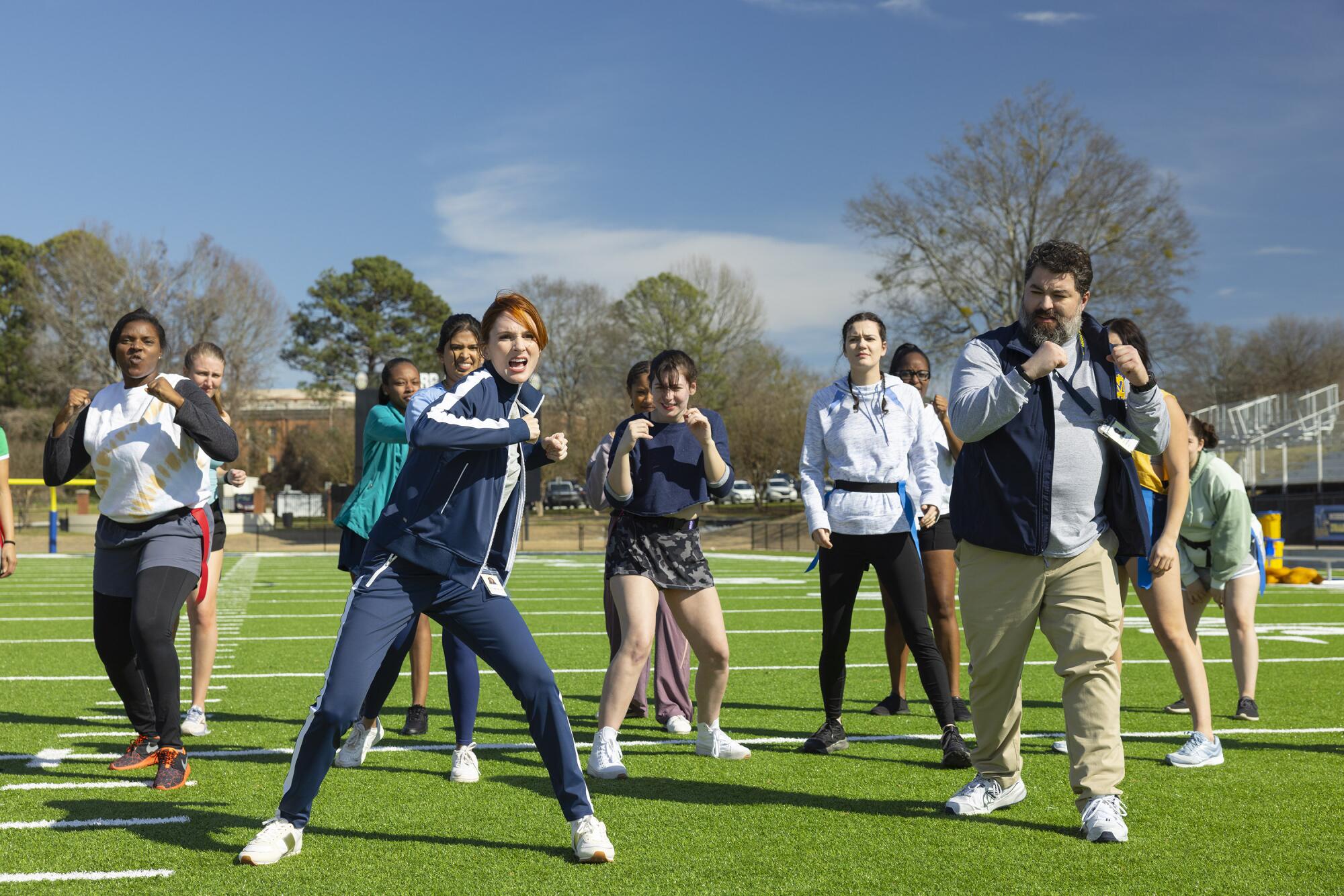
So when the football players come to Evan for help, he decides that the guys are going to be “authentic and respectful in their performance” while going “full out.” Enlisting the help of a local drag queen named Shazam (played by real-life drag superstar Trixie Mattel), he gets the guys to go beyond just wearing dresses and applying makeup. Meanwhile, the school’s football coach, Markie (Sean Patton), brings in Gwen to coach the powder-puff players. Except after he hears about the girls’ fears and listens to a true-crime podcast, the practice turns into self-defense demonstrations that end with some variation of “boom, you’re dead.” “Powderpuff” intercuts these sessions with the drag lessons in a dual-montage sequence set to Laura Branigan’s ’80s anthem “Gloria.”

Two coaches standing in front of a group of girls with their fists in the air on a green football field.

Stephanie Koenig as Gwen and Sean Patton as Markie in the “Powderpuff” episode of “English Teacher.” “When it was time to do the outline and pick who was going to write the specific episode, I was like, ‘Pick me, coach,’” Koenig said.

(Steve Swisher/FX)

“It’s a beautiful image to see a bunch of jocks dressing in drag and just dancing,” Koenig said. “It was all just very exciting. When it was time to do the outline and pick who was going to write the specific episode, I was like, ‘Pick me, coach.’”

Advertisement

The episode also demonstrates the series’ refreshing tendency to zig when you expect it to zag. “What the show does so well is take a topic that people have opinions about, but then it goes the opposite way that you’d expect,” Koenig said. “It’ll take a left turn. This episode was obviously something that was going to work with that approach.”

There’s also a little behind-the-scenes irony in the gridiron scenes. Where Gwen is portrayed as inept in the ways of football, Koenig and her sister actually learned to play from their father (“He wanted boys, but he got two girls,” she said).

As a youngster, however, Koenig spent most of her time practicing jazz dance. She studied drama at Michigan State University, and after graduating in 2009, she moved to New York, figuring she would try to crack Broadway as a means toward a film career.

“I waited in those non-equity lines at 4 in the morning in the freezing cold,” she said. “I was living in a railroad apartment in Queens and just was like, ‘This is it.’” Then, her boyfriend at the time gave her some valuable advice. If she really wanted to act in movies and television, move to Los Angeles. She did when she was 23.

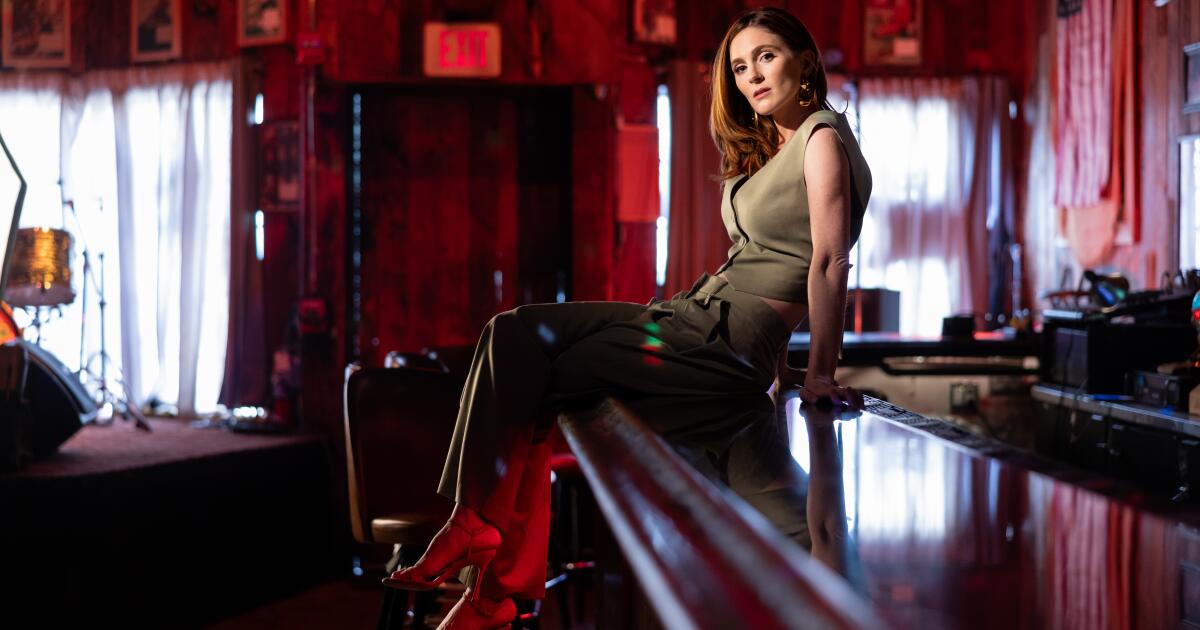
“I don’t have any regrets,” she said. “But I do wish somebody had told me earlier: ‘No, no, no, just go straight to L.A.’ You have to be here for such a long time to get your footing, and to move here when you’re 23 is playing catch-up.” (In fact, the shoot for this story took place at the Escondite in downtown L.A., where she worked as a server while trying to catch her break.)

Advertisement
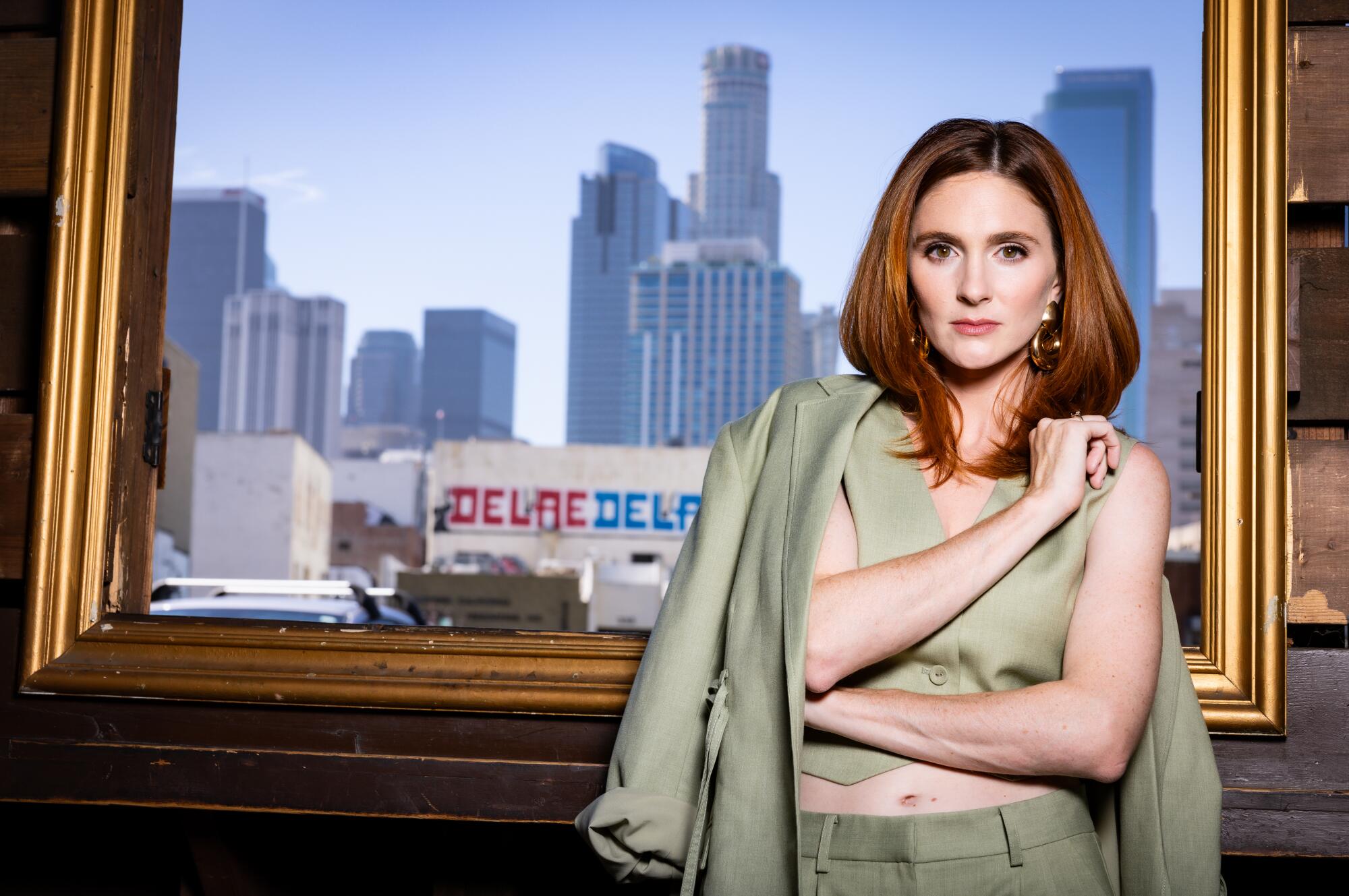
A woman with red hair in a green suit leans against a framed image of buildings.

Stephanie Koenig, at the Escondite, where she worked while trying to break into Hollywood. “You have to be here for such a long time to get your footing, and to move here when you’re 23 is playing catch-up.”

(Christina House/Los Angeles Times)

She met Alvarez soon after she arrived, picked up roles in shows including “The Offer” and “The Flight Attendant” and wrote and directed a spy movie spoof (2021’s “A Spy Movie,” starring herself and Alvarez) for the web. A pilot collaboration with Alvarez came close to getting picked up but fell short. Then came “English Teacher.”

In a sense, both Koenig and Alvarez are poster children for the YouTube age. They got their work out to a loyal audience chunk by chunk, including the absurdist comedy series “Stupid Idiots” (written and directed by Koenig, starring Koenig and Alvarez). When it was time to make bigger moves, they were polished and ready.

“I’m so grateful for YouTube,” Koenig said. “We were able to find our own fans. I’m grateful that I didn’t work really early on in the industry, because I had to use my voice in order to be seen and get work. I had to direct and write. I had to put myself in my own things and just show what I could do.”

Advertisement

Movie Reviews

‘Baby Do Die Do’ movie review: In the mood for Mumbai

Published

on

‘Baby Do Die Do’ movie review: In the mood for Mumbai

Monsoon sets in Mumbai with a bang. Rain drops ram the streets in desperation. The relief easily drifts into panic. Sea of umbrellas everywhere but one amongst them at a local station stands out. Wading through the downpour, its red colour drips with a warning. The person holding it exhibits a stone-cold demeanour, as she looks for an old man in the bustling chaos of the train at rush hour. She moves through the crowd inconspicuously and readies her umbrella, which secretly hides a gun as a trigger appears on its handle. She takes a muffled shot and disappears into the ensuing chaos.

The opening scene in Huma Qureshi’s Baby Do Die Do bears an uncanny resemblance to the real horrific killing of a young man in the local train recently, which laid bare the brutality that some people in the city carry within. An argument can escalate soon into homicide and there would be no one coming to rescue. Baby Karmarkar (Qureshi) carries a similar violence in her heart, that rises from the clutches of a city that failed her when she witnessed the death of her twin sister as a child. The city has turned her into a sociopath

The film however, doesn’t always treat the violence with gravity. Its tone is not always sharp and cynical even as it aims to critique the cornerstones of wealth and power on occasions by establishing the link between the builder lobby and mafia. Director Nachiket Samant largely uses the noir as part of the design element, lending a pulpy, comic-bookish layer to the narrative while the thematic undercurrents don’t really get time to marinate. As a result, the rainy undercurrents, moody lighting and dark humour gets dissolved just into style rather than adding complexity to the narrative.

Baby Do Die Do (Hindi)

Director: Nachiket Samant

Duration: 125 minutes

Advertisement

Cast: Huma Qureshi, Chunky Panday, Sikandar Kher, Seema Pahwa, Rachit Singh, Marudhar Shekhawat, Arun Kushwah

Synopsis: A deaf and mute assassin gets softened by love as she vows to take revenge from the man who murdered her twin sister

That being said, there’s more heart in Baby Do Die Do than the combined range of some of the other monotonous films that have come out in recent times. Its disregard for template is quite reassuring as it also aims to subvert genre cliches with a touch of quirk. The film doesn’t forget to have fun while juggling along with the grimness, as seen in an inventive item song which is inserted when Manu (a brilliant Marudhar Shekhawat), an associate of Baby, is tasked with an assassination that takes him to a gay pub in Andheri East. Saqib Saleem (also producer) makes a guest appearance as a sexy, ripped dancer, grooving seductively to a song with the hook line ‘Alpha Q’ repeated all along, creating an edgy innuendo. The gaze is empowering, building a sense of liberation to Saqib’s character, who controls his body and its movements. Rather than being an object of desire, he becomes its subject, withholding the capacity to flirt with anyone he wants, without crossing a boundary. Even the onlookers carry a sense of respect in their eyes as the camera doesn’t become a medium to represent lecherous gazes.

A still from the film

A still from the film
| Photo Credit:
Saleem Siblings/Youtube

All of this inherent loudness compliments the muted worries of Baby, who cannot hear and speak. It is delightful to see her first tryst with love unfold like a silent film as Siddhu (Rachit Singh), a likeable Sikh music teacher is smitten by her beauty. Their love story starts in a bus and later blooms in a cramped apartment, as there’s again a gender reversal at play, with Baby incorporating toughness as Siddhu stays dipped in vulnerabilities. There’s still a lot more to them that remains unexplored as the film has to fixate on the central conflict of Baby’s vengeance, which remains its weakest and most predictable link.

It is only when it digresses from the way that the film shows beguiling promise. Whether it is in smaller sketchy moments like when a character with vitiligo is called black and white in a humourous scene or the dwarf gangster Lucky (Arun Kushwah) immortalised by his brother, Zafar Katkar (Sikandar Kher) by putting his name on the tallest building in the city. The film also allows these dreaded gangster’s tiny moments to breathe, reflecting a common link between all the characters, born and raised on the same soil of Mumbai. Zafar gets into reverie during a violent hold up in a shanty when the distinct smell in the air takes him back to his childhood. He sniffs a blanket and talks of living in the underbellies and wanting to escape that netherworld as others seem to sympathise to his sentiments. All of them become Mumbaikars in that one moment before mayhem, disarmed of other identities when put in a space of mutual co-existence, rooting for the common concerns of roti, kapda and makaan. It is also short-lived for time has shaped each of them differently and they must react to the version that the city has forced them to be in the present.

Huma Qureshi and Chunky Panday in the film

Huma Qureshi and Chunky Panday in the film
| Photo Credit:
Saleem Siblings/Youtube

Kher inhabits this dichotomy with urgency, lending an astounding tragic-comic quality to his screen presence. He is a treat to watch but the screenplay just stops short of taking him to murkier territories while resorting to familiar, convenient turns to reach the resolution. Even Huma remains impressive as she stays silent for the most part and uses her face to translate Baby’s emotional turmoil. The real surprise in the mix comes from the restrained act put on by Chunky Panday, who represents the helpless middle-class Mumbaikar with remarkable honesty.

Advertisement

These are all characters that become much more superior than the immediate storyline which Baby Do Die Do struggles to run along with. Their dreams feel palpable, their anger unresolvable and their beauty merging with the soul of the city. On occasions, their collective aspirations represent the charms of Bombay films of the 70s and 80s by Sai Paranjpye and Basu Chatterjee. Even the twin sisters retribution tale seems to be a reworked ode to older Hindi movies. It is an aesthetic that is hurriedly disappearing from other contemporary city films.

So, although Baby Do Die Do imagines Mumbai as a cyberpunk landscape, it actually prospers while recollecting the unassuming everyday pulse of the metropolis, whether it is in the tale of a shoe polisher, who suffocated to his death on an overcrowded bridge, a peon in the High Court, who got killed by mistake and the mother whose sanity was taken away by the city’s violence. Then, in the compounding mess created by the bigger folks Murjhani and Bhambhani, it is important, like Baby, to be zara hatke, zara bachke. It is after all, Bambai meri jaan.

Baby Do Die Do is currently running in theatres

Published – July 03, 2026 03:10 pm IST

Advertisement
Continue Reading

Entertainment

California designates Bruce Lee Day, first such honor for a Chinese American

Published

on

California designates Bruce Lee Day, first such honor for a Chinese American

Cut to a seedy alley behind a Chinese restaurant in Rome: A dozen mobsters menace a slight young man who suddenly pulls out a pair of nunchucks. He swings the traditional stick-and-chain weapons and makes quick work of his enemies, who fall one by one, groaning in pain.

The comedic, legendary action scene is from the 1972 film “The Way of the Dragon,” written, directed and starring Bruce Lee. The martial arts star was a trailblazer, allowing Asian Americans to see themselves represented in a strong, positive light on-screen.

And now he has secured a place in California history, becoming the first Chinese American in state history to have a day designated in his honor.

Lee was born in 1940 in San Francisco. His mother was of European descent and his father was a Cantonese opera star who was on tour in the city, affording his son birthright citizenship.

Lee grew up in Hong Kong, where he followed his father’s path as a performer, acting in more than a dozen films as a child and studying the close-quarters southern Chinese martial art Wing Chun.

Advertisement

On May 17, 1959, an 18-year-old Lee returned to San Francisco and eventually made his way to Hollywood. He went on to influence an industry that was at the time bereft of Asian American talent, and helped to popularize the genre of martial arts films and ignite Western interest in Hong Kong action cinema.

In recognition of his contributions, state Assemblymember Matt Haney (D-San Francisco) introduced a bill designating May 17 as “Bruce Lee Day” in California. The bill, signed into law Tuesday by Gov. Gavin Newsom, encourages schools and communities to honor Lee’s life and cultural impact.

Haney has described Lee as a “symbol of pride, resilience and possibility for generations who rarely saw themselves reflected with strength and dignity.”

Lee, who saw himself not only as an actor but also as a poet and philosopher, encountered repeated barriers. Up for the main role in the 1970s television series “Kung Fu,” for example, he was rejected in favor of white actor David Carradine.

In 2020, filmmaker Bao Nguyen sought to show how Lee dispelled anti-Asian sentiment and long-held stereotypes of emasculated Asian men in his ESPN documentary “Be Water.”

Advertisement

“The Asian male was the face of the enemy to many Americans,” Nguyen told The Times in 2020. “It was this vicious cycle of society reflecting media and culture, and media and culture reflecting society. There had to be some kind of intervention there and Bruce, in a way, was that intervention. He was the hero that we hadn’t seen before.”

Lee learned much about the systemic oppression that Black Americans faced from his first student, Jesse Glover, who had been a victim of police brutality.

And scholars have pointed out that, although his films had far-from-perfect politics, they touched on themes of fighting oppression. The 1971 movie “The Big Boss” showed Lee battling alongside laborers. “Fist of Fury” saw him opposing Japanese colonialism and discrimination.

Lee died young in 1973, at age 32 — before he was able to witness the full extent of his stardom. He died just one month before the release of “Enter the Dragon,” which was a box-office sensation and is considered a masterpiece of martial arts filmmaking.

Advertisement
Continue Reading

Movie Reviews

Film Review: “looky loo: PART II” – MediaMikes

Published

on

Film Review: “looky loo: PART II” – MediaMikes

Starring: Kansas Bowling, Jessa Jupiter Flux and Julie Kashmanian
Directed by: Jason Zink
Rated: NR
Running Time: 80 minutes


Our Score: 3.5 out of 5 Stars


The found footage serial killer subgenre is surprisingly crowded with films like “Man Bites Dog,” “Maniac,” and the “Creep” franchise. So while it can be difficult to stand out, 2025’s “Looky-loo” and now “looky-loo: PART II” carve out their own identity by trapping us with very little dialogue and a killer who sees the camera as a creative tool rather than a simple recording device.

Advertisement


For the uninitiated (like I was a month ago), “Looky-loo” follows an aspiring filmmaker whose obsession with cameras evolves into voyeurism, stalking, and eventually murder. Not just one murder, either. He begins staging his victims like actors preparing for a scene, finding as much satisfaction in the production as the killing itself. That’s important because “PART II” picks up almost immediately afterward, with the killer seemingly releasing “Looky-loo” to the public like a drive-in snuff film. He even scrawls “PART II” in blood across a refrigerator, as if he’s proudly unveiling the title card for his next masterpiece.


My perspective may be slightly skewed because I watched both films within a 36-hour span. I never really had time to sit with the first film before diving into the sequel. While I think the original is a solid exercise in restraint, “PART II” noticeably improves on many of its quieter shortcomings. The first film feels a bit like “In a Violent Nature.” Instead of marinating in dense forests and ambient sound, “Looky-loo” lingers in sweaty breathing, uncomfortable silence, and victims blissfully unaware that a killer is standing in the closet. I think it works, but I can also understand why some viewers find it painfully slow.


Advertisement

“PART II” replaces much of that restraint with confidence. The killer stomps upstairs without hesitation, casually raids victims’ refrigerators, drinks their beverages, and only occasionally bothers wearing gloves, as if DNA evidence simply stopped existing. None of these moments feel like plot holes. They’re deliberate choices that suggest someone who either no longer fears getting caught or genuinely believes he’s untouchable. It’s difficult to know which because the film still reveals remarkably little about who he actually is.


What we do learn is perhaps the most interesting development of the sequel. I think our killer is creating incel art. The first film hints at it, but “PART II” pushes the idea much further. While he expands his victims to include men, the murders aren’t treated equally. The men often become victims of blunt rage. The women become productions. They’re staged, framed, and lingered upon with a disturbing artistic obsession. Even more revealing is his growing fixation on female artists. It’s almost as if he can’t tolerate the idea that women might be more creative, more fulfilled, or more talented than he is. The murders begin feeling less like random acts of violence and more like warped attempts to prove he’s the only true artist in the room.


That’s ultimately what elevates the “Looky-loo” series. Like “The Poughkeepsie Tapes,” it invites you to revisit it because so much of the story exists between the scenes rather than inside them. Every repeated viewing uncovers another clue about the psychology hiding behind the camera. Unlike charismatic fictional killers like Hannibal Lecter or Dexter Morgan, this murderer isn’t interested in charming us. He wants us to appreciate the process: the stalking, the waiting, the intrusion, and finally the kill. In his mind, we’re his audience. He believes we should admire his work just as much as he does. And if we don’t, we might as well become part of his next production.

Advertisement


“looky loo: PART II” will have its Midwest premiere at Hysteria Fest in St. Louis on Thursday July 9th.


Advertisement
Continue Reading
Advertisement

Trending
