Ballet flats, low-rise jeans and Cosmopolitans are back in style, so it is the perfect time for all six seasons of “Sex and the City” to stream on Netflix. The HBO series, previously exclusively on Max, premiered April 1 on the streaming service, where a wider subscriber base pulled in first-time viewers and rewatchers who are ready and willing to share their thoughts on social media.
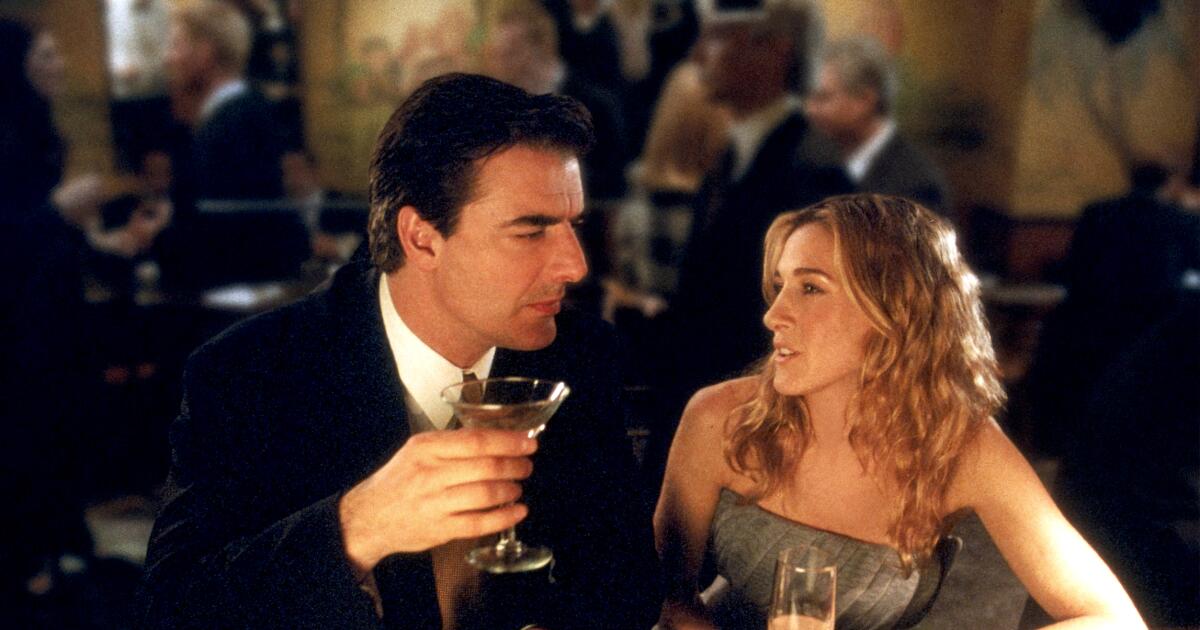
This week, there has been increasing buzz about one of the iconic episodes in the series, when Carrie Bradshaw invites Mr. Big, the ex-boyfriend with whom she cheated on her current boyfriend Aidan, to the latter’s cabin.
I couldn’t help but wonder — does Carrie Bradshaw’s Big versus Aidan love triangle still feel relevant?
When it first premiered in June 1998, “Sex and the City,”an adaptation of Candace Bushnell’s newspaper column and book, broke a lot of barriers with its depiction of four single women in their 30s and 40s navigating their friendship and vibrant sex lives in NYC. (It also fell short in a myriad of ways, namely in how incredibly white, heteronormative and privileged the characters were. While some of this changed in Max’s “And Just Like That,” for the purposes of this essay, I’m just focusing on the original series, not the films or subsequent spinoff.)
Since airing, it’s been common parlance to declare people specific archetypes promulgated by the show either via the four main friends — are you a Carrie or a Samantha? — or by the type of love interest one embodies — is he your Mr. Big or your Aidan?
Advertisement
Sarah Jessica Parker, as Carrie Bradshaw, and John Corbett as Aidan Shaw in an episode from “Sex and the City.”
(HBO)
In particular, when it comes to Carrie’s love interests, both men were pretty flat characters. Big is the stereotypical, wealthy, charming playboy with serious commitment issues who just needs the right woman to come along and “fix” him. Aidan, in contrast, is the stable, Hallmark Christmas movie boyfriend who would love nothing more than to get married and stay home eating fried chicken — but he can skew boring.
The bad boy versus nice guy trope is a staple of mainstream ‘90s rom-coms. Millennials were raised on a diet of toxic, patriarchal relationships on film and TV, where male characters spend the majority of their time treating female characters horrendously, and then redeeming themselves in the final 20 minutes with one grand gesture. We became a generation trained to wait for our Bigs to catch on to their mistakes, come down the street in a shiny limo, and beg forgiveness. If he hasn’t come back and repented, it’s only because it isn’t our last 20 minutes yet.
Advertisement
But does that trope still work in 2024? I’ve spoken with friends of mine — die-hard Big fans who cheered from our sorority house living room when he showed up at Carrie’s Paris hotel in the 2004 series finale — who are now rewatching the series and wondering why they were so hung up on Mr. Big in the first place. This sentiment has been echoed on social media, with viewers who are rewatching asking if Big has always been this infuriating. Is it just because millennials, now in their 30s and 40s, are at a more stable life stage where we can look back at Big as the walking, talking embodiment of a red flag? Or has society itself shifted away from the Mr. Bigs of the world?
Well, as it turns out, both things can be true.
“In your 20s, your life stage is about searching for identity and collecting experiences. Big was exciting because he was giving Carrie all of these new experiences,” says Israa Nasir, a mental health therapist who treats millennials and Gen Z adults going through life transitions. She says when she first watched the show, she remembers thinking Big was amazing. “But in your 30s and 40s you’re in a different life stage developmentally, you’re more about finding roots. Millennials are rooting down, we’re looking for stability. We can look back at Big and be like ‘Big was a huge red flag, because he couldn’t give her stability, which is required to move through the life stages.’”
This stability versus excitement is a conversation topic in Season 3, Episode 7, called “Drama Queens.” Over brunch, Carrie tells her friends she’s been waking up in the middle of the night sweating because she’s so anxious about the fact that everything with Aidan has been going so well.
“I’m used to the hunt, and this is effortless,” Carrie says. “You’re not getting the stomach flip,” adds Samantha. “Which is really just the fear of losing the guy,” says Miranda, ever the pragmatic one. Carrie admits she’s not used to being with someone who doesn’t do the “ever-seductive withholding dance.” When Miranda says she’s comfortable and safe and happy with Steve, Carrie deadpans, “Are you dating a man or a minivan?” Samantha tells her, “Your relationship is my greatest fear realized.”
Advertisement
From left, Kristin Davis, Kim Cattrall, Sarah Jessica Parker and Cynthia Nixon in HBO’s “Sex and the City.”
(Craig Blankenhorn / HBO)
Nasir says that there is a generational difference in how we are engaging with romantic relationships, just by virtue of the world changing and an increase in emotional literacy.
“A 25-year-old current Gen Z person has way more access to self-help content, personal growth, self-awareness, all of those things that help you define yourself and relationships versus a 25-year-old millennial in the mid-2000s who did not really have that,” says Nasir.
Advertisement
“Millennials inherited a very patriarchal system. Many of us are entering the space of self-awareness for the first time whereas Gen Z is already there so their expectations from a relationship are very different.”
Nasir adds that Gen Zers have changed the gender dynamics of dating. They are much more fluid when it comes to identity and sexuality, they’re more open to polyamory, and they don’t engage in the same debates about who pays, who initiates sex, etc. — themes that are a large part of “Sex and the City’s” plotlines. She says when speaking with her Gen Z patients about relationships, she often thinks about the episode where Miranda bluntly tells two young women that maybe “he’s just not that into you.” It was met with horror when Miranda said that, but Nasir said that kind of factual, upfront, candid conversation is par for the course among the younger generations.
In Nasir’s opinion, society hasn’t replaced patriarchal archetypes, we’ve just added more to the spectrum. And even though there are still a plethora of heteronormative love triangles and television often still adheres to the status quo, nuance has crept in. In Netflix’s “Never Have I Ever,” she points out that the lead love interest, Paxton, is the popular guy but with a sensitive side. Nasir says she sees more of an emphasis on platonic love, an expansion of what a long-term soulmate relationship can be, as depicted in series like “Grace and Frankie” or “Insecure.” She compares it with how the archetype of the woman on television changed and expanded from the ‘50s to the ‘90s. “From the ‘90s to the 2020s, there are more types of relationships that you see. We continue with every generation to add to the baseline,” Nasir says.
Suzanne Leonard is a professor of race, gender and sexuality studies at Simmons University in Boston. “We’ve been in a long, 20-year process of undoing the allure of Mr. Big,” says Leonard, adding that she doesn’t know whether the storylines on television have changed as much as the viewership has. “Audiences are much more aware of the dangers of toxic masculinity and that doesn’t read as sexy anymore. I think you have more sophisticated feminist viewers.”
“It’s sort of seeing what was actually right in front of us the whole time, but we couldn’t see it,” she adds. Leonard partly attributes this shift in our views of romance, this fatigue around brooding, emotionally unavailable characters, to the post-#MeToo moment. (She even points out that Chris Noth, the actor who played Big, was accused by several women of sexual abuse).
Advertisement
“Male power and male violence has been so sexualized and romanticized, and in the ‘90s and early 2000s, heterosexual women were really encouraged to be attracted to that type,” says Leonard. #MeToo created an awareness and reckoning with toxic masculinity that forced people to realize what society pushed as alluring might in fact be red flags.
Our emotional vocabulary around these kinds of relationships has also shifted, as therapy-speak infuses our everyday language. Twenty years ago, we didn’t say someone was “toxic” or “gaslighting” or “love bombing.” “It has been able to give us labels to very normal human experiences,” says Nasir. And when you can identify these experiences, you can manage them better by naming them and walking away.
Last week when “Sex and the City” hit Netflix, there was buzz around how Gen Z would react, with some (correct) predictions that the “Carrie is the toxic villain” debate would ramp up as it did when “And Just Like That” aired. “Carrie is the worst human being I have ever seen,” said one first-time watcher. (In contrast, pop star Olivia Rodrigo proudly wore a “Carrie Bradshaw AF” shirt while performing in New York on April 5.)
Right on cue, first-timers began to react to the love triangle storyline on X, formerly Twitter, and TikTok, expressing how upset they were about the Carrie-Big-Aidan triangle. “Now why would Carrie cheat on Aidan with Mr.Big!” tweeted one viewer. “Personally I think Carrie Bradshaw should’ve been court-martialed for inviting Big to Aidan’s cabin,” wrote another.
Then the “Carrie Is Aidan’s Big” discourse began. It’s a debate that felt familiar — was Aidan pathetic for saying he didn’t feel comfortable with her being friends with Big after she had an affair or was he just setting boundaries? When he agreed to get back together with her, should he have wholeheartedly trusted her, and dropped his identity as the victim? Or was Aidan trying to change Carrie into something she wasn’t, and their lifestyles never would have really meshed anyway? And it wasn’t all anti-Big arguments. Did she belong with Big, so they could be toxic together? And there was perhaps the most cutting tweet of all, “Carrie deserved that post-it.”
Advertisement
Did Carrie belong with Big, so they could be toxic together?
(Craig Blankenhorn / HBO)
Pop culture historian Jennifer Keishin Armstrong wrote the book “Sex and the City and Us,” and says she’s always hated Carrie and Big together. “Mr. Big does not come around in the end; that’s the point of your Mr. Big,” says Armstrong, adding that Carrie shouldn’t end up with either of the two men. She is of the mind that Big was terrible for Carrie, but Carrie was terrible for Aidan.
“Television is trying to reflect real life, but it’s hard to get TV out of your head while you’re living your life. This is part of why Mr. Big and Carrie ending up together upsets me because I think it gives false hope when most relationships like this one do not have a happy ending in real life.” (For what it’s worth, the real Carrie agrees.)
Advertisement
Armstrong says the gold standard on TV is now two people with a real friendship who are also attracted to each other. She sees “The Office’s” Jim and Pam as an influential model of this kind of love.
“I do think relationships have gotten more nuanced than they were in the early 2000s,” she adds. “If we look at the TV side of things, think of ‘Fleabag’, whose entire finale is predicated on a very complex, romantic relationship that doesn’t work out the way we’re hoping in our soul, and it’s beautiful.”
It’s hard to imagine how groundbreaking it would have been to have Big and Carrie’s last conversation be them acknowledging their love for each other but promising, “It’ll pass.”
In the series finale, Carrie has a final message about how the most important relationship is the one you have with yourself — but this message is undermined by the fact that this is also the moment she looks at her phone, and for the first time in six seasons, we find out Big’s real name.
I propose an alternate, healthier ending for Big and Carrie — and it already exists in canon. It’s in Part 1 of the series finale, when she confronts Big for boomeranging back into her life right when she’s moving on.
Advertisement
“You do this every time,” Carrie tells Big. “Every time! What, do you have some kind of radar: Carrie might be happy. It’s time to sweep in and s— all over it?”
Big tells her he made a mistake and insists “it’s different this time,” but Carrie interrupts him to say she is done.
“You can drive this down street all you want,” she says, throwing his signature move back in his face. “Because I don’t live here anymore.”
In a roundabout way, the fact that I don’t have a strong attachment to The Wizard of Oz as a film (my late mother loved it, so that memory is deeply rooted in me, but the movie itself never did much for me) contributed directly to how amusing I found Gail Daughtry and the Celebrity Sex Pass to be. This comedy spoofs the plot of the classic fantasy movie, though the jokes are largely about Hollywood. The humor is big and broad, with some of the jokes really landing. Others? Not so much. Still, more than enough do to warrant a recommendation.
Gail Daughtry and the Celebrity Sex Pass gets a lot of mileage out of sending up show business, even if the observations, while funny, are not particularly new. Besides the deluge of jokes, there’s also a lot of likably broad characters to spend time with, especially our lead. They make the 90 minutes and change spent together with them go down very easy.
Sony Pictures Classics
For Gail Daughtry (Zoey Deutch), her life as a small town hairdresser is perfect. Engaged to her high school sweetheart Tom (Michael Cassidy), she’s the picture of happiness, at least until a trip to a celebrity book signing. There, Tom meets and ends up sleeping with his “celebrity pass,” a term Gail wasn’t even really previously aware of. Feeling betrayed, Gail impulsively joins her co-worker and friend Otto (Miles Gutierrez-Riley) on a trip to Los Angeles. There, a psychic convinces her that the can save her marriage by sleeping with her own celebrity pass: Jon Hamm (Jon Hamm).
Journeying through Tinseltown in a manner that recalls Dorothy’s adventure in Oz, Gail and Otto won’t have to find Hamm alone. Joining forces with talent agency assistant Caleb (Ben Wang), down on his luck paparazzo Vincent (Ken Marino), and actor John Slattery (John Slattery). As they search for Hamm, some for their own purposes, they meet other celebrities, while also being hunted by a group of Italian assassins after a case of mistaken identity. Eventually, they come across Hamm, and the moment of truth is at hand.
Sony Pictures Classics
Zoey Deutch dives headfirst into a broad comedy like this, absolutely relishing the opportunity to get silly again. She’s able to make Gail a babe in the woods but also someone you laugh with, not at. It’s a wildly enjoyable turn. Deutch started out in comedies and was always a talented comedic actress, so it’s a pleasure to watch her back at it. Miles Gutierrez-Riley and Ben Wang get some very funny moments, while Ken Marino is a reliable comic presence. Jon Hamm and John Slattery are delighted to be sending up themselves, with amusing results. Supporting players here, in addition to Michael Cassidy, also include Kerri Kenney, Richard Kind, Thomas Lennon, Joe Lo Truglio, Fred Melamed, and more, plus some cameos.
Advertisement
Filmmaker David Wain, again co-writing with Ken Marino, continues to make it look easy. Few can make a silly comedy like Marino and Wain, especially as they pack their flicks with extra bits that only subsequent viewings reveal. Is Gail Daughtry and the Celebrity Sex Pass on the same level as Wet Hot American Summer or They Came Together? No, not quite. At the same time, is this, scattershot approach and all, funnier than most other 2026 releases? You bet. Marino and Wain have a hit rate that allows some of the jokes to miss, as you only have seconds to wait before the next one, which probably will hit.
Gail Daughtry and the Celebrity Sex Pass is very amusing, and occasionally hilarious, even if not as many jokes land as you might expect. Zoey Deutch is great in the lead role, David Wain is in his comfort zone, and the laughs come hot and heavy. If you’re a Wain fan, this new movie should be a must see.
Right now in Los Angeles it’s Wes Week, with multiple tributes to the career of filmmaker Wes Anderson, known for his fastidious visual style, melancholy longing and nerd-chic aesthetic.
On Monday night there was a sold-out 30th anniversary screening of Anderson’s debut feature, “Bottle Rocket,” at the Academy Museum with the filmmaker making a rare in-person L.A. appearance. He sat for a warmly endearing Q&A with actor Luke Wilson and director James L. Brooks, an early champion who executive-produced.
Then on Friday, Saturday and Sunday, the Hollywood Bowl will have three nights celebrating the music of Anderson’s films, hosted by the director’s 10-time fixture, Bill Murray. Among those scheduled to perform are Beck, Jenny Lewis, Karen O, Rufus Wainwright and Devo, among many more. Other surprise guests may appear as well, performing songs familiar from Anderson’s music-stuffed movies.
“I was surprised how many things we did have to leave out,” Anderson, 57, tells The Times in a recent interview conducted via voice notes (his personal preference) recorded from Paris, where he has long lived. “There’s so much music over all these movies because I’ve been doing them for so long. We could do a whole other round of this, but let’s see how it goes on this first one.”
Because of his unique use of music, combining left-field vintage pop songs with classical pieces and original scores by favored composers Alexandre Desplat and Devo’s Mark Mothersbaugh, there have been frequent requests over the years for live performances, but Anderson and his longtime music supervisor Randall Poster have always declined — up until now and this ambitious three-night event at the Bowl.
Advertisement
“From the moment that he said yes we’ve been on the phone talking about his vision and how to execute it,” says Johanna Rees, vice president of programming and creative partnerships at the L.A. Phil, during a recent call from San Diego. “It’s about exploring and celebrating so many styles of music. It’s been such a fun adventure.”
Kara Hayward and Jared Gilman in Wes Anderson’s 2012 movie “Moonrise Kingdom.”
(Focus Features)
This will be more than a typical evening at the Bowl, with dedicated Anderson-branded merchandise and uniformed bicycle riders dispensing candy. “The plan is you walk into the Hollywood Bowl and you are immersed in the world of Wes Anderson,” Rees says.
Advertisement
Criterion, which has long put out high-end home video editions of Anderson’s work and recently issued a 20-disc box set, will also have a special presence at the Bowl. Alongside the popular Criterion Mobile Closet making another stop in L.A., there will also be a lounge, a listening booth and a screening room showing Anderson’s movies as well as ones curated by him, including “Yojimbo,” “Amarcord” and “Belle de Jour.”
“Wes is an amazing community-builder as a human being,” said Peter Becker, president of Criterion, in a video call from the Il Cinema Ritrovato Festival in Bologna, Italy. “If you look at his films and the people he’s been working with consistently, we’re not the only ones who’ve been part of the greater Wes Anderson family for the last 25-plus years. How could we not be a part of this?”
From left, Jason Schwartzman, Adrien Brody and Owen Wilson in the movie “The Darjeeling Limited.”
(Fox Searchlight Pictures)
Music supervisor Poster met Anderson in 1996 at L.A.’s Original Farmers Market shortly after “Bottle Rocket” was finished and immediately began to assist in pulling together the soundtrack release. Though the CD at the time could not include some of the key songs from the movie, these Bowl events will finally offer a flexi-disc of the Rolling Stones’ “2000 Man” as well as a limited-edition yellow vinyl 12-inch record with two songs by the band Love.
Advertisement
The two have worked together on all of Anderson’s films since, with a process that is constantly developing.
“Sometimes we’ve been talking about it even before the film takes shape,” says Poster on a recent phone call from New York. “We get to that point where I feel informed to a certain degree, that we’ve identified an element or two, whether it’s a composer, a specific song, a specific band that allows us to sort of start weaving it together. Sometimes we have more details, and sometimes we’re in a little bit more of a process of discovery.”
As impeccably detailed as his movies can be, Anderson acknowledges that his method can still be a bit vague. “I really couldn’t tell you what it’s all about, where it came from or why,” he says. “It’s just totally instinctive.”
One of the most indelible moments in Anderson’s repertoire is Gwyneth Paltrow’s slow-motion exit from a bus in “The Royal Tenenbaums” to the sounds of Nico’s 1967 recording of the song “These Days,” perfectly capturing a tender, delicate rush of emotions.
“That music was part of the inspiration for the entire movie,” Anderson recalls. “There’s a Ravel string quartet in F Major and this song — those two things together, for whatever reason, suggested something to me that slowly became the whole movie. With Gwyneth Paltrow coming off of the bus, we played the music on the set. It was all a bit choreographed to that.”
Advertisement
“Everybody wanted to do ‘These Days,’ ” says Poster of the artists lined up for this weekend’s shows. “But Jackson Brown wrote ‘These Days’ and Jackson Brown is going to perform ‘These Days.’ Nobody could really argue with that one.” (The rest of the song choices and performers are being kept under wraps.)
Ben Stiller, left, Gwyneth Paltrow and Gene Hackman in the 2001 movie “The Royal Tenenbaums.”
(James Hamilton / Touchstone Pictures)
In choosing music for the movies, inspiration can strike from just about anywhere, as with the Johnny Duncan and the Blue Grass Boys’ recording of “Last Train From San Fernando,” memorable from the opening credits of 2023’s “Asteroid City.”
“I knew that song because my daughter used to listen to it,” says Anderson. “She had a CD of western swing from the ’50s and ’40s that she was listening to again and again. So I stole it from her.”
Advertisement
Poster mentions Anderson’s affinity for woodwinds and novelty instruments along with his tremendous sense of rhythm, which is why the music often has a strong percussive feel, from Gene Krupa’s “Drum Boogie” in last year’s “The Phoenician Scheme” to Japanese taiko drums and the work of composer Peter Jarvis.
“I would say that I think the biggest change is that Wes has taught himself how to read music,” says Poster. “He just really gets into the score’s DNA and really has a great insight into how to arrange thematic pieces that I think help make the movies more wholesome, just being a whole thing.”
Poster playfully refers to Anderson as “The Maestro” and remains struck by how fresh the music cues feel in the context of the films.
“When those clips come on — ‘Here Comes My Baby,’ ‘A Quick One, While He’s Away,’ ‘These Days,’ ‘Needle in the Hay,’ ‘Ooh La La’ — I mean, countless, countless, I always get a kick out of it.”
All of which should add up to a special alchemy at the Bowl.
Advertisement
“They won’t happen again,” says Rees of the three nights curated by Anderson. “Not knowing what he’s going to do in the future, but certainly this is a special event, a one-of-a-kind weekend. It won’t be happening like this again.”
For Anderson, putting together the Hollywood Bowl shows has been a reminder of how far his work has evolved.
“When we made ‘Bottle Rocket,’ I didn’t intend to have an original score at all,” he remembers. “We had some Ennio Morricone music. We put Bob Dylan’s ‘Pat Garrett and Billy the Kid’ in the movie originally — and that’s a score from somebody else’s movie. At a certain point everything sort of changed, and Mark Mothersbaugh came and saw the movie and he liked everything we had in there. And so he brought his own voice in, but from the point of view of somebody who was very sympathetic to what was already in place, and that led to more movies together.”
Showing a bit of his own trademark wistfulness, he adds, “It is quite an amazing thing to have Mark and Devo coming up on the stage to do this music that reflects back on all these years — this whole gathering.”
Supergirl Director: Craig Gillespie DC Studios, Troll Court Entertainment, The Sagan Company In theaters: 06.26.2026
I was a pretty big fan of James Gunn’s Superman. Building up to the release of the film, I relapsed into my comic book obsession, which I had laid to rest many years prior. I read whatever you get recommended when you look up “Superman comic recommendations:” For All Seasons, All Star, Birthright — whatever, you don’t care. David Corenswet’sportrayal of Big Blue was loving, thorough and unbelievably human, which is what Superman is (he’s not Jesus). He is the best of us. He is what we aspire to be.
Supergirl was announced, and I picked up the comic it was based on: Supergirl: Woman of Tomorrow. The questionable morals and talent of author Tom King aside, the book is good! The fantastic art by Bilquis Evely makes King’s (sometimes preachy) prose this beautiful and somber story about trauma and war. It appears that I’m ahead of director Craig Gillespie, who reportedly didn’t read the book and, boy, does it show.
Advertisement
During a bender, Superman’s cousin Kara (Milly Alcock, House of The Dragon)meets Ruthye (Eve Ridley), a child whose family is murdered by Krem (Matthias Schoenaerts, Amsterdam, The Old Guard), the leader of a raider group. She enlists Kara to hunt and kill him, and on their way, they confront their traumas.Kara faces Krem, the films antagonist, retold as an all-powerful kryptonite wielding brute. Photo courtesy: DC Studios.
Every change made from the original comic was for the worse. Most notably, this film simplifies the depth of the comic’s characters. Kara is reduced to a loud, charming alcoholic, which is fine, but in the comic, she’s somber and reflective, making an effort to teach Ruthye how the greater universe works. The antagonist, Krem, is sort of a loser in the comic. He’s a coward who spends his time running away, while in the film he’s a tattooed, pierced, menacing psychopath who appears in almost every major action sequence. He’s almost indistinguishable from The Joker — this all boils down to shame. While they’re becoming increasingly popular, comics are still for losers. Hinting at depth with characters who fly and shoot lasers from their eyes in brightly colored underpants isn’t something that a general audience will accept. They will accept a comic film so long as it constantly flogs itself for being comic-inspired.
Another bastardization is the look of this film. Everly’s amazing use of color in the comic makes the story so engaging. How is this translated? Brown. Just brown. When characters clash, it looks like someone’s wiping their finger across their dirt-covered lens, which is a total departure from Gunn’s fantastic color palette in Superman. The visual effects appear to be rushed and often look horrible — laughably horrible, as a matter of fact. How do you spot a bad action director? Look at the editing. If they have to hide poor action choreography and bad visual effects behind dizzying amounts of cuts, they’re bad. Gillespie is a bad action director. James Gunn promised that the DCU would prioritize artist voice over universal coherence, but if these are the artists he’s hiring, I’m not sure how long this could last.
Performances here are whatever. Alcock could have been good if the script and direction were right, but they’re not. I couldn’t get into Krem due to character assassination, but even if I wasn’t into the comic, I would find his performance as a crazy guy to be a standard for bad superhero movies. Ridley is good, especially for a debut in feature films, but the standout is Jason Momoa (Aquaman, A Minecraft Movie) as Lobo. He is loving the character, absolutely chewing up the scene with thick cigars. He’s a little cheesy-edgy, but that’s just what he is in the comics, so I won’t knock him for it.
While I was watching the film, I was suffering from a discrepancy. Supergirl is as powerful as Superman, but throughout this film, she doesn’t use her powers to their full potential. Something I actually loved about Superman is how much he got his ass kicked. Gunn was out to prove that Superman fights can have stakes — that he’s not just undefeatable and therefore boring as everyone says. Gunn’s ability to create ways to kill the Man of Steel without Kryptonite is amazing! Kara, in this film, is fighting space pirates and constantly forgets to finish the fight. It’s frustrating because the remedy to this in the comic is that they don’t see Krem until the last couple of issues, but in this film, Krem keeps showing up to menace Supergirl, and most of the time she has her powers.
Advertisement
I could ramble about how bad the dialogue can be, how derivative and uninspired it is or whatever lame comic thing I can talk about, but I’ll spare you. Here’s the moral of all this: Comic books are a valid storytelling medium. I recall recommending Alan Moore’sWatchmen to someone and being told that they have more important things to read. Watchmen is one of my favorite works of fiction. I did end up falling out of love with comics because I was told they were childish and I had grown bored of having costumes thrust into my peripherals all the time, but I’m back now, and I love them so much more than ever. I loved Superman because, above all else, it was earnest. There wasn’t a self-deprecatory tone toward its own plot. It didn’t try to bog its drama down with one-liners. It was just proud to be a comic book movie, and I think more movies should.
If you want to see Supergirl, go ahead, but I’d advise you to just read the comic, which is more dramatic, more meaningful and more impactful. —B. Allan Johnson
Read more reviews from B. Allan Johnson below: Film Review: The Bride! Film Review: Backrooms
Advertisement
Do you enjoy SLUG’s film reviews? Consider becoming one of our donors!




 Sony Pictures Classics
 Sony Pictures Classics


