Entertainment
The trans 'Will & Grace' is here, and it's a Netflix road movie starring Will Ferrell


Will Ferrell and Harper Steele, subjects of the new Netflix documentary “Will & Harper.”
(Raul Romo / For The Times)
TORONTO — Will Ferrell is building up a head of steam.
Seated in the nondescript hotel conference room that’s been seized for our interview — a setting that lends our conversation the air of “Between Two Ferns” — the actor has taken up the subject of transphobia in Hollywood films like “Ace Ventura” and is running with it.
“The entertainment culture has taught us to have a flippant attitude that trans people aren’t real people,” Ferrell says. “It’s silly. It’s make-believe. Obviously, we’re getting closer to educating everyone—”
“Are we?” his friend, former “Saturday Night Live” colleague and now road-movie co-star Harper Steele interrupts, stopping him hilariously short. Her deadpan is laced with the ring of truth.
This is the animating question of their new documentary, “Will & Harper,” which follows the pair on a cross-country road trip as they unpack Steele’s 2022 coming out as a trans woman. Along the way, Ferrell and Steele meet Indiana Gov. Eric Holcomb, a supporter of anti-trans legislation; connect with the trans community in Peoria, Ill.; suffer hateful trolling in Texas; and experience the unexpectedly warm embrace of dive bar patrons in Oklahoma. Within the structure of an absurdist buddy comedy from the goofballs who brought you “SNL” sketches like “Oops! I Crapped My Pants” and “More Cowbell,” the film, launching Friday on Netflix, offers one of American pop culture’s most successful portraits to date of the contemporary trans experience — unafraid to answer “all the questions you’re not supposed to ask trans people.”

“You confront someone fast like Dave Chappelle and you’re going to get eviscerated,” says Steele. “It’s like going on Fox News with [former host] Tucker Carlson. Why would I subject myself to that when I’m just going to get eaten up in ways I won’t enjoy?”
(Raul Romo / For The Times)
You might even call “Will & Harper” the trans “Will & Grace.”
“The impact that a sitcom like ‘Will & Grace’ had for the queer community, gay community, is massive,” says the film’s director, Josh Greenbaum. “It’s certainly not what we would call high art, but it speaks a little bit to something we were striving for with our film. I love the expression that laughter is the shortest distance between two people. I’m a big believer in it. We talked about making sure that our film was funny and accessible and an easy on-ramp.”
As with NBC’s landmark sitcom, though — praised by then-Vice President Joe Biden for doing “more to educate the American public than almost anything anybody’s ever done,” but panned by some LGBTQ+ observers for oversimplifying queer identity for straight viewers — this spoonful-of-sugar approach cuts both ways. For Steele, who admits that she loves an “aggressive approach” when it comes to discussing trans rights, “ ‘normalizing’ is a reductive word that puts queer people in a place. It makes me feel like the goal is gay marriage, not generalized liberation.”
“Will & Harper’s” ability to walk a fine line between being edifying and didactic, entertaining and superficial, is woven into its very structure, with its stars’ connection deepening by degrees until they reach the Mojave Desert town of Trona, where Steele, in a shattering moment, reveals the depths of her past self-hatred. At every juncture, it threatens to leave important stones unturned, vital context unaddressed — and at every juncture, instead, it confronts the viewer’s skepticism head-on.
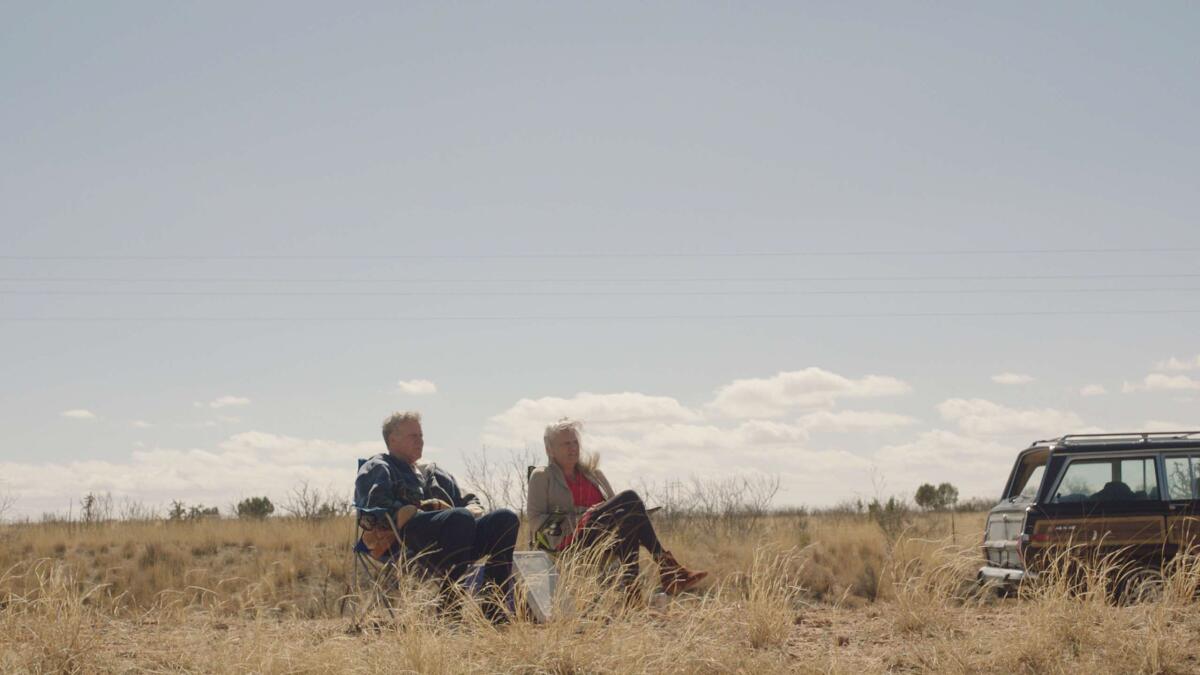
A scene from the documentary “Will & Harper.”
(Sundance Institute)
Not that they planned it that way. Jettisoning an early idea to build the film around comedy bits, Ferrell, Steele and Greenbaum found themselves subject to the vagaries of nonfiction storytelling, and thereby stumbled into the journey’s most bracing scenes. They did not expect, for instance, that a gag involving Ferrell trying to eat a 72-ounce steak in under an hour at a Texas steakhouse would expose him and Steele to uncomfortable leering from the other patrons and a subsequent flurry of social media abuse. Nor did they know that Holcomb would be at a Pacers game they attended in Indianapolis, where the governor and Ferrell were introduced courtside — leading to an on-camera reckoning for the actor about the rudiments of effective allyship.
“If we were in a moment like that again, I wouldn’t hesitate to [ask], ‘By the way, what are your views?’ ” says Ferrell. “Just because I’m OK with poking the bear a little bit more. Especially if I had some knowledge going in. Literally last night at dinner, the waiter misgendered [Steele]. He said, ‘Hello, gentlemen.’ And I said, ‘Nope.’ … That’s now how I react because it feels natural.”
Our conversation, ahead of the film’s Toronto International Film Festival screening, takes place the morning after the presidential debate between Vice President Kamala Harris and former president Donald Trump, in which Trump raised the specter of “transgender operations on illegal aliens in prison.” (“That feels like a line written in an ‘SNL’ sketch,” Ferrell quips.) But politicians’ and pundits’ use of transgender people as a scapegoat would not be possible without their historical mistreatment, or outright erasure, in popular culture. As for the roughly 60% of Americans who do not know a trans person, according to Pew, “Will & Harper” hopes to be an introduction: “Now you know Harper,” Greenbaum says.

Steele and Ferrell with “Will & Harper” director Josh Greenbaum.
(Raul Romo / For The Times)
Such positive messages will compete for attention against transphobic rhetoric from high-profile figures such as Dave Chappelle and Ricky Gervais, even on the same platform. (Netflix, which is releasing “Will & Harper,” is also home to numerous projects by the firebrand comedians in which trans people are treated as the butt of the joke.) But Steele refuses to take their comments seriously — or bend her own creative process simply to combat them.
“When egos get hurt, people troll,” she says. “And I’m looking at a lot of these people and they’re enjoying the trolling.” She hopes Algerian boxer Imane Khelif, Olympic gold medalist in women’s welterweight, “sues the s— out of J.K. Rowling” over tweets in which the “Harry Potter” author falsely described Khelif as a man. “These people, they need help.”
“I want our voice and my example to be louder, in the end,” Steele adds. “I just hope it drowns out the voice that is weaker, and that’s my method. I don’t like confronting. For one, you confront someone fast like Dave Chappelle and you’re going to get eviscerated. It’s like going on Fox News with [former host] Tucker Carlson. Why would I subject myself to that when I’m just going to get eaten up in ways I won’t enjoy?”
“Will & Harper” actively seeks to neutralize the cries of “cancel culture” from cable news anchors and stand-up comics by taking no topic of conversation off the table. With Ferrell as her curious everyman interlocutor, Steele explains her choice of a new name, discusses her physical appearance and sexuality, acknowledges her bouts of suicidal ideation; she introduces her children, visits her sister, shares her letters, diaries and most painful memories. As a result of this vulnerability, she offers a remarkable invitation to viewers who might otherwise pass judgment, or avoid the conversation entirely, out of fear that they will say the wrong thing, or cause offense, or discover that their experience is not in fact universal.
“One of the many things that I loved about her transition is her constant wanting to talk about it,” says Steele’s friend and former “SNL” collaborator Kristen Wiig, who co-wrote and performed an original song for the film. “[It fostered] this open dialogue to keep those connections, make them stronger and to really explain what she had been going through for years that a lot of us weren’t privy to.”

“Will & Harper” has helped Ferrell learn to be a more vocal ally: “I’m OK with poking the bear a little bit more,” he says.
(Raul Romo / For The Times)
The film has already succeeded in sparking that dialogue among viewers, according to Greenbaum. At one screening at the Sundance Film Festival, where the film had its world premiere earlier this year, he recalls meeting a woman and her son, a trans man, who had been estranged since his transition but reconnected when she bought them tickets to “Will & Harper” as a sort of cinematic olive branch. Steele, for her part, admits to having more nerves over “Will & Harper” resonating with trans audiences than persuading cis ones — perhaps because she understands firsthand the harm produced by Hollywood’s powerful mirror.
“Klinger probably destroyed my life,” she says of the cross-dressing “M.A.S.H.” character played for laughs by Jamie Farr. “He was literally looking to be discharged for being crazy for that. That was his whole character.” By contrast, the 1974 James Caan/Alan Arkin buddy cop movie “Freebie and the Bean” became one of her favorite movies, thanks to its thieving female impersonator. “To see a man look that beautiful was confusing,” she says.
In such confusion lay the other animating question of “Will & Harper,” and indeed of LGBTQ+ popular culture more broadly: What story would we, should we, tell about ourselves if we could tell any story we wanted? Some will argue that self-expression is the goal, others moral suasion; some will prefer soft power to storming the barricades and some the reverse. Advocates for populism will confront those for high art while the diplomats among us try to squeeze them together into our society’s narrowing middle ground. And anyone who tells you that theirs is the one true path is either uninformed or lying.
“I guess shame on me, but that was just a funny show with talented actors,” Ferrell says, of “Will & Grace,” gently pushing back on Greenbaum’s earlier assessment. “Big, landmark, statement show, in a way — yes, of course, I recognize that at the same time. But also, that’s just great ensemble comedy. Fun writing. Great premises.”
Notably, Steele doesn’t weigh in on this one. She doesn’t need to. “Will & Harper” — as “Will & Grace” was for gay men of a certain generation — is just one of countless possible varieties of trans representation. There’s no shortage of stories to tell, or unanswerable questions to ask.



Comedy is a matter of taste and preference — it’s a deeply personal thing. Which makes it hard for a critic to give a blanket assessment of a specific kind of comedy, especially if it didn’t work for them, but clearly worked for others (the laughter or lack thereof is the indication). “It’s not funny,” the critic says, “well I had fun,” someone else can reply, and then we’re at an impasse.
Which is the dilemma one finds oneself in with “Gail Daughtry and the Celebrity Sex Pass,” a very strange and shaggy Hollywood satire of sorts from David Wain and The State crew, still riding the goodwill of “Wet Hot American Summer” after all these years. If only this were as funny.
“Gail Daughtry” lives in the same world as that iconic summer camp spoof, as well as Wain’s 2014 rom-com parody, “They Came Together,” in that he’s playing with genre convention and expectation, taking well-known norms to the goofiest extremes. But those films hewed more closely to their respective genres, while “Gail Daughtry” is totally scattered, combining crime and spy movie tropes with a fish-out-of-water comedy and a Hollywood send-up. It has far too many ideas for its own good, and yet no ideas that are good enough to sustain this bizarre curio of a comedy.
What’s ironic is that one of the problems driving this wacky plot forward is the characters have to come up with a movie idea to pitch to star Jon Hamm (playing himself of course), leading them to do some pretty inane and shockingly violent things. It’s almost as if Wain and co-writer and co-star Ken Marino had no idea for a movie, then baked their search for an idea into their script, and then turned it into a madcap adventure about a woman on a quest to have sex with Jon Hamm. What an ouroboros!
OK, about the sex quest. Gail Daughtry (Zoey Deutch) is a chipper hairdresser from Kansas born without the part of the brain that recognizes sarcasm or irony. She’s a cheerful, Pollyanna-ish naïf whose literal-mindedness is almost as extreme as Amelia Bedelia. Her childhood sweetheart and fiancé Tom (Michael Cassidy) is the same. She tells him about the concept of the “celebrity sex pass” as a joke, and he promptly boinks Jennifer Aniston at local book reading.
(Nitpicky aside: why didn’t they use the common nomenclature “hall pass”? Is it copyrighted? “Celebrity sex pass” is clunky and sounds like an off-brand version of the well-known slang.)
That infidelity crisis is how Gail ends up in Los Angeles determined to bang Hamm, collecting a motley crew of similarly clueless helpers along the way. There’s her best friend Otto (Miles Guttierez-Riley), her salon bestie; Caleb (Ben Wang), an overly ambitious intern at Creative Artists Agency; Vince (Marino), a screenwriter turned paparazzo with a heart of gold; and John Slattery, as John Slattery, down on his luck. An accidental briefcase swap has a pair of thugs on their tail, in a forgettable and underdeveloped B-plot.
With a parade of celebrity cameos and collaborators in bit parts, “Gail Daughtry” at times feels like an excuse for Wain and co. to make something at home with all of their friends. Fair enough, it’s great to see all these people employed, but what about what we’re watching? Behold, the Los Angeles of the middle-aged working comedian: the CAA lobby, the Chateau Marmont, Griffith Park, etc. And the plot is as half-baked as the pitch they present to Hamm.
What’s actually interesting about this comedy is the distinct streak of despair and even resentment that reveals itself at the climax, a feeling of helplessness and uselessness. Everyone’s been striving to make it in this crazy town: the intern, the actor, the paparazzo. But not even Jon Hamm can help them get a movie made; even he feels inherently powerless. There’s an unexplored anxiety vibrating there that feels the most thematically fruitful, about what it means, some 25 years after bursting onto the scene with a generation-defining comedy, about maintaining the work, the drive, a sense of purpose, after years of strikes, and in the face of a constricting industry. Do they still have it? Is the dream still alive?
Maybe that’s why Wain and Marino need to invent a dreamer stand-in with Gail, a guileless eternal optimist who knows nothing of the craven Los Angeles and accepts everything at face value (though she is filled with a scary bit of rage too). She might behave like she has a head injury, but she’s going to achieve her goal, dammit. “Gail Daughtry and the Celebrity Sex Pass” might not be as funny as “Wet Hot American Summer” (for this critic), but reframed, it serves as a fascinating status update on life in La La Land for this troupe.
‘Gail Daughtry and the Celebrity Sex Pass’
2 stars (out of 4)
MPA rating: R (for sexual content, violence/bloody images and language)
Running time: 1:33
How to watch: In theaters July 10
Entertainment
Emily Ratajkowski’s viral essay on sex life as a single mom scores her a seven-figure book deal
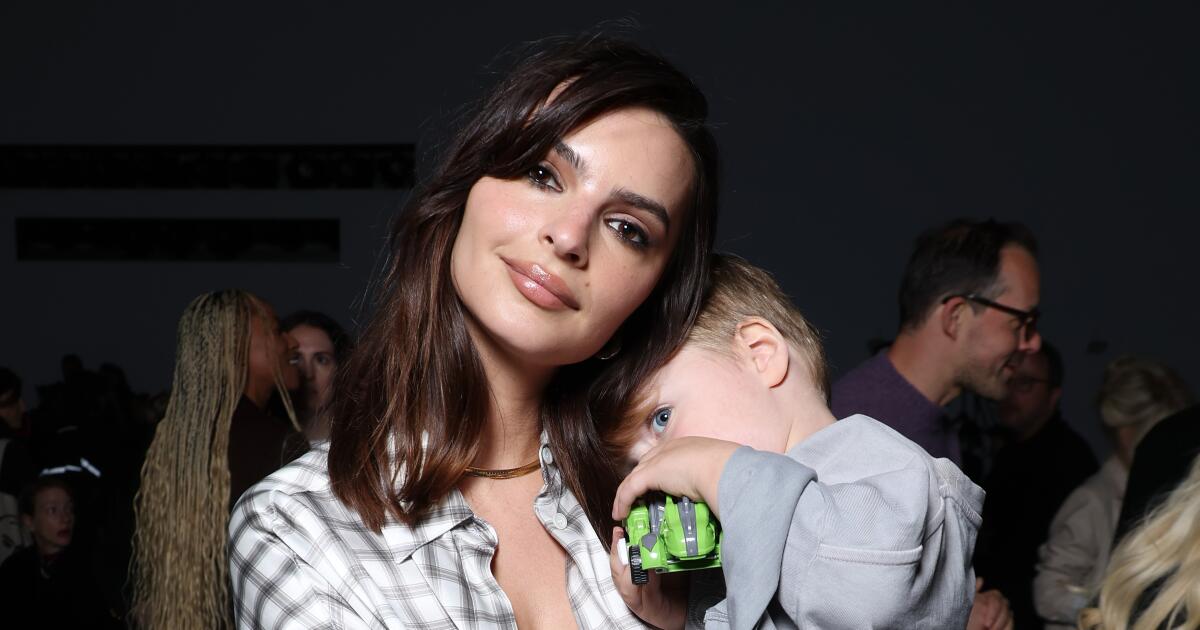
Emily Ratajkowski’s viral essay detailing her sex life as a single mom just landed her a seven-figure book deal.
According to Page Six, the model’s essay in the Cut had publishers champing at the bit in a 12-way bidding war that culminated in the hefty pay day. Editor Helen Rouner at Penguin Press — who also edited Lauren Christensen’s memoir “Firstborn” and Michael W. Clune’s novel “Pan” — reportedly landed the deal.
Penguin Press did not immediately respond to The Times’ request for comment Friday.
Publishers Marketplace announced the forthcoming memoir, describing it as “an examination of modern female identity through the story of the author’s own efforts as a newly single mother in New York City to discover what really constitutes a good life for a woman.”
The essay, which dropped a month ago and quickly broke the internet, drops the veil on EmRata’s sexual adventures (or maybe misadventures) since she and her former husband, Sebastian Bear-McClard, split in 2022.
“It was a violent transition into a new reality of screaming baby on my aching tit and ring on my swollen finger,” Ratajkowski writes of new motherhood. “And then, in a time period that felt both instant and excruciatingly slow, my marriage collapsed. Six months after my son was born, my husband and I stopped having sex. Less than a year later, we separated.”
In the missive, the model interrogates her sexuality — is she a Madonna or a whore? — while untangling bigger questions around gender, power and self-actualization. If Carrie Bradshaw wrote about “Sex and the City,” then Ratajkowski is writing about sex, the city and single motherhood. And naturally, her fleeting paramours have vague monikers: “Vegan Graffiti Artist,” “Spanish Gen-Zer” and “Son of a Billionaire.”
“And then there was the Elder Millennial: obsessed with dental hygiene, psychedelics, and dirty talk,” she writes. “He had approached the subject coyly at first, like it was something he was kind of embarrassed about — the way a kid will test you to see if you’ll talk to them about their dorky obsession of the moment. Do you like Godzilla? What about Star Wars?”
Would-be sleuths with Ratajkowski’s essay and a gossip rag handy will have their work cut out for them.
This will be Ratajkowski’s second book. The first, “My Body,” dropped in 2021 and was a bestselling collection of essays exploring gender, power dynamics, sexuality and the commodification of female beauty in the modeling and entertainment industries.
Ratajkowski’s foray into the spotlight came more than a decade ago when Robin Thicke’s controversial “Blurred Lines” music video made the model an overnight star. She was cast in David Fincher’s adaptation of “Gone Girl,” which hit theaters the following year, and catapulted to top fashion runways — Marc Jacobs, Versace, Victoria’s Secret and Dolce & Gabbana, to name a few. She she’s been romantically linked to Harry Styles, Eric Andre, Shaboozey, Brad Pitt and Pete Davidson, among others.
In 2023, she moonlighted as the host of the “High Low With EmRata” podcast, where she interviewed sex workers, investigated ethical nonmonogamy and pondered the etymology of the word “toxic.” The same year, she told The Times that she was coming into herself post-divorce, “Being able to assert what I want — that feels like it just started: My life as a creator and not as a muse.”

Wainheads will be delighted to see his alums in cameos: Kerri Kenney-Silver, Michael Ian Black, Thomas Lennon, and supporting roles for Zickel and Truglio. A large portion of the cast are his homies. But with Deutch, Gutierrez-Riley, Wang, Slattery, Impacciatore, and yes, Hamm, it’s as if they’re being inducted into a new mad family. Wain and Marino are basically catching Pokémon and hoping they can hold onto the roster (by that logic, yes, Paul Rudd is a legendary Pokémon). The film is anchored by Zoey — everything everywhere all this summer with Voicemails From Isabelle to Minions & Monsters — Deutch in the Dorothy Gale role, exuding a high level of perkiness consistent with the character’s can-do, wide-eyed, midwestern charm and heart.
A major standout, Ben Wang finally gets to show off his comedic abilities, portraying a self-assured, quick-witted agent who makes me laugh every time he reveals his sheltered upbringing in snappy whines at every inconvenience. Sabrina Impacciatore, who has proven to be a comedic juggernaut in The Paper, is having so much fun hamming it up as the mob boss-esque wicked witch counterpart, torturing her henchmen and deliciously chewing up the scenery whenever onscreen. I don’t think they use her to the height of her comedic prowess, but she’s a delight nonetheless. John Slattery is the film’s comedic MVP. The way the writers use his over-the-top character for comedy is downright hilarious every time. They use him as either a punchline or a force of nature, and he’s great. This movie is like Mad Men propaganda, and by God, it works. As someone who’s never seen it, Gail allowed me a better appreciation for Slattery and Hamm.
Man, we don’t deserve Jon Hamm. This is the second time I’ve seen him play a silly, fictionalized version of himself this year (the other being the SXSW crowd-pleasing rom-com Wishful Thinking, which Gail distributor Sony Pictures Classics acquired), and he also voice-acted in his comedic Mayor Jerry role in Hoppers. Maybe working with Wain in 2007’s The Ten was the canon event, but I consider his weird little sex scene with Kristen Wiig in Bridesmaids his awakening. Since then, I’ve only seen him as unserious, and it’s delightful. Oz-like in appearance, he’s funny and befitting the film’s overall light, joyful nature.
LAST STATEMENT
Ultimately, Gail Daughtry and the Celebrity Sex Pass is a campy, delightful romp that succeeds as both a distinctive Hollywood‑centric riff and a Wizard of Oz reimagining, retaining a loving, twisted, demented charm. It’s a weird description, but it’s so high‑spirited and light‑hearted despite being strangely ultraviolent. It might as well be a live‑action episode of Smiling Friends (RIP), yet it’s everything the theatrical market needs today. Ten years ago, this would’ve been a studio production rather than an indie Sundance acquisition, but thank God it exists for the big screen. More absurdist Gail Daughtrys for cinemas (not streaming), please, because this is the most fun to be had in a theater all summer, if not the year thus far.
-

 Augusta, GA2 minutes ago
South Augusta YMCA will not renew Tobacco Road lease
-

 Washington, D.C7 minutes ago
Storm Team4 Forecast: Scattered showers and storms possible Saturday PM
-

 Cleveland, OH14 minutes ago
Cleveland’s First Round woes must end with the 2026 class
-

 Austin, TX17 minutes ago
Texas reports dozens of cyclosporiasis cases tied to contaminated fresh produce
-

 Alabama29 minutes ago
Small Plane Makes Emergency Landing In Peanut Field Near Florida-Alabama Line : NorthEscambia.com
-
Alaska32 minutes ago
An Alaska vacation can remind Israelis the world doesn’t revolve around them | The Jerusalem Post
-
 Arizona37 minutes ago
Arizona AG continues to investigate Glendale apartment complex after Friday deadline to fix A/C
-

 Arkansas44 minutes ago
Office of Keep Arkansas Beautiful Now Part of the ARDOT

