Entertainment
‘The faker a show is, the more ethical it is’: Emily Nussbaum on the conditions of reality TV


On the Shelf
Cue the Sun!: The Invention of Reality TV
By Emily Nussbaum
Random House: 464 pages, $30
If you buy books linked on our site, The Times may earn a commission from Bookshop.org, whose fees support independent bookstores.
Nick Lachey and Jessica Simpson were still “Newlyweds” grappling with the chicken or tuna conundrum when television critic Emily Nussbaum first came up with the idea of writing a book about reality TV.
“I waited 20 years until reality TV was an established industry and I had a career writing about television,” Nussbaum says about the impetus for “Cue the Sun!: The Invention of Reality TV,” which she conceived of in 2003 during a conversation with friends and colleagues amid the explosion of the genre with the shows “The Bachelorette,” “America’s Next Top Model” and “Joe Millionaire.”
Dissuaded by these naysayers, who dismissed the genre as a flash in the pan (insert chortle here), Nussbaum carved out a career in criticism as a culture editor for New York Magazine and as a current staff writer for the New Yorker, covering such prestige shows as “The Sopranos” and “Mad Men” in essays that were collected in her first book, 2019’s “I Like to Watch: Arguing My Way Through the TV Revolution.”
That was part of a two-book deal with Random House, so for her second, Nussbaum thought she’d revisit that idea from two decades ago, not from a critical point of view but from a reported one. Using more than 300 interviews with the people who invented the genre, Nussbaum crafts the story of the origins of reality TV from 1947 to 2009.
But wait — television was a new medium in 1947, let alone reality television. That’s the first clue that “Cue the Sun,” out Tuesday, isn’t your average history of the genre, which Nussbaum calls “dirty documentary.”
While loosely linear, “Cue the Sun!” groups programs by thematic similarities: game shows, prank shows, reality soap operas and clip shows. These include prank show “Candid Camera” and its roots in the radio show “The Candid Microphone,” hence the 1947 date stamp, as well as clip shows such as “America’s Funniest Home Videos” and “Cops,” to which Nussbaum devotes much of the early part of the book.
“Each of those takes cinema verité, which people think of as an elevated discipline where you hold the camera and capture the truth with a lot of patience, and then mix in commercial additives that give it a format: speed it up, make it serialized, make it inexpensive, put pressure on people. That’s how I think of [reality TV],” she says.
Her initial stages of reporting in early 2020 unintentionally foreshadowed the year that would follow: Nussbaum tested positive for COVID-19 and developed long COVID after one of her first reporting trips for the book, which included interviewing the creator of “Cops,” the “charming pirate” John Langley, who looms large over “Cue the Sun!” In June 2020, the clip show was pulled off the air after 33 seasons in response to the Black Lives Matter resurgence that summer. (The show has since resumed.)
“There’s a touchingly naive statement that someone was making, that the problem with ‘Cops’ is not that it would document [police brutality] but that [police] would act nicer on camera [while still committing abuses of power off camera]. And, of course, that’s not an argument that held up because at this point, everyone is a reality producer because everyone has a camera in their hand,” Nussbaum says, conjuring images of civilian-captured police brutality on social media.
Nussbaum doesn’t agree with Langley’s stance on “Cops,” detailed in “Cue the Sun!,” that the program captured raw material and presented it neutrally. However, she acknowledges that it’s “just one show in this book that has major ethical problems.”
One such series that Nussbaum — and, indeed, many others — experiences joy from is “Project Runway.”
“Here’s a show that celebrates creativity, that’s pro-gay … has a fantastic host [in Tim Gunn] who modeled positivity and warmth, [and] is an offshoot of the ‘classy’ ‘Project Greenlight,’ and then I looked into the origins of it and I was like, ‘Oh, yeah, ‘Project Runway’ [was developed] because Harvey Weinstein wanted to have a show about models,’” Nussbaum deadpans with her signature dry wit. (Miriam Haley, a former production assistant on the show, testified at Weinstein’s 2020 trial in New York that the disgraced Hollywood mogul sexually assaulted her at his apartment in 2006.)
While shows such as “Project Runway,” “Survivor” and “The Amazing Race” have all been praised for their contributions to the genre and the culture at large, Nussbaum says it’s actually reality stars who are producers on their own “soft-scripted” shows, like the much-maligned Kardashians, who experience the least problematic conditions.
“The faker a show is, the more ethical it is,” she says. “The people who’ve agreed to be reality stars and ‘play’ themselves, those shows might have their own ethical problems, but they’re not ‘real’ in the same way.”
“Bona-fide amateurs,” a category of reality TV performers that exists somewhere in the gray area among scripted performers, hosts and documentary subjects that Nussbaum discovered while reporting her recent New Yorker article on “Love Is Blind,” are unprotected.
“When I wrote this book, nobody was doing anything to try to protect cast members,” such as former “Real Housewives of New York City” star Bethenny Frankel advocating for reality television stars to unionize amid last year’s strike by members of the Screen Actors Guild-American Federation of Radio and Television Artists. (Nussbaum interviewed producer Andy Cohen for “Cue the Sun!” prior to the filing of several lawsuits against the Bravo franchise from other Housewives.) “This genre is a strikebreaker” that grew out of the 1988 strike by members of the Writers Guild of America that spawned “Cops,” Nussbaum says. “It’s a budget mechanism. It’s a way not to pay writers or actors.”
While it might be hard for some to muster sympathy for reality stars who’ve gone on to make millions from their exposure in the genre, Nussbaum offers this: “[Just] because [some people] find reality stars ridiculous or gross or are villains on the show, which is an edited version of themselves, [doesn’t mean that they don’t] deserve labor rights or to be compensated. The whole idea of the genre as a guilty pleasure prevents people from seeing it as the other things it is, one of which is a workplace.”

Entertainment
His underground puppet shows draw massive crowds to L.A. street corner — and fans don’t even know his name
The artist known as Jeffrey’s Human Persona has remained anonymous for nearly 25 years — the same length of time that he has staged guerrilla-style musical puppet shows titled “almighty Opp” on a gritty street corner in Koreatown on the last Saturday of each month. He missed only three shows in the first 19 years of what he refers to as his “services.” However, the COVID-19 pandemic forced him online in 2020 and a family tragedy kept him away from the corner for another few years.
In December he returned live in front of the used car dealership at Western and Elmwood for the first time since the pandemic-induced shutdown, drawing a crowd of several hundred devoted fans. In February he staged his first ticketed event called “Secret Somewhere Services,” which drew close to 50 guests who paid $100 each for the pop-up show at a private residence in the San Fernando Valley where Willie Nelson’s youngest son, Micah, served as the opening act with his art rock project Particle Kid.
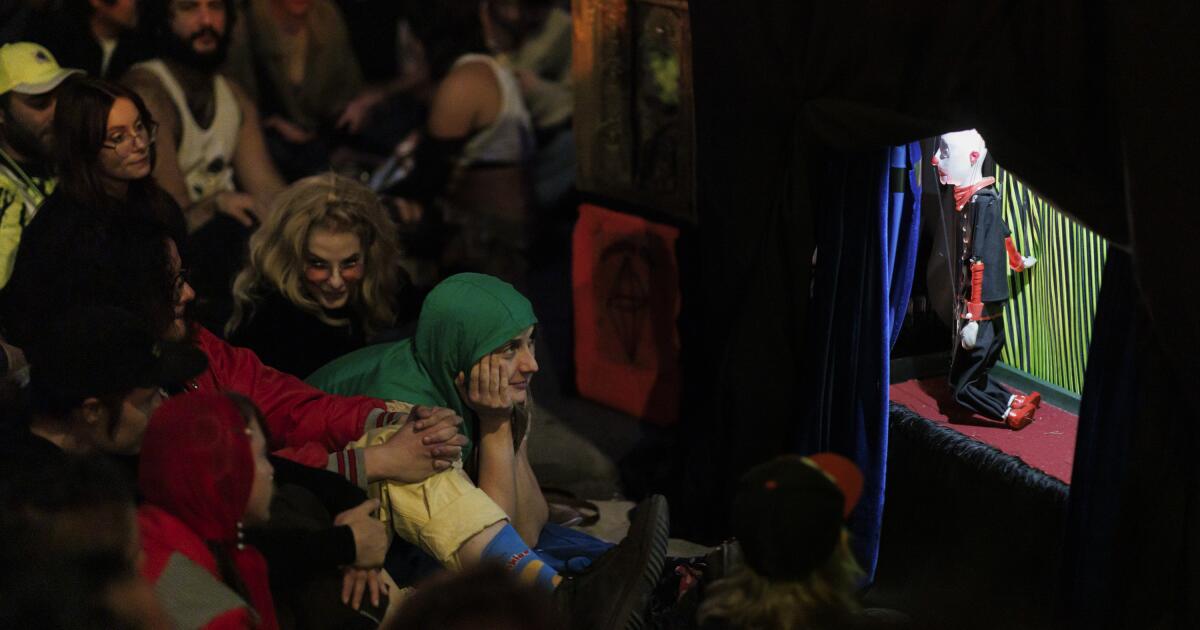
The view of the stage from the back of the crowd during January’s “almighty Opp” puppet show, which has returned to Koreatown after a nearly five-year break due to the COVID-19 pandemic and a family tragedy.
(Carlin Stiehl / For The Times)
“I missed funerals, I missed Christmases, I missed friends’ birthdays. I never took a vacation,” Jeffrey says of his devotion to his monthly performances during a recent phone interview after his late January show, which also drew a large, excitable crowd of supporters. “I treated it like a knife to my heart.”
“Almighty Opp” is truly about Jeffrey’s heart. Services take place in a specially designed black stage populated with a variety of custom fabricated puppets. These creations are not from Mister Rogers’ Neighborhood of Make-Believe. At a recent show the ringleader wore a red dirndl with gray knee socks and black ankle boots. His angular head topped with a green felt crown; his toothy mouth a sinister, grimacing gash; his eyes blackened with what looks like charcoal. Other puppets cavorted around him: A tubby, clownish, snowman-like creature that spits water at the crowd; a tall, spindly clown that uses a miniature pump; a weird sock puppet made out of adhesive bandages; a discarded, disheveled baby doll on strings.
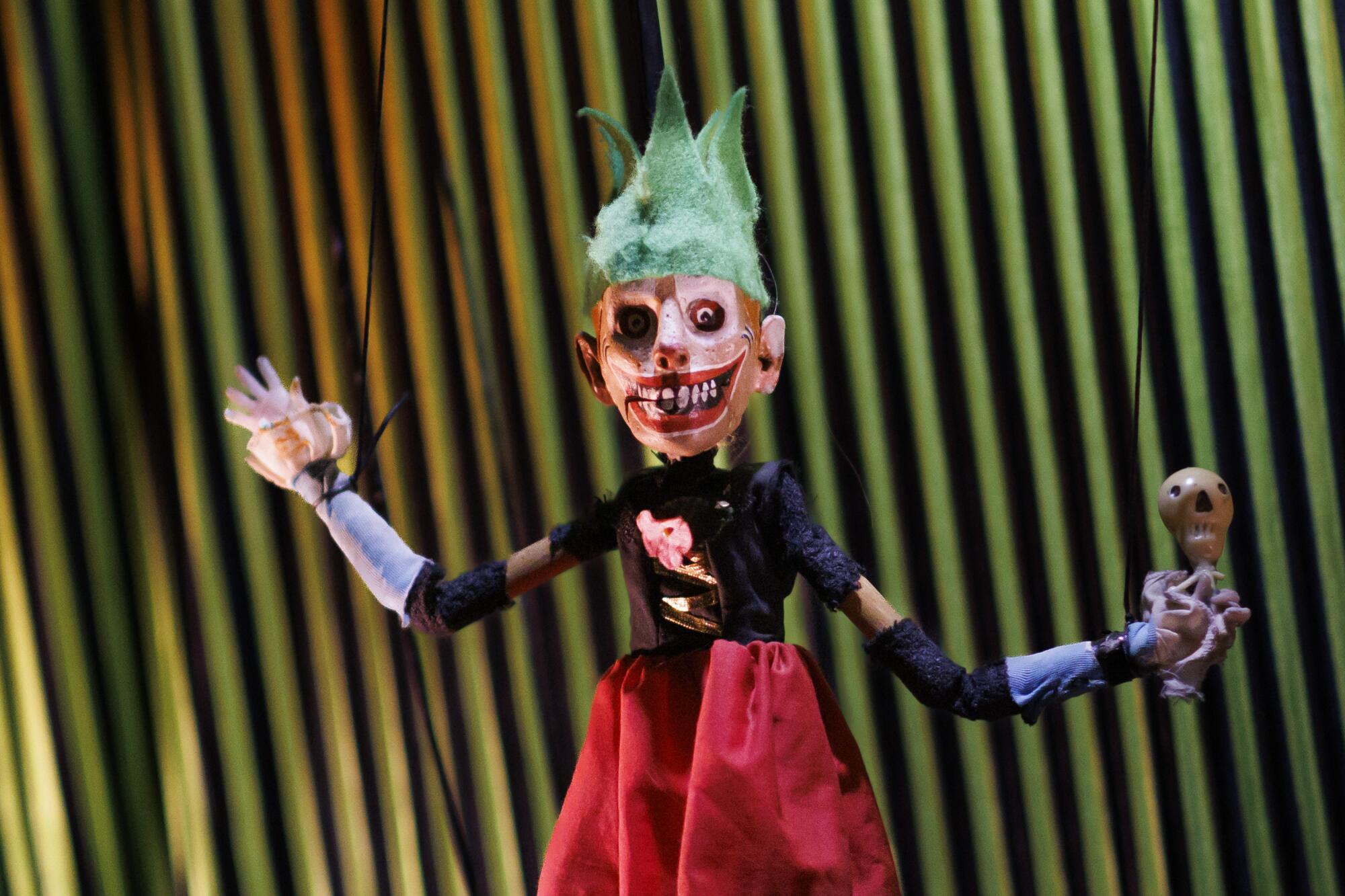
One of the main marionettes used in the “almighty Opp” street show. The puppets sing songs written by the show’s creator, an artist who goes by the name of Jeffrey’s Human Persona.
(Carlin Stiehl / For The Times)
Music is the focal point of each service, with Jeffrey playing guitar and keyboards behind the curtain, singing in a wavering voice reminiscent of Jeff Mangum about the subjects, ideas and feelings that have occupied his mind at various stages of his life. To date, “almighty Opp” has put out 33 albums on Bandcamp featuring songs from services over the years with titles including “Every Day’s the Worst Day,” “Misbegotten Human Beings” and “Bubble Burster.”
“Pretending I had a choice, just as long as we said we did, but now it’s much worse than it seems five years later,” sings a puppet that looks like a bizarro Humpty Dumpty with a huge egg head on a body of red pants during January’s show. “Supporting someone else’s dreams because your good nature’s being used.”
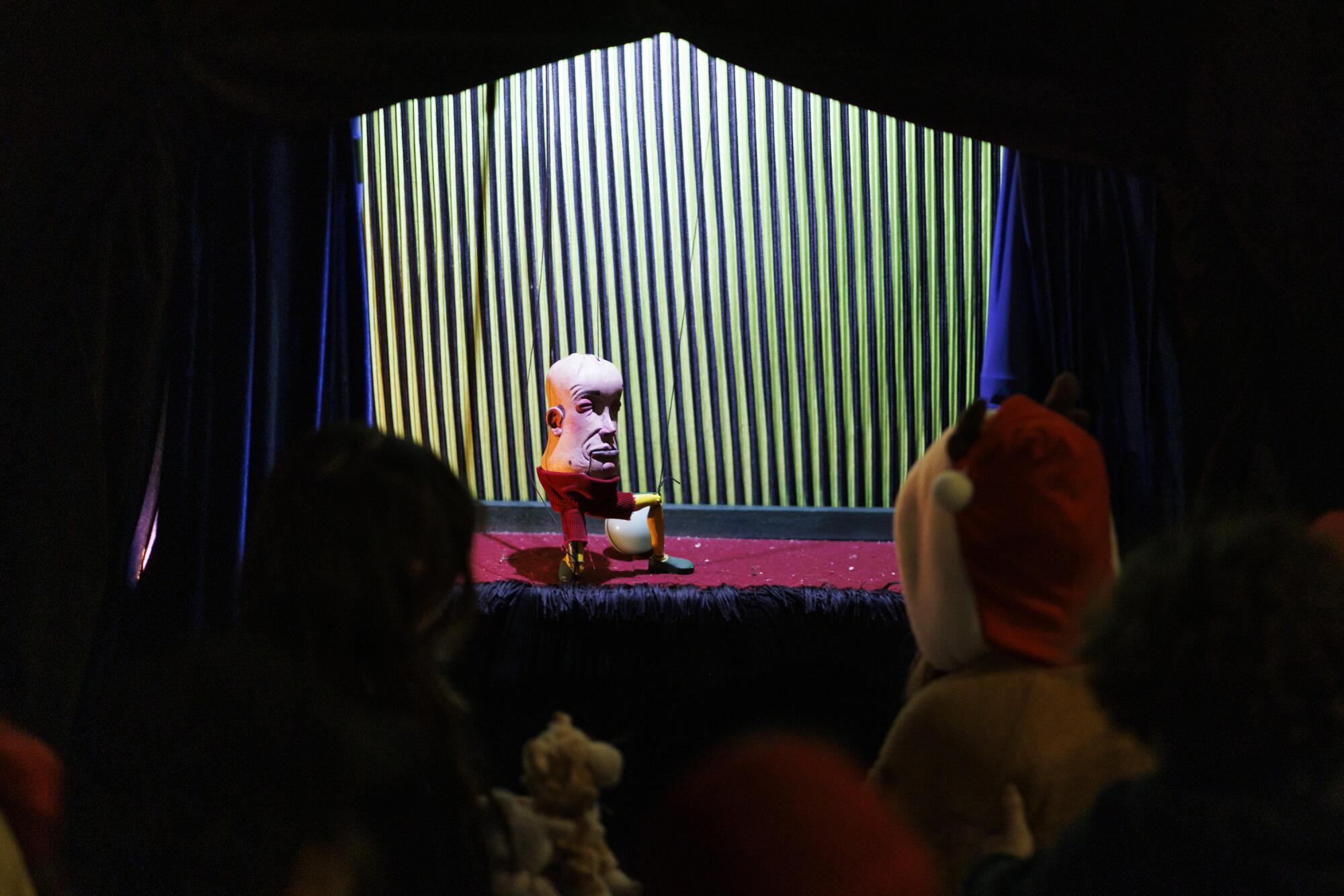
“Almighty Opp” employs a variety of richly detailed, hand-crafted puppets. The show’s creator once worked as an assistant to sculptor Chris Burden.
(Carlin Stiehl / For The Times)
A common refrain, which almost everyone gathered on the gum-stained sidewalk sings in unison, is, “It’s OK to not be OK.”
Jeffrey loves the spontaneous possibilities of the street corner and what he calls the “stumble upon” nature of the services, but the core audience is a returning one. The nearly 200 people gathered on this January evening just past 9 p.m. stand on stools and chairs in the back and loll on the sidewalk on their elbows in the front. They scream and chant and sing along. They turn and hug one another or shake hands when Jeffrey encourages them to meet their neighbors at different points in the show.
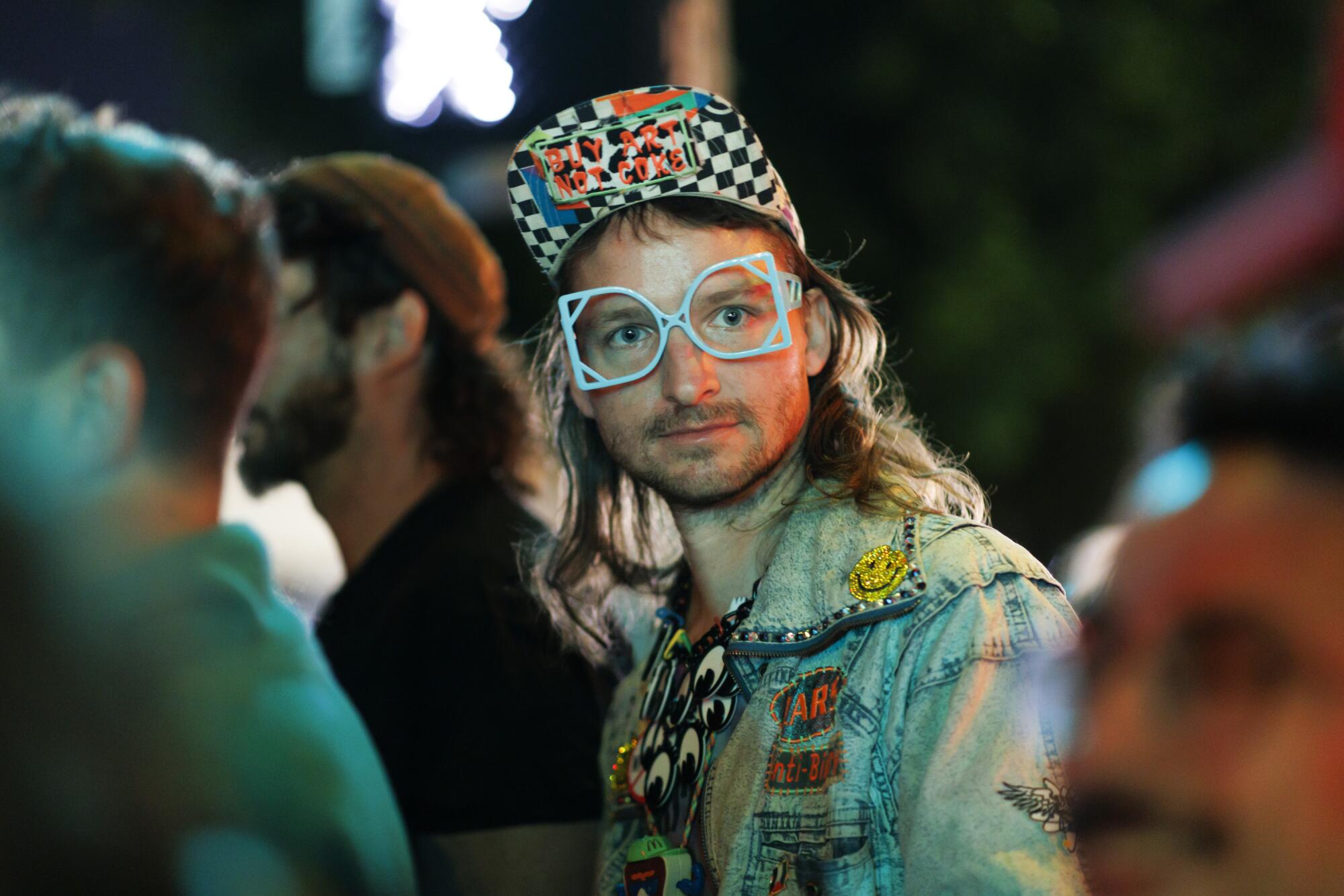
Lars Adams attends an “almighty Opp” show on the last Saturday in January. During the show the crowd is encouraged to turn and greet their neighbors.
(Carlin Stiehl / For The Times)
“Even though I’m performing, I don’t really consider myself a performer,” Jeffrey says. He also isn’t a busker, although his shows are free community events. And even though there are puppets, he doesn’t call “almighty Opp” a puppet show. He is, he says, “an obsessive maker.” The audience is “just coming along for the ride with me — life’s ride — of how I’m feeling at that time. It’s kind of like a Catholic Church service, where the sermon changes, but the structure of it remains the same.”
Unlike a church service, shows are rowdy and a bit untethered. A bus whooshes by, an unhoused man screams as he walks by with a shopping cart. Jeffrey’s wife, known as Shambles, operates the puppets from behind the curtain, while wearing their 5-year-old daughter, known as Crumbo, in a sling. Two other assistants, called DingDing and Cylo, can also be seen behind the black curtain — their faces hidden in knitted clown masks or shielded by makeup. Jeffrey comes before the crowd toward the end of the show — wearing a white mask and a red hoodie — and asks audience members to give testimonials. People stand up and talk about having been changed by the show over the years.
That’s what happened with Micah Nelson. He came when Jeffrey used to hold mirrors in front of people’s faces and have them watch themselves while the crowd watched them. The sessions were uncomfortably long. Nelson later contacted Jeffrey to say he was covering some of his songs, and that his experience with the mirror had a profound effect on him.
When Nelson introduced Jeffrey at the recent “Secret Somewhere” show, the things he said about Jeffrey made the performer blush. Life, Jeffrey said, has a funny way of coming full circle.

Jeffrey’s Human Persona, who created “almighty Opp” in the early aughts, asks audience members gathered on a Koreatown street corner to give testimonials about the show, which he calls a “service.”
(Carlin Stiehl / For The Times)
Jeffrey moved to L.A. from Pittsburgh in 1995 when he was 19. His father bought him the plane ticket after Jeffrey found himself in a bit of a boredom rut with friends and getting into the wrong kind of trouble. He wanted to work in the film industry — he thought L.A. would be like a 1970s Jim Morrison fever dream, but found it not as inspiring. The film business, in which he worked making fantasy art and other fabrications, was not a creative haven, but rather a soul-sucking void.
“I’m tired of making other people’s puppets,” he told a friend one day, and “almighty Opp” was born.
“If you just show up for a paycheck, what are you really doing?” asked Jeffrey during our interview. “I’d rather be a flop and believe in it.”

Children gather at the very front of the stage during January’s “almighty Opp” show, which features original songs on guitar and keyboard. A total of 33 “almighty Opp” albums are available on Bandcamp.
(Carlin Stiehl / For The Times)
He made the original puppets and wrote the first “almighty Opp” album in the second-floor apartment where he lived, just a stone’s throw from the corner where he still performs — the corner where he would propose to his wife during a particularly difficult period of his life. During all those years he worked in a variety of creative roles to support himself: for the toy industry; briefly for the Disney Imagineers; and for about eight years as an assistant to sculptor Chris Burden for whom he helped fabricate the whizzing future land “Metropolis II,” which resides in Los Angeles County Museum of Art’s permanent collection.
Now that “almighty Opp” is live again, Jeffrey is benefiting from the therapeutic aspects of writing down his emotions and experiences. The “Secret Somewhere Services” will continue once a month, or maybe every two months. Guests can check Instagram for tips on how to score a coveted ticket, which comes with its own handcrafted entrance token and map to the ever-changing private venue. Jeffrey is making big puppets for these performances — one is 7 feet tall — and experimenting with the form of the event.
Still, the street corner will remain the soul of his operation — and the music at the heart of it all.
“It’s all about honesty, and the people who understand it and keep coming, they know that it’s something absolutely real,” he says.
Almighty Opp
Where: Corner of Western and Elmwood avenues, in Koreatown
When: The last Saturday of every month, 9 p.m.
Tickets: Free
Running time: Varies, but usually about an hour.

By ABBIE BERNSTEIN / Staff Writer
Posted: March 8th, 2026 / 08:00 PM
THE BRIDE movie poster | ©2026 Warner Bros.
Rating: R
Stars: Jessie Buckley, Christian Bale, Annette Bening, Jake Gyllenhaal, Peter Sarsgaard, Penelope Cruz, Jeannie Berlin, Zlatko Burić
Writer: Maggie Gyllenhaal, based on characters created by Mary Shelley and William Hurlbut and John Balderston
Director: Maggie Gyllenhaal
Distributor: Warner Bros.
Release Date: March 6, 2026
“THE BRIDE!” (as with the recent “WUTHERING HEIGHTS,” the quotation marks are part of the title) is awash in homages, and not just the ones we might reasonably expect in a movie that takes its most obvious inspiration from 1935’s BRIDE OF FRANKENSTEIN.
There’s that, of course, plus its source, Mary Shelley’s 1818 novel FRANKENSTEIN; OR THE MODERN PROMETHEUS, and its sober 1931 film adaptation FRANKENSTEIN. But there are also big nods to wilder takes on the legend, including YOUNG FRANKENSTEIN and THE ROCKY HORROR PICTURE SHOW and even movies that have nothing to do with FRANKENSTEIN, like BONNIE AND CLYDE.
Writer/director Maggie Gyllenhaal casts a wide net in metaphors and ideas and looks. Sometimes “THE BRIDE!” is a comedy, sometimes it’s a crime drama, sometimes it’s a love story, occasionally, it’s even a musical.
Mary Shelley (Jessie Buckley) narrates the tale to us from beyond the grave. She is haughty and naughty, intoxicated by verbiage and her own literary genius. She is going to tell us a story, she says, that she didn’t even dare imagine while alive.
We’re in 1930s Chicago, where a young escort (also Buckley) is having a really awful evening out at a fancy restaurant with some of her peers and a bunch of crass gangsters. Shelley dubs the woman “Ida” and takes possession of her, causing her to speak and act in ways that get her escorted outside. There she stumbles and takes a fatal fall.
The two goons who were with Ida are happy to describe her tumble as the result of their intentional actions to their horrible gangster boss (Zlatko Burić). Ida was suspected of talking to the cops.
Around the same time, Frankenstein’s creation (Christian Bale) – let’s just call him “Frank,” like everybody else does – comes to Chicago to seek out the groundbreaking scientist Dr. Euphronious (Annette Bening), whose published works he has read.
Frank wants the doctor to create a companion for him. His appearance is unusual, but the most alarming injuries are covered by clothing, so he’s not as extreme-looking as, say, Boris Karloff in the role. This isn’t about sex, Frank explains when Euphronious asks why he doesn’t just hire a prostitute. After over a century of loneliness, he seeks a soulmate, and he is sure this can only be achieved by reviving a corpse.
So, Euphronious and Frank dig up the grave that turns out to belong to Ida (we never do learn how they know it belongs to a soulmate candidate as opposed to a shot-and-dumped male gangster). Euphronius revives her. Ida remembers how to walk and talk, but not who she is or what happened, so Frank and the doc tell her she’s been in an accident.
Even without Ida’s beauty, Frank is already devoted to the very notion of her. A more accommodating suitor would be hard to find. Frank has another passion, the musical films of Ronnie Reed (Jake Gyllenhaal, the filmmaker’s brother), a Fred Astaire-like star. Frank imagines himself in the midst of those dance routines, and we get some more within “THE BRIDE!”’s “real” action.
One thing leads to another, Frank and Ida go on the run, leaving a trail of bodies in their wake. They are pursued all over the country. Among those seeking them are sad-eyed police detective Jake Wiles (Peter Sarsgaard) and his secretary Myrna Mallow (Penélope Cruz), who’s better at this whole crime-solving business than he is.
It’s all very kaleidoscopic and energetic, occasionally impressive and sometimes very funny. Bening as the frazzled, worldly Euphronious has some great moments. Buckley, currently and justifiably Oscar-nominated leading performance in HAMNET, juggles the very unalike personas of Mary and Ida with impact.
Oddly, Bale underplays Frank. We get that he is trying his hardest not to spook Ida (or anyone else), but it seems like he should have a bit more spark. Cruz, going for a snappy ‘30s working woman, has her own style that works.
But in addition to being entertaining and eye-catching, Gyllenhaal has a message that gets very muddled. This is less because it’s so familiar by now that it feels a little redundant, and more because a crucial part of the set-up collides head-on with the feminist slant.
Ida seeks to be her own person, but she is literally bodily controlled by Mary Shelley, who puts her creation in danger with her outbursts. This may help get Ida out of the clutches of the mob, but it is possession, the aftereffects of which the character understandably finds confusing and upsetting.
If Gyllenhaal wanted to discuss or dramatize the clash between what Mary, as a woman, is doing to this other woman, that would make sense, but it seems we’re just meant to somehow overlook this while being immersed in how men control women. The resulting cognitive dissonance adds another layer to a movie that already has more than it can comfortably service.
Additionally, when Mary has one of her outbursts while inhabiting Ida, the plot comes to a screeching halt until she’s finished. Many viewers will wish Mary would stop declaiming and just let Ida be herself.
“THE BRIDE!” succeeds in being trippy and some of it is memorable. By the end, though, it is more disjointed than even a movie about experiments and a character made up of multiple people’s body parts ought to be.
Related: Movie Review: NFT: CURSED IMAGESRelated: Movie Review: SCREAM 7
Related: Movie Review: OPERATION TACO GARY’S
Related: Movie Review: ANACORETA
Related: Movie Review: THIS IS NOT A TEST
Related: Movie Review: GHOST TRAIN
Related: Movie Review: COLD STORAGE
Related: Movie Review: THE HAUNTED FOREST
Related: Movie Review: “WUTHERING HEIGHTS”
Related: Movie Review: THE MORTUARY ASSISTANT
Related: Movie Review: THE STRANGERS: CHAPTER 3
Related: Movie Review: PILLION
Related: Movie Review: JIMPA
Related: Movie Review: ISLANDS
Related: Movie Review: WORLDBREAKER
Related: Movie Review: MOTHER OF FLIES
Related: Movie Review: 28 YEARS LATER: THE BONE TEMPLE
Related: Movie Review: NIGHT PATROL
Related: Movie Review: THE CONFESSION (2026)
Related: Movie Review: WE BURY THE DEAD
Related: Movie Review: ANACONDA
Related: Movie Review: AVATAR: FIRE AND ICE
Related: Movie Review: IS THIS THING ON?
Related: Movie Review: MANOR OF DARKNESS
Related: Movie Review: DUST BUNNY
Follow us on Twitter at ASSIGNMENT X
Like us on Facebook at ASSIGNMENT X
Article Source: Assignment X
Article: Movie Review: “THE BRIDE!”
Related
Related Posts:
Entertainment
‘Sinners,’ ‘The Pitt’ win big at Writers Guild Awards after L.A. ceremony cancellation

The already highly decorated “Sinners” was among the top winners at the 78th Writers Guild Awards on Sunday in New York City.
The horror film, directed and written by Ryan Coogler, won the award for original screenplay, and its biggest competitor for the best picture Oscar, Paul Thomas Anderson’s “One Battle After Another,” clinched the win for adapted screenplay. “Sinners” star Miles Caton accepted the award for the former, and “One Battle” cast member Shayna McHayle for the latter.
“Sinners” star Miles Caton and “One Battle After Another” actor Shayna McHale accepted the awards for original and adapted screenplay, respectively.
(Cindy Ord / Getty Images for Writers Guild of America East)
In the TV realm, “The Pitt” made a splash with awards for drama series, new series and episodic drama.
As for lifetime achievement honors, Robert Smigel presented Stephen Colbert with the Walter Bernstein Award for critiquing the power elite on his late-night show, which will air its final episode in May. Terry George received the Ian McLellan Hunter Award for Career Achievement from Don Cheadle, and Diana Son earned the Richard B. Jablow Award for Devoted Service to the Guild from last year’s recipient, Kathy McGee.
Most years, the Writers Guild holds simultaneous ceremonies in New York and Los Angeles. But the East Coast edition became a solo affair after WGA West canceled its ceremony amid an ongoing strike by its own staff union, who claimed guild management had “surveilled workers for union activity, terminated union supporters, and engaged in bad faith surface bargaining.”
The L.A. ceremony was set to honor James Cameron with the Laurel Award for Screenwriting Achievement, Don Reo with the Paddy Chayefsky Laurel Award for Television Writing Achievement and Mstyslav Chernov with the Paul Selvin Award for “2,000 Meters to Andriivka,” which won the award for documentary screenplay Sunday evening.
While WGA West’s board of directors said the ceremony was postponed to give members “an uncomplicated celebration of their achievements,” the Writers Guild Staff Union characterized the cancellation as an attempt to sow division between management and unionized staff, which is ill-timed given upcoming contraction negotiations between the WGA and the Alliance of Motion Picture and Television Producers, which represents Hollywood studios and streamers. In 2023, the WGA went on its longest-ever strike, lasting 148 days.
Comedian and Emmy-nominated producer Roy Wood Jr., who this year hosted the WGA’s East Coast ceremony for the third time, during his opening monologue offered (in jest) his predictions for the negotiations, which begin later this month.
“First, I predict somebody’s gonna lose their s—,” the host said. “Cooler heads are gonna prevail, and then somebody else is gonna lose their s—.”
Here is the full list of Writers Guild Award winners:
Original screenplay: “Sinners,” written by Ryan Coogler; Warner Bro. Pictures
Adapted screenplay: “One Battle After Another,” screenplay by Paul Thomas Anderson, screen story by Paul Thomas Anderson, inspired by the novel “Vineland” by Thomas Pynchon; Warner Bros. Pictures
Documentary screenplay: “2,000 Meters to Andriivka,” written by Mstyslav Chernov; Frontline Features
Drama series: “The Pitt,” written by Cynthia Adarkwa, Simran Baidwan, Valerie Chu, R. Scott Gemmill, Elyssa Gershman, Joe Sachs, Noah Wyle; HBO Max
Comedy series: “The Studio,” written by Evan Goldberg, Alex Gregory, Peter Huyck, Frida Perez, Seth Rogen; Apple TV
New series: “The Pitt,” written by Cynthia Adarkwa, Simran Baidwan, Valerie Chu, R. Scott Gemmill, Elyssa Gershman, Joe Sachs, Noah Wyle; HBO Max
Limited series: “Dying for Sex,” written by Sheila Callaghan, Harris Danow, Madeleine George, Elizabeth Meriwether, Amelia Roper, Kim Rosenstock, Sasha Stewart, Sabrina Wu, Keisha Zollar; FX/Hulu
TV & streaming motion pictures: “Deep Cover,” written by Derek Connolly and Colin Trevorrow; Prime Video
Animation: “Shira Can’t Cook” (“Long Story Short”), written by Mehar Sethi; Netflix
Episodic drama: “7:00 A.M.” (“The Pitt”), written by R. Scott Gemmill; HBO Max
Episodic comedy: “Prelude” (“The Righteous Gemstones”), written by John Carcieri, Jeff Fradley, Danny R. McBride; HBO Max
Comedy/variety series – talk or sketch: “Last Week Tonight with John Oliver,” senior writers: Daniel O’Brien, Owen Parsons, Charlie Redd, Joanna Rothkopf, Seena Vali; writers: Johnathan Appel, Ali Barthwell, Tim Carvell, Liz Hynes, Ryan Ken, Sofía Manfredi, John Oliver, Taylor Kay Phillips, Chrissy Shackelford; HBO Max
Comedy/variety specials: “Marc Maron: Panicked,” written by Marc Maron; HBO Max
Quiz and audience participation: “Celebrity Jeopardy!”, head writer: Bobby Patton; writers: Kyle Beakley, Michael Davies, Terence Gray, Amy Ozols, Tim Siedell, David Levinson-Wilk; ABC
Daytime drama: “The Young and the Restless,” associate head writers: Jeff Beldner, Marla Kanelos, Dave Ryan; writers: Susan Banks, Amanda L. Beall, Marin Gazzaniga, Rebecca McCarty, Madeleine Phillips; CBS/Paramount+
Children’s episodic, long form and specials: “When We Lose Someone” (“Tab Time”), written by Sean Presant; YouTube
Short form streaming: “The Rabbit Hole with Jimmy Kimmel,” writers: Jimmy Kimmel and Jesse Joyce; YouTube
Documentary script — current events: “Trump’s Power & the Rule of Law” (“Frontline”), written by Michael Kirk and Mike Wiser; PBS
Documentary script — other than current events: “Forgotten Hero: Walter White and the NAACP” (“American Experience”), written by Rob Rapley; PBS
News script — regularly scheduled, bulletin or breaking report: “Devastating Flooding in Texas” (“World News Tonight with David Muir”), written by David Muir, Karen Mooney and Dave Bloch; ABC News
News script — analysis, feature or commentary: “Remembering Palestinian Journalists Killed by Israeli Forces” (“Ayman”), written by Lisa Salinas; MSNBC
Digital news: “An Isolated Boarding School Promised to Help Troubled Girls. Former Students Say They Were Abused.,” written by Sebastian Murdock and Taiyler Mitchell; HuffPost
Radio/audio documentary: “Jerry Lewis’ Lost Holocaust Clown Movie” (“Decoder Ring”), written by Max Freedman; Slate
Radio/audio news script — regularly scheduled, bulletin or breaking report: “ABC News Radio Top of the Hour News”, written by Robert Hawley; ABC News Radio
Radio/audio news script — analysis, feature or commentary: “The Life and Legacy of Jimmy Carter,” written by Gail Lee; CBS News Radio
On air promotion: “CBS Comedy,” written by Dan Greenberger; CBS
Times staff writers Stacy Perman and Cerys Davies contributed to this report.

Feud between Vegas gambler and Paramount exec sparks $150-million fraud lawsuit
His underground puppet shows draw massive crowds to L.A. street corner — and fans don’t even know his name

L.A. Times Concierge: ‘Our anniversary trip to Paris fell through! Help us plan an L.A. escapade that feels special’
CBS News’ Justice Department correspondent Scott MacFarlane exits network

Newsom’s fight with Trump and RFK Jr. on public health

Florida High School Football Rankings: Top 25 teams – Oct. 21

Cleary's 21 help Le Moyne down Central Connecticut State 69-64 in OT

How old is Bo Nix? What to know about Oregon quarterback ahead of 2024 NFL Draft

99th annual Pony Swim held in Virginia

Indiana Members Credit Union announced as new anchor tenant at Bottleworks District

What defence support could Ukraine offer Middle East states amid Iran war?

Warrants served in New Jersey, Pennsylvania as feds look into possible NYC terrorism

Video: Airports Struggle to Staff T.S.A. During Partial Government Shutdown

Before-and-after satellite imagery offers a rare look at damage inside Iran
Hungary's opposition leader Péter Magyar calls on Russia to refrain from election interference
-

 Wisconsin1 week ago
Setting sail on iceboats across a frozen lake in Wisconsin
-

 Massachusetts6 days ago
Massachusetts man awaits word from family in Iran after attacks
-

 Maryland1 week ago
AM showers Sunday in Maryland
-

 Florida1 week ago
Florida man rescued after being stuck in shoulder-deep mud for days
-

 Pennsylvania4 days ago
Pa. man found guilty of raping teen girl who he took to Mexico
-

 Oregon1 week ago
2026 OSAA Oregon Wrestling State Championship Results And Brackets – FloWrestling
-

 News1 week ago
2 Survivors Describe the Terror and Tragedy of the Tahoe Avalanche
-

 Sports5 days ago
Keith Olbermann under fire for calling Lou Holtz a ‘scumbag’ after legendary coach’s death