Entertainment
'Sight' highlights the journey and faith of an Asian American medical hero who helped the blind see

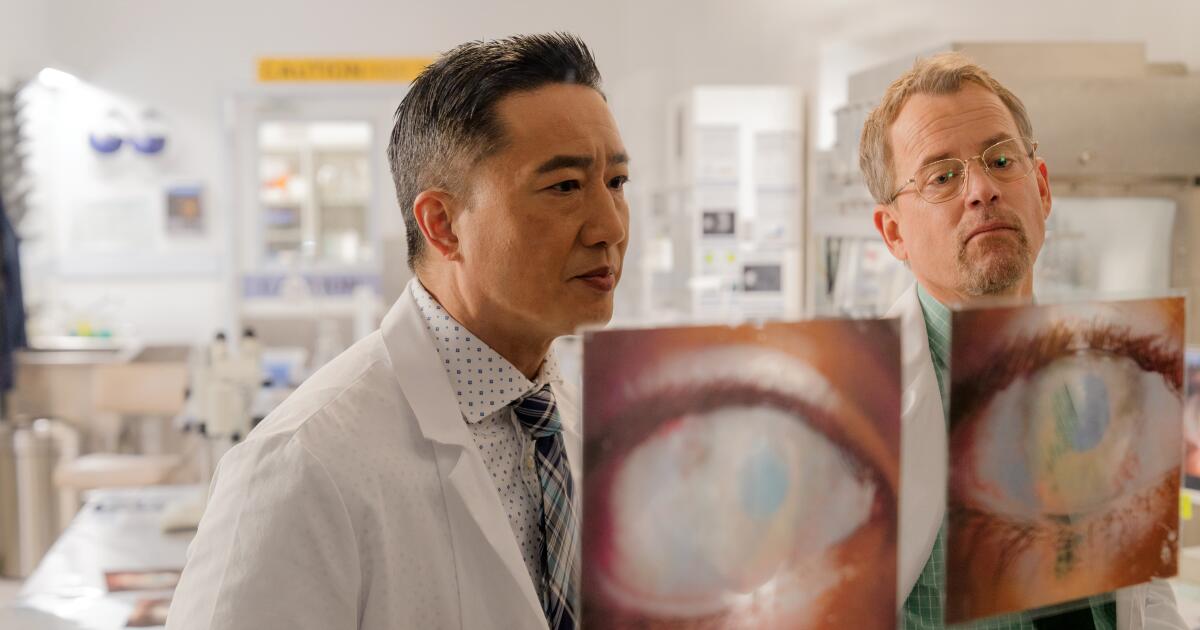
When Dr. Ming Wang came to the United States in 1982 at 21 years old, he had nothing but $50 and a Chinese-to-English translation book. He had just survived the violent cultural revolution in China — including the loss of a dear friend — during which the government had shut down most of the universities in the country.
We see this and much more in flashbacks throughout the movie “Sight,” which is based on Dr. Wang’s autobiography “From Darkness to Sight” and opens this weekend. In it, Dr. Wang (played by Terry Chen) ends up earning medical doctorates from Harvard and MIT (graduating magna cum laude from the latter), while also earning a PhD (laser physics, University of Maryland). He discovers a new way to potentially help blind people see — using an amniotic membrane contact lens if you want to get technical — as he and his medical partner Dr. Misha Bartnovsky (played by Greg Kinnear) embark on a mission to help orphans regain their sight.
The National Library of Medicine estimates that over the last 25 years, more than 20 million eyes were treated with laser eye surgery. Dr. Wang’s pioneering medical technique has restored the eyesight of millions around the world. As one of the leading experts in the field, Dr. Wang’s impact and philanthropy have been recognized in his home state of Tennessee, but his story may not be as widely known. As Asian American and Pacific Islander Heritage Month continues, Wang, who also executive-produced the film, wants to contribute to the storytelling tapestry of this country.
“My main motivation? Asian American stories are not told in American mainstream media too often. Authentic representation is a rare occurrence. I wanted to encourage Asian Americans, Chinese Americans and all immigrants to tell our story,” says Wang. “I will say, though, it’s a humbling experience.”
Ming Wang at 14 (Ben Wang) and Lili (Sara Ye) in “Sight.”
(Courtesy of Angel Studios)
Chen, a Canadian actor, was not only struck by Dr. Wang’s medical accomplishments, but also by the general and specific nature of his tale.
“It had nothing to do with kung fu or martial arts. It had nothing to do with being a gang member or any of the other tropes Hollywood has tripped over. And it also spoke to a larger swath of the immigrant story and the larger diaspora that exists outside of Asia,” says Chen.
Directed by Andrew Hyatt, and also starring Ben Wang, Fionnula Flanagan and Natasha Mumba, the film had the benefit of having Dr. Wang on the set. He was there to help consult on the technical jargon and operating room scenes, but many in the crew took advantage of his presence to ask for advice on medical issues. It was a welcome assurance on a 2020 set that was in the midst of working through a pandemic.
“Dr. Wang was a great resource to have,” says Kinnear. “This is the first movie that I did, that many of us did, after COVID. I kind of had a little bit of hesitation about the journey, but I felt like when I read Dr. Wang’s story, it put everything into perspective very quickly.”
The inspirational nature of the story may have even helped the mood on the set as well.
“When you finally go and you meet everybody and they slowly peel down their masks … I have to say that in the case of this film, [the substance of the story] did trickle down. There was an inspiring good feeling on the set,” says Kinnear.
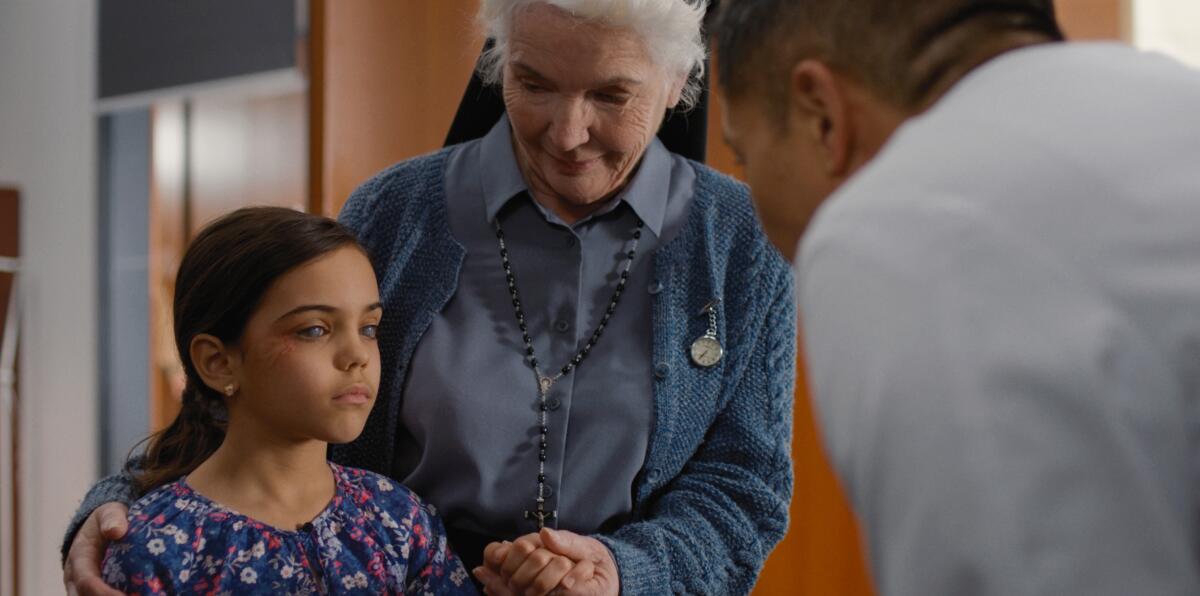
Kajal (Mia Swaminathan), Sister Marie (Fionnula Flanagan) and Dr. Wang (Terry Chen) in “Sight.”
(Courtesy of Angel Studios)
In the film, Dr. Wang tries to restore the sight of a young girl named Kajal (Mia Swaminathan) who is brought to his clinic by a nun ( Flanagan). It is one of the many touches in the film that put faith at the center of Dr. Wang’s struggles and his triumphs. This particular case is one that led to his revelation about using the placenta to create his curative lens, but it was also a case/client that tested his resolve.
“The reason that Kajal was chosen [to be the central case in the film] was because it was a very challenging case. Her injury was so severe that I had to dig deep to find a solution,” says Dr. Wang. “People say there’s no common ground between science and faith. Fortunately, I didn’t give up and as a Christian I kept praying.”
Angel Studios, known for its faith-based films, is distributing “Sight.” But its story of Dr. Wang’s past and his desire to help uplift blind orphans are themes that are just as prominent in the film.
“I think the message of the film is about freedom and faith,” says Dr. Wang. “‘Sight’ is a movie that reminds us how precious freedom is. How much we need to appreciate America. It may just take the story of an immigrant who did not have freedom to remind us how blessed we are.”


In Sender, writer-director Russell Goldman’s high-anxiety debut, the filmmaker expands on his 2022 short Return to Sender, in which Allison Tolman starred as a woman who receives packages she didn’t order. That may not sound like a premise that would result in a paranoid, darkly comedic thriller, much less a feature. But in extending his story from 18 minutes to just over 90, Goldman follows a maddening scenario involving an online retailer called Smirk, a fictionalized Amazon counterpart. More significantly, he captures the frenzied mindset of his protagonist, who grapples with staying sober and several other major life changes—all compounded by a layer of justifiable paranoia brought on by the endless packages. Goldman’s tweaky style and elusive scripting create a peculiar, out-of-whack presentation that destabilizes the viewer, firmly placing us in his main character’s perspective. However, by the end, the journey through this cine-manic headspace doesn’t add up to much, and the potential character study at the center feels somewhat lost in the mechanics of the conspiracy.
Britt Lower (AppleTV’s Severance) stars as Julia, who has just lost her job and moved into a rental home to get her life on track. She is backed financially by her overbearing sister Tatiana (Anna Baryshnikov), who occasionally comes nosing around to verify that Julia doesn’t backslide. And she doesn’t. Julia attends regular Alcoholics Anonymous meetings, where she meets the steely Whitney (Rhea Seehorn), who isn’t interested in being her sponsor. But at home, Julia receives a Smirk package with her brand of lipstick. The problem? She didn’t order it. She calls customer service, and the representative doesn’t help much before telling her, “Be sure to stay alert and aware.” Wait, what? Sender is loaded with nagging, unplaceable details like this. They’re often amusing, intriguing, and exasperating in the same moment. But these pieces don’t complete a whole picture, at least not a narratively satisfying one.
The Smirk packages, delivered by the outwardly helpful, nice-guy driver Charlie (David Dastmalchian), contain a random assortment of objects, from drum kits to protein powder. The squirrelly Julia, already coming apart at the seams from her recent drama, doesn’t know what to make of it. She’s convinced there’s some plot against her, perhaps by someone at Smirk. To what end, she doesn’t know. But Goldman gives us a glimpse of the long-term consequences of her ordeal in the prologue, which features Jamie Lee Curtis (also a producer) as Lisa, a woman in circumstances similar to Julia’s. Lisa’s response to receiving a box of soil with a broken shin pad (with “Can’t Can’t Can” scrawled on it) entails an attempt to suffocate herself with the bubble wrap, only to do far worse with a sharp edge of the shin pad. To show Lisa’s fate, Goldman’s imagery becomes twisted and surreal but also cryptic.
Sender’s disorienting mood is matched by a skewed formal presentation. Cinematographer Gemma Doll-Grossman’s wide-angle lenses and arch angles might feel at home in a Ken Russell or Terry Gilliam feature such as The Devils (1971) or 12 Monkeys (1996). Julia’s half-remembered drinking binges, accented by blurry close-ups, suggest she may have slept with any number of coworkers. She can’t remember, and it embarrasses her. Her rental is dressed in simple if shabby décor, which gives way to Julia’s erratic collage-like overhaul. Melisa Myers’ stuffed production design makes the most of heightened colors and banal, cluttered rooms that lend a normality to the bizarre, ever more disturbing predicament. Nathan Ruyle’s erratic music delivers what must be described as a soundscape rather than a traditional score, with collusive sound effects and tones driving our certainty that Julia is onto something. Along with Marco Rosas’ discordant editing, Goldman’s technical approach effectively reflects Julia’s fragmented, sleep-deprived mind. But his work as a writer hasn’t done enough to justify this level of technique.
After Julia makes a revelatory discovery that small cameras have been embedded in the products from those mysterious packages, the eventual explanation about what has been happening and why strains logic and underwhelms. It also raises even more unanswered questions. Although well-made and acted—Lower and Seehorn should be on track to movie stardom—Goldman’s script could have used another draft to better work through what unfolds. Sender doesn’t give us enough of its characters’ inner lives beyond the situation at hand, so Julia, Charlie, Tatiana, and Whitney feel like devices in a scenario rather than well-drawn human beings. Even so, Goldman fills his film with deeply broken people who try to gain control of their lives by controlling others, exposing and preying on their weaknesses. Despite the material’s potential resonance, Goldman’s style is overpowering. Still, his kernel of an idea and the way he explores it demonstrate his clear skill, and for much of Sender, its sheer oddball energy earns admiration.

“Lethal Weapon” star Danny Glover has revealed he has been living with Alzheimer’s disease for years.
In an interview with NBC’s Lester Holt that aired on the “Today” show on Wednesday, the 79-year-old actor and activist opened up about living with the disease. According to People, he received his diagnosis in 2023, which was not long after he was awarded an honorary Oscar in 2022.
“I could live with it, in a sense,” Glover says of his condition, which has been affecting his movement, speech and memory. “I’m sure as it advances, things are going to be different and changing.”
A neurodegenerative disease, Alzheimer’s is a type of dementia that affects memory, thinking and behavior and worsens over time, according to the Alzheimer’s Assn. Holt reports that more than 7 million Americans over 65 are living with Alzheimer’s, with Black men suffering at a rate double the national average.
Glover and his family say the Hollywood icon is sharing his story now to “have ownership of his life” and to help remove the stigma around the disease.
“They’ve got my back,” Glover says of his family’s support.
Besides his portrayal of L.A. police Det. Roger Murtaugh in the “Lethal Weapon” film series, Glover is known for roles in movies including “Places in the Heart” (1984), “The Color Purple” (1985), “To Sleep With Anger” (1990), “Angels in the Outfield” (1994), “Dreamgirls” (2006) and “The Last Black Man in San Francisco” (2019). He’s also been a vocal advocate for social justice and humanitarian causes both in the U.S. and abroad.
He was the recipient of the Academy of Motion Picture Arts and Sciences’ Jean Hersholt Humanitarian Award in 2022.
“I don’t feel like it’s the end of my life,” he said in his interview with People about living with Alzheimer’s. “There’s work to do.”

Enter your email and we’ll send a secure one-click link to sign in.
WKRN is provided by Nexstar Media Inc., and uses the My Nexstar sign-in, which works across our media network.
Nexstar Media Inc. is a leading, diversified media company that produces and distributes engaging local and national news, sports, and entertainment content across its television and digital platforms. The My Nexstar sign-in works across the Nexstar network—including The CW, NewsNation, The Hill, and more. Learn more at nexstar.tv/privacy-policy.
-

 Kentucky1 minute ago
Kentucky Adds Three More International Swimmers to Women’s 2026 Recruiting Class
-

 Louisiana13 minutes ago
Louisiana State Police introduce two new K-9 officers
-

 Maine16 minutes ago
Lil Wayne Apologizes After Failing to Appear at His Own Concert: ‘I’m So Sorry’
-

 Maryland21 minutes ago
Maryland’s $48 million purchase of Laurel Park approved by state’s Board of Public Works
-

 Michigan28 minutes ago
Michigan ‘defined’ by waves of immigration that keep shifting
-

 Massachusetts31 minutes ago
Massachusetts state police use robotic dog and drone in highway standoff
-

 Minnesota36 minutes ago
Luverne, Minnesota’s 65-foot nutcracker, may be the tallest in the world
-

 Mississippi43 minutes ago
Mississippi Lottery Mississippi Match 5, Cash 3 results for July 1, 2026

