Entertainment
Rick Harrison of 'Pawn Stars' blames the border crisis in the overdose death of his son

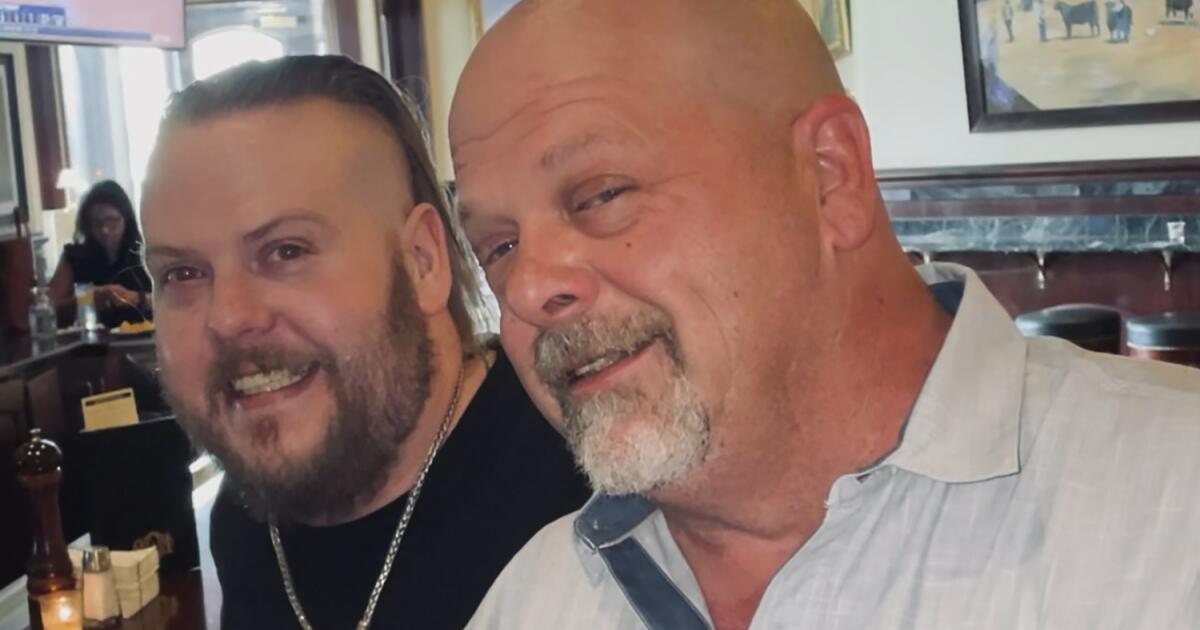
Adam Harrison, one of three sons of reality “Pawn Stars” personality Richard “Rick” Harrison, died in Las Vegas, a family representative said Saturday. He was 39.
On Monday, Harrison, through his rep, told TMZ that his son had overdosed on fentanyl.
“Yes, I can confirm Adam died from a fentanyl overdose. The fentanyl crisis in this country must be taken more seriously. It seems it is just flowing over the borders and nothing is being done about it. We must do better.”
Harrison family spokesperson Laura Herlovich confirmed that Adam Harrison died Friday and asked for privacy for the family while they grieve.
“Our family is extremely saddened by the death of Adam,” the statement said. “We ask for privacy as we grieve his loss.”
The Las Vegas Review-Journal reported that police were investigating Adam Harrison’s death, which was first reported by TMZ. Although “Pawn Stars” did feature Rick Harrison’s oldest son, Corey, Adam Harrison was not featured on the series.
“You will always be in my heart! I love you Adam,” wrote Rick Harrison in an Instagram tribute over the weekend.
In 2023, fatalites from drug overdoses surpassed 112,000 for the first time in the nation’s history. With its staggering death toll, according to a December NPR report, the drug crisis in America has eclipsed epidemics of the past including the 1980s crack cocaine crisis and the prescription opioid epidemic of the aughts.
According to NPR, public health experts foresee debates over how to address the crisis ramping up and becoming especially polarizing during an election year.
“Democratic and Republican politicians have promised to stop or sharply curtail fentanyl smuggling from the Mexico into the U.S., but analysts tell NPR no one has proposed a plan that would accomplish that goal,” the outlet reported.
The Associated Press contributed to this report.


According to data from the Los Angeles City Ethics Commission, Pratt’s supporters include two members of the record industry’s most powerful family who have donated the maximum amount allowed by law.
Los Angeles’ music industry, in recent years, has generally supported progressive causes. But as the primaries for the city’s mayoral race and California‘s governorship wrapped up Tuesday, some music executives and performers have supported and donated large amounts to Spencer Pratt, the right-leaning activist and reality TV star running for mayor.
According to data from the Los Angeles City Ethics Commission, Pratt’s supporters include two members of the record industry’s most powerful family who donated the maximum amount allowed by law.
Pratt is a registered Republican whose heated rhetoric about homeless “zombies” and AI-created advertisements have rankled progressives and delighted conservatives. He has received support from President Trump, who told reporters that “I’d like to see him do well. He’s a character. I don’t know him, I assume he probably supports me… I heard he’s a big MAGA person.”
In response, Pratt told TMZ that “Everybody wants me to succeed because L.A. is the most important city in the country. The only support I need is from moms that wanna feel safe in Los Angeles. I’m laser-focused on that.”
Universal Music Group is home to some of music’s most outspoken progressives, including Olivia Rodrigo and Billie Eilish, whose brother and collaborator Finneas O’Connell donated $250 to the progressive mayoral candidate Nithya Raman on May 6.
Earlier this year, UMG’s chairman and chief executive Lucian Grainge presented Rodrigo with the company’s Universal Music Group x REVERB Amplifier Award, which advocates for “social and environmental nonprofit campaigns through the cultural power of music,” according to a release.
On May 9, Grainge (listed as a resident of Pacific Palisades, where Pratt lost his home in the 2025 fires) maxed out with an $1,800 donation to Pratt’s campaign, as previously reported in The Times. A representative for UMG did not immediately return a request for comment on Grainge’s donation.
He’s not the only Pratt donor in the family.
Grainge’s son Elliot ascended through the record industry with his 10k Projects label, and now heads UMG’s competitor Atlantic Records. Vocal progressives like Cardi B, the Marías and Charli XCX are some of the label’s most high-profile acts.
On May 8, Elliot Grainge also gave $1,800 to Pratt‘s campaign. A representative for Atlantic did not immediately return a request for comment.
Last month, the record producer and composing titan David Foster and his wife, singer Katharine McPhee, performed at a fundraiser for Pratt where they crooned a version of Tina Turner’s hit “The Best” to the mayoral hopeful. “Spencer, you’re simply the best. Better than all the rest. Better than Karen Bass and Nithya Raman,” McPhee sang.
At Warner Music, Gabz Landman, the senior vice president for A&R at Warner Chappell, its powerful music publishing wing, who has worked with Dua Lipa, Laufey and Amy Allen, gave $105.24 to Pratt on Feb. 4. Through a Warner Music representative, Landman said the donation was for merchandise given to a friend, and was not intended as support for Pratt’s campaign.
The superstar EDM producer and DJ Kaskade has left supportive messages on Pratt’s social media, commenting on one of the candidate’s posts that “At this point, who is buying in to Bass’s fairytale narrative?! I am still shocked she hasn’t resigned!” The DJ and producer Diplo also left a supportive comment — a prayer-hands emoji and “please” — on one of Pratt’s social media posts. Records do not show any personal donations to Pratt’s campaign from either artist.
Public records do not show any donations to Pratt’s campaign from live-industry executives atop firms like Live Nation, AEG or Goldenvoice.

There’s a photo of me (below) from the mid-1980s, when I was around age 5, standing on the hood of an old Plymouth in the overgrown field behind my childhood home. I’m holding He-Man’s shield in one hand and his sword, made of yellow plastic, in the other. (Unrelatedly, I’m also wearing an Incredible Hulk shirt in the picture.) And I’m grinning with pride because I have thoroughly conquered the jalopy. The vehicle never ran again, probably because I fucking destroyed it with my sword and shield. Around that time, I also had a He-Man birthday cake and a sizable collection of Mattel’s Masters of the Universe action figures. They were my first foray into toys of this kind, later replaced by G.I. Joe, Teenage Mutant Ninja Turtles, and X-Men. However, my nostalgia for He-Man remains almost nonexistent today, perhaps because, looking back at the material, the mythology remains at once weird and unmemorable, and neither the popular animated series nor the 1987 film, Masters of the Universe, starring Dolph Lundgren and Frank Langella, holds up well.
Over the years, Mattel has tried to revive the toy line and cartoon, but the company’s biggest effort thus far is the new feature from Amazon MGM Studios, which reportedly spent upwards of $200 million on a blockbuster-sized Masters of the Universe. If the 1980s versions of this franchise unabashedly targeted the preadolescent boy demographic, the new iteration has been reconfigured (by a sausage fest of credited screenwriters: Chris Butler, Aaron Nee, Adam Nee, and David Callaham) to adopt a more conventional mold. The movie also incorporates the last three decades of ironic reassessment: the series’ very 1980s obsession with bulging muscles; the loincloth-centric costumes, all of which look like rejected designs from Zardoz (1974); the vague eroticism between He-Man and several characters, including his nemesis, Skeletor; and the eccentricities of the cartoon, from the many heads thrown back in laughter to the bizarre characters—all of which started first as action figures (Stinkor, Mantenna, etc.), around which the writers built a lame storyline.
Despite its origins, Masters of the Universe sets out to become a four-quadrant feature, appealing to everyone, and in that, no one in particular. The story is too bloated for little children, with a 142-minute runtime that challenged the attention spans of the kids in my prescreening, who became restless after an hour. Admittedly, so did I. The material’s self-awareness and humor aren’t memorable enough to distinguish it from other, better examples in this genre, such as Dungeons & Dragons: Honor Among Thieves (2023)—a movie that I enjoy more with each subsequent viewing. And director Travis Knight can’t decide whether the audience should take these characters seriously or laugh at their inherent silliness. He attempts both and does neither very well. The result did not rekindle my nostalgia for this chapter of my childhood; it didn’t create an exciting new take for audiences of all ages, either.
A protracted opening establishes the distant realm called Eternia, where sword-and-sandal heroes stand alongside robots and flying ships with laser guns. Eternia’s resident baddie, Skeletor (voiced by Jared Leto, doing an R-rolling master-thespian thing), wants the Sword of Power, which imbues its wielder with, as you might guess, power. But it’s kept in Castle Grayskull, home of King Randor (James Purefoy), who’s disappointed by his son, Adam (Artie Wilkinson-Hunt), a young boy more interested in goofing around than learning to fight. When Skeletor attacks the castle and proves victorious, the Enchantress (Morena Baccarin), the magically inclined protector of Grayskull, sends Adam away to Earth along with the coveted sword. What happens then? Did a couple of farmers adopt him à la Superman? Or did he grow up in the foster system? The writers ignore such practical questions, picking up the story years later, when the adult Adam (now a hulking Nicholas Galitzine) works in corporate human resources. After Adam finally locates his sword, which was lost when he was transported from Eternia to Earth, he eventually finds his way home with the help of his childhood friend, Teela (Camila Mendes), to retake Grayskull from Skeletor.
Knight’s main source of inspiration, besides the cartoon and earlier movie, seems to be the similarly themed cult classic Flash Gordon (1980). Masters of the Universe’s music features identical-sounding Howard Blake-style guitar riffs and, to echo the original songs Queen wrote for Flash Gordon, the production uses Queen’s “Princes of the Universe” on the soundtrack. In other areas, Knight directs a conventional franchise movie with choppily edited and CGI-heavy battle scenes full of anonymous violence, lifeless chase sequences, digital backdrops resembling video-game environments, and shameless product placements for Coca-Cola and Amazon. The VFX sometimes look impressive; at other times, they look cheap and generic. Fortunately, Knight’s production also offers practical effects and prosthetics for some characters, most memorably the cyborg Trap Jaw. Knight’s secret weapon is costume designer Richard Sale, who visualizes the inherently absurd look of these characters, for better or worse, in tangible garb. The actors inhabiting the excellent costumes don’t have much to do, though. Ask yourself why they hired Kristen Wiig to voice Roboto, a bland robot character whose dialogue could have easily been performed by anyone else, or even just replaced with the beeps and boops of a Star Wars droid. When you have Kristen Wiig, use her.

Elsewhere, Masters of the Universe attempts to be self-aware in its irony and sexually suggestive underpinnings. There’s a running gag about how practically everyone can’t keep their eyes off Adam after he becomes his heroic alter-ego, He-Man, given his oiled-up muscles and blonde locks. But under Adam’s pink shirt, he still looks buff, making his eventual Hulk-like transformation into a muscle-bound barbarian unremarkable. Elsewhere, I liked the detail of Adam growing up on Earth and forgetting everyone’s names on Eternia, so he makes up their names based on their physical characteristics. A man with a big metal hand becomes Fisto (Jóhannes Haukur Jóhannesson), and another with a metal head-butting helmet becomes Ram-Man (Jon Xue Zhang). The writers take advantage of this with veiled dirty jokes about fisting and Ram-Man “giving head” to Skeletor’s goons. That’s about as clever as the movie gets. As for character development, there’s almost none. Skeletor, for instance, wants to be bad for the sake of being bad. His motivations are nonexistent, resulting in an obvious, uninteresting, and one-dimensional villain.
A key series in the conservative, Reagan-era 1980s, the Masters of the Universe cartoon and previous movie valued strength and power, muscles and might. Today, that message has negative, regressive associations with the political right, which often looks at this period from a fond standpoint. To avoid alienating any part of their audience, the filmmakers desperately try to please everyone with a mild progressive commentary to counter the franchise’s original themes. Adam’s character must learn to “be a man” to please his father, King Randor, and his makeshift father figure, Man-at-Arms (Idris Elba, in a chummy reformed drunk role). But there’s also a half-hearted message that Adam, having worked in human resources, knows the value of empathy and emotional intelligence. For a while there, the movie even claims you can’t solve every problem with muscles—that is, until He-Man resolves the conflict by pummeling Skeletor with his fists. The movie’s message is ultimately nonexistent. The committee making this movie has carefully avoided any line-in-the-sand worldview, all in an attempt to manufacture a box-office hit that will please everyone and offend no one.
That’s exactly the problem with Masters of the Universe. It’s so afraid to have a perspective or be about something that nothing onscreen has an impact. This is not to say every movie must have a substantive message. Sometimes, a mindless adventure is enough. However, even on those terms, there’s no tension or danger here because Skeletor is never all that menacing, and Adam alternates between self-parody and earnest heroism. None of the emotional beats land, not the many father-son dynamics nor the hero’s journey. And the production’s competing tones, from its intentional camp to its sword-swinging adventure, lack the balance of wit and scope that Dungeons & Dragons: Honor Among Thieves so delightfully captured. For much of the runtime, I felt bored and, aside from a few chuckles at the childish humor, disengaged from everything happening. Perhaps Roboto describes the movie best when referring to life as “a series of absurdities leading to infinite nothingness.”
Photo: Brian the Barbarian

Entertainment
Scott Pelley fired from ‘60 Minutes’ after accusing CBS News bosses of ‘murdering’ the program

Scott Pelley, a signature on-air talent for “60 Minutes,” was ousted from CBS News a day after he blasted the division’s top management over the firing of the program’s executive producer and two correspondents.
“We have parted ways with Scott Pelley,” the newly installed executive producer Nick Bilton said in a message sent to staff Tuesday.
The network announced Pelley’s departure after a meeting with top CBS News management late Tuesday, where the veteran correspondent continued to ask for answers on why “60 Minutes” executive producer Tanya Simon and correspondents Sharyn Alfonsi and Cecila Vega were let go last week, according to people familiar with the discussions who were not authorized to speak publicly. Editor in Chief Bari Weiss would not address the matter at the meeting.
Shortly after the meeting, Pelley received a letter stating he was terminated with cause.
Pelley’s departure follows a contentious “60 Minutes” staff meeting on Monday where he accused Weiss of “murdering” the country’s most-watched news program.
Pelley also raised doubts over the credentials of Bilton, the former New York Times journalist and documentary filmmaker named last week to run the venerable newsmagazine, citing his lack of experience in TV news.
Bilton was named to replace Simon on Thursday, an unexpected move that also came with the firings of the correspondents. The moves were made by Weiss, who has targeted the prestigious program for changes since she arrived at the network in the fall.
Bilton attempted to defend Weiss, who was not at the meeting, and asserted that CBS News management was committed to guiding “60 Minutes” into the digital future.
“She is murdering ‘60 Minutes,’” Pelley said of Weiss at the meeting held at the program’s Manhattan headquarters. “She does not love this place. She was brought in to kill it, and she’s been doing exactly that.”
Pelley’s stunning remarks at the meeting were applauded by his colleagues. But veterans in the division — who were shocked by the confrontation — took it as a sign that he was ready to leave the program.
Pelley is the fourth correspondent to depart “60 Minutes” since Weiss joined CBS News. Anderson Cooper, who also anchors at CNN, chose not to sign a new deal, citing family reasons, although many insiders said he was not comfortable with the direction of CBS News. Alfonsi and Vega were severed last week.
Those vacancies mean “60 Minutes” will have to line up new talent quickly to fill the correspondent roles. Production on segments for the 2026-27 season is already underway.
In the termination letter sent to Pelley and obtained by The Times, Bilton said he attempted to meet with the correspondent last week to discuss the future of “60 Minutes” and was rebuffed.
“It is a profound disappointment that you rejected that overture and chose ambush,” Bilton wrote. “Yesterday, you hijacked my first meeting with staff to disparage me, my qualifications, and my intentions with remarkable incivility and contempt.”
Bilton said in the letter that he hoped he could find “a path forward” with Pelley at a meeting Tuesday.
“You made clear that you are not interested in such a path,” he added. “Your antipathy to the future of the show is loud and clear.”
Pelley issued a lengthy statement accusing CBS News management of currying favor with the Trump administration by instructing him to put “falsehoods and bias into a politically sensitive story.”
“I’ve been told to include assertions that are unverified,” he said. “To date, in every case, I have ignored these instructions or refuse them.”
Pelley also accused CBS News management of incompetence and unprofessionalism. “In a case involving one of my stories, the entire program came within 19 minutes of not getting on the air at all,” he said.
Pelley, 68, started his career at CBS News in 1989. He covered the Gulf War for the network, traveling in Iraq and Kuwait. He later became chief White House correspondent during Bill Clinton’s turbulent second term.
Pelley became a correspondent for “60 Minutes II,” a midweek edition of the program that ran from 1999 to 2005. After the program was canceled, Pelley moved to the Sunday flagship edition. He also served as anchor of the “CBS Evening News” from 2011 to 2017.
The fate of “60 Minutes” — which saw a 9% audience increase and massive spikes in viewing across social media platforms this past season — has been an ongoing saga since President Trump sued the program over the editing of an interview with his 2024 opponent former Vice President Kamala Harris.
The suit was settled just ahead of the Federal Communications Commission clearing the way for the takeover of Paramount by David Ellison’s Skydance Media.
Ellison acquired Weiss’ digital start-up the Free Press, which established itself as a voice critical of so-called woke politics. She was given a mandate to move CBS News to the political center, which created a perception that her role is to placate the Trump White House as Paramount seeks regulatory approval to acquire Warner Bros. Discovery.
The actions at “60 Minutes” have put the staff at CBS News in a dark mood. Bilton acknowledged their trauma in his note.
“I realize this is a great deal of change in a very short time, and I wouldn’t pretend otherwise,” he wrote. “I won’t relitigate the last week here. What I will commit to is this: My unyielding support for each of you, the journalism that you do and what we will do together going forward”
-

 World6 minutes ago
US ally Kuwait condemns ‘brutal and ongoing Iranian attacks’ after airport was hit
-

 Politics9 minutes ago
Spencer Pratt surges to runoff in LA mayor’s race after angry voters send message to Karen Bass
-

 Health14 minutes ago
One extra serving of processed meat a day linked to higher cancer risk
-

 Sports21 minutes ago
AJ Brown trade outcome: Dianna Russini paid a heavy price while Mike Vrabel emerged unscathed
-

 Technology24 minutes ago
Could your Samsung phone replace your passport?
-
 Business29 minutes ago
Rent-hike ban to protect fire victims ends despite gouging concerns
-
Entertainment36 minutes ago
Two of music’s most powerful executives maxed out donations to Spencer Pratt
-
 Lifestyle39 minutes ago
Vintage-obsessed millennial parents are driving L.A.’s booming kids’ clothing resale market

