Entertainment
Review: Made by a solo Coen brother, 'Drive-Away Dolls' is trashy fun and exceedingly disposable

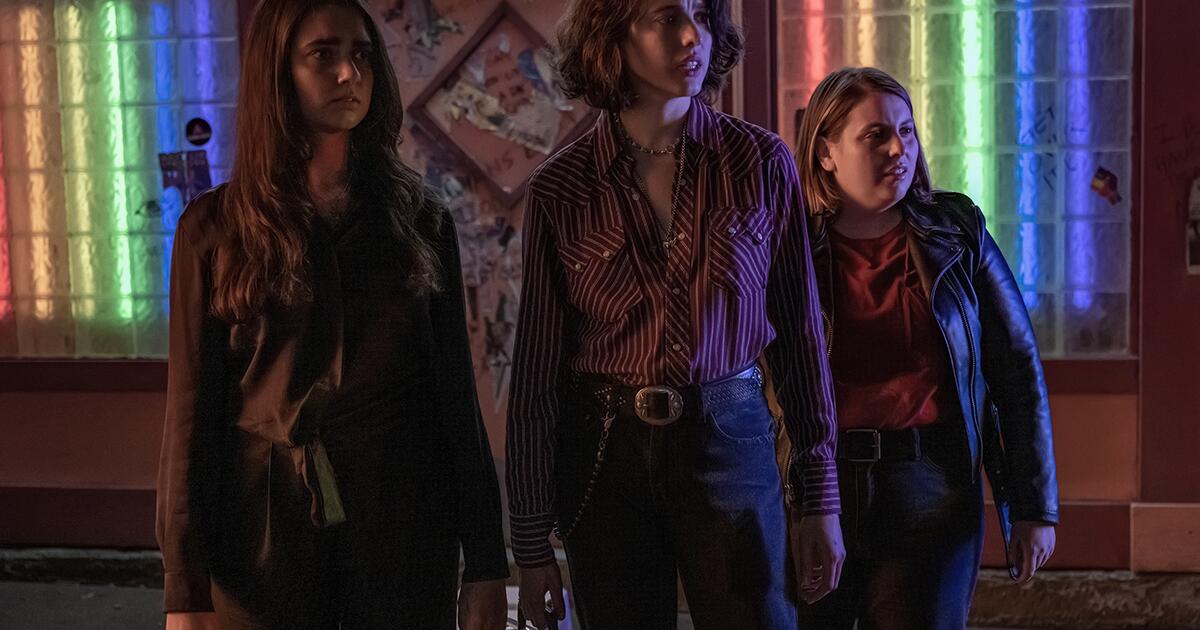
It’s fascinating that Ethan Coen and Tricia Cooke, longtime filmmaking collaborators and spouses, and the creative team behind the exploitation flick “Drive-Away Dolls,” have repeatedly — and lovingly — described their new film as “trashy” in interviews. It’s a way of nodding to influences like the “Pope of Trash” himself, John Waters, and titillating B-movie king Russ Meyer. Or perhaps it’s a way to get ahead of, and away from, certain expectations tied to Coen and his former filmmaking partner, his brother Joel. This ain’t your daddy’s “No Country for Old Men,” after all.
“Drive-Away Dolls” rather excitedly asserts a space that one could call “a country for young lesbians,” if one were so inclined. The film itself is a “queering” of the ’90s crime caper, the kind of sardonic, ironic, muscular and oh-so-masculine film that the Coen brothers and their contemporaries (Quentin Tarantino, Guy Ritchie, et al.), popularized some three decades ago, birthing generations of film bros.
Coen and Cooke wrote the film together and essentially co-directed, though only Coen is credited as the director, with Cooke as editor (she also edited “The Big Lebowski” and “O Brother, Where Art Thou?” with the brothers). The script, written some 20-odd years ago, originated from Cooke’s queer youth in New York City’s lesbian bars and has been sitting on the back burner for years. The 1999 setting of these events is at once a reflection of the script’s age, and an inadvertent throwback to the kinds of movies it references. With its rapid-fire deadpan dialogue, low canted angles, detached, ironic violence and kooky transitional wipes, it feels self-consciously retro, even if it was, at one time, intended to be contemporary.
The plot centers around an odd couple of friends: Jamie (Margaret Qualley), an amorous lesbian Lothario, and Marian (Geraldine Viswanathan), a buttoned-up office worker, who decide to drive to Tallahassee, Fla., when Jamie catches too much heat for cheating on her cop ex, Sukie (Beanie Feldstein). The friends opt for a cheap “drive-away” rental car and are accidentally given a vehicle with a secret stash in the trunk, sparking a chase across state lines involving a senatorial sex scandal. And though they’ve got two bumbling henchmen in pursuit, these gal pals live, laugh and lady-love their way through every sapphic saloon south of the Mason-Dixon line.
From left, Geraldine Viswanathan, Margaret Qualley and Beanie Feldstein in the movie “Drive-Away Dolls.”
(Wilson Webb / Working Title / Focus Features)
It’s “Pulp Fiction” with dildos, and it’s unabashedly horny and female pleasure-centric. Yet, one can’t ignore the nagging sense, at times, that “Drive-Away Dolls” just feels like the lesbian porn parody of a dude-heavy crime comedy. A basement make-out party hosted by a women’s soccer team is just a little too far-fetched, but then again, so is the supremely silly sex scandal that animates the entire plot. The film is often crude in a way that’s cringe-worthy, but it’s also stacked with jokes and moves at such a brisk pace (it’s barely 85 minutes) that it’s over before you know what hit you.
Qualley and Viswanathan are fantastically committed and charismatic, with the former demonstrating a capacity for broad comedy. Viswanathan is lethally precise in her line deliveries. But open the hood of the story and it turns out this beater is a lemon: The mechanics of the plot simply aren’t there. How or even why are these two friends? Colman Domingo growls appealingly as some sort of crime boss, but who is his character? What are the stakes of this scandal and why should we care? Does plot device A insert into story element B? Maybe not, and maybe no one cares if this jumble of amusing parts makes a coherent whole.
The slight and scanty “Drive-Away Dolls” could dissipate with a gust of wind, but it beats a hasty getaway before that becomes a problem. While its story fails to justify its own existence, it delivers what it says on the tin: dumb, randy fun, even if that feels retrograde in more ways than one.
Katie Walsh is a Tribune News Service film critic.
‘Drive-Away Dolls’
Rating: R, for crude sexual content, full nudity, language and some violent content
Running time: 1hour, 24 minutes
Playing: In wide release Friday, Feb. 23


In Sender, writer-director Russell Goldman’s high-anxiety debut, the filmmaker expands on his 2022 short Return to Sender, in which Allison Tolman starred as a woman who receives packages she didn’t order. That may not sound like a premise that would result in a paranoid, darkly comedic thriller, much less a feature. But in extending his story from 18 minutes to just over 90, Goldman follows a maddening scenario involving an online retailer called Smirk, a fictionalized Amazon counterpart. More significantly, he captures the frenzied mindset of his protagonist, who grapples with staying sober and several other major life changes—all compounded by a layer of justifiable paranoia brought on by the endless packages. Goldman’s tweaky style and elusive scripting create a peculiar, out-of-whack presentation that destabilizes the viewer, firmly placing us in his main character’s perspective. However, by the end, the journey through this cine-manic headspace doesn’t add up to much, and the potential character study at the center feels somewhat lost in the mechanics of the conspiracy.
Britt Lower (AppleTV’s Severance) stars as Julia, who has just lost her job and moved into a rental home to get her life on track. She is backed financially by her overbearing sister Tatiana (Anna Baryshnikov), who occasionally comes nosing around to verify that Julia doesn’t backslide. And she doesn’t. Julia attends regular Alcoholics Anonymous meetings, where she meets the steely Whitney (Rhea Seehorn), who isn’t interested in being her sponsor. But at home, Julia receives a Smirk package with her brand of lipstick. The problem? She didn’t order it. She calls customer service, and the representative doesn’t help much before telling her, “Be sure to stay alert and aware.” Wait, what? Sender is loaded with nagging, unplaceable details like this. They’re often amusing, intriguing, and exasperating in the same moment. But these pieces don’t complete a whole picture, at least not a narratively satisfying one.
The Smirk packages, delivered by the outwardly helpful, nice-guy driver Charlie (David Dastmalchian), contain a random assortment of objects, from drum kits to protein powder. The squirrelly Julia, already coming apart at the seams from her recent drama, doesn’t know what to make of it. She’s convinced there’s some plot against her, perhaps by someone at Smirk. To what end, she doesn’t know. But Goldman gives us a glimpse of the long-term consequences of her ordeal in the prologue, which features Jamie Lee Curtis (also a producer) as Lisa, a woman in circumstances similar to Julia’s. Lisa’s response to receiving a box of soil with a broken shin pad (with “Can’t Can’t Can” scrawled on it) entails an attempt to suffocate herself with the bubble wrap, only to do far worse with a sharp edge of the shin pad. To show Lisa’s fate, Goldman’s imagery becomes twisted and surreal but also cryptic.
Sender’s disorienting mood is matched by a skewed formal presentation. Cinematographer Gemma Doll-Grossman’s wide-angle lenses and arch angles might feel at home in a Ken Russell or Terry Gilliam feature such as The Devils (1971) or 12 Monkeys (1996). Julia’s half-remembered drinking binges, accented by blurry close-ups, suggest she may have slept with any number of coworkers. She can’t remember, and it embarrasses her. Her rental is dressed in simple if shabby décor, which gives way to Julia’s erratic collage-like overhaul. Melisa Myers’ stuffed production design makes the most of heightened colors and banal, cluttered rooms that lend a normality to the bizarre, ever more disturbing predicament. Nathan Ruyle’s erratic music delivers what must be described as a soundscape rather than a traditional score, with collusive sound effects and tones driving our certainty that Julia is onto something. Along with Marco Rosas’ discordant editing, Goldman’s technical approach effectively reflects Julia’s fragmented, sleep-deprived mind. But his work as a writer hasn’t done enough to justify this level of technique.
After Julia makes a revelatory discovery that small cameras have been embedded in the products from those mysterious packages, the eventual explanation about what has been happening and why strains logic and underwhelms. It also raises even more unanswered questions. Although well-made and acted—Lower and Seehorn should be on track to movie stardom—Goldman’s script could have used another draft to better work through what unfolds. Sender doesn’t give us enough of its characters’ inner lives beyond the situation at hand, so Julia, Charlie, Tatiana, and Whitney feel like devices in a scenario rather than well-drawn human beings. Even so, Goldman fills his film with deeply broken people who try to gain control of their lives by controlling others, exposing and preying on their weaknesses. Despite the material’s potential resonance, Goldman’s style is overpowering. Still, his kernel of an idea and the way he explores it demonstrate his clear skill, and for much of Sender, its sheer oddball energy earns admiration.

“Lethal Weapon” star Danny Glover has revealed he has been living with Alzheimer’s disease for years.
In an interview with NBC’s Lester Holt that aired on the “Today” show on Wednesday, the 79-year-old actor and activist opened up about living with the disease. According to People, he received his diagnosis in 2023, which was not long after he was awarded an honorary Oscar in 2022.
“I could live with it, in a sense,” Glover says of his condition, which has been affecting his movement, speech and memory. “I’m sure as it advances, things are going to be different and changing.”
A neurodegenerative disease, Alzheimer’s is a type of dementia that affects memory, thinking and behavior and worsens over time, according to the Alzheimer’s Assn. Holt reports that more than 7 million Americans over 65 are living with Alzheimer’s, with Black men suffering at a rate double the national average.
Glover and his family say the Hollywood icon is sharing his story now to “have ownership of his life” and to help remove the stigma around the disease.
“They’ve got my back,” Glover says of his family’s support.
Besides his portrayal of L.A. police Det. Roger Murtaugh in the “Lethal Weapon” film series, Glover is known for roles in movies including “Places in the Heart” (1984), “The Color Purple” (1985), “To Sleep With Anger” (1990), “Angels in the Outfield” (1994), “Dreamgirls” (2006) and “The Last Black Man in San Francisco” (2019). He’s also been a vocal advocate for social justice and humanitarian causes both in the U.S. and abroad.
He was the recipient of the Academy of Motion Picture Arts and Sciences’ Jean Hersholt Humanitarian Award in 2022.
“I don’t feel like it’s the end of my life,” he said in his interview with People about living with Alzheimer’s. “There’s work to do.”

Enter your email and we’ll send a secure one-click link to sign in.
WKRN is provided by Nexstar Media Inc., and uses the My Nexstar sign-in, which works across our media network.
Nexstar Media Inc. is a leading, diversified media company that produces and distributes engaging local and national news, sports, and entertainment content across its television and digital platforms. The My Nexstar sign-in works across the Nexstar network—including The CW, NewsNation, The Hill, and more. Learn more at nexstar.tv/privacy-policy.
-

 Los Angeles, Ca60 minutes ago
Family of boy, 8, killed by falling tree branch at Calabasas park to get $14.6M
-

 Detroit, MI1 hour ago
The worst Detroit sports uniform from every pro team
-

 San Francisco, CA1 hour ago
Discovery Bay driver arrested for San Francisco fatal vehicle collision | Contra Costa Herald
-

 Dallas, TX2 hours ago
Erling Haaland’s Dallas Western wear purchase goes viral
-

 Miami, FL2 hours ago
Miami’s FIFA Fan Fest draws thousands to Bayfront Park to watch Team USA win World Cup match against Bosnia
-

 Boston, MA2 hours ago
2026 Yukon Denali Ultimate gets pricey, but tops the charts
-

 Denver, CO2 hours ago
Nuggets Sign Marvin Bagley to 1-Year Deal: What It Means
-

 Seattle, WA2 hours ago
FOURTH OF JULY 2026: Here’s where Seattle Parks will leave the lights on longer

