

Entertainment
Review: In 'Dune: Prophecy,' women lead and vie for power
Even before Denis Villeneuve’s big-screen, two-part 2021 film introduced it to moviegoers who had missed David Lynch’s enjoyably bonkers 1984 adaptation, Frank Herbert’s “Dune” had become exploited IP.
Herbert completed six novels before his death in 1986; 17 more have been written by his son Brian and Kevin Anderson. But it was the Villeneuve film that launched the brand into the franchise-mad universe of 21st century show business, where any well-performing work of sci-fi or fantasy — and “Dune” is both — is practically required to breed a network of sequels spinoffs and merchandise (Lego Atreides Royal Ornithopter, $164.99; Funko Pop! Paul Atreides, $11.99).
If you’re not familiar with the films or the books, the new HBO series, premiering Sunday, will not do you the favor of supplying much context. It does take place 10,000 years earlier, yet in most respects, life in this far-flung network of planets seems to have changed little in 100 centuries. On either side of that temporal divide, we’re in an essentially feudal society of royal houses and hereditary emperors, clothed in the medieval trappings that have ruled science-fiction fantasy from “Flash Gordon” to “Star Wars” and beyond.
Spice, a super-duper special element that has mind-altering, mind-enhancing powers and is the key to space travel, is already the most valued substance in the universe and is at the bottom of what drives the story’s antagonisms, skulduggery and power plays. It’s “Game of Thrones,” with spaceships and sandworms.
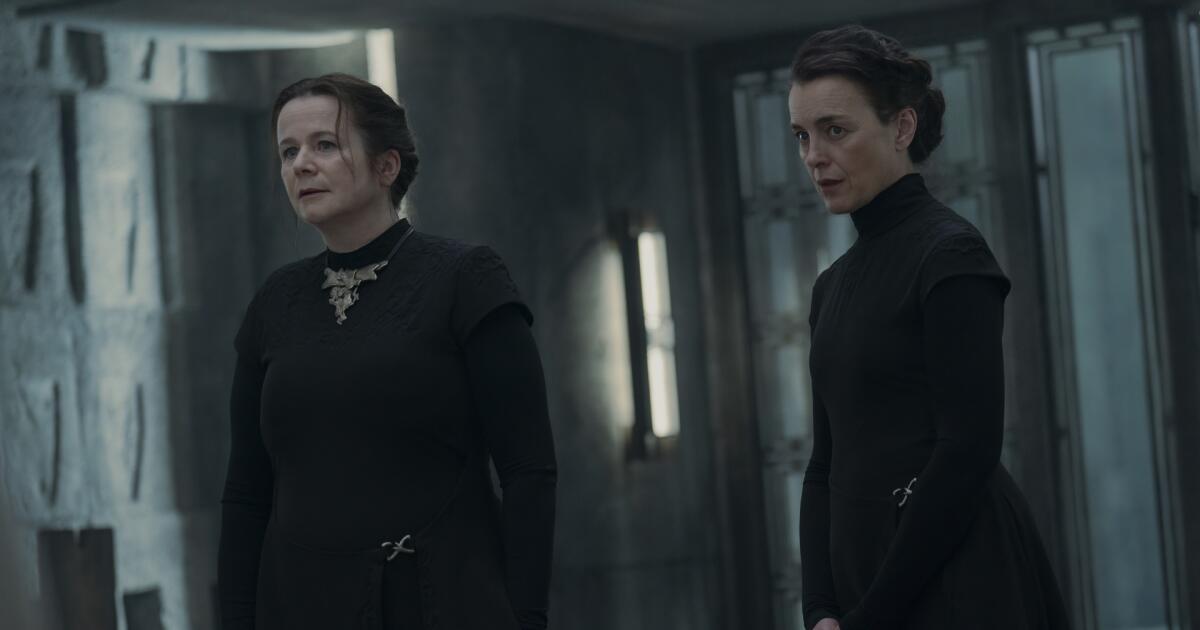
The Sisterhood, later known as the Bene Gesserit in the “Dune” universe.
(Attila Szvacsek / HBO)
The main, and most interesting characters, not to say the star power, in this space opera are Valya Harkonnen, played by Emily Watson, and her sister Tula, played by Olivia Williams. The Harkonnens (the bad guys in “Dune,” or maybe just the worse guys) are, in this era, a disgraced house, banished to a far off, snowbound planet because great-grandpa deserted in the war against the “thinking machines.” (I do appreciate the anti-AI stance.)
In what counts as the present day — there is an earlier timeline in which young Valya is played by Jessica Barden and Tula by Emma Canning — the sisters have lifted themselves to positions of influence by way of the newish Sisterhood, later the Bene Gesserit; they’re nuns, basically, who have learned to bend minds. Such supernatural activity is accompanied by extreme close-ups of an eye, occasioning thoughts of Sauron, and sometimes an unintelligible voice that occasions thoughts of the Beastie Boys’ ”Intergalactic.”
Valya has become the Mother Superior, Tula a Reverend Mother. The two don’t agree on everything, or many things. Valya, a by-any-means-necessary, push-ahead sort, is continuing the late founder’s plan to use a “genetic archive” to implement a long-term plan to breed “better leaders” — which is to say, “leaders we can control.” (The name for this is eugenics, and it is a bad thing that imagines it’s a good one.) Tula, the more sensitive sister, reckons the human cost of their multiple machinations.
The little sisters of the Sisterhood — the novices are an appealing, heterogeneous lot when they get a little screen time — are being trained as “truthsayers,” provided to the heads of different houses to act as human lie detectors. There’s also, per the title, a prophecy, a deathbed vision by Valya’s predecessor of an apocalyptic “red dust” storm that will wipe out … something. The order, or maybe everything? Prophesies are, of course, endemic to these sorts of stories, but they are a poor basis for governance and rarely do anyone any good. Just ask Oedipus, or Macbeth.
Mark Strong plays Emperor Javicco Corrino, ruler of the “known universe,” who is busy completing the arranged marriage of his daughter, Princess Ynez (Sarah-Sofie Boussnina) to a 9-year-old princeling from another house, which will earn him a dowry of rocket ships he can use to destroy the Fremen. (Ynez is also, confusingly, going off to train with the Sisterhood.) The Fremen, whose home planet is Arrakis, where Spice is mined, bedevil the miners and the troops that protect them and, as the indigenous population battling imperial usurpers, are the faction you should root for. I can’t say whether they’ll make an actual appearance in “Prophecy” — only four episodes of six were made available to review — but they’ll still be fighting this fight 10,000 years hence, when it becomes the main business of the original “Dune,” and you can catch them there.
Emperess Natalya (Jodhi May) and Emperor Javicco Corrino (Mark Strong) in “Dune: Prophecy.”
(Attila Szvacsek / HBO)
Attaching himself to Corrino is Desmond Hart (Travis Fimmel), the sole and miraculous survivor from a campaign on Arrakis — the Iraq war of “Dune” — who has gained special powers that make him dangerous to cross, like Billy Mumy sending people to the cornfield in that “Twilight Zone” episode. He’s one of those sci-fi characters whose normal Earthman name distinguishes him as a plebe among patricians. Which does not mean he’s not a horrible, fanatical person. Other male characters include Ynez’s half-brother Constantine (Josh Heuston), with whom she does drugs on the night before her wedding; the Harkonnens’ cousin Harrow (Edward Davis), who has some whale fur he’d like to sell you; and Corrino’s “swordmaster” Keiran Atreidas (Chris Mason), who fences and flirts with Ynez. Ten thousand years later, Paul Atreides will become the messianic hero of “Dune.”
Sisterhood is powerful. In a nice change from recent Earth history, women are the series’ defining force, before and behind the camera. Diane Ademu-John developed the series; Alison Schapker is its showrunner, Anna Foerster the primary director. Its many female characters — so many, good, bad and mostly in between — not only demonstrate power, but, so you don’t miss the point, talk about it. Along with the Harkonnen sisters and their young trainees, who are not shy about expressing an opinion, there are Ynez, who is no pushover, and her mother, Empress Natalya (Jodhi May), who tells her emperor husband, “There was a time when you took my views seriously and the Imperium was stronger for it.” She seems ready to make herself heard again.
The TV series is made in the image of the Villeneuve film, with downward adjustments for budget and such. In the episodes I’ve seen, the action takes place largely indoors — it’s less “Lawrence of Arrakis” than it is, you know, a premium cable show. Like the movie, whose commercial and critical success suggests people approve, it’s pokey and self-serious and almost entirely devoid of humor. There are a few lower-depths, bar-set sequences to change the mood, and some HBO-brand sex scenes that feel imported from a different known universe altogether. But as they involve characters talking about revolution — once again, it’s the Rebels vs. the Empire — they don’t exactly lighten it.
As is the case with many films in which classically trained actors are called upon to elevate genre material, “Prophecy” comes across as simultaneously grand and silly — which, after all, didn’t stop “Star Wars” from taking over the world. (Probably, it helped.). Watson and Williams, respectively aggressive and deceptively passive, attack their roles with commitment. It isn’t Shakespeare, but they play it as if it were.
Movie Reviews
Movie Review: A Home Invasion turns into a “Relentless” Grudge Match
I’d call the title “Relentless” truth in advertising, althought “Pitiless,” “Endless” and “Senseless” work just as well.
This new thriller from the sarcastically surnamed writer-director Tom Botchii (real name Tom Botchii Skowronski of “Artik” fame) begins in uninteresting mystery, strains to become a revenge thriller “about something” and never gets out of its own way.
So bloody that everything else — logic, reason, rationale and “Who do we root for?” quandary is throughly botched — its 93 minutes pass by like bleeding out from screwdriver puncture wounds — excruciatingly.
But hey, they shot it in Lewiston, Idaho, so good on them for not filming overfilmed Greater LA, even if the locations are as generically North American as one could imagine.

Career bit player and Lewiston native Jeffrey Decker stars as a homeless man we meet in his car, bearded, shivering and listening over and over again to a voice mail from his significant other.
He has no enthusiasm for the sign-spinning work he does to feed himself and gas up his ’80s Chevy. But if woman, man or child among us ever relishes anything as much as this character loves his cigarettes — long, theatrical, stair-at-the-stars drags of ecstacy — we can count ourselves blessed.
There’s this Asian techie (Shuhei Kinoshita) pounding away at his laptop, doing something we assume is sketchy just by the “ACCESS DENIED” screens he keeps bumping into and the frantic calls he takes suggesting urgency of some sort or other.
That man-bunned stranger, seen in smoky silhoutte through the opaque window on his door, ringing the bell of his designer McMansion makes him wary. And not just because the guy’s smoking and seems to be making up his “How we can help cut your energy bill” pitch on the fly.
Next thing our techie knows, shotgun blasts are knocking out the lock (Not the, uh GLASS) and a crazed, dirty beardo homeless guy has stormed in, firing away at him as he flees and cries “STOP! Why are you doing this?”
Jun, as the credits name him, fights for his PC and his life. He wins one and loses the other. But tracking his laptop and homeless thug “Teddy” with his phone turns out to be a mistake.
He’s caught, beaten and bloodied some more. And that’s how Jun learns the beef this crazed, wronged man has with him — identity theft, financial fraud, etc.
Threats and torture over access to that laptop ensue, along with one man listing the wrongs he’s been done as he puts his hostage through all this.
Wait’ll you get a load of what the writer-director thinks is the card our hostage would play.
The dialogue isn’t much, and the logic — fleeing a fight you’ve just won with a killer rather than finishing him off or calling the cops, etc. — doesn’t stand up to any scrutiny.
The set-piece fights, which involve Kinoshita screaming and charging his tormentor and the tormentor played by Decker stalking him with wounded, bloody-minded resolve are visceral enough to come off. Decker and Kinoshita are better than the screenplay.
A throw-down at a gas-station climaxes with a brutal brawl on the hood of a bystander’s car going through an automatic car wash. Amusingly, the car-wash owners feel the need to do an Idaho do-si-do video (“Roggers (sic) Car Wash”) that plays in front of the car being washed and behind all the mayhem the antagonists and the bystander/car owner go through. Not bad.
The rest? Not good.
Perhaps the good folks at Rogers Motors and Car Wash read the script and opted to get their name misspelled. Smart move.

Rating: R, graphic violence, smoking, profanity
Cast: Jeffrey Decker, Shuhei Kinoshita
Credits:Scripted and directed by Tom Botchii.. A Saban Entertainment release.
Running time: 1:34
Related
Entertainment
Inga Ibsdotter Lilleaas breaks out in ‘Sentimental Value.’ But she isn’t interested in fame
One of the most moving scenes in Joachim Trier’s “Sentimental Value” happens near the end. During an intense moment between sisters Nora (Renate Reinsve) and Agnes (Inga Ibsdotter Lilleaas), who have both had to reckon with the unexpected return of their estranged father, Gustav (Stellan Skarsgård), Agnes suddenly tells Nora, “I love you.” In a family in which such direct, vulnerable declarations are rare, Agnes’ comment is both a shock and a catharsis.
The line wasn’t scripted or even discussed. Lilleaas was nervous about spontaneously saying it while filming. But it just came out.
“[In] Norwegian culture, we don’t talk so much about what we’re feeling,” explains Lilleaas, who lives in Oslo but is sitting in the Chateau Marmont lounge on a rainy afternoon in mid-November. If the script had contained that “I love you” line, she says, “It would’ve been like, ‘What? I would never say that. That’s too much.’ But because it came out of a genuine feeling in the moment — I don’t know how to describe it, but it was what I felt like I would want to say, and what I would want my own sister to know.”
Since its Cannes premiere, “Sentimental Value” has been lauded for such scenes, which underline the subtle force of this intelligent tearjerker about a frayed family trying to repair itself. And the film’s breakthrough performance belongs to the 36-year-old Lilleaas, who has worked steadily in Norway but not often garnered international attention.
Touted as a possible supporting actress Oscar nominee, Lilleaas in person is reserved but thoughtful, someone who prefers observing the people around her rather than being in the spotlight. Fitting, then, that in “Sentimental Value” she plays the quiet, levelheaded sister serving as the mediator between impulsive Nora and egotistical Gustav. Lilleaas has become quite adept at doing a lot while seemingly doing very little.
“In acting school, some of the best characters I did were mute,” she notes. “They couldn’t express language, but they were very expressive. It was freeing to not have a voice. Agnes, she’s present a lot of the time but doesn’t necessarily have that many lines. To me, that’s freedom — the [dialogue] very often comes in the way of that.”
Inga Ibsdotter Lilleaas in “Sentimental Value.”
(Kasper Tuxen)
Lilleaas hadn’t met Trier before her audition, but they instantly bonded over the challenges of raising young kids. And she sparked to the script’s examination of parents and children. Unlike restless Nora, Agnes is married with a son, able to view her deeply flawed dad from the vantage point of both a daughter and mother. Lilleaas shares her character’s sympathy for the inability of different generations to connect.
“A lot of parents and children’s relationships stop at a point,” she says. “It doesn’t evolve like a romantic relationship, [where] the mindset is to grow together. With families, it’s ‘You’re the child, I’m the parent.’ But you have to grow together and accept each other. And that’s difficult.”
Spend time with Lilleaas and you’ll notice she discusses acting in terms of human behavior rather than technique. In fact, she initially studied psychology. “I’ve always been interested in the [experience] of being alive,” she says. “Tremendous grief is very painful, but you can only experience that if you have great love. I’ve tried the more psychological approach of studying people, but it wasn’t what I wanted. Acting is the perfect medium for me to explore life.”
Other out-of-towners might be disappointed to arrive in sunny Southern California only to be greeted by storm clouds, but Lilleaas is sanguine about the situation. “I could have been at the beach, but it’s fine,” she says, amused, looking out the nearby windows. “I can go to the movies — it’s perfect movie weather.”
Inga Ibsdotter Lilleaas. (Evelyn Freja / For The Times)
Her measured response to both her Hollywood ascension and a rainy forecast speak to her generally unfussed demeanor. During our conversation, Lilleaas’ candor and lack of vanity are striking. How often does a rising star talk about being happy when a filmmaker gives her fewer lines? Or fantasize about a life after acting?
“Some days I’ll be like, ‘I want to give it up. I want to have a small farm,’” she admits. “We lived on a farm and had horses and chickens when I grew up. I miss that. But at the same time, I need to be in an urban environment.”
She gives the matter more thought, sussing out her conflicted feelings. “Maybe as I grow older and have children, I feel this need to go back to something that’s familiar and safe,” she suggests. “I think that’s why I’m searching for small farms [online] — that’s, like, a dream thing. I need some dreams that they’re not reality — it’s a way to escape.”
Lilleaas may have decided against becoming a psychologist, but she’s always interrogating her motivations. This desire for a farm is her latest self-exploration, clarifying for her that she loves her profession but not the superficial trappings that accompany it.
“Ten years ago, this would maybe have been a dream, what’s happening now,” she says, gesturing at her swanky surroundings. “But you realize what you want to focus on and give value. I don’t necessarily want to give this that much value. I appreciate it and everything, but I don’t want to put my heart in it, because I know that it goes up and down and it’s not constant. I put my heart in this movie. Everything that comes after that? My heart can’t be in that.”
Movie Reviews
403 Forbidden
Forbidden
Access to this resource on the server is denied!
Proudly powered by LiteSpeed Web Server
Please be advised that LiteSpeed Technologies Inc. is not a web hosting company and, as such, has no control over content found on this site.
-
World1 week agoHamas builds new terror regime in Gaza, recruiting teens amid problematic election
-
News1 week agoFor those who help the poor, 2025 goes down as a year of chaos
-
Business1 week agoInstacart ends AI pricing test that charged shoppers different prices for the same items
-
World1 week agoPodcast: The 2025 EU-US relationship explained simply
-
Business1 week agoApple, Google and others tell some foreign employees to avoid traveling out of the country
-
Technology1 week agoChatGPT’s GPT-5.2 is here, and it feels rushed
-
Health1 week agoDid holiday stress wreak havoc on your gut? Doctors say 6 simple tips can help
-
Politics1 week ago‘Unlucky’ Honduran woman arrested after allegedly running red light and crashing into ICE vehicle
