
Connect with us

Entertainment

Review: Director Ken Loach's compassion remains a sturdy, reliable virtue in 'The Old Oak'

Published

on

Review: Director Ken Loach's compassion remains a sturdy, reliable virtue in 'The Old Oak'

When it comes to the fiercely political British director Ken Loach’s latest film, “The Old Oak,” a bit of classic Hollywood promotional language comes to mind: Ken Loach is “The Old Oak.” Because seemingly forever, the sturdiest, tallest figure in the cinema of working-class struggle has been Loach, the man behind such raw, forthright classics as “Kes,” “Riff-Raff,” “The Wind That Shakes the Barley,” “I, Daniel Blake” and “Sorry We Missed You.”

If this is the final round for the 87-year-old filmmaker, he’s going out with a protest sign in one hand and a pint in the other. That’s because “The Old Oak,” written by longtime collaborator Paul Laverty and named for the last remaining pub in a downtrodden town in northeast England, shows Loach no less committed to the cause but also as faith-filled as he’s ever been.

It’s 2016 when we enter the story via black-and-white photographs of a busload of displaced Syrians, mostly mothers, children and the elderly, being dropped off in the mining town of Durham, the film’s audio dominated by locals loudly and bigotedly condemning their arrival. When the film itself starts (and cinematographer Robbie Ryan’s clean naturalism takes over), we learn that the refugee documenting everything is a young woman named Yara (Ebla Mari), whose first interaction is with a brutish man who violently grabs her camera and breaks it.

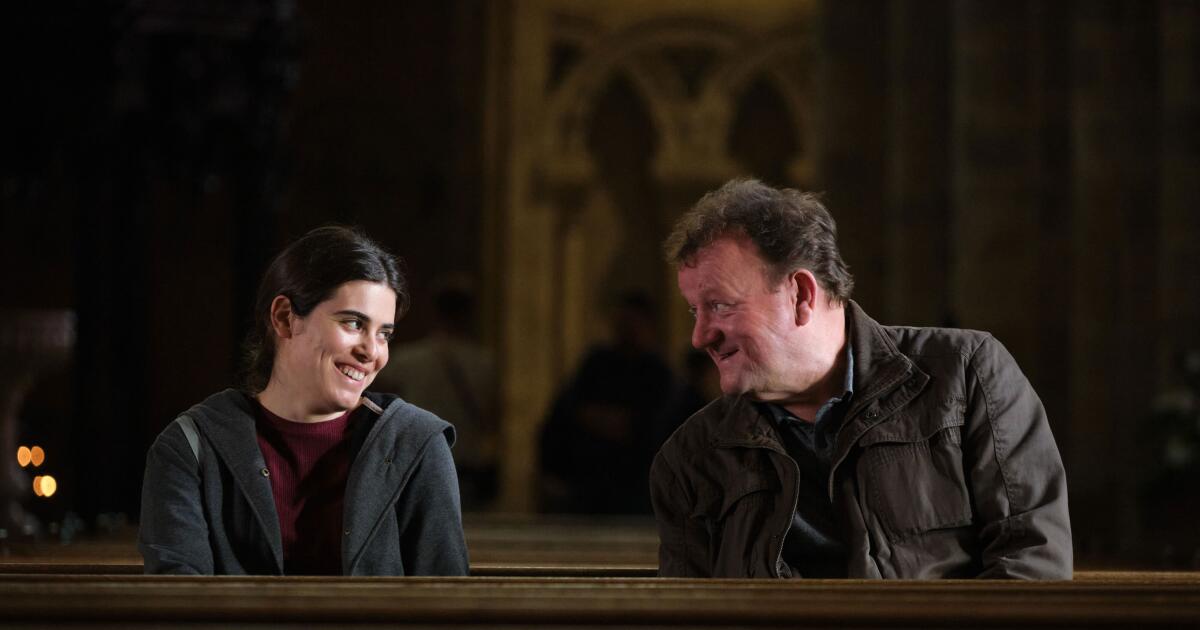
One of the aid helpers appalled at his townsfolk’s behavior is divorced, middle-aged pub owner TJ (an affecting Dave Turner), a lonely man with a good heart and a lot of hurt. He offers to help get Yara’s camera repaired and the unlikely pair strike up a friendship borne of mutual empathy for each other’s pain: her homeland and family brutalized by war; his once-thriving community battered by economic neglect and a poisoning fear. The latter is routinely manifested in the churlish Old Oak regulars for whom nostalgia-fueled resentment is no longer a condition to be changed but a disturbingly snug set of clothes; they view TJ’s kindness toward Yara (or anybody’s charity toward the Syrians) as a betrayal.

Dave Turner in the movie “The Old Oak.”

Advertisement

(Zeitgeist Films)

But on the walls of the threadbare pub’s long-shuttered backroom is photographic evidence — a reminder to TJ, an inspiring history for Yara — of the country’s 1984 miners’ strike, when an embattled people looked out for one another. Soon enough, TJ is spearheading a revitalization of the room so two struggling worlds can meet: communal dinners to feed both the refugees and a deprived town’s isolated youth. As things play out, however, Loach and Laverty are realistic enough in their tale of invigorating compassion to grasp that, as difficult as it is to find and nurture hope, just as essential is recognizing the danger lurking in festering grievance.

As vitally angry as Loach’s films can often be about the issues they’re addressing, the secret glue to his unvarnished, in-the-moment style has always been what camaraderie and care look like within any maelstrom of injustice and oppression. The authenticity of his casting, including his unwavering belief in newcomers, is flawless here, with Mari’s portrait of resilience sharing the frame wonderfully with Turner’s bearish, wounded air. And in a key role as a pub regular, Trevor Fox makes palpable the injury and distrust that can warp an honest reaction to a stranger’s struggles.

Loach is the rare movie agitator who can point to results. In 1966, his television film “Cathy Come Home” rattled the U.K. into acting on homelessness. We may be too inured these days to the unceasing drumbeat of immigration’s realities and disinformation to expect “The Old Oak,” as deeply emotional as it is, to have a similar impact. But we can still feel thankful for this beautifully indignant director’s career-long, never-wavering theme of solidarity, of seeing others’ problems as ours too, worth striking about and fighting against. It’s a righteous oeuvre with marvelously strong roots.

Advertisement

‘The Old Oak’

Not rated

In English with English subtitles (due to strong regional accents)

Running time: 1 hour, 53 minutes

Playing: In limited release.

Advertisement
Continue Reading
Click to comment

Leave a Reply

Your email address will not be published. Required fields are marked *

This site uses Akismet to reduce spam. Learn how your comment data is processed.

Movie Reviews

Review | Hoppers: Pixar’s new animation is a hilarious, heartfelt animal Avatar

Published

on

Review | Hoppers: Pixar’s new animation is a hilarious, heartfelt animal Avatar

4/5 stars

Bounding into cinemas just in time for spring, the latest Pixar animation is a pleasingly charming tale of man vs nature, with a bit of crazy robot tech thrown in.

The star of Hoppers is Mabel Tanaka (voiced by Piper Curda), a young animal-lover leading a one-girl protest over a freeway being built through the tranquil countryside near her hometown of Beaverton.

Because the freeway is the pet project of the town’s popular mayor, Jerry (Jon Hamm), who is vying for re-election, Mabel’s protests fall on deaf ears.

Everything changes when she stumbles upon top-secret research by her biology professor, Dr Sam Fairfax (Kathy Najimy), that allows for the human consciousness to be linked to robotic animals. This lets users get up close and personal with other species.

Advertisement
“This is like Avatar,” Mabel coos, and, in truth, it is. Plugged into a headset, Mabel is reborn inside a robotic beaver. She plans to recruit a real beaver to help populate the glade, which is set to be destroyed by Jerry’s proposed road.
Continue Reading

Entertainment

Kurt Cobain’s Fender, Beatles drum head among $1-billion collection going to auction

Published

on

Kurt Cobain’s Fender, Beatles drum head among -billion collection going to auction

In the summer of 1991, Nirvana filmed the music video for “Smells Like Teen Spirit” on a Culver City sound stage. Kurt Cobain strummed the grunge anthem’s iconic four-chord opening riff on a 1969 Fender Mustang, Lake Placid Blue with a signature racing stripe.

Nearly 35 years later, the six-string relic hung on a gallery wall at Christie’s in Beverly Hills as part of a display of late billionaire businessman Jim Irsay’s world-renowned guitar collection, which heads to auction at Christie’s, New York, beginning Tuesday. Each piece in the Beverly Hills gallery, illuminated by an arched spotlight and flanked by a label chronicling its history, carried the aura of a Renaissance painting.

  • Share via

    Advertisement

Advertisement

Irsay’s billion-dollar guitar arsenal, crowned “The Greatest Guitar Collection on Earth” by Guitar World magazine, is the focal point of the Christie’s auction, which has split approximately 400 objects — about half of which are guitars — into four segments: the “Hall of Fame” group of anchor items, the “Icons of Pop Culture” class of miscellaneous memorabilia, the “Icons of Music” mixed batch of electric and acoustic guitars and an online segment that compiles the remainder of Irsay’s collection. The online sale, featuring various autographed items, smaller instruments and historical documents, features the items at the lowest price points.

A portion of auction proceeds will be donated to charities that Irsay supported during his lifetime.

The instruments of famous musicians have long been coveted collector’s items. But in the case of the Jim Irsay Collection, the handcrafted six-strings have acquired a more ephemeral quality in the eyes of their admirers.

Amelia Walker, the specialist head of private and iconic collections at Christie’s, said at the recent highlight exhibition in L.A. that the auction represents “a real moment where these [objects] are being elevated beyond what we traditionally call memorabilia” into artistic masterpieces.

“They deserve the kind of the pedestal that we give to art as well,” Walker said. “Because they are not only works of art in terms of their creation, but what they have created, what their owners have created with them — it’s the purest form of art.”

Advertisement

Cobain’s Fender was only one of the music history treasures nestled in Christie’s gallery. A few paces away, Jerry Garcia’s “Budman” amplifier, once part of the Grateful Dead’s three-story high “Wall of Sound,” perched atop a podium. Just past it lay the Beatles logo drum head (estimated between $1 million and $2 million) used for the band’s debut appearance on “The Ed Sullivan Show,” which garnered a historic 73 million viewers and catalyzed the British Invasion. Pencil lines were still visible beneath the logo’s signature “drop T.”

A drum head.

Pencil lines are still visible on the drum head Ringo Starr played during the Beatles’ debut appearance on “The Ed Sullivan Show.”

(Christie’s Images LTD, 2026)

It is exceptionally rare for even one such artifact to go to market, let alone a billion-dollar group of them at once, Walker said. But a public sale enabling many to participate and demonstrate the “true market value” of these objects is what Irsay would have wanted, she added.

Dropping tens of millions of dollars on pop culture memorabilia may seem an odd hobby for an NFL general manager, yet Irsay viewed collecting much like he viewed leading the Indianapolis Colts.

Advertisement

Irsay, the youngest NFL general manager in history, said in a 2014 Colts Media interview that watching and emulating the legendary NFL owners who came before him “really taught me to be a steward.”

“Ownership is a great responsibility. You can’t buy respect,” he said. “Respect only comes from you being a steward.”

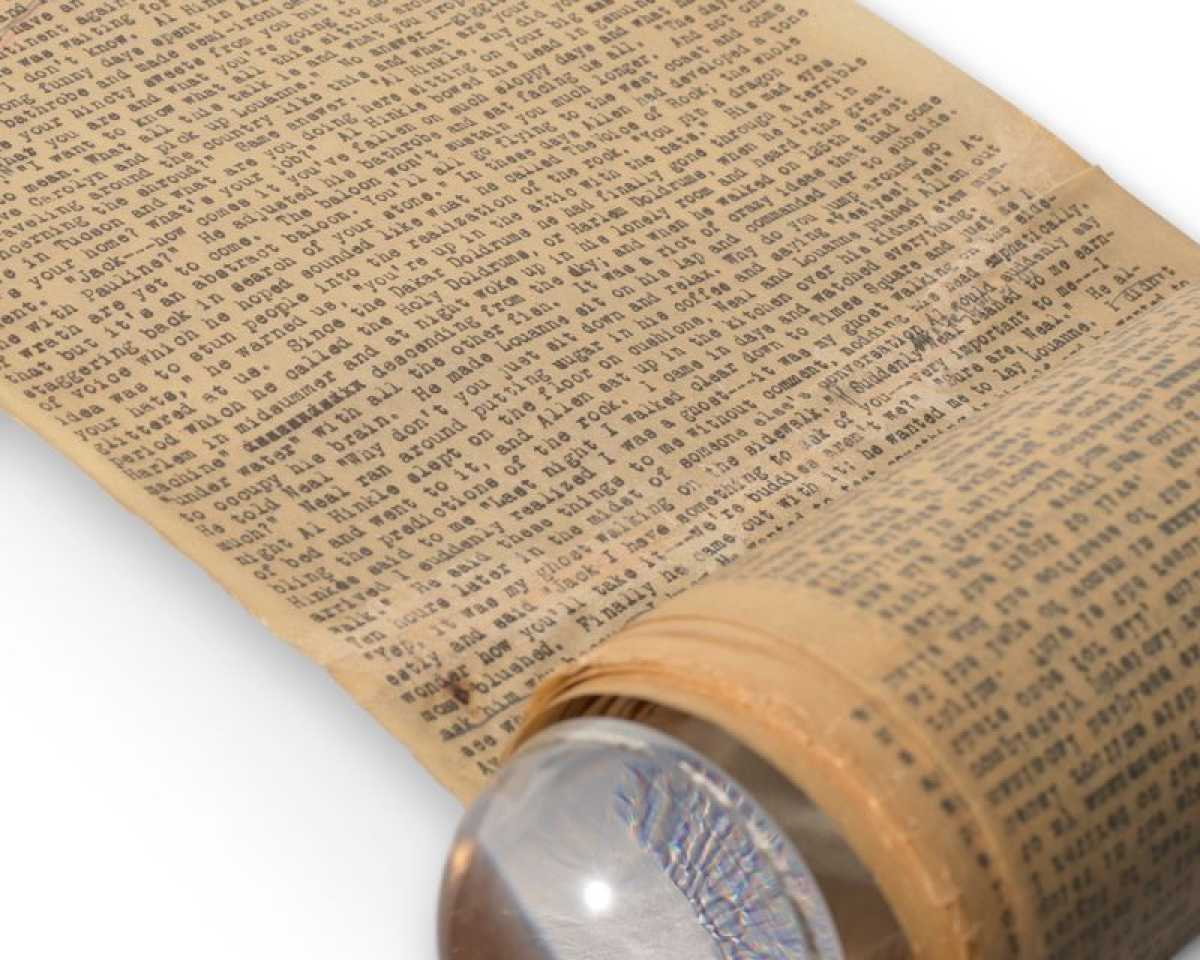
The first major acquisition in Irsay’s collection came in 2001, with his $2.4-million purchase of the original 120-foot scroll for Jack Kerouac’s 1957 novel, “On the Road.” He loved the book and wanted to preserve it, Walker said. But he also frequently lent it out, just like he regularly toured his guitar collection beginning 20 years later.

A scroll of writing.

Jim Irsay purchased the original 120-foot scroll manuscript of Jack Kerouac’s “On the Road” for $2.4 million in 2001.

(Christie’s Images)

Advertisement

“He said publicly, ‘I’m not the owner of these things. I’m just that current custodian looking after them for future generations,’ ” Walker said. “And I think that’s what true collectors always say.”

At its L.A. highlight exhibition, Irsay’s collection held an air of synchronicity. Paul McCartney’s handwritten lyrics for “Hey Jude” hung just a few steps from a promotional poster — the only one in existence — for the 1959 concert Buddy Holly, Ritchie Valens and J.P. “The Big Bopper” Richardson were en route to perform when their plane crashed. The tragedy spurred Don McLean to write “American Pie,” about “the day the music died.”

Holly was McCartney’s “great inspiration,” Christie’s specialist Zita Gibson said. “So everything connects.”

Later, the Beatles’ 1966 song “Paperback Writer” played over the speakers near-parallel to the guitars the song was written on.

Irsay’s collection also contains a bit of whimsy, with gems like a prop golden ticket from 1971’s “Willy Wonka & the Chocolate Factory” — estimated between $60,000 and $120,000 — and reading, “In your wildest dreams you could not imagine the marvelous surprises that await you!”

Advertisement

Another fan-favorite is the “Wilson” volleyball from 2000’s “Cast Away,” starring Tom Hanks, estimated between $60,000 and $80,000, Gibson said.

Historically, such objects were often preserved by accident. But as the memorabilia market has ballooned over the last decade or so, Gibson said, “a lot of artists are much more careful about making sure that things don’t get into the wrong hands. After rehearsals, they tidy up after themselves.”

If anything proves the market value of seemingly worthless ephemera, Walker added, it’s fans clawing for printed set lists at the end of a concert.

“They’re desperate for that connection. This is what it’s all about,” the specialist said. It’s what drove Irsay as well, she said: “He wanted to have a connection with these great artists of his generation and also the generation above him. And he wanted to share them with people.”

In Irsay’s home, his favorite guitars weren’t hung like classic paintings. Instead, they were strewn about the rooms he frequented, available for him to play whenever the urge struck him.

Advertisement

Thanks to tune-up efforts from Walker, many of the guitars headed to auction are fully operational in the hopes that their buyers can do the same.

“They’re working instruments. They need to be looked after, to be played,” Walker said. And even though they make for great gallery art, “they’re not just for hanging on the wall.”

Continue Reading

Movie Reviews

Film reviews: ‘How to Make a Killing,’ ‘Pillion,’ and ‘Midwinter Break’

Published

on

Film reviews: ‘How to Make a Killing,’ ‘Pillion,’ and ‘Midwinter Break’

‘How to Make a Killing’

Directed by John Patton Ford (R)

★★

Continue Reading

Trending
